PLoS Medicine
[Accessed 30 March 2009)
http://www.plosmedicine.org/article/info%3Adoi%2F10.1371%2Fjournal.pmed.1000048
Research Article
A World Malaria Map: Plasmodium falciparum Endemicity in 2007
Simon I. Hay1,2*, Carlos A. Guerra1,2, Peter W. Gething2,3, Anand P. Patil2, Andrew J. Tatem1,2,4,5, Abdisalan M. Noor1,6, Caroline W. Kabaria1, Bui H. Manh7, Iqbal R. F. Elyazar8, Simon Brooker1,9, David L. Smith5,10, Rana A. Moyeed11, Robert W. Snow1,6
Introduction
Maps are essential for all aspects of the coordination of malaria control [1]. In an international policy environment where the malaria control community has been challenged to rethink the plausibility of malaria elimination [2–4], malaria cartography will become an increasingly important tool for planning, implementing, and measuring the impact of malaria interventions worldwide. The last global map of P. falciparum endemicity was published in 1968 [5]. In common with all previous maps of the global distribution of malaria [6–10], and to a large extent those that followed [11–16], the map (i) suffered from an incomplete description of the input data used; (ii) defined contours of “risk” using subjective and poorly explained expert-opinion rules; and (iii) provided no quantification of the uncertainty around predictions. Here we describe the generation of a new global map of malaria endemicity that overcomes these major deficiencies….
Discussion
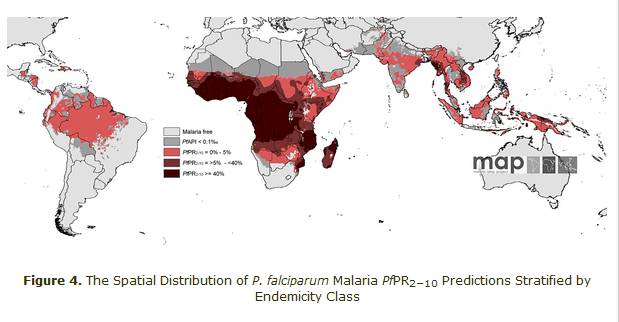
We have to our knowledge, for the first time in 40 y(ears) provided a contemporary map of P. falciparum malaria endemicity at the global scale. The map addresses the key deficiencies of older maps of the global distribution of malaria risk outlined previously and therefore is unique in the following ways. First, it is based on a heavily documented and geographically extensive malariometric survey database (Protocol S1) [58] that will be released in the public domain (where permission has been granted for individual surveys) for all to use and evaluate in 2009 [1]. Second, the MBG methods (Protocol S3) and validation procedures (Protocol S4) have also been documented in exhaustive detail and the relevant code been made available in the public domain. The entire mapping process should therefore be reproducible by those with access to the requisite computing resources. Third, a rigorous assessment of the uncertainty associated with the mapped outputs has been undertaken so that the confidence in the results can be evaluated objectively (Figure 5).
The World Malaria Situation in 2007
The world is substantially less malarious than would be predicted from the inspection of historical maps [5,14], both through a shrinking of the spatial limits and through a reduction in endemicity within this range. There is a striking global transition to a lower risk malaria ecology that will be explored in more detail in future work.
1 Malaria Public Health and Epidemiology Group, Centre for Geographic Medicine, Kenya Medical Research Institute (KEMRI)-University of Oxford-Wellcome Trust Collaborative Programme, Nairobi, Kenya, 2 Spatial Ecology and Epidemiology Group, Department of Zoology, University of Oxford, Oxford, United Kingdom, 3 Centre for Geographical Health Research, School of Geography, University of Southampton, Highfield, Southampton, United Kingdom, 4 Department of Geography, University of Florida, Gainesville, Florida, United States of America, 5 Emerging Pathogens Institute, University of Florida, Gainesville, Florida, United States of America, 6 Centre for Tropical Medicine, Nuffield Department of Clinical Medicine, University of Oxford, Centre for Clinical Vaccinology and Tropical Medicine (CCVTM), Oxford, United Kingdom, 7 Oxford University Clinical Research Unit, Bach Mai Hospital, National Institute of Infectious and Tropical Diseases, Ha Noi, Vietnam, 8 Eijkman-Oxford Clinical Research Unit, Jakarta, Indonesia, 9 Department of Infectious and Tropical Diseases, London School of Hygiene and Tropical Medicine, United Kingdom, 10 Department of Zoology, University of Florida, Gainesville, Florida, United States of America, 11 School of Mathematics and Statistics, University of Plymouth, Plymouth, Devon, United Kingdom
 vaccines and global health :: ethics and policy