How will COVID-19 transform global health post-pandemic? Defining research and investment opportunities and priorities

PLoS Medicine
http://www.plosmedicine.org/
(Accessed 13 Mar 2021)


How will COVID-19 transform global health post-pandemic? Defining research and investment opportunities and priorities
Michael Reid, Quarraisha Abdool-Karim, Elvin Geng, Eric Goosby
Editorial | published 11 Mar 2021 PLOS Medicine
https://doi.org/10.1371/journal.pmed.1003564
…Achieving rapid pandemic control is possible but is predicated on decisive leadership and collaboration for COVID-19 responses—at global, national and local levels—and a commitment to leave no one behind. Global health diplomacy has a critical role to play in catalysing governments and non-state actors to enact effective, innovative and just policy solutions. An ‘every country for itself’ approach clearly does not hold up in this interdependent world, and we need reforms. In particular, the International Health Regulations, which govern all countries to have core health system capacities to detect future pandemics, need to be revitalized. More effective rules of the road are also needed to foster cooperation among countries seeking to manage future outbreaks and as a global trigger for the United Nations and other international organizations to take appropriate actions. A well-funded WHO is also essential to effective global health governance and offers a model for global collaboration. The WHO has a critical role to play in supporting all countries to prioritize universal health systems, not only because it will vastly improve health and be an important bulwark against future pandemics, but also to reap marked economic dividends.
Although we have much to learn about SARS-CoV-2, the epidemic and its consequences, the virus has made one thing clear: for any crisis that threatens the globe, the problems of any of us are the problems of all of us. Global post-pandemic recovery must therefore be coordinated and multi-dimensional. Governance systems that are inclusive, accountable and guided by approaches that prioritize transparent, multisectoral decision-making processes are urgently needed to respond effectively. Only a holistic response based on cross-sectoral collaboration at all levels of society can build the necessary resilience to respond to the immediate and long-term effects of COVID-19. The COVID-19 pandemic reminds us that no country acting alone can respond effectively to health threats in a globalized world [13]. The crisis has also created a unique opportunity to re-imagine and transform global health so that future pandemics are not nearly as devastating as this one, and that health gains made to date are sustained and strengthened rather than reversed.

Human papillomavirus vaccination for adults aged 30 to 45 years in the United States: A cost-effectiveness analysis

PLoS Medicine
http://www.plosmedicine.org/
(Accessed 13 Mar 2021)


Human papillomavirus vaccination for adults aged 30 to 45 years in the United States: A cost-effectiveness analysis
Jane J. Kim, Kate T. Simms, James Killen, Megan A. Smith, Emily A. Burger, Stephen Sy, Catherine Regan, Karen Canfell
Research Article | published 11 Mar 2021 PLOS Medicine
https://doi.org/10.1371/journal.pmed.1003534
…A nonavalent human papillomavirus (HPV) vaccine has been licensed for use in women and men up to age 45 years in the United States. The cost-effectiveness of HPV vaccination for women and men aged 30 to 45 years in the context of cervical cancer screening practice was evaluated to inform national guidelines…Our results from 2 independent models suggest that HPV vaccination for adult women and men aged 30 to 45 years is unlikely to represent good value for money in the US.

Using Point of Care Testing to estimate influenza vaccine effectiveness in the English primary care sentinel surveillance network

PLoS One
http://www.plosone.org/
[Accessed 13 Mar 2021]


Using Point of Care Testing to estimate influenza vaccine effectiveness in the English primary care sentinel surveillance network
Simon de Lusignan, Uy Hoang, Harshana Liyanage, Manasa Tripathy, Julian Sherlock, Mark Joy, Filipa Ferreira, Javier Diez-Domingo, Tristan Clark
Research Article | published 11 Mar 2021 PLOS ONE
https://doi.org/10.1371/journal.pone.0248123

Informed consent rates for neonatal randomized controlled trials in low- and lower middle-income versus high-income countries: A systematic review

PLoS One
http://www.plosone.org/
[Accessed 13 Mar 2021]


Informed consent rates for neonatal randomized controlled trials in low- and lower middle-income versus high-income countries: A systematic review
Jacquelyn K. Patterson, Stuti Pant, Denise F. Jones, Syed Taha, Michael S. Jones, Melissa S. Bauserman, Paolo Montaldo, Carl L. Bose, Sudhin Thayyil
Research Article | published 09 Mar 2021 PLOS ONE
https://doi.org/10.1371/journal.pone.0248263

Influence of a COVID-19 vaccine’s effectiveness and safety profile on vaccination acceptance

PNAS – Proceedings of the National Academy of Sciences of the United States of America
March 02, 2021; vol. 118 no. 9
https://www.pnas.org/content/118/9


Psychological and Cognitive Sciences
Influence of a COVID-19 vaccine’s effectiveness and safety profile on vaccination acceptance
Robert M. Kaplan and Arnold Milstein
PNAS March 9, 2021 118 (10) e2021726118; https://doi.org/10.1073/pnas.2021726118
Significance
Acceptance of vaccines has been on the decline in recent years. Despite encouraging early results for coronavirus vaccine trials, achieving herd immunity requires substantial uptake. We presented scenarios varying vaccine efficacy, minor side effects, and severe reactions to a sample representative of the US population. Vaccine acceptance improved when the efficacy increased beyond 70%. Respondents were unaffected by the probability of minor side effects, such as a sore arm or fever lasting 24 h. The chances of accepting the vaccine were lower when the probability of serious adverse reactions was 1/100,000 in contrast to 1/million or 1/100 million. A replication showed that the results were largely unchanged following the public announcement that the vaccines were 95% effective.
Abstract
Although a safe and effective vaccine holds the greatest promise for resolving the COVID-19 pandemic, hesitancy to accept vaccines remains common. To explore vaccine acceptance decisions, we conducted a national survey of 1,000 people from all US states in August of 2020 and a replication in December of 2020. Using a 3 × 3 × 3 factorial experimental design, we estimated the impact of three factors: probability of 1) protection against COVID-19, 2) minor side effects, and 3) a serious adverse reactions. The outcome was respondents’ reported likelihood of receiving a vaccine for the coronavirus. Probability of vaccine efficacy (50%, 70%, or 90%) had the largest effect among the three factors. The probability of minor side effects (50%, 75%, 90%) including fever and sore arm, did not significantly influence likelihood of receiving the vaccine. The chances of a serious adverse reaction, such as temporary or permanent paralysis, had a small but significant effect. A serious adverse reaction rate of 1/100,000 was more likely to discourage vaccine use in comparison to rates of 1/million or 1/100 million. All interactions between the factors were nonsignificant. A replication following the announcement that vaccines were 95% effective showed small, but significant increases in the likelihood of taking a vaccine. The main effects and interactions in the model remained unchanged. Expected benefit was more influential in respondents’ decision making than expected side effects. The absence of interaction effects suggests that respondents consider the side effects and benefits independently.

HPV vaccination introduction worldwide and WHO and UNICEF estimates of national HPV immunization coverage 2010–2019

Preventive Medicine
Volume 144, March 2021
https://www.sciencedirect.com/journal/preventive-medicine/vol/144/suppl/C


Research article Open access
HPV vaccination introduction worldwide and WHO and UNICEF estimates of national HPV immunization coverage 2010–2019
Laia Bruni, Anna Saura-Lázaro, Alexandra Montoliu, Maria Brotons, … Paul Bloem
Article 106399

Monitoring HPV vaccine impact on cervical disease: Status and future directions for the era of cervical cancer elimination

Preventive Medicine
Volume 144, March 2021
https://www.sciencedirect.com/journal/preventive-medicine/vol/144/suppl/C


Research article Full text access
Monitoring HPV vaccine impact on cervical disease: Status and future directions for the era of cervical cancer elimination
Carlos R. Oliveira, Linda M. Niccolai
Article 106363

Current and future vaccine clinical research with the licensed 2-, 4-, and 9-valent VLP HPV vaccines: What’s ongoing, what’s needed?

Preventive Medicine
Volume 144, March 2021
https://www.sciencedirect.com/journal/preventive-medicine/vol/144/suppl/C


Research article Full text access
Current and future vaccine clinical research with the licensed 2-, 4-, and 9-valent VLP HPV vaccines: What’s ongoing, what’s needed?
Barbara J. Kuter, Suzanne M. Garland, Anna R. Giuliano, Margaret A. Stanley
Article 106321

Embedding research into health services in Latin America and the Caribbean: experiences and challenges of the Technical Support Center*

Revista Panamericana de Salud Pública/Pan American Journal of Public Health (RPSP/PAJPH)
https://www.paho.org/journal/en


Selected Articles
12 Mar 2021
Embedding research into health services in Latin America and the Caribbean: experiences and challenges of the Technical Support Center*
Brief communication | English |

Towards Eradication of Malaria: Is the WHO’s RTS,S/AS01 Vaccination Effective Enough?

Risk Management and Healthcare Policy
https://www.dovepress.com/risk-management-and-healthcare-policy-archive56
[Accessed 13 Mar 2021]


Review
Towards Eradication of Malaria: Is the WHO’s RTS,S/AS01 Vaccination Effective Enough?
Arora N, Anbalagan LC, Pannu AK
Risk Management and Healthcare Policy 2021, 14:1033-1039
Published Date: 12 March 2021

COVID-19 lessons for research

Science
12 March 2021 Vol 371, Issue 6534
http://www.sciencemag.org/current.dtl


Editorial
COVID-19 lessons for research
By Francis S. Collins
Summary
As we mark the 1-year anniversary of the declaration by the World Health Organization (WHO) of COVID-19 as a global pandemic, the world has suffered a staggering and tragic human toll. During this dark time, the scientific community has been called to rise to the occasion in unprecedented ways. The intensity of the work and the sense of urgency have been unremitting and exhausting. As we sort out the triumphs and frustrations, we can begin to reflect on what we have learned.

As vaccine surpluses loom, donation plans urged

Science
12 March 2021 Vol 371, Issue 6534
http://www.sciencemag.org/current.dtl


In Depth
As vaccine surpluses loom, donation plans urged
By Jon Cohen, Kai Kupferschmidt
Science12 Mar 2021 : 1087-1088 Restricted Access
Rich countries have ordered billions of doses more than needed for their populations.
Summary
Last week, U.S. President Joe Biden promised COVID-19 vaccine doses would be available for all U.S. adults by the end of May. That’s welcome news for the United States, and it could also be good news for nations that may benefit from the more than 1 billion extra doses the federal government has ordered. Like three dozen other countries, the United States contracted with multiple vaccine companies for several times the number of doses needed to cover its population. But by now, most of the prepurchased vaccines appear to offer solid protection—which means many countries will receive far more vaccine than they need. Over the next year or two, U.S. surplus doses and those from other countries could add up to enough to immunize everyone in the many poorer nations that lack any secured COVID-19 vaccine.

Market design to accelerate COVID-19 vaccine supply

Science
12 March 2021 Vol 371, Issue 6534
http://www.sciencemag.org/current.dtl


Policy Forum
Market design to accelerate COVID-19 vaccine supply
By Juan Camilo Castillo, Amrita Ahuja, Susan Athey, Arthur Baker, Eric Budish, Tasneem Chipty, Rachel Glennerster, Scott Duke Kominers, Michael Kremer, Greg Larson, Jean Lee, Canice Prendergast, Christopher M. Snyder, Alex Tabarrok, Brandon Joel Tan, Witold Więcek
Science12 Mar 2021 : 1107-1109 Full Access
Build more capacity, and stretch what we already have
Summary
Each month, COVID-19 kills hundreds of thousands of people, reduces global gross domestic product (GDP) by hundreds of billions of dollars, and generates large, accumulating losses to human capital by harming education and health (1–4). Achieving widespread immunization 1 month faster would thus save many lives and mitigate short- and long-run economic harm. Although the value of vaccines may seem obvious, government action and investment in vaccines have not been commensurate with the enormous scale of benefits, with many countries not likely to achieve widespread immunization until the end of 2022.

Social and behavioral science at the forefront of genomics: Discovery, translation, and health equity

Social Science & Medicine
Volume 271, February 2021
https://www.sciencedirect.com/journal/social-science-and-medicine/vol/271/suppl/C


Social and behavioral science at the forefront of genomics: Discovery, translation, and health equity
Edited by Laura M. Koehly, Susan Persky, Philip Shaw, Vence L. Bonham, Christopher S. Marcum, Gustavo P. Sudre, Dawn E. Lea, Sharon K. Davis, Lawrence Brody

COVID-19 Vaccine Roll-Out in South Africa and Zimbabwe: Urgent Need to Address Community Preparedness, Fears and Hesitancy

Vaccines — Open Access Journal
http://www.mdpi.com/journal/vaccines
(Accessed 13 Mar 2021)


Open Access Viewpoint
COVID-19 Vaccine Roll-Out in South Africa and Zimbabwe: Urgent Need to Address Community Preparedness, Fears and Hesitancy
by Tafadzwa Dzinamarira, Brian Nachipo, Bright Phiri and Godfrey Musuka
Vaccines 2021, 9(3), 250; https://doi.org/10.3390/vaccines9030250 (registering DOI) – 12 Mar 2021
Abstract
South Africa became one of the first African countries to receive the COVID-19 vaccine. As the rest of Africa prepares to receive COVID-19 vaccines, most countries in Africa have set up national-level coordination committees for developing national vaccination deployment plans. While the main […]

Factors Affecting Attitudes towards COVID-19 Vaccination: An Online Survey in Slovenia

Vaccines — Open Access Journal
http://www.mdpi.com/journal/vaccines
(Accessed 13 Mar 2021)


Open Access Article
Factors Affecting Attitudes towards COVID-19 Vaccination: An Online Survey in Slovenia
by Luka Petravić, Rok Arh, Tina Gabrovec, Lucija Jazbec, Nika Rupčić, Nina Starešinič, Lea Zorman, Ajda Pretnar, Andrej Srakar, Matjaž Zwitter and Ana Slavec
Vaccines 2021, 9(3), 247; https://doi.org/10.3390/vaccines9030247 (registering DOI) – 12 Mar 2021
Abstract
While the problem of vaccine hesitancy is not new, it has become more pronounced with the new COVID-19 vaccines and represents an obstacle to resolving the crisis. Even people who would usually trust vaccines and experts now prefer to wait for more information. […]

Willingness of Taiwan’s Healthcare Workers and Outpatients to Vaccinate against COVID-19 during a Period without Community Outbreaks

Vaccines — Open Access Journal
http://www.mdpi.com/journal/vaccines
(Accessed 13 Mar 2021)


Open Access Article
Willingness of Taiwan’s Healthcare Workers and Outpatients to Vaccinate against COVID-19 during a Period without Community Outbreaks
by Shikha Kukreti, Mei-Yun Lu, Yi-Hsuan Lin, Carol Strong, Chung-Ying Lin, Nai-Ying Ko, Po-Lin Chen
and Wen-Chien Ko
Vaccines 2021, 9(3), 246; https://doi.org/10.3390/vaccines9030246 – 12 Mar 2021
Abstract
To control the spread of the novel coronavirus disease 2019 (COVID-19), COVID-19 vaccination has been quickly developed. However, the COVID-19 pandemic will not be controlled if the COVID-19 vaccination uptake willingness is low. Therefore, the study aim was to explore the COVID-19 vaccination […]

Emerging SARS-CoV-2 Variants and Impact in Global Vaccination Programs against SARS-CoV-2/COVID-19

Vaccines — Open Access Journal
http://www.mdpi.com/journal/vaccines
(Accessed 13 Mar 2021)


Open Access Review
Emerging SARS-CoV-2 Variants and Impact in Global Vaccination Programs against SARS-CoV-2/COVID-19
by Carmen Elena Gómez, Beatriz Perdiguero and Mariano Esteban
Vaccines 2021, 9(3), 243; https://doi.org/10.3390/vaccines9030243 – 11 Mar 2021
Abstract
The emergence of severe acute respiratory syndrome coronavirus-2 (SARS-CoV-2) variants in different continents is causing a major concern in human global health. These variants have in common a higher transmissibility, becoming dominant within populations in a short time, and an accumulation of a […]

Media/Policy Watch

Media/Policy Watch
This watch section is intended to alert readers to substantive news, analysis and opinion from the general media and selected think tanks and similar organizations on vaccines, immunization, global public health and related themes. Media Watch is not intended to be exhaustive, but indicative of themes and issues CVEP is actively tracking. This section will grow from an initial base of newspapers, magazines and blog sources, and is segregated from Journal Watch above which scans the peer-reviewed journal ecology.
We acknowledge the Western/Northern bias in this initial selection of titles and invite suggestions for expanded coverage. We are conservative in our outlook in adding news sources which largely report on primary content we are already covering above. Many electronic media sources have tiered, fee-based subscription models for access. We will provide full-text where content is published without restriction, but most publications require registration and some subscription level.


The Atlantic
http://www.theatlantic.com/magazine/
Accessed 13 Mar 2021
Health
People Are Keeping Their Vaccines Secret
COVID-19 vaccinations have become a public spectacle, but they touch intensely private questions.
Katherine J. Wu March 11, 2021


BBC
http://www.bbc.co.uk/
Accessed 13 Mar 2021
[No new, unique, relevant content]


The Economist
http://www.economist.com/
Accessed 13 Mar 2021
Papers, please — Are vaccine passports a good idea?
They are likely to make the biggest difference to international travel
Mar 13th 2021

Shots fired — The many guises of vaccine nationalism
Italy will not be the last to block shipments
Mar 13th 2021


Financial Times
https://www.ft.com/
Accessed 13 Mar 2021
Covid-19 vaccines
EU member states squabble over vaccine distribution
Group of countries warn of heavy disparities in shipments across Europe
March 14, 2021
A row has broken out between EU member states over coronavirus vaccine allocation in the latest fallout from AstraZeneca’s worsening supply shortfalls to the bloc.
Leaders of a group of European states wrote to the presidents of the European Council and European Commission complaining of “huge disparities” in the allocations of vaccines between member states. The letter, which was signed by Austria, Bulgaria, Croatia, the Czech Republic, Latvia and Slovenia, calls for a debate at leaders’ level.
However, other member states countered that the six member states are complaining about the adverse results of their own procurement decisions. The commission defended the system, saying the allocation of doses had followed a “transparent process”…

Coronavirus Business Update
US intensifies vaccine diplomacy
Indo-Pacific initiative with ‘Quad’ allies aims to counter Chinese influence
March 12, 2021
Top of Form
Bottom of Form

The FT View
The editorial board
A tantalising glimpse of a post-vaccine world
First, Americans had Dolly Parton singing of vaccines to the tune of “Jolene” to encourage them to get the jab (“I’m begging of you, please don’t hesitate/ ’cause once you’re dead then that’s a bit too late”). Now they have a further incentive. The Centers for Disease Control and Prevention this week said fully vaccinated adults could meet each other or people at low risk of contracting Covid-19 indoors, without social distancing or masks. If Americans needed any more impetus, they could look across to Israel, whose population is celebrating after its superfast vaccine rollout led to most restrictions being lifted, or disregarded.

For locked-down citizens elsewhere, the US and Israeli moves offer enticing glimpses of a post-vaccination world. Yet the US guidelines, in particular, prompted surprise elsewhere. In the UK, which has vaccinated a bigger proportion of its adults than the US, distancing rules remain in place for all. England’s chief medical officer warned this week the virus could surge again in autumn, long after inoculations are supposed to be completed.

The CDC argued it was important to spell out how life could begin to return to normal. The benefits of reducing social isolation for the vaccinated outweighed the risks, it said, and might “help improve . . . vaccine acceptance and uptake” among the hesitant. Social distancing and mask-wearing have also met more resistance in the US than anywhere; with infections still raging, governors in Texas and Mississippi have lifted statewide mask requirements for all — which President Joe Biden called “Neanderthal thinking”.

In Israel, 4m of its nearly 7m adults are fully vaccinated, with a further 1m awaiting their second shot. The rest are deemed unlikely to get the jab, through scepticism or perceived lack of need. The government’s laissez-faire approach to enforcing remaining restrictions may partly reflect the fact that it is facing another election on March 23, the fourth in two years. But, while it is pondering how to persuade sceptics to get jabs, the government appears to be following a tacit policy of monitoring hospital admissions while being ready to let the virus circulate among the young unvaccinated.

Other governments may in time opt for a similar approach. One reason for maintaining measures such as mask-wearing even with vaccinations well under way has been uncertainty over whether jabs prevent transmission as well as infection. Evidence is slowly mounting that they do. Israel’s health ministry found shots were 94 per cent effective at preventing symptomatic infections, and 89 per cent against infections of any kind, including those without symptoms. If little or no virus can be detected, many scientists assume it cannot be passed on. Recommended Covid-19 vaccines Covid-19 vaccine tracker: the global race to vaccinate

The big threat to the “dream” scenario of governments being able to ease restrictions almost entirely as inoculation programmes end is the emergence of new variants that resist existing vaccines or cause worse symptoms and higher hospitalisations even among the young and healthy. Later rounds of jabs — booster shots against mutated strains — seem inevitable. Testing programmes may be needed for some time to hunt down new variants, and as an alternative to “vaccine passports” for those who cannot or choose not to be jabbed.

Little by little, however, outlines of the post-pandemic normal are becoming discernible. Rich-world governments that are making good progress with vaccinations now need to prepare to donate their surplus doses to the developing world — to ensure they are not the only ones that can enjoy that brighter future.

Bottom of Form


Forbes
http://www.forbes.com/
Accessed 13 Mar 2021
[No new, unique, relevant content]


Foreign Affairs
http://www.foreignaffairs.com/
Accessed 13 Mar 2021
Snapshot March 11, 2021
Vaccine Diplomacy Is Paying Off for China
China’s vaccine diplomacy is off to a strong start, but Beijing still faces stiff competition and tough questions from abroad.
Yanzhong Huang

Snapshot March 9, 2021
How Many Vaccine Doses Can Nations Ethically Hoard?
A new framework sets the obligatory threshold for sharing vaccine doses at the point where deaths directly and indirectly caused by COVID-19 begin to resemble those from…
Ezekiel J. Emanuel, Cécile Fabre, Daniel Halliday, R. J. Leland, Allen Buchanan, Kok-Chor Tan, and Shuk Ying Chan
…We propose a novel framework to answer that question—the Fair Priority for Residents (FPR) framework—which sets the obligatory threshold for sharing vaccine doses at the point where deaths directly and indirectly caused by COVID-19 begin to resemble those from influenza. Tens of thousands of Americans die every year from the flu, but the U.S. government treats these deaths as normal background risk. The government takes modest measures to provide vaccines but does not mandate vaccination or mask wearing, even though doing so would save lives. We propose that governments have a duty to give “fair priority” to their residents when distributing vaccines in order to reduce COVID-19-related mortality to pre-crisis, or “flu risk,” levels. Once they have reached that point, however, their duty to assist people threatened by COVID-19 abroad outweighs their duty to further reduce mortality in their own countries….


Foreign Policy
http://foreignpolicy.com/
Accessed 13 Mar 2021
Argument
Quad Summit’s Vaccine Deal Is Biden’s Bold First Move in Asia
It’s a smart step to counter China, but the next ones won’t be as easy.
Michael J. Green

Argument
Scarcity and Ethics
The pandemic is offering a crash course to wealthy countries on dealing with problems they can’t buy their way out of.
By Malka Older
| March 12, 2021, 9:48 AM


The Guardian
http://www.guardiannews.com/
Accessed 13 Mar 2021
[No new, unique, relevant content]


New Yorker
http://www.newyorker.com/
Accessed 13 Mar 2021
Annals of Medicine
Why COVID-19 Vaccines Aren’t Yet Available to Everyone
President Biden has promised that all adults will be eligible to receive a vaccine by May. But manufacturing and distributing enough doses will depend on a lot of things going right.
By Sue Halpern
6:00 A.M.

Letter from the U.K.
The Fight Against Vaccine Misinformation
Society’s return to normal depends on widespread acceptance of the vaccine. Distrust stands in the way.
By Anna Russell
March 10, 2021

Q. & A.
Life After Vaccination
Dr. Ashish K. Jha considers what restrictions should remain in place once a large number of Americans have received protection against COVID-19.
By Isaac Chotiner
March 9, 2021


New York Times
http://www.nytimes.com/
Accessed 13 Mar 2021
World
China asks visa applicants to get inoculated with Chinese-made vaccines.
A new rule for foreigners applying in Hong Kong for visas gives preference to those who choose shots produced in China.
By Keith Bradsher March 13

Politics
Biden Takes First Tentative Steps to Address Global Vaccine Shortage
Under pressure to play catch-up on “vaccine diplomacy,” President Biden says he will help finance vaccine manufacturing capacity but is still resisting exports of doses.
By Sheryl Gay Stolberg and Michael Crowley March 12


Washington Post
https://www.washingtonpost.com/
Accessed 13 Mar 2021
China aims to vaccinate 70-80% of population by mid-2022
Associated Press · Mar 13, 2021

ICE has no clear plan for vaccinating thousands of detained immigrants fighting deportation
Maria Sacchetti · Mar 12, 2021

Think Tanks et al

Think Tanks et al

Brookings
http://www.brookings.edu/
Accessed 13 Mar 2021
Brown Center Chalkboard
Coronavirus and schools: Reflections on education one year into the pandemic
Daphna Bassok, Lauren Bauer, Stephanie Riegg Cellini, Helen Shwe Hadani, Michael Hansen, Douglas N. Harris, Brad Olsen, Richard V. Reeves, Jon Valant, and Kenneth K. Wong
Friday, March 12, 2021
 
 
Center for Global Development [to 13 Mar 2021]
http://www.cgdev.org/page/press-center
Publication
March 8, 2021
A Moral Failure in Pandemic Response
As the virus spread and shut down life as we know it, global response became increasingly tainted by provincialism. From seizing masks and medical supplies en route to other countries to preventing vaccine exports, the world’s richest countries turned inward and neglected the global response effort. It is not too late to correct what has been an egregious failure in leadership.
W. Gyude Moore

March 8, 2021
Financing for Global Health Security and Pandemic Preparedness: Taking Stock and What’s Next
The COVID-19 pandemic has exposed the ways in which global pandemic preparedness and response are under-prioritized and under-resourced. But the good news is that today’s shortfalls are finally eliciting global action.
Amanda Glassman and Eleni Smitham
 
 
Chatham House [to 13 Mar 2021]
https://www.chathamhouse.org/
Accessed 13 Mar 2021
[No new digest content identified]


CSIS
https://www.csis.org/
Accessed 13 Mar 2021
Podcast Episode
Dr. Peter Hotez: Anti-Vaccine Movement, Resistance and the Texas Turmoil
March 11, 2021 | By H. Andrew Schwartz, J. Stephen Morrison

Transcript
A Conversation with Dr. Anthony Fauci and Professor Paul Kelly
March 9, 2021


Kaiser Family Foundation
https://www.kff.org/search/?post_type=press-release
Accessed 13 Mar 2021
March 11, 2021 News Release
KFF COVID-19 Vaccine Monitor: The Impact of the COVID-19 Pandemic on LGBT People
The latest report from the KFF COVID-19 Vaccine Monitor examines how the COVID-19 pandemic has impacted the lives of lesbian, gay, bisexual and transgender (LGBT) people and finds that larger shares of LGBT adults report economic losses and mental health struggles than their non-LGBT counterparts. Based on data gathered on…

March 10, 2021 News Release
Updated KFF Calculator Estimates Marketplace Premiums to Reflect Expanded Tax Credits in COVID-19 Relief Legislation
KFF has updated its 2021 Health Insurance Marketplace Calculator to reflect the expanded premium tax credits available to people who purchase their own coverage through their state’s health insurance exchange as passed by Congress in the American Rescue Plan Act and expected to be signed into law soon. The calculator…

March 10, 2021 News Release
Early COVID-19 Vaccination Efforts Through Community Health Centers Are Reaching People of Color
More than half of those who received their first dose of a COVID-19 vaccine through a community health center were people of color, suggesting that health centers appear to be doing a better job of reaching people of color than are overall vaccination efforts, finds a new KFF analysis. People of…

March 9, 2021 News Release
KFF COVID-19 Vaccine Monitor Probes Americans’ Experiences Trying to Sign Up for a Vaccine and to Find Relevant Information
Many Relied on Another Person’s Help to Try to Get a Vaccine Appointment As many states and local authorities ramp up their COVID-19 vaccination efforts, the latest KFF COVID-19 Vaccine Monitor report provides the first in-depth look at Americans’ experiences trying to gather relevant information and sign up to get…

Urban Institute [to 13 Mar 2021]
https://www.urban.org/publications
Publications
Historic Vaccination Patterns Provide Insights for Covid 19 Vaccine Rollout
Understanding longstanding barriers to vaccine uptake is necessary to ensure the success of Covid-19 vaccination efforts. This analysis examines historic vaccination patterns among adults using data from the 2016-18 National Health Interview Survey (NHIS). We examine flu vaccination rates among three risk groups: nonelderly adults (ages 19-64) at low- and high-risk of severe disease from Covid-19, and all
Stacey McMorrow, Tyler Thomas
March 12, 2021
Brief

World Economic Forum [to 13 Mar 2021]
https://agenda.weforum.org/news/
Media
Vaccine Confidence and Demand Rises Worldwide, Survey Finds
News 12 Mar 2021
:: A new Ipsos-World Economic Forum survey shows a notable increase in the number of people who want to be vaccinated against COVID-19 since December 2020
:: Italy, Spain, UK, Brazil, France, Mexico, Canada and Germany have seen the greatest uptick in vaccine intent – all rising by more than 20 points in just three months
:: Expert says trends are positive, but not at levels needed for herd immunity
:: Read the report and check out the data

Vaccines and Global Health: The Week in Review :: 6 March 2021

Vaccines and Global Health: The Week in Review is a weekly digest  summarizing news, events, announcements, peer-reviewed articles and research in the global vaccine ethics and policy space. Content is aggregated from key governmental, NGO, international organization and industry sources, key peer-reviewed journals, and other media channels. This summary proceeds from the broad base of themes and issues monitored by the Center for Vaccine Ethics & Policy in its work: it is not intended to be exhaustive in its coverage. You are viewing the blog version of our weekly digest, typically comprised of between 30 and 40 posts below all dated with the current issue date

.– Request an Email Summary: Vaccines and Global Health : The Week in Review is published as a single email summary, scheduled for release each Saturday evening before midnight (EDT in the U.S.). If you would like to receive the email version, please send your request to david.r.curry@centerforvaccineethicsandpolicy.org.

– pdf version A pdf of the current issue is available here: 

– blog edition: comprised of the approx. 35+ entries posted below.

– Twitter:  Readers can also follow developments on twitter: @vaxethicspolicy.
.
– Links:  We endeavor to test each link as we incorporate it into any post, but recognize that some links may become “stale” as publications and websites reorganize content over time. We apologize in advance for any links that may not be operative. We believe the contextual information in a given post should allow retrieval, but please contact us as above for assistance if necessary.

Support this knowledge-sharing service: Your financial support helps us cover our costs and to address a current shortfall in our annual operating budget. Click here to donate and thank you in advance for your contribution.

.
David R. Curry, MS
Executive Director
Center for Vaccine Ethics and Policy

Rotavirus vaccines made available for use in humanitarian crises

Milestones :: Perspectives :: Research


Rotavirus vaccines made available for use in humanitarian crises
Health partners welcome landmark pricing agreement through Humanitarian Mechanism, urging more manufacturers to follow suit
4 March 2021 News release Geneva/London/New York
Médecins Sans Frontières (MSF), Save the Children, UNICEF and the World Health Organization (WHO) welcome the opportunity to make rotavirus vaccine available to more children living in humanitarian crises thanks to a landmark pricing agreement with the manufacturer, GSK.

Children living in refugee camps, displaced communities or in other emergency situations now have a better chance of being protected against severe diarrhoeal disease with these lower price rotavirus vaccines. Diarrhoea is one of the leading causes of death among children under five.

The agreement makes use of the multi-partner Humanitarian Mechanism, launched in 2017. Rotavirus vaccine is the second vaccine  to be accessed through the scheme, which depends on manufacturers making their vaccines available at their lowest price for use in emergencies – across countries of all income levels. The first to be made available was the pneumococcal vaccine.

“We welcome this engagement from manufacturers and hope it will be a step towards making more vaccines available in the future at affordable prices,” said Dr Kate O’Brien, Director of Immunization, Vaccines and Biologicals at WHO. “It is unacceptable that some of the most at-risk children are not vaccinated against devastating diseases like rotavirus because of lack of availability or high costs.”…
The Humanitarian Mechanism facilitates access to vaccines for humanitarian organizations working in countries affected by emergencies, where access and prices have otherwise been a bottleneck…

Since 2017, nearly one million doses of pneumococcal vaccine have been approved for use by civil society organizations through the Mechanism in 12 countries: Algeria, Central African Republic, Chad, Democratic Republic of the Congo, Ethiopia, Greece, Kenya, Lebanon, Niger, Nigeria, South Sudan and Syria. The pneumococcal vaccine protects against childhood pneumonia, also a leading cause of childhood deaths during emergencies.


Once secured through the Mechanism, the vaccines are offered to humanitarian organizations working in camps and other emergency settings, who can make applications to access the vaccine at these lower prices.

“The Humanitarian Mechanism has already expanded the number of children who can receive lifesaving vaccines, but to reach its full potential and save more lives, MSF calls on manufacturers to commit additional vaccines and to allow governments hosting children in humanitarian emergencies to access the vaccines too,” said Miriam Alia, Vaccination and Outbreak Response Referent at MSF. “Children everywhere, no matter where they live, should have access to lifesaving vaccinations.”…

COVID Vaccines – UN Security Council; UNESCO

Milestones :: Perspectives :: Research


COVID Vaccines – UN Security Council; UNESCO

Security Council Calls for Increased Global Cooperation to Facilitate COVID-19 Vaccine Access in Conflict Areas, Unanimously Adopting Resolution 2565 (2021)
26 February 2021
SC/14454
The Security Council today announced the adoption of a resolution calling for strengthened international cooperation to facilitate equitable and affordable access to COVID-19 vaccines in armed conflict and post-conflict situations, and during complex humanitarian emergencies.

Acting through its special silence procedure enacted during the pandemic, the Council unanimously adopted resolution 2565 (2021), recognizing the role of extensive immunization against COVID-19 as a global public good for health.  It stressed the need to develop international partnerships, particularly to scale-up manufacturing and distribution capabilities, in recognition of differing national contexts.

By other terms, it reiterated its demand for a general and immediate cessation of hostilities in all situations on its agenda, demanding as well that all parties to armed conflicts engage immediately in a durable, extensive, and sustained humanitarian pause to facilitate the equitable, safe and unhindered delivery and distribution of COVID-19 vaccinations in areas of armed conflict.

Reaffirming that these calls do not apply to military operations against Islamic State in Iraq and the Levant (ISIL/Da’esh), Al-Qaida and Al-Nusra Front, or their associates, the Council demanded that all parties to armed conflicts fully comply with their obligations under international law.

Further, the Council requested the Secretary-General to provide a full assessment of the impediments to vaccine accessibility and the COVID-19 response, including vaccination programmes, in situations of armed conflict and complex humanitarian emergencies — and as necessary, make recommendations to the Council.  It expressed its intention to review situations brought to its attention by the Secretary-General where hostilities and armed group activities are impeding COVID19 vaccination and to consider what further measures may be necessary to ensure such impediments are removed, and hostilities paused to enable vaccination.

It emphasized the urgent need for “solidarity, equity and efficacy”, inviting donation of vaccine doses from developed economies and all those in a position to do so to low- and middle-income countries and other countries in need, particularly through the COVAX Facility — a global mechanism for pooled procurement and equitable distribution of COVID-19 vaccines.

[Security Council resolutions are currently adopted through a written procedure vote under temporary, extraordinary and provisional measures implemented in response to the COVID-19 pandemic, as set out in a letter (document S/2020/253) by its President for March 2020 (China).]


::::::

UNESCO calls for COVID-19 vaccines to be considered a global public good
24/02/2021
UNESCO’s International Bioethics Committee (IBC) and the World Commission on the Ethics of Scientific Knowledge and Technology (COMEST) have called for a change of course in current COVID-19 vaccination strategies, urging that vaccines be treated as a global public good to ensure they are made equitably available in all countries, and not only to those who bid the highest for these vaccines. Both committees have a long track record in providing ethical guidance on sensitive issues*.

The statement was presented during an online event on 24 February, which gathered UNESCO’s ethics bodies together with Dr Tedros Adhanom Ghebreyesus, Director-General of the World Health Organization, and Professor Jeffrey Sachs from Columbia University.

The IBC-COMEST Statement stresses three key messages:
Firstly, pharmaceutical industries have a responsibility to share the intellectual property acquired with government support to enable manufacturers in all countries to provide access to vaccines for all, which should be considered a global public good. The IBC and COMEST also stress the responsibility of the pharmaceutical industry to invest in factories capable of producing vaccines of the highest possible efficacy and facilitating rapid distribution where needed.

Secondly, the IBC and COMEST say that the vaccine’s benefit to the greatest number of people cannot be considered the sole ethical criterion. Equality, equity, protection from vulnerability, reciprocity and the best interests of children must also be taken into account. Furthermore, decisions on fair distribution and prioritization should be based on the advice of a multidisciplinary group of experts in bioethics, law, economics, and sociology, together with scientists.


Thirdly, the IBC and COMEST consider that vaccination strategies should be based on a non-compulsory, non-punitive model, grounded in information and education, including dialogue with people who may be hesitant about vaccination or hostile to it. Refusing to be vaccinated should not affect the individual’s fundamental rights, specifically his or her right to access healthcare or employment.

Other issues the statement covers include: international cooperation across all different sectors working on COVID-19 to share the benefits of research; the sustainability issues that favour the emergence of zoonotic diseases; trust in science and healthcare authorities; the indispensable need for dialogue between science, ethics, politics and civil society.

World Bank Bond Expands Support to COVID-19 Resilience Through the United Nations Children’s Fund (UNICEF)

Milestones :: Perspectives :: Research


World Bank Bond Expands Support to COVID-19 Resilience Through the United Nations Children’s Fund (UNICEF)
Washington, DC, March 4, 2021—The World Bank (International Bank for Reconstruction and Development or IBRD) has issued a US$100 million 5-year bond which both supports IBRD’s ongoing sustainable development and COVID-19 activities and adds a new feature to support similar efforts by the United Nations Children’s Fund (UNICEF). As countries confront the economic challenges of the pandemic, which has affected millions of children worldwide, the issuance will channel an amount equivalent to half of the total proceeds, US$50 million, to UNICEF. This frontloading of financing to UNICEF will support its pandemic response programs for children around the world over the 5-year period.

“This World Bank bond serves as an example of how the private sector can share financial risks to achieve positive development impact,” said David Malpass, World Bank Group President. He added, “We are grateful to our investors for joining this effort and demonstrating how investors can participate in the global response to COVID-19, through this unique opportunity to scale up resources available to UNICEF to expand its programs. The bond also spotlights impact investor support for World Bank Sustainable Development Bonds and the potential for finding new ways to collaborate for impact.”


“The COVID-19 pandemic has exacerbated deep inequalities within and across countries worldwide,” said Henrietta Fore, UNICEF Executive Director. “Keeping children at the heart of recovery efforts and focusing on innovative partnerships will enable us to reimagine children’s futures and secure more equitable societies.”

“Making real headway in alleviating social challenges requires new ways of doing things. We’re excited to innovate in the financial space and our institutional and private clients have shown overwhelming support for investments that can further their social missions,” said Jim O’Donnell, Head of Citi Global Wealth.

Coalition of International NGOs Call for Equitable Access for Vaccines and Treatment during COVID-19 Pandemic

Milestones :: Perspectives :: Research


Coalition of International NGOs Call for Equitable Access for Vaccines and Treatment during COVID-19 Pandemic
Mar 4, 2021
…On February 11, 2021, the World Federation of Public Health Associations hosted a historic meeting to initiate a coalition amongst leaders from international NGOs who share a common interest in equitable access for vaccines and treatment during COVID-19.

The organizations agreed to work together to build and sustain equity in global public health through increased advocacy for social protection and social development in vulnerable communities. Moreover, leaders expressed the need for an environmentally conscious and safe way to develop, distribute, and deliver vaccines, as this will also help reduce inequity following the pandemic by ensuring we do not exacerbate adverse climate effects. The Coalition is committed to engaging with other organizations, governments, and key stakeholders to achieve a coordinated response to the pandemic. The organizations will dedicate themselves to continue compiling resources, sharing evidence-based best practices, and using their collective voice to advocate for those who are disproportionately harmed by the pandemic, including chronically ill patients, individuals lacking access to health care services and medication, and marginalized communities.

Therefore, together we call on the World Health Assembly, the G20, every government, and all organizations that engage in public health, social policy, and advocacy to make the ethical choice now for the health and the economic well-being of all populations globally, especially the most vulnerable — leaving no one behind.


We call on all of these actors to work together to:
:: Guarantee more and equitable access to vaccines
:: Increase the health care, public health, and social protection workforce
:: Challenge uncoordinated social, economic, and health system dynamics to maximize vaccine production, distribution, and uptake
:: Address the national and international spending priorities during the pandemic
:: Guarantee an environmentally and economically sustainable and equitable production and distribution of the vaccines
:: Engage all groups in society, including youth and young professionals, key stakeholders, and health professionals in the decision-making process and implementation
:: Engage with civil societies, patient organizations, and the broader public across diverse communities to address communication, including risk communication, tackling misinformation and combatting hesitancy, on every level.

Overall, we believe that this growing Coalition has immense potential to strengthen our individual and collective responses to inequity, which like the virus itself, works beyond national borders both during the pandemic and in the years of recovery to follow. We are keen to begin this important work, and we look forward to contributing to and sharing our joint initiatives across our extensive networks…

Signed by:
FDI World Dental Federation
Healthcare Without Harm
International Alliance of Patients’ Organizations
International Council of Nurses
International Federation on Ageing
International Federation of Environmental Health
International Federation of Medical Students’ Associations
International Federation of Social Workers
International Hospital Federation
International Pharmaceutical Federation
International Pharmaceutical Students’ Federation
International Physicians for the Prevention of Nuclear War
International Veterinary Students’ Association
The European Forum for Primary Care
The Global Ageing Network
Union for International Cancer Control
WHO Collaborating Centre on Family Medicine and Primary Health Care – Ghent University
World Association for Disaster and Emergency Medicine
World Federation of Public Health Associations
World Heart Federation
World Organization of Family Doctors
World Patients Alliance
World Physiotherapy

COVAX: Vaccine Supply/Allocation

Milestones :: Perspectives :: Research


COVAX: Vaccine Supply/Allocation

The COVAX Facility – FIRST ROUND OF ALLOCATION: ASTRA ZENECA/OXFORD VACCINE (manufactured by AstraZeneca & licensed and manufactured by Serum Institute of India)
Feb-May 2021 – last updated 2 March 2021
Introduction
Following from the publication of an interim distribution forecast, and based on current knowledge of supply availability, this first round of allocations provides information on provision of doses of the AstraZeneca(AZ)/Oxford vaccine to COVAX Facility participants, through May 2021.

This first round allocation outlines delivery of 237 million* doses of the AZ/Oxford vaccine – manufactured by AstraZeneca (AZ) & licensed and manufactured by Serum Institute of India (SII/AZ) – to 142 Facility participants.
[*This total does NOT include 5% of supply set aside for Humanitarian & Contingencies Buffer, not yet approved by Gavi Board]

This list will be updated by the end of the week to provide indicative timelines for the supply of these doses, split into Feb-March and April-May. These timelines are dependent on a variety of factors including national regulatory requirements, availability of supply, and fulfilment of other criteria such as validated national deployment and vaccination plans (NDVPs) from AMC participants, indemnification & liability agreements, and export and import authorisations.

Participants not listed have either exercised their rights to opt-out of this vaccine, wish to transfer allocated doses to AMC participants, are AMC-eligible but have not joined the AMC, have voluntarily delayed receipt of doses and communicated this intent ahead of allocation, or have not met financial requirements.

In addition to this first round of allocations, an exceptional distribution of 1.2 million doses of the Pfizer-BioNTech vaccine, anticipated for delivery in Q1 2021, was announced in early February. These doses are reflected in the table below, to provide a global overview of allocations to-date but are not part of this round of allocation.

Further allocation rounds for vaccines in the COVAX portfolio will be announced in due course.


Overview of the process
This first round of allocation took place as per the Fair allocation mechanism for COVID-19 vaccines through the COVAX Facility, which was developed by WHO in consultation with its Member States. This allocation framework for fair and equitable access to COVID-19 health products sets forth the criteria and approach to allocation of vaccines through the COVAX Facility.

The operationalization of the Framework, in accordance with the principles and provisions set forth in the document above, is performed by the Joint Allocation Taskforce (JAT), composed of staff from Gavi, the Vaccine Alliance and WHO, and the Independent Allocation Vaccine Group (IAVG). The main purpose of the IAVG is to make validation assessments of proposals for Vaccine Allocation Decisions (“VAD proposals”), which outline the volumes

of Vaccines that should be allocated to each country/economy participating under COVAX within a given time frame. The IAVG will consider VAD proposals prepared and submitted by the JAT.The IAVG met twice over 22 and 23 February 2021 to discuss this first round of allocation. All 12 IAVG members were present during both meetings, and therefore full quorum was achieved. The deliberations resulted in consensus and no divergent views were recorded on the proposed allocation.As is normal procedure, the IAVG allocation report was then validated by the WHO Deputy Director-General, and the decision was communicated tothe Office of the COVAX Facility, administered by Gavi.


TABLE: Allocations by Facility participant
Note: Table will be updated later this week to provide further information on anticipated supply timelines, split into February-March and April-May 2021.
[138 countries listed at title link above including an allocation for “non-UN Member States” of 1,125,600 doses of AZ]


::::::

Independent Allocation of Vaccines Group (IAVG)
[WHO webpage – accessed 6 Mar 2021]
One of the principal objectives of COVAX is to promote the fair and equitable allocation of COVID-19 vaccines that are procured or distributed through COVAX (the “Vaccines”) to countries and economies participating in COVAX. To achieve such objective, the mechanism through which Vaccines are allocated must be transparent and independent.

In this context, WHO, Gavi and CEPI (collectively, the “COVAX Partners”) support the establishment by WHO of an Independent Allocation of Vaccines Group (“IAVG”) pursuant to the WHO Regulations for Study and Scientific Groups, Collaborating Institutions and Other Mechanisms of Collaboration, and in accordance with these Terms of Reference. The IAVG is expected to play a pivotal role in the allocation of Vaccines under COVAX and to foster the independence of, and provide transparency into, the Vaccine-allocation decision-making under COVAX.

The main purpose of the IAVG is to make validation assessments of proposals for Vaccine Allocation Decisions (“VAD proposals”), which outline the volumes of Vaccines that should be allocated to each country/economy participating under COVAX within a given time frame. The IAVG will consider VAD proposals prepared and submitted by the Joint Allocation Taskforce (“JAT”), composed of WHO and Gavi staff.

The IAVG will have the following functions:
:: To review the VAD proposals submitted by the JAT and to request clarifications from the JAT when necessary;
:: To discuss with the JAT any adjustments to the VAD proposals considered necessary on the basis of IAVG’s critical assessment;
:: To make validation assessments of the VAD proposals, ensuring they are technically informed and based on the latest available data and evidence;
:: For each VAD proposal that is validated by the IAVG (hereinafter a “VAD”), to document and justify the validation of such VAD, including any adjustments made to the original VAD proposal submitted to the IAVG by the JAT;
:: To deliver the VADs to the WHO Deputy-Director General for further implementation by the JAT.


::::::

Independent Allocation of Vaccines Group (IAVG) Members – as of January 2021
Members
Professor Anna Mia Ekström
Dr Arlene King
Christopher Maher
Dr Narendra Kumar Arora
Dr Bruce G. Gellin
Dr Dafrossa Cyrily Lyimo
Professor Tjandra Aditama
Doctor Alejandro Cravioto
Maria Guevara
Dr Manica Balasegaram
Dr Poh Lian Lim
Dr Masahiko Hachiya

Terms of Reference: https://www.who.int/groups/iavg/terms-of-reference

::::::

Documents and reports
22 February 2021
Report of the Independent Allocation of Vaccines Group on the allocation of COVAX Facility secured vaccines: 22 February 2021
Overview
This report covers the first Allocation of Astra Zeneca vaccines produced at the following two sites for which WHO issued an Emergency Use Listing on 15 February 2021:
:: Serum Institute of India Pvt Ltd – COVID-19 Vaccine (ChAdOx1-S [recombinant]) – COVISHIELD™ – “SII AZ”
:: AstraZeneca/SKBio – COVID-19 Vaccine (ChAdOx1-S [recombinant]) – “AZ” …

::::::

Annexes
Report of the Joint Allocation Taskforce (JAT) on the distribution of COVAX Facility secured vaccines
COVAX FACILITY DISTRIBUTION of Astra Zeneca vaccines produced at two different sites: SK BIO in Republic of Korea and Serum Institute of India Pvt Ltd
Date of report 19 February 2021
Summary
:: The current distribution round is enclosing allocation of Astra Zeneca vaccines produced by two different manufacturers at the following two sites for which WHO issued an Emergency Use Listing on 15 February 2021:
>> Serum Institute of India Pvt Ltd – COVID-19 Vaccine (ChAdOx1-S [recombinant]) –
COVISHIELD™ – “SII AZ”
>>AstraZeneca/SKBio – COVID-19 Vaccine (ChAdOx1-S [recombinant]) – “AZ”

:: To date, 1,200,420 M doses of vaccine (Pfizer) have been allocated in a separate and distinct process (more details here) which was performed on 29 January 2021. These are referred to as “First Wave” doses. This was due to specificities pertaining to the Pfizer/ BioNTech deal as well as learning objectives. These doses are not included in this allocation round, however coverage reached in the participants that received these early doses are reflected in the allocation. To date no doses have been shipped to the 18 First Wave participants.

:: Supply needs for a COVAX Buffer are also factored in this allocation – with 5% of total available supply set aside. Further information is available in the Supply section below.

:: Considering the supply and demand characteristics, the overall number of doses to be distributed is 237,468,000 to 142 participants for the period January to May 2021 for AZ and SII AZ

:: Given the supply available (and the 2-dose regime) and the population of all the participants in this round, the average proportion of population covered in this round across countries is 5.52% (not weighted for population size)…

Remarks by Henrietta Fore, UNICEF Executive Director at COVAX media briefing on first deliveries and first round of allocations

Milestones :: Perspectives :: Research


Statement 03/02/2021
Remarks by Henrietta Fore, UNICEF Executive Director at COVAX media briefing on first deliveries and first round of allocations
As prepared for delivery
NEW YORK, 2 March 2021 – “The last year has been a dark one for families all over the world, but the rapid development of COVID-19 vaccines provided a hopeful light at the end of the tunnel. At long last, the COVAX Facility begins to make good on its promise to make sure that light shines for all.

And we are off and running. Vaccine doses have arrived in West Africa and Asia, with many more countries to follow in the coming days and weeks. We’ve now seen Africa’s first vaccinations with COVAX doses in Ghana and Ivory Coast, in truly moving ceremonies in both countries yesterday.

“But what took place Monday is more than a feel-good story that speaks to our collective best natures, it is a necessary first step that speaks to our collective best interests. The only way out of this pandemic is to ensure vaccination is available around the globe, and that people from less wealthy countries are not left behind in the race to be protected.

“At UNICEF, we are committed to making this happen. Last week’s momentous arrivals are just the first batches of vaccines that UNICEF will ship through the COVAX Facility as part of this historic effort to deliver close to 2 billion doses of COVID-19 vaccines to around 190 countries and territories. To date, more than 1.1 million doses have been delivered, with more than twenty more countries expected to receive hundreds of thousands of doses this week.  

“I would like to thank SII for being the first to help deliver vaccines to AMC countries and for working around the clock to package and make vaccines available in record time, as well as to the Government of India for their immense support. We have a lot of work ahead of us.

“In terms of delivery, UNICEF is also working closely with airlines and other partners to find innovative solutions to help us deliver COVAX vaccines as quickly as possible. We’ve already seen tremendous partnership. I would like to thank freight forwarders and Emirates Airlines for helping UNICEF with shipments to Ghana and Ivory Coast in record turnaround time. Only today we have 5 shipments including to DRC, Angola and Nigeria where we are delivering COVID19 vaccines consolidated with syringes and routine vaccines insuring children are also protected, among many other 20 countries receiving vaccines this week.

“We have also supported governments in developing national vaccination plans and preparing for the arrival of vaccines. Along with our partners, we have mapped out existing cold chain equipment and storage capacity. And we have delivered and installed thousands of new fridges to keep vaccines at the right temperature in health facilities this past year. In Ghana, for example, we have delivered 2,500 fridges since May of last year. But much work still remains.

“With each of these steps, we move closer to the moment when we can start to return to normal for the billions of children and families affected around the world. And this is, obviously, our focus at UNICEF. Over the next couple of weeks, we will be talking a lot about how this pandemic has impacted the lives of children, starting later today when we will be issuing estimates of the number of children who have been unable to attend class in person for almost the entire past year…

“These are remarkable efforts, and the work we all – the private sector, UN and development agencies, governments, donors, and other partners – will doubtlessly continue to do more moving together, and will stand for generations to come as proof of what the world can do, when we do it together. It is history in the making. Thank you.”

Coronavirus [COVID-19] – WHO Public Health Emergency of International Concern (PHEIC)

Milestones :: Perspectives :: Research


Coronavirus [COVID-19] – WHO
Public Health Emergency of International Concern (PHEIC)
https://www.who.int/emergencies/diseases/novel-coronavirus-2019


Weekly Epidemiological and Operational updates
Last update: 23 January 2021
Confirmed cases :: 115 653 459 [week ago: 113 076 707] [two weeks ago: 110 384 747]
Confirmed deaths :: 2 571 823 [week ago: 2 512 272] [two weeks ago 2 446 008]
Countries, areas or territories with cases :: 223

WHO: Regulation and Prequalification

Milestones :: Perspectives :: Research


WHO: Regulation and Prequalification

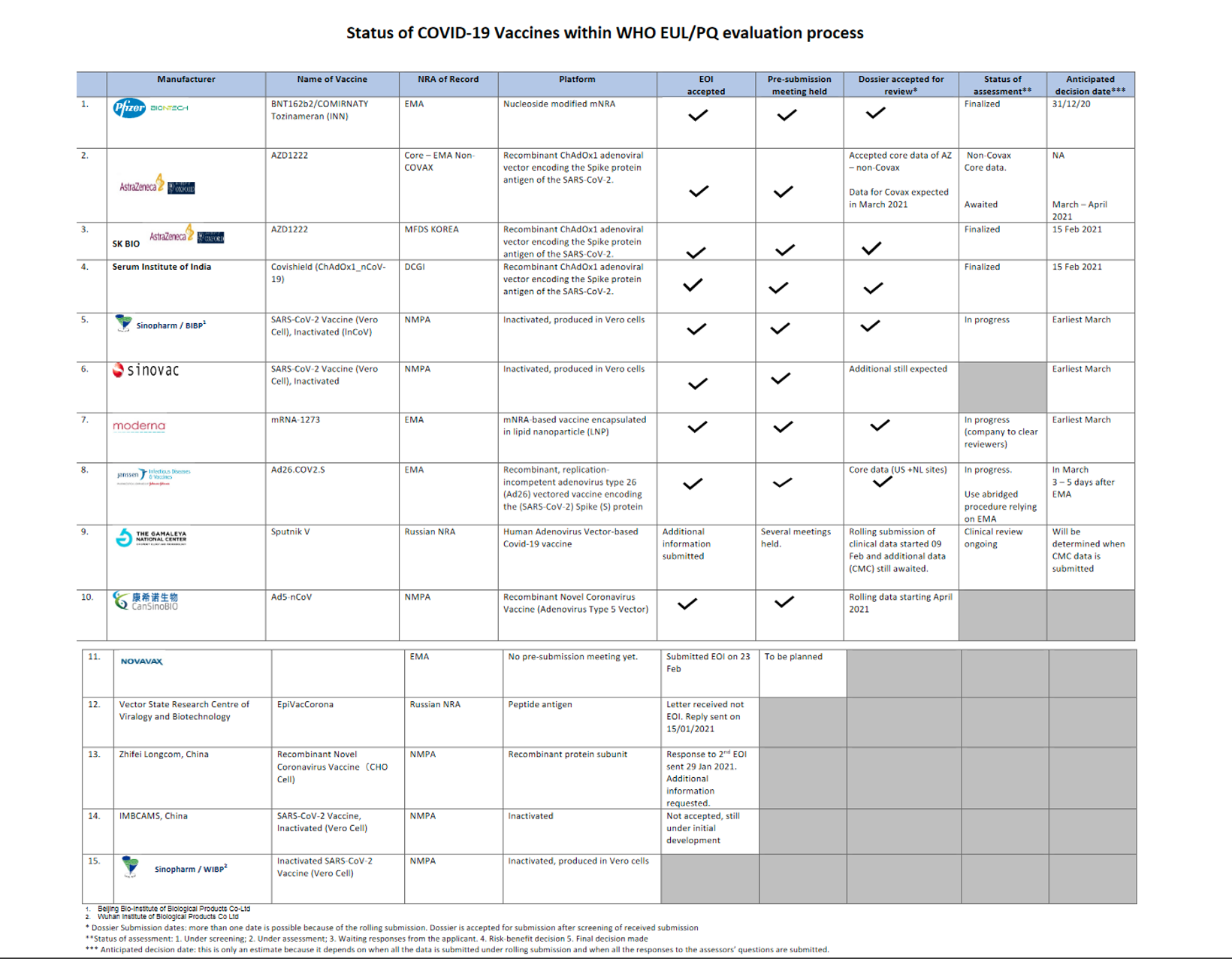
Status of COVID-19 Vaccines within WHO EUL/PQ evaluation process 24 Feb 2021
For 16 vaccine candidates, the presents Manufacturer, Name of Vaccine, NRA of Record, Platform, EOI Accepted Status, Pre-submission Meeting Held Status, Dossier Accepted for Review, Status of Assessment; Anticipated/Completed Decision Date
[click on the link above for full scale view]

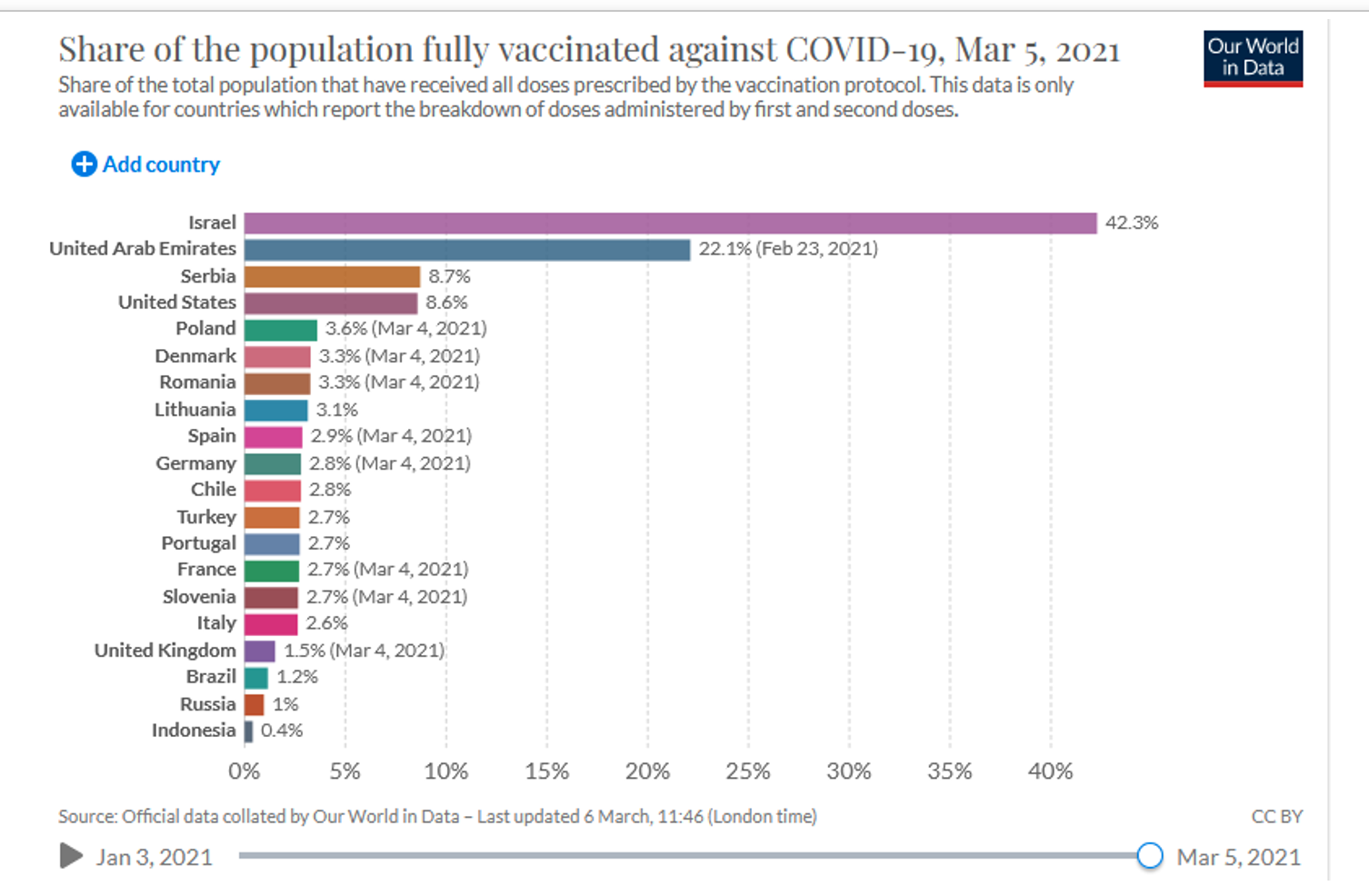
Our World in Data Coronavirus (COVID-19) Vaccinations – Fully Vaccinated Population Percentage

Milestones :: Perspectives :: Research


Our World in Data
Coronavirus (COVID-19) Vaccinations – Fully Vaccinated Population Percentage
Our World in Data and the SDG-Tracker are collaborative efforts between researchers at the University of Oxford, who are the scientific editors of the website content; and the non-profit organization Global Change Data Lab, who publishes and maintains the website and the data tools that make our work possible. At the University of Oxford we are based at the Oxford Martin Programme on Global Development.


Research and data: Hannah Ritchie, Esteban Ortiz-Ospina, Diana Beltekian, Edouard Mathieu, Joe Hasell, Bobbie Macdonald, Charlie Giattino, and Max Roser
Web development: Breck Yunits, Ernst van Woerden, Daniel Gavrilov, Matthieu Bergel, Shahid Ahmad, Jason Crawford, and Marcel Gerber

U.S.: COVID-19 Vaccines – Announcements/Regulatory Actions/Deployment

Milestones :: Perspectives :: Research


U.S.: COVID-19 Vaccines – Announcements/Regulatory Actions/Deployment

:: COVID Data Tracker Friday, March 6, 2021


White House [U.S.]
Briefing Room
Fact Sheet: The U.S. Response to Ebola Outbreaks in West and East Africa
March 05, 2021 • Statements and Releases

Press Briefing by White House COVID-19 Response Team and Public Health Officials
March 05, 2021 • Press Briefings

Press Briefing by White House COVID-19 Response Team and Public Health Officials
March 03, 2021 • Press Briefings

Remarks by President Biden on the Administration’s COVID-19 Vaccination Efforts
March 02, 2021 • Speeches and Remarks

Press Briefing by White House COVID-19 Response Team and Public Health Officials
March 01, 2021 • Press Briefings

Biden Administration Announces Historic Manufacturing Collaboration Between Merck and Johnson & Johnson to Expand Production of COVID-19 Vaccines
President Biden Invokes Defense Production Act to Support Measures to Accelerate Vaccine Development
March 2, 2021
President Biden announced today that his Administration has helped forge a historic manufacturing collaboration between two of the largest U.S. health care and pharmaceutical companies, Merck and Johnson & Johnson (J&J), to expand production of J&J’s COVID-19 vaccine. The collaboration will increase manufacture of vaccine drug substance, as well as its fill-finish capacity – two of the biggest bottlenecks facing J&J in the production of its vaccine.


The U.S. Department of Health and Human Services (HHS) will collaborate with Merck to repurpose some of its existing Merck facilities for rapid large-scale manufacturing of vaccines and therapeutics for use in public health emergencies including the current pandemic. The facilities will be available to private sector partners working with the federal government on the COVID-19 response or to produce Merck products against COVID-19. Janssen Pharmaceuticals, part of Johnson & Johnson, will be the first federal partner to use repurposed Merck facilities to manufacture COVID-19 vaccine. Merck will use two of its facilities to produce drug substance, formulate and fill vials of J&J’s vaccine.

Consistent with the Administration’s mission to ensure that the United States has sufficient long term sustainable capacity to manufacture vaccines, the Biomedical Advanced Research and Development Authority (BARDA), part of the HHS Office of the Assistant Secretary for Preparedness and Response (ASPR), will leverage the Defense Production Act to provide an initial investment of $105 million in funding for Merck, at the Administration’s request, to convert, upgrade and equip Merck facilities to the standards necessary to safely manufacture the vaccine. The company will address all the necessary qualification and validation activities needed for the facilities to be used for large-scale manufacturing.

To further accelerate production of the J&J vaccine, President Biden also announced he has invoked the Defense Production Act to expedite materials in vaccine production, such as equipment, machinery and supplies like single use bags, and he has directed the Department of Defense (DOD) to provide daily logistical support to strengthen J&J’s efforts. With the urging and assistance of the Administration, J&J also will begin operating its manufacturing facilities 24/7 to maximize production output.

These efforts will contribute to J&J’s ability to accelerate delivery of their vaccine doses from 100 million doses by the end of June to at or near 100 million doses by the end of May. In the long term, these actions will ultimately double J&J’s U.S. capacity to produce drug substance and increase the U.S. capacity for fill-finish.

Europe: COVID-19 Vaccines – Announcements/Regulatory Actions/Deployment

Milestones :: Perspectives :: Research


Europe: COVID-19 Vaccines – Announcements/Regulatory Actions/Deployment


News: EMA starts rolling review of the Sputnik V COVID-19 vaccine
Last updated: 04/03/2021
EMA’s human medicines committee (CHMP) has started a rolling review of Sputnik V (Gam-COVID-Vac), a COVID-19 vaccine1 developed by Russia’s Gamaleya National Centre of Epidemiology and Microbiology. The EU applicant for this medicine is R-Pharm Germany GmbH.
The CHMP’s decision to start the rolling review is based on results from laboratory studies and clinical studies in adults. These studies indicate that Sputnik V triggers the production of antibodies and immune cells that target the SARS-CoV-2 coronavirus and may help protect against COVID-19.
EMA will evaluate data as they become available to decide if the benefits outweigh the risks. The rolling review will continue until enough evidence is available for formal marketing authorisation application.
EMA will assess Sputnik V’s compliance with the usual EU standards for effectiveness, safety and quality…


News: EMA and Health Canada publish clinical data used to support their authorisations of the Moderna COVID-19 vaccine
Last updated: 02/03/2021
Openness and transparency are key to building confidence in COVID-19 vaccines. Today, EMA and Health Canada collaboratively published the full clinical data reviewed as part of their authorisations of the Moderna COVID-19 vaccine.
This international partnership highlights the shared commitment of both organisations to ensure the public has as much information as possible to make decisions regarding vaccination. Increasing access to clinical data can also have widespread benefits for the health care system and the research community. EMA and Health Canada are the only two jurisdictions in the world publishing this comprehensive information.
“With the publication of the data package for Moderna’s COVID-19 vaccine, we are publishing the clinical reports that we assessed in support of the authorisation of this vaccine, and going forward, we will continue with this open data approach for all other COVID-19 vaccines,” said Emer Cooke, EMA’s Executive Director. “EMA and Health Canada’s joint commitment to openness and transparency will support global research, allow for public scrutiny and reinforce society’s trust in COVID-19 vaccines as mass vaccination campaigns continue to be rolled out across the EU, Canada and the rest of the world.”…

Africa: COVID-19 Vaccines – Announcements/Regulatory Actions/Deployment

Milestones :: Perspectives :: Research


Africa: COVID-19 Vaccines – Announcements/Regulatory Actions/Deployment


UNICEF
Press release 03/05/2021
More than 1.7 million COVID-19 vaccines arrive in the Democratic Republic of Congo

Press release 03/03/2021
Sudan receives first delivery of COVID-19 vaccines with over 800,000 doses
Sudan becomes first country in the Middle East and North Africa to receive vaccines via the COVAX Facility

Press release 03/03/2021
340,000 doses of COVAX vaccines due in Rwanda today
Air freight carrying the AstraZeneca/Oxford SII vaccines supplied through the COVAX Facility arrives in Kigali. Pfizer-BioNTech vaccines expected to arrive later today.

Russia: COVID-19 Vaccines – Announcements/Regulatory Actions/Deployment

Milestones :: Perspectives :: Research


Russia: COVID-19 Vaccines – Announcements/Regulatory Actions/Deployment


Russia: Sputnik V – “the first registered COVID-19 vaccine”
https://sputnikvaccine.com/newsroom/pressreleases/
Press Releases
Sputnik V authorized in Iraq
Press release, 04.03.2021

Sputnik V authorized in Laos
Press release, 04.03.2021

Sputnik V authorized in Sri Lanka
Press release, 04.03.2021

EMA starts rolling review of Sputnik V
Press release, 04.03.2021

Sputnik V approved for use in Angola, Congo and Djibouti
Press release, 03.03.2021

Sputnik V approved for use in Slovakia
Press release, 01.03.2021

India: COVID-19 Vaccines – Announcements/Regulatory Actions/Deployment

Milestones :: Perspectives :: Research


India: COVID-19 Vaccines – Announcements/Regulatory Actions/Deployment


Indian Council for Medical Research (ICMR)
https://www.icmr.gov.in/media.html
Phase 3 Clinical Trial of COVAXIN, developed by ICMR & Bharat Biotech, shows 81% efficacy
The results, evaluated by an independent data safety and monitoring board, show that the vaccine is well-tolerated and efficacious against SARS-CoV-2 across a wide range of age groups and variants in the country
New Delhi, 3 March 2021: Phase 3 results of the COVAXIN, developed by Indian Council of Medical Research (ICMR)in partnership with Bharat Biotech International Limited (BBIL),has shown an interim vaccine efficacy of 81% in preventing Covid-19. The Phase 3 trial, jointly initiated by ICMR and BBIL in mid-November 2020,wasconducted in a total of 25,800 individuals across 21 sites. The interim efficacy trend of 81%, analyzed as per the protocol approved by the DCGI, puts it at par with other global front-runner vaccines. “The bench-to-bedside journey of completely indigenous COVID-19 vaccine in less than 8months’ time showcases the immense strength of Atmanirbhar Bharat[self-reliant India] to fight the odds and stand tall in the global public health community. It is also a testament to India’s emergence as a global vaccine superpower” said Dr. Balram Bhargava, Director General, ICMR. The COVAXIN is the first COVID-19 vaccine that has been developed completely in India…

China: COVID-19 Vaccines – Announcements/Regulatory Actions/Deployment

Milestones :: Perspectives :: Research


China: COVID-19 Vaccines – Announcements/Regulatory Actions/Deployment

National Medical Products Administration – PRC [to 6 Mar 2021]
http://english.nmpa.gov.cn/news.html
News
Sinopharm chairman says vaccines can protect against COVID variants
2021-03-05
Early research shows that the inactivated COVID-19 vaccines produced by Sinopharm can provide protection against 10 mutated variants of SARS-CoV-2, including strains from the United Kingdom and South Africa, said Yu Qingming, Sinopharm’s board chairman and a deputy to the National People’s Congress.

Output of Sinopharm COVID-19 vaccines to top 1 bln doses in 2021
2021-03-04
China has put the inactivated COVID-19 vaccines developed by state-owned pharmaceutical firm Sinopharm into mass production and this year’s output is expected to surpass 1 billion doses, Yu Qingming, chairman of Sinopharm Group, said on March 3.

Over 5 mln get COVID-19 vaccine in Beijing
2021-03-04
Over 5 million people in Beijing had received COVID-19 vaccines as of 2 pm on March 2, local authorities said.

New vaccine to ‘provide 2-year protection’
2021-03-01
An adenovirus vector vaccine against COVID-19 by CanSino Biologics is projected to provide protection for two years if a booster shot is administered, said a scientist who played a key role in the vaccine’s development.

COVID Vaccine Developer Announcements

Milestones :: Perspectives :: Research


COVID Vaccine Developer Announcements

Moderna Announces Supply Agreement to Provide 13 Million Doses of COVID-19 Vaccine Moderna to the Philippines
March 06, 2021

Moderna Announces New Drug Application Submitted to Import and Distribute Moderna’s COVID-19 Vaccine Candidate in Japan
March 04, 2021

Merck to Help Produce Johnson & Johnson’s COVID-19 Vaccine; BARDA to Provide Merck With Funding to Expand Merck’s Manufacturing Capacity for COVID-19 Vaccines and Medicines
March 02, 2021
KENILWORTH, N.J.–(BUSINESS WIRE)–Merck (NYSE:MRK), known as MSD outside the United States and Canada, announced today it has entered into multiple agreements to support efforts to expand manufacturing capacity and supply of SARS-CoV-2/COVID-19 medicines and vaccines. The Biomedical Advanced Research and Development Authority (BARDA), a division of the Office of the Assistant Secretary for Preparedness and Response (ASPR) within the U.S. Department of Health and Human Services (HHS), will provide Merck with funding of up to $268.8 million to adapt and make available a number of existing manufacturing facilities for the production of SARS-CoV-2/COVID-19 vaccines and medicines. Merck has also entered into agreements with Janssen Pharmaceuticals, Inc., one of the Janssen Pharmaceutical Companies of Johnson & Johnson, to support the manufacturing and supply of Johnson & Johnson’s SARS-CoV-2/COVID-19 vaccine. Merck will use its facilities in the United States to produce drug substance, formulate and fill vials of Johnson & Johnson’s vaccine.

“We are steadfast in our commitment to contribute to the global response to the pandemic as part of the remarkable efforts of the entire medical and scientific community,” said Mike Nally, executive vice president, Human Health at Merck. “This funding from BARDA will allow us to accelerate our efforts to scale up our manufacturing capacity to enable timely delivery of much needed medicines and vaccines for the pandemic.”

Under the terms of the BARDA agreement, Merck will adapt and make available some of the company’s existing manufacturing sites to accelerate manufacturing efforts for SARS-CoV-2/COVID-19 vaccines and medicines. This funding is in addition to Merck’s continued investment in its global vaccines manufacturing network as part of its planned capital investments of more than $20 billion from 2020 through the end of 2024…

COVID Vaccination: Incentives/Mandates/Passports

Milestones :: Perspectives :: Research


COVID Vaccination: Incentives/Mandates/Passports

Marriott International to Provide Associates Financial Award for COVID-19 Vaccination
BETHESDA, Md., March 4, 2021 /PRNewswire/ — Marriott International, Inc. (NASDAQ: MAR) today announced it has created the Vaccination Care Program, which will provide a financial award to U.S. and Canadian associates at its managed properties who get vaccinated for COVID-19. Employees will receive the equivalent of four hours of pay upon completion of the vaccination…

EU to propose Covid-19 vaccine passports in March
01/03/2021 – text by: FRANCE 24
The European Commission will present a proposal in March on creating an EU-wide digital vaccination passport, an issue that has divided member states, Commission chief Ursula von der Leyen said on Monday.
“We will submit a legislative proposal in March,” von der Leyen told German conservative lawmakers during a video conference on Monday.
With vaccinations now well under way, governments are increasingly seeing vaccine “passports” – or other forms of Covid-19 status certificates – as a way out of the cycles of shutdowns and curfews that have ground travel to a near halt.
The certificates would enable people to present proof of vaccination and thus skip quarantine protocols when arriving in a new country.
Greece unveiled a digital vaccination certificate in February for those who have received two doses of the vaccine.
Other countries that are currently issuing or asking for vaccine certificates include the Czech Republic, Poland, Italy, Spain and Portugal…

POLIO Public Health Emergency of International Concern (PHEIC); WHO/OCHA Emergencies

Emergencies

POLIO
Public Health Emergency of International Concern (PHEIC)

Polio this week as of 03 March 2021

Summary of new WPV and cVDPV viruses this week (AFP cases and ES positives):
:: Afghanistan: one cVDPV2 case and nine cVDPV2 positive environmental samples
:: Pakistan: three WPV1 environmental samples, three cVDPV2 cases and 10 cVDPV2 positive environmental samples
:: Egypt: two cVDPV2 positive environmental samples
:: Ethiopia: one cVDPV2 case and one positive environmental sample
:: Liberia: three cVDPV2 positive environmental samples
:: South Sudan: seven cVDPV2 cases
:: Tajikistan: one cVDPV2 positive environmental sample

::::::
::::::

WHO/OCHA Emergencies

Editor’s Note:
Continuing with this edition, we include information about the last apparent update evident on the WHO emergency country webpages, recognizing almost universal and significant interims since last update regardless of the level of the emergency listed.

WHO Grade 3 Emergencies [to 6 Mar 2021]

Democratic Republic of the Congo – No new digest announcements [Last apparent update: 12 Jan 2021]
Mozambique floods – No new digest announcements identified [Last apparent update: 3 November 2020]
Nigeria – No new digest announcements identified [Last apparent update: 29 Jun 2020]
Somalia – No new digest announcements identified [Last apparent update: 17 July 2020]
South Sudan – No new digest announcements identified [Last apparent update: 4 February 2020]
Syrian Arab Republic – No new digest announcements identified [Last apparent update: 24 October 2020]
Yemen – No new digest announcements identified [Last apparent update: 30 June 2020]

::::::

WHO Grade 2 Emergencies [to 6 Mar 2021]
Angola
:: Angola becomes the first country in Eastern and Southern Africa region to receive COVAX Vaccines… 02 March 2021
Angola today received 624,000 doses of the AstraZeneca-Oxford vaccine from the Sérum Institute of India as part of the COVAX initiative, which aims to ensure the equitable distribution of vaccines against COVID-19 worldwide.

Burkina Faso
:: Au Burkina Faso, la « menace non perçue par les populations » de la résistance aux a… 05 mars 2021

Malawi Floods
:: Malawi receives first shipment of COVID-19 vaccines from COVAX 05 March 2021

Niger
:: La Première Dame du Niger Dr Lalla Malika Issoufou s’exprime sur l’impact de la COVI… 04 mars 2021

Afghanistan – No new digest announcements identified [Last apparent update: 5 July 2020]
Burundi – No new digest announcements identified [Last apparent update: 04 July 2019]
Cameroon – No new digest announcements identified [Last apparent update: 22 August 2019]
Central African Republic – No new digest announcements identified [Last apparent update: 12 June 2018]
Ethiopia – No new digest announcements identified [Last apparent update: 22 August 2019]
Iran floods 2019 – No new digest announcements identified [Last apparent update: 2 March 2020]
Iraq – No new digest announcements identified [Last apparent update: 21 February 2020]
Libya – No new digest announcements identified [Last apparent update: 7 October 2019]
Measles in Europe – No new digest announcements identified [Last apparent update: 16-12-2020]
MERS-CoV – No new digest announcements identified [Last apparent update: 8 July 2019]
Mozambique – No new digest announcements identified [Last apparent update: 03 November 2020]
Myanmar – No new digest announcements identified [Last apparent update: 11 février 2021]
occupied Palestinian territory – No new digest announcements identified [Last apparent update: 4 September 2019]
HIV in Pakistan – No new digest announcements identified [Last apparent update: 27 August 2019]
Sao Tome and Principe Necrotizing Cellulitis (2017) – No new digest announcements
Sudan – No new digest announcements identified [Last apparent update: 24 June 2020]
Ukraine – No new digest announcements identified [Last apparent update: 1 May 2019]
Zimbabwe – No new digest announcements identified [Last apparent update: 10 May 2019]

::::::

WHO Grade 1 Emergencies [to 6 Mar 2021]

Chad – No new digest announcements identified [Last apparent update: 30 June 2018]
Djibouti – No new digest announcements identified [Last apparent update: 25 novembre 2020]
Kenya – No new digest announcements identified [Last apparent update: 11 December 2020]
Mali – No new digest announcements identified [Last apparent update: 3 May 2017]
Namibia – viral hepatitis – No new digest announcements identified [Last apparent update: 20 July 2018]
Tanzania – No new digest announcements identified [Last apparent update: 21 October 2020]

::::::
::::::

UN OCHA – L3 Emergencies
The UN and its humanitarian partners are currently responding to three ‘L3’ emergencies. This is the global humanitarian system’s classification for the response to the most severe, large-scale humanitarian crises. 
Syrian Arab Republic
:: Syrian Arab Republic: COVID-19 Humanitarian Update No. 24 As of 3 March 2021

Yemen – No new digest announcements identified

::::::

UN OCHA – Corporate Emergencies
When the USG/ERC declares a Corporate Emergency Response, all OCHA offices, branches and sections provide their full support to response activities both at HQ and in the field.
East Africa Locust Infestation
:: Desert Locust situation update 3 March 2021

COVID-19
::  Coronavirus Disease (COVID-19): Weekly Epidemiological Update (2 March 2021)
[See Week in Review above for detail]

::::::
::::::

WHO & Regional Offices [to 6 Mar 2021]

WHO & Regional Offices [to 6 Mar 2021]
5 March 2021
News release
New WHO/IAEA publication provides guidance on radiotherapy equipment to fight cancer

5 March 2021
Departmental news
WHO publishes materials that aim to provide high-quality care to people affected by lymphatic filariasis

4 March 2021
News release
Rotavirus vaccines made available for use in humanitarian crises
[See Milestones above for detail]

4 March 2021
Medical product alert
Medical Product Alert N°1/2021: Falsified Vitamin A

3 March 2021
Departmental news
New WHO report on Human T-lymphotropic virus type 1 highlights strategies for its prevention and control

2 March 2021
Statement
COVAX publishes first round of allocations

2 March 2021
News release
WHO: 1 in 4 people projected to have hearing problems by 2050

1 March 2021
Departmental news
World Pharmacopoeias support public health during COVID-19 pandemic

1 March 2021
News release
First COVID-19 COVAX vaccine doses administered in Africa


::::::

Weekly Epidemiological Record [WER] 5 March 2021, Vol. 96, No. 09, pp. 65–68
:: Performance of acute flaccid paralysis (AFP) surveillance and incidence of poliomyelitis, 2020


::::::

WHO Regional Offices
Selected Press Releases, Announcements
WHO African Region AFRO
:: Niger’s First Lady, Dr Lalla Malika Issoufou, speaks on COVID-19 impact on women 04 March 2021

WHO Region of the Americas PAHO
No new digest content identified

WHO South-East Asia Region SEARO
No new digest content identified

WHO European Region EURO
:: WHO/Europe launches caregiver skills training in Kazakhstan to support children with neurodevelopmental delays 05-03-2021
:: Republic of Moldova prepares for COVID-19 vaccine deployment 04-03-2021
:: International Women’s Day: the need to build back better, with women in the lead 04-03-2021
:: Inspiring change: women’s leadership in health care is vital during the COVID-19 pandemic and beyond 04-03-2021
:: How healthy are children’s eating habits? – WHO/Europe surveillance results 03-03-2021

WHO Eastern Mediterranean Region EMRO
:: First COVID-19 vaccines arrive in Djibouti 6 March 2021

WHO Western Pacific Region
No new digest content identified

CDC/ACIP [U.S.] [to 6 Mar 2021]

CDC/ACIP [U.S.] [to 6 Mar 2021]
http://www.cdc.gov/media/index.html
https://www.cdc.gov/vaccines/acip/index.html
Latest News Releases, Announcements
CDC to Require Airlines to Collect Contact Information from Passengers from DRC and Guinea
Tuesday, March 2, 2021

MMWR News Synopsis Friday, March 5, 2021
:: SARS-CoV-2 Infection Risk among Active Duty Military Members Deployed to a Field Hospital—New York City, April 2020
:: Estimated SARS-CoV-2 Seroprevalence Among Persons Aged <18 Years — Mississippi, May–September 2020
:: Community Transmission of SARS-CoV-2 at Three Fitness Facilities — Hawaii, June–July 2020 (Early Release February 24, 2021)
:: COVID-19 Outbreak Among Attendees of an Exercise Facility — Chicago, Illinois, August–September 2020 (Early Release February 24, 2021)
:: Reduction in COVID-19 Patients Requiring Mechanical Ventilation Following Implementation of a National COVID-19 Vaccination Program — Israel, December 2020–February 2021 (Early Release February 26, 2021)
:: The Advisory Committee on Immunization Practices’ Interim Recommendation for Use of Janssen COVID-19 Vaccine — United States, February 2021 (Early Release March 2, 2021)

Coronavirus Disease 2019 (COVID-19)- CDC

Coronavirus Disease 2019 (COVID-19)– CDC
Selected Resources
:: Overall US COVID-19 Vaccine Distribution and Administration Update as of Fri, 05 Mar 2021 06:00:00 EST Friday, March 05, 2021
:: The Advisory Committee on Immunization Practices’ Interim Recommendation for Use of Janssen COVID-19 Vaccine – United States, February 2021 Thursday, March 04, 2021
:: US COVID-19 Cases Caused by Variants Thursday, March 04, 2021
:: Media Statement from CDC Director Rochelle P. Walensky, MD, MPH, on Signing the Advisory Committee on Immunization Practices’ Recommendation to Use Janssen’s COVID-19 Vaccine in People 18 and Older Sunday, February 28, 2021

China CDC

China CDC
http://www.chinacdc.cn/en/
No new digest content identified.

National Health Commission of the People’s Republic of China [to 6 Mar 2021]
http://en.nhc.gov.cn/
News
March 6: Daily briefing on novel coronavirus cases in China
On March 5, 31 provincial-level regions and the Xinjiang Production and Construction Corps on the Chinese mainland reported 10 new cases of confirmed infections.

National Medical Products Administration – PRC [to 6 Mar 2021]
http://english.nmpa.gov.cn/news.html
News
Sinopharm chairman says vaccines can protect against COVID variants
2021-03-05
[See China above for detail]

Output of Sinopharm COVID-19 vaccines to top 1 bln doses in 2021
2021-03-04
[See China above for detail]

Over 5 mln get COVID-19 vaccine in Beijing
2021-03-04
Over 5 million people in Beijing had received COVID-19 vaccines as of 2 pm on March 2, local authorities said.

New vaccine to ‘provide 2-year protection’
2021-03-01
[See China above for detail]