Knowledge, Attitudes and Perceptions of COVID-19 Vaccination among Healthcare Workers of an Inner-City Hospital in New York

Vaccines — Open Access Journal
http://www.mdpi.com/journal/vaccines


Open Access Article
Knowledge, Attitudes and Perceptions of COVID-19 Vaccination among Healthcare Workers of an Inner-City Hospital in New York
by Federico Ciardi et al
Vaccines 2021, 9(5), 516; https://doi.org/10.3390/vaccines9050516 – 17 May 2021
Abstract
Introduction: New York City is one of the areas most affected by the COVID-19 pandemic in the United States. Healthcare workers are among those at high risk of contracting the virus, and a vital source of information and trust in vaccines to the […]

Factors Affecting COVID-19 Vaccine Acceptance: An International Survey among Low- and Middle-Income Countries

Vaccines — Open Access Journal
http://www.mdpi.com/journal/vaccines


Open Access Article
Factors Affecting COVID-19 Vaccine Acceptance: An International Survey among Low- and Middle-Income Countries
by Suzanna Awang Bono et al
Vaccines 2021, 9(5), 515; https://doi.org/10.3390/vaccines9050515 – 17 May 2021
Abstract
Vaccination is fast becoming a key intervention against the ongoing COVID-19 pandemic. We conducted cross-sectional online surveys to investigate COVID-19 vaccine acceptance across nine Low- and Middle-Income Countries (LMICs; N = 10,183), assuming vaccine effectiveness at 90% and 95%. The prevalence of vaccine […

Media/Policy Watch

Media/Policy Watch
This watch section is intended to alert readers to substantive news, analysis and opinion from the general media and selected think tanks and similar organizations on vaccines, immunization, global public health and related themes. Media Watch is not intended to be exhaustive, but indicative of themes and issues CVEP is actively tracking. This section will grow from an initial base of newspapers, magazines and blog sources, and is segregated from Journal Watch above which scans the peer-reviewed journal ecology.
We acknowledge the Western/Northern bias in this initial selection of titles and invite suggestions for expanded coverage. We are conservative in our outlook in adding news sources which largely report on primary content we are already covering above. Many electronic media sources have tiered, fee-based subscription models for access. We will provide full-text where content is published without restriction, but most publications require registration and some subscription level.
The sheer volume of vaccine and pandemic-related coverage is extraordinary. We will strive to present the most substantive analysis and commentary we encounter.


The Atlantic
http://www.theatlantic.com/magazine/
Accessed 22 May 2021
[No new, unique, relevant content]


BBC
http://www.bbc.co.uk/
Accessed 22 May 2021
[No new, unique, relevant content]


The Economist
http://www.economist.com/
Accessed 22 May 2021
[No new, unique, relevant content]


Financial Times
https://www.ft.com/
Accessed 22 May 2021
Gordon Brown: G7 must bear the burden of vaccinating the world
May 21, 2021
Top of Form
Bottom of Form

Covid-19 vaccines
IMF says $50bn is needed to end Covid pandemic in 2022
May 21, 2021
Top of Form
Bottom of Form

COVAX
Covax scrambles to make up vaccine shortfall due to Indian export halt
Serum Institute of India was due to provide more than a third of the scheme’s forecast supply of doses for 2021
May 21, 2021


Forbes
http://www.forbes.com/
Accessed 22 May 2021
May 20, 2021
Over 75% Of Canadians May Need To Be Vaccinated Before Canada-U.S. Border Reopens
Over 75% of Canadians may need to be vaccinated before Canada-U.S. border can be opened.
By Sandra MacGregor Contributor


Foreign Affairs
http://www.foreignaffairs.com/
Accessed 22 May 2021
Snapshot May 21, 2021
U.S. Global Health Leadership Must Go Beyond Command and Control
The United States neither can nor should abdicate a strong leadership role in global health. The question is how it leads.
Jonathan Cohen


Foreign Policy
http://foreignpolicy.com/
Accessed 22 May 2021
Latin America’s Vaccine Stars and Struggles
Technology transfers to produce shots are slowly underway in the region.
By Catherine Osborn May 21, 2021


New Yorker
http://www.newyorker.com/
Accessed 22 May 2021
Medical Dispatch
The Struggle to Improve Vaccination Rates Among Latinos in New York
Vast disparities in immunization levels persist between the city’s communities.
By Stephania Taladrid 6:00 A.M.


New York Times
http://www.nytimes.com/
Accessed 22 May 2021
U.S.
Vaccinations are lagging at many U.S. prisons, where major virus outbreaks have been common.
Only two in five federal inmates have gotten at least one shot so far, compared with three-fifths of adults nationwide. Despite the elevated risk behind bars, mistrust and refusal rates run high.
By Ann Hinga Klein and Maura Turcotte May 22, 2021

Asia Pacific
Pakistan’s Private Vaccine Sales Highlight Rich-Poor Divide
An inoculation push, plagued with limited supplies and red tape, makes doses available to those who can pay for them. In a country with a struggling economy, most can’t.
By Salman Masood May 22, 2021

Politics
100 Million Vaccine Doses Held Up Over Contamination Concerns, Firm Reveals
Executives from Emergent, which ruined millions of coronavirus vaccine doses, divulged to Congress the scope of the regulatory review of its troubled Baltimore plant.
By Sheryl Gay Stolberg and Sharon LaFraniere May 22, 2021

World
A vaccine maker in India signals it won’t export doses before year’s end, slowing aid to the world’s poorest.
By Sameer Yasir May 19, 2021
The vaccination woes of some of the world’s poorest nations will continue as the Serum Institute of India, a crucial manufacturing pillar in the plan to supply two billion doses of Covid-19 vaccines to low-income countries, signaled that it would not be able to provide vaccines beyond India before the year’s end.
The revelation, tucked into a statement by the vaccine manufacturing giant that attempted to deflect mounting criticism, was another setback for Covax, the global vaccine partnership for the poor. It is already more than 140 million doses behind schedule, and the Serum Institute’s announcement suggested it was all but impossible to meet the goal of two billion doses by the end of the year.
The announcement once again underscored the glaring contrast of inequality: As some of the richer nations tout levels of vaccinations that allow them to reopen their society, most of the poorer nations have barely gotten a start.
“We continue to scale up manufacturing and prioritize India,” the Serum Institute of India said in the statement on Tuesday. “We also hope to start delivering to Covax and other countries by the end of this year.”…


Washington Post
https://www.washingtonpost.com/
Accessed 22 May 2021
Biden says U.S. will provide coronavirus vaccines for 550,000 South Korean troops
In a joint news conference with South Korean President Moon Jae-in, President Biden pledged to provide vaccines for 550,000 South Korean soldiers who work with American forces. Biden and Moon also discussed a possible partnership on coronavirus vaccine manufacturing.
Politics · May 21, 2021

Think Tanks et al

Think Tanks et al
 
 
Brookings
http://www.brookings.edu/
Accessed 22 May 2021
[No new digest content]
 
 
Center for Global Development [to 22 May 2021]
http://www.cgdev.org/page/press-center
Content
Dear President Biden and Congress: Time for US to Lead Response to the Growing COVID-19 Global Vaccine Crisis
May 17, 2021
Today we joined colleagues from CSIS, Duke University, and the COVID Collective in an open letter to the Biden Administration and US Congress with a clear message: to hasten the end of the COVID-19 global pandemic, American leadership is required to ensure universal global access to high-quality and safe vaccines, support rapid vaccine distribution and administration, and build a sustainable global network of vaccine manufacturing capacity. Vaccines offer an exit route out of the pandemic – but only if they reach a critical mass of people in need across continents, socioeconomic strata, and marginalized populations.
Amanda Glassman, Rachel Silverman and Prashant Yadav

Chatham House [to 22 May 2021]
https://www.chathamhouse.org/
Accessed 22 May 2021
[No new digest content]


CSIS
https://www.csis.org/
Accessed 22 May 2021
Report
Open Letter Calling for Urgent High-Level US Leadership to Address Escalating Global COVID-19 Vaccine Crisis
May 17, 2021


Kaiser Family Foundation
https://www.kff.org/search/?post_type=press-release
Accessed 22 May 2021
May 20, 2021 News Release
New Campaign from THE CONVERSATION / LA CONVERSACIÓN Responds to Information Needs about COVID-19 Vaccines Among Latinos and Spanish-speaking People in U.S.
News Release May 20, 2021 – THE CONVERSATION / LA CONVERSACIÓN expands to address information needs about the COVID-19 vaccines in the Latinx community with new videos featuring doctors, nurses and promotoras (community health workers) in English and Spanish. This installment of the campaign is produced by KFF (Kaiser Family…

Vaccines and Global Health: The Week in Review :: 15 May 2021

Posted on 

Vaccines and Global Health: The Week in Review is a weekly digest  summarizing news, events, announcements, peer-reviewed articles and research in the global vaccine ethics and policy space. Content is aggregated from key governmental, NGO, international organization and industry sources, key peer-reviewed journals, and other media channels. This summary proceeds from the broad base of themes and issues monitored by the Center for Vaccine Ethics & Policy in its work: it is not intended to be exhaustive in its coverage. You are viewing the blog version of our weekly digest, typically comprised of between 30 and 40 posts below all dated with the current issue date

.– Request an Email Summary: Vaccines and Global Health : The Week in Review is published as a single email summary, scheduled for release each Saturday evening before midnight (EDT in the U.S.). If you would like to receive the email version, please send your request to david.r.curry@centerforvaccineethicsandpolicy.org.

– pdf version A pdf of the current issue is available here: 

– blog edition: comprised of the approx. 35+ entries posted below.

– Twitter:  Readers can also follow developments on twitter: @vaxethicspolicy.
.
– Links:  We endeavor to test each link as we incorporate it into any post, but recognize that some links may become “stale” as publications and websites reorganize content over time. We apologize in advance for any links that may not be operative. We believe the contextual information in a given post should allow retrieval, but please contact us as above for assistance if necessary.

Support this knowledge-sharing service: Your financial support helps us cover our costs and to address a current shortfall in our annual operating budget. Click here to donate and thank you in advance for your contribution.

.
David R. Curry, MS
Executive Director
Center for Vaccine Ethics and Policy

COVID-19: Make it the Last Pandemic

Milestones :: Perspectives :: Research


COVID-19: Make it the Last Pandemic
The Independent Panel for Pandemic Preparedness and Response
May 2021 :: 86 pages
The Independent Panel was established by the World Health Organization (WHO) Director-General in response to the World Health Assembly resolution 73.1. The mission of the Independent Panel is to provide an evidence-based path for the future, grounded in lessons of the present and the past to ensure countries and global institutions, including specifically WHO, effectively address health threats.
Members:
Rt Hon. Helen Clark Co-Chair
H.E. Ellen Johnson Sirleaf Co-Chair
Mauricio Cárdenas
Aya Chebbi
Mark Dybul
Michel Kazatchkine
Joanne Liu
Precious Matsoso
David Miliband
Thoraya Obaid
Preeti Sudan
Ernesto Zedillo
Zhong Nanshan

Main Report: COVID-19: Make it the Last Pandemic – PDF, 5.1 MB
From the Introduction
…Seized by the gravity of the crisis, in May 2020 the World Health Assembly requested the Director-general of WHO to initiate an impartial, independent, and comprehensive review of the international health response to COVID-19 and of experiences gained and lessons learned from that, and to make recommendations to improve capacities for the future. The Director-General asked H.E. Ellen Johnson Sirleaf and the Rt Hon. Helen Clark to convene an independent panel for this purpose and to report to the World Health Assembly in May 2021.

The Panel has taken a systematic, rigorous and comprehensive approach to its work. It has sought to listen to and learn from a wide range of interlocutors. Since mid-September 2020, the Panel has reviewed extensive literature, conducted original research, heard from experts in 15 round-table discussions and in interviews, received the testimony of people working on the front lines of the pandemic in town-hall-style meetings, and welcomed many submissions from its open invitation to contribute.

The Panel has examined the state of pandemic preparedness prior to COVID-19, the circumstances of the identification of severe acute respiratory syndrome coronavirus 2 (SARS-CoV-2) and the disease it causes, coronavirus disease (COVID-19), and responses globally, regionally and nationally, particularly in the pandemic’s early months. It has also analysed the wide-ranging impact of the pandemic and the ongoing social and economic crisis that it has precipitated.


This report presents the Panel’s findings on what happened, the lessons to be learned from that, and our recommendations for strategic action now to end this pandemic and to ensure that any future infectious disease outbreak does not become a catastrophic pandemic…

[Excerpts; Editor’s selection/text bolding]
[p.14]
The Independent Panel makes the following urgent calls
I. Apply non-pharmaceutical public health measures systematically and rigorously in every country at the scale the epidemiological situation requires. All countries to have an explicit evidence-based strategy agreed at the highest level of government to curb COVID-19 transmission.


II. High income countries with a vaccine pipeline for adequate coverage should, alongside their scale up, commit to provide to the 92 low and middle income countries of the Gavi COVAX Advance Market Commitment, at least one billion vaccine doses no later than 1 September 2021 and more than two billion doses by mid-2022, to be made available through COVAX and other coordinated mechanisms.

III. G7 countries to commit to providing 60% of the US$ 19 billion required for ACT-A in 2021 for vaccines, diagnostics, therapeutics and strengthening health systems with the remainder being mobilised from others in the G20 and other higher income countries. A formula based on ability to pay should be adopted for predictable, sustainable, and equitable financing of such global public goods on an ongoing basis.

IV. The World Trade Organization and WHO to convene major vaccine-producing countries and manufacturers to get agreement on voluntary licensing and technology transfer arrangements for COVID-19 vaccines (including through the Medicines Patent Pool). If actions do not occur within three months, a waiver of intellectual property rights under the Agreement on Trade-Related Aspects of Intellectual Property Rights should come into force immediately.

V. Production of and access to COVID-19 tests and therapeutics, including oxygen, should be scaled up urgently in low- and middle income countries with full funding of US$1.7 billion for needs in 2021 and the full utilization of the US$3.7 billion in the Global Fund’s COVID-19 Response Mechanism Phase 2 for procuring tests, strengthening laboratories and running surveillance and tests.


VI. WHO to develop immediately a roadmap for the short-term, and within three months scenarios for the medium- and long-term response to COVID-19, with clear goals, targets and milestones to guide and monitor the implementation of country and global efforts towards ending the COVID-19 pandemic.

[p.45]
5. The Independent Panel’s recommendations for transforming the international system for pandemic preparedness and response
The Panel believes that system-level change is needed to overcome the manifest failure of the international system to prevent, contain, and mitigate the impact of a pandemic. Pandemic preparedness and response have to function at national, regional and global levels, across different sectors of social and economic life, and include government, business and community.

The current pandemic needs to be stopped as quickly as possible. Then measures in the recovery phase must be taken to ensure that such a pandemic never happens again, by building forward better. The lost ground in progress towards the Sustainable Development Goals needs to be made up by redressing the interlocking impacts of the pandemic on health, livelihoods, and inequality.

The Panel’s recommendations follow from the diagnosis we have made of what went wrong at each stage of the pandemic, in preparedness, surveillance and alert and early and sustained response and from our view of the leadership required to transform the system.

There is a need for:
:: Stronger leadership and better coordination at national, regional and international level, including a more focused and independent WHO, a Pandemic Treaty, and a senior Global Health Threats Council.
:: investment in preparedness now, and not when the next crisis hits, more accurate measurement of it, and accountability mechanisms to spur action;
:: an improved system for surveillance and alert at a speed that can combat viruses like SARS-CoV-2, and authority given to WHO to publish information and to dispatch expert missions immediately;
:: a pre-negotiated platform able to produce vaccines, diagnostics, therapeutics and supplies and secure their rapid and equitable delivery as essential global common goods;
:: access to financial resources, both for investments in preparedness and to be able to inject funds immediately at the onset of a potential pandemic.

The Panel calls on Member States to request the United Nations Secretary-General to convene a special session of the United Nations General Assembly to reach agreement on the reforms needed to ensure that the world can prevent the next outbreak of a new pathogen becoming another pandemic…

[p.48]
2. Focus and strengthen the independence, authority and financing of the WHO
The Panel recommends
I. Establish WHO´s financial independence, based on fully unearmarked resources, increase Member States fees to 2/3 of the budget for the WHO base programme and have an organized replenishment process for the remainder of the budget.

II. Strengthen the authority and independence of the Director-General, including by having a single term of office of seven years with no option for re-election. The same rule should be adopted for Regional Directors.

III. Strengthen the governance capacity of the Executive Board, including by establishing a Standing Committee for Emergencies.

IV. Focus WHO’s mandate on normative, policy, and technical guidance, including supporting countries and regions to build capacity for pandemic preparedness and response and for resilient and equitable
health systems.

V. Empower WHO to take a leading, convening, and coordinating role in operational aspects of an emergency response to a pandemic, without, in most circumstances, taking on responsibility for procurement and supplies, while also ensuring other key functions of WHO do not suffer including providing technical advice and support in operational settings.

VI. Resource and equip WHO Country Offices sufficiently to respond to technical requests from national governments to support pandemic preparedness and response, including support to build resilient equitable and accessible health systems, UHC and healthier populations.

VII. Prioritize the quality and performance of staff at each WHO level, and de-politicize recruitment (especially at senior levels) by adhering to criteria of merit and relevant competencies.

[p.52]
4. Establish a new international system for surveillance, validation and alert
The Panel recommends
I. WHO to establish a new global system for surveillance, based on full transparency by all parties, using state-of-the-art digital tools to connect information centres around the world and including animal and environmental health surveillance, with appropriate protections of people’s rights.

II. WHO to be given the explicit authority by the World Health Assembly to publish information about outbreaks with pandemic potential on an immediate basis, without requiring the prior approval of national governments.

III. WHO to be empowered by the World Health Assembly to investigate pathogens with pandemic potential in all countries with short-notice access to relevant sites, provision of samples and standing multientry visas for international epidemic experts to outbreak locations.

IV. Future declarations of a PHEIC by the WHO Director-General should be based on the precautionary principle where warranted, as in the case of respiratory infections. PHEIC declarations should be based on clear, objective, and published criteria. The Emergency Committee advising the WHO Director-General must be fully transparent in its membership and working methods. On the same day that a PHEIC is declared, WHO must provide countries with clear guidance on what action should to be taken and by whom to contain the health threat…


Background documents represent the Panel’s in-depth research including an authoritative chronology of the early response. Additional background papers will be posted in the month of May 2021.
Background Paper 1: Building on the past – PDF, 952 KB
Background Paper 2a: The authoritative chronology – PDF, 19.9 MB
Background Paper 3: From science to policy – PDF, 1.8 MB
Background Paper 5: Access to vaccines, therapeutics and diagnostics – PDF, 3 MB
Background Paper 6: Scaling up vaccination, legal aspects – PDF, 609 KB
Background Paper 7: Access to essential supplies – PDF, 1.3 MB
Background Paper 8: Impact on essential health – PDF, 1.1 MB
Background Paper 9: Social impact – PDF, 1.5 MB
Background Paper 10: Community involvement – PDF, 1 MB
Background Paper 11: Human rights – PDF, 940 KB
Background Paper 13: Economic impact – PDF, 1.4 MB
Background Paper 14: Financing Pandemic Preparedness and Response – PDF, 1.6 MB
Background Paper 15: WHO institutional review – PDF, 1.6 MB
Background Paper 16: International treaties – PDF, 1 MB

National Organizations Share Strategies to Improve Crisis Standards of Care Implementation During Future COVID-19 Surges and Beyond

Milestones :: Perspectives :: Research


National Organizations Share Strategies to Improve Crisis Standards of Care Implementation During Future COVID-19 Surges and Beyond
The Best Time to Address Crisis Standards of Care Issues Is Now
May 13, 2021 | Statement from Signatories below

Although the late winter wave of COVID-19  in the United States seems to have crested, the emergence of variant strains and ongoing questions about immunity and vulnerability leave open the real possibility of additional waves later this year. Meanwhile, there is a growing humanitarian crisis befalling South Asia – in particular, the tragedy unfolding in India, where the health care system has essentially collapsed and many victims of COVID-19 are unable to receive any level of care whatsoever.

These current events should make clear how important it is to prepare for future waves of the virus, as the fight against COVID-19 is not over. We must promote vaccination at every turn, support efforts to share clinical and operational lessons learned in order to make improvements based on this past year’s experiences, and ready our health care system and communities for the potential for further surges in demand for care.

The prospect of once again facing decisions about whether to transition to crisis standards of care (CSC) calls for action now, while a relative lull in cases allows stakeholders to plan thoughtfully for such decisions. This is especially important in light of painful lessons the pandemic has taught about the need for clarity and consistency across institutions and jurisdictions about invoking CSC and the disproportionate impact COVID-19 has had on historically minoritized and marginalized populations. Going forward, addressing equity must be recognized as a vital consideration for refining and deploying CSC. The challenge of CSC that are not sensitive to issues of equity can be compounded when they are put into practice through processes that similarly fail to embed considerations of equity.

As a concept, CSC were originally designed to involve declarations from the state government when invoked. Unfortunately, in jurisdictions where these declarations occurred during the pandemic, CSC was not needed in many cases. On the other hand, in many jurisdictions where health care providers were making difficult triage decisions, there was no formal recognition of the application of CSC. Further, “declarations” were difficult because only certain aspects of the response qualified as CSC (e.g., the supply of personal protective equipment), while others were not. The actions of the state should be tied to the necessary actions of clinicians (e.g., liability protections for certain actions, statewide clinical guidance).

The role of the state increases as the clinical situation becomes dire. However, political considerations may preclude appropriate acknowledgement of challenging conditions. The expectations in each state should be clearly understood and agreed to by health care leaders and policy makers.


Going forward, the following actions would support a more efficient response:
:: Ensuring that health care facilities in a given area have common indicators and agreed-on thresholds for what is considered “crisis” –in terms of both staffing and decisions being made.
:: Creating messages for health care providers and the public to communicate effectively about what to expect from the health care system when crisis thresholds are reached.
:: Ensuring that strategies are in place to “load-balance” patients and resources regionally to avoid triage decisions, particularly decisions that are likely to lead to adverse and inequitable outcomes.
:: Briefing local officials on response plans and providing situational updates, thereby encouraging recognition of crisis situations “on the ground” as well as official support for the response.

Providers have significant concerns about their liability protections under CSC. Protections vary significantly by state. Although the “reasonable provider” standard does provide some overall protection, the following actions would provide greater clarity and security:
:: Understanding what protections are provided by the state and federal laws.
:: Ensuring that legal counsel in health care facilities/systems understands the importance of developing policy for CSC resource allocation decisions, rather than leaving decisions to providers. Legal counsel should be prepared to defend the system and provider decisions.

The concept of “triage teams” was designed to support decision making when the outcome of a decision may be grave (e.g., ventilator allocation). This construct proved too narrow due for the breadth and novelty of the decisions faced by providers during the COVID-19 pandemic, which were often ad hoc and difficult. Going forward, the following strategies would improve care and decision making:
:: Ensuring that any provider facing a novel/uncomfortable allocation decision has a designated point of contact to obtain immediate expert advice (e.g., an intensivist on call) and a channel to raise the issue to an incident management team.
:: Employing a standardized assessment of the goals of care with the patient and family at the time of hospitalization and reconsidering for the continuation of therapies when the patient’s condition changes.
:: Ensuring the availability of palliative care providers to support providers as well as family and patient needs and to facilitate more complicated decision making; and encouraging best practices of palliative care to enhance the comfort of all patients and ensure that care is consistent with patient wishes.
:: Developing facility/system policy to support common allocation decisions (e.g., strategies adopted house-wide to stretch dialysis or oxygen resources) whenever possible.
:: Emphasizing that staff should not be taking upon themselves decisions to restrict resources (e.g., withholding mechanical ventilation due to personal interpretation of resource scarcity or impending scarcity).

Among the biggest challenges for health care systems throughout COVID-19 has been having too few staff with appropriate training to meet the needs of incoming patients, particularly for emergency and critical care. Going forward, the following actions would help ameliorate the effects of this shortage:
:: Providing health care staff with support, respite, information about behavioral health resources, and monitoring/check-ins for adverse personal impacts.
:: Assessing intent of staff in the next 6-12 months to retire, re-train, or cut back hours to avoid potential dramatic impact on staffing after COVID-19.
:: Educating staff about plans during any future surge (e.g., plans for expanding space or staff, triggers, and expectations for how staff will be deployed).
:: Ensuring that staff have access to education (proactive and just-in-time) as well as onboarding and mentoring for non-traditional positions.
:: Developing regional plans for surge staffing that avoid direct competition among facilities and systems for contract and other staff, and ensuring that communities plan support needs for hospital staffing prior to the staffing of community-based alternate care sites.

Hospitals and health care providers have responded with great skill to the burdens of COVID-19. Whatever challenges lie ahead, a partnership between clinical and administrative staff, including legal counsel, is necessary in order to ensure the development of channels to share information and develop policies that will mitigate the consequences of resource shortages and moral distress that accompanies rationing decisions. Further, hospitals are not islands – connection between and across jurisdictions and regions is needed to load-balance patients and resources in the interest of fairness and equity – both key goals of CSC.

The best time to address these issues is now, while they are top of mind. Failure to capitalize on this opportunity means the continuation of a fractured system that could do much more to protect both patients and providers in times of crisis.

Signatories:

Reducing Global COVID Vaccine Shortages: New Research and Recommendations for US Leadership

Milestones :: Perspectives :: Research


Reducing Global COVID Vaccine Shortages: New Research and Recommendations for US Leadership
Duke Margolis Center for Health Policy :: Mark McClellan, MD, PhD. Krishna Udayakumar, MD, MBA, Michael Merson, MD, Gary Edson, JD, MBA
Policy Brief – April 15, 2021 :: 12 pages
PDF: https://healthpolicy.duke.edu/sites/default/files/2021-04/US%20Vaccine%20Access%20Leadership.pdf
Abstract
A small number of high- and middle-income nations and regions including the United States (US), United Kingdom (UK), the European Union (EU), China, and India account for the majority of COVID-19 vaccines administered thus far. The uneven global distribution of COVID-19 vaccines has raised concerns and spurred demand for action to ensure equitable access, including growing calls to waive intellectual property protections. There are a number of challenges to scaling-up global access beyond intellectual property barriers, and addressing these challenges requires a multipronged, coordinated approach. Leadership from the US on safe, effective, and equitable global access to COVID-19 vaccines is imperative.
In this paper, we present the scope of the global vaccine access challenge, and propose a complementary three-part US-led solution that: 1) increases and leverages funding for the global effort to advance vaccine access through COVAX; 2) undertakes coordinated bilateral and multilateral mechanisms to provide excess doses to countries in need; and 3) increases safe and reliable manufacturing and distribution capacity.

[Excerpts p.6-8]
The following key principles should drive the strategy and priorities for access and distribution involving this robust manufacturing capacity:
:: Allocation and distribution should be equitable, based on the evolving burden from COVID-19 and urgency of need relative to available health resources;
:: Each country should have sufficient vaccine supply to protect its own population, while maximizing support for all other nations to do so to end the pandemic as quickly as possible; and
:: Timing is critical – countries with excess doses should release them to other countries provided that domestic needs are met, including “manufacturing slot swaps,” which achieves both adequate supply and accelerates availability to help save lives and protect health systems globally…


Vaccine allocation and distribution could occur through three potentially complementary mechanisms:
(1) Donation through COVAX: As the global multilateral platform for COVID-19 vaccine access, COVAX could channel donated doses through its existing population-based allocation framework and infrastructure. COVAX partners have extensive experience deploying vaccines to low-income nations, working with UNICEF, providing one system for advancing equity across the world. However, this model and COVAX’s tripartite governance is untested at scale against a shifting and massive pandemic challenge. Moreover, in its first phase, COVAX is allocating doses primarily based on population. This could help avoid political biases in allocations, but could also result in vaccine allocation that is less effective in controlling the pandemic.

(2) Bilateral donations or loans (PEPFAR model): The US can lead by example through bilateral donations or loans to specific countries. A complementary strategy to COVAX would be to use a bilateral program, modeled on PEPFAR, that would include supplying not just the doses but also technical and managerial support and funding to assure supply and distribution logistics and training of health workers. For HIV and antiretroviral therapy, PEPFAR brought together the range of resources – including USAID, CDC, DoD, and the Peace Corps – to provide the coordinated support required to address local distribution challenges and uncertainty or hesitancy about treatment. Similar assistance now could build on PEPFAR experience and resources.

Factors for consideration in distributing excess vaccines to countries could include: disease burden, capacity of health systems, US ability to leverage existing distribution systems or provide added technical assistance (existing infrastructure, for example through PEPFAR and bilateral immunization programs, could help deliver vaccines and eventually antiviral treatments), and trade and diplomatic considerations (Mexico, Central and South America). The bilateral approach may be particularly important for efforts to distribute mRNA-based vaccines due to the current cold-chain storage and distribution requirements. In taking these steps, the US should encourage similar initiatives by other G7 countries that could be implemented in parallel to multi-lateral efforts, just as the US coupled PEPFAR with support for the multilateral Global Fund to Fight AIDS, Tuberculosis, and Malaria. Importantly, bilateral and multilateral efforts should be coordinated such that countries receive the same vaccine from different sources, augmenting distribution capabilities without fragmentation of support.

(3) Use of multi-lateral platforms independent of COVAX: This model would build upon recent announcements regarding the Quad platform to provide financing for additional vaccine manufacturing capacity in the Asia/Pacific region in partnership with India, Japan, and Australia. The US could provide donations of vaccines as well as financing and technical assistance through the Quad and other existing multilateral platforms, such as the African Union/Africa CDC joint COVID-19 African Vaccine Acquisition Task Force (AVATT), and the Africa Medical Supplies Platform (AMSP),and regional bodies such Association of Southeast Asian Nations (ASEAN).

With increasing vaccination and better outbreak control in the US and other high-income countries, the approach used here can facilitate timely redirection of manufacturing capacity to other countries, paving the way to faster global control….

COVID-19 Data Explorer: Global Humanitarian Operations

Milestones :: Perspectives :: Research


COVID Vaccines – OCHA:: HDX

COVID-19 Data Explorer: Global Humanitarian Operations
COVID-19 Vaccine Roll-out
May 15, 2021 | COVAX (WHO,GAVI,CEPI), UNDESA, Press Reports | DATA
Global COVID-19 Figures: 161M total confirmed cases; 3.3M total confirmed deaths
Global vaccines administered: 1.40B
Number of Countries: 26
COVAX First Allocations (Number of Doses): 73M
COVAX Delivered (Number of Doses): 14M
Other Delivered (Number of Doses): 24M
Total Delivered (Number of Doses): 38M
Total Administered (Number of Doses): 20M

Coronavirus [COVID-19] – WHO Public Health Emergency of International Concern (PHEIC)

Milestones :: Perspectives :: Research


Coronavirus [COVID-19] – WHO
Public Health Emergency of International Concern (PHEIC)
https://www.who.int/emergencies/diseases/novel-coronavirus-2019


Weekly Epidemiological and Operational updates
Last update: 15 May 2021
Confirmed cases :: 161 513 458 [week ago: 156 496 592]
Confirmed deaths :: 3 352 109 [week ago: 3 264 143]
Vaccine doses administered: No data at inquiry


::::::

Press conferences on COVID-19
14/05/2021 :: 54:01
WHO DG: “I understand why some countries want to vaccinate their children and adolescents, but right now I urge them to reconsider and to instead donate vaccines to COVAX”


Weekly epidemiological update on COVID-19 – 11 May 2021
Overview
Global overview: The number of new COVID-19 cases and deaths globally slightly decreased this week, with over 5.5 million cases and over 90 000 deaths. Case and death incidences, however, remain at the highest levels since the beginning of the pandemic. New weekly cases decreased in the regions of Europe and Eastern Mediterranean, while the South-East Asia Region continued an upward trajectory for 9 weeks and reported a further 6% increase last week.
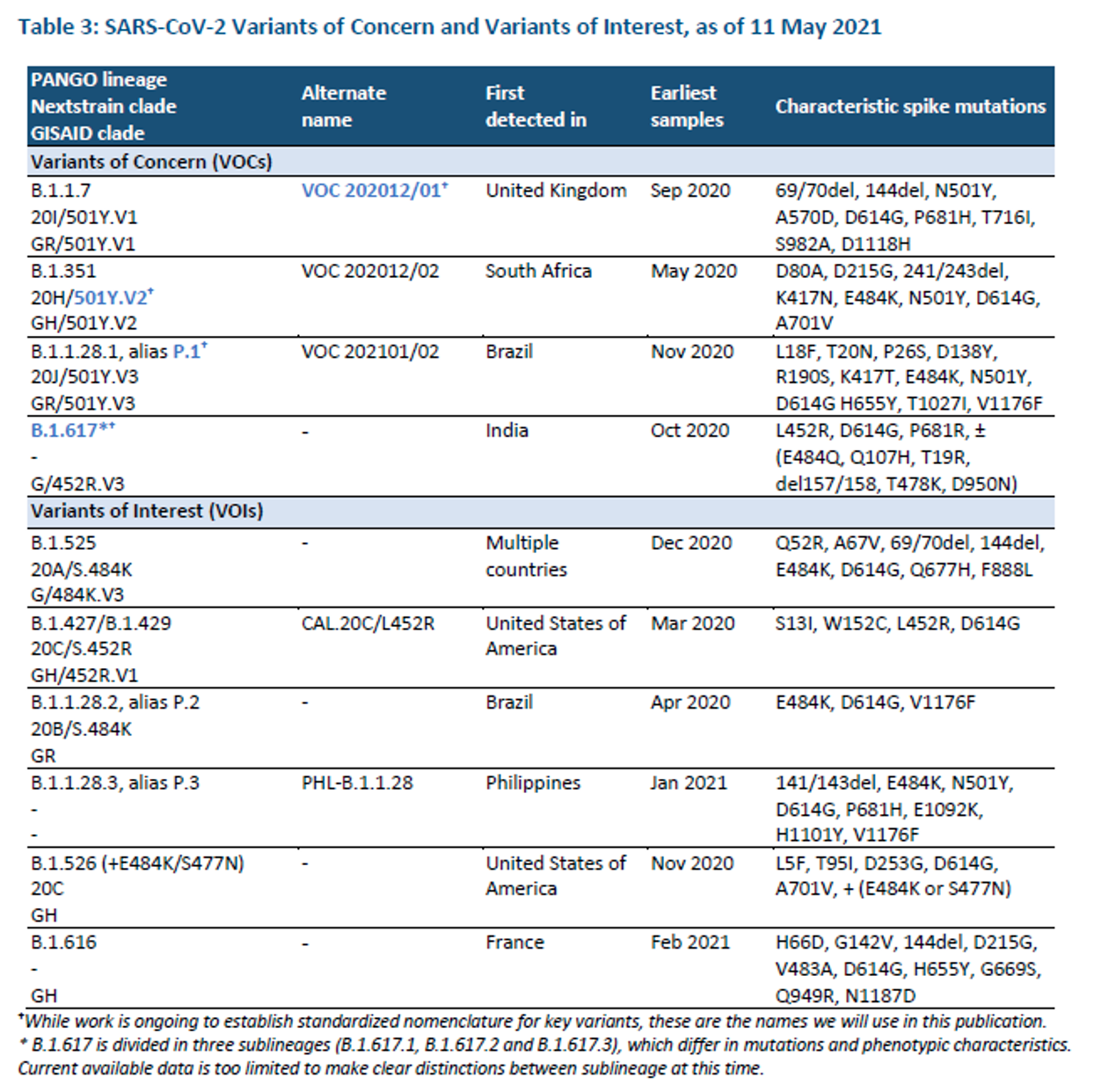
Special focus: In this edition, special focus updates are provided on four SARS-CoV-2 variants of concern [B.1.1.7 (VOC202012/01); B.1.351 (501Y.V2); P.1; B.1.617] and six variants of interest, including the geographic distribution, and phenotypic impacts on transmissibility, vaccines, therapeutics and diagnostics.


Weekly operational update on COVID-19 – 10 May 2021
Overview
In this edition of the Weekly Operational Update on COVID-19, highlights of country-level actions and WHO support to Member States include:
:: Equipment donated to support Belize’s COVID-19 vaccine deployment
:: Strengthening International Health Regulations capacities at points of entry during COVID-19 in the Republic of Moldova
:: Strengthening COVID-19 contact tracing efforts in the Philippines
:: COVID-19 vaccination campaign in Bhutan: from planning to execution
:: Rapid assessment of medical oxygen and biomedical equipment requirements in Guinea Bissau
:: Launching of COVID-19 vaccination Intra-Action Reviews (IAR)
:: Readiness for COVID-19 vaccination through simulation in Trinidad and Tobago
:: Tips to celebrate Eid-El-Fitr safely, a position paper COVID-19 vaccination in humanitarian settings and multi-platform dissemination of WHO online courses in Portuguese
:: Regular updates on WHO’s resource requirements and funds received to support countries in implementing the COVID-19 Strategic Preparedness and Response Plan 2021, WHO/PAHO procurement of critical supplies, and implementation of the Unity Studies

Draft landscape and tracker of COVID-19 candidate vaccines

Milestones :: Perspectives :: Research


Draft landscape and tracker of COVID-19 candidate vaccines
14 May 2021 | Publication
The COVID-19 candidate vaccine landscape and tracker database compiles detailed information on COVID-19 vaccine candidates in development.
The landscape is updated regularly – twice a week (Tuesday and Friday, 17:00 CET).
Download: https://cdn.who.int/media/docs/default-source/blue-print/07.05.2021-novel-coronavirus_landscape_covid-19.xlsx.zip?sfvrsn=23955096_3&download=true

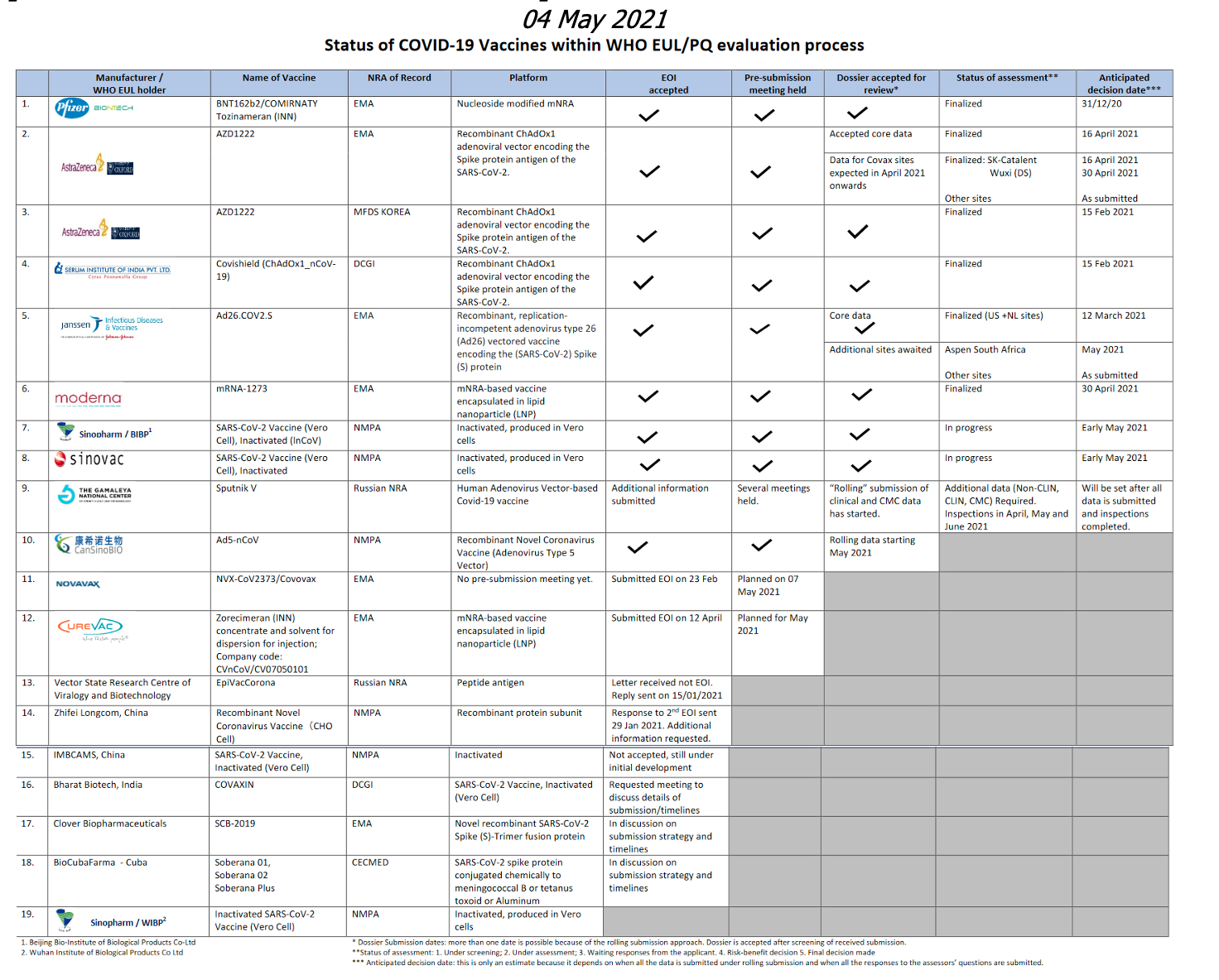
Status of COVID-19 Vaccines within WHO EUL/PQ evaluation process 23 April 2021

Milestones :: Perspectives :: Research


Status of COVID-19 Vaccines within WHO EUL/PQ evaluation process 23 April 2021
For 19 vaccine candidates, presents Manufacturer, Name of Vaccine, NRA of Record, Platform, EOI Accepted Status, Pre-submission Meeting Held Status, Dossier Accepted for Review, Status of Assessment; Anticipated/Completed Decision Date
[click on the link above for full scale view]

COVID Vaccine Developer/Manufacturer Announcements [organizations from WHO EUL/PQ listing above]

Milestones :: Perspectives :: Research


COVID Vaccine Developer/Manufacturer Announcements [organizations from WHO EUL/PQ listing above]


AstraZeneca
Press Releases – No new digest announcements identified

Bharat Biotech, India
Press Releases – Website not responding at inquiry

BioCubaFarma – Cuba
Últimas Noticias – No new digest announcements identified


CanSinoBIO
News – No new digest announcements identified

Clover Biopharmaceuticals – China
News – No new digest announcements identified


Curevac [Bayer Ag – Germany]
News
May 13, 2021
Second-Generation COVID-19 Vaccine Candidate, CV2CoV, Demonstrates High Immunogenicity Against Virus Variants in Preclinical Study
May 13, 2021
:: Second-generation lead COVID-19 vaccine candidate, CV2CoV, developed in collaboration by CureVac and GSK
:: CV2CoV mRNA shows high levels of antigen production in rat model
:: Fast onset of strong neutralizing antibody titers after first vaccination
:: High cross-neutralizing capacity of induced antibodies against selected Variants of Concern


Gamaleya National Center
Latest News and Events – No new digest announcements identified [See Russia/RFID below]

IMBCAMS, China
Home – No new digest announcements identified


Janssen/JNJ
Press Releases – No new digest announcements identified


Moderna
Press Releases
May 12, 2021
Moderna Announces New Supply Agreement with Australia for 25 Million Doses of its COVID-19 Vaccine


Novavax
Press Releases
Novavax Statement on Updated PREVENT-19 Trial Protocol
Statement = COVID-19
5/10/2021
An updated protocol version 8.0 for our PREVENT-19 Phase 3 clinical trial (the PRE-fusion protein subunit Vaccine Efficacy Novavax Trial) was posted to the Novavax website today. PREVENT-19 is a randomized, observer-blinded, placebo-controlled study evaluating the efficacy, safety, and immunogenicity of NVX-CoV2373 with Matrix-M™ adjuvant in up to 30,000 subjects 18 years of age and older compared with placebo. The company’s pivotal Phase 3 study in the U.S. and Mexico began in December 2020 and significant progress has been made to-date, with final data expected in the second quarter of 2021…

Novavax Announces Positive Preclinical Data for Combination Influenza and COVID-19 Vaccine Candidate
5/10/2021
– Manuscript highlights development of robust responses to both influenza and COVID-19 and protection against the SARS-CoV-2 virus
– Data shared via preprint server for biology, bioRxiv, ahead of publication…A pre-print of the manuscript is available at bioRxiv.org.


Pfizer
Recent Press Releases
05.10.2021
Pfizer and BioNTech Receive First U.S. Authorization for Emergency Use of COVID-19 Vaccine in Adolescents
:: In a Phase 3 trial, the vaccine was 100% effective and generally well tolerated in participants aged 12 to 15 years
:: Data also submitted to European Medicines Agency (EMA) and other global regulators, with additional authorizations expected in coming weeks


Serum Institute of India
NEWS & ANNOUNCEMENTS – No new digest announcements identified


Sinopharm/WIBPBIBP
News – No new digest announcements identified


Sinovac
Press Releases – No new digest announcements identified


Vector State Research Centre of Viralogy and Biotechnology
Home – No new digest announcements identified

Zhifei Longcom, China
[Anhui Zhifei Longcom Biologic Pharmacy Co., Ltd.]
[No website identified]

U.S.: COVID-19 Vaccines – Announcements/Regulatory Actions/Deployment

Milestones :: Perspectives :: Research


U.S.: COVID-19 Vaccines – Announcements/Regulatory Actions/Deployment

Vaccines and Related Biological Products Advisory Committee
No new digest content identified.

EARLY RELEASE: The Advisory Committee on Immunization Practices’ Interim Recommendation for Use of Pfizer-BioNTech COVID-19 Vaccine in Adolescents Aged 12-15 Years – United States, May 2021
Early Release / May 14, 2021 / 70
Summary
What is already known about this topic?
On May 10, 2021, the Food and Drug Administration expanded Emergency Use Authorization for the Pfizer-BioNTech COVID-19 vaccine to include adolescents aged 12–15 years.
What is added by this report?
On May 12, 2021, after a systematic review of all available data, the Advisory Committee on Immunization Practices made an interim recommendation for use of the Pfizer-BioNTech COVID-19 vaccine in adolescents aged 12–15 years for the prevention of COVID-19.
What are the implications for public health practice?
The Pfizer-BioNTech COVID-19 vaccine is the first COVID-19 vaccine approved for use in adolescents and has high efficacy against symptomatic COVID-19. Vaccination will be important to protect adolescents against symptomatic COVID-19 disease and to reduce community transmission of SARS-CoV-2.

Coronavirus (COVID-19) Update: FDA Authorizes Pfizer-BioNTech COVID-19 Vaccine for Emergency Use in Adolescents in Another Important Action in Fight Against Pandemic
May 10, 2021
Today, the U.S. Food and Drug Administration expanded the emergency use authorization (EUA) for the Pfizer-BioNTech COVID-19 Vaccine for the prevention of coronavirus disease 2019 (COVID-19) caused by severe acute respiratory syndrome coronavirus 2 (SARS-CoV-2) to include adolescents 12 through 15 years of age. The FDA amended the EUA originally issued on Dec. 11, 2020 for administration in individuals 16 years of age and older.

“The FDA’s expansion of the emergency use authorization for the Pfizer-BioNTech COVID-19 Vaccine to include adolescents 12 through 15 years of age is a significant step in the fight against the COVID-19 pandemic,” said Acting FDA Commissioner Janet Woodcock, M.D. “Today’s action allows for a younger population to be protected from COVID-19, bringing us closer to returning to a sense of normalcy and to ending the pandemic. Parents and guardians can rest assured that the agency undertook a rigorous and thorough review of all available data, as we have with all of our COVID-19 vaccine emergency use authorizations.”…

Today, the U.S. Food and Drug Administration expanded the emergency use authorization (EUA) for the Pfizer-BioNTech COVID-19 Vaccine for the prevention of coronavirus disease 2019 (COVID-19) caused by severe acute respiratory syndrome coronavirus 2 (SARS-CoV-2) to include adolescents 12 through 15 years of age. The FDA amended the EUA originally issued on Dec. 11, 2020 for administration in individuals 16 years of age and older.

“The FDA’s expansion of the emergency use authorization for the Pfizer-BioNTech COVID-19 Vaccine to include adolescents 12 through 15 years of age is a significant step in the fight against the COVID-19 pandemic,” said Acting FDA Commissioner Janet Woodcock, M.D. “Today’s action allows for a younger population to be protected from COVID-19, bringing us closer to returning to a sense of normalcy and to ending the pandemic. Parents and guardians can rest assured that the agency undertook a rigorous and thorough review of all available data, as we have with all of our COVID-19 vaccine emergency use authorizations.”…


::::::

White House [U.S.]
Briefing Room – Selected Major COVID Announcements
Press Briefing by White House COVID-19 Response Team and Public Health Officials
May 13, 2021 • Press Briefings

Remarks by President Biden on the COVID-19 Response and the Vaccination Program
May 13, 2021 • Speeches and Remarks

FACT SHEET: Biden-Harris Administration to Invest $7 Billion from American Rescue Plan to Hire and Train Public Health Workers in Response to COVID-19
May 13, 2021 • Statements and Releases

Remarks by President Biden on the COVID-19 Response and the Vaccination Program
May 12, 2021 • Speeches and Remarks

FACT SHEET: President Biden to Announce Additional Efforts to Get America Vaccinated, Including Free Rides to Vaccination Sites from Lyft and Uber, Vaccination Clinics at Community Colleges, and Additional Resources for States’ Community Outreach Efforts
May 11, 2021 • Statements and Releases

Statement by President Biden on FDA’s Expanded Emergency Use Authorization of the Pfizer-BioNTech COVID-19 Vaccine to Include Adolescents
May 10, 2021 • Statements and Releases


::::::

COVID Data Tracker [U.S.] May 8, 2021

Europe: COVID-19 Vaccines – Announcements/Regulatory Actions/Deployment

Milestones :: Perspectives :: Research


Europe: COVID-19 Vaccines – Announcements/Regulatory Actions/Deployment


European Medicines Agency
News & Press Releases
No new digest content identified.


European Centre for Disease Prevention and Control
https://www.ecdc.europa.eu/en
Latest Updates
Threat Assessment Brief: Emergence of SARS-CoV-2 B.1.617 variants in India and situation in the EU/EEA
11 May 2021
Executive summary
:: First reported in India in December 2020, SARS-CoV-2 lineages B.1.617.1, B.1.617.2 and B.1.617.3 have been increasingly detected in other countries.
:: The aim of this Threat Assessment Brief is to assess the potential public health implications of the B.1.617 lineages for EU/EEA countries with a focus on lineage B.1.617.2.
:: Over the past eight weeks India and some surrounding countries have seen a sharp increase in the number of reported SARS-CoV-2 cases and deaths. This has been associated with a rising proportion of sequenced viruses belonging to lineages B.1.617.1 and B.1.617.2.
:: The United Kingdom has seen a rapid increase in detection of lineage B.1.617.1 and, to a greater extent, B.1.617.2, associated with travel to India and onward community transmission. On the 6 May, the United Kingdom (UK) designated lineage B.1.617.2 as a variant of concern.
:: In the EU/EEA there are indications that the frequency of detection of both lineages B.1.617.1 and B.1.617.2 is increasing.
:: Currently described lineages B.1.617.1, B.1.617.2 and B.1.617.3 have distinct mutation profiles and warrant individual assessment. Given the still very limited available data with respect to their transmissibility, disease severity and immune escape potential relative to other co-circulating SARS-CoV-2 variants in the EU/EEA, the full impact of these lineages on public health is not yet possible to assess.
:: At this time, ECDC maintains its assessment of B.1.617.1, B.1.617.2 and B.1.617.3 as variants of interest and will continue to actively monitor the situation.


European Commission
https://ec.europa.eu/commission/presscorner/home/en
News
Press release 12 May 2021
Coronavirus variants: Commission calls for limiting essential travel from India
The Commission calls on EU Member States to take coordinated action to further restrict travel from India on a temporary basis, with a view to limiting the spread of the B.1.617.2 variant first detected in India.

Press release 11 May 2021
Sahel and Central Africa: €210 million in EU humanitarian aid
The EU is reaffirming its solidarity with vulnerable people in countries in the Sahel and Central Africa through a humanitarian budget of €210 million in 2021.

Russia: COVID-19 Vaccines – Announcements/Regulatory Actions/Deployment

Milestones :: Perspectives :: Research


Russia: COVID-19 Vaccines – Announcements/Regulatory Actions/Deployment


Russia: Sputnik V – “the first registered COVID-19 vaccine”
https://sputnikvaccine.com/newsroom/pressreleases/
Press Releases
Sputnik V approved for use in the Republic of Ecuador
Press release, 15.05.2021

Single-dose Sputnik Light vaccine approved for use in Venezuela
Press release, 15.05.2021

Vaccination with Sputnik V launched in India
Press release, 14.05.2021
…Sputnik V has become the first foreign-made vaccine that is used in India contributing to the world’s largest COVID-19 vaccination campaign.
Inoculations with Sputnik V in Hyderabad today followed the arrival of the first batch of the vaccine in India on May 1, 2021. The second batch of Sputnik V is expected to arrive in India by the end of the week.
Sputnik V was approved for use in India on April 12, 2021 and granted an emergency use authorization. India is the leading production hub for Sputnik V. RDIF has reached agreements with the leading pharmaceutical companies in the country (Gland Pharma, Hetero Biopharma, Panacea Biotec, Stelis Biopharma, Virchow Biotech) aimed at production of more than 850 million doses per year…

Sputnik V approved for use in the Republic of Maldives
Press release, 13.05.2021

Sputnik Light vaccine approved for use in Angola
Press release, 12.05.2021

The Sputnik V vaccine helps San Marino to become the first country in Europe to defeat COVID and reduce the infection rate to zero
Press release, 10.05.2021

India: COVID-19 Vaccines – Announcements/Regulatory Actions/Deployment

Milestones :: Perspectives :: Research


India: COVID-19 Vaccines – Announcements/Regulatory Actions/Deployment


Government of India – Press Information Bureau
Latest Press Releases
PM chairs a high level meeting on Covid and vaccination related situation
Posted on: 15 May 2021
PM chaired a high-level meeting to discuss the Covid and vaccination related situation in the country. Officials briefed the PM on the current Covid related situation in the country….
…PM said that India’s fight against Covid has been guided throughout by scientists and subject experts and will continue being guided by them.
Officials briefed PM about the vaccination process and the state-wise coverage of 45+ population. The roadmap for future vaccine availability was also discussed. He directed officials to work closely with states to ramp up the speed of vaccination.


Ministry of Health and Family Welfare
https://www.mohfw.gov.in/


Indian Council for Medical Research (ICMR)
https://www.icmr.gov.in/media.html
No new digest content identified.

POLIO Public Health Emergency of International Concern (PHEIC); WHO/OCHA Emergencies

Emergencies

POLIO
Public Health Emergency of International Concern (PHEIC)

Polio this week as of 12 May 2021
:: The GPEI has released the 2021 National Emergency Action Plan (NEAP) for Afghanistan which contains the current epidemiology and situational overview and progress on the 2020 NEAP among other contents.
:: The latest issue of the newSpecial magazine features an article titled “Experience in eradicating polio helps COVID-19 response” which details the role that polio workers have played in fighting the pandemic. The article is available here on page 34.
:: Last week, the GPEI and UN Foundation together with the UK and UAE Missions to the UN in New York hosted a high-level dialogue looking at the intersection of gender and immunization. The panelists made recommendations on championing women & girls in immunization, drawing on the polio programme. Watch the recorded discussion here.

Summary of new WPV and cVDPV viruses this week (AFP cases and ES positives):
:: Afghanistan: two cVDPV2 positive environmental samples
:: Benin: one cVDPV2 case
:: Burkina Faso: one cVDPV2 case
:: Liberia: one cVDPV2 case
:: Sierra Leone: two cVDPV2 positive environmental samples
:: Tajikistan: two cVDPV2 positive environmental samples
:: Yemen : one cVDPV1 case

::::::
::::::

WHO/OCHA Emergencies

Editor’s Note:
Continuing with this edition, we include information about the last apparent update evident on the WHO emergency country webpages, recognizing almost universal and significant interims since last update regardless of the level of the emergency listed.

WHO Grade 3 Emergencies [to 15 May 2021]

Democratic Republic of the Congo – No new digest announcements identified [Last apparent update: 3 May 2021]
Mozambique floods – No new digest announcements identified [Last apparent update: 3 November 2020]
Nigeria – No new digest announcements identified [Last apparent update: 29 Jun 2020]
Somalia – No new digest announcements identified [Last apparent update: 17 July 2020]
South Sudan – No new digest announcements identified [Last apparent update: 4 February 2020]
Syrian Arab Republic – No new digest announcements identified [Last apparent update: 24 October 2020]
Yemen – No new digest announcements identified [Last apparent update: 30 June 2020]

::::::

WHO Grade 2 Emergencies [to 15 May 2021]
Burkina Faso
:: Burkina Faso : Appel à plus de mobilisation en faveur de la planification familiale 06 mai 2021

Iraq
:: Iraq receives second delivery of COVID-19 vaccines through the COVAX Facility
Baghdad, 12 May 2021 – Despite a continued global shortage and limited production of COVID-19 vaccines, on 9 May Iraq received the second shipment of the AstraZeneca COVID-19 vaccine through the COVAX Facility. The arrival of the second shipment of exactly 499 200 doses brings the total number of vaccines received by the Iraqi health authorities from the COVAX Facility to nearly one million….

Afghanistan – No new digest announcements identified [Last apparent update: 5 July 2020]
Angola – No new digest announcements identified [Last apparent update: 16 March 2021]
Burundi – No new digest announcements identified [Last apparent update: 04 July 2019]
Cameroon – No new digest announcements identified [Last apparent update: 22 August 2019]
Central African Republic – No new digest announcements identified [Last apparent update: 12 June 2018]
Ethiopia – No new digest announcements identified [Last apparent update: 22 August 2019]
Iran floods 2019 – No new digest announcements identified [Last apparent update: 2 March 2020]
Libya – No new digest announcements identified [Last apparent update: 7 October 2019]
Malawi – No new digest announcements identified [Last apparent update: 22 April 2021
Measles in Europe No new digest announcements identified [Last apparent update: 26-04-2021]
MERS-CoV – No new digest announcements identified [Last apparent update: 8 July 2019]
Mozambique – No new digest announcements identified [Last apparent update: 03 November 2020]
Myanmar – No new digest announcements identified [Last apparent update: 29 March 2021]
NigerNo new digest announcements identified [Last apparent update: 16 avril 2021]
occupied Palestinian territory – No new digest announcements identified [Last apparent update: 4 September 2019]
HIV in Pakistan – No new digest announcements identified [Last apparent update: 27 August 2019]
Sao Tome and Principe Necrotizing Cellulitis (2017) – No new digest announcements
Sudan – No new digest announcements identified [Last apparent update: 24 June 2020]
Ukraine – No new digest announcements identified [Last apparent update: 1 May 2019]
Zimbabwe – No new digest announcements identified [Last apparent update: 10 May 2019]

::::::

WHO Grade 1 Emergencies [to 15 May 2021]

Chad – No new digest announcements identified [Last apparent update: 30 June 2018]
Djibouti – No new digest announcements identified [Last apparent update: 25 novembre 2020]
Kenya – No new digest announcements identified [Last apparent update: 23 April 2021
Mali – No new digest announcements identified [Last apparent update: 3 May 2017]
Namibia – viral hepatitis – No new digest announcements identified [Last apparent update: 20 July 2018]
Tanzania – No new digest announcements identified [Last apparent update: 21 October 2019]

::::::
::::::

UN OCHA – Current Emergencies
Current Corporate Emergencies
Ethiopia Humanitarian Bulletin Issue #6 26 April – 10 May …

::::::
::::::

WHO & Regional Offices [to 15 May 2021]

WHO & Regional Offices [to 15 May 2021]
https://www.who.int/

17 May 2021 Departmental news
Streets for Life campaign calls for 30 km/h urban streets to ensure safe, healthy, green and liveable cities

14 May 2021 Departmental news
Building Climate-Resilient Health Systems: Four key actions to follow in National Adaptation Plan (NAP) processes


::::::

Weekly Epidemiological Record, Vol. 96, No. 19, pp. 157–164 14 May 2021
:: Health systems for health security – Strengthening prevention, preparedness and response to health emergencies


::::::

WHO Regional Offices
Selected Press Releases, Announcements
WHO African Region AFRO
:: What fuels the use of unproven COVID-19 therapies? 14 May 2021
The emergence of COVID-19 and the pandemic have raised many challenges regarding treatment and spawned the use of unproven therapies. Professor Lucille Blumberg, the Deputy Director of the South African National Institute for Communicable Diseases, discusses the causes, the risks and how to tackle unproven COVID-19 cures.
:: Risks and challenges in Africa’s COVID-19 vaccine rollout 14 May 2021
Africa’s largest-ever vaccination drive is well under way. Forty-nine African countries are rolling out COVID-19 vaccines and over 22 million doses have been given on the continent. Valuable lessons are emerging, but major risks and challenges threaten Africa’s fragile gains.
:: Joining forces to tackle the Ebola Infodemic in Guinea 12 May 2021
On a sultry morning in early March in the small town of Gouécké in south-eastern Guinea, scores of concerned community and customary leaders gathered for a meeting with WHO’s local team of social anthropologists.

WHO Region of the Americas PAHO
No new digest content identified

WHO South-East Asia Region SEARO
No new digest content identified

WHO European Region EURO
:: Refugees and migrants hosted in Serbian reception centres get their COVID-19 vaccine doses 12-05-2021
:: Former Chief Nursing Officer for Wales says nurse leadership must help shape a more just and equitable health-care system 12-05-2021
:: High rates of childhood obesity alarming given anticipated impact of COVID-19 pandemic 11-05-2021

WHO Eastern Mediterranean Region EMRO
:: Egypt receives second shipment of 1.77 million COVID-19 vaccines through the COVAX Facility
14 May 2021
:: Iraq receives second delivery of COVID-19 vaccines through the COVAX Facility 12 May 2021
:: Nurses and midwives: the bridge between patients and health care 12 May 2021
:: WHO support strengthens emergency services in Syria 10 May

WHO Western Pacific Region
:: Advice to hospitals on how to ease pandemic pressure 12 May 2021

MMWR News Synopsis Friday, May 7, 2021

MMWR News Synopsis Friday, May 7, 2021
:: Surveillance To Track Progress Toward Polio Eradication — Worldwide, 2019–2020
:: Effectiveness of Pfizer-BioNTech and Moderna Vaccines Against COVID-19 Among Hospitalized Adults Aged ≥65 Years — United States, January–March 2021 (Early Release April 28, 2021)
:: Safety Monitoring of the Janssen (Johnson & Johnson) COVID-19 Vaccine — United States, March–April 2021 (Early Release April 30, 2021)
:: Anxiety-Related Adverse Event Clusters After Janssen COVID-19 Vaccination — Five U.S. Mass Vaccination Sites, April 2021 (Early Release April 30, 2021)

Coronavirus Disease 2019 (COVID-19)- CDC

Coronavirus Disease 2019 (COVID-19)– CDC
Selected Resources
EARLY RELEASE: Interim Estimates of Vaccine Effectiveness of Pfizer-BioNTech and Moderna COVID-19 Vaccines Among Health Care Personnel – 33 U.S. Sites, January-March 2021

EARLY RELEASE: The Advisory Committee on Immunization Practices’ Interim Recommendation for Use of Pfizer-BioNTech COVID-19 Vaccine in Adolescents Aged 12-15 Years – United States, May 2021

Largest CDC COVID-19 Vaccine Effectiveness Study in Health Workers Shows mRNA Vaccines 94% Effective

Overall US COVID-19 Vaccine Distribution and Administration Update as of Fri, 14 May 2021 06:00:00 EST

Grading of Recommendations, Assessment, Development, and Evaluation (GRADE): Pfizer-BioNTech COVID-19 Vaccine for Persons Aged 12-15 Years

ACIP Evidence to Recommendations for Use of Pfizer-BioNTech COVID-19 Vaccine under an Emergency Use Authorization

Africa CDC [to 15 May 2021]

Africa CDC [to 15 May 2021]
http://www.africacdc.org/
News
COMMUNIQUE OF THE HIGH-LEVEL EMERGENCY VIRTUAL MEETING OF AFRICAN MINISTERS OF HEALTH ON THE COVID-19 SITUATION IN AFRICA
14 May 2021
[Excerpt]
… THE HIGH-LEVEL MINISTERIAL MEETING:
:: WELCOMES AND RECOGNIZES the efforts by the Member States in response to COVID-19 pandemic.
:: COMMENDS the efforts of Africa CDC, WHO, partners, and AU Member States in working closely under the AFTCOR to coordinate our efforts across the continent.
:: COLLECTIVELY ENDORSES an adapted joint continental strategy with focus on enhanced Prevention, Monitoring, and Treatment (PMT) in order to meet the changing dimensions of the COVID-19 on the continent as well as the evolving nature of the global pandemic.
:: CALLS UPON all Member States to intensify their efforts for vaccination against COVID-19 as a critical component to prevent, contain and bring the pandemic to an end as quickly as possible.
:: ALSO CALL UPON AU Member States to take up their COVID-19 vaccine allocations through the African Vaccine Acquisition Task Team platform and engage with the African Export Import Bank to work out the details for the advance purchase agreement.
:: UNDERSCORES the need the protect schools and ensure schools remain opens.
:: ALSO UNDERSCORE the urgent need to protect other critical health programmes on the continent against the impact of the COVID-19 pandemic. These programmes including but not limited to HIV, TB, Malaria, and immunization efforts.
:: STRESSES the need to understand the impact of vaccine impact and safety in the continent and CALLS on AU Members States to conduct surveillance for vaccine effectiveness and safety…

China CDC

China CDC
http://www.chinacdc.cn/en/
CCDC Weekly – Weekly Reports: Current Volume (3)
2021-05-14 / No. 20
:: Methods and Applications: Trend Analysis and Intervention Effect Starting Point Detection of COVID-19 Epidemics Using Recalibrated Time Series Models — Worldwide, 2020
:: Methods and Applications: A Longitudinal Cohort Study Using a Modified Child-Pugh Score to Escalate Respiratory Support in COVID-19 Patients — Hubei Province, China, 2020

National Health Commission of the People’s Republic of China [to 15 May 2021]
http://en.nhc.gov.cn/
News
May 15: Daily briefing on novel coronavirus cases in China
On May 14, 31 provincial-level regions and the Xinjiang Production and Construction Corps on the Chinese mainland reported 14 new cases of confirmed infections.

Vaccine best path to global immunity, expert says
2021-05-14

China’s Sinopharm COVID-19 vaccine safe, efficacious: WHO official
2021-05-13

WHO approval of Sinopharm vaccine set to benefit world coronavirus fight
2021-05-10

National Medical Products Administration – PRC [to 15 May 2021]
http://english.nmpa.gov.cn/news.html
News
Over 354m COVID-19 vaccine doses administered across China
2021-05-14
More than 354.27 million doses of COVID-19 vaccines had been administered across China as of Wednesday, the National Health Commission said on May 13.

Organization Announcements

Organization Announcements
Editor’s Note:
Careful readers will note that the number and range of organizations now monitored in our Announcements section below has grown as the impacts of the pandemic have spread across global economies, supply chains and programmatic activity of multilateral agencies and INGOs.


Paul G. Allen Frontiers Group [to 15 May 2021]
https://alleninstitute.org/what-we-do/frontiers-group/news-press/
News
No new digest content identified.


BARDA – U.S. Department of HHS [to 15 May 2021]
https://www.phe.gov/about/barda/Pages/default.aspx
News
No new digest content identified.


BMGF – Gates Foundation [to 15 May 2021]
https://www.gatesfoundation.org/ideas/media-center
Press Releases and Statements
Press release May 12, 2021
Postsecondary Value Commission Report Proposes Action to Address Disparities in Economic Returns to College with Regard to Race, Income and Gender
SEATTLE – May 12, 2021: The national Postsecondary Value Commission, supported by the Bill & Melinda Gates Foundation and managed by the Institute for Higher Education Policy (IHEP), released its final findings today using national and institutional data sources confirming wide-ranging disparity in the value of a postsecondary education in terms of race, income and gender.

Statement May 06, 2021
Statement from Gates Foundation CEO Mark Suzman: No barriers should stand in the way of equitable vaccine access
The Bill & Melinda Gates Foundation has been working urgently since January 2020 with a range of partners to help COVID-19 vaccines reach as many people as possible, as quickly as possible. Today, with the heartbreaking surges in India and Brazil, and the lack of vaccines across African countries, it is clear there’s much more to be done.
No barriers should stand in the way of equitable access to vaccines, including intellectual property, which is why we are supportive of a narrow waiver during the pandemic. Those negotiations will occur via the WTO process, led by country negotiators…


Bill & Melinda Gates Medical Research Institute [to 15 May 2021]
https://www.gatesmri.org/
The Bill & Melinda Gates Medical Research Institute is a non-profit biotech organization. Our mission is to develop products to fight malaria, tuberculosis, and diarrheal diseases—three major causes of mortality, poverty, and inequality in developing countries. The world has unprecedented scientific tools at its disposal; now is the time to use them to save the lives of the world’s poorest people
No new digest content identified.


CARB-X [to 15 May 2021]
https://carb-x.org/
News
05.10.2021  |
CARB-X is funding Australian-biotech SpeeDx to develop a rapid point-of-care diagnostic for sexually transmitted diseases Chlamydia trachomatis and Neisseria gonorrhoeae
CARB-X is awarding SpeeDx, a diagnostics company in Sydney, Australia, up to $1.8 million to develop a rapid test for Chlamydia trachomatis and Neisseria gonorrhoeae, sexually transmitted bacteria that can cause serious infections and that are spreading around the world at alarming rates. SpeeDx is also eligible for $1.9 million in additional funds from CARB-X if the project achieves certain milestones, subject to available funds.


Center for Vaccine Ethics and Policy – GE2P2 Global Foundation [to 15 May 2021]
https://centerforvaccineethicsandpolicy.net/
News/Analysis/Statements
:: Past weekly editions and posting of all segments of Vaccines and Global Health: The Week in Review are available here.
:: [NEW] Informed Consent: A Monthly Review – May 2021 is now posted here


CEPI – Coalition for Epidemic Preparedness Innovations [to 15 May 2021]
http://cepi.net/
Latest News
COVAX Manufacturing Task Force to tackle vaccine supply challenges
COVAX has set up a “Manufacturing Task Force” to identify and resolve issues impeding equitable access to vaccines through COVAX.
14 May 2021

CEPI expands global footprint of its COVID-19 vaccine lab network, and opens testing against Variants of Concern
From July 2021, all COVID-19 vaccine developers are invited to use the network to evaluate their candidate vaccines against SARS-CoV-2 variants.
14 May 2021

The vaccines and the variants: CEPI’s work to tackle an evolving threat
The emergence of SARS-CoV-2 variants underscores the urgent need to double down our efforts to bring COVID-19 under control through the deployment of safe and effective vaccines globally.
11 May 202


DARPA – Defense Advanced Research Projects Agency [to 15 May 2021
https://www.darpa.mil/news
News
No new digest content identified.


Duke Global Health Innovation Center [to 15 May 2021]
https://dukeghic.org/
WEEKLY COVID VACCINE RESEARCH UPDATE
Last dated update: FRIDAY, April 16, 2021


EDCTP [to 15 May 2021]
http://www.edctp.org/
The European & Developing Countries Clinical Trials Partnership (EDCTP) aims to accelerate the development of new or improved drugs, vaccines, microbicides and diagnostics against HIV/AIDS, tuberculosis and malaria as well as other poverty-related and neglected infectious diseases in sub-Saharan Africa, with a focus on phase II and III clinical trials
No new digest content identified.


Emory Vaccine Center [to 15 May 2021]
http://www.vaccines.emory.edu/
Vaccine Center News
No new digest content identified.


European Vaccine Initiative [to 15 May 2021]
http://www.euvaccine.eu/
Latest News
No new digest content identified.


FDA [to 15 May 2021]
https://www.fda.gov/NewsEvents/Newsroom/PressAnnouncements/default.htm
Press Announcements /Selected Details
May 14, 2021 – Coronavirus (COVID-19) Update: May 14, 2021

May 11, 2021 – Coronavirus (COVID-19) Update: May 11, 2021

May 11, 2021 – FDA In Brief: FDA Finalizes Guidance with Internationally Harmonized Recommendations to Further Support Safe, High-Quality Human Drug Products

May 10, 2021 – Coronavirus (COVID-19) Update: FDA Authorizes Pfizer-BioNTech COVID-19 Vaccine for Emergency Use in Adolescents in Another Important Action in Fight Against Pandemic
[See U.S. COVID Actions above for detail]


Fondation Merieux [to 15 May 2021]
http://www.fondation-merieux.org/
News, Events
Mérieux Foundation co-organized event
Evidence to actions: countries and communities driving adaptive, evidence-informed approaches to end cholera
May 20, 2021 – Virtual Event


Gavi [to 15 May 2021]
https://www.gavi.org/
News Releases
12 May 2021
Japan to host Gavi’s COVAX Advance Market Commitment (AMC) Summit
Geneva, 12 May 2021 – The Government of Japan yesterday announced that it will host the virtual Gavi COVAX Advance Market Commitment (AMC) Summit on June 2nd 2021. The event, co-hosted by Japanese Prime Minister H.E. Yoshihide Suga and José Manuel Barroso, Chair of the Gavi Board, will aim to secure at least US $8.3 billion for 2020-21 in order to accelerate access to 1.8 billion COVID-19 vaccine doses for lower-income economies via the Gavi COVAX Advance Market Commitment by raising an additional US$ 2 billion from donors and the private sector in addition to US$ 6.3 billion raised before the campaign was launched at the “One World Protected” event on April 15th…

10 May 2021
Corporations, charities and governments step up support for equitable COVID-19 vaccine access at Vax Live concert
:: Over US$ 60 million raised for the procurement of COVID-19 vaccines for lower-income countries via the Gavi COVAX Advance Market Commitment (COVAX AMC)
:: The United Arab Emirates and Croatia have also committed millions of COVID-19 vaccines doses for lower-income countries
:: The pledges were announced at Global Citizen’s Vax Live Concert on Saturday, co-hosted by Selena Gomez and featuring messages from Prince Harry, the Duke of Sussex, His Holiness Pope Francis and several Heads of State


GHIT Fund [to 15 May 2021]
https://www.ghitfund.org/newsroom/press
GHIT was set up in 212 with the aim of developing new tools to tackle infectious diseases that
No new digest content identified.


Global Fund [to 15 May 2021]
https://www.theglobalfund.org/en/news/
News & Stories
News
Global Fund 45th Board Meeting Reports Continued Progress Despite COVID-19 Pandemic
12 May 2021
The Board of the Global Fund to Fight AIDS, Tuberculosis and Malaria overwhelmingly praised the continued progress of the Global Fund in the past year despite the challenges of the COVID-19 pandemic.


Global Research Collaboration for Infectious Disease Preparedness [GloPID-R] [to 15 May 2021]
https://www.glopid-r.org/news/
News
No new digest content identified.


Hilleman Laboratories [to 15 May 2021]
http://www.hillemanlabs.org/
Website not responding at inquiry


Human Vaccines Project [to 15 May 2021]
http://www.humanvaccinesproject.org/media/press-releases/
HVP COVID Report
Vaccines in a Year? How About a Few Months?
Nick Jackson, MSc., DLSHTM, Ph.D.
Head of Programs and Technology, Vaccine Research and Development
Coalition for Epidemic Preparedness Innovations (CEPI)


IAVI [to 15 May 2021]
https://www.iavi.org/newsroom
PRESS RELEASES/FEATURES
No new digest content identified.


International Coalition of Medicines Regulatory Authorities [ICMRA]
http://www.icmra.info/drupal/en/news
Selected Statements, Press Releases, Research
No new digest content identified.


ICRC [to 15 May 2021]
https://www.icrc.org/en/whats-new
Selected News Releases, Statements, Reports
No new digest content identified.


International Generic and Biosimilar Medicines Association [IGBA]
https://www.igbamedicines.org/
News
IGBA Applauds UK MHRA Biosimilar Guidance Revision: Science-driven Evolution for Sustainable Access to Biologics (May 2021)
11.5.2021
The International Generic and Biosimilar medicines Association (IGBA), which represents global manufacturers of generic and biosimilar medicines, welcomes the UK MHRA publication of its updated guidance on the licensing of biosimilar products (10 May 2021). This publication marks a positive milestone in the evolution of evidence requirements for biosimilar approval through the removal of the default need for a comparative efficacy trial, instead basing approval on a comprehensive comparability exercise, including a comparative pharmacokinetics (PK) trial.


IFFIm
http://www.iffim.org/
Press Releases/Announcements
No new digest content identified.


IFRC [to 15 May 2021]
http://media.ifrc.org/ifrc/news/press-releases/
Selected Press Releases, Announcements
Bangladesh, India, Laos, Nepal, Philippines
Asia: 5.9 million COVID infections overwhelm hospitals
Kuala Lumpur/Delhi/Geneva, 12 May 2021 – The world’s fastest surge of COVID-19 is pushing hospitals and health systems to the brink of collapse as Asia has fast become the global COVID-19 hotspot, suffering more than twice as many new infections than a …
12 May 2021


Institut Pasteur [to 15 May 2021]
https://www.pasteur.fr/en/press-area
Press release
11.05.2021
Genetics: Biosynthesis pathway of a new DNA nucleobase elucidated
DNA is composed of nucleobases represented by the letters A, T, G and C. They form the basis of the genetic code and…


IOM / International Organization for Migration [to 15 May 2021]
http://www.iom.int/press-room/press-releases
News
IOM Supports the UN COVID-19 Vaccination Roll-Out in Yemen
2021-05-11 16:31
Aden – The International Organization for Migration (IOM) has begun its support to the United Nations (UN) COVID-19 vaccination roll-out in Yemen where cases have recently surged. The Organization is providing vaccinations at five health centres in Aden, Ma’rib, Shabwah, Taiz and Lahj.
Yemen received 360,000 COVID-19 vaccine doses through the COVAX Facility on 31 March. The roll-out of the vaccination campaign began on 20 April…


IRC International Rescue Committee [to 15 May 2021]
http://www.rescue.org/press-release-index
Media highlights [Selected]
Press Release
Analysis shows 87% of COVID-19 vaccine doses have been given in wealthier countries, despite surges in cases in conflict-affected countries, warns IRC
May 12, 2021


IVAC [to 15 May 2021]
https://www.jhsph.edu/research/centers-and-institutes/ivac/index.html
Updates; Events
Webinar: Addressing challenges in vaccination in fragile contexts
Register Now
Description: With COVID-19 vaccines now available worldwide, reaching underserved and vulnerable populations is a priority under the Immunization Agenda 2030 (IA2030). Numerous challenges and operational issues have presented themselves in fragile contexts including vaccine access, risk of vaccine preventable diseases, and vaccine hesitancy. Join the IA2030 Strategic Priority 5 working group for a 90-minute webinar (May 21 at 7:30am ET / 13:30 CET) hosted by the International Vaccine Access Center to discuss vaccinating against COVID-19 in fragile contexts in coordination with the launch of IA2030 at the World Health Assembly.


IVI [to 15 May 2021]
http://www.ivi.int/
Selected IVI News, Announcements, Events
No new digest content identified.


JEE Alliance [to 15 May 2021]
https://www.jeealliance.org/
Selected News and Events
No new digest content identified.


Johns Hopkins Center for Health Security [to 15 May 2021]
https://www.centerforhealthsecurity.org/news/center-news/
Center News
Johns Hopkins Center for Health Security and National Organizations Share Strategies to Improve Crisis Standards of Care Implementation During Future COVID-19 Surges and Beyond
May 13, 2021
[See Milestones above for full text]


MSF/Médecins Sans Frontières [to 15 May 2021]
http://www.msf.org/
Latest [Selected Announcements
More oxygen supplies needed to avoid COVID-19 patients “gasping for air”
Press Release 10 May 2021


National Academy of Medicine – USA [to 15 May 2021]
https://nam.edu/programs/
Selected News/Programs
Upcoming Events:
National Organizations Share Strategies to Improve Crisis Standards of Care Implementation During Future COVID-19 Surges and Beyond
May 13, 2021
[See Milestones above for detail]


National Vaccine Program Office – U.S. HHS [to 15 May 2021]
https://www.hhs.gov/vaccines/about/index.html
Upcoming Meetings/Latest Updates
No new digest content identified.


NIH [to 15 May 2021]
http://www.nih.gov/news-events/news-releases
News Releases
Gene therapy restores immune function in children with rare immunodeficiency
May 11, 2021 — Researchers found that 48 of 50 children retained their replenished immune system function two to three years later and did not require additional treatments for ADA-SCID.


UN OCHA Office for the Coordination of Humanitarian Affairs [to 15 May 2021]
https://www.unocha.org/
Press Releases
13 May 2021
Humanitarian Coordinator condemns killing of an aid worker in Budi, Eastern Equatoria

10 May 2021
Humanitarian Coordinator condemns attacks against humanitarian workers in Renk, Upper Nile


PATH [to 15 May 2021]
https://www.path.org/media-center/
Press Releases
No new digest content identified.


Sabin Vaccine Institute [to 15 May 2021]
http://www.sabin.org/updates/pressreleases
Statements and Press Releases
No new digest content identified.


UNAIDS [to 15 May 2021]
http://www.unaids.org/en
Selected Press Releases/Reports/Statements
14 May 2021
Protecting prisoners from HIV and COVID-19 in Mexico

11 May 2021
Community-led HIV services stepped up in the Philippines during the COVID-19 pandemic

10 May 2021
UNAIDS saddened by the death of Smarajit Jana


UNDP United Nations Development Programme [to 15 May 2021]
http://www.undp.org/content/undp/en/home/presscenter.html
Latest from News Centre
No new digest content identified.


UNHCR Office of the United Nations High Commissioner for Refugees [to 15 May 2021]
http://www.unhcr.org/en-us/media-centre.htmlS
Selected News Releases, Announcements
UNHCR, aid partners call for renewed and strong support for the Rohingya refugees
14 May 2021
… With the refugee crisis in its fourth year, Bangladesh needs robust and sustained international support to ensure the safety and wellbeing of stateless Rohingya refugees. This must not become a forgotten crisis. Both Rohingya refugees and Bangladesh, having generously hosted them for decades, must see the world standing with them.
Adding to the complexity of this crisis, the COVID-19 pandemic has compounded vulnerabilities for refugees and host communities alike. To date, the Government of Bangladesh, with the support of the humanitarian community, has effectively managed the COVID-19 response and the spread of the disease in the Rohingya camps and surrounding areas, though the trajectory of the virus remains unpredictable. A coordinated and inclusive response has saved lives. However, it is critical to ensure the continued delivery of all humanitarian assistance and protection services…


UNICEF [to 15 May 2021]
https://www.unicef.org/media/press-releases
Selected Press Releases, Statements
Statement 05/10/2021
UNICEF Executive Director Henrietta Fore’s remarks at the European Commission High-Level Conference on the Mental Health Impact of COVID-19
As prepared for delivery
… “Emerging evidence indicates that the mental health impacts will be significant and long-lasting. Especially in the poorest countries and neighbourhoods. And for the most disadvantaged children — those living with disabilities, migrants and refugees, ethnic minorities, or those living in humanitarian settings like conflicts.
“The situation is no different in Europe. In fact, one in five adolescents in Europe is experiencing mental health problems.
“A recent OECD survey of youth organizations found that poor mental health is among the biggest impacts of COVID-19.
“And a recent UNICEF rapid review of the impact of COVID on children and adolescents across 77 countries — including 20 European countries — found that children and adolescents are reporting increased stress, anxiety, and substance use.
“They’re out of school. They’re not seeing their friends. They’re not accessing recreational and social activities. They’re facing abuse or neglect. And so often, they’re afraid of reaching out for help because of cultural norms and stigma, which remains very high.
“At the same time, these young people are coming up against a barrier that affects every person struggling with their mental health — a lack of services.
“All countries — rich and poor alike — are facing a huge gap between mental health needs and access to quality services…”


Unitaid [to 15 May 2021]
https://unitaid.org/
Featured News
13 May 2021
Unitaid supports new Global Initiative to end Cryptococcal Meningitis deaths by 2030
Unitaid is pleased to support the new Global Initiative to end Cryptococcal Meningitis deaths by 2030, launched on May 12th 2021 by key partners in the Cryptococcal Meningitis Advocacy Group. This target will help bring renewed focus on preventing the deaths of those living with HIV.
Cryptococcal Meningitis (CM) is a major cause of mortality among people living with HIV, accounting for 15% of the global 690,000 AIDS-related deaths in 2019 alone. An opportunistic infection, it primarily impacts those with weakened immune systems and is fatal if left untreated…


Vaccination Acceptance Research Network (VARN) [to 15 May 2021]
https://vaccineacceptance.org/news.html#header1-2r
Announcements
No new digest content identified.


Vaccine Confidence Project [to 15 May 2021]
http://www.vaccineconfidence.org/
News, Research and Reports
Coronavirus global impact
Launched April 2, 2020 and recurring every 3 days, Premise Data is utilizing its global network of Contributors to assess economic, social, and health sentiment surrounding the coronavirus (COVID-19).


Vaccine Education Center – Children’s Hospital of Philadelphia [to 15 May 2021]
http://www.chop.edu/centers-programs/vaccine-education-center
News
No new digest content identified.


Wellcome Trust [to 15 May 2021]
https://wellcome.ac.uk/news
News and reports
No new digest content identified.


The Wistar Institute [to 15 May 2021]
https://www.wistar.org/news/press-releases
Press Releases
Press Release May. 11, 2021
The Wistar Institute Receives Transformative National Science Foundation Grant to Expand and Accelerate STEM Training Program
Impactful, inclusive workforce development program will develop a pipeline of young scientists for careers in growing life sciences sector.


WFPHA: World Federation of Public Health Associations [to 15 May 2021]
https://www.wfpha.org/
Latest News
No new digest content identified.


World Bank [to 15 May 2021]
http://www.worldbank.org/en/news/all
Selected News, Announcements
World Bank Redeploys $153 Million to Support Pakistan’s COVID-19 Vaccine Drive
WASHINGTON, May 13, 2021—The World Bank’s Board of Executive Directors today approved the restructuring of the Pandemic Response Effectiveness in Pakistan (PREP) project, originally approved in April 2020…
Date: May 13, 2021 Type: Press Release

Antimicrobial Resistance (AMR)
Antimicrobial Resistance (AMR) Antimicrobials are drugs – such as antibiotics – that kill or control disease-causing microbes. Antimicrobial resistance (AMR) occurs when microbes mutate or adapt in…
Date: May 13, 2021 Type: Brief

Widespread Informality Likely to Slow Recovery from COVID-19 in Developing Economies
Study Finds One-Third of Economic Activity Occurs Outside Governments’ Line of Sight WASHINGTON, May 11, 2021—A strikingly large percentage of workers and firms operate outside the line of sight of governments…
Date: May 11, 2021 Type: Press Release Language


World Customs Organization – WCO [to 15 May 2021]
http://www.wcoomd.org/
Latest News – Selected Items
No new digest content identified.


World Organisation for Animal Health (OIE) [to 15 May 2021]
https://www.oie.int/en/for-the-media/press-releases/2021/
Press Releases
No new digest content identified.


WTO – World Trade Organisation [to 15 May 2021]
http://www.wto.org/english/news_e/news_e.htm
WTO News and Events
Bolivia outlines vaccine import needs in use of WTO flexibilities to tackle pandemic
12 May 2021
The government of Bolivia has formally notified the WTO of the country’s need to import COVID-19 vaccines, taking another step towards using flexibilities in WTO intellectual property rules as part of its pandemic response.
Bolivia notified the WTO it needed to import 15 million doses of a vaccine under the legal system introduced in a 2017 amendment to the Agreement on Trade-Related Aspects of Intellectual Property Rights (TRIPS). That amendment, which created Article 31bis of the TRIPS Agreement, provides an additional legal pathway for import-reliant countries to access affordable medicines, vaccines and other pharmaceutical products.
Bolivia’s submission follows through on its February notification signalling that it intended to exercise the flexibilities under the amendment.
Bolivia’s notification opens up the possibility of importing the needed vaccines from any one of around 50 WTO members that have put in place domestic laws providing for the production and export of medicines made under compulsory licence through this system…


::::::


ARM [Alliance for Regenerative Medicine] [to 15 May 2021]
Press Releases – Alliance for Regenerative Medicine (alliancerm.org)
Press Releases
No new digest content identified.


BIO [to 15 May 2021]
https://www.bio.org/press-releases
Press Releases
No new digest content identified.


DCVMN – Developing Country Vaccine Manufacturers Network [to 15 May 2021]
http://www.dcvmn.org/
News; Upcoming events
No new digest content identified.


ICBA – International Council of Biotechnology Associations [to 15 May 2021]
https://internationalbiotech.org/news/
News
No new digest content identified.


IFPMA [to 15 May 2021]
http://www.ifpma.org/resources/news-releases/
Selected Press Releases, Statements, Publications
COVID-19 Biopharmaceutical Industry – Regulatory Guiding Principles (May 2021)
Published on: 11 May 2021
[Formatting/text-bolding from original]
On 14 May 2020, we released our first Regulatory Guiding Principles in the unprecedented and unknown context of the COVID-19 pandemic. One year on and we are still facing the impact of this public health emergency, yet we have seen many advancements and successes. New vaccines against COVID-19 are now available, and multiple new therapeutic medicines are in various stages of the pharmaceutical pipeline. The timelines and pressure behind research and development efforts at such a global scale have never been seen before.
With all the progress that has been made against COVID-19, we risk losing sight of the other activities that transpired to ensure continued biopharmaceutical research, patient supply and access to medicines and vaccines for other conditions than COVID-19. Biopharmaceutical companies were operating and manufacturing in an environment with supply chains that were greatly impacted.
One year ago, we reiterated our continued commitments to four principles focusing on partnership and collaboration, progressing research, maintaining supply, and meeting quality and safety standards. Today, we are still honoring those commitments and are working to implement the best practices and lessons learnt by building stronger systems for the future of global health. The importance of these Regulatory Guiding Principles is clearly evident in what has been achieved during the past, very challenging year.


Working in partnership and collaboration with national regulatory authorities (NRAs) to define the best science-based regulatory strategies for ensuring the availability of COVID-19 medicines and vaccines – We are engaging with NRAs and regulatory coalitions to provide input, as well as feedback, on regulatory agilities, streamlined processes, rolling reviews and reliance principles implemented to accelerate the development and registration of COVID-19 medicines and vaccines. These lessons learned, along with further development and use of digital technologies, will help to modernize the current regulatory environment to better adapt to scientific and technical innovations in a sustainable fashion while providing best practices for future pandemic preparedness.


Progressing research into new treatments and prevention of other conditions – Lockdowns, movement restrictions, and stay-at home recommendations redirected health resources to the front line and away from new and ongoing clinical research for non-COVID-19 treatments. Patient enrollment in new clinical trials and access to existing clinical research sites were initially affected. Keeping participants safe and maintaining clinical trial integrity were priorities and implementation of new technologies like remote monitoring helped improve our recruitment of volunteers, clinical trials conduct, and monitoring and data capture.


Maintaining supply of medicines and vaccines – The manufacture of a medicine frequently requires more than 200 material components, along with a range of technologies. While an initial surge in global demand led to some acute shortages for these components, supply chains overall demonstrated significant resilience during the pandemic. We will continue to work with our partners to identify solutions that address the resilience and reliability of global supply as supported by predictable and agile regulatory processes and requirements.


Ensuring all our medicines and vaccines continue to meet appropriate standards for quality and safety – Quality manufacturing and patient safety monitoring are fundamental to our work and to public health. Even though the biopharmaceutical industry experienced various disruptions to ‘business as usual’ during the pandemic, quality, safety and efficacy of the medicines and vaccines we manufacture remained a key priority. Engagement with regulatory stakeholders will continue to ensure that quality and high-level standards are met.


PhRMA [to 15 May 2021]
http://www.phrma.org/
Selected Press Releases, Statements
New polling shows Americans are sounding the alarm on the TRIPS IP waiver
May 14, 2021
Once you peel back the layers of the TRIPS waiver and understand the risks to health and safety, recent data shows that Americans want a better way.
Blog Post

The Biden Administration allows politics to upend a pragmatic pandemic response
May 14, 2021
Not only will this policy do nothing to help save lives globally, it could have a damaging impact for American patients.
Blog Post

Journal Watch

Journal Watch
Vaccines and Global Health: The Week in Review continues its weekly scanning of key peer-reviewed journals to identify and cite articles, commentary and editorials, books reviews and other content supporting our focu-s on vaccine ethics and policy. Journal Watch is not intended to be exhaustive, but indicative of themes and issues the Center is actively tracking. We selectively provide full text of some editorial and comment articles that are specifically relevant to our work. Successful access to some of the links provided may require subscription or other access arrangement unique to the publisher.
If you would like to suggest other journal titles to include in this service, please contact David Curry at: david.r.curry@centerforvaccineethicsandpolicy.org

Ending the HIV Epidemic

AMA Journal of Ethics
Volume 23, Number 5: E371-433 May 2021
https://journalofethics.ama-assn.org/issue/ending-hiv-epidemic


Ending the HIV Epidemic
A human immunodeficiency virus (HIV) epidemic began in the United States in the 1970s. “Ending the HIV Epidemic: A Plan for America” was launched in October 2019 by the US Department of Health and Human Services, with the goal of stopping the spread of HIV by 2030. Accomplishing this goal demands not only expanding existing programs, but recognizing and responding to clinically, ethically, socially, and culturally relevant features of contemporary patients’ experiences of stigma, oppression, and living with HIV. This issue considers ethical and clinical complexities patients and clinicians encounter in HIV care today.

Taking stock of the availability and functions of National Ethics Committees worldwide

BMC Medical Ethics
http://www.biomedcentral.com/bmcmedethics/content
(Accessed 15 May 2021)


Taking stock of the availability and functions of National Ethics Committees worldwide
National Ethics Committees (NECs) offer important oversight and guidance functions and facilitate public debate on bioethical issues. In an increasingly globalized world where technological advances, multi-national research collaborations, and pandemics are creating ethical dilemmas that transcend national borders, coordination and the joining of efforts among NECs are key. The purpose of this study is to take stock of the current NEC landscape, their varying roles and missions, and the range of bioethical topics on which they deliberated since their inception
Authors: Patrik Hummel, Taghreed Adam, Andreas Reis and Katherine Littler
Citation: BMC Medical Ethics 2021 22:56
Content type: Research article
Published on: 10 May 2021

Knowledge, attitudes and uptake related to influenza vaccine among healthcare workers during the 2018–2019 influenza season in Tunisia

BMC Public Health
http://bmcpublichealth.biomedcentral.com/articles
(Accessed 15 May 2021)


Knowledge, attitudes and uptake related to influenza vaccine among healthcare workers during the 2018–2019 influenza season in Tunisia
The influenza vaccine (IV) is considered the most effective strategy to prevent seasonal influenza infection and annual vaccination of healthcare workers (HCWs) is recommended by the World Health Organization …
Authors: Ines Cherif, Ghassen Kharroubi, Leila Bouabid, Adel Gharbi, Aicha Boukthir, Nissaf Ben Alaya, Afif Ben Salah and Jihene Bettaieb
Citation: BMC Public Health 2021 21:907
Content type: Research
Published on: 13 May 2021

Emergence and rapid transmission of SARS-CoV-2 B.1.1.7 in the United States

Cell
May 13, 2021 Volume 184 Issue 10 p2525-2796
https://www.cell.com/cell/current


Articles
Emergence and rapid transmission of SARS-CoV-2 B.1.1.7 in the United States
Nicole L. Washington, et al.
Genomic epidemiology analyses explain the introduction and transmission of the B.1.1.7 variant of SARS-CoV-2 into the US, with projections for it to soon be the dominant strain in the country.

Introduction to collection: confronting the challenges of health research in humanitarian crises

Conflict and Health
http://www.conflictandhealth.com/
[Accessed 15 May 2021]


Commentary Open Access Published: 14 May 2021
Introduction to collection: confronting the challenges of health research in humanitarian crises
Authors: Amit S. Mistry, Brandon A. Kohrt, Blythe Beecroft, Nalini Anand and Iman Nuwayhid
Background
Humanitarian crises, such as armed conflict, forced displacement, natural disasters, and major disease outbreaks, take a staggering toll on human health, especially in low-resource settings. Yet there is a dearth of robust evidence to inform the governments, non-governmental organizations (NGOs), and other humanitarian organizations on how to best respond to them. The Fogarty International Center of the U.S. National Institutes of Health commissioned a collection of Research in Practice articles that highlights the experiences of scientists conducting research in the context of humanitarian crises. Unlike traditional research papers, the case analyses in this collection go beyond what research was completed and focus on why the research was important and how it was conducted in these extremely challenging settings.
Overview of papers
As of May 8, 2021, 18 papers have been published in the collection, with an additional 5 under review. One manuscript was not submitted by the author due to competing demands. Individual papers are published across two journals and a joint landing page for the collection is accessible at https://www.biomedcentral.com/collections/lessonsfromthefield. The landing page will be updated as manuscripts complete the review process.

Ripple effects of research capacity strengthening: a study of the effects of a project to support test facilities in three African countries towards Good Laboratory Practice certification

Gates Open Research
https://gatesopenresearch.org/browse/articles
[Accessed 15 May 2021]


Research Article metrics Revised
Ripple effects of research capacity strengthening: a study of the effects of a project to support test facilities in three African countries towards Good Laboratory Practice certification [version 2; peer review: 1 approved, 1 approved with reservations, 1 not approved]
Sara Begg, Alexandra Wright, Graham Small, Diabate Abdoulaye, William Kisinza, Benjamin Koudou, Sarah Moore, Franklin Mosha, Constant Edi, Matthew Kirby, Patrick Kija, Robert Malima, Jason Moore, Imelda Bates
Peer Reviewers Michael Käser; Adedayo O. Oduola; Elizabeth Hunsperger
Funder – Bill and Melinda Gates Foundation
LATEST VERSION PUBLISHED 10 May 202

Compliance of WHO and UNICEF estimates of national immunization coverage (WUENIC) with Guidelines for Accurate and Transparent Health Estimates Reporting (GATHER) criteria

Gates Open Research
https://gatesopenresearch.org/browse/articles
[Accessed 15 May 2021]


Research Article metrics AWAITING PEER REVIEW
Compliance of WHO and UNICEF estimates of national immunization coverage (WUENIC) with Guidelines for Accurate and Transparent Health Estimates Reporting (GATHER) criteria [version 1; peer review: awaiting peer review]
M. Carolina Danovaro-Holliday, Marta Gacic-Dobo, Mamadou S. Diallo, Padraic Murphy, David W. Brown
Peer Reviewers Invited
Funder – Bill and Melinda Gates Foundation
PUBLISHED 10 May 2021

Covid-19 in the Caribbean: lessons learned from the ongoing international medical and scientific cooperation

Globalization and Health
http://www.globalizationandhealth.com/
[Accessed 15 May 2021]


Covid-19 in the Caribbean: lessons learned from the ongoing international medical and scientific cooperation
Authors: Dabor Resiere, Hossein Mehdaoui, Hedda Dyer, Cyrille Chabartier, André Cabié, Jocelyn Inamo, Keats Compton, Rémi Neviere, Bruno Megarbane and Hatem Kallel
Content type: Commentary
10 May 2021

Disability inclusion in humanitarian action

Humanitarian Exchange Magazine
Number 78, October 2020
https://odihpn.org/magazine/inclusion-of-persons-with-disabilities-in-humanitarian-action-what-now/


Disability inclusion in humanitarian action
by HPN October 2020
The theme of this edition of Humanitarian Exchange, co-edited with Sherin Alsheikh Ahmed from Islamic Relief Worldwide, is disability inclusion in humanitarian action. Persons with disabilities are not only disproportionately impacted by conflicts, disasters and other emergencies, but also face barriers to accessing humanitarian assistance. At the same time, global commitments and standards and the IASC Guidelines on the inclusion of persons with disabilities in humanitarian action all emphasise how persons with disabilities are also active agents of change. Disability and age-focused organisations have led on testing and demonstrating how inclusion can be done better. Yet despite this progress, challenges to effective inclusion remain.

As Kirstin Lange notes in the lead article, chief among these challenges is humanitarian agencies’ lack of engagement with organisations of persons with disabilities. Simione Bula, Elizabeth Morgan and Teresa Thomson look at disability inclusion in humanitarian response in the Pacific, and Kathy Al Jubeh and Alradi Abdalla argue for a ‘participation revolution’, building on learning from the gender movement. Tchaurea Fleury and Sulayman AbdulMumuni Ujah outline how the Bridge Article 11 training initiative is encouraging constructive exchange between humanitarian and disability actors. The lack of good, disaggregated data is highlighted by Sarah Collinson; Frances Hill, Jim Cranshaw and Carys Hughes emphasise the need for training resources in local languages and accessible formats; and Sophie Van Eetvelt and colleagues report on a review of the evidence on inclusion of people with disabilities and older people.

Rebecca Molyneux and co-authors analyse the findings of a review of a DFID programme in north-east Nigeria, while Carolin Funke highlights the importance of strategic partnerships between disability-focused organisations, drawing on her research in Cox’s Bazar. Sherin Alsheikh Ahmed describes Islamic Relief Worldwide’s approach to mainstreaming protection and inclusion, while Pauline Thivillier and Valentina Shafina outline IRC’s Client Responsive Programming. The edition ends with reflections by Mirela Turcanu and Yves Ngunzi Kahashi on CAFOD’s SADI approach.

Neutralizing Antibodies Against SARS-CoV-2 Variants After Infection and Vaccination

JAMA
May 11, 2021, Vol 325, No. 18, Pages 1813-1912
https://jamanetwork.com/journals/jama/currentissue


Research Letter
Neutralizing Antibodies Against SARS-CoV-2 Variants After Infection and Vaccination
Venkata Viswanadh Edara, PhD; William H. Hudson, PhD; Xuping Xie, PhD; et al.
free access
JAMA. 2021;325(18):1896-1898. doi:10.1001/jama.2021.4388
This study examines the neutralizing antibody response to 4 SARS-CoV-2 variants in infected and vaccinated individuals.

Spike Antibody Levels of Nursing Home Residents With or Without Prior COVID-19 3 Weeks After a Single BNT162b2 Vaccine Dose

JAMA
May 11, 2021, Vol 325, No. 18, Pages 1813-1912
https://jamanetwork.com/journals/jama/currentissue


Spike Antibody Levels of Nursing Home Residents With or Without Prior COVID-19 3 Weeks After a Single BNT162b2 Vaccine Dose
Hubert Blain, MD, PhD; Edouard Tuaillon, MD, PhD; Lucie Gamon; et al.
free access has active quiz
JAMA. 2021;325(18):1898-1899. doi:10.1001/jama.2021.6042
This study compares IgG antibody levels after a single dose of the BNT162b2 (Pfizer-BioNTech) vaccine in nursing home residents with vs without prior COVID-19.

Influenza Vaccination and Hospitalization Outcomes Among Older Patients With Cardiovascular or Respiratory Diseases

Journal of Infectious Diseases
Volume 223, Issue 7, 1 April 2021
https://academic.oup.com/jid/issue/223/7


VIRUSES
Influenza Vaccination and Hospitalization Outcomes Among Older Patients With Cardiovascular or Respiratory Diseases
Yuanjie Pang, Qi Wang, Min Lv, Mengke Yu, Ming Lu
The Journal of Infectious Diseases, Volume 223, Issue 7, 1 April 2021, Pages 1196–1204, https://doi.org/10.1093/infdis/jiaa493
Influenza vaccination was associated with lower risk of in-hospital death among patients hospitalized for cardiovascular or respiratory disease, lower risk of readmission among patients hospitalized for cardiovascular disease, and lower direct medical costs for both cardiovascular and respiratory diseases.

One-Year Decline of Poliovirus Antibodies Following Fractional-Dose Inactivated Poliovirus Vaccine

Journal of Infectious Diseases
Volume 223, Issue 7, 1 April 2021
https://academic.oup.com/jid/issue/223/7


One-Year Decline of Poliovirus Antibodies Following Fractional-Dose Inactivated Poliovirus Vaccine
Ali Faisal Saleem, Ondrej Mach, Mohammad Tahir Yousafzai, Zaubina Kazi, Attaullah Baig
The Journal of Infectious Diseases, Volume 223, Issue 7, 1 April 2021, Pages 1214–1221, https://doi.org/10.1093/infdis/jiaa504
A significant decline in antibody titers 12 months following the second IPV dose was observed. The slope of decline was similar for full IPV and fIPV recipients, providing further evidence that fIPV is a viable option for IPV dose sparing.

Efficacy of a low-dose candidate malaria vaccine, R21 in adjuvant Matrix-M, with seasonal administration to children in Burkina Faso: a randomised controlled trial

The Lancet
May 15, 2021 Volume 397 Number 10287 p1781-1858, e12-e14
https://www.thelancet.com/journals/lancet/issue/current


Articles
Efficacy of a low-dose candidate malaria vaccine, R21 in adjuvant Matrix-M, with seasonal administration to children in Burkina Faso: a randomised controlled trial
Mehreen S Datoo, et al.
Background
Stalled progress in controlling Plasmodium falciparum malaria highlights the need for an effective and deployable vaccine. RTS,S/AS01, the most effective malaria vaccine candidate to date, demonstrated 56% efficacy over 12 months in African children. We therefore assessed a new candidate vaccine for safety and efficacy.
Interpretation
R21/MM appears safe and very immunogenic in African children, and shows promising high-level efficacy.

Impact and effectiveness of mRNA BNT162b2 vaccine against SARS-CoV-2 infections and COVID-19 cases, hospitalisations, and deaths following a nationwide vaccination campaign in Israel: an observational study using national surveillance data

The Lancet
May 15, 2021 Volume 397 Number 10287 p1781-1858, e12-e14
https://www.thelancet.com/journals/lancet/issue/current


Impact and effectiveness of mRNA BNT162b2 vaccine against SARS-CoV-2 infections and COVID-19 cases, hospitalisations, and deaths following a nationwide vaccination campaign in Israel: an observational study using national surveillance data
Eric J Haas, et al
Interpretation
Two doses of BNT162b2 are highly effective across all age groups (≥16 years, including older adults aged ≥85 years) in preventing symptomatic and asymptomatic SARS-CoV-2 infections and COVID-19-related hospitalisations, severe disease, and death, including those caused by the B.1.1.7 SARS-CoV-2 variant. There were marked and sustained declines in SARS-CoV-2 incidence corresponding to increasing vaccine coverage. These findings suggest that COVID-19 vaccination can help to control the pandemic.

Problems with traffic light approaches to public health emergencies of international concern

The Lancet
May 15, 2021 Volume 397 Number 10287 p1781-1858, e12-e14
https://www.thelancet.com/journals/lancet/issue/current


Viewpoint
Problems with traffic light approaches to public health emergencies of international concern
Clare Wenham, et al.
…Conclusion
The PHEIC mechanism is a potentially powerful and unique normative tool within the international system to spur collective action. However, PHEICs and the IHR are not perfect. The problems with PHEIC declarations are not about insufficient gradients of a health emergency. Instead, the tension within this global health security mechanism results from states’ refusal to engage in collective action in response to expert advice from an international organisation, particularly when seeing action as against short-term interests: a classic problem in international relations.
Although a non-binary PHEIC might appeal, to some governments and WHO, analysing similar efforts suggests that traffic light systems might only be useful at slowing traffic. A tiered or regional system will introduce bigger problems into global health diplomacy.