Interventions to improve district-level routine health data in low-income and middle-income countries: a systematic review

BMJ Global Health
June 2021 – Volume 6 – 6
https://gh.bmj.com/content/6/6


Interventions to improve district-level routine health data in low-income and middle-income countries: a systematic review (11 June, 2021)
Jieun Lee, Caroline A Lynch, Lauren Oliveira Hashiguchi, Robert W Snow, Naomi D Herz, Jayne Webster, Justin Parkhurst, Ngozi A Erondu

Integrated health service delivery during COVID-19: a scoping review of published evidence from low-income and lower-middle-income countries

BMJ Global Health
June 2021 – Volume 6 – 6
https://gh.bmj.com/content/6/6


Original research
Integrated health service delivery during COVID-19: a scoping review of published evidence from low-income and lower-middle-income countries (16 June, 2021)
Md Zabir Hasan, Rachel Neill, Priyanka Das, Vasuki Venugopal, Dinesh Arora, David Bishai, Nishant Jain, Shivam Gupta

Ivermectin to prevent hospitalizations in patients with COVID-19 (IVERCOR-COVID19) a randomized, double-blind, placebo-controlled trial

BMC Infectious Diseases
http://www.biomedcentral.com/bmcinfectdis/content
(Accessed 3 Jul 2021)


Ivermectin to prevent hospitalizations in patients with COVID-19 (IVERCOR-COVID19) a randomized, double-blind, placebo-controlled trial
Severe acute respiratory syndrome coronavirus 2 (SARS-CoV2) has changed our lives. The scientific community has been investigating re-purposed treatments to prevent disease progression in coronavirus disease (…
Authors: Julio Vallejos, Rodrigo Zoni, María Bangher, Silvina Villamandos, Angelina Bobadilla, Fabian Plano, Claudia Campias, Evangelina Chaparro Campias, Maria Fernanda Medina, Fernando Achinelli, Hector Andres Guglielmone, Jorge Ojeda, Diego Farizano Salazar, Gerardo Andino, Pablo Kawerin, Silvana Dellamea…
Citation: BMC Infectious Diseases 2021 21:635
Content type: Research
Published on: 2 July 2021

Significant decline of HPV 6 infection and genital warts despite low HPV vaccination coverage in young women in Germany: a long-term prospective, cohort data analysis

BMC Infectious Diseases
http://www.biomedcentral.com/bmcinfectdis/content
(Accessed 3 Jul 2021)


Significant decline of HPV 6 infection and genital warts despite low HPV vaccination coverage in young women in Germany: a long-term prospective, cohort data analysis
The introduction of human papillomavirus (HPV) vaccination has resulted in a remarkable decline of genital warts in women and men, but in Germany historical rates of vaccination are relatively low. We report l…
Authors: Agnieszka Denecke, Thomas Iftner, Angelika Iftner, Sebastian Riedle, Marion Ocak, Alexander Luyten, Isak Üye, Kübra Tunc and Karl Ulrich Petry
Citation: BMC Infectious Diseases 2021 21:634
Content type: Research article
Published on: 2 July 2021

How ethics committees and requirements are structuring health research in the Philippines: a qualitative study

BMC Medical Ethics
http://www.biomedcentral.com/bmcmedethics/content
(Accessed 3 Jul 2021)


How ethics committees and requirements are structuring health research in the Philippines: a qualitative study
The last few decades have seen the rising global acknowledgment of the importance of ethics in the conduct of health research. But research ethics committees or institutional review boards (IRBs) have also bee…
Authors: Gideon Lasco, Vincen Gregory Yu and Lia Palileo-Villanueva
Citation: BMC Medical Ethics 2021 22:85
Content type: Research
Published on: 1 July 2021

Adherence with reporting of ethical standards in COVID-19 human studies: a rapid review

BMC Medical Ethics
http://www.biomedcentral.com/bmcmedethics/content
(Accessed 3 Jul 2021)


Adherence with reporting of ethical standards in COVID-19 human studies: a rapid review
Patients with COVID-19 may feel under pressure to participate in research during the pandemic. Safeguards to protect research participants include ethical guidelines [e.g. Declaration of Helsinki and good clin…
Authors: Lydia O’Sullivan, Ronan P. Killeen, Peter Doran and Rachel K. Crowley
Citation: BMC Medical Ethics 2021 22:80
Content type: Research
Published on: 28 June 2021

Paediatric rotavirus vaccination, coeliac disease and type 1 diabetes in children: a population-based cohort study

BMC Medicine
http://www.biomedcentral.com/bmcmed/content
(Accessed 3 Jul 2021)


Paediatric rotavirus vaccination, coeliac disease and type 1 diabetes in children: a population-based cohort study
Rotavirus infection has been proposed as a risk factor for coeliac disease (CD) and type 1 diabetes (T1D). The UK introduced infant rotavirus vaccination in 2013. We have previously shown that rotavirus vaccin…
Authors: Thomas Inns, Kate M. Fleming, Miren Iturriza-Gomara and Daniel Hungerford
Citation: BMC Medicine 2021 19:147
Content type: Research article
Published on: 29 June 2021

Content analysis of digital media coverage of the human papillomavirus vaccine school-entry requirement policy in Puerto Rico

BMC Public Health
http://bmcpublichealth.biomedcentral.com/articles
(Accessed 3 Jul 2021)


Content analysis of digital media coverage of the human papillomavirus vaccine school-entry requirement policy in Puerto Rico
In August 2018, Puerto Rico (PR) became the 4th state or territory in the United States to adopt a human papillomavirus (HPV) vaccine school-entry requirement, for students 11–12 years old. Evidence suggests t…
Authors: Vivian Colón-López, Vilnery Rivera-Figueroa, Glizette O. Arroyo-Morales, Diana T. Medina-Laabes, Roxana Soto-Abreu, Manuel Rivera-Encarnación, Olga L. Díaz-Miranda, Ana P. Ortiz, Katelyn B. Wells, Coralia Vázquez-Otero and Pamela C. Hull
Citation: BMC Public Health 2021 21:1286
Content type: Research article
Published on: 1 July 2021

Patterns of recommended vaccine receipt among women ages 24–45 years: a cross-sectional analysis

BMC Public Health
http://bmcpublichealth.biomedcentral.com/articles
(Accessed 3 Jul 2021)


Patterns of recommended vaccine receipt among women ages 24–45 years: a cross-sectional analysis
Vaccine receipt among mid-adults remains low, with only one quarter of adults being up to date for all recommended vaccines. It is important to understand the myriad factors that influence vaccine receipt amon…
Authors: Mallory K. Ellingson, Carlos R. Oliveira, Sangini S. Sheth, Erin L. Sullivan, Ashlynn Torres, Eugene D. Shapiro and Linda M. Niccolai
Citation: BMC Public Health 2021 21:1283
Content type: Research
Published on: 1 July 2021

Patterns of recommended vaccine receipt among women ages 24–45 years: a cross-sectional analysis

BMC Public Health
http://bmcpublichealth.biomedcentral.com/articles
(Accessed 3 Jul 2021)


Patterns of recommended vaccine receipt among women ages 24–45 years: a cross-sectional analysis
Vaccine receipt among mid-adults remains low, with only one quarter of adults being up to date for all recommended vaccines. It is important to understand the myriad factors that influence vaccine receipt amon…
Authors: Mallory K. Ellingson, Carlos R. Oliveira, Sangini S. Sheth, Erin L. Sullivan, Ashlynn Torres, Eugene D. Shapiro and Linda M. Niccolai
Citation: BMC Public Health 2021 21:1283
Content type: Research
Published on: 1 July 2021

Localisation and local humanitarian action

Humanitarian Exchange Magazine
Number 79, May 2021
https://odihpn.org/magazine/inclusion-of-persons-with-disabilities-in-humanitarian-action-what-now/


Localisation and local humanitarian action
by HPN October 2020
The theme of this edition of Humanitarian Exchange is localisation+ and local humanitarian action. Five years ago this week, donors, United Nations (UN) agencies,  non-governmental organisations (NGOs), the International Committee of the Red Cross (ICRC) and International Federation of Red Cross and Red Crescent Societies (IFRC) committed within the Grand Bargain to increase multi-year investments in the institutional capacities of local and national responders, and to provide at least 25% of humanitarian funding to them as directly as possible. Since then, there is increasing consensus at policy and normative level, underscored by the Covid-19 pandemic, that local leadership should be supported.  Localisation has gone from a fringe conversation among policy-makers and aid agencies in 2016 to a formal priority under the Grand Bargain. Wider global movements on anti-racism and decolonisation have also brought new momentum to critical reflections on where power, knowledge and capacity reside in the humanitarian system. Yet progress has been slow and major gaps remain between the rhetoric around humanitarian partnerships, funding and coordination and practices on the ground.

Research ethics during a pandemic (COVID-19)

International Health
Volume 13, Issue 4, July 2021
https://academic.oup.com/inthealth/issue/13/4


COMMENTARIES
Research ethics during a pandemic (COVID-19)
Kheng-Wei Yeoh, Ketan Shah
The current pandemic with the novel severe acute respiratory syndrome coronavirus 2 (SARS-CoV-2) has resulted in a major global health crisis.1 This has put tremendous strain on healthcare systems around the world and naturally raises issues concerning the allocation of scarce resources. It presents a clear and urgent need for research into management of the disease in individuals and of the epidemic in populations. Addressing this need around the world raises practical and ethical issues for the scientific research…

Multicomponent Informed Consent with Marshallese Participants

Journal of Empirical Research on Human Research Ethics
Volume 16 Issue 3, July 2021
http://journals.sagepub.com/toc/jre/current


Empirical Studies on Informed Consent
Multicomponent Informed Consent with Marshallese Participants

Rachel S. Purvis, Britni L. Ayers, Cari A. Bogulski, Kyle F. Kaminicki, Lauren K. Haggard-Duff, Lynda A. Riklon, Anita Iban, Rotha Mejbon-Samuel, Rumina Lakmis, Sheldon Riklon, Joseph W. Thompson, Pearl A. McElfish
First Published March 29, 2021; pp. 144–153

Informed Consent for Online Research—Is Anybody Reading?: Assessing Comprehension and Individual Differences in Readings of Digital Consent Forms

Journal of Empirical Research on Human Research Ethics
Volume 16 Issue 3, July 2021
http://journals.sagepub.com/toc/jre/current


Informed Consent for Online Research—Is Anybody Reading?: Assessing Comprehension and Individual Differences in Readings of Digital Consent Forms
Caitlin Geier, Robyn B. Adams, Katharine M. Mitchell, Bree E. Holtz
First Published May 24, 2021; pp. 154–164

Boundaries Between Research Ethics and Ethical Research Use in Artificial Intelligence Health Research

Journal of Empirical Research on Human Research Ethics
Volume 16 Issue 3, July 2021
http://journals.sagepub.com/toc/jre/current


Special Topic: Ethical issues in Artificial Intelligence (AI) Research
Boundaries Between Research Ethics and Ethical Research Use in Artificial Intelligence Health Research
Gabrielle Samuel, Jenn Chubb, Gemma Derrick
First Published March 18, 2021; pp. 325–337

Overview of the Issue

Journal of Health Care for the Poor and Underserved (JHCPU)
Volume 32, Number 2, May 2021 Supplement
https://muse.jhu.edu/issue/44396


Table of Contents
Overview of the Issue
Kevin B. Johnson, Tiffani J. Bright, Cheryl R. Clark
…The importance of techquity—defined as the strategic development and deployment of technology in health care and health to advance health equity—was even more apparent after the events of 2020. COVID-19 upended access to care and illuminated the impact of structural racism as a cause for a widening gap of access during the pandemic. Black Lives Matter became more than a trending hashtag on Twitter, or a movement resulting in peaceful protests and calls for policy reform: it put additional focus on the issue of race as a social and not a biological construct and called into question the rationale for common practices in health care that were triggered by race. A notable example was the emerging realization that kidney function assessment was tied to race and hardwired into many of our electronic health records. The real-world evidence around our lack of techquity was incontrovertible.
This Supplemental Issue of JHCPU provides articles that describe challenges to techquity, frameworks to improve the role of technology in care, and examples of how technology can transform health, public health, and health care…

Learning from crisis: building resilient systems to combat future pandemics

The Lancet
Jul 03, 2021 Volume 398 Number 10294 p1-92, e1-e6
https://www.thelancet.com/journals/lancet/issue/current


Lecture
Learning from crisis: building resilient systems to combat future pandemics
Ilona Kickbusch, Gabriel M Leung, Robin J Shattock
COVID-19 has accelerated medical research in the quest to understand this new pandemic threat, to answer public health questions, and to develop a vaccine that could allow a return to “normal” life. A spotlight has illuminated how evidence becomes policy, and the interface of politics and science, which encompasses ecological, financial, and social risks, among others. In a lecture delivered for the Academy of Medical Sciences on Nov 2, 2020, we examined the threat of future pandemics in the light of COVID-19, reviewing how to prepare, how to build resilient health systems, and what we can learn from coronavirus to combat pandemics of the future.

International Collaboration to Ensure Equitable Access to Vaccines for COVID-19: The ACT-Accelerator and the COVAX Facility

The Milbank Quarterly
A Multidisciplinary Journal of Population Health and Health Policy


Volume 99, Issue 2 Pages: 329-599 June 2021
https://onlinelibrary.wiley.com/toc/14680009/current
Original Scholarship
Open Access
International Collaboration to Ensure Equitable Access to Vaccines for COVID-19: The ACT-Accelerator and the COVAX Facility
MARK ECCLESTON-TURNER, HARRY UPTON
Pages: 426-449
First Published: 02 March 2021
Policy Points
:: Equitable access to a COVID-19 vaccine in all countries remains a key policy objective, but experience of previous pandemics suggests access will be limited in developing countries, despite the rapid development of three successful vaccine candidates.
:: The COVAX Facility seeks to address this important issue, but the prevalence of vaccine nationalism threatens to limit the ability of the facility to meet both its funding targets and its ambitious goals for vaccine procurement.
:: A failure to adequately address the underlying lack of infrastructure in developing countries threatens to further limit the success of the COVAX Facility.

Allocating a COVID-19 Vaccine: Balancing National and International Responsibilities

The Milbank Quarterly
A Multidisciplinary Journal of Population Health and Health Policy


Perspectives
Free Access
Allocating a COVID-19 Vaccine: Balancing National and International Responsibilities
REIDAR K. LIE, FRANKLIN G. MILLER
Pages: 450-466
First Published: 09 December 2020
Policy Points
:: In this paper we propose a middle-ground policy for the distribution of an effective COVID-19 vaccine, between a cosmopolitan approach that rejects entirely nation-state priority and unbridled vaccine nationalism that disregards obligations to promote an equitable global allocation of an effective vaccine over time.
:: Features of the COVAX partnership, a collaboration among the Global Alliance for Vaccines and Immunizations (GAVI), the Coalition for Epidemic Preparedness Innovations (CEPI), and the World Health Organization (WHO) to develop and distribute COVID-19 vaccines make it an appropriate framework for a middle-ground policy.

Covid-19 and the Investigator Pipeline

New England Journal of Medicine
July 1, 2021 Vol. 385 No. 1
http://www.nejm.org/toc/nejm/medical-journal


Perspective
Covid-19 and the Investigator Pipeline
Katrina Armstrong, M.D., M.S.C.E.
… Emerging infectious diseases and other health threats will continue to pose a danger to the United States and the global community. It’s time to leverage vaccine-development efforts to take on another important Covid-related challenge: stabilizing the investigator pipeline. As recent months have shown, the scientific pipeline is both in jeopardy and central to our ability to address emerging health threats.

Incentives for Immunity — Strategies for Increasing Covid-19 Vaccine Uptake

New England Journal of Medicine
July 1, 2021 Vol. 385 No. 1
http://www.nejm.org/toc/nejm/medical-journal


Incentives for Immunity — Strategies for Increasing Covid-19 Vaccine Uptake
Kevin G. Volpp, M.D., Ph.D., and Carolyn C. Cannuscio, Sc.D.
… Incentives alone are unlikely to deliver the population immunity that will end the pandemic. The series of million-dollar jackpots that is being deployed in Ohio is an intriguing alternative to test, but it is unclear whether this will be a widely embraced approach. We need to go further in adopting a combination of behaviorally informed policies that will protect our health and the health of the economy for years to come.

Rotavirus vaccine efficacy up to 2 years of age and against diverse circulating rotavirus strains in Niger: Extended follow-up of a randomized controlled trial

PLoS Medicine
http://www.plosmedicine.org/
(Accessed 3 Jul 2021)


Rotavirus vaccine efficacy up to 2 years of age and against diverse circulating rotavirus strains in Niger: Extended follow-up of a randomized controlled trial
Sheila Isanaka, Céline Langendorf, Monica Malone McNeal, Nicole Meyer, Brian Plikaytis, Souna Garba, Nathan Sayinzoga-Makombe, Issaka Soumana, Ousmane Guindo, Rockyiath Makarimi, Marie Francoise Scherrer, Eric Adehossi, Iza Ciglenecki, Rebecca F. Grais
Research Article | published 02 Jul 2021 PLOS Medicine
https://doi.org/10.1371/journal.pmed.1003655

Worldviews, trust, and risk perceptions shape public acceptance of COVID-19 public health measures

PNAS – Proceedings of the National Academy of Sciences of the United States of America
June 15, 2021; vol. 118 no. 24
https://www.pnas.org/content/118/24


Psychological and Cognitive Sciences
Worldviews, trust, and risk perceptions shape public acceptance of COVID-19 public health measures
Michael Siegrist and Angela Bearth
PNAS June 15, 2021 118 (24) e2100411118; https://doi.org/10.1073/pnas.2100411118
Significance
The successful implementation of measures aimed at reducing the number of people infected with COVID-19 crucially depends on public acceptance of these measures. We show that it is not gender or age but psychological variables, such as trust and worldviews, that strongly influence people’s risk perceptions and acceptance of the measures. We are able to show these effects in both cross-sectional and longitudinal study designs. Since the acceptance of implemented measures crucially depends on whether they are in line with people’s values and worldviews, the latter two variables are as relevant as epidemiological facts for successful risk management.

Strengthening and accelerating SARS-CoV-2 vaccine safety surveillance through registered pre-approval rollout after challenge tests

Vaccine
Volume 39, Issue 26 Pages 3455-3536 (11 June 2021)
https://www.sciencedirect.com/journal/vaccine/vol/39/issue/26


Discussion No access
Strengthening and accelerating SARS-CoV-2 vaccine safety surveillance through registered pre-approval rollout after challenge tests
Nir Eyal, Tobias Gerhard, Brian L. Strom
Pages 3455-3458

Minimising missed opportunities to promote and deliver immunization services to middle and older age adults: Can hospital-based programs be a solution?

Vaccine
Volume 39, Issue 26 Pages 3455-3536 (11 June 2021)
https://www.sciencedirect.com/journal/vaccine/vol/39/issue/26


Research article Abstract only
Minimising missed opportunities to promote and deliver immunization services to middle and older age adults: Can hospital-based programs be a solution?
Kathleen McFadden, Anita Heywood, Amalie Dyda, Jessica Kaufman, Holly Seale
Pages 3467-3472

Older adults’ vaccine hesitancy: Psychosocial factors associated with influenza, pneumococcal, and shingles vaccine uptake

Vaccine
Volume 39, Issue 26 Pages 3455-3536 (11 June 2021)
https://www.sciencedirect.com/journal/vaccine/vol/39/issue/26


Research article Open access
Older adults’ vaccine hesitancy: Psychosocial factors associated with influenza, pneumococcal, and shingles vaccine uptake
Louise A. Brown Nicholls, Allyson J. Gallant, Nicola Cogan, Susan Rasmussen, … Lynn Williams
Pages 3520-3527

Patient and clinician factors associated with uptake of the human papillomavirus (HPV) vaccine among adolescent patients of a primary care network

Vaccine
Volume 39, Issue 26 Pages 3455-3536 (11 June 2021)
https://www.sciencedirect.com/journal/vaccine/vol/39/issue/26


Research article Abstract only
Patient and clinician factors associated with uptake of the human papillomavirus (HPV) vaccine among adolescent patients of a primary care network
Julie H.T. Dang, Susan L. Stewart, Dean A. Blumberg, Hector P. Rodriguez, Moon S. Chen
Pages 3528-3535

Media/Policy Watch

Media/Policy Watch
This watch section is intended to alert readers to substantive news, analysis and opinion from the general media and selected think tanks and similar organizations on vaccines, immunization, global public health and related themes. Media Watch is not intended to be exhaustive, but indicative of themes and issues CVEP is actively tracking. This section will grow from an initial base of newspapers, magazines and blog sources, and is segregated from Journal Watch above which scans the peer-reviewed journal ecology.
We acknowledge the Western/Northern bias in this initial selection of titles and invite suggestions for expanded coverage. We are conservative in our outlook in adding news sources which largely report on primary content we are already covering above. Many electronic media sources have tiered, fee-based subscription models for access. We will provide full-text where content is published without restriction, but most publications require registration and some subscription level.
The sheer volume of vaccine and pandemic-related coverage is extraordinary. We will strive to present the most substantive analysis and commentary we encounter.


The Atlantic
http://www.theatlantic.com/magazine/
Accessed 3 Jul 2021
[No new, unique, relevant content]


BBC
http://www.bbc.co.uk/
Accessed 3 Jul 2021
[No new, unique, relevant content]


The Economist
http://www.economist.com/
Accessed 3 Jul 2021
After the disease
The long goodbye to covid-19
The pandemic is still far from over, but glimpses of its legacy are emerging
Jul 3, 2021
WHEN WILL it end? For a year and a half, covid-19 has gripped one country after another. Just when you think the virus is beaten, a new variant comes storming back, more infectious than the last. And yet, as the number of vaccinations passes 3bn, glimpses of post-covid life are emerging. Already, two things are clear: that the last phase of the pandemic will be drawn-out and painful; and that covid-19 will leave behind a different world…


Financial Times
https://www.ft.com/
Coronavirus latest: Fourth of July travel projected to near record high
Brazil’s top prosecutor opens investigation into Bolsonaro over vaccine deal
July 2, 2021

Coronavirus latest: Michigan’s $5m vaccine lottery draws 500,000 applicants in first day
Michigan’s $5m vaccine lottery draws 500,000 applicants in first day
July 2, 2021

Coronavirus: White House sets up ‘surge response teams’ to tackle Delta hotspots – as it happened
Africa’s head of vaccine procurement hits out at EU for hoarding jabs
July 1, 2021


Forbes
http://www.forbes.com/
Accessed 3 Jul 2021
[No new, unique, relevant content]


Foreign Affairs
http://www.foreignaffairs.com/
Accessed 3 Jul 2021
[No new, unique, relevant content]


Foreign Policy
http://foreignpolicy.com/
Accessed 3 Jul 2021
[No new, unique, relevant content]


New Yorker
http://www.newyorker.com/
Accessed 3 Jul 2021
[No new, unique, relevant content]


New York Times
http://www.nytimes.com/
Accessed 3 Jul 2021
World
These are the U.S. states trying lotteries to increase Covid vaccinations.
By Adeel Hassan and Andrea Kannapell 3 July 2021

Middle East
Iran’s president warns of a potential fifth wave as the Delta variant spreads.
By Jesus Jiménez 3 July 2021

Americas
Brazil Vaccine Scandal Imperils Bolsonaro as Protests Spread
Brazilians were angry over how slowly their government moved to acquire coronavirus vaccines. Now they’re incensed over a corruption scandal involving vaccine deals.
By Ernesto Londoño and Flávia Milhorance 3 July 2021


Washington Post
https://www.washingtonpost.com/
Accessed 3 Jul 2021
[No new, unique, relevant content]

Think Tanks et al

Think Tanks et al
 
 
Brookings
http://www.brookings.edu/
Accessed 3 Jul 2021
TechTank
Vaccine passports underscore the necessity of U.S. privacy legislation
Nicol Turner Lee, Samantha Lai, and Emily Skahill
Monday, June 28, 2021
 
 
Center for Global Development [to 3 Jul 2021]
http://www.cgdev.org/page/press-center
Publication
Plus ça change: COVID-19 and Its Collateral Impact during the Vaccine Era
July 1, 2021
Over the past year we partnered with researchers in Kenya, the Philippines, South Africa, and Uganda to document, from a whole-of-health perspective, what we know about the nature, scale, and scope of COVID-19’s disruptions to essential health services in those countries, and the health effects of such disruptions. In a working paper released today, we build on a blog we published in March when we released working papers from each country team (the papers are available here: Kenya, the Philippines, South Africa, Uganda). In this new working paper, we summarize the results and lessons across the four countries in more detail.  We also tie together many of the blogs we have written on this topic over the past year (this series of blogs can be found here).
Damian Walker et al.
 
 
Chatham House [to 3 Jul 2021]
https://www.chathamhouse.org/
Accessed 3 Jul 2021
[No new digest content identified]


CSIS
https://www.csis.org/
Accessed 3 Jul 2021
Blog Post
Covid-19’s Toll on Youth in Southeast Asia
July 2, 2021

Podcast Episode
Richard Hatchett on CEPI in the Covid-19 Era
July 1, 2021 | By J. Stephen Morrison

Transcript
CEPI 2.0: A Critical Inflection Point
June 29, 2021

Transcript
The Reality of Rolling Out COVID-19 Vaccines
June 29, 2021

Commentary
The CPTPP and Intellectual Property Rights Protection
June 28, 2021 | By Joanna Shelton


Kaiser Family Foundation
https://www.kff.org/search/?post_type=press-release
June 30, 2021 News Release
Workers Are More Likely to Get a COVID-19 Vaccine When Their Employers Encourage It and Provide Paid Sick Leave, Though Most Workers Don’t Want Their Employers to Require It
A Third of Parents with Kids Ages 12-17 Report Their Kids Are Now Vaccinated; Most Parents Oppose Mandatory Vaccinations for School Children As more employers return to in-person work, the latest KFF COVID-19 Vaccine Monitor report shows that workers are more likely to have gotten a COVID-19 vaccine when their…
 
 
Urban Institute [to 3 Jul 2021]
https://www.urban.org/publications
Publications
COVID-19 Vaccine Attitudes among Nonelderly Adults Who Reported Being Unlikely to Get Vaccinated
Adults’ decisionmaking about getting the COVID-19 vaccines is complex. This brief provides qualitative insights from interviews conducted in February 2021 with 40 nonelderly adults who reported in the Urban Institute’s December 2020 Well-Being and Basic Needs Survey (WBNS) that they would probably or definitely not get a COVID-19 vaccine. Our key findings are as follows: As of February 2021, most interviewees
Dulce Gonzalez, Haley Samuel-Jakubos, Brigette Courtot, Clara Alvarez Caraveo, Joshua Aarons
June 21, 2021
Brief

Vaccines and Global Health: The Week in Review :: 26 June 2021

Vaccines and Global Health: The Week in Review is a weekly digest  summarizing news, events, announcements, peer-reviewed articles and research in the global vaccine ethics and policy space. Content is aggregated from key governmental, NGO, international organization and industry sources, key peer-reviewed journals, and other media channels. This summary proceeds from the broad base of themes and issues monitored by the Center for Vaccine Ethics & Policy in its work: it is not intended to be exhaustive in its coverage. You are viewing the blog version of our weekly digest, typically comprised of between 30 and 40 posts below all dated with the current issue date

.– Request an Email Summary: Vaccines and Global Health : The Week in Review is published as a single email summary, scheduled for release each Saturday evening before midnight (EDT in the U.S.). If you would like to receive the email version, please send your request to david.r.curry@centerforvaccineethicsandpolicy.org.

– pdf version A pdf of the current issue is available here: 

– blog edition: comprised of the approx. 35+ entries posted below.

– Twitter:  Readers can also follow developments on twitter: @vaxethicspolicy.
.
– Links:  We endeavor to test each link as we incorporate it into any post, but recognize that some links may become “stale” as publications and websites reorganize content over time. We apologize in advance for any links that may not be operative. We believe the contextual information in a given post should allow retrieval, but please contact us as above for assistance if necessary.

Support this knowledge-sharing service: Your financial support helps us cover our costs and to address a current shortfall in our annual operating budget. Click here to donate and thank you in advance for your contribution.

.
David R. Curry, MS
Executive Director
Center for Vaccine Ethics and Policy

Gavi Board strengthens commitment to reaching the most vulnerable through routine immunisation and COVAX :: What does COVAX’s latest supply forecast tell us?

Milestones :: Perspectives :: Research


Editor’s Note:
These Gavi announcements represent critical milestones in COVID response and, as such, we present their full text.

Gavi Board strengthens commitment to reaching the most vulnerable through routine immunisation and COVAX
:: Gavi Board makes key strategic decisions to support Gavi’s 5.0 strategy of leaving no child behind through immunisation; doubles down on ambitious targets for COVAX
:: New market-shaping strategy, alliances with civil society among measures aimed at reducing the number of children receiving no doses of vaccine, by 25% globally – by 2025 
:: US$ 775 million in COVAX delivery funding approved for lower-income economies that are eligible for support through the Gavi COVAX Advance Market Commitment (AMC)
:: José Manuel Barroso: “Protecting the most vulnerable and enabling access to the lifesaving power of vaccines has always been at the heart of Gavi’s mission. As Africa, with the lowest vaccine coverage in the world, and other regions face a renewed surge of the virus, the global community must step up now to help COVAX to meet its ambitious equitable access goals to support these countries.”

Geneva, 25 June 2021 – The Board of Gavi, the Vaccine Alliance has made several decisions to strengthen the organisation’s commitment to protecting the most vulnerable everywhere – through routine immunisation, access to COVID-19 vaccines via the Gavi-hosted COVAX Facility and support for outbreak preparedness and response activities.

In addition to taking decisions relating to Gavi’s strategic direction, the Board united in condemning today’s gross inequity in vaccine delivery and committed itself to redoubling efforts to close the gap.

“Protecting the most vulnerable and enabling equitable access to lifesaving vaccines has always been at the heart of Gavi’s mission,” said José Manuel Barroso, Chair of the Gavi Board. “As Africa, with the lowest vaccine coverage in the world, and other regions face a renewed surge of the virus, we must use all our resourcefulness and innovation to help those most at risk: the global community must step up now to help COVAX to meet its ambitious equitable goals to support these countries.”


Supporting COVAX to deliver 
Earlier this week COVAX, the world’s first global procurement facility for pandemic vaccines, released an updated supply forecast demonstrating that, thanks to new agreements with manufacturers and dose-sharing by higher income economies, supplies were expected to reach two billion doses in January 2022 – only a short time later than previous forecasts, despite severe on-going supply delays. According to the forecast, COVAX’s goal of delivering 1.8 billion doses to lower-income economies eligible for donor-supported doses via the Gavi COVAX Advance Market Commitment (COVAX AMC) would be reached in the first quarter of 2022.

In order to help prepare countries for this rapid scale up, the Gavi Board approved new funding of US$ 775 million to support the delivery of COVAX-funded doses in lower-income economies and humanitarian zones over the next two years. Gavi is co-lead of COVAX and hosts the Office of the COVAX Facility. The funding comes in addition to a previously Board-approved envelope of US$ 150 million in delivery support.

The Board also approved an evolution in the model of participation for self-financing participants (SFPs) of the COVAX Facility. Starting in 2022, the model will enable SFPs that rely on the Facility to access doses to continue procuring vaccines through COVAX under revised terms and conditions. The move, based on lessons learned over the past year, will enable simplified operations and reduce financial risks to Gavi and COVAX.

“As the only global solution designed around equitable access to COVID-19 vaccines, we need to continue to adapt the COVAX model as the pandemic evolves,” said Dr Seth Berkley, CEO of Gavi. “The additional delivery support funding will help make sure that COVAX-funded doses are rapidly and efficiently rolled out in lower-income economies. But it will not help us end the acute phase of pandemic alone: to do this, we need governments, manufacturers and multilateral development banks to truly get behind COVAX and get us doses now so we can scale up protecting lives and do so quickly.”


Reaching the most vulnerable with routine immunisation
Many decisions at the two-day board meeting concerned Gavi’s new 5.0 strategy.

Guiding the Alliance’s mission over the period 2021–2025, Gavi 5.0’s goal is to “leave no one behind with immunisation”, with a core focus on reaching “zero-dose” children and missed communities, with equity as the organising principle. 

The following decisions are aimed at providing a critical framework for achieving this goal – building on Gavi’s existing strengths, as well as forming new partnerships and evolving key policies:
:: A measurement framework for the work of the Alliance in the next five years. In line with its 5.0 overarching objective of leaving no one behind, Gavi will aim to reduce the number of zero-dose children globally by 25% in 2021–2025. Other indicators include immunising an additional 300 million children and preventing 7-8 million future deaths through Gavi’s support for routine immunisation programmes and vaccination campaigns, while unlocking US$ 80-100 billion in economic benefits.

:: A 2021-2025 Market Shaping Strategy that will foster a sustainable, competitive future supplier base by encouraging healthy demand through a more coordinated and country-centric approach. The strategy will also focus on enabling vaccine product innovations that best meet country needs and that directly contribute to the Gavi 5.0 goals of increasing equitable vaccine coverage and reaching zero-dose children and missed communities.

:: The Civil Society and Community Engagement Approach to ensure effective management, enhanced capacity and efficient funding of Gavi’s engagement with civil society organisations (CSOs). Beyond their comparative advantage in reaching zero-dose children and missed communities, CSOs have key roles to play in helping to ensure immunisation is maintained, restored and strengthened in the context of COVID-19, and that vaccines are introduced in an equitable way.

:: An initial investment of up to US$ 5 million for the Vaccine Innovation Prioritisation Strategy (VIPS) for costs related to short-term (2021–2023) activities to provide guidance for and incentivise development of three innovation priorities, including clarifying the potential demand, defining investment cases and understanding the need for and design of push and pull funding mechanisms, as well as generating evidence of programmatic impact.

:: Yellow Fever diagnostic capacity strengthening initially to create the first commercial test kits for Yellow Fever, which has been accomplished, and support for costs related to the procurement and distribution of laboratory reagents, supplies and equipment which has been extended until the end of 2022. The costs remain within the initially approved envelope of US$ 8.2 million authorised for the 2019–2021 period.

:: An approach to strengthen fiduciary risk assurance and financial management of Gavi grants in the 5.0 strategic period, with associated investment of US$ 139 million for 2022–2025. As Gavi funding will increasingly be channelled through government systems, the investments will be used to help build sustainable financial management capacity of government systems, as well as ensure the continued use of fiduciary risk mitigation mechanisms.

Encompassing both COVAX and Gavi 5.0 is Gavi’s risk appetite statement, which defines the criteria and trade-off considerations that guide the Alliance’s appetite for risk at the mission, strategy and organisational level. Against the backdrop of the ongoing COVID-19 pandemic, the Board approved an approach where the Alliance will seek to find the right balance between successfully delivering on the COVAX mission, where Gavi plays a central role, while minimising risks to Gavi’s core resources and programmes, acknowledging the reality that a higher risk appetite is needed in a pandemic setting.


Key departures and appointments
The Board approved a one-year exceptional contract extension for Gavi CEO Dr Seth Berkley to guarantee stable and strong leadership of the Alliance in this critical time and ensure successful implementation of COVAX and Gavi 5.0. The current CEO’s 3rd term will now end in August 2023 and succession planning will be led by Gavi Board Chair.

The Board also welcomed new Board members including Awa Marie Coll Seck, Naguib Kheraj and Bounfeng Phoummalaysith.

In addition, the Board thanked Stephen Zinser and Muhammad Ali Pate as their terms as Board members concluded. Stephen Zinser has been a Gavi Board member since 2014 and has guided Gavi’s transition through two strategic periods. Muhammad Ali Pate began his term as a Board member in July 2019 lending his counsel and extensive experience to support the work of the Alliance. Mr Pate has also been an invaluable member of Market Sensitive Decisions Committee (MSDC) since October 2019.

Finally, the Gavi Board gave a warm send-off to Bill Roedy. Mr Roedy joined Gavi in 2010 as its first envoy. He was appointed to the Board in 2015 and has been Board Vice Chair in 2018–2019. Mr Roedy is recognised as a global health leader who has used his extensive network and experience to champion both Gavi and immunisation.


::::::

What does COVAX’s latest supply forecast tell us?
23 June 2021 – by Aurélia Nguyen, Managing Director, Office of the COVAX Facility

COVAX’s latest supply forecast is now published. According to this latest assessment, the vaccines pillar of the ACT-Accelerator will have 1.9 billion doses available for supply by the end of 2021 and, thanks to a number of recently signed advance purchase agreements, now has signed deals in place for a total of 2.8 billion doses in 2021 and 2022, with a further 1.3 billion secured should it need them. This is due in large part to the pledges made by donors to the Gavi COVAX AMC.

The forecast is encouraging given the supply disruptions COVAX and countries with bilateral deals are currently experiencing, as well as the general challenges manufacturers are experiencing as they ramp up supply at historic speed and scale. But what does it mean in the context of COVAX’s stated goal of ending the acute phase of the pandemic? Unsurprisingly, given that it represents the most ambitious roll-out of vaccines in history, the numbers in the document provide some important insights.


Short term supply concerns persist
The first observation is that, despite remaining more or less on target for its original year-end goal to make 2 billion doses available to participants, COVAX deliveries will continue to be very lean through July and August. This is a result of a number of well-documented factors, including the diversion of production at the Serum Institute of India (SII), an important early supplier, to meet acute domestic needs, as well as challenges scaling up deliveries across AstraZeneca’s global manufacturing network and fulfilling requirements to enable delivery of the Pfizer vaccine – COVAX’s other two currently active suppliers.


Dose sharing is becoming an important immediate-term source of doses
In response to COVAX’s call to countries with excess supply to help alleviate short term supply shortages by sharing doses, a number of donors have now stepped forward. According to the forecast, 515 million doses have been pledged, and they should start becoming available in significant numbers very soon, with 80 million expected by the end of July and a total of 115 million by the end of August. Apart from the period between September and October when 100 million dose donations are expected to come online, supply from countries’ pledges are anticipated to be relatively evenly paced through the year, with around 40-50 million donated doses available each month until the end of December.


Absorptive capacity is a very real concern
The reason why COVAX has been urging donors to share doses in the third quarter rather than later in the year is to avoid the possibility of COVAX participants’ health systems becoming too stretched by the volume of deliveries later in the year. COVAX’s partners work closely with countries in the Facility, especially the 92 lower-income economies eligible for support through the Gavi COVAX AMC, to ensure conditions are in place to enable mass vaccination. From September onwards, the forecast projects that a number in the region of 400 million doses will become available every month so it’s critical that sufficient funding is unlocked, where necessary, to help countries prepare for this.


COVAX will keep on doing deals
COVAX has currently signed deals for 2.8 billion doses. This is more than enough to fulfil our goal of delivering 1.8 billion doses to AMC economies as well as supplying the approximately 480 million doses ordered by self-financing economies. A key reason COVAX has signed deals and options for more doses is to allow participants that want to receive more doses to procure them through cost-sharing; taking advantage of COVAX’s pricing and access, plus other advantages such as its no-fault compensation scheme, to raise protection rates in their countries further. COVAX’s goal from the beginning has also been to build a portfolio of 10-12 vaccines to ensure suitability for all contexts and to mitigate risks around over-reliance on specific sources in case there are issues related to failure at the R&D stage, regulatory hurdles or supply challenges. Gavi, on behalf of the Facility, also negotiates key flexibilities such as options and potential access to future variant-adapted vaccines to ensure the Facility portfolio can continue to be tailored to participants’ evolving needs. To this end, expect further advance purchase agreements to be announced in the coming weeks and months.


Mind the gap (between availability and deliveries)
One important distinction between the supply forecast and COVAX’s delivery tracker, which is hosted by COVAX’s key delivery partner UNICEF, is that the forecast tracks the availability of doses at the manufacturer. With a number of technical, regulatory and legal tasks to be overcome before doses can be released, there is always a delay between doses becoming available and being shipped and delivered to countries. Although COVAX partners work closely with countries, manufacturers and other stakeholders to minimise this gap, the estimated timings shown here reflect the availability of doses at the manufacturer and not in country.


The Supply Forecast will continue to evolve
There are a number of other caveats worth noting in the forecast too, all of which relate to the scale and number of moving pieces across COVAX’s unprecedented end-to-end solution. The timing of regulatory approval, for example, can be volatile, especially since it is common that more than one manufacturing site is involved in the supply chain. Likewise local licensing or export controls can and have had an impact on supply schedules. For these reasons as well as the fact that more secured doses are expected to be added to its portfolio, COVAX will aim to keep this forecast updated as regularly as possible through 2021 and beyond. Watch this space
UNHCR calls on states to remove barriers to access to COVID-19 vaccines for refugees

Milestones :: Perspectives :: Research


UNHCR calls on states to remove barriers to access to COVID-19 vaccines for refugees
24 June 2021
Four months since the first delivery of COVID-19 vaccines from the COVAX facility, the global initiative to ensure the vaccines’ equitable distribution, UNHCR, the UN Refugee Agency, calls on States to expedite the roll-out of vaccination campaigns and remove barriers that limit access to vaccines for the world’s 82.4 million forcibly displaced people.

UNHCR is monitoring the inclusion of refugees and asylum seekers in COVID-19 vaccination plans and roll-out in 162 countries.

Of the 126 countries with a refugee population of more than 500 people, UNHCR has confirmed that 123 have either explicitly included refugees in their vaccination plans or provided assurances that they will do so. This is also the case for asylum-seekers in 93 out of 96 countries.

Moreover, UNHCR is able to confirm that refugees and asylum-seekers have begun receiving COVID-19 vaccinations in 91 of the 162 countries monitored. UNHCR commends the States that have included these forcibly displaced populations in the vaccine roll-out and urges others to follow their lead.
“Around the world, we have seen an unwavering commitment to not leave refugees behind in COVID-19 vaccination planning,” said Ann Burton, Chief of UNHCR’s Public Health Section. “But barriers to vaccination persist. Stronger efforts are needed to ensure that States’ assurances for refugee inclusion turn into tangible reality.”

To register for or receive vaccinations, some States require identity documents which refugees often do not have. Others have set up online systems that can deter or prevent people without access to the Internet or who are not computer literate from registering for vaccines.

In several countries, vaccination sites are located far from where refugees live, which could deter them from seeking immunization. This is the case particularly in Sub-Saharan Africa, where newly reported COVID-19 cases are on the rise, in contrast to the observable decline in many parts of the world.
Other factors that prevent people from getting vaccinated include the real or perceived cost of the vaccine services, language barriers, as well as lack of information, misinformation and limited opportunities to ask questions, which can lead to vaccine hesitancy.

UNHCR welcomes the efforts of States to overcome these hurdles. Moldova and Serbia prioritized bringing the vaccine to people living in asylum centers, while in Serbia vaccination is completed for refugees living in private accommodation as well. Senegal and Cameroon allowed refugees to register in designated health facilities and city councils in the vicinity of their communities. Portugal introduced a specific registration system for undocumented persons to ensure that no one is excluded from the vaccine roll-out. Meanwhile, in the Democratic Republic of the Congo (DRC) the region’s largest awareness-raising campaign on COVID-19 has reached more than 1.7 million people since the beginning of the pandemic.

UNHCR stands ready to work with all States to ensure at least 20 per cent of refugees are vaccinated by the end of 2021, as per the target set by COVAX. The Agency also urges States with surplus vaccine doses to share them with lower and middle-income countries and to support the COVAX facility.
“Beyond the moral imperative, this is in our collective self-interest,” said Burton. “As long as the pandemic remains out of control somewhere, it is threat for everyone everywhere.”

WHO supporting South African consortium to establish first COVID mRNA vaccine technology transfer hub

Milestones :: Perspectives :: Research


WHO supporting South African consortium to establish first COVID mRNA vaccine technology transfer hub
Geneva/Johannesburg/Paris: The World Health Organization (WHO) and its COVAX partners are working with a South African consortium comprising Biovac, Afrigen Biologics and Vaccines, a network of universities and the Africa Centres for Disease Control and Prevention (CDC) to establish its first COVID mRNA vaccine technology transfer hub.

The move follows WHO’s global  call for Expression of Interest (EOI) on 16 April 2021 to establish COVID mRNA vaccine technology transfer hubs to scale up production and access to COVID vaccines. Over the coming weeks, the partners will negotiate details with the Government of South Africa and public and private partners inside the country and from around the world.

South African President Cyril Ramaphosa said: “The COVID-19 pandemic has revealed the full extent of the vaccine gap between developed and developing economies, and how that gap can severely undermine global health security. This landmark initiative is a major advance in the international effort to build vaccine development and manufacturing capacity that will put Africa on a path to self determination. South Africa welcomes the opportunity to host a vaccine technology transfer hub and to build on the capacity and expertise that already exists on the continent to contribute to this effort.”

“This is great news, particularly for Africa, which has the least access to vaccines,” said Dr Tedros Adhanom Ghebreyesus, WHO Director-General. “COVID-19 has highlighted the importance of local production to address health emergencies, strengthen regional health security and expand sustainable access to health products.”

…Technology transfer hubs are training facilities where the technology is established at industrial scale and clinical development performed. Interested manufacturers from low- and middle-income countries can receive training and any necessary licenses to the technology. WHO and partners will bring in the production know-how, quality control and necessary licenses to a single entity to facilitate a broad and rapid technology transfer to multiple recipients.

The technology transfer hub will benefit from the Medicines Patent Pool’s (MPP’s) vast experience of intellectual property (IP) management and issuing of IP licenses. MPP is also assisting WHO to negotiate with technical partners and supporting in the governance of the hubs…

COVID Vaccines – OCHA:: HDX

Milestones :: Perspectives :: Research


COVID Vaccines – OCHA:: HDX

COVID-19 Data Explorer: Global Humanitarian Operations
COVID-19 Vaccine Roll-out
Jun 25, 2021 | COVAX (WHO,GAVI,CEPI), UNDESA, Press Reports | DATA


Global COVID-19 Figures: 179M total confirmed cases; 3.9M total confirmed deaths
Global vaccines administered: 2.79B
Number of Countries: 26 [26]
COVAX First Allocations (Number of Doses): 73M [73M]
COVAX Delivered (Number of Doses): 15M [15M]
Other Delivered (Number of Doses): 37M [34M]
Total Delivered (Number of Doses): 52M [49M]
Total Administered (Number of Doses): 46M [41M]

Coronavirus [COVID-19] – WHO Public Health Emergency of International Concern (PHEIC)

Milestones :: Perspectives :: Research


Coronavirus [COVID-19] – WHO
Public Health Emergency of International Concern (PHEIC)
https://www.who.int/emergencies/diseases/novel-coronavirus-2019


Weekly Epidemiological and Operational updates
Last update: 18 Jun 2021
Confirmed cases :: 179 686 071 [week ago: 177 108 695]
Confirmed deaths :: 3 899 172 [week ago 3 840 223]
Vaccine doses administered: 2 624 733 776 [week ago: 2 378 482 776]


::::::

Weekly operational update on COVID-19 – 22 June 2021
Overview
In this edition of the COVID-19 Weekly Operational Update, highlights of country-level actions and WHO support to countries include:
:: Shipment of medical kits to support essential health services in Afghanistan
:: Risk Communication and Community Engagement training for frontline responders in Kyrgyzstan
:: Support as COVID-19 cases surge in Africa, nearing first wave peak
:: Release of Basic Psychosocial Skills online course for Pacific COVID-19 responders
:: Infodemic management training in the Democratic Republic of the Congo to support COVID-19 vaccine rollout
:: Launch of an updated COVID-19 National Rapid Response Teams Online Learning Programme and mixed modality trainings in Guinea-Bissau
:: Progress on a subset of indicators from the SPRP 2021 Monitoring and Evaluation Framework
:: Updates on WHO’s financing to support countries in SPRP 2021 implementation and provision of critical supplies.
Weekly epidemiological update on COVID-19 – 22 June 2021
Overview
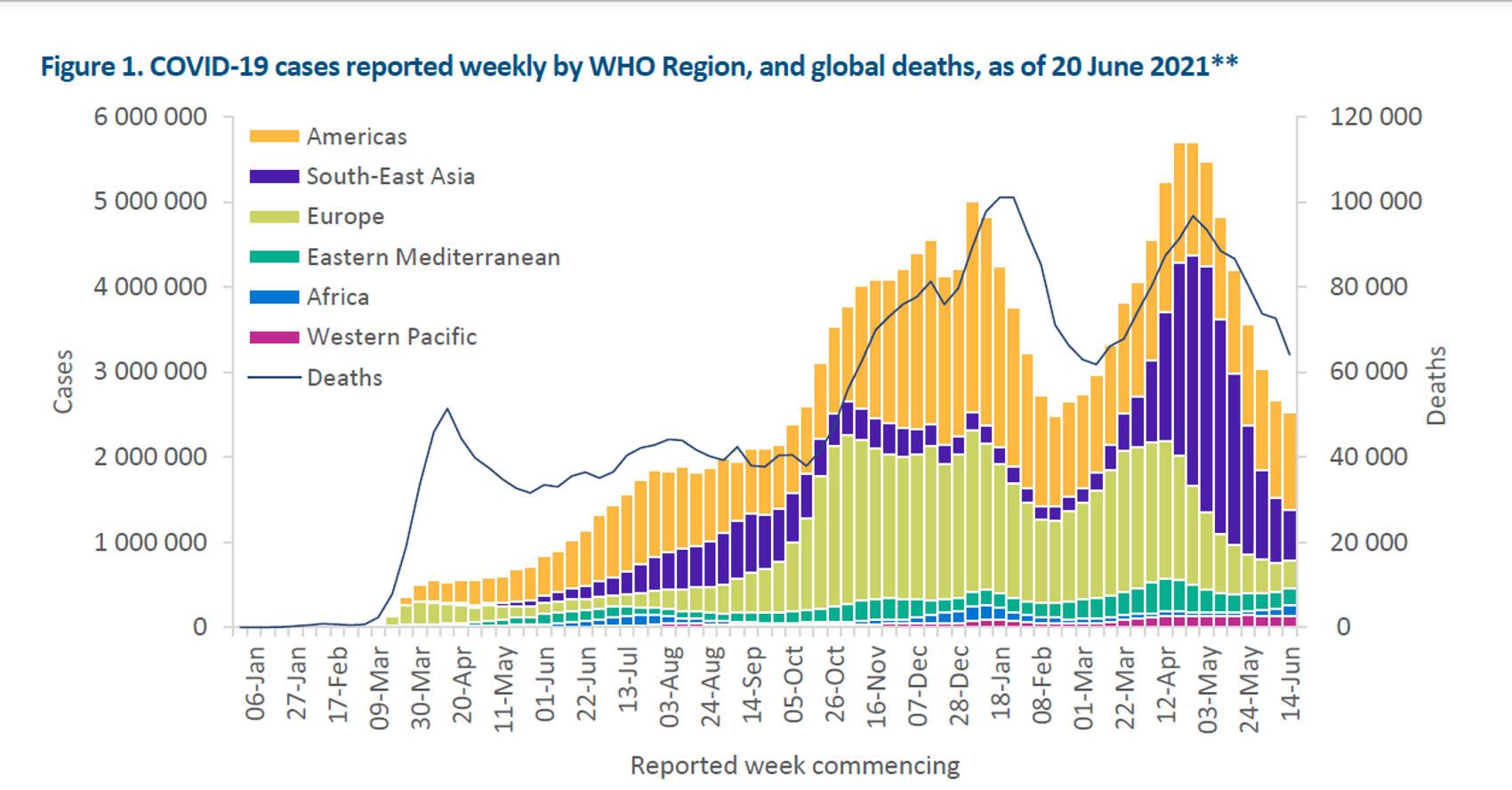
Global numbers of cases and deaths continued to decrease over the past week (14-20 June 2021) with just over 2.5 million new weekly cases and over 64 000 deaths, a 6% and a 12% decrease respectively, compared to the previous week. While the number of cases reported globally now exceeds 177 million, the lowest weekly case incidence since February 2021 was reported last week. Globally, mortality remains high with more than 9000 deaths reported each day over the past week, however, the number of new deaths reported in the past week decreased across all Regions except for the Eastern Mediterranean and the African Regions.
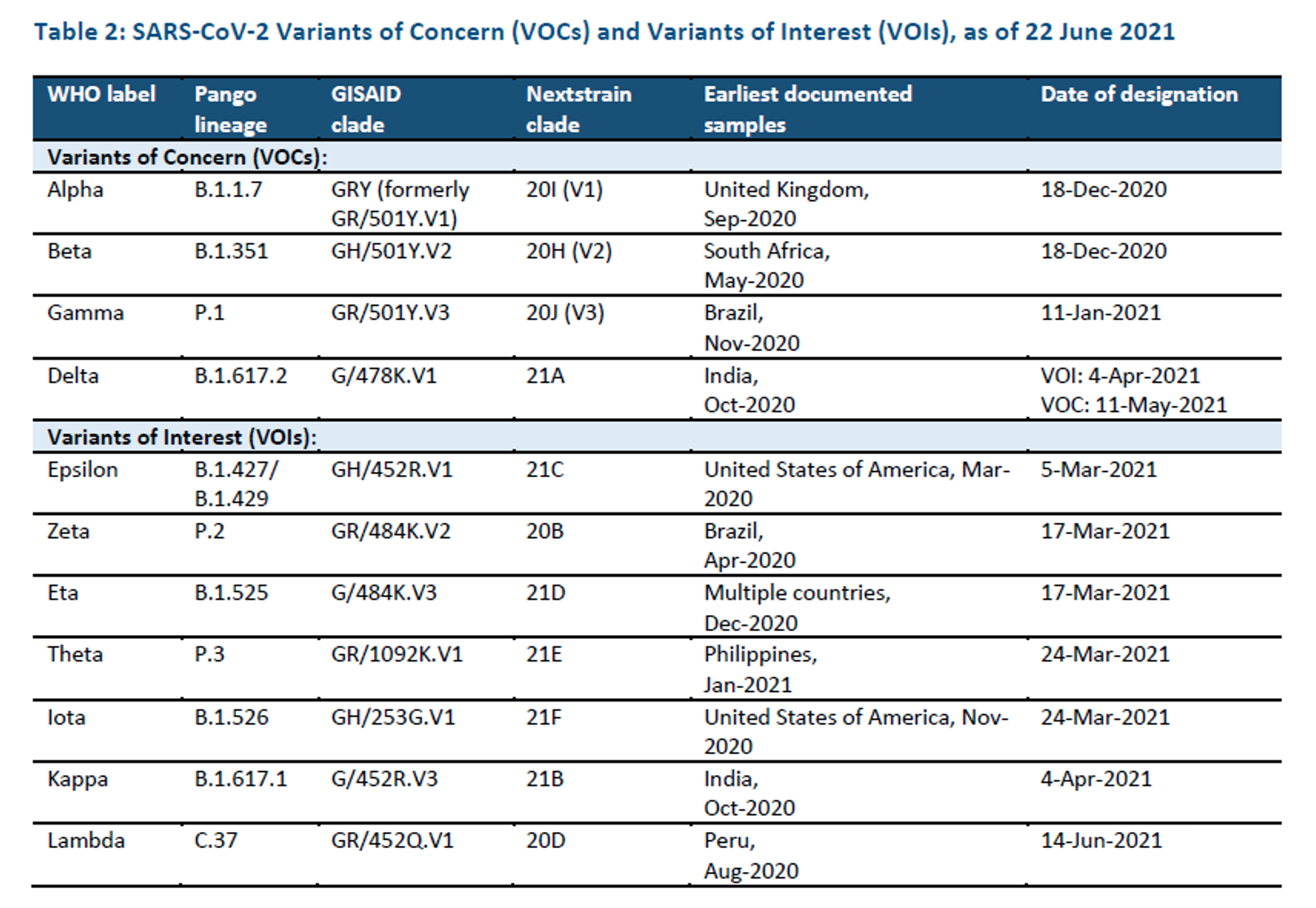
In this edition, a special focus update is provided on SARS-CoV-2 Variants of Interest (VOIs) and Variants of Concern (VOCs) Alpha (B.1.1.7), Beta (B.1.351), Gamma (P.1), and Delta (B.1.617.2). This includes updates on emerging evidence surrounding the phenotypic characteristics of VOCs (transmissibility, disease severity, risk of reinfection, and impacts on diagnostics and vaccine performance), as well as updates on the geographic distribution of VOCs.
This edition also includes a summary of a Global Consultation on SARS-CoV-2 Variants of Concern and their Impact on Public Health Interventions.

::::::
::::::

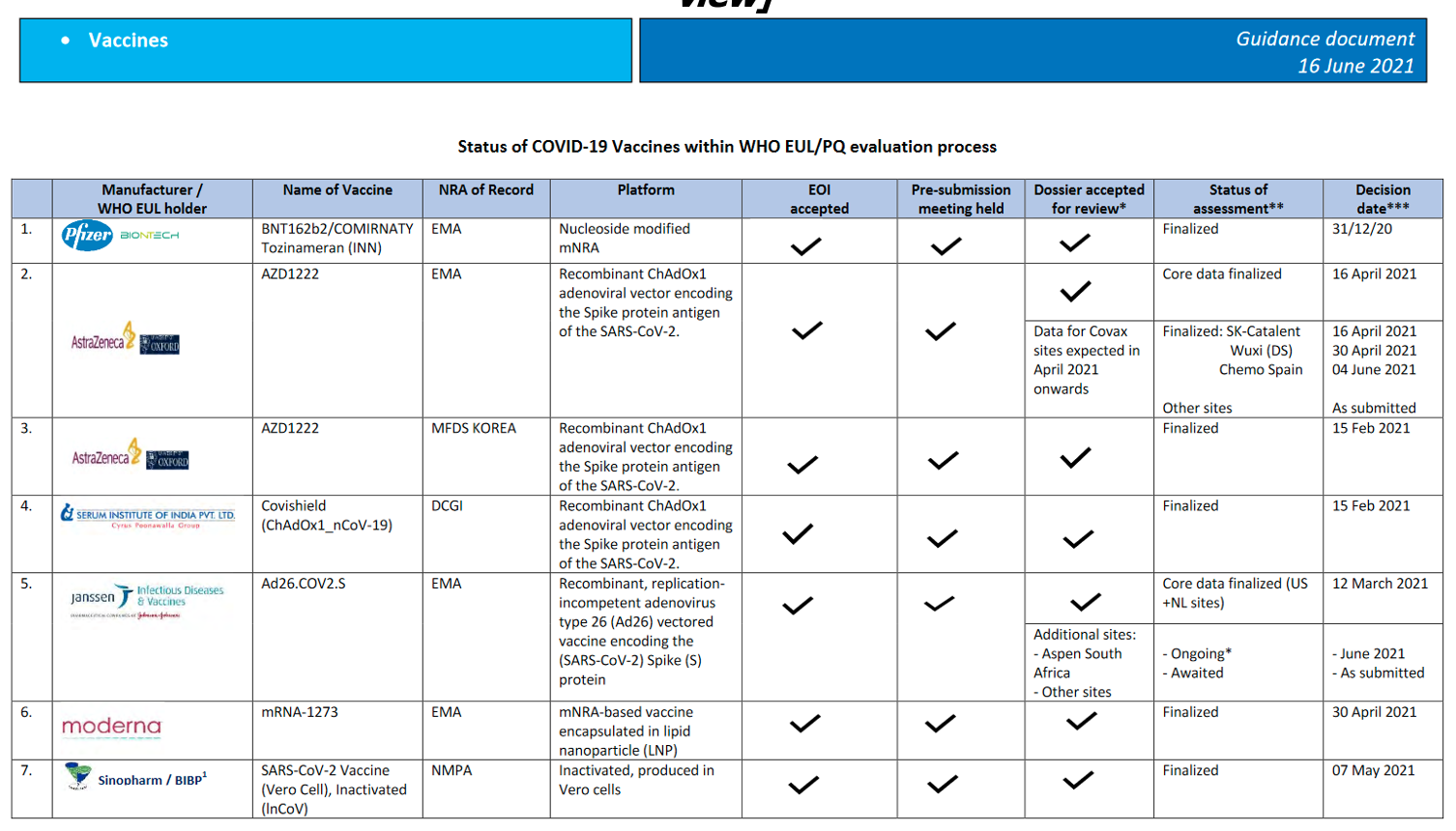
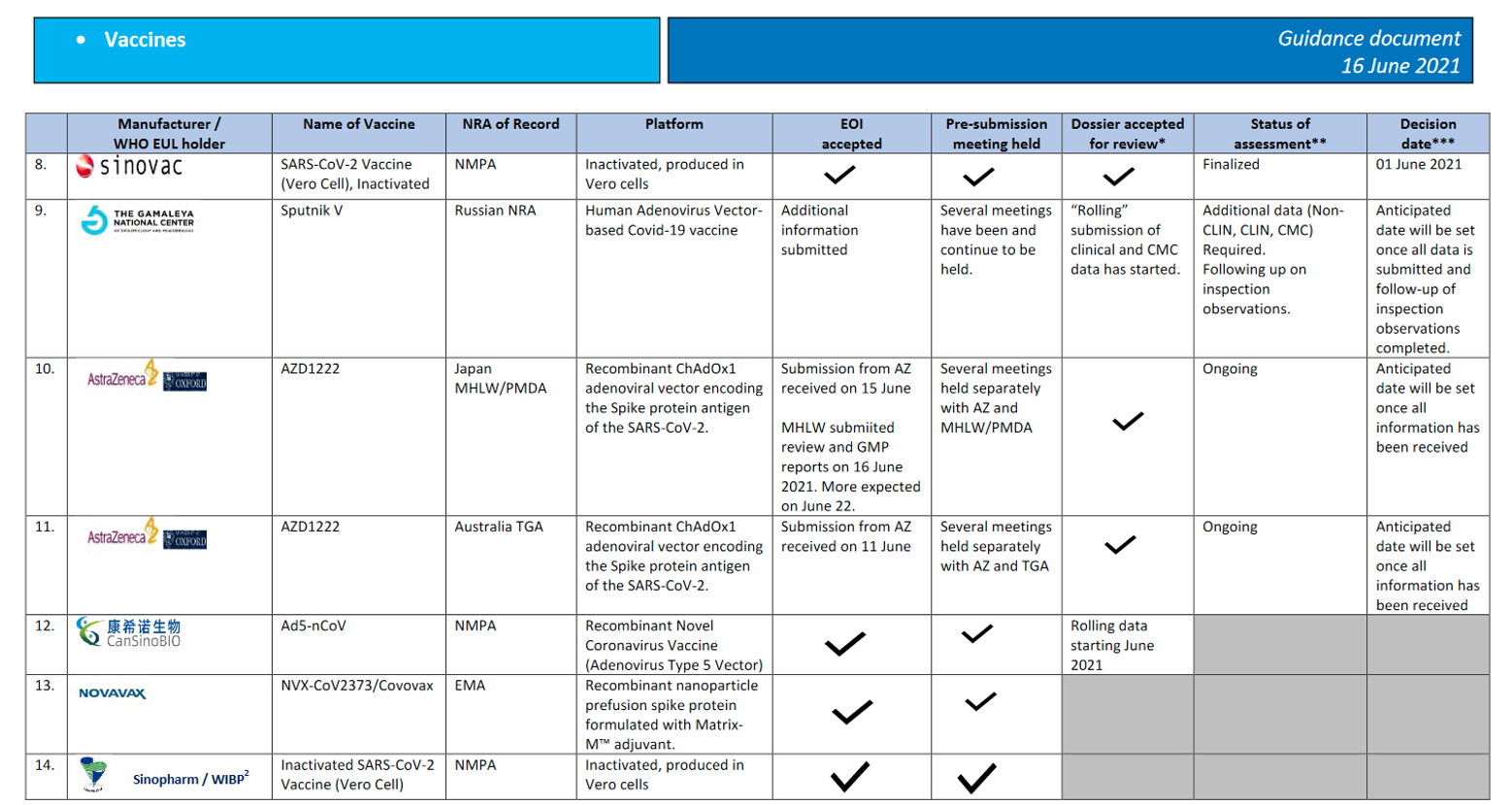
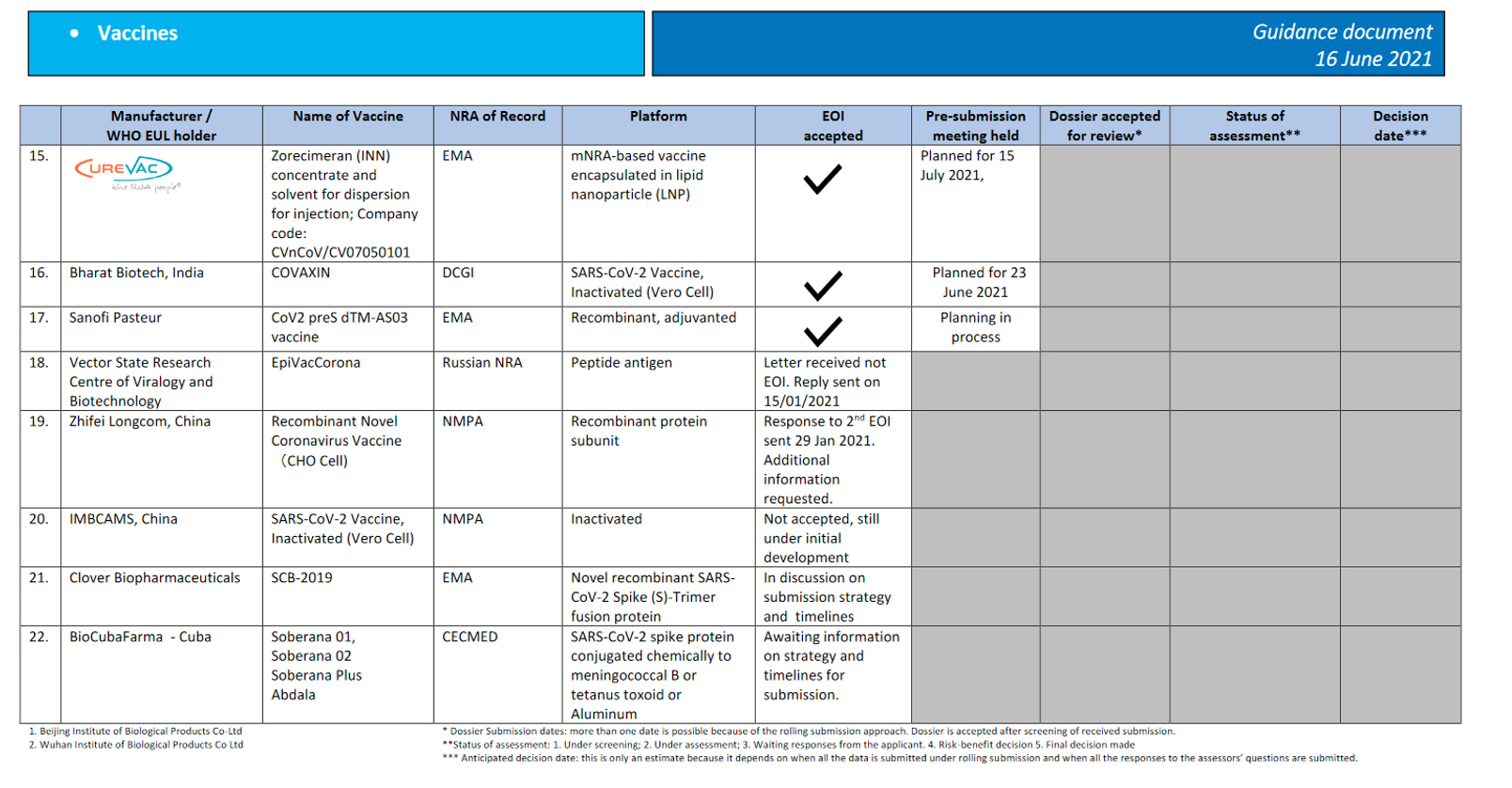
Status of COVID-19 Vaccines within WHO EUL/PQ evaluation process 26 June 2021
For 22 vaccine candidates, presents Manufacturer, Name of Vaccine, NRA of Record, Platform, EOI Accepted Status, Pre-submission Meeting Held Status, Dossier Accepted for Review, Status of Assessment; Anticipated/Completed Decision Date
[No update posted from 16 June 2021 data below; click on the link above for full scale view]

COVID Vaccine Developer/Manufacturer Announcements [relevant press releases/announcement from organizations from WHO EUL/PQ listing above]

Milestones :: Perspectives :: Research


COVID Vaccine Developer/Manufacturer Announcements [relevant press releases/announcement from organizations from WHO EUL/PQ listing above]


AstraZeneca
Press Releases – No new digest announcements identified

BioCubaFarma – Cuba
Últimas Noticias
La apuesta de Cuba por el desarrollo de vacunas propias contra la Covid19 tiene una experiencia de más de 30 años.
24/06/2021 23:27:18

[google translate: Cuba’s commitment to the development of its own vaccines against Covid19 has an experience of more than 30 years. 06/24/2021 11:27:18 PM]


CanSinoBIO
News
CanSinoBIO Announces Approval for Its Group A and Group C Meningococcal Conjugate Vaccine in China
2021-06-23

Clover Biopharmaceuticals – China
News – No new digest announcements identified


Curevac [Bayer Ag – Germany]
News Home – No new digest announcements identified


Gamaleya National Center
Latest News and Events – No new digest announcements identified [See Russia/RFID below]

IMBCAMS, China
Home – No new digest announcements identified


Janssen/JNJ
Press Releases – No new digest announcements identified


Moderna
Press Releases
June 22, 2021
European Commission Purchases Additional 150 Million Doses of Moderna’s COVID-19 Vaccine for Delivery in 2022


Novavax
Press Releases
Novavax Statement on Completion of the National Research Council of Canada Biologics Manufacturing Centre
Jun 22, 2021
The Honourable François-Philippe Champagne, Minister of Innovation, Science and Industry announced today that construction of the new Biologics Manufacturing Centre (BMC) at the National Research Council of Canada’s (NRC)’s Royalmount location in Montréal, Québec has been completed.
The partnership will enable the first manufacturing capabilities in Canada for a COVID-19 vaccine once the facility and NVX-CoV2373, Novavax’ recombinant nanoparticle protein-based COVID-19 vaccine candidate, receive the required Health Canada approvals. Novavax and the NRC are working closely together on technology transfer to establish the step-by-step process of producing NVX-CoV2373 at the BMC…


Pfizer
Recent Press Releases – No new digest announcements identified


Sanofi Pasteur
Press Releases
June 22 2021 Press releases
Sanofi and Translate Bio initiate Phase 1 clinical trial of mRNA influenza vaccine


Serum Institute of India
NEWS & ANNOUNCEMENTS – No corporate announcements identified
[Last media release April 21, 2021]


Sinopharm/WIBPBIBP
News – Website not responding at inquiry


Sinovac
Press Releases – No new digest announcements identified


Vector State Research Centre of Viralogy and Biotechnology
Home – No new digest announcements identified

Zhifei Longcom, China
[Anhui Zhifei Longcom Biologic Pharmacy Co., Ltd.]
[No website identified]


::::::

GSK
Press releases for media
New GSK to deliver step-change in growth and performance over next ten years driven by high-quality Vaccines and Specialty Medicines portfolio and late-stage pipeline
23 June 2021
Maximising Vaccines and Specialty Medicines
New GSK will prioritise R&D and commercial investment in Vaccines and Specialty Medicines, which are expected to grow to around three-quarters of company sales by 2026. As part of its 2021-26 outlook, Vaccines is expected to grow sales at a high single-digit % CAGR and Specialty Medicines at a double-digit % CAGR.
The company is focused across four core therapeutic areas (TAs): Infectious Diseases, HIV, Oncology and Immunology/Respiratory. In addition, New GSK will remain open to opportunities outside these core TAs where there are scale opportunities rooted in immune science and genetic validation.
Capturing the increasing opportunities now seen across the prevention and treatment of disease offers significant scientific and commercial opportunities for New GSK. At the heart of this is the company’s R&D focus on the science of the immune system, human genetics and advanced technologies; and its world-leading capabilities in vaccine and pharmaceutical development.
The company currently has a pipeline of 20 vaccines and 42 medicines – many of which are potential best or first in class opportunities…


SK Biosciences
Press releases
SK bioscience to Sign MOU with Andong and North Gyeongsang Province for Expansion of Factories and Sites
SK invested about 150 billion won in the expansion of existing vaccine manufacturing plants used for mRNA…
2021. 06. 21

Duke – Launch and Scale Speedometer

Milestones :: Perspectives :: Research


Duke – Launch and Scale Speedometer

TRACKING COVID-19 VACCINE PURCHASES ACROSS THE GLOBE
[accessed 26 June 2021]


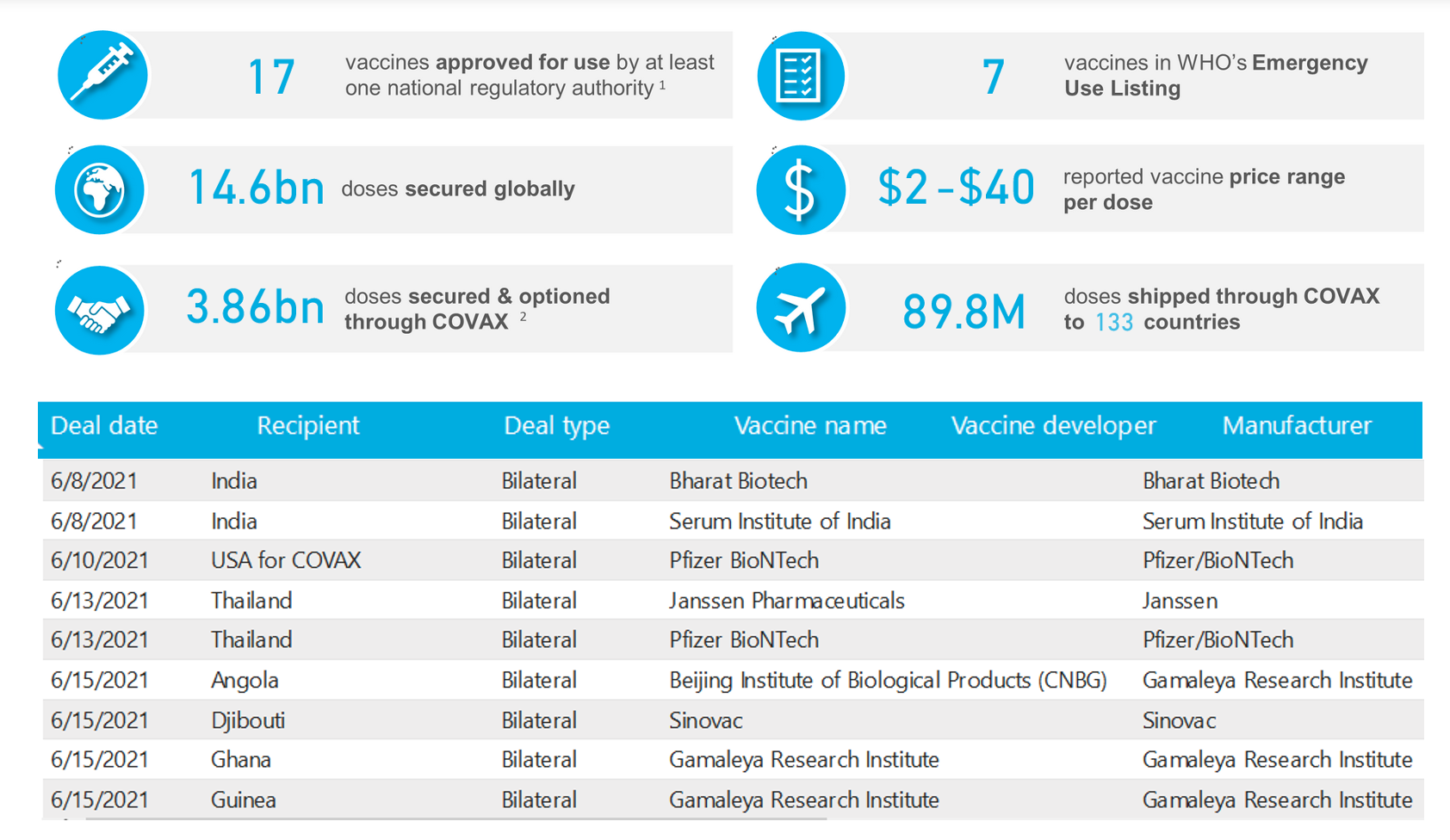
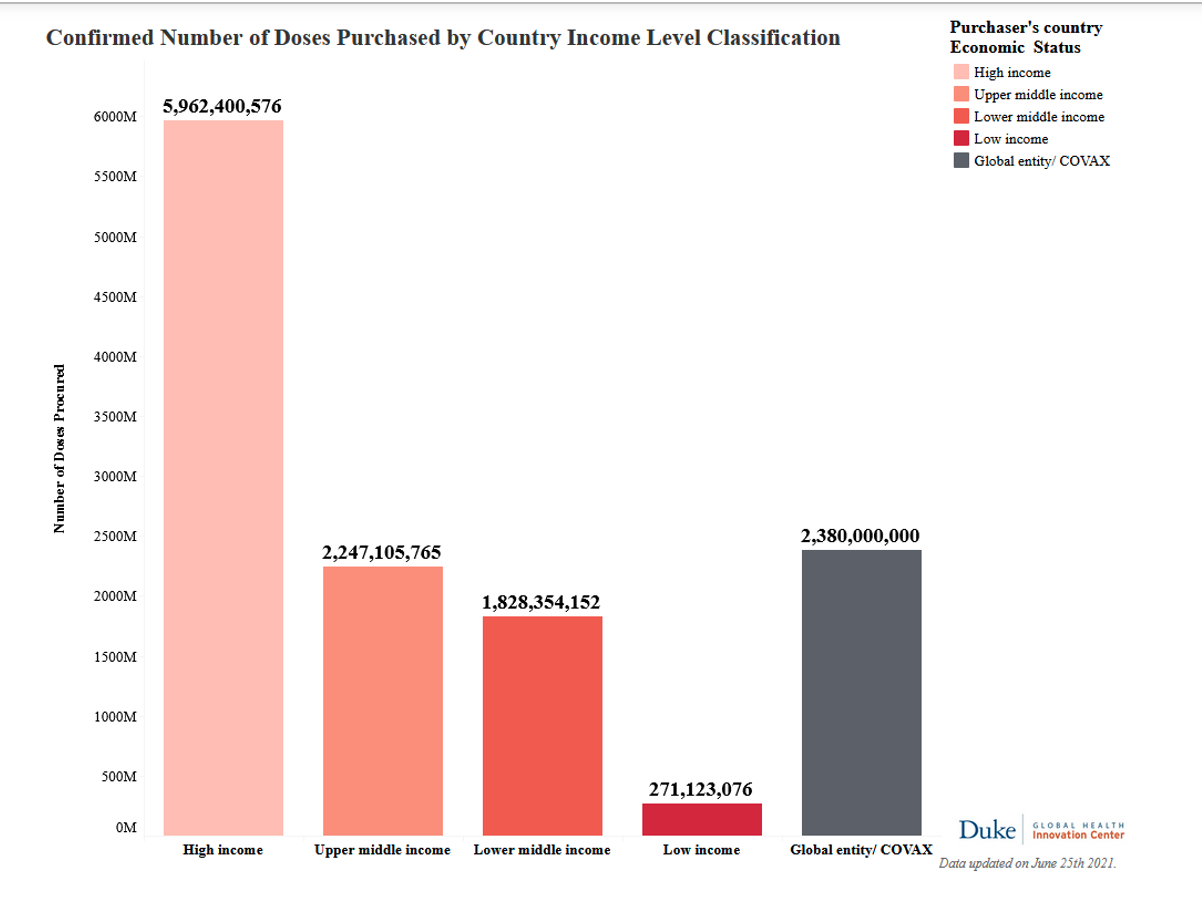
17.9 billion doses reserved
Countries have purchased vaccine doses from a wide pool of candidates to cover their populations. So far, confirmed purchases cover 11.9 billion doses, with another 6 billion doses currently under negotiation or reserved as optional expansions of existing deals…

High-income countries hedged their bets while low-income countries were left out
In 2020, many high-income countries hedged their bets by purchasing enough doses to vaccinate their populations several times over, even before any candidates were approved and have continued to procure more doses of approved vaccines in 2021, in an effort to receive doses as quickly as possible. Because of global manufacturing constraints, the direct deals made by high-income (and some middle-income) countries mean that a smaller piece of the pie is available for low- and middle-income countries and for equity-focused partnerships like COVAX in 2021…

U.S.: COVID-19 Vaccines – Announcements/Regulatory Actions/Deployment

Milestones :: Perspectives :: Research


U.S.: COVID-19 Vaccines – Announcements/Regulatory Actions/Deployment

Vaccines and Related Biological Products Advisory Committee
:: No meetings scheduled


::::::

White House [U.S.]
Briefing Room – Selected Major COVID Announcements
Remarks by President Biden Highlighting the Importance of Getting Vaccinated and Kicking Off a Community Canvassing Event
June 24, 2021 • Speeches and Remarks

Press Briefing by White House COVID-19 Response Team and Public Health Officials
June 22, 2021 • Press Briefings

Europe: COVID-19 Vaccines – Announcements/Regulatory Actions/Deployment

Milestones :: Perspectives :: Research


Europe: COVID-19 Vaccines – Announcements/Regulatory Actions/Deployment


European Medicines Agency
News & Press Releases
News: Additional manufacturing site for COVID-19 Vaccine Janssen (new)
CHMP, Last updated: 25/06/2021
… The site, located in Anagni, Italy, is operated by Catalent Anagni SRL. The site will perform finished product manufacturing.
The site is expected to support the continued supply of COVID-19 Vaccine Janssen in the European Union.
This recommendation does not require a European Commission decision and the site can become operational immediately.


News: Meeting highlights from the Committee for Medicinal Products for Human Use (CHMP) 21-24 June 2021 (new)
CHMP, Last updated: 25/06/2021


News: Two additional manufacturing sites for BioNTech/Pfizer’s COVID-19 vaccine (new)
CHMP, Last updated: 22/06/2021
… One site, located in Reinbek, Germany, is operated by Allergopharma GmbH & Co. KG. The other in Stein, Switzerland, is operated by Novartis Pharma. The sites will perform finished product manufacturing steps at different stages of the process.
The two new sites are expected to support the continued supply of Comirnaty in the European Union.
This recommendation does not require a European Commission decision and the sites can become operational immediately.


European Centre for Disease Prevention and Control
https://www.ecdc.europa.eu/en
Latest Updates
News
ECDC statement on the SARS-CoV-2 Delta variant in the EU/EEA
23 Jun 2021
ECDC publishes a threat assessment brief on the implications of the spread of the Delta variant of concern for the EU/EEA.
Dr. Andrea Ammon, ECDC Director:
Variants of SARS-CoV-2 are emerging at a significant rate worldwide. ECDC is constantly analysing the characteristics of these variants to rapidly inform public health authorities in the European Union. Some variants can put our efforts to control the pandemic at risk and require immediate actions.


Based on available scientific evidence, the Delta variant is more transmissible than other circulating variants and we estimate that by the end of August it will represent 90% of all SARS-CoV-2 viruses circulating in the European Union.

Unfortunately, preliminary data shows that it can also infect individuals that have received only one dose of the currently available vaccines. It is very likely that the Delta variant will circulate extensively during the summer, particularly among younger individuals that are not targeted for vaccination. This could cause a risk for the more vulnerable individuals to be infected and experience severe illness and death if they are not fully vaccinated.

The good news is that having received two doses of any of the currently available vaccines provides high protection against this variant and its consequences. However, about 30% of individuals older than 80 years and about 40% of individuals older than 60 years have not yet received a full vaccination course in the European Union.

There are still too many individuals at risk of severe COVID-19 infection whom we need to protect as soon as possible. Until most of the vulnerable individuals are protected, we need to keep the circulation of the Delta virus low by strictly adhering to public health measures, which worked for controlling the impact of other variants.

It is very important to progress with the vaccine roll-out at a very high pace. At this stage it becomes crucial that the second vaccination dose is administered within the minimum authorised interval from the first dose, to speed up the rate at which vulnerable individuals become protected. I am aware that it requires a significant effort from public health authorities and the society at large to achieve this goal. But now is the time to walk the extra mile. We have several safe and effective vaccines available and every single infection prevented now through our compliance with public health measures, is a life that can be saved by vaccination.


European Commission
https://ec.europa.eu/commission/presscorner/home/en
No new digest content identified

Africa: COVID-19 – Announcements/Regulatory Actions/Deployment

Milestones :: Perspectives :: Research


Africa: COVID-19 – Announcements/Regulatory Actions/Deployment

World Bank and African Union Team Up to Support Rapid Vaccination for Up to 400 million People in Africa
Working with countries and partners across Africa to quickly expand equitable access to vaccines
WASHINGTON, June 21, 2021— The African Finance Ministers and the World Bank Group met today to fast track vaccine acquisition on the continent and avoid a third wave. In a boost to the African Union’s target to vaccinate 60% of the continent’s population by 2022, the World Bank and the AU announced that they are partnering to support the Africa Vaccine Acquisition Task Team (AVATT) initiative with resources to allow countries to purchase and deploy vaccines for up to 400 million people across Africa.

This extraordinary regional effort complements COVAX and comes at a time of rising COVID-19 cases in the region. World Bank financing is available to support the purchase and deployment of doses secured by AVATT.

“The World Bank is very pleased to support African countries through this partnership with the African Union to quickly provide hundreds of millions of doses,” said World Bank Group President David Malpass. “Working together, we can expedite doses to countries and support deployment. Countries urgently need more pathways for acquiring vaccines that match their needs and have early delivery schedules.”

“As a result of this joint initiative between the World Bank and African institutions such as the Africa Import Export Bank and the Africa Centre for Disease Control, we now have the capacity to vaccinate at least 400 million people, or 30% of our population of 1.3 billion,” said Strive Masiyiwa, African Union Special Envoy and coordinator of the AVATT. “We really appreciate the extraordinary partnership on this initiative between the AU Vaccine Champion, HE President Cyril Ramaphosa, and David Malpass, the President of the World Bank.”…