COVAX Milestone
COVAX crosses milestone of 500 million donated doses shipped to 105 countries
:: COVAX has now shipped over 500 million donated doses to 105 countries
:: 31 countries have contributed to the effort, which accounts for nearly half of COVAX’s total shipments of over 1.1 billion doses – of which more than a billion have been distributed to lower-income economies supported through the Gavi Advance Market Commitment (Gavi COVAX AMC)
Geneva, 4 February 2022 – Over half a billion COVID-19 vaccines donated by high income countries have now been shipped to COVAX participating economies. The milestone, which was reached nine months after the first dose donations in April 2021 has seen the participation of 31 donors and benefited 105 countries.
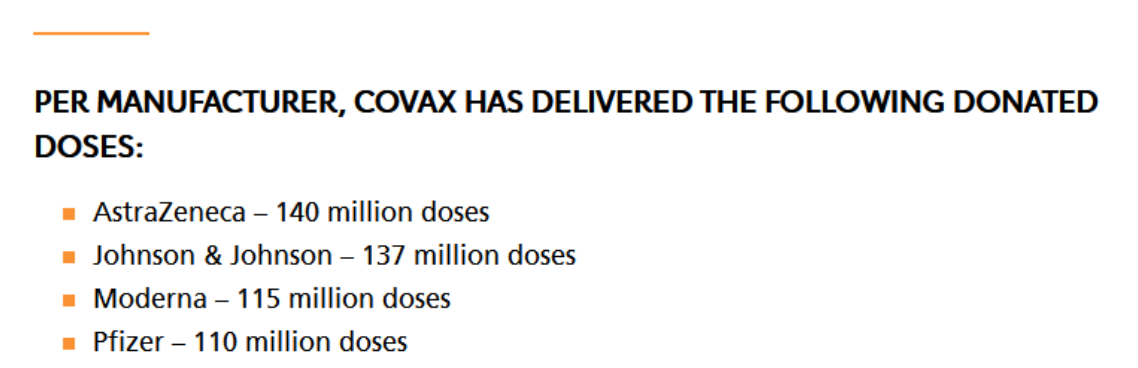
Donations gained speed at a time when global supply was severely constrained, and have played a major role in COVAX’s effort to ensure all countries have access to life-saving vaccines, accounting for nearly half of the 1.1 billion doses now delivered to participating economies (over 1 billion of those doses have gone to lower-income economies eligible for vaccines through the Gavi COVAX Advance Market Commitment, or Gavi COVAX AMC). Over 95% of the donated doses have been shipped to lower-income economies eligible for vaccines through the Gavi COVAX AMC, with over 45% shipped to the African continent. The design and operationalization of the COVAX dose sharing mechanism is being supported by a contribution of CAD 5 million from Canada.
Without dose donations, balanced across 4 suppliers, hundreds of millions of people would still be waiting for their first COVID-19 vaccination. As COVAX seeks to help all countries meet their national vaccination objectives in 2022 through tailored support, donations will continue to play an important role in our efforts.
“The COVAX dose donation programme has played an important role in helping us reach over 1.1 billion doses delivered to 144 countries. We now celebrate the milestone of 500 million donated doses shipped,” said Prof. José Manuel Barroso, Board Chair of Gavi, the Vaccine Alliance. “We thank Team Europe, the United States, the United Kingdom, Japan, Canada, Norway, Switzerland, Iceland, New Zealand and Hong Kong SAR, China for supporting COVAX’s goal of equitable access to life-saving COVID-19 vaccines.”

COVAX has funds and donated doses confirmed to achieve an average coverage level of 45% of the populations of 91 lower income economies by mid-2022 based on a two-dose vaccine regime. In order to ensure it has the flexibility to provide further assistance to countries, or respond to new needs, COVAX in January launched a call for at least an additional US$ 5.2 billion in new funding.
The money is needed urgently to resource a rapid response mechanism to finance at least 600 million doses Pandemic Vaccine Pool for use as and when needed by AMC countries to respond to demand for doses for effective coverage against new variants or boosters against waning immunity, support countries’ readiness and delivery efforts and pay for costs associated with rolling out more donated doses…
To continue the work on dose donations, we are today publishing revised dose sharing principles that COVAX uses to guide the donation process with donors and manufacturers. These update the principles published in December 2020.
:: A full list of dose donations and pledges can be found here.
:: The Investment Opportunity, entitled Break COVID Now, can be read here.
::::::
PRINCIPLES FOR SHARING COVID-19 VACCINE DOSES WITH COVAX
VERSION 2 03 FEBRUARY 2020
This document updates version 1 of the principles for dose sharing which were published in December 2020.
[Text bolding in black from original; Editor’s text bolding in red]
COVAX is a multilateral initiative to ensure fair and equitable access to COVID-19 vaccines for all countries regardless of wealth. Donors have contributed substantial funds to the Gavi COVAX Advance Market Commitment (AMC) to accelerate access to safe, efficacious, and early doses of COVID-19 vaccines, and these funds are the primary source of doses from COVAX for AMC eligible countries. However, acute supply constraints have severely limited the availability of doses in many countries and there is an urgent need for additional dose sharing that can be delivered immediately. Continued access to shared doses will enable these countries to further build their capacity to roll out vaccines and immunize their populations as soon as possible.
Given the urgent need to mobilise additional supply, the Facility has established a dose sharing mechanism. Dose sharing encompasses several different modalities, including dose donations from bilateral agreements between donors and manufacturers, donations by SFP countries of doses available pursuant to their SFP Commitment Agreement, and the donation of doses already under title and possession of a donor country. The Facility will continue to explore options to accept donated doses under various circumstances, as they align with its principles and goals. COVAX is also open to offers from donors that involves the Facility purchasing doses from the donor (i.e. dose resale) as long as the offer fits with the principles outlined below and helps to further COVAX’s goals of increasing supply equitably to Participants. Donors’ commitments to donate doses to the Facility are recorded here, with the first donated doses delivered in June 2021.
Dose donation through the Facility is the simplest and fastest way for donors to increase supply to COVAX. The Facility has a legal framework for dose donation with several manufacturers. It continues to evolve its processes to reduce transaction costs for all parties. Both donors and recipients will benefit from the sharing of doses through the Facility, using the Facility’s established procurement processes, and providing AMC eligible countries access to the No Fault Compensation Scheme.
The Facility retains the right to accept or refuse a donation offer based on the holistic value of the offer to increase vaccine supply to recipient countries while maintaining COVAX’s principles. The following principles for shared doses guide the Facility’s consideration of dose sharing offers:
1. Safe and effective: shared doses must be of assured quality with, at a minimum, WHO prequalification/emergency use listing or licensure/authorization from an SRA. Vaccine doses can be transferred to countries most rapidly if they are already in the COVAX Facility Portfolio; other vaccines could be shared when they are eligible to join the Portfolio.
2. Availability and visibility: shared doses should be made available as soon as possible to maximise impact. Pledges that have been made should be front-loaded according to demand and capacity in order to maximise impact. The Facility asks for as much lead time as possible on volume and timing of shared doses and will pool shared doses where possible to ensure equitable and informed allocation decisions and more efficient delivery. This provides recipient countries the opportunity to plan their immunisation programmes, which is essential to achieve high coverage.
3. Rapidly deployable: sharing of doses should be signaled as early as possible in the manufacturing process, with the dose-sharing country facilitating WHO authorizations, so that doses are shipped directly from the manufacturer with standard COVAX labelling and packaging, allowing rapid deployment and maximizing shelf-life. The Facility will not accept doses where the shelf-life at the time of delivery in country will be less than two and a half months. Where new agreements with a donor or manufacturer are needed, accepting standard templates will speed up agreements and reduce transaction costs for all parties, including recipients.
4. Flexibly deployable: doses should be allocated to the Facility to allow flexible deployment to meet Participants’ needs. To facilitate equitable access and in keeping with COVAX’s allocation mechanism, unearmarked doses are the standard. In limited and exceptional cases, the Facility may allow earmarking if requested by a donor country and when such earmarking does not impede the ability to allocate doses equitably. In such cases earmarking should be limited to “soft earmarking” across broad regions and/or a long list of countries. The Facility will allocate all doses according to the standard Fair Allocation criteria, taking into account absorptive capacity, readiness, the epidemiological situation, and logistics. Requests by donors to adjust country allocation decisions will not be accepted. Requirements by a donor to earmark may be a reason for the Facility to reject a dose sharing offer if the earmarking requirements do not allow adherence to the allocation principles.
While the Humanitarian Buffer will be primarily resourced through AMC funds, the Facility may determine, subject to the relevant legal agreements, that doses shared with the Facility can be used to meet the needs of populations served by the Buffer. As a result of the challenges of matching dose donations to applications to the Buffer, doses cannot be earmarked to the Buffer.
5. Cost-effective: The attractiveness of dose sharing offers will depend on the severity of supply constraints in the given context and other operational considerations. Shared doses should be in sufficient and predictable volumes, particularly where donors already have title to the doses, to have a substantive impact in achieving the goals of the Facility. Donated doses are fully paid for by the dose-donating country, and donors should also pay for ancillary costs to cover syringes, diluent, freight and the NFC. With respect to resale, the Facility will not pay any more than standard COVAX APA prices for a given vaccine.
COVAX welcomes further commitments by potential dose-sharing countries and manufacturers to these principles, which are in line with the overall principles of COVAX, and to partner with COVAX to provide additional doses for equitable distribution.
 vaccines and global health :: ethics and policy