New England Journal of Medicine
February 10, 2022 Vol. 386 No. 6
https://www.nejm.org/toc/nejm/medical-journal
Editorials
Molnupiravir — A Step toward Orally Bioavailable Therapies for Covid-19 R. Whitley
New England Journal of Medicine
February 10, 2022 Vol. 386 No. 6
https://www.nejm.org/toc/nejm/medical-journal
Editorials
Molnupiravir — A Step toward Orally Bioavailable Therapies for Covid-19 R. Whitley
PLoS Medicine
http://www.plosmedicine.org/
(Accessed 12 Feb 2022)
Information nudges for influenza vaccination: Evidence from a large-scale cluster-randomized controlled trial in Finland
Lauri Sääksvuori, Cornelia Betsch, Hanna Nohynek, Heini Salo, Jonas Sivelä, Robert Böhm
Research Article | published 09 Feb 2022 PLOS Medicine
https://doi.org/10.1371/journal.pmed.1003919
PLoS One
http://www.plosone.org/
[Accessed 12 Feb 2022]
Research Article
Perceptions of risk of SARS-CoV-2 transmission in social and educational activities by infectious diseases and general pediatric healthcare providers, a pre-vaccine risk perception cross-sectional survey
Andrew B. Janowski, Philip M. Polgreen, Susan E. Beekmann, Jason G. Newland
Research Article | published 11 Feb 2022 PLOS ONE
https://doi.org/10.1371/journal.pone.0263767
PLoS One
http://www.plosone.org/
[Accessed 12 Feb 2022]
Factors affecting intention to take COVID-19 vaccine among Pakistani University Students
Mosharop Hossian, Md Abdullah Saeed Khan, Anum Nazir, Mohammad Hayatun Nabi, Mehedi Hasan, Ramisha Maliha, Mohammad Ali Hossain, Md Utba Rashid, Nizwa Itrat, Mohammad Delwer Hossain Hawlader
Research Article | published 11 Feb 2022 PLOS ONE
https://doi.org/10.1371/journal.pone.0262305
PLoS One
http://www.plosone.org/
[Accessed 12 Feb 2022]
Attitudes towards influenza, and COVID-19 vaccines during the COVID-19 pandemic among a representative sample of the Jewish Israeli population
Yasmin Maor, Shaked Caspi
Research Article | published 11 Feb 2022 PLOS ONE
https://doi.org/10.1371/journal.pone.0255495
PLoS One
http://www.plosone.org/
[Accessed 12 Feb 2022]
A method for estimating the impact of new vaccine technologies on vaccination coverage rates
Ben Davis, Michael Krautmann, Pascale R. Leroueil
Research Article | published 10 Feb 2022 PLOS ONE
https://doi.org/10.1371/journal.pone.0263612
PLoS One
http://www.plosone.org/
[Accessed 12 Feb 2022]
Characterizing polarization in online vaccine discourse—A large-scale study
Bjarke Mønsted, Sune Lehmann
Research Article | published 09 Feb 2022 PLOS ONE
https://doi.org/10.1371/journal.pone.0263746
PLoS One
http://www.plosone.org/
[Accessed 12 Feb 2022]
Misinformation, believability, and vaccine acceptance over 40 countries: Takeaways from the initial phase of the COVID-19 infodemic
Karandeep Singh, Gabriel Lima, Meeyoung Cha, Chiyoung Cha, Juhi Kulshrestha, Yong-Yeol Ahn, Onur Varol
Research Article | published 09 Feb 2022 PLOS ONE
https://doi.org/10.1371/journal.pone.0263381
PLoS One
http://www.plosone.org/
[Accessed 12 Feb 2022]
The impact of the COVID-19 pandemic on scientific research in the life sciences
Massimo Riccaboni, Luca Verginer
Research Article | published 09 Feb 2022 PLOS ONE
https://doi.org/10.1371/journal.pone.0263001
PLoS One
http://www.plosone.org/
[Accessed 12 Feb 2022]
The impact of risk perceptions and belief in conspiracy theories on COVID-19 pandemic-related behaviours
Jack P. Hughes, Alexandros Efstratiou, Sara R. Komer, Lilli A. Baxter, Milica Vasiljevic, Ana C. Leite
Research Article | published 08 Feb 2022 PLOS ONE
https://doi.org/10.1371/journal.pone.0263716
PNAS – Proceedings of the National Academy of Sciences of the United States
January 11, 2022; vol. 119 no. 3
https://www.pnas.org/content/119/3
Biophysics and Computational Biology
Heterologous vaccination interventions to reduce pandemic morbidity and mortality: Modeling the US winter 2020 COVID-19 wave
Nathaniel Hupert, Daniela Marín-Hernández, Bo Gao, Ricardo Águas, and Douglas F. Nixon
PNAS January 18, 2022 119 (3) e2025448119; https://doi.org/10.1073/pnas.2025448119
PNAS – Proceedings of the National Academy of Sciences of the United States
January 11, 2022; vol. 119 no. 3
https://www.pnas.org/content/119/3
Psychological and Cognitive Sciences
Open Access
Politicians polarize and experts depolarize public support for COVID-19 management policies across countries
Alexandra Flores, Jennifer C. Cole, Stephan Dickert, Kimin Eom, Gabriela M. Jiga-Boy, Tehila Kogut, Riley Loria, Marcus Mayorga, Eric J. Pedersen, Beatriz Pereira, Enrico Rubaltelli, David K. Sherman, Paul Slovic, Daniel Västfjäll, and Leaf Van Boven
PNAS January 18, 2022 119 (3) e2117543119; https://doi.org/10.1073/pnas.2117543119
PNAS – Proceedings of the National Academy of Sciences of the United States
January 11, 2022; vol. 119 no. 3
https://www.pnas.org/content/119/3
Evolution
Open Access
Targeted vaccination and the speed of SARS-CoV-2 adaptation
Sylvain Gandon and Sébastien Lion
PNAS January 18, 2022 119 (3) e2110666119; https://doi.org/10.1073/pnas.2110666119
Public Health Reports
Volume 137 Issue 1, January/February 2022
https://journals.sagepub.com/toc/phrg/137/1
Commentary
Faith-Based Organizations and SARS-CoV-2 Vaccination: Challenges and Recommendations
Jeff Levin, PhD, MPH, Ellen L. Idler, PhD, Tyler J. VanderWeele, PhD
First Published October 25, 2021; pp. 11–16
Public Health Reports
Volume 137 Issue 1, January/February 2022
https://journals.sagepub.com/toc/phrg/137/1
Topical Review
Research Synthesis, HIV Prevention Response, and Public Health: CDC’s HIV/AIDS Prevention Research Synthesis Project
Linda J. Koenig, PhD, Cynthia M. Lyles, PhD, Darrel Higa, PhD, Mary M. Mullins, MSLS, Theresa A. Sipe, PhD, MPHfor the HIV/AIDS Prevention Research Synthesis Project
First Published February 26, 2021; pp. 32–47
Public Health Reports
Volume 137 Issue 1, January/February 2022
https://journals.sagepub.com/toc/phrg/137/1
Law and the Public’s Health
Adolescent Consent to COVID-19 Vaccination: The Need for Law Reform
Robert S. Olick, JD, PhD, Y. Tony Yang, ScD, LLM, MPH, Jana Shaw, MD, MPH
First Published September 21, 2021; pp. 163–167
Risk Management and Healthcare Policy
https://www.dovepress.com/risk-management-and-healthcare-policy-archive56
[Accessed 12 Feb 2022]
Original Research
Epidemiological Characteristics and Transmission Patterns of COVID-19 Cases Among Children and Adolescents Aged 0–18 Years in South Korea
Jang J, Hwang MJ, Kim YY, Park SY, Yoo M, Kim SS, Lee S, Kwon D
Published Date: 9 February 2022
Risk Management and Healthcare Policy
https://www.dovepress.com/risk-management-and-healthcare-policy-archive56
[Accessed 12 Feb 2022]
Original Research
Precise Community-Based Public Health Management: Crucial Experience Responding to COVID-19 in Wuhan, China
Ran L, Tan X, Zhang Y
Published Date: 9 February 2022
Science
Volume 375| Issue 6581| 11 Feb 2022
https://www.science.org/toc/science/current
Policy Forum
EU and US legislation seek to open up digital platform data
BY Brandie Nonnecke, Camille Carlton
10 Feb 2022: 610-612
Free
Constraints on data access must be addressed to facilitate research
Science
Volume 375| Issue 6581| 11 Feb 2022
https://www.science.org/toc/science/current
Reports
COVID mortality in India: National survey data and health facility deaths
BY Prabhat Jha, et al.
06 Jan 2022: 667-671
Open Access
India’s cumulative COVID deaths by September 2021 were six to seven times higher than reported officially.
Science
Volume 375| Issue 6581| 11 Feb 2022
https://www.science.org/toc/science/current
Neutralization of SARS-CoV-2 Omicron by BNT162b2 mRNA vaccine–elicited human sera
BY Alexander Muik […] Uğur Şahin
18 Jan 2022: 678-680
Open Access
Sera from individuals vaccinated with three doses of the Pfizer/BioNtech mRNA vaccine BNT162b2 can neutralize the SARS-CoV-2 Omicron variant.
Science Translational Medicine
Volume 14| Issue 631| 9 Feb 2022
https://www.science.org/toc/stm/current
Research Articles
Robust immune responses are observed after one dose of BNT162b2 mRNA vaccine dose in SARS-CoV-2–experienced individuals
BY Marie I. Samanovic, et al.
09 Feb 2022
Open Access
Prior history of COVID-19 enhances adaptive immune responses to mRNA vaccination.
Tropical Medicine & International Health
Volume 27, Issue 2 Pages: i-iv, 121-216 February 2022
https://onlinelibrary.wiley.com/toc/13653156/current
EDITORS’ CHOICE
Open Access
Environmentally sustainable practices in global health research and higher education institutions: Lessons from consultation with the TropEd Global Health institutions
Kate Whitfield, Alexandru Cretu, Teun Bousema, Justin Cohen
Pages: 122-128
First Published: 21 December 2021
Tropical Medicine & International Health
Volume 27, Issue 2 Pages: i-iv, 121-216 February 2022
https://onlinelibrary.wiley.com/toc/13653156/current
RESEARCH ARTICLES
Epidemiology of 4963 deaths associated with COVID-19 during three pandemic waves in a Latin American city with a high mortality rate, 2020–2021
Erika Viana-Cárdenas, Abel Triana, Humberto Mendoza, Emiro Buendia, Diego Viasus
Pages: 158-164
First Published: 07 December 2021
Tropical Medicine & International Health
Volume 27, Issue 2 Pages: i-iv, 121-216 February 2022
https://onlinelibrary.wiley.com/toc/13653156/current
Review of authorship for COVID-19 research conducted during the 2020 first-wave epidemic in Africa reveals emergence of promising African biomedical research and persisting asymmetry of international collaborations
Serge Tonen-Wolyec, Dieu-Merci Mbumba Lupaka, Salomon Batina-Agasa, François-Xavier Mbopi Keou, Laurent Bélec
Pages: 137-148
First Published: 05 January 2022
Tropical Medicine & International Health
Volume 27, Issue 2 Pages: i-iv, 121-216 February 2022
https://onlinelibrary.wiley.com/toc/13653156/current
REVIEWS
Open Access
Are national treatment guidelines for falciparum malaria in line with WHO recommendations and is antimalarial resistance taken into consideration? – A review of guidelines in non-endemic countries
Marc T. Visser, Rens Zonneveld, Thomas J. Peto, Michele van Vugt, Arjen M. Dondorp, Rob W. van der Pluijm
Pages: 129-136
First Published: 03 January 2022
Vaccine
Volume 40, Issue 4 Pages 555-690 (28 January 2022)
https://www.sciencedirect.com/journal/vaccine/vol/40/issue/4
Discussion Full text access
Mass vaccination campaign during the 2016 influenza outbreak in Panama: Challenges and implications for COVID-19 vaccination efforts
Franz Castro, Juan Miguel Pascale, Itzel Slocum Hewitt, Arlene Calvo
Pages 555-557
Vaccine
Volume 40, Issue 4 Pages 555-690 (28 January 2022)
https://www.sciencedirect.com/journal/vaccine/vol/40/issue/4
Short communication Full text access
Underserved population acceptance of combination influenza-COVID-19 booster vaccines
Robert P. Lennon, Ray Block, Eric C. Schneider, Laurie Zephrin, … Arnav Shah
Pages 562-567
Vaccine
Volume 40, Issue 4 Pages 555-690 (28 January 2022)
https://www.sciencedirect.com/journal/vaccine/vol/40/issue/4
Short communication Open access
Did the European suspension of the AstraZeneca vaccine decrease vaccine acceptance during the COVID-19 pandemic?
Michael Bang Petersen, Frederik Jørgensen, Marie Fly Lindholt
Pages 558-561
Vaccine
Volume 40, Issue 4 Pages 555-690 (28 January 2022)
https://www.sciencedirect.com/journal/vaccine/vol/40/issue/4
Research article Open access
Immunogenicity of the ChAdOx1 nCoV-19 vaccine against SARS-CoV-2 with 12-dose vials: An interim analysis
Anan Manomaipiboon, Uraporn Phumisantiphong, Jakravoot Maneerit, Yupin Chalearmchai, … Thananda Trakarnvanich
Pages 587-593
Vaccine
Volume 40, Issue 4 Pages 555-690 (28 January 2022)
https://www.sciencedirect.com/journal/vaccine/vol/40/issue/4
Research article Open access
Does a major change to a COVID-19 vaccine program alter vaccine intention? A qualitative investigation
Samantha J. Carlson, Lara McKenzie, Leah Roberts, Christopher C. Blyth, Katie Attwell
Pages 594-600
Vaccine
Volume 40, Issue 4 Pages 555-690 (28 January 2022)
https://www.sciencedirect.com/journal/vaccine/vol/40/issue/4
Research article Full text access
Levels and factors derived from the Health Action Process Approach of behavioral intentions to take up COVID-19 vaccination: A random population-based study
Yanqiu Yu, Wanru Jia, Mason M.C. Lau, Joseph T.F. Lau
Pages 612-620
Vaccine
Volume 40, Issue 4 Pages 555-690 (28 January 2022)
https://www.sciencedirect.com/journal/vaccine/vol/40/issue/4
Research article Abstract only
Childhood vaccination timeliness following maternal migration to an informal urban settlement in Kenya
Julia M. Porth, Abram L. Wagner, Emily Treleaven, Nancy L. Fleischer, … Matthew L. Boulton
Pages 627-639
Vaccine
Volume 40, Issue 4 Pages 555-690 (28 January 2022)
https://www.sciencedirect.com/journal/vaccine/vol/40/issue/4
Research article Open access
A non-inferiority trial comparing two killed, whole cell, oral cholera vaccines (Cholvax vs. Shanchol) in Dhaka, Bangladesh
Fahima Chowdhury, Afroza Akter, Taufiqur Rahman Bhuiyan, Imam Tauheed, … Firdausi Qadri
Pages 640-649
Vaccine
Volume 40, Issue 4 Pages 555-690 (28 January 2022)
https://www.sciencedirect.com/journal/vaccine/vol/40/issue/4
Research article Abstract only
Vaccine initiation and 3-dose series completion of 4vHPV vaccine among US insured males 2012–2016
Kandace L. Amend, Bruce Turnbull, Li Zhou, Morgan A. Marks, … John D. Seeger
Pages 682-688
Pre-Print Servers
Gates Open Research
https://gatesopenresearch.org/browse/articles
[Accessed 12 Feb 2022]
Research Article metrics AWAITING PEER REVIEW
Modeling anticipated changes in numbers of SARS-CoV-2 infections within communities due to immunization campaigns [version 1; peer review: awaiting peer review]
Kurt Frey, Brittany Hagedorn, Kevin A. McCarthy, Raymond Hutubessy, Susan Annemarie Wang
Peer Reviewers Invited
Funder
Global Good Fund
PUBLISHED 09 Feb 2022
medRxiv
https://www.medrxiv.org/content/about-medrxiv
medRxiv is a free online archive and distribution server for complete but unpublished manuscripts (preprints) in the medical, clinical, and related health sciences. Preprints are preliminary reports of work that have not been certified by peer review. They should not be relied on to guide clinical practice or health-related behavior and should not be reported in news media as established information. medRxiv is for the distribution of preprints – complete but unpublished manuscripts – that describe human health research conducted, analyzed, and interpreted according to scientific principles…
Impact of COVID-19 pandemic and anti-pandemic measures on tuberculosis, viral hepatitis, HIV/AIDS and malaria – a systematic review
Barbora Kessel, Torben Heinsohn, Jördis J Ott, Jutta Wolff, Max J Hassenstein, Berit Lange
medRxiv 2022.02.10.22270782; doi: https://doi.org/10.1101/2022.02.10.22270782
Fundamental limits on inferring epidemic resurgence in real time using effective reproduction numbers
Kris V Parag, Christl A. Donnelly
medRxiv 2021.09.08.21263270; doi: https://doi.org/10.1101/2021.09.08.21263270
SARS-CoV-2 neutralization after mRNA vaccination and variant breakthrough infection
Christian Gaebler, Justin DaSilva, Eva Bednarski, Frauke Muecksch, Fabian Schmidt, Yiska Weisblum, Katrina Millard, Martina Turroja, Alice Cho, Zijun Wang, Marina Caskey, Michel C. Nussenzweig, Paul Bieniasz, Theodora Hatziioannou
medRxiv 2022.02.09.22270692; doi: https://doi.org/10.1101/2022.02.09.22270692
Long term antibody response to SARS-CoV-2 in children
Gabor A. Dunay, Madalena Barroso, Mathias Woidy, Marta K. Danecka, Geraldine Engels, Katharina Hermann, Friederike S. Neumann, Kevin Paul, Jan Beime, Gabriele Escherich, Kristin Fehse, Lev Grinstein, Franziska Haniel, Luka J. Haupt, Laura Hecher, Torben Kehl, Christoph Kemen, Markus J. Kemper, Robin Kobbe, Aloisa Kohl, Thomas Klokow, Dominik Noerz, Jakob Olfe, Friderike Schlenker, Jessica Schmiesing, Johanna Schrum, Freya Sibbertsen, Philippe Stock, Stephan Tiede, Eik Vettorazzi, Dimitra E. Zazara, Antonia Zapf, Marc Luetgehetmann, Jun Oh, Thomas S. Mir, Ania C. Muntau, C19.CHILD Study Group, Soeren W. Gersting
medRxiv 2022.02.11.22270611; doi: https://doi.org/10.1101/2022.02.11.22270611
COVID-19 vaccine hesitancy in diverse groups in the UK – is the driver economic or cultural in student populations?
Francis Drobniewski, Dian Kusuma, Agnieszka Broda, Enrique Castro-Sanchez, Raheelah Ahmad
medRxiv 2021.12.14.21267773; doi: https://doi.org/10.1101/2021.12.14.21267773
Ethnic disparities in immunisation: analyses of zero-dose prevalence in 64 low- and middle-income countries
Bianca Oliveira Cata-Preta, Thiago Melo Santos, Andrea Wendt, Daniel R Hogan, Tewodaj Mengistu, Aluisio Jardim Dornellas Barros, Cesar Gomes Victora
medRxiv 2022.02.09.22270671; doi: https://doi.org/10.1101/2022.02.09.22270671
Abstract
Background The Sustainable Development Goals (SDGs) recommend stratification of health indicators by ethnic group, yet there are few studies that have assessed if there are ethnic disparities in childhood immunisation in low and middle income countries (LMICs).
Methods We identified 64 LMICs with standardized national surveys carried out since 2010, which provided information on ethnicity or a proxy variable and on vaccine coverage; 339 ethnic groups across the 64 countries were identified after excluding those with fewer than 50 children in the sample and countries with a single ethnic group. Lack of vaccination with diphtheria-pertussis-tetanus (DPT) vaccine, a proxy for no access to routine vaccination or zero-dose status, was the outcome of interest. Differences among ethnic groups were assessed using a chi-squared test for heterogeneity. Additional analyses controlled for household wealth, maternal education and urban-rural residence.
Findings The median gap between the highest and lowest zero-dose prevalence ethnic groups in all countries was equal to 10 percentage points (interquartile range 4-22; range 1 to 84) and the median ratio was 3.3 (interquartile range 1.8-6.7; range 1.1-30.4). In 35 of the 64 countries, there was significant heterogeneity in zero-dose prevalence among the ethnic groups. In most countries, adjustment for wealth, education and residence made little difference to the ethnic gaps, but in four countries (Angola, Benin, Nigeria, and Philippines) the high-low ethnic gap decreased by over 15 pp after adjustment. Children belonging to a majority group had 29% lower prevalence of zero-dose compared to the rest of the sample.
Interpretation Statistically significant ethnic disparities in child immunisation were present in over half of the countries studied. Such inequalities have been seldom described in the published literature. Regular analyses of ethnic disparities are essential for monitoring trends, targeting resources and assessing the impact of health interventions to ensure zero-dose children are not left behind in the Sustainable Development Goals era.
How many relevant SARS-CoV-2 variants might we expect in the future?
Roberto Littera, Maurizio Melis
medRxiv 2021.11.17.21266463; doi: https://doi.org/10.1101/2021.11.17.21266463
Safety and Efficacy of Preventative COVID Vaccines: The StopCoV Study
Sharon Walmsley, Leah Szadkowski, Bradly Wouters, Rosemarie Clarke, Karen Colwill, Paula Rochon, Michael Brudno, Rizani Ravindran, Janet Raboud, Allison McGeer, Amit Oza, Christopher Graham, Amanda Silva, Dorin Manase, Laura Parente, Jacqueline Simpson, Roaya Monica Dayam, Adrian Pasculescu, Anne-Claude Gingras
medRxiv 2022.02.09.22270734; doi: https://doi.org/10.1101/2022.02.09.22270734
Model-based estimates of deaths averted and cost per life saved by scaling-up mRNA COVID-19 vaccination in low and lower-middle income countries in the COVID-19 Omicron variant era
Alexandra Savinkina, Alyssa Bilinski, Meagan C. Fitzpatrick, A. David Paltiel, Zain Rizvi, Joshua A. Salomon, Tommy Thornhill, Gregg Gonsalves
medRxiv 2022.02.08.22270465; doi: https://doi.org/10.1101/2022.02.08.22270465
[See Featured Journal Articles above for detail]
A recombinant BCG-based vaccine against the human respiratory syncytial virus induces a balanced cellular immune response against viral and mycobacterial antigens
Gaspar A. Pacheco, Nicolás M. S. Gálvez, Catalina A. Andrade, Yaneisi Vázquez, Linmar Rodríguez-Guilarte, Pablo A. González, Susan M. Bueno, Alexis M. Kalergis
medRxiv 2022.02.07.22270648; doi: https://doi.org/10.1101/2022.02.07.22270648
Clinical and Economic Impact of COVID-19 on Plantation Workers: Preliminary Results from the Guatemala Agricultural Workers and Respiratory Illness Impact (AGRI) Study
Daniel Olson, Diva M. Calvimontes, Molly M. Lamb, Gerber Guzman, Edgar Barrios, Andrea Chacon, Neudy Rojop, Kareen Arias, Melissa Gomez, Guillermo Antonio Bolanos, Jose Monzon, Anna N. Chard, Chelsea Iwamoto, Lindsey M. Duca, Nga Vuong, Melissa Fineman, Kelsey Lesteberg, David Beckham, Mario L. Santiago, Kendra Quicke, Gregory Ebel, Emily Zielinski Gutierrez, Eduardo Azziz-Baumgartner, Frederick G. Hayden, Hani Mansour, Kathryn Edwards, Lee S. Newman, Edwin J. Asturias
medRxiv 2022.02.07.22270274; doi: https://doi.org/10.1101/2022.02.07.22270274
A “step too far” or “perfect sense”? A qualitative study of British adults’ views on mandating COVID-19 vaccination and vaccine passports
Martine Stead, Allison Ford, Douglas Eadie, Hannah Biggs, Claire Elliott, Michael Ussher, Helen Bedford, Kathryn Angus, Kate Hunt, Anne Marie MacKintosh, Curtis Jessop, Andy MacGregor
medRxiv 2022.02.07.22270458; doi: https://doi.org/10.1101/2022.02.07.22270458
Time to reinfection and vaccine breakthrough SARS-CoV-2 infections: a retrospective cohort study
Sevda Molani, Andrew M. Baumgartner, Yeon Mi Hwang, Venkata R. Duvvuri, Jason D. Goldman, Jennifer J. Hadlock
medRxiv 2022.02.07.22270613; doi: https://doi.org/10.1101/2022.02.07.22270613
Effectiveness of Covid-19 Vaccines against the SARS-COV-2-Delta (B.1.617.2) in China-A Real World Study
Xinge Ma, Jianfeng Han, Hongxia Li, Chang Liu
medRxiv 2022.02.07.22270490; doi: https://doi.org/10.1101/2022.02.07.22270490
Wellcome Open Research [to 12 Feb 2022]
https://wellcomeopenresearch.org/browse/articles
[Accessed 12 Feb 2022]
Wellcome Open Research provides all Wellcome researchers with a place to rapidly publish any results they think are worth sharing. All articles benefit from rapid publication, transparent peer review and editorial guidance on making all source data openly available.
Research Article metrics AWAITING PEER REVIEW
Impact of the COVID-19 pandemic on routine surveillance for adults with chronic hepatitis B virus (HBV) infection in the UK [version 1; peer review: awaiting peer review]
Cori Campbell, Tingyan Wang, David A. Smith, Oliver Freeman, Theresa Noble, Kinga A Várnai, Steve Harris, Hizni Salih, Gail Roadknight, Stephanie Little, Ben Glampson, Luca Mercuri, Dimitri Papadimitriou, Christopher R Jones, Vince Taylor, Afzal Chaudhry, Hang Phan, Florina Borca, Josune Olza, Frazer Warricker, Luis Romão, David Ramlakhan, Louise English, Paul Klenerman, Monique I. Andersson, Jane Collier, Eleni Nastouli, Salim I. Khakoo, William Gelson, Graham S. Cooke, Kerrie Woods, Jim Davies, Eleanor Barnes, Philippa C. Matthews
Peer Reviewers Invited
Funders
Wellcome Trust
GlaxoSmithKline
NIHR Oxford Biomedical Research Centre
PUBLISHED 11 Feb 2022
Research Article metrics AWAITING PEER REVIEW
Public attitudes to a human challenge study with SARS-CoV-2: a mixed-methods study [version 1; peer review: awaiting peer review]
Caroline Barker, Katharine Collet, Diane Gbesemete, Maria Piggin, Daniella Watson, Philippa Pristerà, Wendy Lawerence, Emma Smith, Michael Bahrami-Hessari, Halle Johnson, Katherine Baker, Ambar Qavi, Carmel McGrath, Christopher Chiu, Robert C. Read, Helen Ward
Peer Reviewers Invited
Funders
Wellcome
GCRF Networks in Vaccines Research and Development
National Institute of Health Research
PUBLISHED 10 Feb 2022
Open Letter metrics
Revised
Towards a feminist philosophy of engagements in health-related research [version 2; peer review: 2 approved]
Sonja Erikainen, Ellen Stewart, Angela Marques Filipe, Sarah Chan, Sarah Cunningham-Burley, Sophie Ilson, Gabrielle King, Carol Porteous, Stephanie Sinclair, Jamie Webb
Peer Reviewers Mary Madden; Kieran C. O’Doherty
Funder
Wellcome Trust
LATEST VERSION PUBLISHED 10 Feb 2022
Open Letter metrics AWAITING PEER REVIEW
A network of empirical ethics teams embedded in research programmes across multiple sites: opportunities and challenges in contributing to COVID-19 research and responses [version 1; peer review: awaiting peer review]
Nothando Ngwenya, Jennifer Ilo Van Nuil, Deborah Nyirenda, Mary Chambers, Phaik Yeong Cheah, Janet Seeley, Primus Chi, Lindiwe Mafuleka, Busisiwe Nkosi, Dorcas Kamuya, Alun Davies, Mira Leonie Schneiders, Noni Mumba, Siphephelo Dlamini, Nicola Desmond, Vicki Marsh, Dinnah Rippon, Michael Parker, Sassy Molyneux
Peer Reviewers Invited
Funder
Wellcome Trust
PUBLISHED 10 Feb 2022
Abstract
Covid-19 continues to teach the global community important lessons about preparedness for research and effective action to respond to emerging health threats. We share the COVID-19 experiences of a pre-existing cross-site ethics network-the Global Health Bioethics Network-which brings together researchers and practitioners from Africa, Europe, and South east Asia. We describe the network and its members and activities, and the work-related opportunities and challenges we faced over a one-year period during the pandemic. We highlight the value of having strong and long-term empirical ethics networks embedded across diverse research institutions to be able to: 1) identify and share relevant ethics challenges and research questions and ways of ’doing research’; 2) work with key stakeholders to identify appropriate ways to contribute to the emerging health issue response – e.g. through ethics oversight, community engagement, and advisory roles at different levels; and 3) learn from each other and from diverse contexts to advocate for positive change at multiple levels. It is our view that being both embedded and long term offers particular opportunities in terms of deep institutional and contextual knowledge and relationships with and access to a wide range of stakeholders in place. Being networked offers opportunities to draw upon a wide range of expertise and perspectives operating at multiple levels, and to bring together internal and external perspectives (i.e. different positionalities). Long term funding means that the people and resources are in place and ready to respond in a timely way. However, many tensions and challenges remain, including difficulties in negotiating power and politics regarding roles that researchers and research institutions play in an emergency, and the position of empirical ethics activities in programmes of research more specifically. We discuss some of these tensions and challenges, and consider the implications for our own and similar networks in future.
Think Tanks
Brookings
http://www.brookings.edu/
Accessed 12 Feb 2022
Future Development
Why global vaccine equity is the prescription for a full recovery
Indermit Gill and Michele Ruta
Friday, February 11, 2022
Testimony
Improving access to quality public education in Africa
Rebecca Winthrop
Friday, February 11, 2022
Center for Global Development [to 12 Feb 2022]
https://www.cgdev.org/
Accessed 12 Feb 2022
COVID-19 Vaccine Development and Rollout in Historical Perspective
Publication
February 9, 2022
This paper explores the historical record in the development and deployment of vaccines globally and puts the COVID-19 vaccine rollout in that context. Although far more can be done and should be done to speed equitable access to vaccines in the COVID-19 response, it is worth noting the revolutionary speed of both the vaccine development and the diffusion process, and the potential good news that this signals for the future of pandemic preparedness and response.
New Study: COVID-19 Vaccine Rollout Fastest in Global History
February 9, 2022
WASHINGTON—The COVID-19 vaccine rollout so far has been the fastest in global history and unprecedented in scale, according to a new study released today from the Center for Global Development, which also emphasized the considerable global inequality in access to vaccines to date.
Researchers at the global think tank assessed how vaccines have been developed and deployed against 15 older infectious diseases and compared those efforts to the response to COVID-19.
The COVID-19 Vaccine Rollout Was the Fastest in Global History, but Low-Income Countries Were Left Behind
February 9, 2022
The reaction to COVID-19 has been record-breaking. Today we release a paper that reports on the development and rollout of COVID-19 vaccines in historical perspective, and it suggests a pattern of unparalleled, but still deeply inequitable, progress.
Amanda Glassman, Charles Kenny and George Yang
The Vaccine Mark-Up: Counting More in ODA than We Paid for Vaccines is Illogical, Immoral, and Unpopular
February 7, 2022
Someone in a high-income country is 11x more likely to have been fully inoculated than someone in a low-income country. We set out here how the OECD plans to count COVID vaccines, why this reduces the UK’s overall spending on ODA, and how MPs think we should count them.
Euan Ritchie, Anthony McDonnell and Ranil Dissanayake
Chatham House [to 12 Feb 2022]
https://www.chathamhouse.org/
Accessed 12 Feb 2022
[No new digest content identified]
CSIS
https://www.csis.org/
Accessed 12 Feb 2022
Commentary
China May Move beyond Zero-Covid. That Could Benefit Us All.
February 9, 2022 | By J. Stephen Morrison, Scott Kennedy
Kaiser Family Foundation
https://www.kff.org/search/?post_type=press-release
Accessed 12 Feb 2022
February 10, 2022 News Release
Telehealth Accounted for 8% of Outpatient Visits More Than a Year into COVID-19 Pandemic, Suggesting a More Permanent Shift in How Patients Receive Care
Telehealth use skyrocketed during the early months of the pandemic. While it has since decreased somewhat from that high, it still represents a much more substantial share of health care than before COVID, a new KFF-Epic Research analysis finds. From March through August 2021, 8% of all outpatient visits were…
Vaccines and Global Health: The Week in Review is a weekly digest summarizing news, events, announcements, peer-reviewed articles and research in the global vaccine ethics and policy space. Content is aggregated from key governmental, NGO, international organization and industry sources, key peer-reviewed journals, and other media channels. This summary proceeds from the broad base of themes and issues monitored by the Center for Vaccine Ethics & Policy in its work: it is not intended to be exhaustive in its coverage. You are viewing the blog version of our weekly digest, typically comprised of between 30 and 40 posts below all dated with the current issue date
.– Request an Email Summary: Vaccines and Global Health : The Week in Review is published as a single email summary, scheduled for release each Saturday evening before midnight (EDT in the U.S.). If you would like to receive the email version, please send your request to david.r.curry@centerforvaccineethicsandpolicy.org.
– pdf version: A pdf of the current issue is available here:
– blog edition: comprised of the approx. 35+ entries posted below.
– Twitter: Readers can also follow developments on twitter: @vaxethicspolicy.
.
– Links: We endeavor to test each link as we incorporate it into any post, but recognize that some links may become “stale” as publications and websites reorganize content over time. We apologize in advance for any links that may not be operative. We believe the contextual information in a given post should allow retrieval, but please contact us as above for assistance if necessary.
Support this knowledge-sharing service: Your financial support helps us cover our costs and to address a current shortfall in our annual operating budget. Click here to donate and thank you in advance for your contribution.
.
David R. Curry, MS
Executive Director
Center for Vaccine Ethics and Policy
Vaccines: The Week in Review
UNICEF Leadership
Catherine Russell assumes functions as new UNICEF Executive Director
NEW YORK, 1 February 2022 – Catherine Russell took office today as UNICEF’s new Executive Director, becoming the fourth woman to lead the organization in its 75-year history.
“It is an honor and a privilege to join UNICEF and help lead its remarkable work for children at such a crucial moment,” said Russell. “At a time when millions of children globally are still reeling from the impact of the COVID pandemic and other crises, UNICEF is leading the call to protect their rights and their futures. I look forward to the work ahead.”
From 2020 to 2022, Ms. Russell served in the US government as Assistant to the President and Director of the White House Office of Presidential Personnel. She previously served from 2013 to 2017 as Ambassador-at-Large for Global Women’s Issues at the U.S. Department of State. In that post, she integrated women’s issues across all elements of U.S. foreign policy, represented the United States in more than 45 countries, and worked with foreign governments, multilateral organizations and civil society. She was the principal architect of the ground-breaking “U.S. Global Strategy to Empower Adolescent Girls.”
Previously, Ms. Russell served as Deputy Assistant to the President at the White House under President Barack Obama, Senior Advisor on International Women’s Issues on the Senate Foreign Relations Committee, Associate Deputy Attorney General at the Department of Justice, and Staff Director of the Senate Judiciary Committee. Before re-entering government service in 2020, she taught at the Harvard Kennedy School as an Institute of Politics Fellow. She also served as the board co-chair of the Women’s Foreign Policy Group, as a board member of Women for Women International, as a member of the Sesame Street Advisory Board, as a member of the non-profit organization, KIVA Advisory Council, and as a member of the Thomson Reuters Foundation’s Trust Women initiative.
Ms. Russell holds a Bachelor of Arts in Philosophy, magna cum laude, from Boston College and a Juris Doctor degree from the George Washington University Law School. She is the eighth Executive Director to lead the 20,000-person-strong agency.
COVAX Milestone
COVAX crosses milestone of 500 million donated doses shipped to 105 countries
:: COVAX has now shipped over 500 million donated doses to 105 countries
:: 31 countries have contributed to the effort, which accounts for nearly half of COVAX’s total shipments of over 1.1 billion doses – of which more than a billion have been distributed to lower-income economies supported through the Gavi Advance Market Commitment (Gavi COVAX AMC)
Geneva, 4 February 2022 – Over half a billion COVID-19 vaccines donated by high income countries have now been shipped to COVAX participating economies. The milestone, which was reached nine months after the first dose donations in April 2021 has seen the participation of 31 donors and benefited 105 countries.
Donations gained speed at a time when global supply was severely constrained, and have played a major role in COVAX’s effort to ensure all countries have access to life-saving vaccines, accounting for nearly half of the 1.1 billion doses now delivered to participating economies (over 1 billion of those doses have gone to lower-income economies eligible for vaccines through the Gavi COVAX Advance Market Commitment, or Gavi COVAX AMC). Over 95% of the donated doses have been shipped to lower-income economies eligible for vaccines through the Gavi COVAX AMC, with over 45% shipped to the African continent. The design and operationalization of the COVAX dose sharing mechanism is being supported by a contribution of CAD 5 million from Canada.
Without dose donations, balanced across 4 suppliers, hundreds of millions of people would still be waiting for their first COVID-19 vaccination. As COVAX seeks to help all countries meet their national vaccination objectives in 2022 through tailored support, donations will continue to play an important role in our efforts.
“The COVAX dose donation programme has played an important role in helping us reach over 1.1 billion doses delivered to 144 countries. We now celebrate the milestone of 500 million donated doses shipped,” said Prof. José Manuel Barroso, Board Chair of Gavi, the Vaccine Alliance. “We thank Team Europe, the United States, the United Kingdom, Japan, Canada, Norway, Switzerland, Iceland, New Zealand and Hong Kong SAR, China for supporting COVAX’s goal of equitable access to life-saving COVID-19 vaccines.”
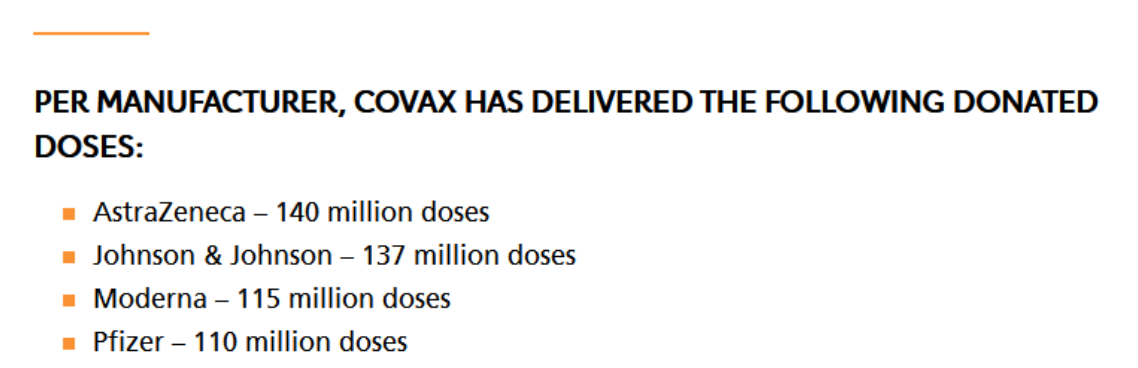

COVAX has funds and donated doses confirmed to achieve an average coverage level of 45% of the populations of 91 lower income economies by mid-2022 based on a two-dose vaccine regime. In order to ensure it has the flexibility to provide further assistance to countries, or respond to new needs, COVAX in January launched a call for at least an additional US$ 5.2 billion in new funding.
The money is needed urgently to resource a rapid response mechanism to finance at least 600 million doses Pandemic Vaccine Pool for use as and when needed by AMC countries to respond to demand for doses for effective coverage against new variants or boosters against waning immunity, support countries’ readiness and delivery efforts and pay for costs associated with rolling out more donated doses…
To continue the work on dose donations, we are today publishing revised dose sharing principles that COVAX uses to guide the donation process with donors and manufacturers. These update the principles published in December 2020.
:: A full list of dose donations and pledges can be found here.
:: The Investment Opportunity, entitled Break COVID Now, can be read here.
::::::
PRINCIPLES FOR SHARING COVID-19 VACCINE DOSES WITH COVAX
VERSION 2 03 FEBRUARY 2020
This document updates version 1 of the principles for dose sharing which were published in December 2020.
[Text bolding in black from original; Editor’s text bolding in red]
COVAX is a multilateral initiative to ensure fair and equitable access to COVID-19 vaccines for all countries regardless of wealth. Donors have contributed substantial funds to the Gavi COVAX Advance Market Commitment (AMC) to accelerate access to safe, efficacious, and early doses of COVID-19 vaccines, and these funds are the primary source of doses from COVAX for AMC eligible countries. However, acute supply constraints have severely limited the availability of doses in many countries and there is an urgent need for additional dose sharing that can be delivered immediately. Continued access to shared doses will enable these countries to further build their capacity to roll out vaccines and immunize their populations as soon as possible.
Given the urgent need to mobilise additional supply, the Facility has established a dose sharing mechanism. Dose sharing encompasses several different modalities, including dose donations from bilateral agreements between donors and manufacturers, donations by SFP countries of doses available pursuant to their SFP Commitment Agreement, and the donation of doses already under title and possession of a donor country. The Facility will continue to explore options to accept donated doses under various circumstances, as they align with its principles and goals. COVAX is also open to offers from donors that involves the Facility purchasing doses from the donor (i.e. dose resale) as long as the offer fits with the principles outlined below and helps to further COVAX’s goals of increasing supply equitably to Participants. Donors’ commitments to donate doses to the Facility are recorded here, with the first donated doses delivered in June 2021.
Dose donation through the Facility is the simplest and fastest way for donors to increase supply to COVAX. The Facility has a legal framework for dose donation with several manufacturers. It continues to evolve its processes to reduce transaction costs for all parties. Both donors and recipients will benefit from the sharing of doses through the Facility, using the Facility’s established procurement processes, and providing AMC eligible countries access to the No Fault Compensation Scheme.
The Facility retains the right to accept or refuse a donation offer based on the holistic value of the offer to increase vaccine supply to recipient countries while maintaining COVAX’s principles. The following principles for shared doses guide the Facility’s consideration of dose sharing offers:
1. Safe and effective: shared doses must be of assured quality with, at a minimum, WHO prequalification/emergency use listing or licensure/authorization from an SRA. Vaccine doses can be transferred to countries most rapidly if they are already in the COVAX Facility Portfolio; other vaccines could be shared when they are eligible to join the Portfolio.
2. Availability and visibility: shared doses should be made available as soon as possible to maximise impact. Pledges that have been made should be front-loaded according to demand and capacity in order to maximise impact. The Facility asks for as much lead time as possible on volume and timing of shared doses and will pool shared doses where possible to ensure equitable and informed allocation decisions and more efficient delivery. This provides recipient countries the opportunity to plan their immunisation programmes, which is essential to achieve high coverage.
3. Rapidly deployable: sharing of doses should be signaled as early as possible in the manufacturing process, with the dose-sharing country facilitating WHO authorizations, so that doses are shipped directly from the manufacturer with standard COVAX labelling and packaging, allowing rapid deployment and maximizing shelf-life. The Facility will not accept doses where the shelf-life at the time of delivery in country will be less than two and a half months. Where new agreements with a donor or manufacturer are needed, accepting standard templates will speed up agreements and reduce transaction costs for all parties, including recipients.
4. Flexibly deployable: doses should be allocated to the Facility to allow flexible deployment to meet Participants’ needs. To facilitate equitable access and in keeping with COVAX’s allocation mechanism, unearmarked doses are the standard. In limited and exceptional cases, the Facility may allow earmarking if requested by a donor country and when such earmarking does not impede the ability to allocate doses equitably. In such cases earmarking should be limited to “soft earmarking” across broad regions and/or a long list of countries. The Facility will allocate all doses according to the standard Fair Allocation criteria, taking into account absorptive capacity, readiness, the epidemiological situation, and logistics. Requests by donors to adjust country allocation decisions will not be accepted. Requirements by a donor to earmark may be a reason for the Facility to reject a dose sharing offer if the earmarking requirements do not allow adherence to the allocation principles.
While the Humanitarian Buffer will be primarily resourced through AMC funds, the Facility may determine, subject to the relevant legal agreements, that doses shared with the Facility can be used to meet the needs of populations served by the Buffer. As a result of the challenges of matching dose donations to applications to the Buffer, doses cannot be earmarked to the Buffer.
5. Cost-effective: The attractiveness of dose sharing offers will depend on the severity of supply constraints in the given context and other operational considerations. Shared doses should be in sufficient and predictable volumes, particularly where donors already have title to the doses, to have a substantive impact in achieving the goals of the Facility. Donated doses are fully paid for by the dose-donating country, and donors should also pay for ancillary costs to cover syringes, diluent, freight and the NFC. With respect to resale, the Facility will not pay any more than standard COVAX APA prices for a given vaccine.
COVAX welcomes further commitments by potential dose-sharing countries and manufacturers to these principles, which are in line with the overall principles of COVAX, and to partner with COVAX to provide additional doses for equitable distribution.
Africa needs to ramp up COVID-19 vaccination six-fold
WHO Africa site
Brazzaville, 3 February 2022 – Although COVID-19 vaccine supplies to Africa have risen significantly, the continent is struggling to expand rollout, with only 11% of the population fully vaccinated. The vaccination rate needs to increase six times if the continent is to meet the 70% target set for the middle of this year. The World Health Organization (WHO), UNICEF, the International Federation of Red Cross and Red Crescent Societies (IFRC) and partners are launching a new initiative aimed at resolving bottlenecks.
To date, Africa has received more than 587 million vaccine doses, 58% through the COVAX Facility, 36 % from bilateral deals and 6% through Africa Vaccines Acquisition Trust (AVAT) of the African Union. In January 2022, 96 million doses were shipped to Africa, which is more than double that of six months ago. Increasing deliveries have eased shortages and turned the spotlight on the need for countries to rapidly ramp up vaccine rollout.
“The world has finally heard our calls. Africa is now accessing the vaccines it has demanded for far too long. This is a dose of hope for this year,” said Dr Matshidiso Moeti, WHO Regional Director for Africa. “However, a dependable pipeline must go hand in hand with operational funding to move doses out of depots and into people’s arms. WHO and partners are working with countries to urgently fix operational challenges including supporting health workers to speed up vaccine delivery, save lives and beat back this pandemic.”
Currently 6 million people are vaccinated on average every week in Africa, and this number needs to increase to 36 million to reach the 70% target agreed globally. Although Mauritius and Seychelles have already met the 70% target and seven African countries have vaccinated 40% of their population, vaccination rates on the continent remain low. Twenty-one countries have fully vaccinated less than 10% of their populations, while 16 have vaccinated less than 5% and three have fully vaccinated less than 2%.
The slow uptake in COVID-19 vaccines in Africa requires global partners and countries to reset their programmes. WHO, UNICEF, IFRC and other partners are scaling up efforts to overcome hurdles, improve coordination and speed up vaccination drives. They have called for support to ensure vaccines are administered as quickly as possible upon arrival to avoid expired vaccines.
“UNICEF is at the forefront of the largest, most sophisticated ground operation in the history of immunization – and it will take a response of the same magnitude to turn vaccines into vaccinations,” said Mr Mohamed M. Malick Fall, UNICEF Regional Director for Eastern & Southern Africa. “Richer countries must not only ensure they are donating vaccine doses that have adequate shelf lives but also contribute funding for in-country operational costs.”
Data reported to WHO from 40 countries finds that there is a US$ 1.29 billion gap in funding for operational costs…
WHO and partners are deploying, technical experts to 20 countries with significant challenges in vaccine deployment to form special support teams for three to six months and in some cases possibly up to a year. Already 50 experts have been deployed. They are working under the leadership of the ministries of health to strengthen partner coordination, logistical and financial planning, including microplanning, surveillance of adverse events following immunization, as well as the management of data on vaccination uptake and vaccine stock. Engaging and empowering communities so they follow key public health measures and support vaccination is important. Under the leadership of governments, partners are working with communities to strengthen trust and confidence in vaccination.
“This year, a lot more needs to be done to gain communities’ trust. When communities are in the driver’s seat, they become vital contributors to finding solutions to the outbreaks of diseases. In South Sudan, community-based Red Cross volunteers tackled the problem of slow vaccine uptake, through improved community trust, and helped prevent vaccine wastage,” said Mr Mohammed Omer Mukhier, IFRC Regional Director for Africa…
ACT-Accelerator campaign launch
9 February 2022 15:00
The ACT-Accelerator Facilitation Council has developed a Financing Framework with a grant funding ask to enable ACT-Accelerator agencies to support low coverage countries to achieve the global vaccines, tests, treatment and PPE targets. Achieving the global targets is crucial to end the pandemic.
This event aims to raise awareness of ACT-Accelerator achievements and build political support for the urgent financial needs of its agencies to scale up this vital work.
It will launch the ‘fair share’ resource mobilization asks to countries, provide a platform to political leaders to confirm their commitments to profile the ACT-Accelerator using the G20, G7 and USA Global COVID-19 Summit to reinforce and recognize exemplary contributors to the ACT-Accelerator to date.
Tonnes of COVID-19 health care waste expose urgent need to improve waste management systems
1 February 2022 News release
Tens of thousands of tonnes of extra medical waste from the response to the COVID-19 pandemic has put tremendous strain on health care waste management systems around the world, threatening human and environmental health and exposing a dire need to improve waste management practices, according to a new WHO report.
The WHO Global analysis of health care waste in the context of COVID-19: status, impacts and recommendations bases its estimates on the approximately 87,000 tonnes of personal protective equipment (PPE) that was procured between March 2020- November 2021 and shipped to support countries’ urgent COVID-19 response needs through a joint UN emergency initiative. Most of this equipment is expected to have ended up as waste.
The authors note that this just provides an initial indication of the scale of the COVID-19 waste problem. It does not take into account any of the COVID-19 commodities procured outside of the initiative, nor waste generated by the public like disposable medical masks.
They point out that over 140 million test kits, with a potential to generate 2,600 tonnes of non-infectious waste (mainly plastic) and 731,000 litres of chemical waste (equivalent to one-third of an Olympic-size swimming pool) have been shipped, while over 8 billion doses of vaccine have been administered globally producing 144,000 tonnes of additional waste in the form of syringes, needles, and safety boxes.
As the UN and countries grappled with the immediate task of securing and quality-assuring supplies of PPE, less attention and resources were devoted to the safe and sustainable management of COVID-19 related health care waste.
“It is absolutely vital to provide health workers with the right PPE, “said Dr Michael Ryan, Executive Director, WHO Health Emergencies Programme. “But it is also vital to ensure that it can be used safely without impacting on the surrounding environment.”
This means having effective management systems in place, including guidance for health workers on what to do with PPE and health commodities after they have been used.
Today, 30% of healthcare facilities (60% in the least developed countries) are not equipped to handle existing waste loads, let alone the additional COVID-19 load. This potentially exposes health workers to needle stick injuries, burns and pathogenic microorganisms, while also impacting communities living near poorly managed landfills and waste disposal sites through contaminated air from burning waste, poor water quality or disease carrying pests.
“COVID-19 has forced the world to reckon with the gaps and neglected aspects of the waste stream and how we produce, use and discard of our health care resources, from cradle to grave,” said Dr Maria Neira, Director, Environment, Climate Change and Health at WHO.
“Significant change at all levels, from the global to the hospital floor, in how we manage the health care waste stream is a basic requirement of climate-smart health care systems, which many countries committed to at the recent UN Climate Change Conference, and, of course, a healthy recovery from COVID-19 and preparedness for other health emergencies in the future.”
The report lays out a set of recommendations for integrating better, safer, and more environmentally sustainable waste practices into the current COVID-19 response and future pandemic preparedness efforts and highlights stories from countries and organizations that have put into practice in the spirit of “building back better”…
Technical document
Global analysis of health care waste in the context of COVID-19
Status, impacts and recommendations
1 February 2022 |
Overview
Globally, safe waste management services for healthcare waste are lacking, especially in least developed countries. The latest available data (from 2019) indicate that 1 in 3 healthcare facilities globally do not safely manage healthcare waste. The COVID-19 pandemic has led to large increases in healthcare waste, straining under resourced healthcare facilities and exacerbating environmental impacts from solid waste. This report quantifies the additional COVID-19 healthcare waste generated, describes current healthcare waste management systems and their deficiencies, and summarizes emerging best practices and solutions to reduce the impact of waste on human and environmental health. The recommendations included in the report build on actions in the WHO manifesto for a healthy recovery from COVID-19: prescriptions and actionables for a healthy and green recovery. They target the global, national and facility levels to promote a “win–win” scenario for COVID-19 PPE use, testing and vaccinations that are safe and support environmental sustainability.
WHO, WIPO, WTO heads chart future cooperation on pandemic response
1 February 2022
The Directors-General of the World Health Organization (WHO), the World Intellectual Property Organization (WIPO) and the WTO met on 1 February to chart future directions for trilateral cooperation in support of an effective global response to the COVID-19 pandemic.
Joint news item
The Directors-General of the World Health Organization (WHO), the World Intellectual Property Organization (WIPO) and the World Trade Organization (WTO) today reaffirmed their commitment to working closely together to help overcome the COVID-19 pandemic and its devastating human, social, and economic impacts.
Meeting in Geneva on 1 February, 2022, WHO Director-General Tedros Adhanom Ghebreyesus, WIPO Director General Daren Tang and WTO Director-General Ngozi Okonjo-Iweala reviewed progress made on the initiatives announced in their joint statement of 15 June 2021, pledging cooperation on COVID-19-related medical technologies and charting future directions for their organizations’ trilateral cooperation to ensure it continues to address the evolving needs of people across the globe.
They welcomed the impending launch of a trilateral technical assistance platform, which will provide a one-stop shop making available the three organizations’ expertise to governments in a tailored and coordinated way so as best to respond to individual national needs for COVID-19 health technologies. This will include support for the full use of legal and policy options for access to health technologies, including through the implementation of any solution to the COVID-19-related intellectual property proposals currently before the WTO’s TRIPS Council.
The three Directors-General reviewed the series of technical capacity building workshops planned , starting with a workshop held in September 2021 that focused on intellectual property licensing and technology transfer along with the sharing of know-how and clinical trial information. An event later this month will seek to support policymakers to more effectively use data to inform their pandemic policy choices, and a subsequent workshop will address challenges of access relating to diagnostic technologies.
The Directors-General welcomed the ongoing efforts by their three organizations to make up-to-date information available, including the series of joint COVID-19 information notes, supplementing and updating the 2020 joint publication “Promoting Access to Medical Technologies and Innovation”.
Finally, the three Directors-General confirmed that they would convene a high-level policy symposium in the early summer on the COVID-19 pandemic, taking stock of COVID-19 challenges and focusing on what is needed to recover from this health crisis and better prepare for future ones.
The Directors-General concluded their meeting in a spirit of solidarity and practical determination to spare no effort to address the continuing scourge of the pandemic, and to mobilise the necessary knowledge resources and support so that no country would be left behind.
Pfizer and BioNTech Initiate Rolling Submission for Emergency Use Authorization of Their COVID-19 Vaccine in Children 6 Months Through 4 Years of Age Following Request From U.S. FDA
Tuesday, February 01, 2022
:: With pediatric COVID-19 cases surpassing 10 million and at the request of the FDA, the companies have submitted available data on the safety and efficacy of two 3 µg doses as part of a three-dose primary series for this age group to address the urgent public health need
:: Companies plan to submit additional data on a third 3 µg dose in this age group in the coming months
:: If authorization is granted, the Pfizer-BioNTech vaccine would be the first COVID-19 vaccine available for pediatric populations under 5 years of age
NEW YORK & MAINZ, Germany–(BUSINESS WIRE)– Pfizer Inc. (NYSE: PFE) and BioNTech SE (Nasdaq: BNTX) today announced that following a request from the U.S. Food and Drug Administration (FDA) the companies have initiated a rolling submission seeking to amend the Emergency Use Authorization (EUA) of the Pfizer-BioNTech COVID-19 Vaccine to include children 6 months through 4 years of age (6 months to <5 years of age), in response to the urgent public health need in this population. The companies expect to complete the EUA submission in the coming days. This application is for authorization of the first two 3 µg doses of a planned three-dose primary series in this age group. Data on a third dose given at least 8 weeks after completion of the second dose are expected in the coming months and will be submitted to the FDA to support a potential expansion of this requested EUA.
Since the pandemic began, more than 10.6 million children have tested positive for COVID-19 in the U.S.,1 with children under 4 accounting for more than 1.6 million of those cases.2 Further, reported COVID-19 cases and related hospitalization among children have spiked dramatically across the United States during the Omicron variant surge. For the week ending January 22, children under 4 accounted for 3.2% of the total hospitalizations due to COVID-19.2 If authorization is granted, the Pfizer-BioNTech COVID-19 Vaccine would be the first vaccine available to help protect children under 5 years of age from this disease, potentially including future emerging variants of concern.
“As hospitalizations of children under 5 due to COVID-19 have soared, our mutual goal with the FDA is to prepare for future variant surges and provide parents with an option to help protect their children from this virus,” said Albert Bourla, Chairman and Chief Executive Officer, Pfizer. “Ultimately, we believe that three doses of the vaccine will be needed for children 6 months through 4 years of age to achieve high levels of protection against current and potential future variants. If two doses are authorized, parents will have the opportunity to begin a COVID-19 vaccination series for their children while awaiting potential authorization of a third dose.”
“Our vaccine has already demonstrated a favorable safety, tolerability and efficacy profile in multiple clinical trials and real-world studies for all age groups starting from 5 years old,” said Ugur Sahin, M.D., CEO and Co-founder of BioNTech. “If authorized, we are very excited about the prospect of offering parents the opportunity to help protect their children 6 months through 4 years of age from COVID-19 and the potentially severe consequences of infection.”
The request to amend the EUA is based on the totality of data on the safety, tolerability, immunogenicity, and available efficacy of two doses of the Pfizer-BioNTech COVID-19 Vaccine. The companies also plan to share these data with the European Medicines Agency and other regulatory agencies around the world.
The companies plan to provide ample supply of the 3 µg dose to meet demand should the FDA approve the EUA application. The companies previously announced planned global supply capacity of approximately four billion doses of the Pfizer-BioNTech COVID-19 Vaccine in 2022. The companies continue to supply the vaccine under their existing supply agreement with the U.S. government, which continues through April 2022…
Selected Opinion/Editorial
The Washington Post
February 2, 20220
The Post’s View
Opinion: The smallest kids still lack a vaccine. The FDA must leave no uncertainty.
By Editorial Board
In considering whether to give emergency-use authorization to the Pfizer-BioNTech vaccine for children under 5 years old, it is imperative that the Food and Drug Administration retains public trust and protects the integrity of the process. Many parents are eager for their children to get this vaccine, but many others might be hesitant. The FDA is taking an unusual route in considering the merits and must not leave any doubts in the air.
The anxiety of parents about children under 5 is acute: These are the only Americans not yet eligible for a vaccine. Overall, in billions of doses, the mRNA vaccines have proved safe and effective. Although children represent a small percentage of pandemic hospitalizations, and deaths are rare, the case numbers have spiked during the omicron wave.
Pfizer said Dec. 17 that a two-dose vaccine worked well to stimulate antibodies in children from 6 months to 2 years old in a clinical trial, but did not work in children from 2 years old to under 5. The company said it would attempt a clinical trial with a third dose, to see if that got better results, and if successful, it would seek an emergency-use authorization from the FDA for a three-dose regimen. At issue is not vaccine safety or tolerance but whether it is effective.
On Tuesday, Pfizer announced the FDA has requested that it submit information for an emergency-use authorization of the first two doses, leaving the third for later. This raises the question: What has changed since the December announcement that those two didn’t work? We might learn more when the matter comes before an FDA advisory committee soon. Pfizer said results on the third dose would only be available in “the coming months.”
In statements, the FDA and Pfizer both pointed to the omicron surge as the reason for the unusual process. An FDA spokesperson said the new variant “has rapidly facilitated the collection of important additional clinical data impacting the potential benefit-risk profile of a vaccine for the youngest children.” FDA officials felt it was “prudent” to get the data from Pfizer now instead of waiting, especially because of “notable increase in reports of children experiencing covid-19 long haul symptoms, including in some cases children developing autoimmune diseases and Type 1 diabetes after having had covid-19.”
The company and the FDA are right to feel a sense of urgency. But parents will be asking: Should they start with two doses, given Pfizer’s statement that in the earlier trial, they didn’t work for children from 2 to under 5? Should parents be comfortable starting a vaccine series — which Pfizer calls “a planned three-dose primary series” — without knowing anything about the effectiveness of the third dose?
Everyone must hope the vaccines will work for those who have most of their lives ahead of them. But parents are already displaying reluctance to get children from 5 to 12 years old vaccinated. For the next step, the FDA must be crystal clear and leave no gaps or uncertainties. A vaccine should never be a shot in the dark.
::::::
Coronavirus [COVID-19] – WHO
Public Health Emergency of International Concern (PHEIC)
https://www.who.int/emergencies/diseases/novel-coronavirus-2019
Weekly Epidemiological and Operational updates
Last update: 04 Feb 2022
Confirmed cases :: 386 548 962
Confirmed deaths :: 5 705 754
Vaccine doses administered: 10 040 768 270
::::::
Weekly epidemiological update on COVID-19 – 01 February 2022
Overview
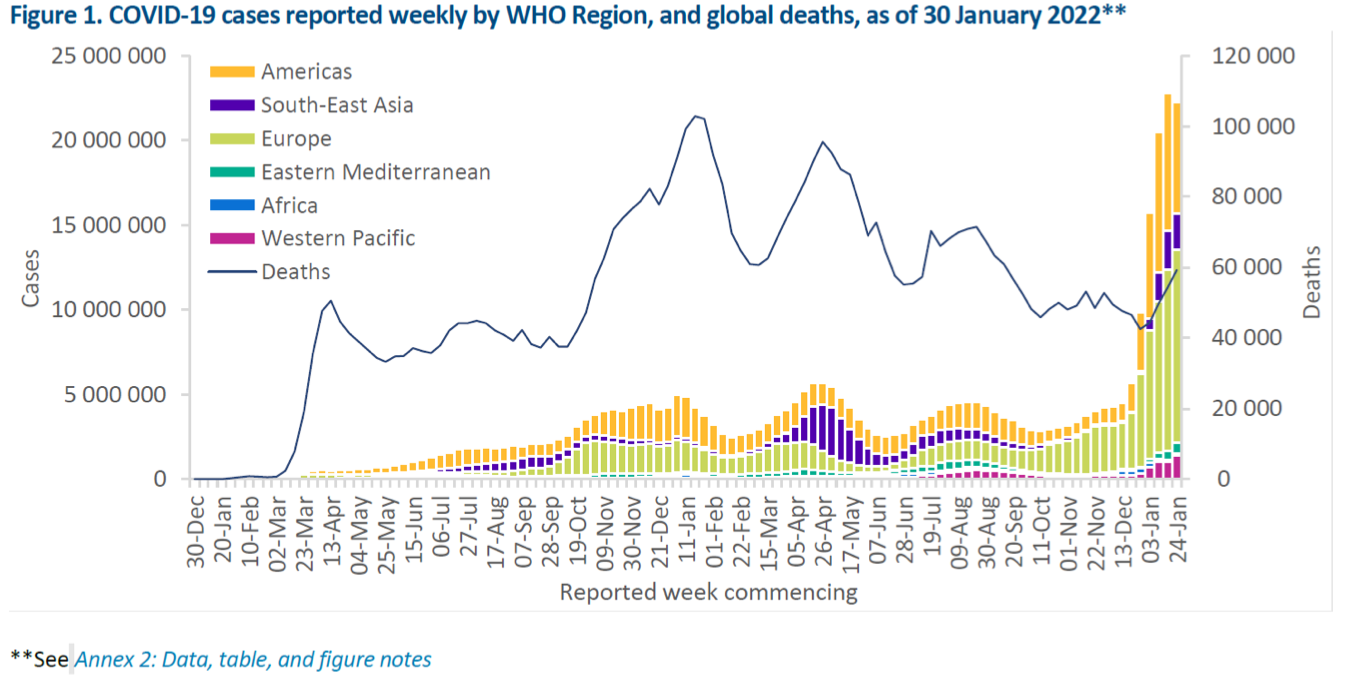
Globally, during the week of 24 to 30 January 2022, the number of new COVID-19 cases remained similar to that reported during the previous week, while the number of new deaths increased by 9%. Across the six WHO regions, over 22 million new cases and over 59 000 new deaths were reported. As of 30 January 2022, over 370 million confirmed cases and over 5.6 million deaths have been reported globally.
At the Regional level, increases in the number of new cases were reported by the Western Pacific (37%) the Eastern Mediterranean (24%) and the European (7%) regions, while a decrease was reported by the Region of the Americas (20%) and the South-East Asia Region (8%). The number of new cases reported in the African Region remained similar to the previous week. The number of new weekly deaths continued to increase in the South-East Asia Region (41%), the Eastern Mediterranean Region (32%) and the Region of the Americas (16%), while the African Region reported a decrease of 7%. The incidence of deaths remained similar to the previous week in the European and the Western Pacific regions.
WHO Director General Speeches [selected]
https://www.who.int/director-general/speeches
Selected
WHO Director-General’s opening remarks at the media briefing on COVID-19 – 1 February 2022
Neglected tropical diseases affect the poorest and most marginalized communities, and the COVID-19 pandemic has made things worse
We are now starting to see a very worrying increase in deaths, in most regions of the world. It’s premature for any country either to surrender, or to declare victory
As this virus evolves, so vaccines may need to evolve
WHO published a new report on the burden of medical waste from the pandemic threatening human and environmental health
Member States asked us to develop a set of proposals on strengthening the global health architecture for emergency preparedness, response and resilience, to present to the World Health Assembly in May
Status of COVID-19 Vaccines within WHO EUL/PQ evaluation process 23 December 2021
[Full scale view available at title link above]
[No change from 23 December 2021]
COVID Vaccines/Therapeutics – Developer/Manufacturer Announcements
[Selected press releases/announcements from organizations from WHO EUL/PQ listing above and other organizations]
AstraZeneca
Press Releases – No new digest announcements identified
Bharat Biotech
Press Releases – No new digest announcements identified
BioCubaFarma – Cuba
Últimas Noticias – No new digest announcements identified
CanSinoBIO
News – [Website not responding at inquiry]
Clover Biopharmaceuticals – China
News
Clover Appoints Nicholas Jackson, Ph.D., as President of Global Research and Development Feb 1, 2022
Curevac [Bayer Ag – Germany]
News – No new digest announcements identified
Gamaleya National Center
Latest News and Events –
Sputnik V vaccine granted full permanent approval in Russia
:: Highest safety and efficacy of Sputnik V confirmed during clinical trials and in real-world use around the world.
:: Sputnik V has been authorized in 71 countries with total population of over 4 billion people.
February 4, 2022
IMBCAMS, China
Home – Website not responding at inquiry
Janssen/JNJ
Press Releases
Feb 01, 2022 United States
U.S. FDA Approves CABENUVA (rilpivirine and cabotegravir) for Use Every Two Months, Expanding the Label of the First and Only Long-Acting HIV Treatment
Moderna
Press Releases
January 31, 2022
Moderna Receives Full U.S. FDA Approval for COVID-19 Vaccine Spikevax
:: Approval based on a comprehensive submission package including efficacy and safety data approximately six months after second dose
:: SPIKEVAX has received approval by regulators in more than 70 countries, including Canada, Japan, the European Union, the UK, Israel
:: 807 million doses of Moderna’s COVID-19 vaccine shipped globally in 2021; approximately 25% of those doses shipped to low- and middle-income countries
Novavax
Press Releases
New Zealand’s Medsafe Grants Provisional Approval for Novavax’ COVID-19 Vaccine
Feb 3, 2022
Novavax Submits Request to the U.S. FDA for Emergency Use Authorization of COVID-19 Vaccine
Jan 31, 2022
Pfizer
Recent Press Releases
02.04.2022
Valneva and Pfizer Report Further Positive Phase 2 Data for Lyme Disease Vaccine Candidate
02.01.2022
Pfizer Announces New Chief Development Officer
NEW YORK–(BUSINESS WIRE)– Pfizer Inc. (NYSE: PFE) today announced that William Pao, M.D., Ph.D., will join the Company as Executive Vice President and Chief Development Officer effective March 21, 2022. Dr. Pao will be a member of Pfizer’s Executive Leadership Team reporting to Chairman and Chief Executive Officer, Albert Bourla. He joins Pfizer from Roche, where he most recently served as the Head of Pharma Research and Early Development (pRED) and oversaw the discovery and early development of a portfolio of new molecular entities to treat diseases related to cancer, neuroscience, ophthalmology, rare diseases, immunology, infectious diseases, and rare blood disorders, across seven global sites. He was also a member of Roche’s Enlarged Corporate Executive Committee.
Dr. Pao succeeds Rod MacKenzie who recently announced his intent to retire after a 35-year career at Pfizer. Mr. MacKenzie has agreed to continue in his role until a seamless transition is completed…
Sanofi Pasteur
Press Releases – No new digest announcements identified
Serum Institute of India
NEWS & ANNOUNCEMENTS – No new digest announcements identified
Sinopharm/WIBPBIBP
News – No new digest announcements identified
Sinovac
Press Releases – No new digest announcements identified
Vector State Research Centre of Viralogy and Biotechnology
Home – No new digest announcements identified
Zhifei Longcom, China
[Anhui Zhifei Longcom Biologic Pharmacy Co., Ltd.]
[No website identified]
::::::
GSK
Press releases for media – No new digest announcements identified
Merck
News releases – No new digest announcements identified
Novartis
News – No new digest announcements identified
SK Biosciences
Press releases – No new digest announcements identified
Valneva
Press Releases
February 4, 2022
Valneva and Pfizer Report Further Positive Phase 2 Data for Lyme Disease Vaccine Candidate
January 31, 2022
Valneva Announces Initiation of Adolescent Phase 3 Trial for its Single-Shot Chikungunya Vaccine Candidate
UNICEF COVID-19 Vaccine Market Dashboard :: Agreements Table Accessed 05 Feb 2022
An overview of information collected from publicly announced bilateral and multilateral supply agreements [no new agreements since 10/22/2021 reported]

 vaccines and global health :: ethics and policy