::::::
Coronavirus [COVID-19] – WHO
Public Health Emergency of International Concern (PHEIC)
https://www.who.int/emergencies/diseases/novel-coronavirus-2019
Weekly Epidemiological and Operational updates
Last update: 25 Feb 2022
Confirmed cases :: 430 257 564
Confirmed deaths :: 5 922 049
Vaccine doses administered: 10 407 359 583
::::::
Weekly epidemiological update on COVID-19 – 22 February 2022
Overview
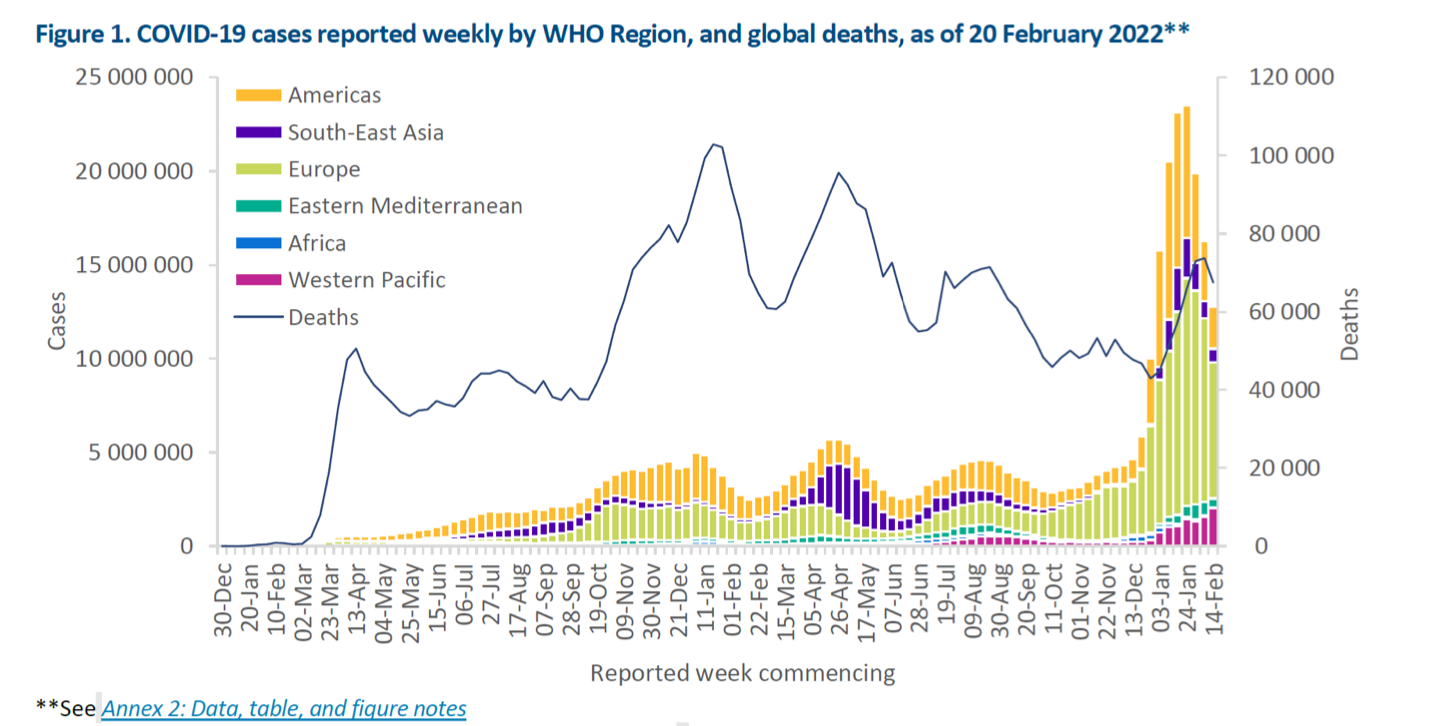
Globally, during the week of 14 to 20 February 2022, the number of new COVID-19 cases and deaths decreased by 21% and 8% respectively, compared to the previous week. Across the six WHO regions, over 12 million new cases and over 67 000 new deaths were reported. As of 20 February 2022, over 422 million confirmed cases and over 5.8 million deaths have been reported globally.
At the regional level, the Western Pacific Region reported a 29% increase in the number of new weekly cases while all other regions reported decreases. The number of new weekly deaths increased in the Western Pacific (+21%) and the African (+20%) regions, and decreased in the South-East Asia (-37%), the Regions of the Americas (-9%), the European (-5%) and Eastern Mediterranean regions (-4%).
In this edition we provide an update on:
The geographic distribution of circulating SARS-CoV-2 variants of concern (VOCs), including the prevalence and summary of current evidence of the Omicron variant. We also provide updates on vaccine effectiveness for the Delta and Omicron variants.
::::::
Statement on Omicron sublineage BA.2
WHO 22 February 2022
As part of its on-going work to track variants, WHO’s Technical Advisory Group on SARS-CoV-2 Virus Evolution (TAG-VE) met yesterday to discuss the latest evidence on the Omicron variant of concern, including its sublineages BA.1 and BA.2.
Based on available data of transmission, severity, reinfection, diagnostics, therapeutics and impacts of vaccines, the group reinforced that the BA.2 sublineage should continue to be considered a variant of concern and that it should remain classified as Omicron. The group emphasized that BA.2 should continue to be monitored as a distinct sublineage of Omicron by public health authorities.
The Omicron variant of concern is currently the dominant variant circulating globally, accounting for nearly all sequences reported to GISAID. Omicron is made up of several sublineages, each of them being monitored by WHO and partners. Of them, the most common ones are BA.1, BA.1.1 (or Nextstrain clade 21K) and BA.2 (or Nextstrain clade 21L). At a global level, the proportion of reported sequences designated BA.2 has been increasing relative to BA.1 in recent weeks, however the global circulation of all variants is reportedly declining.
BA.2 differs from BA.1 in its genetic sequence, including some amino acid differences in the spike protein and other proteins. Studies have shown that BA.2 has a growth advantage over BA.1. Studies are ongoing to understand the reasons for this growth advantage, but initial data suggest that BA.2 appears inherently more transmissible than BA.1, which currently remains the most common Omicron sublineage reported. This difference in transmissibility appears to be much smaller than, for example, the difference between BA.1 and Delta. Further, although BA.2 sequences are increasing in proportion relative to other Omicron sublineages (BA.1 and BA.1.1), there is still a reported decline in overall cases globally…
::::::
WHO Director General Speeches [selected]
https://www.who.int/director-general/speeches
Selected
25 February 2022
Speech
WHO Director-General as Guest Lecture at Robert S. McNamara Lecture on War and Peace, Harvard Kennedy School – 25 February 2022
[See Perspectives above for excerpt]
25 February 2022
Speech
WHO Director-General’s opening remarks at High-Level Thematic Debate: Galvanizing Momentum for Universal Vaccination, President of the 76th Session of the General Assembly – 25 February 2022
24 February 2022
Speech
WHO Director-General’s opening remarks at COVID-19 Global research & innovation forum – 24 February 2022
24 February 2022
Speech
WHO Director-General’s opening remarks at first meeting of the Intergovernmental Negotiating Body to draft and negotiate a WHO convention, agreement or other international instrument on pandemic prevention, preparedness and response – 24 February 2022
[Excerpt]
…This is a momentous undertaking, and a necessary one. Because the COVID-19 pandemic has shown that the status quo is not good enough to protect our communities, our societies, and our economies.
The pandemic has exposed and exacerbated fundamental weaknesses in pandemic preparedness and response at both the national and the global levels:
:: Complex and fragmented governance and lack of leadership;
:: Inadequate financing;
:: And insufficient systems and tools.
Instead of solidarity, the pandemic has been marred by inequity.
Equity does not mean providing access to tools when there is a surplus, when the privileged have used what they need. It is about timely access, so that all people have access to all the available tools, at the same time.
The lack of trust or the trust deficit between and within countries, partners and stakeholders has shattered our unified defence during the pandemic. Voluntary mechanisms have not solved and will not solve these challenges.
Global health security is too important to be left to chance, or goodwill, or shifting geopolitical currents, or the vested interests of companies and shareholders. Recognizing that our fates as a global community are intertwined, the World Health Assembly established this intergovernmental negotiating body during a special session, which, by the way, is only the second time it had held such an extraordinary meeting.
Today’s meeting is the start of an historic opportunity for Member States to work together to strengthen the world’s structures and systems for pandemic preparedness and response.
While we are operating under an ambitious timeline, we need to take the lessons learned from the COVID-19 pandemic and use them to build back better. The aim should be a world better prepared to prevent pandemic threats and respond to them when they do occur, in at least five ways:
First, by building national, regional and global capacities for preparing and responding to pandemics and other global health emergencies, based on a whole-of-government and whole-of-society approach;
Second, by establishing global access and benefit sharing for all pathogens, and determining a global policy for the equitable production and distribution of countermeasures;
Third, by establishing robust systems and tools for pandemic preparedness and response;
Fourth, by building a long-term plan for sustainable financing, so that support for global health threat management and response systems is shared by all;
And fifth, by empowering WHO to fulfil its mandate as the directing and coordinating authority on international health work, including for pandemic preparedness and response
At the Special Session, the World Health Assembly specifically noted the importance of broad engagement to ensure a successful outcome. So we encourage all Member States to participate in this process and support the work of the INB, in developing a new international instrument on pandemic prevention, preparedness and response.
Now begins the critical process of coming together around a common goal – health – for the future of our children and their children.
Together, let us chart a way forward, for this and future generations, to better prevent, prepare and respond to future pandemics and health emergencies.
23 February 2022
Speech
WHO Director-General’s remarks at the Preparatory Meeting of the Global Fund’s Seventh Replenishment – 23 February 2022
23 February 2022
Speech
WHO Director-General’s opening remarks at the media briefing on COVID-19 – 23 February 2022
22 February 2022
Speech
WHO Director-General’s remarks at ILO Multisectoral Policy Forum: “Building a human-centered recovery from the COVID-19 crisis” – 22 February 2022
Status of COVID-19 Vaccines within WHO EUL/PQ evaluation process 23 December 2021
[Full scale view available at title link above]
[Updated on 18 February 2022]
 vaccines and global health :: ethics and policy