Cost-effectiveness of pertussis booster vaccination for preschool children in Japan

Vaccine
Volume 40, Issue 7 Pages 967-1060 (11 February 2022)
https://www.sciencedirect.com/journal/vaccine/vol/40/issue/7


Short communication Open access
Research articleAbstract only
Cost-effectiveness of pertussis booster vaccination for preschool children in Japan
Motoko Tanaka, Reiko Okubo, Shu-Ling Hoshi, Nobuyuki Ishikawa, Masahide Kondo
Pages 1010-1018

Variation in influenza vaccine assessment, receipt, and refusal by the concentration of Medicare Advantage enrollees in U.S. nursing homes

Vaccine
Volume 40, Issue 7 Pages 967-1060 (11 February 2022)
https://www.sciencedirect.com/journal/vaccine/vol/40/issue/7


Research article Open access
Variation in influenza vaccine assessment, receipt, and refusal by the concentration of Medicare Advantage enrollees in U.S. nursing homes
Patience Moyo, Elliott Bosco, Barbara H. Bardenheier, Maricruz Rivera-Hernandez, … Andrew R. Zullo
Pages 1031-1037

The Use of Cost-Effectiveness Thresholds for Evaluating Health Interventions in Low- and Middle-Income Countries From 2015 to 2020: A Review

Value in Health
March 2022 Volume 25 Issue 3 p321-472
https://www.valueinhealthjournal.com/current


BRIEF REPORT
The Use of Cost-Effectiveness Thresholds for Evaluating Health Interventions in Low- and Middle-Income Countries From 2015 to 2020: A Review
Joseph Kazibwe, Adrian Gheorghe, David Wilson, Francis Ruiz, Kalipso Chalkidou, Y-Ling Chi
Published online: October 28, 2021
p385-389

Pre-Print Servers

Gates Open Research
https://gatesopenresearch.org/browse/articles
[Accessed 05 Mar 2022]

[No new digest content identified]

medRxiv
https://www.medrxiv.org/content/about-medrxiv
medRxiv is a free online archive and distribution server for complete but unpublished manuscripts (preprints) in the medical, clinical, and related health sciences. Preprints are preliminary reports of work that have not been certified by peer review. They should not be relied on to guide clinical practice or health-related behavior and should not be reported in news media as established information. medRxiv is for the distribution of preprints – complete but unpublished manuscripts – that describe human health research conducted, analyzed, and interpreted according to scientific principles…

Precision recruitment for high-risk participants in a COVID-19 research study
Aziz Mezlini, Eamon Caddigan, Allison Shapiro, Ernesto Ramirez, Helena Kondow-McConaghy, Justin Yang, Kerry DeMarco, Pejman Naraghi-Arani, Luca Foschini
medRxiv 2022.03.03.22271504; doi: https://doi.org/10.1101/2022.03.03.22271504

Impact of Population Mixing Between a Vaccinated Majority and Unvaccinated Minority on Disease Dynamics. Implications for SARS-CoV-2
Ashleigh Tuite, Afia Amoako, David Fisman
medRxiv 2021.12.14.21267742; doi: https://doi.org/10.1101/2021.12.14.21267742

Determinants of COVID-19 vaccine acceptability in Mozambique: the role of institutional trust
Bo Hu, Wei Yang, Paul Alexandre Bouanchaud, Yolanda Chongo, Jennifer Wheeler, Sergio Chicumbe, Marcos Chissano
medRxiv 2022.03.03.22271828; doi: https://doi.org/10.1101/2022.03.03.22271828
Abstract
Background Vaccination plays an imperative role in protecting public health and preventing avoidable mortality. Yet, the reasons for vaccine hesitancy are not well understood. This study investigates the factors associated with the acceptability of COVID-19 vaccine in Mozambique. Methods The data came from the three waves of the COVID-19 Knowledge, Attitudes and Practices (KAP) survey which followed a cohort of 1,371 adults in Mozambique over three months (N=3,809). Data collection was through a structured questionnaire using telephone interviewing (CAPI). Multilevel regression analysis was conducted to identify the trajectories of, and the factors associated with COVID-19 vaccine acceptability. Results There was great volatility in COVID-19 vaccine acceptability over time. Institutional trust was consistently and strongly correlated with different measures of vaccine acceptability. There was a greater decline in vaccine acceptability in people with lower institutional trust. The positive correlation between institutional trust and vaccine acceptability was stronger in younger than older adults. Vaccine acceptability also varied by gender and marital status. Conclusions Vaccine acceptability is sensitive to news and information circulated in the public domain. Institutional trust is a central driver of vaccine acceptability and contributes to the resilience of the health system. Our study highlights the importance of health communication and building a trustful relationship between the general public and public institutions in the context of a global pandemic.

Acute and long-term impacts of COVID-19 on economic vulnerability: a population-based longitudinal study (COVIDENCE UK)
Anne E Williamson, Florence Tydeman, Alec Miners, Kate Pyper, Adrian R Martineau
medRxiv 2022.03.03.22271835; doi: https://doi.org/10.1101/2022.03.03.22271835

An observational study of the association between COVID-19 vaccination rates and participation in a vaccine lottery
Dajung Jun, Anthony Scott
medRxiv 2022.03.02.22271734; doi: https://doi.org/10.1101/2022.03.02.22271734
Abstract
Objectives Are financial incentives from entry in a vaccine lottery associated with a higher probability of vaccination for COVID-19? Design A cross-sectional study with adjustment for covariates using logistic regression Setting October and November 2021, Australia. Participants 2,375 respondents of the Taking the Pulse of the Nation Survey Interventions Participation in the Million Dollar Vaccination Lottery Primary and secondary outcome measures The proportion of respondents who had any vaccination, a first dose only, or second dose compared to all other respondents Results Those who participated in the lottery were 2.27 times more likely to be vaccinated after the lottery opened on October 1st than those who did not. This was driven by those receiving second doses. Lottery participants were 1.38 times more likely to receive their first dose after October 1st and 2.31 times more likely to receive their second dose after October 1st. Conclusions Lottery participation is associated with a higher vaccination rate, with this effect dominated by a higher rate of second doses. There is a smaller insignificant difference for those receiving a first dose, suggesting lotteries may not be as effective at reducing vaccine hesitancy, compared to ‘nudging’ people to get their second dose more quickly.

Prevalence of Chronic Diseases, Depression, and Stress among U.S. Child Care Professionals during the COVID-19 Pandemic
Jad A. Elharake, Mehr Shafiq, Ayse Cobanoglu, Amyn A. Malik, Madeline Klotz, John Eric Humphries, Thomas Murray, Kavin M. Patel, David Wilkinson, Inci Yildirim, Rachel Diaz, Rosalia Rojas, Anael Kuperwajs Cohen, Aiden Lee, Chin R. Reyes, Saad B. Omer, Walter S. Gilliam
medRxiv 2022.03.01.22271717; doi: https://doi.org/10.1101/2022.03.01.22271717

The Serological Sciences Network (SeroNet) for COVID-19: Depth and Breadth of Serology Assays and Plans for Assay Harmonization
Amy B. Karger, James D. Brien, Jayne M. Christen, Santosh Dhakal, Troy J. Kemp, Sabra L. Klein, Ligia A. Pinto, Lakshmanane Premkumar, John D. Roback, Raquel A. Binder, Karl W. Boehme, Suresh Boppana, James M. Crawford, John L. Daiss, Alan P. Dupuis II, Ana M. Espino, Catherine Forconi, J. Craig Forrest, Roxie C. Girardin, Douglas A. Granger, Steve W. Granger, Natalie S. Haddad, Christopher D. Heaney, Danielle T. Hunt, Joshua L. Kennedy, Christopher L. King, Kate Kruczynski, Joshua LaBaer, F. Eun-Hyung Lee, William T. Lee, Shan-Lu Liu, Gerard Lozanski, Todd Lucas, Ann M. Moormann, Vel Murugan, Nkemakonam C. Okoye, Petraleigh Pantoja, Anne F. Payne, Jin Park, Swetha Pinninti, Amelia K. Pinto, Nora Pisanic, Ji Qiu, Carlos A. Sariol, Lusheng Song, Tara L. Steffen, E. Taylor Stone, Linda M. Styer, Mehul S. Suthar, Stefani N. Thomas, Bharat Thyagarajan, Jennifer L. Yates, Kimia Sobhani
medRxiv 2022.02.27.22271399; doi: https://doi.org/10.1101/2022.02.27.22271399

Racial/Ethnic Disparities in the Observed COVID-19 Case Fatality Rate Among the U.S. Population
L. Philip Schumm, Mihai C. Giurcanu, Kenneth J. Locey, Jean Czerlinski Ortega, Zhenyu Zhang, Robert L. Grossman
medRxiv 2022.03.01.22271708; doi: https://doi.org/10.1101/2022.03.01.22271708

Healthcare services access, use, and barriers among migrants in Europe: a systematic review
Petros Galanis, Koureas Spyros, Olga Siskou, Olympia Konstantakopoulou, Georgios Angelopoulos, Daphne Kaitelidou
medRxiv 2022.02.24.22271449; doi: https://doi.org/10.1101/2022.02.24.22271449

Assessing the Burden of COVID-19 in Developing Countries: Systematic Review, Meta-Analysis, and Public Policy Implications
Andrew Levin, Nana Owusu-Boaitey, Sierra Pugh, Bailey K. Fosdick, Anthony B. Zwi, Anup Malani, Satej Soman, Lonni Besançon, Ilya Kashnitsky, Sachin Ganesh, Aloysius McLaughlin, Gayeong Song, Rine Uhm, Daniel Herrera-Esposito, Gustavo de los Campos, Ana Carolina Pecanha Antiono, Enyew Birru Tadese, Gideon Meyerowitz-Katz
medRxiv 2021.09.29.21264325; doi: https://doi.org/10.1101/2021.09.29.21264325

Vaccine hesitancy strongly correlates with COVID-19 deaths underreporting
Adam Sobieszek, Miriam Lipniacka, Tomasz Lipniacki
medRxiv 2022.02.27.22271579; doi: https://doi.org/10.1101/2022.02.27.22271579

Genomic surveillance of SARS-CoV-2 in a university community: insights into tracking variants, transmission, and spread of Gamma (P.1) variant
Ilinca I. Ciubotariu, Jack Dorman, Nicole M. Perry, Lev Gorenstein, Jobin J. Kattoor, Abebe A. Fola, Amy Zine, G. Kenitra Hendrix, Rebecca P. Wilkes, Andrew Kitchen, Giovanna Carpi
medRxiv 2022.02.25.22271521; doi: https://doi.org/10.1101/2022.02.25.22271521

SARS-CoV-2 mRNA Vaccination-Associated Myocarditis in Children Ages 12-17: A Stratified National Database Analysis
Tracy Beth Høeg, Allison Krug, Josh Stevenson, John Mandrola
medRxiv 2021.08.30.21262866; doi: https://doi.org/10.1101/2021.08.30.21262866

Wellcome Open Research [to 05 Mar 2022]
https://wellcomeopenresearch.org/browse/articles
[Accessed 05 Mar 2022]

Wellcome Open Research provides all Wellcome researchers with a place to rapidly publish any results they think are worth sharing. All articles benefit from rapid publication, transparent peer review and editorial guidance on making all source data openly available.

Method Article metrics
Revised
An optimization of four SARS-CoV-2 qRT-PCR assays in a Kenyan laboratory to support the national COVID-19 rapid response teams [version 2; peer review: 1 approved, 1 approved with reservations]
Khadija Said Mohammed, Zaydah R. de Laurent, Donwilliams O. Omuoyo, Clement Lewa, Elijah Gicheru, Robinson Cheruiyot, Brian Bartilol, Shadrack Mutua, Jennifer Musyoki, Horace Gumba, Jedidah Mwacharo, Debra Riako, Shaban J. Mwangi, Bonface M. Gichuki, Lydia Nyamako, Angela Karani, Henry Karanja, Daisy Mugo, John N. Gitonga, Susan Njuguna, Wilson Gumbi, Brian Tawa, Metrine Tendwa, Wesley Cheruiyot, Yiakon Sein, John K. Nyambu, Shem O. Patta, Thani Suleiman Thani, Eric K. Maitha, Benson Kitole, Mohamed S. Mwakinangu, Barke S. Muslih, John Ochieng Otieno, Joyce U. Nyiro, Patience Kiyuka, Leonard Ndwiga, Kevin Wamae, Domtila Kimani, Johnstone Makale, John Mwita Morobe, Victor Osoti, Arnold W. Lambisia, Calleb Odundo, Salim Mwarumba, Martin Mutunga, Philip Bejon, Benjamin Tsofa, Charles N. Agoti, Lynette Isabella Ochola-Oyier
Peer Reviewers Davis Nwakanma; Esther Omuseni and John Waitumbi
Funders
Wellcome Trust
DELTAS Africa Initiative
PATH
National Institute for Health Research
Department for International Development, UK Government
LATEST VERSION PUBLISHED 04 Mar 2022

Research Article metrics AWAITING PEER REVIEW
Pandemic preparedness and responsiveness of research review committees: lessons from review of COVID-19 protocols at KEMRI Wellcome Trust Research Programme in Kenya [version 1; peer review: awaiting peer review]
Alex Hinga, Lisha Jeena, Esther Awuor, Jane Kahindi, Marianne Munene, Samson Kinyanjui, Sassy Molyneux, Vicki Marsh, Dorcas Kamuya
Peer Reviewers Invited
Funders
Wellcome Trust
African Academy of Sciences
PUBLISHED 03 Mar 2022

Research Article metrics AWAITING PEER REVIEW
Health care users’ acceptance of broad consent for storage of biological materials and associated data for research purposes in Uganda [version 1; peer review: awaiting peer review]
Hellen Nansumba, Mugalula Flaviano, Semanda Patrick, Ssewanyana Isaac, Douglas Wassenaar
Peer Reviewers Invited
Funder
Wellcome Trust
PUBLISHED 01 Mar 2022
Pre-Print Servers


Gates Open Research
https://gatesopenresearch.org/browse/articles
[Accessed 05 Mar 2022]

[No new digest content identified]


medRxiv
https://www.medrxiv.org/content/about-medrxiv
medRxiv is a free online archive and distribution server for complete but unpublished manuscripts (preprints) in the medical, clinical, and related health sciences. Preprints are preliminary reports of work that have not been certified by peer review. They should not be relied on to guide clinical practice or health-related behavior and should not be reported in news media as established information. medRxiv is for the distribution of preprints – complete but unpublished manuscripts – that describe human health research conducted, analyzed, and interpreted according to scientific principles…

Precision recruitment for high-risk participants in a COVID-19 research study
Aziz Mezlini, Eamon Caddigan, Allison Shapiro, Ernesto Ramirez, Helena Kondow-McConaghy, Justin Yang, Kerry DeMarco, Pejman Naraghi-Arani, Luca Foschini
medRxiv 2022.03.03.22271504; doi: https://doi.org/10.1101/2022.03.03.22271504

Impact of Population Mixing Between a Vaccinated Majority and Unvaccinated Minority on Disease Dynamics. Implications for SARS-CoV-2
Ashleigh Tuite, Afia Amoako, David Fisman
medRxiv 2021.12.14.21267742; doi: https://doi.org/10.1101/2021.12.14.21267742

Determinants of COVID-19 vaccine acceptability in Mozambique: the role of institutional trust
Bo Hu, Wei Yang, Paul Alexandre Bouanchaud, Yolanda Chongo, Jennifer Wheeler, Sergio Chicumbe, Marcos Chissano
medRxiv 2022.03.03.22271828; doi: https://doi.org/10.1101/2022.03.03.22271828
Abstract
Background Vaccination plays an imperative role in protecting public health and preventing avoidable mortality. Yet, the reasons for vaccine hesitancy are not well understood. This study investigates the factors associated with the acceptability of COVID-19 vaccine in Mozambique. Methods The data came from the three waves of the COVID-19 Knowledge, Attitudes and Practices (KAP) survey which followed a cohort of 1,371 adults in Mozambique over three months (N=3,809). Data collection was through a structured questionnaire using telephone interviewing (CAPI). Multilevel regression analysis was conducted to identify the trajectories of, and the factors associated with COVID-19 vaccine acceptability. Results There was great volatility in COVID-19 vaccine acceptability over time. Institutional trust was consistently and strongly correlated with different measures of vaccine acceptability. There was a greater decline in vaccine acceptability in people with lower institutional trust. The positive correlation between institutional trust and vaccine acceptability was stronger in younger than older adults. Vaccine acceptability also varied by gender and marital status. Conclusions Vaccine acceptability is sensitive to news and information circulated in the public domain. Institutional trust is a central driver of vaccine acceptability and contributes to the resilience of the health system. Our study highlights the importance of health communication and building a trustful relationship between the general public and public institutions in the context of a global pandemic.

Acute and long-term impacts of COVID-19 on economic vulnerability: a population-based longitudinal study (COVIDENCE UK)
Anne E Williamson, Florence Tydeman, Alec Miners, Kate Pyper, Adrian R Martineau
medRxiv 2022.03.03.22271835; doi: https://doi.org/10.1101/2022.03.03.22271835

An observational study of the association between COVID-19 vaccination rates and participation in a vaccine lottery
Dajung Jun, Anthony Scott
medRxiv 2022.03.02.22271734; doi: https://doi.org/10.1101/2022.03.02.22271734
Abstract
Objectives Are financial incentives from entry in a vaccine lottery associated with a higher probability of vaccination for COVID-19? Design A cross-sectional study with adjustment for covariates using logistic regression Setting October and November 2021, Australia. Participants 2,375 respondents of the Taking the Pulse of the Nation Survey Interventions Participation in the Million Dollar Vaccination Lottery Primary and secondary outcome measures The proportion of respondents who had any vaccination, a first dose only, or second dose compared to all other respondents Results Those who participated in the lottery were 2.27 times more likely to be vaccinated after the lottery opened on October 1st than those who did not. This was driven by those receiving second doses. Lottery participants were 1.38 times more likely to receive their first dose after October 1st and 2.31 times more likely to receive their second dose after October 1st. Conclusions Lottery participation is associated with a higher vaccination rate, with this effect dominated by a higher rate of second doses. There is a smaller insignificant difference for those receiving a first dose, suggesting lotteries may not be as effective at reducing vaccine hesitancy, compared to ‘nudging’ people to get their second dose more quickly.

Prevalence of Chronic Diseases, Depression, and Stress among U.S. Child Care Professionals during the COVID-19 Pandemic
Jad A. Elharake, Mehr Shafiq, Ayse Cobanoglu, Amyn A. Malik, Madeline Klotz, John Eric Humphries, Thomas Murray, Kavin M. Patel, David Wilkinson, Inci Yildirim, Rachel Diaz, Rosalia Rojas, Anael Kuperwajs Cohen, Aiden Lee, Chin R. Reyes, Saad B. Omer, Walter S. Gilliam
medRxiv 2022.03.01.22271717; doi: https://doi.org/10.1101/2022.03.01.22271717

The Serological Sciences Network (SeroNet) for COVID-19: Depth and Breadth of Serology Assays and Plans for Assay Harmonization
Amy B. Karger, James D. Brien, Jayne M. Christen, Santosh Dhakal, Troy J. Kemp, Sabra L. Klein, Ligia A. Pinto, Lakshmanane Premkumar, John D. Roback, Raquel A. Binder, Karl W. Boehme, Suresh Boppana, James M. Crawford, John L. Daiss, Alan P. Dupuis II, Ana M. Espino, Catherine Forconi, J. Craig Forrest, Roxie C. Girardin, Douglas A. Granger, Steve W. Granger, Natalie S. Haddad, Christopher D. Heaney, Danielle T. Hunt, Joshua L. Kennedy, Christopher L. King, Kate Kruczynski, Joshua LaBaer, F. Eun-Hyung Lee, William T. Lee, Shan-Lu Liu, Gerard Lozanski, Todd Lucas, Ann M. Moormann, Vel Murugan, Nkemakonam C. Okoye, Petraleigh Pantoja, Anne F. Payne, Jin Park, Swetha Pinninti, Amelia K. Pinto, Nora Pisanic, Ji Qiu, Carlos A. Sariol, Lusheng Song, Tara L. Steffen, E. Taylor Stone, Linda M. Styer, Mehul S. Suthar, Stefani N. Thomas, Bharat Thyagarajan, Jennifer L. Yates, Kimia Sobhani
medRxiv 2022.02.27.22271399; doi: https://doi.org/10.1101/2022.02.27.22271399

Racial/Ethnic Disparities in the Observed COVID-19 Case Fatality Rate Among the U.S. Population
L. Philip Schumm, Mihai C. Giurcanu, Kenneth J. Locey, Jean Czerlinski Ortega, Zhenyu Zhang, Robert L. Grossman
medRxiv 2022.03.01.22271708; doi: https://doi.org/10.1101/2022.03.01.22271708

Healthcare services access, use, and barriers among migrants in Europe: a systematic review
Petros Galanis, Koureas Spyros, Olga Siskou, Olympia Konstantakopoulou, Georgios Angelopoulos, Daphne Kaitelidou
medRxiv 2022.02.24.22271449; doi: https://doi.org/10.1101/2022.02.24.22271449

Assessing the Burden of COVID-19 in Developing Countries: Systematic Review, Meta-Analysis, and Public Policy Implications
Andrew Levin, Nana Owusu-Boaitey, Sierra Pugh, Bailey K. Fosdick, Anthony B. Zwi, Anup Malani, Satej Soman, Lonni Besançon, Ilya Kashnitsky, Sachin Ganesh, Aloysius McLaughlin, Gayeong Song, Rine Uhm, Daniel Herrera-Esposito, Gustavo de los Campos, Ana Carolina Pecanha Antiono, Enyew Birru Tadese, Gideon Meyerowitz-Katz
medRxiv 2021.09.29.21264325; doi: https://doi.org/10.1101/2021.09.29.21264325

Vaccine hesitancy strongly correlates with COVID-19 deaths underreporting
Adam Sobieszek, Miriam Lipniacka, Tomasz Lipniacki
medRxiv 2022.02.27.22271579; doi: https://doi.org/10.1101/2022.02.27.22271579

Genomic surveillance of SARS-CoV-2 in a university community: insights into tracking variants, transmission, and spread of Gamma (P.1) variant
Ilinca I. Ciubotariu, Jack Dorman, Nicole M. Perry, Lev Gorenstein, Jobin J. Kattoor, Abebe A. Fola, Amy Zine, G. Kenitra Hendrix, Rebecca P. Wilkes, Andrew Kitchen, Giovanna Carpi
medRxiv 2022.02.25.22271521; doi: https://doi.org/10.1101/2022.02.25.22271521

SARS-CoV-2 mRNA Vaccination-Associated Myocarditis in Children Ages 12-17: A Stratified National Database Analysis
Tracy Beth Høeg, Allison Krug, Josh Stevenson, John Mandrola
medRxiv 2021.08.30.21262866; doi: https://doi.org/10.1101/2021.08.30.21262866

Wellcome Open Research [to 05 Mar 2022]
https://wellcomeopenresearch.org/browse/articles
[Accessed 05 Mar 2022]

Wellcome Open Research provides all Wellcome researchers with a place to rapidly publish any results they think are worth sharing. All articles benefit from rapid publication, transparent peer review and editorial guidance on making all source data openly available.

Method Article metrics
Revised
An optimization of four SARS-CoV-2 qRT-PCR assays in a Kenyan laboratory to support the national COVID-19 rapid response teams [version 2; peer review: 1 approved, 1 approved with reservations]
Khadija Said Mohammed, Zaydah R. de Laurent, Donwilliams O. Omuoyo, Clement Lewa, Elijah Gicheru, Robinson Cheruiyot, Brian Bartilol, Shadrack Mutua, Jennifer Musyoki, Horace Gumba, Jedidah Mwacharo, Debra Riako, Shaban J. Mwangi, Bonface M. Gichuki, Lydia Nyamako, Angela Karani, Henry Karanja, Daisy Mugo, John N. Gitonga, Susan Njuguna, Wilson Gumbi, Brian Tawa, Metrine Tendwa, Wesley Cheruiyot, Yiakon Sein, John K. Nyambu, Shem O. Patta, Thani Suleiman Thani, Eric K. Maitha, Benson Kitole, Mohamed S. Mwakinangu, Barke S. Muslih, John Ochieng Otieno, Joyce U. Nyiro, Patience Kiyuka, Leonard Ndwiga, Kevin Wamae, Domtila Kimani, Johnstone Makale, John Mwita Morobe, Victor Osoti, Arnold W. Lambisia, Calleb Odundo, Salim Mwarumba, Martin Mutunga, Philip Bejon, Benjamin Tsofa, Charles N. Agoti, Lynette Isabella Ochola-Oyier
Peer Reviewers Davis Nwakanma; Esther Omuseni and John Waitumbi
Funders
Wellcome Trust
DELTAS Africa Initiative
PATH
National Institute for Health Research
Department for International Development, UK Government
LATEST VERSION PUBLISHED 04 Mar 2022

Research Article metrics AWAITING PEER REVIEW
Pandemic preparedness and responsiveness of research review committees: lessons from review of COVID-19 protocols at KEMRI Wellcome Trust Research Programme in Kenya [version 1; peer review: awaiting peer review]
Alex Hinga, Lisha Jeena, Esther Awuor, Jane Kahindi, Marianne Munene, Samson Kinyanjui, Sassy Molyneux, Vicki Marsh, Dorcas Kamuya
Peer Reviewers Invited
Funders
Wellcome Trust
African Academy of Sciences
PUBLISHED 03 Mar 2022

Research Article metrics AWAITING PEER REVIEW
Health care users’ acceptance of broad consent for storage of biological materials and associated data for research purposes in Uganda [version 1; peer review: awaiting peer review]
Hellen Nansumba, Mugalula Flaviano, Semanda Patrick, Ssewanyana Isaac, Douglas Wassenaar
Peer Reviewers Invited
Funder
Wellcome Trust
PUBLISHED 01 Mar 2022
Think Tanks

Think Tanks
 
 
Brookings
http://www.brookings.edu/
Accessed 05 Mar 2022
Africa in Focus
How strengthened political engagement can lead to improved health outcomes in Africa
Jean-Baptiste Nikiema
Tuesday, March 1, 2022
 
 
Center for Global Development [to 05 Mar 2022]
https://www.cgdev.org/
Accessed 05 Mar 2022
Expanding Emergency Vaccine Manufacturing Capacity in Latin America and the Caribbean
Publication
March 3, 2022
The COVID-19 pandemic has transformed the global vaccine manufacturing landscape, with capacity more than doubling in the past 18 months. Before the pandemic, manufacturers produced an estimated total of five billion vaccine doses each year. In 2021, manufacturers produced 12 billion doses of COVID-19 vaccine, with 1.4 billion doses produced in December alone.

How Can Latin America and the Caribbean Successfully Expand Emergency Vaccine Manufacturing?
March 3, 2022
The COVID-19 pandemic has pushed global vaccine manufacturing capacity to new limits and primed the pump for further expansion in regions like Lati
Morgan Pincombe and Javier Guzman
 
 
Chatham House [to 05 Mar 2022]
https://www.chathamhouse.org/
Accessed 05 Mar 2022
[No new digest content identified]


CSIS
https://www.csis.org/
Accessed 05 Mar 2022
Upcoming Event
Overcoming Gender-Related Barriers to Immunization Services
March 8, 2022

Podcast Episode
Live From Munich: Dr. Seth Berkley: “It is a Security Issue”
March 4, 2022 | By Katherine E. Bliss, J. Stephen Morrison


Kaiser Family Foundation
https://www.kff.org/search/?post_type=press-release
Accessed 05 Mar 2022
March 1, 2022 News Release
Large Shares of the Public Worry about the Consequences of Both Ending and Keeping COVID-19 Restrictions, with Partisans Largely Split on Which Direction is Most Concerning
As federal, state, and local authorities move to roll back COVID-19 restrictions, a new KFF COVID-19 Vaccine Monitor survey finds many people ready to get back to normal but a public also nervous about the potential consequences. Large shares of the public are worried about the implications of both keeping…
 
 
Rand [to 05 Mar 2022]
https://www.rand.org/pubs.html
Reports, Selected Journal Articles
[No new digest content identified]

Vaccines and Global Health: The Week in Review :: 26 February 2022

Vaccines and Global Health: The Week in Review is a weekly digest  summarizing news, events, announcements, peer-reviewed articles and research in the global vaccine ethics and policy space. Content is aggregated from key governmental, NGO, international organization and industry sources, key peer-reviewed journals, and other media channels. This summary proceeds from the broad base of themes and issues monitored by the Center for Vaccine Ethics & Policy in its work: it is not intended to be exhaustive in its coverage. You are viewing the blog version of our weekly digest, typically comprised of between 30 and 40 posts below all dated with the current issue date

.– Request an Email Summary: Vaccines and Global Health : The Week in Review is published as a single email summary, scheduled for release each Saturday evening before midnight (EDT in the U.S.). If you would like to receive the email version, please send your request to david.r.curry@centerforvaccineethicsandpolicy.org.

– pdf version A pdf of the current issue is available here:

– blog edition: comprised of the approx. 35+ entries posted below.

– Twitter:  Readers can also follow developments on twitter: @vaxethicspolicy.
.
– Links:  We endeavor to test each link as we incorporate it into any post, but recognize that some links may become “stale” as publications and websites reorganize content over time. We apologize in advance for any links that may not be operative. We believe the contextual information in a given post should allow retrieval, but please contact us as above for assistance if necessary.

Support this knowledge-sharing service: Your financial support helps us cover our costs and to address a current shortfall in our annual operating budget. Click here to donate and thank you in advance for your contribution.

.
David R. Curry, MS
Executive Director
Center for Vaccine Ethics and Policy

Remembering Dr. Paul Farmer

::::::


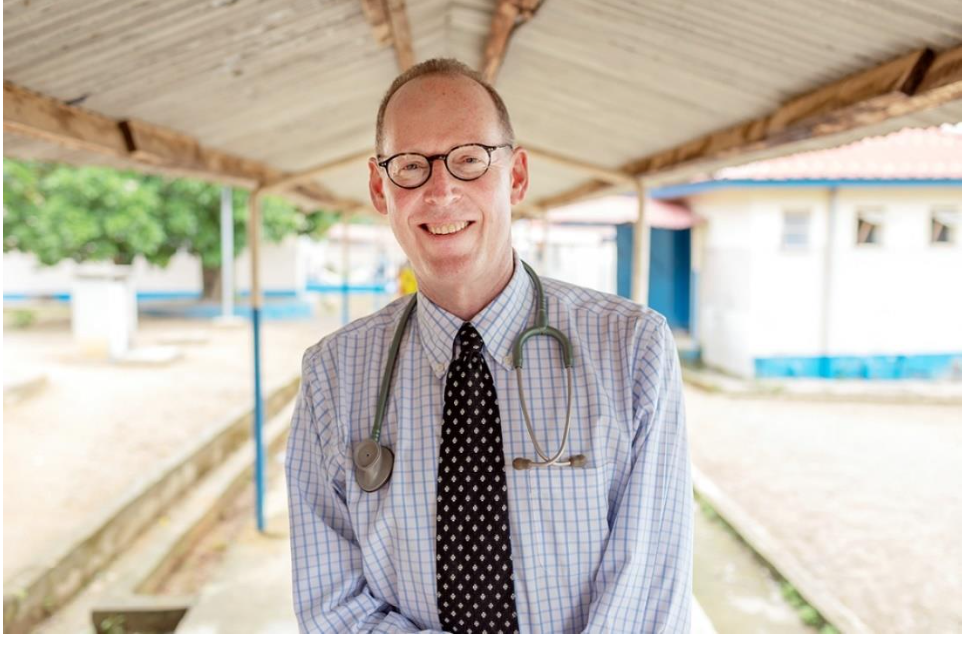
Remembering Dr. Paul Farmer
World-renowned infectious disease doctor, anthropologist, global health advocate, and author leaves large legacy
Posted on Feb 21, 2022

Partners In Health announced that its founder, Dr. Paul Farmer, unexpectedly passed away today in Rwanda from an acute cardiac event while he was sleeping. Dr. Farmer was 62 years old. He is survived by his wife, Didi Bertrand Farmer, and their three children.

Partners In Health CEO Dr. Sheila Davis released the following statement: “Paul Farmer’s loss is devastating, but his vision for the world will live on through Partners in Health. Paul taught all those around him the power of accompaniment, love for one another, and solidarity. Our deepest sympathies are with his family.”

::::::


About Dr. Paul Farmer
Paul Farmer, M.D., Ph.D., was Kolokotrones University Professor and chair of the Department of Global Health and Social Medicine at Harvard Medical School, chief of the Division of Global Health Equity at Brigham and Women’s Hospital in Boston, and co-founder and chief strategist of Partners In Health. 

Dr. Farmer and his colleagues pioneered novel, community-based treatment strategies that demonstrate the delivery of high-quality health care in resource-poor settings. He wrote extensively on health, human rights, and the consequences of social inequality. Dr. Farmer was a member of the American Academy of Arts and Sciences and the Institute of Medicine of the National Academy of Sciences, from which he was the recipient of the 2018 Public Welfare Medal.

He authored multiple books, including: In the Company of the Poor: Conversations with Dr. Paul Farmer and Fr. Gustavo Gutiérrez, Reimagining Global Health: An Introduction, and To Repair the World: Paul Farmer Speaks to the Next Generation. His most recent book was released in November 2020: Fevers, Feuds, and Diamonds: Ebola and the Ravages of History.

Inequity ‘a Moral Indictment of Our Times’, Secretary-General Tells Universal Vaccination Debate, Saying It Gives COVID Free Reign to Circulate Unchecked

Inequity ‘a Moral Indictment of Our Times’, Secretary-General Tells Universal Vaccination Debate, Saying It Gives COVID Free Reign to Circulate Unchecked
Secretary-General Statements and Messages
25 February 2022 SG/SM/21159
Following is the text of Secretary-General António Guterres’ video remarks to the high-level thematic debate on “Galvanizing Momentum for Universal Vaccination”, in New York today:

Mr. President of the General Assembly, Excellencies, ladies and gentlemen,
Let me begin by thanking the President of the General Assembly for convening this critical meeting focused on galvanizing momentum for universal vaccination.

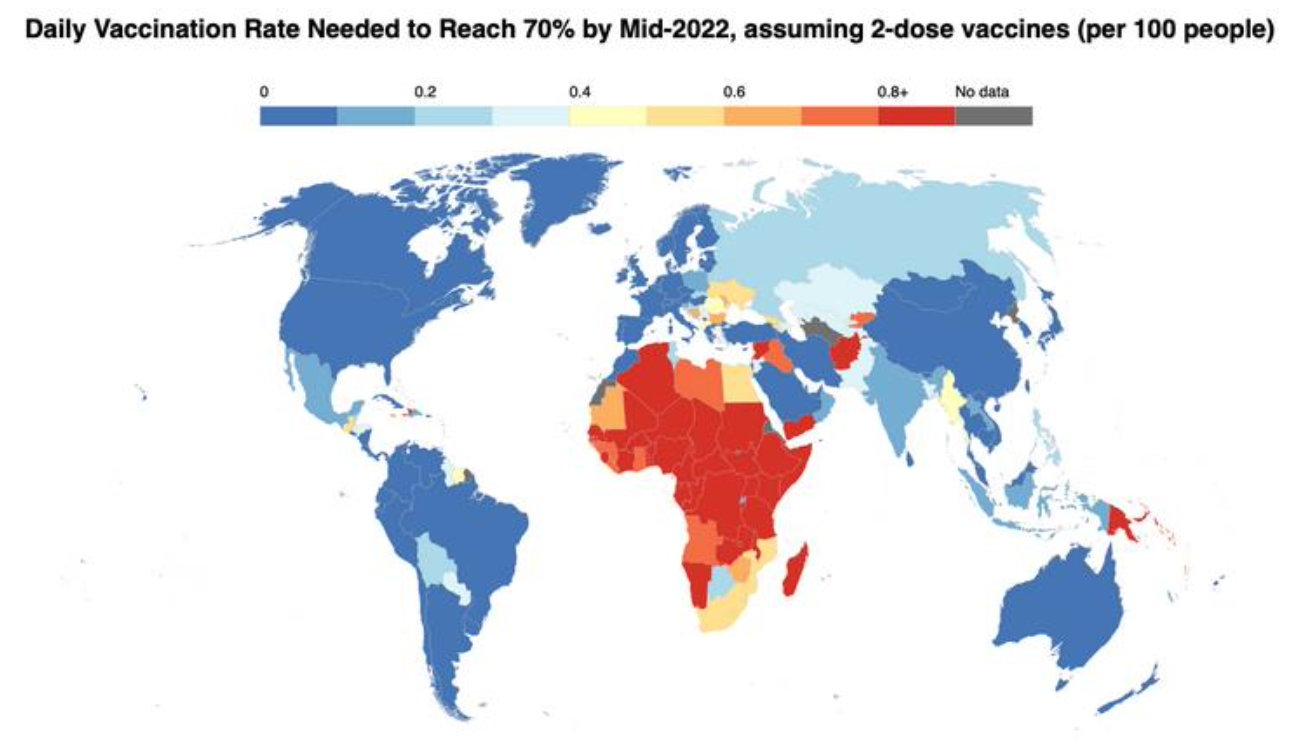
We have the tools and the know-how to end the COVID-19 pandemic this year.  But we have a long way to go.  We are nowhere near meeting the WHO [World Health Organization] goal to vaccinate 70 per cent of people in all countries by the middle of this year.


Yes, over 10 billion doses of COVID-19 vaccines have been administered globally.  But this number masks the stark inequity in vaccine access.  High-income countries have administered 13 times more doses per person than low-income countries.  Eighty-five per cent of the people of Africa have not received a single vaccine dose.

This inequity is a moral indictment of our times.  It costs lives.  It damages economies.  And it gives the virus free reign to circulate unchecked and mutate, eroding hard-won gains and threatening the whole world.

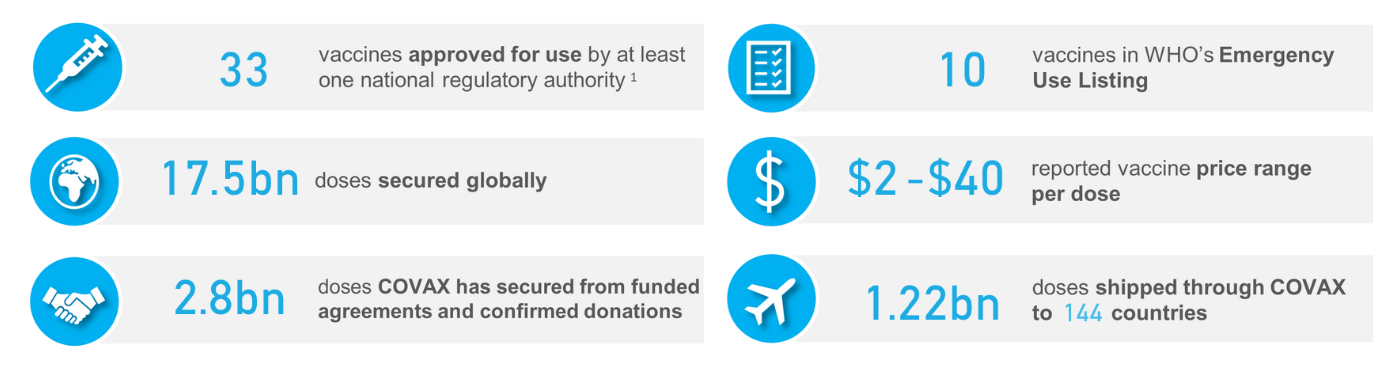
Ending the pandemic requires ensuring access to tests, vaccines and treatments for everyone, everywhere.  In recent months, deliveries of COVID-19 vaccines have been steadily increasing.  This month marked COVAX’s delivery of 1 billion doses to 92 low- and middle-income countries.

But much more is needed.  Galvanizing momentum means countries fulfilling and accelerating vaccine dose-sharing and donation commitments to COVAX with better quality of supply.  It means manufacturers prioritizing and fulfilling vaccine contracts with COVAX, ensuring full transparency on monthly production and creating the conditions for the local or regional production of tests, vaccines and treatments.

This includes pharmaceutical companies more rapidly sharing licences, know-how and technology.  Regional production is critical for sustainable supply.  It means significant investments in fragile health and economic infrastructure.  It means donors and international financial institutions stepping up with the necessary support.  And it means fighting the plague of vaccine misinformation.

We have seen hopeful progress when supply is secured and predictable … when doses are donated with ample shelf-life … and when there is a deep understanding of what a country needs to accelerate vaccinations.

Let’s build on that momentum together.  In the coming days, weeks and months let us use every opportunity — through the G20, the World Health Assembly, the G7 and the General Assembly — to mobilize ambitious action to meet the WHO vaccination strategy targets and ensure no one is left behind.  If we do it right, we won’t just end this pandemic, we will begin a truly meaningful effort to prevent future ones and build a safer, healthier world for all.
Thank you.

WHO Director-General as Guest Lecture at Robert S. McNamara Lecture on War and Peace, Harvard Kennedy School – 25 February 2022

WHO Director-General as Guest Lecture at Robert S. McNamara Lecture on War and Peace, Harvard Kennedy School – 25 February 2022
25 February 2022
Speech [Excerpt]
The authors of WHO’s Constitution were well aware of the link between health and peace, which is why they wrote in the preamble that the health of all peoples is fundamental to the attainment of peace and security, and is dependent upon the fullest co-operation of individuals and States.

Since those words were written, the world has faced many outbreaks and epidemics. Just this century, we have seen H5N1 influenza, SARS, MERS, the H1N1 pandemic, multiple Ebola outbreaks, Zika and more.

But of course, nothing matches the scale of the COVID-19 pandemic, which has thrown the world into turmoil for more than two years. COVID-19 is a powerful demonstration that a pandemic is so much more than a health crisis. It illustrates the interconnectedness between health and the economy, security, education, and the intimate links between the health of humans, animals and our planet. There are many lessons to learn about what has worked and what has not. Let me suggest five:


The first is that science must guide policy, not the other way round.
Throughout the pandemic, WHO has convened thousands of scientists from around the world to examine the rapidly emerging evidence and distil it into the guidance we give the world.
Just this week, we have convened a research and innovation forum to identify the most pressing research priorities and chart the way forward.

Science has given us valuable insights into how this virus spreads, how it causes disease, and how to stop it. But in some countries and communities, and on social media, the marginalization and politicization of science has impeded the response to the pandemic and cost lives. Politics undermining science. My point is not that science should be the only consideration in decision-making about public health. My point is that science should be the central and guiding consideration.


The second lesson is that science can in fact widen inequalities, unless it is paired with a commitment to equity.
I’m sure that most or all of you are vaccinated. And yet as we speak, 83% of the population of Africa is yet to receive a single dose of vaccine. Vaccine nationalism, export bans and bilateral deals between manufacturers and high-income nations severely restricted the number of doses COVAX was able to ship in the first half of last year. The supply situation has now improved, and COVAX has been able to ship more than 1.2 billion doses of vaccine to 144 countries and territories.

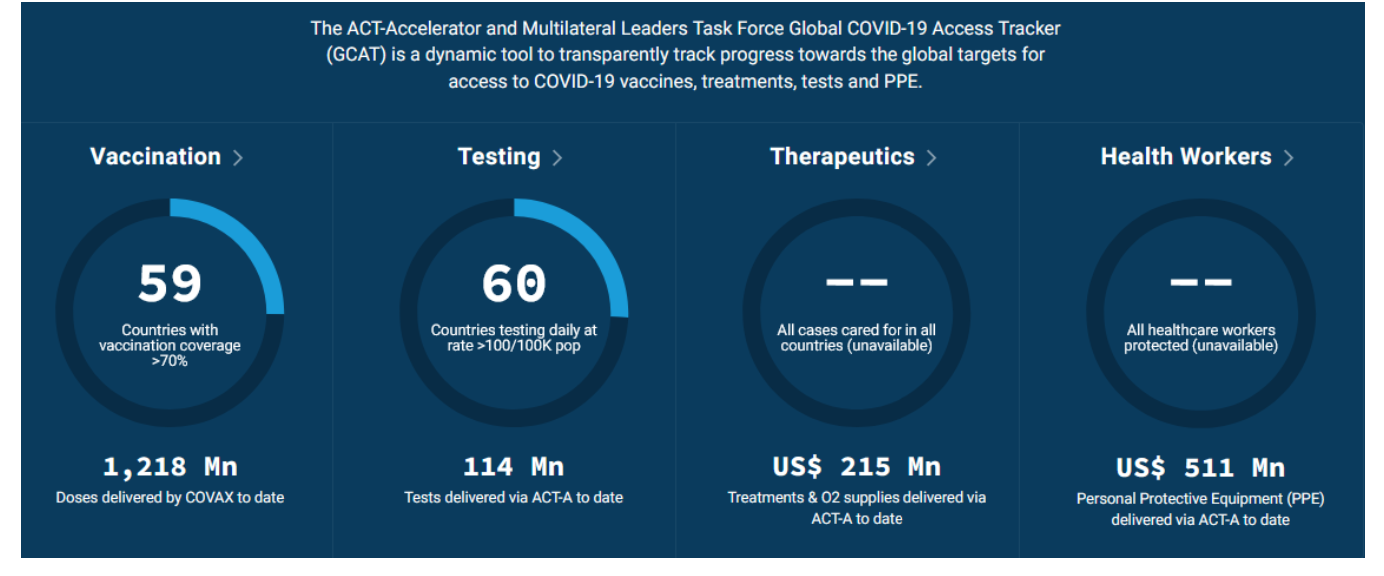
WHO and our partners are working night and day to support countries to turn vaccines into vaccinations, to reach our target of vaccinating 70% of the population of every country by the middle of this year. To reach that target, we are calling on all countries to urgently fill the ACT Accelerator’s financing gap of US$16 billion, to ensure equitable access to vaccines, tests and treatments and PPE everywhere.


The third lesson is that a resilient health system is not the same thing as an advanced medical care system.
Even some countries with the most sophisticated medical care were overwhelmed by COVID-19.
By contrast, some middle-income countries with fewer resources fared much better, thanks to investments in public health after outbreaks of SARS, MERS, H1N1 and others, especially in the Mekong region.

For instance, the simple art of contact tracing is one that many high-income countries have struggled with, but it’s one that many low- and middle-income countries have done well, because of their experience with infectious disease outbreaks, and their investments in public health. The backbone of public health is robust primary health care, for detecting outbreaks at the earliest possible stage, as well as for preventing disease and promoting health at the community level.


The fourth lesson is that the world needs a new agreement that sets the rules of the game for responding to epidemics and pandemics.
Instead of a coherent and cohesive global response, the pandemic has been marked by a chaotic patchwork of responses, which in some cases have punished countries for doing the right thing, as in the case of the travel bans imposed on South Africa and Botswana when they first reported the emergence of the Omicron variant.


And the fifth lesson is that trust is everything.
A study published in The Lancet earlier this month examined the reasons why some countries have had higher rates of infection and death than others from COVID-19. The age profile of the country, GDP per capita, and mean body mass index were all found to play a part. But the researchers found that perhaps the single most important factor in countries’ preparedness and ability to respond effectively is trust.

The study concluded that stronger risk communication and community engagement are essential for making the world safer against future epidemics and pandemics.


Vaccines, diagnostics, therapeutics and other tools are essential, but the most effective tool is engaged and empowered communities…

IFPMA – Three priorities to urgently increase access to COVID-19 vaccines

IFPMA – Three priorities to urgently increase access to COVID-19 vaccines
25 February 2022
[Excerpts]
…Today, over 12 billion doses of vaccines have been produced, and more than 60 percent of the world’s population have received at least one dose.[1] Getting as many people as possible vaccinated remains critical to our pandemic response. Even in the face of new variants, including most recently Omicron, current vaccines show continued protection from infection and significant effectiveness against hospitalization and death. For those people who do contract COVID-19 or are at-risk, several approved treatments are now an important and integral part of combatting COVID-19.

Whilst significant progress has been made, COVID-19 vaccines are still not reaching equitably all priority populations worldwide. In May 2021, …biopharmaceutical companies publicly committed to continue working with governments, international institutions, and non-governmental organizations to address vaccine inequity. Over the past six months, governments that have significant domestic supplies of COVID-19 vaccines have increasingly shared them with low- and lower-middle-income countries and vaccine manufacturers have continued to further ramp up production, including through voluntary licensing and technology transfer across several continents. By the end of January 2022, COVAX delivered its first billion vaccine doses.[2] In addition, over 3 billion doses have been delivered to low- and lower-middle-income countries. Moving forwards, we expect that a significant number of doses will continue to be delivered to low- and lower-middle-income countries.


Our collective efforts are materializing, but to achieve an improvement in vaccine equity, manufacturers, governments, international institutions, and other non-governmental organizations must redouble efforts to support countries as they mobilize to execute national vaccine rollouts and remove barriers to the efficient distribution and administration of vaccine doses, so that they reach those who need them most.

To support this endeavor,…biopharmaceutical companies will continue to work with all relevant stakeholders on the following three overarching priorities and supporting activities:


STEP UP SUPPORT FOR COUNTRY READINESS TO ROLL OUT COVID-19 VACCINE DOSES:
Work collaboratively with governments and established procurement mechanisms, such as COVAX and the African Vaccine Acquisition Trust (AVAT), to improve COVID-19 vaccine demand forecasting, alignment of deliveries and donations, distribution and administration, particularly in low- and lower-middle income countries;
Continue engaging and sharing information with COVAX and other relevant organizations to ensure countries have better visibility of COVAX deliveries and donations;
Provide timely information to assist with regulatory system streamlining and appropriate flexibilities to smooth the path for the reallocation of doses, and enable swift approval of new COVID-19 vaccines and manufacturing facilities;
Continue to increase confidence in vaccines and vaccination programs, particularly by countering misinformation, providing timely vaccine effectiveness and safety data, and supporting adequate no-fault compensation programs;
Continue to encourage governments to expand the number of vaccinators in countries to be able to rapidly deploy supply.


CONTRIBUTE TO EQUITABLE DISTRIBUTION OF COVID-19 VACCINE DOSES:
Continue to work with governments that have significant supplies of COVID-19 vaccines to improve dose sharing with low- and lower-middle-income countries in a responsible and timely way, through COVAX or other efficient established mechanisms such as AVAT;
Expend every effort to make uncommitted COVID-19 vaccine doses available with urgency to prioritized populations in low- and lower-middle income countries through COVAX or other efficient established mechanisms;
Work with relevant authorities to facilitate recognition of an extension to the COVID-19 vaccine shelf-life and batch-level extensions in line with ongoing studies looking at the stability of vaccines, to avoid vaccine wastage;
Encourage the elimination of remaining trade and regulatory barriers to support cross-border supply and free flow of goods, raw materials, services, and personnel needed for COVID-19 vaccine manufacturing, distribution, and administration;
Support efforts that tackle supply chain and logistic bottlenecks to increase vaccination rates.


CONTINUE TO DRIVE INNOVATION:
Continue to prioritize research to develop the next generation of COVID-19 vaccines that can provide long lasting and strong protection against variants of concern, and address logistical issues in storage, delivery, and administration;
Urge governments to guarantee unhindered access to pathogens (samples and sequences) of any COVID-19 variants to support the rapid development of potential new vaccines and treatments;
Continue to optimize production of vaccines, without compromising safety and quality, including through existing and additional voluntary collaborations with partners that can produce significant quantities.

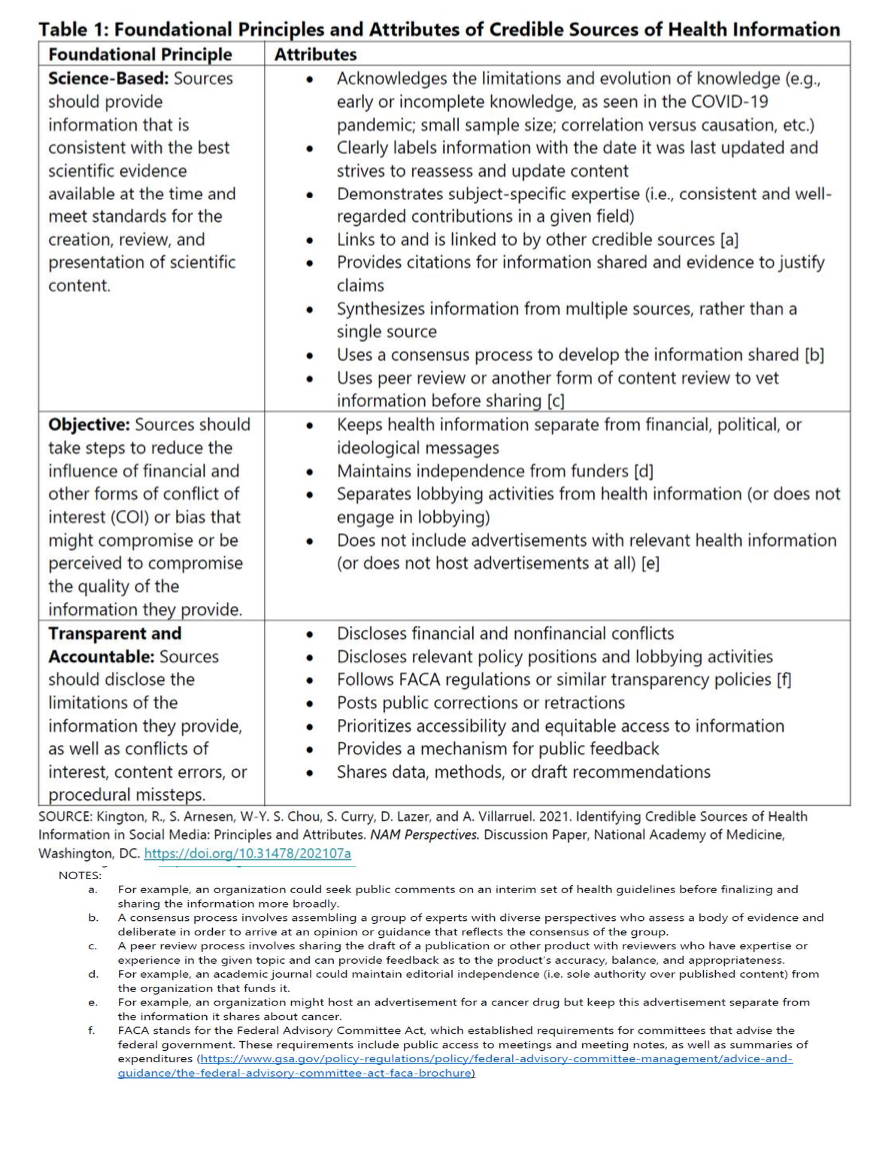
WHO and NAM [National Academy of Medicine] encourage digital platforms to apply global principles for identifying credible sources of health information

WHO and NAM [National Academy of Medicine] encourage digital platforms to apply global principles for identifying credible sources of health information
24 February 2022
The World Health Organization (WHO) and the National Academy of Medicine (NAM) are encouraging social media companies and other digital platforms to apply global principles for identifying credible sources of health information in their channels. The principles, originally published in a 2021 NAM paper, were evaluated by an international group of public health experts convened by WHO and BMJ in December 2021. The WHO meeting report is now available for download.

“Digital platforms have a uniquely powerful opportunity to enable worldwide access to high-quality health information,” said NAM president Victor J. Dzau. “We hope these principles can serve as a launchpad for productive collaboration among industry, public health, and consumer representatives to protect and improve the health of people everywhere.”

“The rapid spread of health misinformation through digital platforms has become a serious threat to public health globally,” said Andy Pattison, Team Lead, Digital Channels, Department of Digital Health and Innovation, WHO. “Since the COVID-19 pandemic began, WHO has worked with technology companies to keep people safe and informed by improving accessibility of high-quality health information online. It is every platform’s responsibility to protect the safety and health of their users. For this reason, we encourage all digital platforms to incorporate the new global principles for identifying credible sources of health information in their guidelines, safety policies and enforcement to protect public health.”

The principles state that, to be considered credible, sources should be science-based, objective, transparent, and accountable. The NAM paper provides a list of material attributes that platforms and consumers can use to assess a source’s alignment with these principles.

Participants at the December 2021 WHO meeting agreed that the principles and attributes are generally applicable to global contexts. However, they identified potential implementation challenges, noting that “factors such as culture, language, the influence of the source of information and political views within the country can affect what is seen as credible.”…

Public Thinks COVID-19 Is Here to Stay, Global Survey Finds

World Economic Forum [to 26 Feb 2022]
https://agenda.weforum.org/news/
Media [Selected]
Public Thinks COVID-19 Is Here to Stay, Global Survey Finds
News 24 Feb 2022
Most adults surveyed across 30 countries agree that even if maximum measures were to be maintained COVID-19 will never be fully eradicated
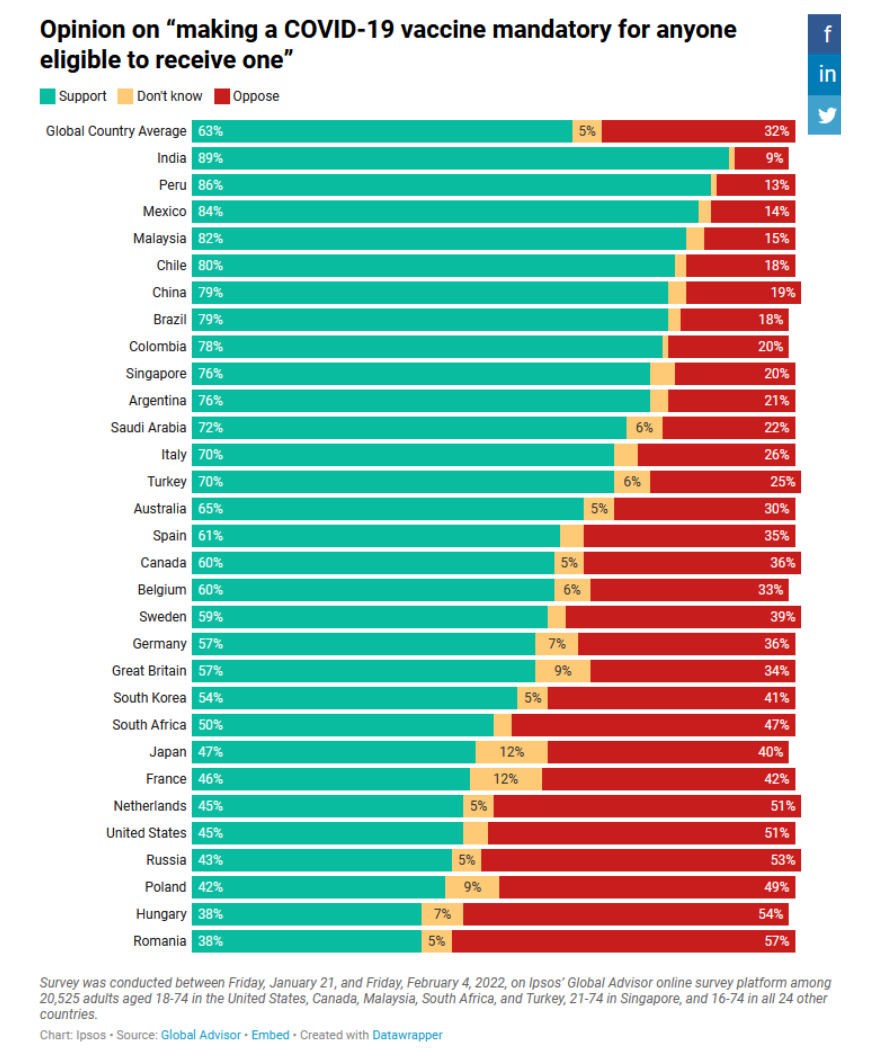
However, support for mandatory vaccination or proof of vaccination in certain public locations varies wildly across different regions and countries
Generally, Asian and Latin American countries are the most supportive of maintaining vaccine mandates, while Eastern and Central Europe and the United States were the most opposed
Read more about the World Economic Forum-Ipsos Global Survey on COVID-19 Expectations and Vaccination here
A new Ipsos survey for the World Economic Forum finds that, on average across 30 countries, 71% of adults do not expect that COVID-19 will ever stop spreading entirely. A majority of adults in every country – from 51% in China to 85% in the Netherlands – agree that “even with all the measures being taken, we will never be able to fully stop the spread of COVID-19 and variants.”
However, the survey reveals vastly different levels of popular support for mandatory vaccination across countries. In India, China, Malaysia, Singapore, and throughout Latin America, more than 75% support “making a COVID-19 vaccine mandatory for anyone eligible to receive one.” In most of Central and Eastern Europe as well as in the United States, majorities are opposed to it. Views about requiring proof of vaccination to be allowed in various facilities (e.g., sporting venues, restaurants, workplaces) mirror those on mandatory vaccination and vary similarly across countries.
Over the past year, support for vaccination mandates has grown significantly in China, Italy, Australia, Germany, and France, but it has decreased in Japan and the U.S.
These are the main findings of a survey of 20,525 adults aged 18-74 from 30 countries conducted by Ipsos on its Global Advisor online platform between January 21 and February 4, 2022…
…Support for mandatory COVID-19 vaccination
On average across all 30 countries surveyed, 63% support “making a COVID-19 vaccine mandatory for anyone eligible for it” while 32% oppose it and 5% don’t know. Support exceeds 75% in emerging countries of Asia and Latin America, led by India (89%) Peru (86%). In contrast, opposition dominates in Romania (57%), Hungary (54%), Russia (53%), the United States (51%), and the Netherlands (51%).

Coronavirus [COVID-19] – WHO Public Health Emergency of International Concern (PHEIC)

::::::


Coronavirus [COVID-19] – WHO
Public Health Emergency of International Concern (PHEIC)
https://www.who.int/emergencies/diseases/novel-coronavirus-2019


Weekly Epidemiological and Operational updates
Last update: 25 Feb 2022
Confirmed cases :: 430 257 564
Confirmed deaths :: 5 922 049
Vaccine doses administered: 10 407 359 583


::::::

Weekly epidemiological update on COVID-19 – 22 February 2022
Overview
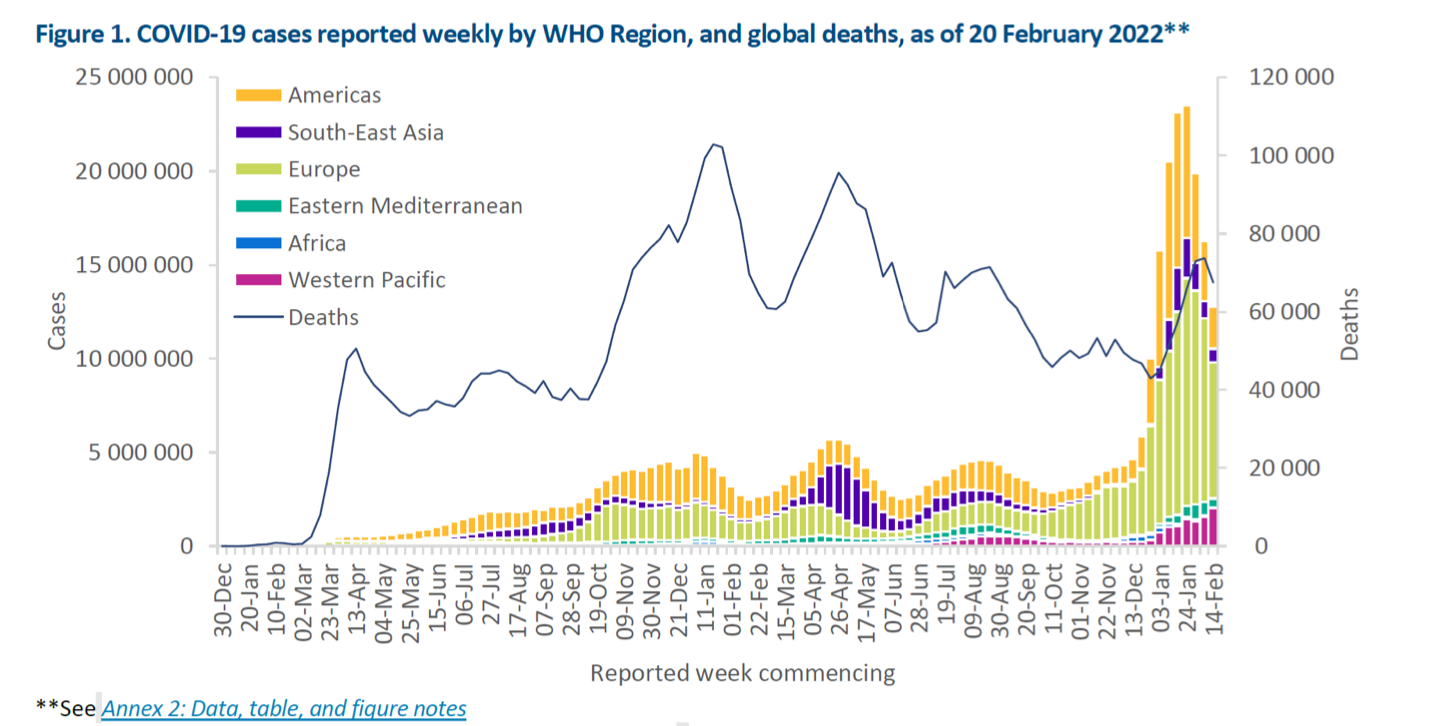
Globally, during the week of 14 to 20 February 2022, the number of new COVID-19 cases and deaths decreased by 21% and 8% respectively, compared to the previous week. Across the six WHO regions, over 12 million new cases and over 67 000 new deaths were reported. As of 20 February 2022, over 422 million confirmed cases and over 5.8 million deaths have been reported globally.
At the regional level, the Western Pacific Region reported a 29% increase in the number of new weekly cases while all other regions reported decreases. The number of new weekly deaths increased in the Western Pacific (+21%) and the African (+20%) regions, and decreased in the South-East Asia (-37%), the Regions of the Americas (-9%), the European (-5%) and Eastern Mediterranean regions (-4%).
In this edition we provide an update on:
The geographic distribution of circulating SARS-CoV-2 variants of concern (VOCs), including the prevalence and summary of current evidence of the Omicron variant. We also provide updates on vaccine effectiveness for the Delta and Omicron variants.


::::::

Statement on Omicron sublineage BA.2
WHO 22 February 2022
As part of its on-going work to track variants, WHO’s Technical Advisory Group on SARS-CoV-2 Virus Evolution (TAG-VE) met yesterday to discuss the latest evidence on the Omicron variant of concern, including its sublineages BA.1 and BA.2.

Based on available data of transmission, severity, reinfection, diagnostics, therapeutics and impacts of vaccines, the group reinforced that the BA.2 sublineage should continue to be considered a variant of concern and that it should remain classified as Omicron. The group emphasized that BA.2 should continue to be monitored as a distinct sublineage of Omicron by public health authorities.  

The Omicron variant of concern is currently the dominant variant circulating globally, accounting for nearly all sequences reported to GISAID. Omicron is made up of several sublineages, each of them being monitored by WHO and partners. Of them, the most common ones are BA.1, BA.1.1 (or Nextstrain clade 21K) and BA.2 (or Nextstrain clade 21L). At a global level, the proportion of reported sequences designated BA.2 has been increasing relative to BA.1 in recent weeks, however the global circulation of  all variants is reportedly declining.

BA.2 differs from BA.1 in its genetic sequence, including some amino acid differences in the spike protein and other proteins. Studies have shown that BA.2 has a growth advantage over BA.1.  Studies are ongoing to understand the reasons for this growth advantage, but initial data suggest that BA.2 appears inherently more transmissible than BA.1, which currently remains the most common Omicron sublineage reported.  This difference in transmissibility appears to be much smaller than, for example, the difference between BA.1 and Delta. Further, although BA.2 sequences are increasing in proportion relative to other Omicron sublineages (BA.1 and BA.1.1), there is still a reported decline in overall cases globally…


::::::

WHO Director General Speeches [selected]
https://www.who.int/director-general/speeches
Selected
25 February 2022
Speech
WHO Director-General as Guest Lecture at Robert S. McNamara Lecture on War and Peace, Harvard Kennedy School – 25 February 2022
[See Perspectives above for excerpt]

25 February 2022
Speech
WHO Director-General’s opening remarks at High-Level Thematic Debate: Galvanizing Momentum for Universal Vaccination, President of the 76th Session of the General Assembly – 25 February 2022

24 February 2022
Speech
WHO Director-General’s opening remarks at COVID-19 Global research & innovation forum  – 24 February 2022

24 February 2022
Speech
WHO Director-General’s opening remarks at first meeting of the Intergovernmental Negotiating Body to draft and negotiate a WHO convention, agreement or other international instrument on pandemic prevention, preparedness and response – 24 February 2022
[Excerpt]
…This is a momentous undertaking, and a necessary one. Because the COVID-19 pandemic has shown that the status quo is not good enough to protect our communities, our societies, and our economies.

The pandemic has exposed and exacerbated fundamental weaknesses in pandemic preparedness and response at both the national and the global levels:
:: Complex and fragmented governance and lack of leadership;
:: Inadequate financing;
:: And insufficient systems and tools.
Instead of solidarity, the pandemic has been marred by inequity.

Equity does not mean providing access to tools when there is a surplus, when the privileged have used what they need. It is about timely access, so that all people have access to all the available tools, at the same time.

The lack of trust or the trust deficit between and within countries, partners and stakeholders has shattered our unified defence during the pandemic. Voluntary mechanisms have not solved and will not solve these challenges.

Global health security is too important to be left to chance, or goodwill, or shifting geopolitical currents, or the vested interests of companies and shareholders. Recognizing that our fates as a global community are intertwined, the World Health Assembly established this intergovernmental negotiating body during a special session, which, by the way, is only the second time it had held such an extraordinary meeting.

Today’s meeting is the start of an historic opportunity for Member States to work together to strengthen the world’s structures and systems for pandemic preparedness and response.

While we are operating under an ambitious timeline, we need to take the lessons learned from the COVID-19 pandemic and use them to build back better. The aim should be a world better prepared to prevent pandemic threats and respond to them when they do occur, in at least five ways:


First, by building national, regional and global capacities for preparing and responding to pandemics and other global health emergencies, based on a whole-of-government and whole-of-society approach;

Second, by establishing global access and benefit sharing for all pathogens, and determining a global policy for the equitable production and distribution of countermeasures;

Third, by establishing robust systems and tools for pandemic preparedness and response;

Fourth, by building a long-term plan for sustainable financing, so that  support for global health threat management and response systems is shared by all;

And fifth, by empowering WHO to fulfil its mandate as the directing and coordinating authority on international health work, including for pandemic preparedness and response

At the Special Session, the World Health Assembly specifically noted the importance of broad engagement to ensure a successful outcome. So we encourage all Member States to participate in this process and support the work of the INB, in developing a new international instrument on pandemic prevention, preparedness and response.

Now begins the critical process of coming together around a common goal – health – for the future of our children and their children.  

Together, let us chart a way forward, for this and future generations, to better prevent, prepare and respond to future pandemics and health emergencies.

23 February 2022
Speech
WHO Director-General’s remarks at the Preparatory Meeting of the Global Fund’s Seventh Replenishment – 23 February 2022

23 February 2022
Speech
WHO Director-General’s opening remarks at the media briefing on COVID-19 – 23 February 2022

22 February 2022
Speech
WHO Director-General’s remarks at ILO Multisectoral Policy Forum: “Building a human-centered recovery from the COVID-19 crisis” – 22 February 2022

Status of COVID-19 Vaccines within WHO EUL/PQ evaluation process 23 December 2021
[Full scale view available at title link above]
[Updated on 18 February 2022]


COVID Vaccines/Therapeutics – Developer/Manufacturer Announcements

COVID Vaccines/Therapeutics – Developer/Manufacturer Announcements
[Selected press releases/announcements from organizations from WHO EUL/PQ listing above and other organizations]


AstraZeneca
Press ReleasesNo new digest announcements identified

Bharat Biotech
Press Releases – No new digest announcements identified

BioCubaFarma – Cuba
Últimas Noticias – Website not leading at inquiry


Biontech
Press Releases
Pfizer and BioNTech Receive Positive CHMP Opinion for COVID-19 Vaccine Booster in Adolescents 12 through 17 Years of Age in the European Union
24 February 202


CanSinoBIO
News – [Website not responding at inquiry]

Clover Biopharmaceuticals – China
News – No new digest announcements identified


Curevac [Bayer Ag – Germany]
News – Website not responding at inquiry


Gamaleya National Center
Latest News and Events – See Russia below

IMBCAMS, China
Home – Website not responding at inquiry


Janssen/JNJ
Press Releases – No new digest announcements identified


Moderna
Press Releases
February 24, 2022
EMA Committee for Medicinal Products for Human Use (CHMP) Adopts Positive Opinion Recommending Authorization for The Use of The Moderna Covid-19 Vaccine in Children (6-11 Years) In the European Union

February 23, 2022
Moderna and Thermo Fisher Scientific Announce Long-Term Strategic Collaboration
Agreement to leverage dedicated commercial fill-finish manufacturing capacity in the US for mRNA vaccines and therapies

February 22, 2022
Moderna Initiates Phase 3 Portion of Pivotal Trial for mRNA Respiratory Syncytial Virus (RSV) Vaccine Candidate, Following Independent Safety Review of Interim Data


Novavax
Press Releases
Novavax Announces Shipments of its COVID-19 Vaccine to European Union Member States
Feb 23, 2022


Pfizer
Recent Press Releases
02.24.2022
Pfizer and BioNTech Receive Positive CHMP Opinion for COVID-19 Vaccine Booster in Adolescents 12 through 17 Years of Age in the European Union

02.23.2022
CDC Advisory Committee on Immunization Practices Votes to Recommend TicoVac™, Pfizer’s Tick-Borne Encephalitis (TBE) Vaccine, For Those at Risk of Virus Exposure


Sanofi Pasteur
Press Releases
February 23 2022
Press releases
Sanofi and GSK to seek regulatory authorization for COVID-19 vaccine
* Final analysis of the global VAT02 booster trial confirms universal ability to boost neutralizing antibodies 18- to 30-fold across vaccine platforms (mRNA, adenovirus)
* In the VAT08 Phase 3 primary series trial, two doses of the Sanofi-GSK vaccine in seronegative populations demonstrated:
* 100% efficacy against severe COVID-19 disease and hospitalizations
* 75% efficacy against moderate or severe COVID-19 disease
* 57.9% efficacy against any symptomatic COVID-19 disease, in line with expected vaccine effectiveness in today’s environment dominated by variants of concern
* Favorable safety profile following both primary series and booster vaccinations


Serum Institute of India
NEWS & ANNOUNCEMENTS – No new digest announcements identified

Shifa Pharmed [Iran]
http://shafapharmed.com/
No news page identified.


Sinopharm/WIBPBIBP
News – No new digest announcements identified


Sinovac
Press Releases – No new digest announcements identified


Vector State Research Centre of Viralogy and Biotechnology
Home – No new digest announcements identified

Zhifei Longcom, China
[Anhui Zhifei Longcom Biologic Pharmacy Co., Ltd.]
[No website identified]


::::::

GSK
Press releases for media
Medicago and GSK announce the approval by Health Canada of COVIFENZ®, an adjuvanted plant-based COVID-19 vaccine
24 February 2022 Medicago, a biopharmaceutical company headquartered in Quebec City, and GlaxoSmithKline (GSK) today announced that Health Canada has granted approval for COVIFENZ®, COVID-19 vaccine, (plant-based virus-like particles [VLP], recombinant, adjuvanted). This vaccine is indicated for active immunization to prevent coronavirus disease 2019 (COVID19) caused by severe acute respiratory syndrome coronavirus 2 (SARSCoV2) in individuals 18 to 64 years of age…

23 February 2022 Sanofi and GSK to seek regulatory authorization for COVID-19 vaccine


Merck
News releases – No new digest announcements identified


Novartis
News – No new digest announcements identified


SK Biosciences
Press releases – No new digest announcements identified


Valneva
Press Releases
February 25, 2022
Valneva Receives Initial CHMP Assessment of its Inactivated, Adjuvanted COVID-19 Vaccine Candidate VLA2001

February 21, 2022
Valneva Awarded Up to £20 Million by Scottish Enterprise to Advance Vaccine Development

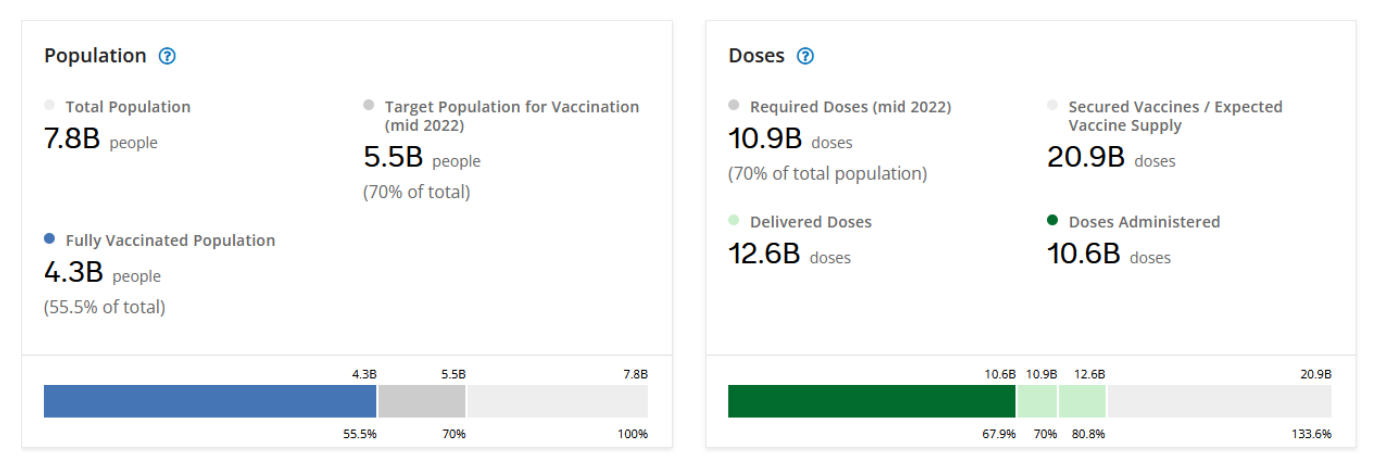
COVID-19 Global Targets and Progress Tracker – IMF

COVID-19 Global Targets and Progress Tracker – IMF
The COVID-19 Global Targets and Progress Tracker presents a consolidated view of the progress towards global COVID-19 targets, barriers in access to COVID-19 tools, and delivery of donor pledges. The global targets presented in the Tracker are based on an alignment of the targets identified in the IMF Pandemic Proposal, ACT-A Strategic Plan & Budget, and the US-hosted Global C19 Summit, and as such have been reaffirmed by multilateral institutions and global leaders. We will continue to enhance the tracker as we improve our data collection efforts.

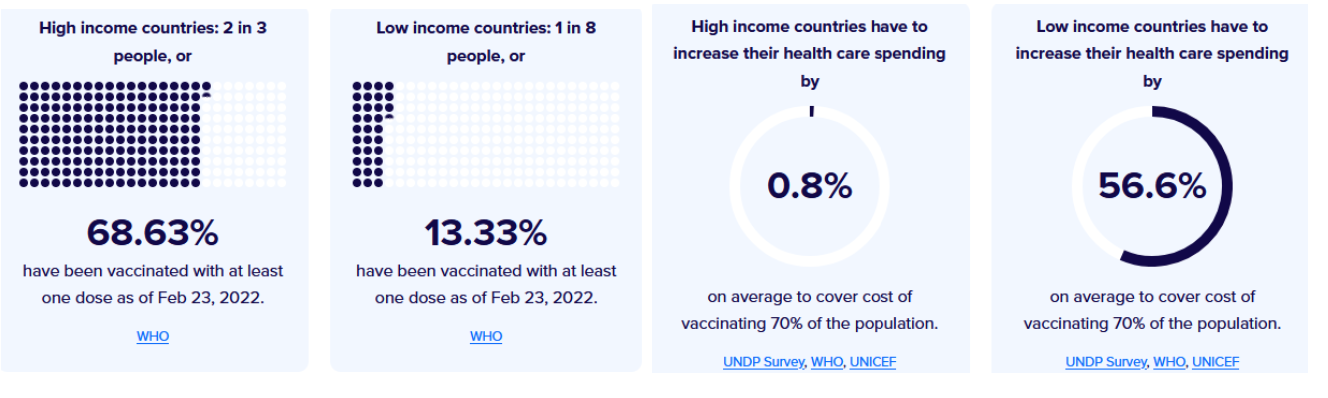
Global Dashboard on COVID-19 Vaccine Equity

Global Dashboard on COVID-19 Vaccine Equity
The Dashboard is a joint initiative of UNDP, WHO and the University of Oxford with cooperation across the UN system, anchored in the SDG 3 Global Action Plan for Healthy Lives and Well-being for All.

Dashboard on Vaccine Equity [accessed 26 Feb 2022]: https://data.undp.org/vaccine-equity/
See also visualization on Vaccine Access and Vaccine Affordability

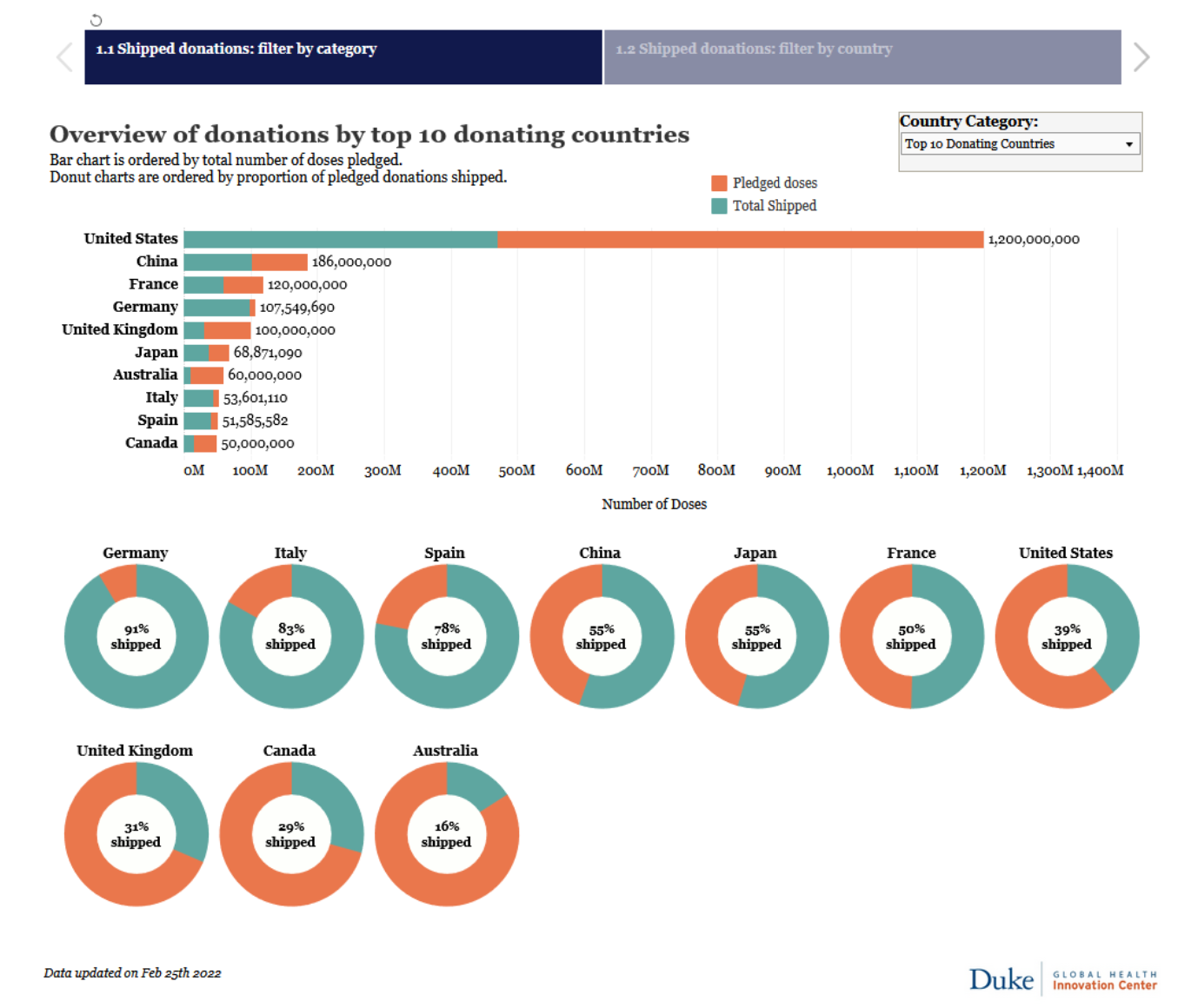
The Race for Global COVID-19 Vaccine Equity

Duke – Launch and Scale Speedometer
The Race for Global COVID-19 Vaccine Equity
A flurry of nearly 200 COVID-19 vaccine candidates are moving forward through the development and clinical trials processes at unprecedented speed; more than ten candidates are already in Phase 3 large-scale trials and several have received emergency or limited authorization. Our team has aggregated and analyzed publicly available data to track the flow of procurement and manufacturing and better understand global equity challenges. We developed a data framework of relevant variables and conducted desk research of publicly available information to identify COVID vaccine candidates and status, deals and ongoing negotiations for procurement and manufacturing, COVID burden by country, and allocation and distribution plans. We have also conducted interviews with public officials in key countries to better understand the context and challenges facing vaccine allocation and distribution
[accessed 24 July 2021]
See our COVID Vaccine Purchases research
See our COVID Vaccine Manufacturing research
See our COVID Vaccine Donations & Exports research

COVID-19 Data Explorer: Global Humanitarian Operations

COVID Vaccines – OCHA:: HDX

COVID-19 Data Explorer: Global Humanitarian Operations
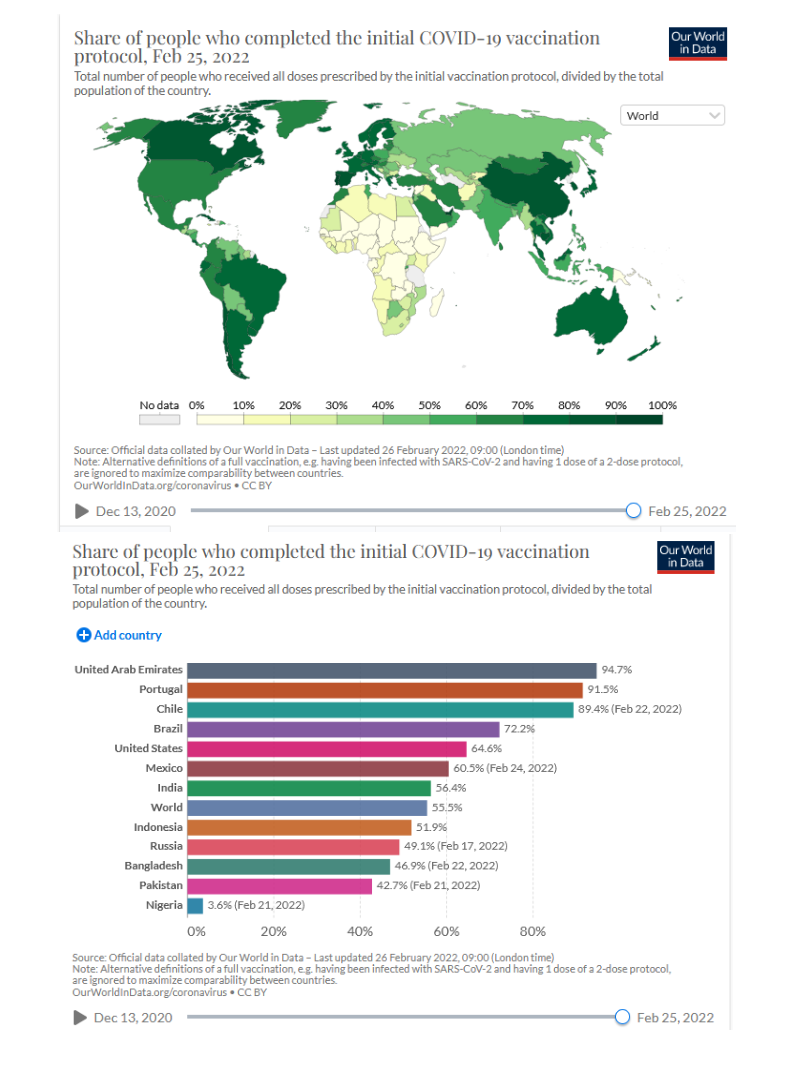
COVID-19 Vaccine Roll-out
26 Feb 2022 | COVAX (WHO,GAVI,CEPI), UNDESA, Press Reports | DATA
Global COVID-19 Figures: 430M total confirmed cases; 5.9M total confirmed deaths
Global vaccines administered: 10.6B
Number of Countries: 28
COVAX Allocations Round 4-9 (Number of Doses): 170M
COVAX Delivered (Number of Doses): 260M
Other Delivered (Number of Doses): 250M
Total Delivered (Number of Doses): 510M
Total Administered (Number of Doses): 310M

Multilateral Leaders Task Force on COVID-19 [IMF, World Bank Group, WHO, WTO]

Multilateral Leaders Task Force on COVID-19 [IMF, World Bank Group, WHO, WTO]
https://data.covid19taskforce.com/data
A global effort to help developing countries access and deliver COVID-19 vaccines, testing, and therapeutics, as they work to end the pandemic and boost economic recovery.
The International Monetary Fund, World Bank Group, World Health Organization and World Trade Organization have joined forces to accelerate access to COVID-19 vaccines, therapeutics and diagnostics by leveraging multilateral finance and trade solutions, particularly in low- and middle-income countries.
Website accessed 26 Feb 2022: https://data.covid19taskforce.com/data The global view below is complemented by country-specific dashboards here.

U.S.: COVID-19 Vaccines – Announcements/Regulatory Actions/Deployment

U.S.: COVID-19 Vaccines – Announcements/Regulatory Actions/Deployment


HHS
News
Readout of Secretary Becerra’s Virtual Roundtable on Increasing Routine Vaccinations
February 24, 2022 | News Release


BARDA – U.S. Department of HHS [to 26 Feb 2022]
https://aspr.hhs.gov/newsroom/Pages/NewsRoomHome.aspx
News
No new digest content identified.


::::::


FDA
Press Announcements
No new digest content identified.


Vaccines and Related Biological Products Advisory Committee– FDA
https://www.fda.gov/advisory-committees/blood-vaccines-and-other-biologics/vaccines-and-related-biological-products-advisory-committee
Calendar
Vaccines and Related Biological Products Advisory Committee March 3, 2022 Meeting Announcement – 03/03/2022
The Committee will meet in open session to discuss and make recommendations on the selection of strains to be included in the influenza virus vaccines for the 2022 – 2023 influenza season…


::::::


White House [U.S.] [to 26 Feb 2022]
Briefing Room – Selected Major COVID Announcements
FACT SHEET: Administration Announces New Actions to Address the Needs of People with Disabilities and Older Adults in Response to and Recovery from COVID-⁠19
February 24, 2022 • Statements and Releases


U.S. Department of State [to 26 Feb 2022]
https://www.state.gov/coronavirus/releases/
Media Notes
No new digest content identified.


USAID [to 26 Feb 2022]
https://www.usaid.gov/news-information/press-releases/2021
Selected Press Releases, Statements, Announcements
News
New General License 20 Authorizing Certain Afghanistan Transactions
February 25, 2022
USAID welcomes the announcement by the Department of the Treasury’s Office of Foreign Assets Control (OFAC) that it is expanding authorizations for commercial and financial transactions in Afghanistan, including with its governing institutions. The issuance of General License (GL) 20 aims to ensure that U.S. sanctions do not prevent or inhibit the transactions and activities needed to support the basic human needs of the people of Afghanistan, and underscores the United States’ commitment to working with the private sector, international partners and allies, and international organizations to support the people of Afghanistan.

On Russia’s Unprovoked and Unjustified Attack on Ukraine
February 25, 2022
After months of relentless diplomacy in which the United States, Ukraine and our allies engaged with Russia in good faith to avoid further conflict, President Putin has shown he is not interested in peace, but only in power—in invading a neighbor in a premeditated and unprovoked attack, carving up sovereign territory by force, and denying the Ukrainian people the right to live in peace and and determine their own future. He has gone so far as to suggest Ukraine has no ability to exist as a nation separate from Russia, and baselessly and debasingly invoked claims of genocide to create a pretext for this war of choice—a war for which Russia is entirely responsible.

USAID Providing Humanitarian Assistance in Response to Devastating Floods in Petrópolis, Brazil
February 24, 2022
The U.S. Agency for International Development (USAID) is providing $100,000 in immediate humanitarian assistance to support people affected by severe flooding and landslides following an intense storm in Brazil’s Petrópolis city, Rio de Janeiro State. The devastating storm generated more rain in a single afternoon than the historical average for the entire month. The fatal floods have affected thousands of people across the city, displacing at least 3,000 people, and destroying homes.

Europe: COVID-19 Vaccines – Announcements/Regulatory Actions/Deployment

Europe: COVID-19 Vaccines – Announcements/Regulatory Actions/Deployment


European Medicines Agency
News & Press Releases
News: Meeting highlights from the Committee for Medicinal Products for Human Use (CHMP) 21-24 February 2022 (new)
CHMP, Last updated: 25/02/2022


News: EMA recommends authorisation of booster doses of Comirnaty from 12 years of age (new)
CHMP, Last updated: 24/02/2022


News: EMA recommends approval of Spikevax for children aged 6 to 11 (new)
CHMP, PDCO, Last updated: 24/02/2022


::::::


European Centre for Disease Prevention and Control
https://www.ecdc.europa.eu/en
Latest Updates [Selected]
No new digest content identified.


::::::

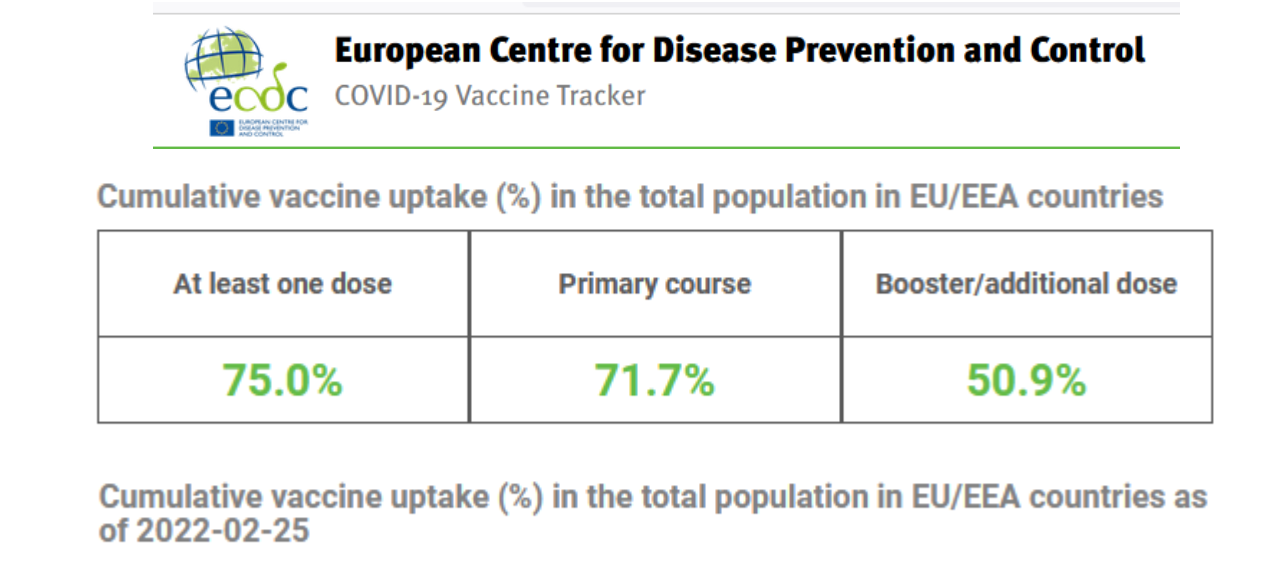
Accessed 26 Feb 2022
https://vaccinetracker.ecdc.europa.eu/public/extensions/COVID-19/vaccine-tracker.html#uptake-tab


::::::


European Commission
https://ec.europa.eu/commission/presscorner/home/en
Statement 25 February 2022
World Rare Disease Day: Statement by Commissioner Stella Kyriakides
Today, more than 6,000 rare diseases are affecting up to 36 million people in the EU. For those living with rare diseases – many of them children – quality of life is strongly affected, as they often cause chronic pain and suffering, and some can be life-threatening.

Russia: COVID-19 Vaccines – Announcements/Regulatory Actions/Deployment

Russia: COVID-19 Vaccines – Announcements/Regulatory Actions/Deployment


Russia: Sputnik V – “the first registered COVID-19 vaccine”
https://sputnikvaccine.com/newsroom/pressreleases/
Press Releases
Kazakhstan becomes the first country outside Russia to authorize Sputnik M vaccine for adolescents
Press release, 22.02.2022

Sputnik Light can become a major booster for those vaccinated with inactivated Chinese COVID vaccines globally after China has officially recommended mix & match approach with adenoviral vector-based vaccines as boosters
Press release, 21.02.2022

India: COVID-19 Vaccines – Announcements/Regulatory Actions/Deployment

India: COVID-19 Vaccines – Announcements/Regulatory Actions/Deployment


Ministry of Health and Family Welfare

https://www.mohfw.gov.in/


Government of India – Press Information Bureau
Latest Press Releases
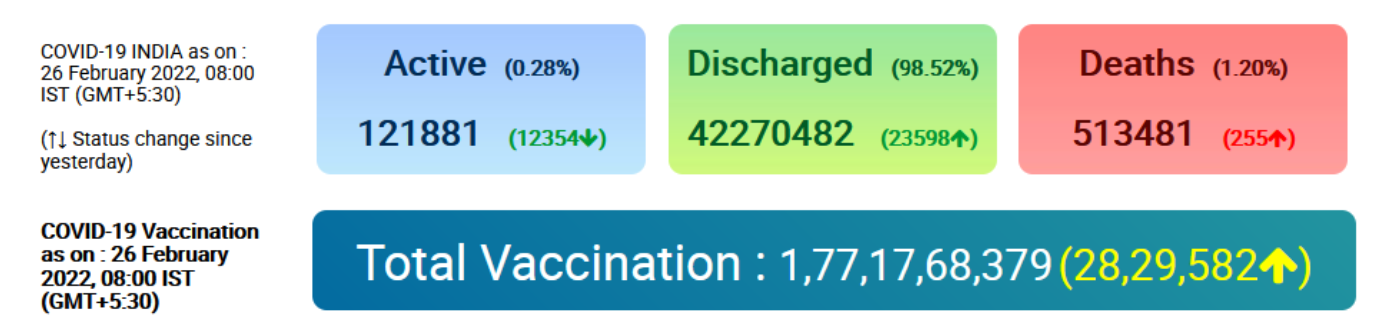
COVID – 19 Vaccination Update – Day 407
:: India’s cumulative vaccination coverage over 177.40Crore
:: More than 21 lakh Vaccine doses administered today till 7 pm
Posted On: 26 FEB 2022 8:06PM by PIB Delhi


Indian Council for Medical Research (ICMR)
https://www.icmr.gov.in/media.html
Press Releases
No new digest content identified.

China: COVID-19 Vaccines – Announcements/Regulatory Actions/Deployment

China: COVID-19 Vaccines – Announcements/Regulatory Actions/Deployment


National Health Commission of the People’s Republic of China [to 26 Feb 2022]
http://en.nhc.gov.cn/
News
Feb 26: Daily briefing on novel coronavirus cases in China
On Feb 25, 31 provincial-level regions and the Xinjiang Production and Construction Corps on the Chinese mainland reported 249 new cases of confirmed infections.

China widens choices for COVID-19 booster shots
Updated: 2022-02-21 | CHINA DAILY
China began delivering COVID-19 booster shots over the weekend based on technologies different from those used in initial inoculations in the country, in an effort to reinforce herd immunity against the disease.
The method, known as sequential immunization, targets people over 18 years old who are fully vaccinated with one of the three inactivated vaccines produced by Sinopharm and Sinovac Biotech, according to the National Health Commission. Two shots are required for full vaccination.
Instead of receiving an additional shot developed with the same technology, which has been standard practice in the country since October, people eligible for a booster now have wider choices. They can get a protein subunit COVID-19 vaccine made by Anhui Zhifei Longcom Biopharmaceutical or a viral vector vaccine from CanSino Biologics.
Protein subunit vaccines use a subunit of virus antigen to trigger an immune response, and viral vector vaccines use a modified version of a different virus to instruct our cells to fight the virus, according to Chinese researchers.
“Research has shown that boosters of both the same and different technologies are effective at further improving protection against the disease,” Wu Liangyou, deputy director of the commission’s Bureau of Disease Prevention and Control, said at a briefing on Saturday. “The public only needs to select one of them.”…

Second medical team from mainland arrives in Hong Kong in fighting latest COVID-19 outbreak
2022-02-21
HONG KONG – The second team of mainland health experts and workers arrived in the Hong Kong Special Administrative Region (HKSAR) via the Shenzhen Bay Port on Saturday to work with the HKSAR government in fighting the latest COVID-19 outbreak.
The team is comprised of 114 members, including four critical care medical specialists, four administrative staff members, and 106 sampling workers.
The four critical care specialists will discuss with clinical medical experts in Hong Kong on the treatment of severe and critical COVID-19 cases, and share the treatment experience of COVID-19 patients in the mainland.
Also on Saturday, the construction of two community isolation and treatment facilities built with assistance from the mainland began at Penny’s Bay and Kai Tak Pier in Hong Kong, respectively.
Designed and constructed by China State Construction International Holdings Ltd, the two isolation facilities are expected to provide about 9,500 quarantine units when fully operational…

POLIO Public Health Emergency of International Concern (PHEIC)

Emergencies

POLIO
Public Health Emergency of International Concern (PHEIC)
https://polioeradication.org/polio-today/polio-now/this-week/

Polio this week as of 23 February 2022
::  After the safe and successful rollout of nationwide polio campaigns since November 2021, we have received tragic news that 8 health workers at the forefront have been killed this morning in a series of shootings in Takhar and Kunduz in northeast Afghanistan.  The vaccination campaign has been suspended in both provinces.  A statement has been issued by the Regional Director of WHO’s Eastern Mediterranean Region, Dr Ahmed Al-Mandhari, as well as by the United Nations in the country, condemning these attacks, expressing condolences to the families and underscoring that the provision of health and the safety of health workers at the forefront are paramount, and must be kept neutral to any geo-political situation anywhere. Our thoughts and prayers are both with the families and our teams on the ground at this time.
:: Last week, Malawi reported a WPV1 case in a 3-year-old girl in the capital, Lilongwe. Analysis shows that the virus is genetically linked to WPV1 that was detected in Pakistan’s Sindh province in October 2019. This is the first WPV1 case from the continent of Africa in over five years. Read more

Summary of new WPV and cVDPV viruses this week (AFP cases and ES positives):
– DR Congo: two cVDPV2 cases
– Madagascar:  two cVDPV1 cases and six cVDPV1 positive environmental samples
– Malawi: one WPV1 case
– Nigeria: three cVDPV2 cases and eight positive environmental samples
– Yemen: three cVDPV2 cases


::::::
::::::

Disease Outbreak News (DONs)
:: Lassa Fever – United Kingdom of Great Britain and Northern Ireland
21 February 2022
On 9 February 2022, WHO was notified by the United Kingdom health authorities of two laboratory confirmed cases and one probable case of Lassa fever. As of 18 February, three cases have been confirmed and one death has been reported. These are the first reported Lassa fever cases in the United Kingdom since 2009, and represents the second known case of secondary transmission of Lassa fever in Europe.
The first case travelled to Mali in late 2021, where Lassa fever is endemic. After returning to the United Kingdom, the individual developed symptoms of fever, fatigue and loose stool, and was subsequently hospitalized. The first case has now recovered. The second and third cases were family members of the first case and did not travel to Mali. Both were admitted to the hospital and the third case has sadly died…


::::::
::::::

WHO/OCHA Emergencies

Health emergencies list – WHO
“The health emergencies list details the disease outbreaks, disasters and humanitarian crises where WHO plays an essential role in supporting countries to respond to and recover from emergencies with public health consequences.”
Afghanistan crisis [Last apparent update: 17 Jan 2022]

Crisis in Northern Ethiopia [Last apparent update: 1 June 2021]

Ebola outbreak, Democratic Republic of the Congo, 2021 [Last apparent update: 17 Aug 2021]

Ebola outbreak outbreak, N’Zerekore, Guinea, 2021 [Last apparent update: 17 Aug 2021]

Coronavirus disease (COVID-19) pandemic [See COVID above]


Ebola outbreak, Equateur Province, Democratic Republic of the Congo, 2020
[Last apparent update: 17 Aug 2021]

Ebola outbreak, North Kivu, Ituri, Democratic Republic of the Congo, 2018 – 2020
[Last apparent update: 17 Aug 2021]

Ebola outbreak, Democratic Republic of the Congo, 2018 [Last apparent update: 24 July 2018]

Yemen crisis [Last apparent update: 12 February 2021]

Syria crisis [Last apparent update: 18 June 2021]

Somalia crisis [Last apparent update: 24 March 2018]

Nigeria crisis [Last apparent update: 1 Oct 2021]

Ebola outbreak, Democratic Republic of the Congo, 2017 [Last apparent update: 17 Aug 2021]

Zika virus disease outbreak, 2015-2016 [Last apparent update: 24 Jan 2020]

Ebola outbreak: West Africa, 2014-2016 [Last apparent update: 17 Aug 2021]

Iraq crisis [Last apparent update: 9 Jan 2008]

South Sudan crisis [Last apparent update: 23 Sep 2020]

Avian influenza A (H7N9) virus outbreak [Last apparent update: 13 September 2021]

Middle East respiratory syndrome (MERS-CoV) outbreak [Last apparent update: 8 July 2019]

Influenza A (H1N1) virus, 2009-2010 pandemic [Last apparent update: 10 Aug 2010]


::::::

UN OCHA – Current Emergencies
Current Corporate Emergencies
Afghanistan
No new updates identified.

Northern Ethiopia
Ethiopia – Northern Ethiopia Humanitarian Update Situation Report, 24 February 2022
HIGHLIGHTS
Regional authorities estimate few hundred thousand people displaced in Zone 2 in Afar, while displacement is still ongoing, significantly increasing the needs in the region.
More than 6.8 million people reached with of food assistance in Amhara under the current food distribution cycle launched two months ago.
About 4 MT of seeds distributed to more than 11,000 farming households in Tigray since the start of the year.
More than 1,500 children, including more than 630 girls, in 13 schools in Dubti and Awash Fentale woredas in Afar enrolled in informal learning programs.
Humanitarian partners continue to reduce their operations in Tigray due to lack of supplies, fuel, and cash.
::::::
::::::

WHO & Regional Offices [to 26 Feb 2022]

WHO & Regional Offices [to 26 Feb 2022]
https://www.who.int/
News [Selected]
25 February 2022
News release
Recommendations announced for influenza vaccine composition for the 2022-2023 northern hemisphere influenza season

24 February 2022
Statement
WHO Director-General: Deeply concerned over escalating health crisis in Ukraine

24 February 2022
Departmental news
WHO and NAM encourage digital platforms to apply global principles for identifying credible sources of health information
[See Perspectives above for detail]

23 February 2022
Departmental news
ILO-WHO step up collaboration to address health emergencies and promote healthier and safer working populations

23 February 2022
News release
Moving forward on goal to boost local pharmaceutical production, WHO establishes global biomanufacturing training hub in Republic of Korea

22 February 2022
Statement
Statement on Omicron sublineage BA.2
[See COVID above for detail]

22 February 2022
Departmental news
WHO launches new guideline for the control and elimination of human schistosomiasis

21 February 2022
Departmental news
The Vaccine Manufacturing Workshop for South-East Asia and Western Pacific Regions ended

21 February 2022
Joint News Release
New WHO/ILO guide urges greater safeguards to protect health workers

21 February 2022
Departmental news
WHO validates Saudi Arabia for eliminating trachoma as a public health problem

::::::


WHO Regional Offices
Selected Press Releases, Announcements
WHO African Region
:: New push to drive up Africa’s COVID-19 vaccination
24 February 2022 Brazzaville – One year since the COVAX Facility delivered the first COVID-19 vaccines to Africa, around 400 million doses have been administered – the region’s largest ever vaccine rollout in a single year. However, vaccination rates in the continent are the lowest in the world. To help bolster uptake, World Health Organization (WHO), UNICEF, Gavi, the Vaccine Alliance, and partners are supporting mass vaccination campaigns in 10 priority countries to reach 100 million people by the end of April 2022.
:: Mauritius’ strong COVID-19 vaccination drive reaches 76% of population 25 February 2022
:: Ramping up COVID-19 vaccination among Kenya’s hard-to-reach communities 22 February 2022

WHO Region of the Americas PAHO
:: PAHO Urges Increased Polio Vaccination of Children in the Americas
23 Feb 2022 Only 82% of children received a third dose of polio vaccine in 2020, the lowest rate since 1994 Washington, DC, February 23, 2022 (PAHO)- The Pan American Health Organization (PAHO) is calling on the countries of the Americas to redouble efforts to vaccinate children against polio.  The vaccination rate with all three doses of the polio…
:: Low vaccination rates in the Caribbean must be urgently addressed to stop the spread of COVID-19 says PAHO Director
23 Feb 2022 10 out of 13 countries and territories in the Americas yet to reach 40% coverage are in the Caribbean but the tide can still be turned with targeted interventions Washington D.C. 23 February 2022 (PAHO) – Low vaccination coverage in many countries of the Caribbean must be urgently addressed to stop the spread of COVID-19 and protect the most…

WHO South-East Asia Region SEARO
No new digest content identified

WHO European Region EURO
:: WHO/Europe Statement on Ukraine (24 February 2022) 24-02-2022

WHO Eastern Mediterranean Region EMRO
:: COVID-19 triggers critical care and ICU capacity-building by WHO in fragile, conflict-affected and vulnerable countries 24 February 2022
:: WHO and IsDB in Yemen: ensuring treatment for children with genetic blood disorders 23 February 2022
:: Somalia hosts first ever health research conference in Garowe 20 February 2022

WHO Western Pacific Region
No new digest content identified


::::::

WHO Events
https://www.who.int/news-room/events/2
[Selected]
9th ACT-Accelerator Facilitation Council meeting
28 February 2022 12:30 – 15:00 CET
Primary Objectives 
:: To take stock of progress to meet global COVID-19 targets for vaccines, tests, treatments and PPE
:: Share country experience, lessons learnt and progress in meeting global COVID-19 targets
:: Reinforce Facilitation Council commitment and political support for the ACT-Accelerator campaign


Expanding our understanding of post COVID-19 condition web series: Neurology and Mental Health
1 March 2022 13:30 – 15:30 CET


Global Evidence Review on Health and Migration: Strengthening information about health services related to NCDs for refugees and migrants to support evidence-based policy making on migration and health
1 March 2022 14:00 – 15:00 CET


Malaria vaccine R&D and immunization: lessons learned and considerations for global health impact
3 March 2022 09:00 – 12:00 ET


Immunization and vaccines related implementation research advisory committee (IVIR-AC) – March 2022
7 – 11 March 2022


::::::

New WHO Publications
https://www.who.int/publications/i
Selected Titles
25 February 2022
Shaping the global innovation and access landscape for better paediatric medicines
Overview
The lack of appropriate paediatric medicines and formulations is hindering the achievement of the Sustainable Development Goals and universal health coverage and is putting children’s lives at risk.
The Global Accelerator for Paediatric Formulations Strategy (GAP-f) 2022–2024 strategy builds from the work undertaken to date by the network of leading partners, both individually and collectively, through GAP-f. With this new strategy, we are excited to increase our footprint into a broader set of diseases to bring us closer to our vision of all children having equitable access to the medicines they need.

23 February 2022
Annexes to the recommendations for use of the Moderna mRNA-1273 vaccine against COVID-19

23 February 2022
Interim recommendations for use of the Moderna mRNA-1273 vaccine against COVID-19

22 February 2022
WHO Pharmaceuticals Newsletter – N°1, 2022

21 February 2022
Global vaccine safety blueprint 2.0 (‎GVSB2.0)‎ 2021-2023
Overview
The lack of appropriate paediatric medicines and formulations is hindering the achievement of the Sustainable Development Goals and universal health coverage and is putting children’s lives at risk.
The Global Accelerator for Paediatric Formulations Strategy (GAP-f) 2022–2024 strategy builds from the work undertaken to date by the network of leading partners, both individually and collectively, through GAP-f. With this new strategy, we are excited to increase our footprint into a broader set of diseases to bring us closer to our vision of all children having equitable access to the medicines they need.

MMWR  Weekly: Current Volume (71)

MMWR  Weekly: Current Volume (71)
February 25, 2022 / No. 8 PDF of this issue
Interim Guidance: 4-Month Rifapentine-Moxifloxacin Regimen for the Treatment of Drug-Susceptible Pulmonary Tuberculosis — United States, 2022
Use of Ebola Vaccine: Expansion of Recommendations of the Advisory Committee on Immunization Practices To Include Two Additional Populations — United States, 2021
Antigen Test Positivity After COVID-19 Isolation — Yukon-Kuskokwim Delta Region, Alaska, January–February 2022
Results from a Test-to-Release from Isolation Strategy Among Fully Vaccinated National Football League Players and Staff Members with COVID-19 — United States, December 14–19, 2021
Pediatric Emergency Department Visits Before and During the COVID-19 Pandemic— United States, January 2019–January 2022
Pediatric Emergency Department Visits Associated with Mental Health Conditions Before and During the COVID-19 Pandemic — United States, January 2019–January 2022
Erratum: Vol. 71, No. 3

Coronavirus Disease 2019 (COVID-19)- CDC

Coronavirus Disease 2019 (COVID-19)– CDC
Approximately 25 announcements/reports/data summaries.
2/25/22Transcript for CDC Media Telebriefing: Update on COVID-19
2/25/22Cases in the U.S.
2/25/22EARLY RELEASE: SARS-CoV-2 B.1.1.529 (Omicron) Variant Transmission Within Households — Four U.S. Jurisdictions, November 2021–February 2022
2/25/22CDC Media Telebriefing: Update on COVID-19
2/25/22Overall US COVID-19 Vaccine Distribution and Administration Update as of Fri, 25 Feb 2022 06:00:00 EST

Africa CDC [to 26 Feb 2022]

Africa CDC [to 26 Feb 2022]
http://www.africacdc.org/
News
Tropical Storm Ana Hits hard five countries in the Southern Africa Region
28 January 2022

Africa CDC News
Capacity building for South Sudan health emergency responders on the Incident Management System
26 January 2022

Press Releases
Parsyl partners with Africa CDC to distribute 10,000 vaccine monitoring devices in support of continent’s COVID-19 response

National Health Commission of the People’s Republic of China [to 26 Feb 2022]

China CDC http://www.chinacdc.cn/en/

National Health Commission of the People’s Republic of China [to 26 Feb 2022]
http://en.nhc.gov.cn/
News
Feb 26: Daily briefing on novel coronavirus cases in China
On Feb 25, 31 provincial-level regions and the Xinjiang Production and Construction Corps on the Chinese mainland reported 249 new cases of confirmed infections.

China widens choices for COVID-19 booster shots
Updated: 2022-02-21 | CHINA DAILY

Second medical team from mainland arrives in Hong Kong in fighting latest COVID-19 outbreak
2022-02-21

National Medical Products Administration – PRC [to 26 Feb 2022]
http://english.nmpa.gov.cn/
News
Over 3.1 billion COVID-19 vaccine doses administered on Chinese mainland
2022-02-25
The number of COVID-19 vaccine doses administered on the Chinese mainland had reached over 3.1 billion by Wednesday, data from the National Health Commission showed.

CCDC Weekly Reports: Current Volume (4)
2022-02-25 / No. 8 PARASITIC DISEASE ISSUE
View  PDF of this issue
Preplanned Studies: A Knowledge Survey on Health Education of Echinococcosis Among Students — Ganzi Tibetan Autonomous Prefecture, Sichuan Province, China, 2020
Preplanned Studies: Intestinal Protozoan Infections in Patients with Diarrhea — Shanghai Municipality, Zhenjiang City, and Danyang City, China, 2011–2015 and 2019–2021
Preplanned Studies: Transmission Risks of Mountain-Type Zoonotic Visceral Leishmaniasis — Six Endemic Provincial-Level Administrative Divisions, China, 2015–2020
Commentary: Ending the “Neglect” to End Neglected Tropical Diseases

Organization Announcements

Organization Announcements

Editor’s Note:

Careful readers will note that the number and range of organizations now monitored in our Announcements section below has grown as the impacts of the pandemic have spread across global economies, supply chains and programmatic activity of multilateral agencies and INGOs.

Airfinity    [to 26 Feb 2022]

https://www.airfinity.com/insi ghts

INSIGHTS & COMPANY NEWS

No new digest content identified.

Paul G. Allen Frontiers Group    [to 26 Feb 2022]

News

No new digest content identified.

BMGF – Gates Foundation  [to 26 Feb 2022]

Press Releases and Statements

No new digest content identified.

Bill & Melinda Gates Medical Research Institute    [to 26 Feb 2022]

The Bill & Melinda Gates Medical Research Institute is a non-profit biotech organization. Our mission is to develop products to fight malaria, tuberculosis, and diarrheal diseases—three major causes of mortality, poverty, and inequality in developing countries. The world has unprecedented scientific tools at its disposal; now is the time to use them to save the lives of the world’s poorest people

No new digest content identified.

CARB-X   [to 26 Feb 2022]

News

No new digest content identified.

Center for Vaccine Ethics and Policy – GE2P2 Global Foundation   [to 26 Feb 2022]

https://centerforvaccineethicsandpolicy.net/

News/Analysis/Statements

:: Informed Consent: A Monthly Review – February 2022is now posted here

:: Past weekly editions and posting of all segments of Vaccines and Global Health: The Week in Review are available here.

:: Statement on ICF [Informed Consent Form] Posting for Clinical Trials Involving Gene Editing/Gene Therapies – Invitation to Endorse


CEPI – Coalition for Epidemic Preparedness Innovations  [to 26 Feb 2022]

http://cepi.net/

Latest News

Japan pledges US$300 million to CEPI’s pandemic preparedness plan

This investment comes at a critical time as the global community strives to end the acute phase of the COVID-19 pandemic and ensure that the world is better prepared to respond to future viral threats.

End Pandemics

25 Feb 2022

UK pledges £160 million to CEPI to boost global vaccine development

Funding will support CEPI’s work to cut new vaccine development time to 100 days, which could save millions of lives around the world.

End Pandemics

24 Feb 2022

New global vaccine trial launched to evaluate fractional COVID-19 booster shots

CEPI will provide up to US $8.7 million (AU $12.3million) to support the trial, led by the Murdoch Children’s Research Institute (MCRI), Australia, with support from PATH.

COVAX

21 Feb 2022

CEPI, THSTI and Panacea Biotec partner to develop broadly protective Betacoronavirus vaccines

CEPI will provide funding of up to $12.5m to Indian consortium, the sixth award under its programme to develop broadly protective coronavirus vaccines

21 Feb 2022

DARPA – Defense Advanced Research Projects Agency [U.S.] [to 26 Feb 2022

https://www.darpa.mil/news

News

No new digest content identified.

Duke Global Health Innovation Center  [to 26 Feb 2022]

Our Blog

No new digest content identified.

EDCTP    [to 26 Feb 2022]

http://www.edctp.org/

The European & Developing Countries Clinical Trials Partnership (EDCTP) aims to accelerate the development of new or improved drugs, vaccines, microbicides and diagnostics against HIV/AIDS, tuberculosis and malaria as well as other poverty-related and neglected infectious diseases in sub-Saharan Africa, with a focus on phase II and III clinical trials

News

25 February 2022

5FC HIV-Crypto consortium starts trial on improved treatment of cryptococcal meningitis in advanced HIV disease

Emory Vaccine Center    [to 26 Feb 2022]

http://www.vaccines.emory.edu/

Vaccine Center News

No new digest content identified.

European Vaccine Initiative  [to 26 Feb 2022]

http://www.euvaccine.eu/

Latest News, Events

No new digest content identified.

Evidence Aid   [to 26 Feb 2022]

Evidence Aid aims to save lives and livelihoods in disasters by providing decision-makers with the best available evidence and by championing its use.

http://www.evidenceaid.org/

New Resources

Promotional communications for influenza vaccination programmes Added February 25, 2022

Public health interventions and infectious diseases amongst children in low- and middle-income countries: overview of reviews Added February 23, 2022

Water, sanitation and hygiene (WASH) and undernutrition and governance in children under five in sub-Saharan Africa Added February 21, 2022

Strategies intended to address vaccine hesitancy: overview of reviews (search up to November 2014)  Added February 20, 2022

Fondation Merieux  [to 26 Feb 2022]

http://www.fondation-merieux.org/

News, Events 

Announcement

Passing of Professor François Gros

February 20, 2022 – Lyon, France

   The Mérieux Foundation was deeply moved to learn of the death of Professor François Gros, President of Honor of its Board of Directors, on February 18, 2022.

   A French biologist, he was internationally recognized for his contribution to the discovery of messenger RNA and for his career as a researcher and teacher dedicated to the study of genes and their role in the regulation of cellular functions.

   Head of the Pasteur Institute from 1976 to 1982, advisor to Prime Ministers Pierre Mauroy and Laurent Fabius, he was also Permanent Secretary of the French Academy of Sciences and member of the Institut de France…

Gavi [to 26 Feb 2022]

https://www.gavi.org/

News Releases

No new digest content identified.

GHIT Fund   [to 26 Feb 2022]

https://www.ghitfund.org/newsroom/press

No new digest content identified.

Global Fund  [to 26 Feb 2022]

https://www.theglobalfund.org/en/news/

News & Stories

23 February 2022

Five African Presidents Launch Global Fund’s US$18 Billion Campaign to Restore Progress Against AIDS, TB and Malaria Amid COVID-19 Disruption

Global Fund Applauds UK Contribution to the COVID-19 Response Mechanism

25 February 2022

   GENEVA – The Global Fund to Fight AIDS, Tuberculosis and Malaria applauds the decision by the United Kingdom Foreign, Commonwealth & Development Office to contribute GBP 60 million to the Global Fund’s COVID-19 Response Mechanism…

Global Research Collaboration for Infectious Disease Preparedness [GloPID-R] [to 26 Feb 2022]

https://www.glopid-r.org/news/

News

No new digest content identified.

Hilleman Laboratories   [to 26 Feb 2022]

http://www.hilleman-labs.org/

News & Insights

22 February 2022

Hilleman Laboratories breaks ground on pilot cGMP facility for vaccine development

New facility is part of SGD80 million vaccine development and manufacturing hub in Singapore

HHMI – Howard Hughes Medical Institute    [to 26 Feb 2022]

https://www.hhmi.org/news

Press Room                

Research   Feb 23 2022

How Some Gut Microbes Awaken Zombie Viruses in Their Neighbors

   Gut bacteria brew all sorts of chemicals, but we don’t know what most of them do. A new study suggests that one such compound, previously linked to cancer, may serve as a bizarre weapon in microbial skirmishes.

Human Vaccines Project   [to 26 Feb 2022]

http://www.humanvaccinesproject.org/

News

HVP COVID Report

Feb 18, 2022

Kristen Jill Abboud: How Many Doses of COVID-19 Vaccines Are Enough?

IAVI  [to 26 Feb 2022]

https://www.iavi.org/

Latest News

No new digest content identified

International Coalition of Medicines Regulatory Authorities [ICMRA]

http://www.icmra.info/drupal/en/news

Selected Statements, Press Releases, Research

No new digest content identified.

IFFIm

http://www.iffim.org/

Press Releases/Announcements

No new digest content identified.

IFRC   [to 26 Feb 2022]

http://media.ifrc.org/ifrc/news/press-releases/

Selected Press Releases, Announcements

23/02/2022

Afghanistan: Global support critical as COVID runs r…

21/02/2022

Madagascar: Red Cross teams rush to avert a tragedy

Institut Pasteur   [to 26 Feb 2022]

https://www.pasteur.fr/en/press-area

Press Documents

Press release

21.02.2022

Transplantation chemotherapy eliminates regenerative capacity of brain’s innate immune cells

   Annually over 50,000 bone marrow transplantations occur worldwide as a therapy for multiple cancerous and non-cancerous…

Press release

21.02.2022

Death of Professor François Gros, on February 18, 2022

IOM / International Organization for Migration [to 26 Feb 2022]    

http://www.iom.int/press-room/press-releases

News – Selected

News

24 Feb 2022

Statement on the Situation in Ukraine: IOM Director General António Vitorino

ISC / International Science Council  [to 26 Feb 2022]

https://council.science/current/

ISC is a non-governmental organization with a unique global membership that brings together 40 international scientific Unions and Associations and over 140 national and regional scientific organizations including Academies and Research Councils.

News  Blogs  Podcasts 

Call for expressions of interest to evaluate the “Leading Integrated Research for Agenda 2030 in Africa” funding programme

24.02.2022


Heide Hackmann to step down as CEO of International Science Council

21.02.2022

  The International Science Council (ISC) today announces that Heide Hackmann will step down as Chief Executive Officer. Mathieu Denis, Science Director, will become Acting CEO, and a recruitment process for a new CEO of the ISC is underway.

   Heide Hackmann has served as Chief Executive Officer of the International Science Council (ISC) since its creation in 2018, and as Executive Director of the ISC’s two predecessor organizations: the International Social Science Council (ISSC), from 2006 to 2015, and the International Council for Science (ICSU), from 2015 to 2018… 

IVAC  [to 26 Feb 2022]

Updates; Events

No new digest content identified.

IVI   [to 26 Feb 2022]

http://www.ivi.int/

IVI News & Announcements

No new digest content identified.

Johns Hopkins Center for Health Security   [to 26 Feb 2022]

https://www.centerforhealthsecurity.org/news/center-news/

Center News

Health Security Releases Special Feature on US Gene Drive Governance
February 24, 2022

MSF/Médecins Sans Frontières  [to 26 Feb 2022]

http://www.msf.org/

Latest [Selected Announcements]

War and conflict

MSF assesses response as Ukraine conflict escalates

Statement 25 Feb 2022

Nigeria

Tackling deadly and difficult-to-diagnose Lassa fever

Project Update 25 Feb 2022

Niger

Airstrike kills 12 people including children in south Niger

Press Release 21 Feb 2022

National Academy of Sciences – USA  [to 26 Feb 2022]

http://www.nasonline.org/news-and-multimedia/

News

No new digest content identified.

National Vaccine Program Office – U.S. HHS  [to 26 Feb 2022]

https://www.hhs.gov/vaccines/about/index.html

Upcoming Meetings/Latest Updates                          

No new digest content identified.

NIH  [to 26 Feb 2022]

http://www.nih.gov/news-events/news-releases

News Releases 

People from racial, ethnic, and other groups report frequent COVID-19–related discrimination

   February 24, 2022 — Study highlights the need for public health messaging strategies that address biases against all population groups that have been marginalized.

OECD  [to 26 Feb 2022]

http://www.oecd.org/newsroom/publicationsdocuments/bydate/

Newsroom

Statement from OECD Secretary-General on initial measures taken in response to Russia’s large scale aggression against Ukraine

   Following on from yesterday’s statement condemning the large scale aggression by Russia against Ukraine in the strongest possible terms and as part of its urgent reconsideration of all cooperation with Russia, the OECD Council has taken a number of initial decisions today.

25 Feb 2022

Plastic pollution is growing relentlessly as waste management and recycling fall short, says OECD

   The world is producing twice as much plastic waste as two decades ago, with the bulk of it ending up in landfill, incinerated or leaking into the environment, and only 9% successfully recycled, according to a new OECD report.

22 Feb 2022

OXFAM [to 26 Feb 2022]

https://www.oxfam.org/en/

Press Releases   

EU countries fall short of their promises to stop tax havens

24 February 2022

   Today, European ministers updated the EU’s list of tax havens. The update added no countries to the blacklist and 10 countries to the greylist.


New EU proposal on sustainable business needs fixing to work for people and the planet

23 February 2022

   Today, the European Commission put forward a proposal for a law to clean up supply chains worldwide and make business sustainable. This new law will introduce important reforms only applying to a small group of very large companies selling goods and services on the EU market. Contrary to the Commission’s initial ambitions, it does not include significant reforms to directors’ duties.  

PATH  [to 26 Feb 2022]                                     

https://www.path.org/media-center/

Press Releases

No new digest content identified.

Sabin Vaccine Institute  [to 26 Feb 2022]

http://www.sabin.org/updates/pressreleases

Statements and Press Releases

No new digest content identified.

UNAIDS [to 26 Feb 2022]

http://www.unaids.org/en

Selected Press Releases/Reports/Statements

23 February 2022

“They [the transgender community] don’t have to be products. They can be producers too”

22 February 2022

What’s the impact of the new HIV variant on the HIV response?

21 February 2022

Four years of the Fast-Track cities project—what have we achieved and learned, and what is next?

21 February 2022

Many key populations avoid health services

UNHCR Office of the United Nations High Commissioner for Refugees [to 26 Feb 2022]

http://www.unhcr.org/en-us/media-centre.htmlS

Selected News Releases, Announcements

No new digest content identified.

UNICEF  [to 26 Feb 2022]

https://www.unicef.org/media/press-releases

Press Releases, News Notes, Statements  [Selected]

No new digest content identified.

Unitaid  [to 26 Feb 2022]

Featured News

23 February 2022

The ACT-A Oxygen Emergency Taskforce…one year on

21 February 2022

In memory of Dr Paul Farmer

   …As co-founder and chief strategist of PIH, his influence was integral to the delivery of several successful joint projects with Unitaid, including one of Unitaid’s flagship TB investments, which aimed at improving treatment for  multidrug-resistant TB around the world…

21 February 2022

Unitaid appoints Tenu Avafia Deputy Executive Director

   Geneva – Unitaid is pleased to welcome Tenu Avafia as its Deputy Executive Director. Tenu brings over 20 years of professional and managerial experience in public health, human rights inclusive development and trade-related matters across country, regional and global settings…

Vaccine Equity Cooperative [nee Initiative]   [to 26 Feb 2022]

News

No new digest content identified.

Vaccination Acceptance & Demand Initiative [Sabin)  [to 26 Feb 2022]

https://www.vaccineacceptance.org/

Announcements

No new digest content identified.

Vaccine Confidence Project  [to 26 Feb 2022]

http://www.vaccineconfidence.org/

News, Research and Reports

No new digest content identified.

Vaccine Education Center – Children’s Hospital of Philadelphia  [to 26 Feb 2022]

http://www.chop.edu/centers-programs/vaccine-education-center

News

Vaccine Update for Providers

February 2022

Announcements: Register for the March webinar; find out about new and updated videos

   On March 16, 2022, at noon ET, Dr. Offit will discuss: “Approving COVID-19 Vaccines for Children: When Do We Know Enough?” 

Registration open! 

Wellcome Trust  [to 26 Feb 2022]

https://wellcome.ac.uk/news

News. Opinion, Reports

Opinion

Author: Raphael Sonabend

Standardising health and climate metrics to drive urgent action

22 February 2022

The Wistar Institute   [to 26 Feb 2022]

Press Releases

No new digest content identified.

WFPHA: World Federation of Public Health Associations  [to 26 Feb 2022]

Latest News – Blog

No new digest content identified.

World Bank [to 26 Feb 2022]

http://www.worldbank.org/en/news/all

Selected News, Announcements

Government of Nepal and World Bank Sign Agreement of $18 Million for Nepal’s COVID-19 health response including vaccines

   KATHMANDU, February 25, 2022 – The Government of Nepal and the World Bank today signed an agreement for a second additional concessional loan financing of $18 million (Rs. 2.14 billion) for COVID-19…

Date: February 25, 2022 Type: Press Release

COVID-19 Trade Policy Database: Food and Medical Products

   Many governments are using trade policy measures to increase the availability of medical and food products during the COVID-19 pandemic. Tracking them is important for assessing their incidence, effectiveness…

Date: February 25, 2022 Type: Brief

World Customs Organization – WCO  [to 26 Feb 2022]

http://www.wcoomd.org/

Latest News – Selected Items

21 February 2022

WCO Secretary General addresses data, e-commerce and illicit trade at the Munich Security Conference

   …The WCO-coordinated enforcement operations demonstrated that e-commerce has become one of the major conduits for illicit trade. Therefore, it has become essential to obtain access to good quality data for risk management purposes, using digital technology in a paperless trade environment. Like in the case of traditional containerized trade, where there is an established data flow from the trade community to Customs, there is also a need for Customs to enhance cooperation with the e-commerce operators, including e-commerce platforms…

World Organisation for Animal Health (OIE)   [to 26 Feb 2022]

Press Releases, Statements

No new digest content identified.

WTO – World Trade Organisation [to 26 Feb 2022]

http://www.wto.org/english/news_e/news_e.htm

WTO News and Events

WTO members agree on mid-June dates for reconvening MC12

23 February 2022

   WTO members agreed on 23 February that the postponed 12th Ministerial Conference (MC12) will now take place during the week of 13 June in Geneva. The decision at a meeting of the organization’s General Council was taken following the easing of COVID-19 pandemic restrictions in the host country Switzerland.

   MC12 was due to take place from 30 November to 3 December 2021 but was postponed due to the outbreak of the Omicron variant of COVID-19, which led to the imposition of travel restrictions and quarantine requirements in Switzerland and many other European countries.

   Ambassador Dacio Castillo of Honduras, the chair of the General Council, noted that fixing the dates for the eagerly awaited meeting should provide impetus to the WTO’s work and focus for the discussion on ministerial outcomes. The exact dates of the meeting will be defined later, he noted.

   “Let us work together, with the primary objective in mind, that the Conference will provide the WTO, and us here in Geneva, with an opportunity to demonstrate that the WTO can deliver,” Ambassador Castillo declared. “Let us make this count.”

   The pandemic has twice forced the postponement of MC12.  The meeting was originally scheduled to take place in June 2020 in Nur-Sultan, Kazakhstan.

::::::

Editor’s Note:

This WTA announcement does not happen to note that resolution of TRIPS intellectual property issues around COVID vaccines has been confounded by recurring MC12 scheduling delays, as well as WTA decisions taken such resolution could not be achieved from meaningful work outside of the MC12 meeting format.

::::::

ARM [Alliance for Regenerative Medicine]  [to 26 Feb 2022]

Selected Press Releases

No new digest content identified.

BIO    [to 26 Feb 2022]

Press Releases, Letters, Testimony, Comments [Selected]

No new digest content identified.

DCVMN – Developing Country Vaccine Manufacturers Network  [to 26 Feb 2022]

http://www.dcvmn.org/

News; Upcoming events

No new digest content identified.

ICBA – International Council of Biotechnology Associations   [to 26 Feb 2022]

News

Website still in “maintenance mode”

IFPMA   [to 26 Feb 2022]

http://www.ifpma.org/resources/news-releases/

Selected Press Releases, Statements, Publications

Three priorities to urgently increase access to COVID-19 vaccines

25 February 2022

[See COVID above for detail]

Position paper – In-country testing of Advanced Therapy Medicinal Products

25 February 2022

   This paper discusses specifics of ATMPs, where traditional in-country testing is challenging, outlining existing control strategies to detect potential issues, with recommendations to waive in-country testing without compromising product safety, quality and efficacy and in compliance with requirements, i.e., by recognition of certificates from countries with mature National Regulatory Authorities (NRAs).*

* Mature NRAs refers to Stringent Regulatory Authorities, SRAs [1-3]. A list of SRAs has been published by the WHO here. Once the WHO listed authority (WLA) system is fully implemented the term WLA will replace the term SRA.

International Generic and Biosimilar Medicines Association [IGBA]

News

No new digest content identified.

International Alliance of Patients’ Organizations – IAPO  [to 26 Feb 2022]

https://www.iapo.org.uk/news/topic/6

Press and media [Selected]

Invitation to participate in our Global Health Technology Assessment Survey

Tuesday, 22 February 2022

   Patient involvement in Global Health Technology Assessment (HTA) is still in its infancy, although several efforts continue to be initiated in recent years.

   In response, IAPO and DUKE NUS are conducting a global survey to assess patients’ awareness, involvement and learning needs in HTA in order to develop training materials that meet the learning needs of patient organizations to support  them to be meaningfully involved in HTA processes….

  Take the survey in: English  Spanish  Chinese or Thai 

PhRMA    [to 26 Feb 2022]

http://www.phrma.org/

Latest News [Selected]

No new digest content identified.

Journal Watch

Journal Watch
Vaccines and Global Health: The Week in Review continues its weekly scanning of key peer-reviewed journals to identify and cite articles, commentary and editorials, books reviews and other content supporting our focu-s on vaccine ethics and policy. Journal Watch is not intended to be exhaustive, but indicative of themes and issues the Center is actively tracking. We selectively provide full text of some editorial and comment articles that are specifically relevant to our work. Successful access to some of the links provided may require subscription or other access arrangement unique to the publisher.
If you would like to suggest other journal titles to include in this service, please contact David Curry at: david.r.curry@centerforvaccineethicsandpolicy.org

Tactical Health and Law Enforcement

AMA Journal of Ethics
Volume 24, Number 2: E107-163 Feb 2022
https://journalofethics.ama-assn.org/issue/tactical-health-and-law-enforcement


Tactical Health and Law Enforcement
Tactical health involves providing field-based clinical support to law enforcement operations during frontline crisis interventions and prehospital emergency care. Health professional skill can inform individual officers’ occupational health maintenance and help agents of the state navigate primary and secondary trauma and posttrauma experiences in field- and clinic-based settings. Tactical health expertise can also inform department- and agency-level policies, decisions, and responses to community health and safety threats. Ethical questions considered in this issue focus on the nature and scope of health professionals’ collaborations with law enforcement personnel during and following critical event preparation and responses.

Pneumococcal meningitis and COVID-19: dangerous coexistence. A case report

BMC Infectious Diseases
http://www.biomedcentral.com/bmcinfectdis/content
(Accessed 26 Feb 2022)


Pneumococcal meningitis and COVID-19: dangerous coexistence. A case report
SARS-CoV-2 is the major cause of infections in humans since December 2019 and is top of the global health concern currently. Streptococcus pneumoniae is one of the leading pathogens of invasive bacterial diseases…
Authors: Katarzyna Guziejko, Piotr Czupryna, Ewa Katarzyna Zielenkiewicz-Madejska and Anna Moniuszko-Malinowska
Citation: BMC Infectious Diseases 2022 22:182
Content type: Case report
Published on: 23 February 2022

Pneumococcal meningitis and COVID-19: dangerous coexistence. A case report

BMC Infectious Diseases
http://www.biomedcentral.com/bmcinfectdis/content
(Accessed 26 Feb 2022)


Pneumococcal meningitis and COVID-19: dangerous coexistence. A case report
SARS-CoV-2 is the major cause of infections in humans since December 2019 and is top of the global health concern currently. Streptococcus pneumoniae is one of the leading pathogens of invasive bacterial diseases…
Authors: Katarzyna Guziejko, Piotr Czupryna, Ewa Katarzyna Zielenkiewicz-Madejska and Anna Moniuszko-Malinowska
Citation: BMC Infectious Diseases 2022 22:182
Content type: Case report
Published on: 23 February 2022

Development and validation of an instrument to measure pediatric nurses’ adherence to ethical codes

BMC Medical Ethics
http://www.biomedcentral.com/bmcmedethics/content
(Accessed 26 Feb 2022)


Development and validation of an instrument to measure pediatric nurses’ adherence to ethical codes
Authors: Raziyeh Beykmirza, Lida Nikfarid, Reza Negarandeh, Naeimeh Sarkhani and Mahboube Moradi Cherati
Content type: Research
25 February 2022

Determinants of pre-vaccination antibody responses to SARS-CoV-2: a population-based longitudinal study (COVIDENCE UK)

BMC Medicine
http://www.biomedcentral.com/bmcmed/content
(Accessed 26 Feb 2022)


Determinants of pre-vaccination antibody responses to SARS-CoV-2: a population-based longitudinal study (COVIDENCE UK)
Prospective population-based studies investigating multiple determinants of pre-vaccination antibody responses to SARS-CoV-2 are lacking.
Authors: Mohammad Talaei, Sian Faustini, Hayley Holt, David A. Jolliffe, Giulia Vivaldi, Matthew Greenig, Natalia Perdek, Sheena Maltby, Carola M. Bigogno, Jane Symons, Gwyneth A. Davies, Ronan A. Lyons, Christopher J. Griffiths, Frank Kee, Aziz Sheikh, Alex G. Richter…
Citation: BMC Medicine 2022 20:87
Content type: Research article
Published on: 22 February 2022

Association between risk perception and influenza vaccine hesitancy for children among reproductive women in China during the COVID-19 pandemic: a national online survey

BMC Public Health
http://bmcpublichealth.biomedcentral.com/articles
(Accessed 26 Feb 2022)


Association between risk perception and influenza vaccine hesitancy for children among reproductive women in China during the COVID-19 pandemic: a national online survey
In China, the national prevalence of parental influenza vaccine hesitancy (IVH) during the pandemic of coronavirus disease 2019 (COVID-19), and the association between risk perception and parental IVH are stil…
Authors: Min Du, Liyuan Tao and Jue Liu
Citation: BMC Public Health 2022 22:385
Content type: Research
Published on: 23 February 2022

Association between social media use and the acceptance of COVID-19 vaccination among the general population in Saudi Arabia – a cross-sectional study

BMC Public Health
http://bmcpublichealth.biomedcentral.com/articles
(Accessed 26 Feb 2022)


Association between social media use and the acceptance of COVID-19 vaccination among the general population in Saudi Arabia – a cross-sectional study
The Coronavirus Disease of 2019 (COVID-19) pandemic is a worldwide global public health threat. Although acceptance of COVID-19 vaccination will be a critical step in combating the pandemic, achieving high upt…


Authors: Sahar S. Othman, Abeer Alsuwaidi, Rafal Aseel, Reema Alotaibi, Reem Bablgoom, Ghadeer alsulami, Razan Alharbi and Ranya Ghamri
Citation: BMC Public Health 2022 22:375
Content type: Research
Published on: 21 February 2022

CRISPR Rewrites the Future of Medicine

The CRISPR Journal
Volume 5, Issue 1 / February 2022
https://www.liebertpub.com/toc/crispr/5/1


Editorial
CRISPR Rewrites the Future of Medicine
Rodolphe Barrangou
Published Online:22 February 2022
…As always, the CRISPR collaborative network relies on teamwork, encompassing leaders in academia, clinical settings, and regulatory agencies enabling industry pioneers to develop CRISPR drugs. Critical translational endeavors by genome-editing companies and their pharmaceutical partners are translating progress into actual therapies that patients need, barely 2 years after the initial dosing of SCD patient Victoria Gray.
Several ongoing studies are anticipated to corroborate the safety and efficacy of CRISPR medicines, with about 50 studies currently registered on clinicaltrials.gov. Active studies in the aforementioned disorders and immunotherapies will be joined by trials on lymphoma (CB010A), myeloma (CTX-120), leukemia (NTLA-5001), carcinoma (CTX-130), Leber congenital amaurosis (EDIT-101), angioedema (NTLA-2002) and others, with more than two dozen studies actively recruiting. Most activity is centered in the United States and China, with trials also taking place in the United Kingdom, Canada, France, Sweden, and New Zealand, illustrating the global enthusiasm for CRISPR-based therapies.
CRISPR’s path to the clinic is reaching a critical point where clinical-stage development requires translational efforts by biotech pioneers joining forces with pharmaceutical companies to scale up these programs. Publicly disclosed partnerships include Intellia Therapeutics with Regeneron and Novartis; Editas Medicine with Bristol Myers Squibb and AskBio; CRISPR Therapeutics with Vertex and Bayer; Beam Therapeutics with Pfizer; and Caribou Biosciences with Abbvie. This trend has inspired additional partnerships and investments in up-and-coming players such as Mammoth Biosciences and Metagenomi, as well as fueling next-generation CRISPR startups such as Prime Medicine, Graphite Bio, LifeEDIT, Scribe Therapeutics, Tessera Therapeutics, Tome Biosciences, and Tune Therapeutics.
We thank our special issue guest editors, Annarita Miccio (Institut Imagine, Paris) and Matthew Porteus (Stanford University), for helping to shepherd this issue to completion. The articles in this issue illustrate how quickly translational efforts are progressing, how far into the clinic we already are, and set the stage for the expanded and accelerated deployment of CRISPR therapeutic payloads. We look forward to following this path in future issues of The CRISPR Journal.

The Importance of Developing Rigorous Social Science Methods for Community Engagement and Behavior Change During Outbreak Response

Disaster Medicine and Public Health Preparedness
Volume 15 – Issue 6 – December 2021
https://www.cambridge.org/core/journals/disaster-medicine-and-public-health-preparedness/latest-issue


Commentary
The Importance of Developing Rigorous Social Science Methods for Community Engagement and Behavior Change During Outbreak Response
Henry C. Ashworth, Sara Dada, Conor Buggy, Shelley Lees
Published online by Cambridge University Press: 09 July 2020, pp. 685-690
Abstract
Despite growing international attention, the anthropological and socio-behavioral elements of epidemics continue to be understudied and under resourced and lag behind the traditional outbreak response infrastructure. As seen in the current 2019 coronavirus disease (COVID-19) pandemic, the importance of socio-behavioral elements in understanding transmission and facilitating control of many outbreak-prone pathogens, this is problematic. Beyond the recent strengthening of global outbreak response capacities and global health security measures, a greater focus on the socio-behavioral components of outbreak response is required. We add to the current discussion by briefly highlighting the importance of socio-behavior in the Ebola virus disease (EVD) response, and describe vital areas of future development, including methods for community engagement and validated frameworks for behavioral modeling and change in outbreak settings.

On the Ethics of Vaccine Nationalism: The Case for the Fair Priority for Residents Framework

Ethics & International Affairs
Winter 2021 (35.4) | December 2021
https://www.ethicsandinternationalaffairs.org/2021/winter-2021-35-4/


TABLE OF CONTENTS
FEATURE
On the Ethics of Vaccine Nationalism: The Case for the Fair Priority for Residents Framework
Ezekiel J. Emanuel, Allen Buchanan, Shuk Ying Chan, Cécile Fabre, Daniel Halliday, R. J. Leland, Florencia Luna, Matthew S. McCoy, Ole F. Norheim, G. Owen Schaefer, Kok-Chor Tan, Christopher Heath Wellman
Abstract
COVID-19 vaccines are likely to be scarce for years to come. Many countries, from India to the U.K., have demonstrated vaccine nationalism. What are the ethical limits to this vaccine nationalism? Neither extreme nationalism nor extreme cosmopolitanism is ethically justifiable. Instead, we propose the fair priority for residents (FPR) framework, in which governments can retain COVID-19 vaccine doses for their residents only to the extent that they are needed to maintain a noncrisis level of mortality while they are implementing reasonable public health interventions. Practically, a noncrisis level of mortality is that experienced during a bad influenza season, which society considers an acceptable background risk. Governments take action to limit mortality from influenza, but there is no emergency that includes severe lockdowns. This “flu-risk standard” is a nonarbitrary and generally accepted heuristic. Mortality above the flu-risk standard justifies greater governmental interventions, including retaining vaccines for a country’s own citizens over global need. The precise level of vaccination needed to meet the flu-risk standard will depend upon empirical factors related to the pandemic. This links the ethical principles to the scientific data emerging from the emergency. Thus, the FPR framework recognizes that governments should prioritize procuring vaccines for their country when doing so is necessary to reduce mortality to noncrisis flu-like levels. But after that, a government is obligated to do its part to share vaccines to reduce risks of mortality for people in other countries. We consider and reject objections to the FPR framework based on a country: (1) having developed a vaccine, (2) raising taxes to pay for vaccine research and purchase, (3) wanting to eliminate economic and social burdens, and (4) being ineffective in combating COVID-19 through public health interventions.