Global, regional, and national trends in under-5 mortality between 1990 and 2019 with scenario-based projections until 2030: a systematic analysis by the UN Inter-agency Group for Child Mortality Estimation

Lancet Global Health
Feb 2022 Volume 10 Number 2 e154-e297
https://www.thelancet.com/journals/langlo/issue/current


Global, regional, and national trends in under-5 mortality between 1990 and 2019 with scenario-based projections until 2030: a systematic analysis by the UN Inter-agency Group for Child Mortality Estimation
David Sharrow, et al. as members of the UN Inter-agency Group for Child Mortality Estimation and its Technical Advisory Group

Safety and immunogenicity of an inactivated COVID-19 vaccine, BBIBP-CorV, in people younger than 18 years: a randomised, double-blind, controlled, phase 1/2 trial

Lancet Infectious Diseases
Feb 2022 Volume 22 Number 2 p151-296, e41-e65
https://www.thelancet.com/journals/laninf/issue/current


Articles
Safety and immunogenicity of an inactivated COVID-19 vaccine, BBIBP-CorV, in people younger than 18 years: a randomised, double-blind, controlled, phase 1/2 trial
ShengLi Xia, et al.

Global, regional, and national sex differences in the global burden of tuberculosis by HIV status, 1990–2019: results from the Global Burden of Disease Study 2019

Lancet Infectious Diseases
Feb 2022 Volume 22 Number 2 p151-296, e41-e65
https://www.thelancet.com/journals/laninf/issue/current


Global, regional, and national sex differences in the global burden of tuberculosis by HIV status, 1990–2019: results from the Global Burden of Disease Study 2019
GBD 2019 Tuberculosis Collaborators

Risk factors for the spread of vaccine-derived type 2 polioviruses after global withdrawal of trivalent oral poliovirus vaccine and the effects of outbreak responses with monovalent vaccine: a retrospective analysis of surveillance data for 51 countries in Africa

Lancet Infectious Diseases
Feb 2022 Volume 22 Number 2 p151-296, e41-e65
https://www.thelancet.com/journals/laninf/issue/current


Risk factors for the spread of vaccine-derived type 2 polioviruses after global withdrawal of trivalent oral poliovirus vaccine and the effects of outbreak responses with monovalent vaccine: a retrospective analysis of surveillance data for 51 countries in Africa
Laura V Cooper, et al.

The economic and public health impact of intellectual property licensing of medicines for low-income and middle-income countries: a modelling study

Lancet Public Health
Feb 2022 Volume 7 Number 2 e93-e194
https://www.thelancet.com/journals/lanpub/issue/current


Articles
The economic and public health impact of intellectual property licensing of medicines for low-income and middle-income countries: a modelling study
Sébastien Morin, Hannah Barron Moak, Oliver Bubb-Humfryes, Christian von Drehle, Jeffrey V Lazarus,
Esteban Burrone
Non-exclusive voluntary licensing that is access-oriented has been suggested as an option to increase access to medicines to address the COVID-19 pandemic. To date, there has been little research on the effect of licensing, mainly focused on economic and supply chain considerations, and not on the benefits in terms of health outcomes. We aimed to study the economic and health effect of voluntary licensing for medicines for HIV and hepatitis C virus (HCV) in low-income and middle-income countries (LMICs).

Intravenous immunoglobulins in patients with COVID-19-associated moderate-to-severe acute respiratory distress syndrome (ICAR): multicentre, double-blind, placebo-controlled, phase 3 trial

Lancet Respiratory Medicine
Feb 2022 Volume 10 Number 2 p121-220, e11-e24
https://www.thelancet.com/journals/lanres/issue/current


Articles
Intravenous immunoglobulins in patients with COVID-19-associated moderate-to-severe acute respiratory distress syndrome (ICAR): multicentre, double-blind, placebo-controlled, phase 3 trial
Aurélien Mazeraud,et al.

Safety, immunogenicity, and efficacy of a COVID-19 vaccine (NVX-CoV2373) co-administered with seasonal influenza vaccines: an exploratory substudy of a randomised, observer-blinded, placebo-controlled, phase 3 trial

Lancet Respiratory Medicine
Feb 2022 Volume 10 Number 2 p121-220, e11-e24
https://www.thelancet.com/journals/lanres/issue/current


Safety, immunogenicity, and efficacy of a COVID-19 vaccine (NVX-CoV2373) co-administered with seasonal influenza vaccines: an exploratory substudy of a randomised, observer-blinded, placebo-controlled, phase 3 trial
Seth Toback, et al. on behalf of the 2019nCoV-302 Study Group

The WHO deserves more money for its core mission — and more respect

Nature
Volume 602 Issue 7895, 3 February 2022
https://www.nature.com/nature/volumes/601/issues/7894


Editorial | 01 February 2022
The WHO deserves more money for its core mission — and more respect
After decades of neglect, the World Health Organization needs to be properly funded. The United States is — wrongly — opposing a new funding plan. Other nations shouldn’t wait to adopt it.

Choosing drugs for UK COVID-19 treatment trials

Nature Reviews Drug Discovery
Volume 21 Issue 2, February 2022
https://www.nature.com/nrd/volumes/21/issues/2


Comment | 07 December 2021
Choosing drugs for UK COVID-19 treatment trials
In 2020, the UK government funded a portfolio of platform trials to develop new treatments for COVID-19. A key feature was the independent prioritization of candidate drugs with central coordination to prevent duplication, accelerating recruitment to deliver definitive trial results. A similar approach could be used for non-communicable diseases where treatment advances have been limited.
Patrick F. Chinnery, Marion Bonnet, Tao You

Off-Label Prescription of COVID-19 Vaccines in Children: Clinical, Ethical, and Legal Issues

Pediatrics
Volume 149, Issue 2, February 1, 2022
https://pediatrics.aappublications.org/


Ethics Rounds
Off-Label Prescription of COVID-19 Vaccines in Children: Clinical, Ethical, and Legal Issues
Jennifer E. deSante-Bertkau, MD, MBE; Timothy K. Knilans, MD; Govind Persad, JD, PhD; Patricia J. Zettler, JD; Holly Fernandez Lynch, JD, MBE
Abstract
The US Food and Drug Administration (FDA) approval of the biologics license application for the Pfizer-BioNTech coronavirus disease 2019 vaccine (Comirnaty) on August 23, 2021, opened the door to the off-label vaccination of children younger than the age range currently covered by either the biologics license application (16 years old and older) or the emergency use authorization (12 to 15 years old). Although prescribing medications at doses, for conditions, or in populations other than those approved by the FDA is generally legal and is common in pediatrics, the FDA, the Centers for Disease Control and Prevention, and the American Academy of Pediatrics have recommended against off-label prescription of the coronavirus disease 2019 vaccine. Several commentaries consider a case in which parents ask their child’s pediatrician to prescribe the vaccine for their 11-year-old with special health care needs before approval or authorization in her age group. The first commentary considers the potential benefits and risks to the patient, as well as to the family, the provider, and society, emphasizing the unknown risks in younger patients and the need for adequate informed consent. The second commentary describes an algorithm and principles for evaluating off-label prescribing and argues that the current benefits of prescribing Comirnaty off label to children <12 do not outweigh the risks. The third commentary addresses ethical and legal issues, ultimately calling on federal agencies to remove legal barriers to making the vaccine available to children in age groups that currently lack authorization.

Acceptance rate and risk perception towards the COVID-19 vaccine in Botswana

PLoS One
http://www.plosone.org/
[Accessed 05 Feb 2022]


Research Article
Acceptance rate and risk perception towards the COVID-19 vaccine in Botswana
Lebapotswe B. Tlale, Lesego Gabaitiri, Lorato K. Totolo, Gomolemo Smith, Orapeleng Puswane-Katse, Eunice Ramonna, Basego Mothowaeng, John Tlhakanelo, Tiny Masupe, Goabaone Rankgoane-Pono, John Irige, Faith Mafa, Samuel Kolane
Research Article | published 04 Feb 2022 PLOS ONE
https://doi.org/10.1371/journal.pone.0263375

People’s perceptions of, willingness-to-take preventive remedies and their willingness-to-vaccinate during times of heightened health threats

PLoS One
http://www.plosone.org/
[Accessed 05 Feb 2022]


People’s perceptions of, willingness-to-take preventive remedies and their willingness-to-vaccinate during times of heightened health threats
Angela Bearth, Anne Berthold, Michael Siegrist
Research Article | published 02 Feb 2022 PLOS ONE
https://doi.org/10.1371/journal.pone.0263351

Comparing the impact of vaccination strategies on the spread of COVID-19, including a novel household-targeted vaccination strategy

PLoS One
http://www.plosone.org/
[Accessed 05 Feb 2022]


Comparing the impact of vaccination strategies on the spread of COVID-19, including a novel household-targeted vaccination strategy
André Voigt, Stig Omholt, Eivind Almaas
Research Article | published 02 Feb 2022 PLOS ONE
https://doi.org/10.1371/journal.pone.0263155

Compounding inequalities: Adolescent psychosocial wellbeing and resilience among refugee and host communities in Jordan during the COVID-19 pandemic

PLoS One
http://www.plosone.org/
[Accessed 05 Feb 2022]


Compounding inequalities: Adolescent psychosocial wellbeing and resilience among refugee and host communities in Jordan during the COVID-19 pandemic
Nicola Jones, Sarah Baird, Bassam Abu Hamad, Zulfiqar A. Bhutta, Erin Oakley, Manisha Shah, Jude Sajdi, Kathryn M. Yount
Research Article | published 02 Feb 2022 PLOS ONE
https://doi.org/10.1371/journal.pone.0261773

Modeling for COVID-19 college reopening decisions: Cornell, a case study

PNAS – Proceedings of the National Academy of Sciences of the United States
January 11, 2022; vol. 119 no. 2
https://www.pnas.org/content/119/2


Applied Mathematics
Open Access
Modeling for COVID-19 college reopening decisions: Cornell, a case study
Peter I. Frazier, J. Massey Cashore, Ning Duan, Shane G. Henderson, Alyf Janmohamed, Brian Liu, David B. Shmoys, Jiayue Wan, and Yujia Zhang
PNAS January 11, 2022 119 (2) e2112532119; https://doi.org/10.1073/pnas.2112532119

Intersectional inequalities in science

PNAS – Proceedings of the National Academy of Sciences of the United States
January 11, 2022; vol. 119 no. 2
https://www.pnas.org/content/119/2


Social Sciences
Open Access
Intersectional inequalities in science
Diego Kozlowski, Vincent Larivière, Cassidy R. Sugimoto, and Thema Monroe-White
PNAS January 11, 2022 119 (2) e2113067119; https://doi.org/10.1073/pnas.2113067119
Significance
The US scientific workforce is not representative of the population. Barriers to entry and participation have been well-studied; however, few have examined the effect of these disparities on the advancement of science. Furthermore, most studies have looked at either race or gender, failing to account for the intersection of these variables. Our analysis utilizes millions of scientific papers to study the relationship between scientists and the science they produce. We find a strong relationship between the characteristics of scientists and their research topics, suggesting that diversity changes the scientific portfolio with consequences for career advancement for minoritized individuals. Science policies should consider this relationship to increase equitable participation in the scientific workforce and thereby improve the robustness of science.

Repercussions of the COVID-19 pandemic on preventive health services in Brazil

Preventive Medicine
Volume 155 February 2022
https://www.sciencedirect.com/journal/preventive-medicine/vol/155/suppl/C


Research article Full text access
Repercussions of the COVID-19 pandemic on preventive health services in Brazil
Mayra Monteiro de Oliveira, Trevon L. Fuller, Claudia R. Gabaglia, Mary Catherine Cambou, … Karin Nielsen-Saines
Article 106914

Pfizer-BioNTech vaccine effectiveness against Sars-Cov-2 infection: Findings from a large observational study in Israel

Preventive Medicine
Volume 155 February 2022
https://www.sciencedirect.com/journal/preventive-medicine/vol/155/suppl/C


Research article Full text access
Pfizer-BioNTech vaccine effectiveness against Sars-Cov-2 infection: Findings from a large observational study in Israel
Yaki Saciuk, Jennifer Kertes, Micha Mandel, Beatriz Hemo, … Anat Ekka Zohar
Article 106947

Investigating the association between COVID-19 vaccination and care home outbreak frequency and duration

Public Health
Volume 203 Pages 1-130 (February 2022)
https://www.sciencedirect.com/journal/public-health/vol/203/suppl/C


Research article Full text access
Investigating the association between COVID-19 vaccination and care home outbreak frequency and duration
D.T. Bradley, S. Murphy, P. McWilliams, S. Arnold, … D. O’Reilly
Pages 110-115

How NFTs could transform health information exchange

Science
Volume 375| Issue 6580| 4 Feb 2022
https://www.science.org/toc/science/current


Policy Forum
How NFTs could transform health information exchange
BY Kristin Kostick-Quenet, et al.
03 Feb 2022: 500-502
Can patients regain control over their health information?
Abstract
Personal (sometimes called “protected”) health information (PHI) is highly valued (1) and will become centrally important as big data and machine learning move to the forefront of health care and translational research. The current health information exchange (HIE) market is dominated by commercial and (to a lesser extent) not-for-profit entities and typically excludes patients. This can serve to undermine trust and create incentives for sharing data (2). Patients have limited agency in deciding which of their data is shared, with whom, and under what conditions. Within this context, new forms of digital ownership can inspire a digital marketplace for patient-controlled health data. We argue that nonfungible tokens (NFTs) or NFT-like frameworks can help incentivize a more democratized, transparent, and efficient system for HIE in which patients participate in decisions about how and with whom their PHI is shared.

Protective activity of mRNA vaccines against ancestral and variant SARS-CoV-2 strains

Science Translational Medicine
Volume 14| Issue 630| 2 Feb 2022
https://www.science.org/toc/stm/current


Research Articles
Protective activity of mRNA vaccines against ancestral and variant SARS-CoV-2 strains
BY Baoling Ying, et al
02 Feb 2022
Open Access
mRNA-1273–based vaccines protect against historical and variant SARS-CoV-2 strains in 129S2 and K18-hACE2 mice.
Abstract
Although mRNA vaccines encoding the spike protein of severe acute respiratory syndrome coronavirus 2 (SARS-CoV-2) prevent COVID-19, the emergence of new viral variants jeopardizes their efficacy. Here, we assessed the immunogenicity and protective …

Impact of an accelerated measles-mumps-rubella (MMR) vaccine schedule on vaccine coverage: An ecological study among London children, 2012–2018

Vaccine
Volume 40, Issue 3 Pages 397-554 (24 January 2022)
https://www.sciencedirect.com/journal/vaccine/vol/40/issue/3


Research article Abstract only
Impact of an accelerated measles-mumps-rubella (MMR) vaccine schedule on vaccine coverage: An ecological study among London children, 2012–2018
Joanne Lacy, Elise Tessier, Nick Andrews, Joanne White, … Michael Edelstein
Pages 444-449

COVID-19 vaccine perceptions and uptake in a national prospective cohort of essential workers

Vaccine
Volume 40, Issue 3 Pages 397-554 (24 January 2022)
https://www.sciencedirect.com/journal/vaccine/vol/40/issue/3


Research article Open access
COVID-19 vaccine perceptions and uptake in a national prospective cohort of essential workers
Karen Lutrick, Holly Groom, Ashley L. Fowlkes, Kimberly D Groover, … Sarang Yoon
Pages 494-502

Pre-Print Servers

Pre-Print Servers


Gates Open Research
https://gatesopenresearch.org/browse/articles
[Accessed 05 Feb 2022]

Research Article metrics AWAITING PEER REVIEW
Polio health economics: assessing the benefits and costs of polio, non-polio, and integrated activities of the Global Polio Eradication Initiative [version 1; peer review: awaiting peer review]
Kimberly M. Thompson, Dominika A. Kalkowska, Kamran Badizadegan
Peer Reviewers Invited
Funder
Bill and Melinda Gates Foundation
PUBLISHED 03 Feb 2022
Abstract
Background: Investments made by countries and donors to support polio eradication and the Global Polio Eradication Initiative (GPEI) over the past 35 years provided financial support for significant health interventions beyond the prevention of polio. Prior economic analyses that sought to quantify the economic benefits of some interventions encountered insufficient data and evidence associated with non-polio-specific activities. The 2022-2026 GPEI Strategic Plan explicitly identified integration and gender equity as funded mandates that must move forward in parallel with polio eradication, but these goals remain vaguely defined from a health economic perspective.
Methods: To ensure unambiguous and full accounting for all financial investments in the GPEI, polio eradication, and other desirable objectives, we identify the health economic analysis methods and inputs needed to ensure transparent financial accountability and cost-effective use of funds.
Results: Sufficient inputs and methods exist to characterize the health and economic benefits of polio-specific activities, but we identified the need for additional information and method development for some non-polio-specific and cost-sharing activities. Donors who seek to support non-polio-specific objectives as part of the GPEI may want to provide dedicated support financing for which it may be difficult to apply typical health economic criteria and to expect net health and/or net economic benefits.
Conclusions: Given the mixture of funding sources provided to the GPEI, which includes support by governments and private donors, we recommend that the GPEI separately account for financial needs that represent necessities for polio eradication from those used for other stated objectives. An added layer of specificity that identifies all funds according to each activity, the accountable party and/or parties, and the associated measurable health or other outcome(s), will enable improved health economic analyses and reporting to donors who seek to track returns on their investments.

Open Letter metrics
Revised
How modelling can help steer the course set by the World Health Organization 2021-2030 roadmap on neglected tropical diseases [version 2; peer review: 2 approved]
Jessica Clark, Wilma A. Stolk, María-Gloria Basáñez, Luc E. Coffeng, Zulma M. Cucunubá, Matthew A. Dixon, Louise Dyson, Katie Hampson, Michael Marks, Graham F. Medley, Timothy M. Pollington, Joaquin M. Prada, Kat S. Rock, Henrik Salje, Jaspreet Toor, T. Déirdre Hollingsworth
Peer Reviewers Angus McLure; Margaret C. Baker
Funders
Bill and Melinda Gates Foundation
UK Foreign, Commonwealth & Development Office
European and Developing Countries Clinical Trials Partnership (EDCTP2) programme
MRC Centre for Global Infectious Disease Analysis
UK Department for International Development
UK Medical Research Council
LATEST VERSION PUBLISHED 02 Feb 2022


medRxiv
https://www.medrxiv.org/content/about-medrxiv
medRxiv is a free online archive and distribution server for complete but unpublished manuscripts (preprints) in the medical, clinical, and related health sciences. Preprints are preliminary reports of work that have not been certified by peer review. They should not be relied on to guide clinical practice or health-related behavior and should not be reported in news media as established information. medRxiv is for the distribution of preprints – complete but unpublished manuscripts – that describe human health research conducted, analyzed, and interpreted according to scientific principles…

Measles incidence in South Africa: a six-year review, 2015 – 2020
Mukhlid Yousif, Heather Hong, Susan Malfeld, Sheilagh Smit, Lillian Makhathin, Tshepo Motsamai, Dipolelo Tselana, Morubula Manamela, Mercy Kamupira, Elizabeth Maseti, Kennedy Otwombe, Kerrigan McCarthy, Melinda Suchard
medRxiv 2022.02.03.22270382; doi: https://doi.org/10.1101/2022.02.03.22270382

Transparency and reporting characteristics of COVID-19 randomized controlled trials.
Philipp Kapp, Laura Esmail, Lina Ghosn, Philippe Ravaud, Isabelle Boutron
medRxiv 2022.02.03.22270357; doi: https://doi.org/10.1101/2022.02.03.22270357

Effectiveness of the inactivated COVID-19 vaccine (CoronaVac) in adult population in Indonesia
Anton Suryatma, Raras Anasi, Miko Hananto, Asep Hermawan, Ririn Ramadhany, Irene Lorinda Indalao, Agustiningsih Agustiningsih, Ely Hujjatul Fikriyah, Teti Tejayanti, Rustika Rustika, Kristina Lumban Tobing, Ketut Suarjaya, I Wayan Widia, Pandji Wibawa Dhewantara
medRxiv 2022.02.02.22270351; doi: https://doi.org/10.1101/2022.02.02.22270351

Equitable COVID-19 vaccine prioritization: front-line workers or 65-74 year olds?
Eva Rumpler, Justin M Feldman, Mary T Bassett, Marc Lipsitch
medRxiv 2022.02.03.22270414; doi: https://doi.org/10.1101/2022.02.03.22270414

High Burden of COVID-19 among Unvaccinated Law Enforcement Officers and Firefighters
Alberto J. Caban-Martinez, Manjusha Gaglani, Lauren E.W. Olsho, Lauren Grant, Natasha Schaefer-Solle, Paola Louzado-Feliciano, Harmony L. Tyner, Sarang K. Yoon, Allison L. Naleway, Michael Smith, Brian E. Sokol, Karen Lutrick, Ashley L. Fowlkes, Jennifer Meece, Roger Noriega, Marilyn Odean, Andrew L. Phillips, Holly C. Groom, Kempapura Murthy, Laura J. Edwards, Katherine D. Ellingson, Young M. Yoo, Alexandra Cruz, Karley Respet, Matthew S. Thiese, Jennifer L. Kuntz, Spencer Rose, Louise S. Hadden, Joe K. Gerald, Josephine Mak, Damena Gallimore-Wilson, Jessica Lundgren, Kurt T. Hegmann, Kayan Dunnigan, Meredith G. Wesley, Edward J. Bedrick, Julie Mayo Lamberte, John M. Jones, Angela Hunt, Matthew M. Bruner, Kimberly Groover, Preeta K. Kutty, Addison Testoff, Lindsay B. LeClair, Jini N. Etolue, Mark G. Thompson, Jefferey L. Burgess
medRxiv 2021.11.24.21266396; doi: https://doi.org/10.1101/2021.11.24.21266396

Risk assessment of COVID-19 epidemic resurgence in relation to SARS-CoV-2 variants and vaccination passes
Tyll Krueger, Krzysztof Gogolewski, Marcin Bodych, Anna Gambin, Giulia Giordano, Sarah Cuschieri, Thomas Czypionka, Matjaz Perc, Elena Petelos, Magdalena Rosinska, Ewa Szczurek
medRxiv 2021.05.07.21256847; doi: https://doi.org/10.1101/2021.05.07.21256847 Revision

Is mandatory vaccination in population over 60 adequate to control the COVID-19 pandemic in E.U.?
N.P. Rachaniotis, T.K. Dasaklis, F. Fotopoulos, M. Chouzouris, V. Sypsa, A. Lyberaki, P. Tinios
medRxiv 2022.01.25.22269867; doi: https://doi.org/10.1101/2022.01.25.22269867 Revision

Understanding of and Trust in the Centers for Disease Control and Prevention’s Revised COVID-19 Isolation and Quarantine Guidance Among US Adults
Vishala Mishra, Joseph P. Dexter
medRxiv 2022.02.01.22270288; doi: https://doi.org/10.1101/2022.02.01.22270288

Side Effects of COVID-19 Vaccines and Perceptions about COVID-19 and Its Vaccines in Bangladesh
Md Mohsin, Sultan Mahmud, Ashraf Uddin Mian, Prottay Hasan, Abdul Muyeed, Ariful Islam, Maisha Maliha Rahman, Mahfuza Islam, Md Hasinur Rahaman Khan, M. Shafiqur Rahman
medRxiv 2022.01.31.22270172; doi: https://doi.org/10.1101/2022.01.31.22270172

Wellcome Open Research [to 05 Feb 2022]
https://wellcomeopenresearch.org/browse/articles
[Accessed 05 Feb 2022]

Wellcome Open Research provides all Wellcome researchers with a place to rapidly publish any results they think are worth sharing. All articles benefit from rapid publication, transparent peer review and editorial guidance on making all source data openly available.

Study Protocol metrics AWAITING PEER REVIEW
Characterising and Addressing the Psychosocial Impact of Tuberculosis in Indonesia (CAPITA): A study protocol [version 1; peer review: awaiting peer review]
Ahmad Fuady, Agus Fitriangga, Agus Sugiharto, Bustanul Arifin, Ferdiana Yunita, Finny Fitry Yani, Helmi Suryani Nasution, I Wayan Gede Artawan Eka Putra, Saidah Rauf, Muchtaruddin Mansyur, Tom Wingfield
Peer Reviewers Invited
Funders
Wellcome Trust
Royal Society of Tropical Medicine and Hygiene
PUBLISHED 04 Feb 2022

Research Article metrics
Revised
10-year longitudinal study of malaria in children: Insights into acquisition and maintenance of naturally acquired immunity [version 3; peer review: 1 approved, 1 approved with reservations]
John W.G. Addy, Yaw Bediako, Francis M. Ndungu, John Joseph Valetta, Adam J. Reid, Jedida Mwacharo, Joyce Mwongeli Ngoi, Joshua Wambua, Edward Otieno, Jennifer Musyoki, Khadija Said, Matthew Berriman, Kevin Marsh, Philip Bejon, Mario Recker, Jean Langhorne
Peer Reviewers Rodrigo M Corder; Rhea J Longley
Funders
Wellcome Trust
Francis Crick Institute
Medical Research Council
LATEST VERSION PUBLISHED 04 Feb 2022

Research Article metrics AWAITING PEER REVIEW
“An increase in COVID-19 patients would be overwhelming”: A qualitative description of healthcare workers’ experiences during the first wave of COVID-19 (March 2020 to October 2020) at Malawi’s largest referral hospital. [version 1; peer review: awaiting peer review]
Felix Limbani, Blessings M Kapumba, Henry Mzinganjira, Tamara Phiri, Henry C Mwandumba, Jamie Rylance, Ben Morton, Nicola Desmond
Peer Reviewers Invited
Funder
Wellcome Trust
PUBLISHED 04 Feb 2022

Research Article metrics
Revised
Sensitivity of RT-PCR testing of upper respiratory tract samples for SARS-CoV-2 in hospitalised patients: a retrospective cohort study [version 2; peer review: 2 approved]
Thomas C. Williams, Elizabeth Wastnedge, Gina McAllister, Ramya Bhatia, Kate Cuschieri, Kallirroi Kefala, Fiona Hamilton, Ingólfur Johannessen, Ian F. Laurenson, Jill Shepherd, Alistair Stewart, Donald Waters, Helen Wise, Kate E. Templeton
Peer Reviewers James Otieno; Mariska M.G. Leeflang
Funder
Wellcome Trust
LATEST VERSION PUBLISHED 01 Feb 2022
Think Tanks

Think Tanks
 
 
Brookings [to 05 Feb 2022]
http://www.brookings.edu/
Accessed 05 Feb 2022
Africa in Focus
Figure of the week: Vaccine inequity in Africa
Sakinatou Djantchiemo and Tamara White
Friday, February 4, 2022
 
 
Center for Global Development [to 05 Feb 2022]
https://www.cgdev.org/
Publications [Selected]
January 28, 2022
Decentralized Purchasing of Essential Medicines and Its Impact on Availability, Prices, and Quality: A Review of Current Evidence
Providing patients with high-quality essential medicines requires a well-functioning procurement, distribution, and regulatory system. However, in many low- and lower-middle-income countries (LMICs), public sector supply chain performance is far from optimal, resulting in frequent stockouts at health clinics. Decentralized purchasing of essential medicines by health facilities themselves provides greater autonomy to health facilities in managing their medicine stock, and has the potential to reduce essential medicine stockouts.
Lyudmila Nepomnyashchiy and Prashant Yadav
 
 
Chatham House [to 05 Feb 2022]
https://www.chathamhouse.org/
Accessed 05 Feb 2022
World in brief: AU-EU summit
African states on the front foot as they demand action
The World Today 4 February 2022
The sixth African Union-European Union summit taking place in mid-February faces a fresh set of challenges as the world emerges from the Covid pandemic.

Traditionally held every three years, the previous summit was in 2017 in Côte d’Ivoire with this sixth summit being postponed due to the pandemic.

The two-day conference in Brussels from February 17 will move forward the debate on vaccine production and licensing, as well as exploring the deepening concerns over debt financing, infrastructure, migration, climate and security in the Sahel.

The African continent has been hard hit by the pandemic, with World Bank figures showing levels of debt in sub-Saharan low to middle-income countries reaching $702 billion in 2020, the highest in a decade.

Recent complaints by Cyril Ramaphosa, South Africa’s president, of ‘vaccine apartheid’, along with similar grievances over Covid travel restrictions by other African leaders, have raised the temperature.
‘Covid is shaping the entire economic and political terrain of African states at the moment and there is a lot of bad blood,’ said Phil Clark, a professor of international politics at the School of Oriental and African Studies in London.

‘They are going to the summit with a fair amount of anger over how Europe has tackled Covid in Africa, and the EU will have their work cut out to move beyond that.’…


CSIS
https://www.csis.org/
Accessed 05 Feb 2022
Transcript
Covid-19 Vaccine Confidence at One Year
February 4, 2022
So I am particularly pleased to invite Heidi Larson, professor of anthropology, risk, and decision science, and director of The London School’s Vaccine Confidence Project, which she founded in 2010, to set the stage. Heidi is the author of the book “Stuck: How Vaccine Rumors Start and Why They Don’t Go Away,” which came out in the summer of 2020. Since 2015, she has been leading work on the Vaccine Confidence Index, which surveys vaccine attitudes in 60 to 70 countries. And this past December the BBC placed her on its prestigious 100 Women list, which last year highlighted those who are hitting reset, playing their part to reinvent our society, our culture, and our world.

Podcast Episode
Dr. Michael Osterholm: “Don’t Be Surprised When You Are Surprised.”
January 28, 2022 | By H. Andrew Schwartz, J. Stephen Morrison


Kaiser Family Foundation
https://www.kff.org/search/?post_type=press-release
Accessed 05 Feb 2022
February 1, 2022 News Release
Vaccine Monitor: 6 in 10 Parents of Teens and One-Third of Parents of 5-11 Year-Olds Say Their Child is Vaccinated for COVID-19, Both Up Since November
1 in 4 Parents Say Their Student Had to Quarantine in January Due to COVID-19 Infection or Exposure; Overall 4 in 10 Report Some Education Disruption Growing shares of parents say that their eligible children have gotten at least one dose of a COVID-19 vaccine, and three in ten parents…
 
 
Rand [to 05 Feb 2022]
https://www.rand.org/pubs.html
Reports, Selected Journal Articles
Report
The U.S. Equity-First Vaccination Initiative: Early Insights
The Equity-First Vaccination Initiative aims to reduce racial/ethnic disparities in U.S. coronavirus vaccination rates. Five demonstration sites are using hyper-local, community-led strategies to increase vaccine confidence and access.
Jan 28, 2022
Laura J. Faherty, Jeanne S. Ringel, Malcolm V. Williams, Ashley M. Kranz, Lilian Perez, Lucy Schulson, Allyson D. Gittens, Brian Phillips, Lawrence Baker, Priya Gandhi, Khadesia Howell, Rebecca Wolfe, Tiwaladeoluwa Adekunle

Vaccines and Global Health: The Week in Review is a service of the Center for Vaccine Ethics and Policy (CVEP)/GE2P2 Global Foundation, which is solely responsible for its content.

Vaccines and Global Health: The Week in Review is a service of the Center for Vaccine Ethics and Policy (CVEP)/GE2P2 Global Foundation, which is solely responsible for its content.

:::::::

Copyright GE2P2 Global Foundation 2021. Some Rights Reserved.

This work is licensed under the Creative Commons Attribution 4.0 International License. To view a copy of this license, visit http://creativecommons.org/licenses/by/4.0/ or send a letter to Creative Commons, PO Box 1866, Mountain View, CA 94042, USA.

Under the terms of this license, you may copy, redistribute, and adapt the work for non-commercial purposes, provided the work is appropriately cited, as indicated below. In any use of this work, there should be no suggestion that the GE2P2 Global Foundation endorses any specific organization, products, or services. The use of the GE2P2 Global Foundation The Rockefeller foundation,
Boston University, or 3-D Commission logos is not permitted. If you adapt the work, then you must license your work under the same or equivalent Creative Commons license.

:::::::

CVEP is a program of the GE2P2 Global Foundation whose purpose and mission is to advance ethical and scientific rigor in research and evidence generation for governance, policy and practice in health, human rights action, humanitarian response, heritage stewardship, education and sustainable development. The Foundation serves governments, international agencies, INGOs, civil society organizations (CSOs), commercial entities, consortia and alliances.

Support for this service is provided by the Bill & Melinda Gates Foundation; the Bill & Melinda Gates Medical Research Institute , PATH, and industry resource members Janssen/J&J, Pfizer and Takeda, (list in formation).

Support is also provided by a growing list of individuals who use this membership service to support their roles in public health, clinical practice, government, NGOs and other international institutions, academia and research organizations, and industry.

Vaccines and Global Health: The Week in Review :: 29 January 2022

Vaccines and Global Health: The Week in Review is a weekly digest  summarizing news, events, announcements, peer-reviewed articles and research in the global vaccine ethics and policy space. Content is aggregated from key governmental, NGO, international organization and industry sources, key peer-reviewed journals, and other media channels. This summary proceeds from the broad base of themes and issues monitored by the Center for Vaccine Ethics & Policy in its work: it is not intended to be exhaustive in its coverage. You are viewing the blog version of our weekly digest, typically comprised of between 30 and 40 posts below all dated with the current issue date

.– Request an Email Summary: Vaccines and Global Health : The Week in Review is published as a single email summary, scheduled for release each Saturday evening before midnight (EDT in the U.S.). If you would like to receive the email version, please send your request to david.r.curry@centerforvaccineethicsandpolicy.org.

– pdf version A pdf of the current issue is available here:

– blog edition: comprised of the approx. 35+ entries posted below.

– Twitter:  Readers can also follow developments on twitter: @vaxethicspolicy.
.
– Links:  We endeavor to test each link as we incorporate it into any post, but recognize that some links may become “stale” as publications and websites reorganize content over time. We apologize in advance for any links that may not be operative. We believe the contextual information in a given post should allow retrieval, but please contact us as above for assistance if necessary.

Support this knowledge-sharing service: Your financial support helps us cover our costs and to address a current shortfall in our annual operating budget. Click here to donate and thank you in advance for your contribution.

.
David R. Curry, MS
Executive Director
Center for Vaccine Ethics and Policy

WHO – 150th session of the Executive Board

WHO – 150th session of the Executive Board
24 – 29 January 2022
Main Documents [Selected]
Resolutions [Selected]
EB150.R3
The global health sector strategies on, respectively, HIV, viral hepatitis and sexually transmitted infections

Decisions [Selected]
EB150(4)
Political declaration of the third high-level meeting of the General Assembly on the prevention and control of noncommunicable diseases

Conf Papers {Selected]
EB150/CONF./1
Global strategy and plan of action on public health, innovation and intellectual property
Draft decision proposed by Argentina, Bangladesh, Brazil, Colombia, Costa Rica, Ecuador, India, Indonesia, Kenya, Peru, Portugal, South Africa and Uruguay

EB150/CONF./2 Rev.1
Standing Committee on Health Emergency (Pandemic) Prevention, Preparedness and Response
Draft decision proposed by Australia, Austria, Belgium, Canada, Denmark, France, Germany, Japan, Slovenia, Switzerland and United States of America

EB150/CONF./3
Strengthening of the International Health Regulations (2005) through a process for revising the regulations through potential amendments
Draft decision proposed by Albania, Australia, Canada, Colombia, India, Japan, Monaco, Montenegro, Norway, Peru, Republic of Korea, United Kingdom of Great Britain and Northern Ireland, United States of America, Uruguay and Member States of the European Union

Statements by non-State actors in official relations with WHO at the WHO governing bodies meetings
150th EB Constituency Statements
150th EB Individual Statements

European Health Union: new rules to improve clinical trials in the EU

European Health Union: new rules to improve clinical trials in the EU
Statement 28 January 2022
As of Monday 31 January,  the assessment and supervision of clinical trials throughout the EU will be harmonised, notably via a Clinical Trials Information System (CTIS) run by the European Medicines Agency. On this date the Regulation on Clinical Trials will enter into application. This Regulation will improve conducting clinical trials in the EU, with the highest standards of safety for participants and increased transparency of trial information.

Welcoming this important step, European Commissioner for Health and Food Safety, Stella Kyriakides, made the following statement: “The Clinical Trials Regulation marks an important and positive step for European patients and brings us closer to a stronger European Health Union. It will allow us to have swifter authorisation of clinical trials across our Member States, thus improving the efficiency of clinical research as a whole. At the same time, the high quality and safety standards already set for such trials will be upheld. While almost 4000 clinical trials are already carried out each year in the EU, the Regulation will make vital research even more beneficial to the researchers and patients who depend on fast and reliable trials the most.

Over the coming years, the Regulation will create a framework for a more agile clinical trial approval process that will bring Member States closer together in the area of clinical trials. In turn, this will inspire further confidence and trust among citizens, who are at the centre of clinical research. This is why the Regulation is based on the key principle of transparency, allowing for public scrutiny at every step of the way.

Questions and answers on the Regulation
[Excerpt]
2. What changes is the Regulation bringing to clinical trials in the EU?
The Clinical Trials Regulation aims to ensure a greater level of harmonisation of the rules of conducting clinical trials throughout the EU. Key features are:
A streamlined application procedure for all clinical trials conducted in Europe via an online portal (the “Clinical Trials Information System” or CTIS)
A single authorisation procedure for all clinical trials, to allow a fast and thorough assessment by all concerned EU countries
The extension of the silent agreement principle(1) to the authorisation process giving more legal certainty to the organisations or individuals that undertake clinical trials
Transparency of clinical trial data will become the rule. Information on the approval, execution and result of a given clinical trial will be available for the general public.
Improvement of the collaboration between Member States on the assessment of unexpected events occurring in clinical trials, thus assuring the highest standards of safety for participants in European clinical trials. Ultimately, this will lead to an even better understanding of the benefits and the risks of authorised medicinal products.

(1) In the existing legislation, the principle of silent agreement exists only for the assessment by the National Competent Authority. The explicit agreement from an ethics committee was required, even when the timelines foreseen in the legislation were not respected. This lead in practice to delays and uncertainties.


::::::

European Health Union: a stronger role for the European Medicines Agency
Press release 25 January 2022
Today, as part of the on-going work to build a strong European Health Union, the Council has adopted the Regulation revising the mandate of the European Medicines Agency (EMA),  taking an important step towards EMA’s reinforcement in crisis preparedness and management for medicinal products and medical devices. The new rules will allow the Agency to closely monitor and mitigate shortages of medicines and medical devices during major events and public health emergencies and facilitate faster approval of medicines which could treat or prevent a disease causing a public health crisis. The adoption of a stronger mandate for EMA is part of the European Health Union package proposed by the Commission in November 2020.

Welcoming the adoption today, Vice-President for Promoting our European Way of Life, Margaritis Schinas, said: “Today’s adoption marks a milestone for European citizens who have been expecting the EU to put together the tools we need to respond swiftly and efficiently in case of a health crisis.  In the past two years, the European Medicines Agency has been a key player in the EU’s response to the COVID-19 pandemic, notably in advising, assessing and authorising vaccines and medicines to prevent and treat COVID-19. We promised this to EU citizens and we are delivering!”

Thanks to its reinforced mandate, the Agency can facilitate a coordinated EU-level response to health crises by:
monitoring and mitigating the risk of shortages of critical medicines and medical devices;
providing scientific advice on medicines that may have the potential to treat, prevent or diagnose the diseases causing those crises;
coordinating studies to monitor the effectiveness and safety of medicinal products intended to treat, prevent or diagnose diseases related to the public health crisis;
coordinating clinical trials for medicinal products intended to treat, prevent or diagnose diseases related to the public health crisis;
transferring the expert panels of the Medical Device Regulation to the Agency.

The legislation also formally establishes the Medicines and Medical Devices Shortages Steering Group and the Emergency Task Force, working on the above tasks…

Pandemic influenza preparedness framework for the sharing of influenza viruses and access to vaccines and other benefits

Pandemic influenza preparedness framework for the sharing of influenza viruses and access to vaccines and other benefits
WHO – 25 January 2022 :: 70 pages
Overview
The objective of the Pandemic Influenza Preparedness Framework is to improve pandemic influenza preparedness and response, and strengthen the protection against the pandemic influenza by improving and strengthening the WHO global influenza surveillance and response system (“WHO GISRS”), with the objective of a fair, transparent, equitable, efficient, effective system for, on an equal footing:
(i) the sharing of H5N1 and other influenza viruses with human pandemic potential; and
(ii) access to vaccines and sharing of other benefits.

This Framework applies to the sharing of H5N1 and other influenza viruses with human pandemic potential and the sharing of benefits. This Framework does not apply to seasonal influenza viruses or other non-influenza pathogens or biological substances that may be contained in clinical specimens shared under this Framework.

This second edition of the Pandemic Influenza Preparedness (PIP) Framework reflects an amendment to Annex 2, Standard Material Transfer Agreement 2, Footnote 1, that was adopted by the Seventy-second World Health Assembly in May 2019.The amendment clarifies that, under certain circumstances, the indirect use of PIP Biological Materials will require the conclusion of an SMTA2. The amendment is in effect from the closure of the Seventy-second World Health Assembly (28 May 2019).

[Excerpts]
6.10 Access to vaccines in the inter-pandemic period for developing countries
6.10.1 Separately from measures to support the WHO PIP vaccine stockpile set out in section 6.9 above:
(i) Member States should urge influenza vaccine manufacturers to set aside a portion of each production cycle of vaccines for H5N1 and other influenza viruses with human pandemic potential for stockpiling and/or use, as appropriate, by developing countries; and
(ii) Member States should continue to work with each other, with the Director-General and with influenza vaccine manufacturers, with the aim of ensuring that adequate quantities of vaccines for H5N1 and other influenza viruses with human pandemic potential are made available to developing countries at the same time as to developed countries, on the basis of public health risk and needs and at tiered prices (see 6.12 below).


6.11 Access to pandemic influenza vaccines
6.11.1 Member States should urge vaccine manufacturers to set aside a portion of each production cycle of pandemic influenza vaccine for use by developing countries; and
6.11.2 The Director-General, consulting Member States and the Advisory Group, will convene an expert group to continue to develop international mechanisms, including existing ones, for the production and distribution of influenza vaccines on the basis of public health risk and needs during a pandemic, for consideration by the World Health Assembly in 2010.

6.13 Technology transfer
6.13.1 The Director-General will continue to work closely with Member States and influenza vaccine manufacturers to implement the WHO Global Pandemic Influenza Action Plan to Increase Vaccine Supply, including its strategies to build new production facilities in developing and/or industrialized countries and through transfer of technology, skills and know-how.
6.13.2 Member States should urge influenza vaccine, diagnostic and pharmaceutical manufacturers to make specific efforts to transfer these technologies to other countries, particularly developing countries, as appropriate.
6.13.3 Technology transfer should be conducted in a manner consistent with applicable national laws and international laws and obligations, facilitated progressively over time, on mutually agreed terms, and be suitable to the capacity of recipient Member States, to empower developing countries to study and manufacture influenza vaccines, diagnostics and pharmaceuticals.
6.13.4 Influenza vaccine manufacturers who receive PIP biological materials may grant, subject to any existing licensing restrictions, on mutually agreed terms, a non-exclusive, royalty-free licence to any influenza vaccine manufacturer from a developing country, to use its intellectual property and other protected substances, products, technology, know-how, information and knowledge used in the process of influenza vaccine development and production, in particular for pre-pandemic and pandemic vaccines for use in agreed developing countries.
6.13.5 Member States seeking to receive technology to produce influenza vaccine should be encouraged to first conduct studies on the disease burden of seasonal influenza with related economic analysis in their country. Should the study warrant, Member States should be encouraged to consider incorporating seasonal influenza vaccination into their national immunization programme, which will enable sustainable functioning of the manufacturing facilities…

WTO Members discuss way forward in dedicated meeting on WTO pandemic response

WTO Members discuss way forward in dedicated meeting on WTO pandemic response
27 January 2022
WTO members met on 27 January to discuss the WTO response to the COVID-19 pandemic. The informal meeting convened by the Chair of the General Council, Ambassador Dacio Castillo of Honduras, looked at issues related to cross-border trade flows and the proposal to waive certain intellectual property protections related to COVID-19 countermeasures. Director-General Ngozi Okonjo-Iweala called on members to move swiftly to try and reach a comprehensive outcome by the end of February.
The General Council Chair called the meeting following weeks of consultations with delegations on the way forward. In those conversations, members were of the view that only a holistic, comprehensive and balanced outcome on the WTO pandemic response would be credible. Delegations expressed willingness and eagerness to continue working on this crucial topic, with the objective of achieving results, and to do so without delay, he said…
The General Council Chair acknowledged the differences between WTO members not only on substance but also on how to carry the discussions forward. Several delegations expressed interest in squaring the circle urgently, while others were more cautious and hesitant to immediately re-engage at this point in time. “But I believe that a path forward can still be found and that these divergences should not stop us from progressing,” he said…
DG Okonjo-Iweala thanked members for a “very constructive” discussion in which all delegations recognized the importance, for the credibility of the WTO, of agreeing on a meaningful pandemic response. She also noted “the acknowledgement that this demands a holistic approach, both on the side of intellectual property but also on the side of the other trade-related aspects for very sensible reasons, and this is that one cannot move without the other.”…
Regarding the small-group discussions on the IP-related aspects of the pandemic response, she asked for members’ patience. “This is a very difficult issue. If it were easy, it would have been resolved in the almost two years that this discussion has been going on (in the TRIPS Council). This small group process … is going on but it is very tough. I have to say there is no easy road.”
In conclusion, DG Okonjo-Iweala said: “We should strive to get this result out by the end of February. It will be really sad if this organization keeps talking and debating on this pandemic, and that by the time we come up with a response people will not think it relevant…”

Governing the Access to COVID-19 Tools Accelerator: towards greater participation, transparency, and accountability

Featured Journal Content

The Lancet
Jan 29, 2022 Volume 399 Number 10323 p411-494, e2
https://www.thelancet.com/journals/lancet/issue/current
Health Policy
Governing the Access to COVID-19 Tools Accelerator: towards greater participation, transparency, and accountability
Suerie Moon, PhD Jana Armstrong, MBA Brian Hutler, PhD Prof Ross Upshur, MD Rachel Katz, MA Caesar Atuire, PhD et al. Show all authors
Published:December 10, 2021
DOI: https://doi.org/10.1016/S0140-6736(21)02344-8
Summary
The Access to COVID-19 Tools Accelerator (ACT-A) is a multistakeholder initiative quickly constructed in the early months of the COVID-19 pandemic to respond to a catastrophic breakdown in global cooperation. ACT-A is now the largest international effort to achieve equitable access to COVID-19 health technologies, and its governance is a matter of broad public importance. We traced the evolution of ACT-A’s governance through publicly available documents and analysed it against three principles embedded in the founding mission statement of ACT-A: participation, transparency, and accountability. We found three challenges to realising these principles. First, the roles of the various organisations in ACT-A decision making are unclear, obscuring who might be accountable to whom and for what. Second, the absence of a clearly defined decision making body; ACT-A instead has multiple centres of legally binding decision making and uneven arrangements for information transparency, inhibiting meaningful participation. Third, the nearly indiscernible role of governments in ACT-A, raising key questions about political legitimacy and channels for public accountability. With global public health and billions in public funding at stake, short-term improvements to governance arrangements can and should now be made. Efforts to strengthen pandemic preparedness for the future require attention to ethical, legitimate arrangements for governance.

Coronavirus [COVID-19] – WHOPublic Health Emergency of International Concern (PHEIC)

Featured Journal Content

::::::


Coronavirus [COVID-19] – WHO
Public Health Emergency of International Concern (PHEIC)
https://www.who.int/emergencies/diseases/novel-coronavirus-2019


Weekly Epidemiological and Operational updates
Last update: 28 Jan 2022
Confirmed cases :: 364 191 494
Confirmed deaths :: 5 631 457
Vaccine doses administered: 9 854 237 363


::::::

Weekly epidemiological update on COVID-19 – 25 January 2022
Overview
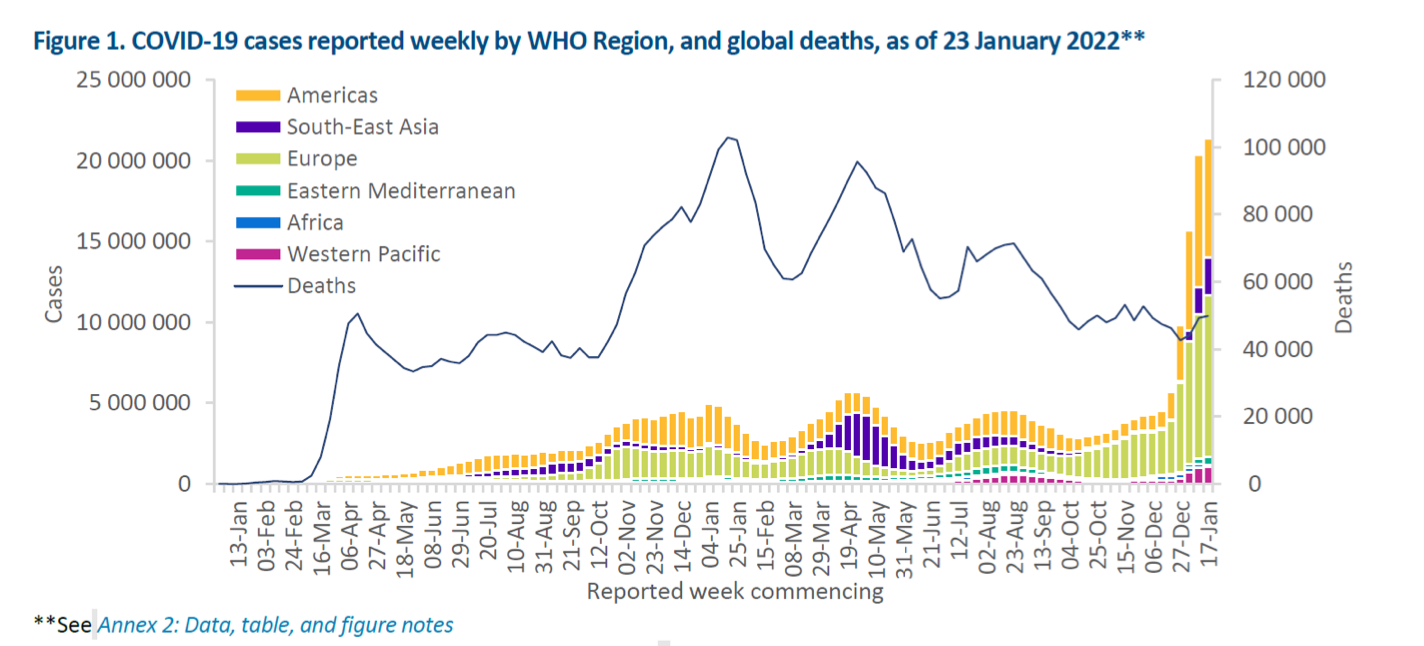
Globally, the number of new COVID-19 cases increased in the past week (17-23 January 2022) by 5%, while the number of new deaths remained similar to that reported during the previous week. Across the six WHO regions, over 21 million new cases were reported this week, representing the highest number of weekly cases recorded since the beginning of the pandemic.
Nearly 50 000 new deaths were also reported. As of 23 January 2022, over 346 million confirmed cases and over 5.5 million deaths have been reported worldwide.
A slower increase in case incidence was observed at the global level, with only half of the regions reporting an increase in the number of new weekly cases, as compared to five out of six regions in the previous week. The Eastern Mediterranean Region reported the largest increase in the number of new cases (39%), followed by the South-East Asia Region (36%) and the European Region (13%).
The number of new weekly deaths increased in the South-East Asia Region (44%), the Eastern Mediterranean Region (15%) and the Region of the Americas (7%), while the other Regions all reported declines in new weekly deaths.
In this edition, we provide updates on the geographic distribution of circulating SARS-CoV-2 variants of concern (VOCs), and summarize their phenotypic characteristics based on available studies. A specific brief update on the Omicron variant, is also provided.


::::::

WHO Events
Update on SARS-CoV-2 variant of concern Omicron
1 February 2022 13:30 – 14:30 CET


WHO Public Health Laboratories knowledge sharing webinars – SARS-CoV-2 variants, Emergency Use Listing (EUL) and diagnostics performance monitoring
2 February 2022 11:00 – 12:30 CET


::::::

WHO Director General Speeches [selected]
https://www.who.int/director-general/speeches
Selected
29 January 2022
Speech
WHO Director-General’s closing remarks at the 150th session of the Executive Board – 29 January 2022

24 January 2022
Speech
WHO Director-General’s opening remarks at the 150th session of the Executive Board — 24 January 2022

Featured Journal Content


Status of COVID-19 Vaccines within WHO EUL/PQ evaluation process 23 December 2021
[Full scale view available at title link above]
[No change from 23 December 2021]


COVID Vaccines/Therapeutics – Developer/Manufacturer Announcements

Featured Journal Content


COVID Vaccines/Therapeutics – Developer/Manufacturer Announcements
[Selected press releases/announcements from organizations from WHO EUL/PQ listing above and other organizations]


AstraZeneca
Press Releases – No new digest announcements identified

Bharat Biotech
Press Releases – No new digest announcements identified

BioCubaFarma – Cuba
Últimas Noticias
Vacunas cubanas muestran altos títulos de neutralización contra ómicron.
Resumen:  Las vacunas cubanas han permitido que la COVID-19 en Cuba s comporte de modo diferente al resto del mundo. Las últimas evidencias demuestran altos títulos de neutralización contra la variante ómicron.
28 de Enero, 2022
[Cuban vaccines show high neutralization titers against omicron.
Abstract: Cuban vaccines have allowed COVID-19 in Cuba to behave differently from the rest of the world. The latest evidence shows high neutralization titers against the omicron variant.]


CanSinoBIO
News – [Website not responding at inquiry]

Clover Biopharmaceuticals – China
News – No new digest announcements identified


Curevac [Bayer Ag – Germany]
News
January 17, 2022
CureVac Chief Technology Officer to Pursue New Career outside Biotech Industry


Gamaleya National Center
Latest News and Events – No new digest announcements identified [See Russia/RFID below]

IMBCAMS, China
Home – No new digest announcements identified


Janssen/JNJ
Press Releases – No new digest announcements identified


Moderna
Press Releases
January 27, 2022
IAVI and Moderna Launch Trial of HIV Vaccine Antigens Delivered Through mRNA Technology

January 26, 2022
Moderna Announces First Participant Dosed in Phase 2 Study of Omicron-Specific Booster Candidate and Publication of Data on Booster Durability Against Omicron Variant


Novavax
Press Releases
Novavax and Israel Announce Advance Purchase Agreement for Supply of COVID-19 Vaccine
Jan 28, 2022


Pfizer
Recent Press Releases
01.27.2022
Pfizer Receives CHMP Positive Opinion for Novel COVID-19 Oral Treatment

01.25.2022
Pfizer and BioNTech Initiate Study to Evaluate Omicron-Based COVID-19 Vaccine in Adults 18 to 55 Years of Age

01.24.2022
Pfizer and BioNTech Publish Data from Two Laboratory Studies on COVID-19 Vaccine-induced Antibodies Ability to Neutralize SARS-CoV-2 Omicron Variant


Sanofi Pasteur
Press Releases – No new digest announcements identified


Serum Institute of India
NEWS & ANNOUNCEMENTS – No new digest announcements identified


Sinopharm/WIBPBIBP
News – No new digest announcements identified


Sinovac
Press Releases – No new digest announcements identified


Vector State Research Centre of Viralogy and Biotechnology
Home – No new digest announcements identified

Zhifei Longcom, China
[Anhui Zhifei Longcom Biologic Pharmacy Co., Ltd.]
[No website identified]


::::::

GSK
Press releases for media – No new digest announcements identified


Merck
News releases
January 28, 2022
Merck and Ridgeback’s Molnupiravir, an Investigational Oral Antiviral COVID-19 Medicine, Demonstrated Activity Against Omicron Variant in In Vitro Studies


Novartis
News
Novartis and Molecular Partners report positive topline data from Phase 2 study for ensovibep (MP0420), a DARPin antiviral therapeutic for COVID-19
Jan 10, 2022


SK Biosciences
Press releases – No new digest announcements identified


Valneva
Press Releases
January 25, 2022
Valneva Advances Booster Phase of Cov-Compare Trial of Its Inactivated COVID-19 Vaccine Candidate