Quadrivalent influenza nanoparticle vaccines induce broad protection

Nature
Volume 592 Issue 7855, 22 April 2021
https://www.nature.com/nature/volumes/592/issues/7855


Article | 24 March 2021
Quadrivalent influenza nanoparticle vaccines induce broad protection
A nanoparticle influenza vaccine candidate is shown to induce broad cross-reactive antibody responses in animal models.
Seyhan Boyoglu-Barnum, Daniel Ellis  & Masaru Kanekiyo

Intelligence, health and death

Nature Human Behaviour
Volume 5 Issue 4, April 2021
https://www.nature.com/nathumbehav/volumes/5/issues/4


Review Article | 01 April 2021
Intelligence, health and death
Cognitive epidemiology studies prospective associations between cognitive abilities and health outcomes. Deary et al. review research in this field over the past decade, synthesizing evidence and outlining open questions.
Ian J. Deary, W. David Hill & Catharine R. Gale

A global panel database of pandemic policies (Oxford COVID-19 Government Response Tracker)

Nature Human Behaviour
Volume 5 Issue 4, April 2021
https://www.nature.com/nathumbehav/volumes/5/issues/4


Resource | 08 March 2021
A global panel database of pandemic policies (Oxford COVID-19 Government Response Tracker)
The Oxford COVID-19 Government Response Tracker (OxCGRT) records data on 19 different government COVID-19 policy indicators for over 190 countries. Covering closure and containment, health and economics measures, it creates an evidence base for effective responses.
Thomas Hale, Noam Angrist & Helen Tatlow

An Uncertain Public — Encouraging Acceptance of Covid-19 Vaccines

New England Journal of Medicine
April 22, 2021 Vol. 384 No. 16
http://www.nejm.org/toc/nejm/medical-journal


Perspective
An Uncertain Public — Encouraging Acceptance of Covid-19 Vaccines
Gillian K. SteelFisher, Ph.D., Robert J. Blendon, Sc.D., and Hannah Caporello, B.A.
… To understand public attitudes toward taking a Covid-19 vaccine and the factors likely to affect willingness to do so going forward, we examined 39 nationally representative, randomized polls with publicly available tabulations that were conducted between August 2020 and February 2021 (see Supplementary Appendix, available at NEJM.org). Our framework provides a perspective different from that of much of the media reporting on individual polls and informs our recommendations for outreach efforts to encourage vaccine uptake — efforts in which we believe physicians can play an important role…

Towards the elimination of Plasmodium vivax malaria: Implementing the radical cure

PLoS Medicine
http://www.plosmedicine.org/
(Accessed 24 Apr 2021)


Towards the elimination of Plasmodium vivax malaria: Implementing the radical cure
Kamala Thriemer, Benedikt Ley, Lorenz von Seidlein
Collection Review | published 23 Apr 2021 PLOS Medicine
https://doi.org/10.1371/journal.pmed.1003494
Summary points
:: Efforts to control Plasmodium vivax malaria have been less successful than for Plasmodium falciparum, resulting in higher prevalence of P. vivax malaria in most coendemic regions. One of the key differences between the 2 species is the ability of P. vivax to form hypnozoites causing relapses which facilitate transmission. Preventing P. vivax relapses is key for the elimination of P. vivax malaria.
:: The widescale use of the radical cure to clear hypnozoites has been underutilized in most endemic countries. Two breakthroughs have increased the likelihood that the radical cure will be rolled out in P. vivax endemic regions: To clear hypnozoites, primaquine can be administered in short, high-dose regimens or a single dose of the recently licensed tafenoquine is administered. Novel technologies allow measurement of glucose-6-phosphate dehydrogenase (G6PD) activity at the point of care. Identifying patients with low G6PD activity, not eligible for these novel regimens, is a precondition for their safe administration.
:: Novel approaches to P. vivax elimination such as mass drug administrations of antimalarial drugs including 8-aminoquinolines require considerable resources and carry safety risks.
:: A safe and protective P. vivax vaccine would be an asset in the elimination of P. vivax malaria but is unlikely to be available in the near future.
:: Case management that includes a radical cure is currently the most promising approach to P. vivax elimination. New regimens for radical cure and the possibility to minimise the risk of haemolysis through novel G6PD tests bring up operational challenges, but if deployed wisely could have sufficient impact to eliminate if not eradicate P. vivax malaria.

Addressing power asymmetries in global health: Imperatives in the wake of the COVID-19 pandemic

PLoS Medicine
http://www.plosmedicine.org/
(Accessed 24 Apr 2021)


Addressing power asymmetries in global health: Imperatives in the wake of the COVID-19 pandemic
Seye Abimbola, Sumegha Asthana, Cristian Montenegro Cortes, Renzo R. Guinto, Desmond Tanko Jumbam, Lance Louskieter, Kenneth Munge Kabubei, Shehnaz Munshi, Kui Muraya, Fredros Okumu, Senjuti Saha, Deepika Saluja, Madhukar Pai
Collection Review | published 22 Apr 2021 PLOS Medicine
https://doi.org/10.1371/journal.pmed.1003604
Summary points
:: The Coronavirus Disease 2019 (COVID-19) pandemic, the Black Lives Matter and Women in Global Health movements, and ongoing calls to decolonise global health have all created space for uncomfortable but important conversations that reveal serious asymmetries of power and privilege that permeate all aspects of global health.
:: In this article, we, a diverse, gender-balanced group of public (global) health researchers and practitioners (most currently living in the so-called global South), outline what we see as imperatives for change in a post-pandemic world.
:: At the individual level (including and especially ourselves), we emphasise the need to emancipate and decolonise our own minds (from the colonial conditionings of our education), straddle and use our privilege responsibly (to empower others and avoid elite capture), and build “Southern” networks (to affirm our ownership of global health).
:: At the organisational level, we call for global health organisations to practice real diversity and inclusion (in ways that go beyond the cosmetic), to localise their funding decisions (with people on the ground in the driving seat), and to progressively self-decentralise (and so, divest themselves of financial, epistemic, and political power).
:: And at both the individual and organisational level, we emphasise the need to hold ourselves, our governments, and global health organisations accountable to these goals, and especially for governance structures and processes that reflect a commitment to real change.
:: By putting a spotlight on coloniality and existing inequalities, the COVID-19 pandemic inspires calls for a more equitable world and for a decolonised and decentralised approach to global health research and practice, one that moves beyond tokenistic box ticking about diversity and inclusion into real and accountable commitments to transformative change.

Dynamic prioritization of COVID-19 vaccines when social distancing is limited for essential workers

PNAS – Proceedings of the National Academy of Sciences of the United States of America
April 20, 2021; vol. 118 no. 16
https://www.pnas.org/content/118/16


Economic Sciences
Open Access
Dynamic prioritization of COVID-19 vaccines when social distancing is limited for essential workers
Jack H. Buckner, Gerardo Chowell, and Michael R. Springborn
PNAS April 20, 2021 118 (16) e2025786118; https://doi.org/10.1073/pnas.2025786118

Introduction to Special Issue on Risk Assessment, Economic Evaluation, and Decisions

Risk Analysis
Volume 41, Issue 4 Pages: 559-699 April 2021
https://onlinelibrary.wiley.com/toc/15396924/current


Special Issue: Risk Assessment, Economic Evaluation, and Decisions
Perspectives
Introduction to Special Issue on Risk Assessment, Economic Evaluation, and Decisions
James K. Hammitt, Lisa A. Robinson
Abstract
Integrating risk assessment, economic evaluation, and uncertainty to inform policy decisions is a core challenge to risk analysis. In September 2019, the Harvard Center for Risk Analysis, with support from the Society for Risk Analysis Economics and Benefits Analysis Specialty Group and others, convened a workshop to address this issue. The workshop built in part on the recommendations of the 2009 National Research Council report, Science and Decisions: Advancing Risk Assessment. It honored John S. Evans, whose thoughtful and innovative teaching and scholarship have significantly advanced thinking on these issues. This special issue features a profile of Dr. Evans and nine articles that build on work presented at the workshop.

Determinants of Incomplete Vaccination Among Children Aged 12 to 23 Months in Gindhir District, Southeastern Ethiopia: Unmatched Case–Control Study

Risk Management and Healthcare Policy
https://www.dovepress.com/risk-management-and-healthcare-policy-archive56
[Accessed 24 Apr 2021]


Original Research
Determinants of Incomplete Vaccination Among Children Aged 12 to 23 Months in Gindhir District, Southeastern Ethiopia: Unmatched Case–Control Study
Zenbaba D, Sahiledengle B, Debela MB, Tufa T, Teferu Z, Lette A, Gezahegn H, Solomon D, Tekalegn Y
Risk Management and Healthcare Policy 2021, 14:1669-1679
Published Date: 21 April 2021

Safety monitoring of COVID-19 vaccines – Lessons learned from the 1976 national influenza immunization program about detecting rare vaccine-related severe adverse events in emergency mass-vaccination programs

Vaccine
Volume 39, Issue 16 Pages 2183-2318 (15 April 2021)
https://www.sciencedirect.com/journal/vaccine/vol/39/issue/16


Discussion Full text access
Safety monitoring of COVID-19 vaccines – Lessons learned from the 1976 national influenza immunization program about detecting rare vaccine-related severe adverse events in emergency mass-vaccination programs
Alan Kendal
Pages 2187-2189

Systematic literature review of cross-protective effect of HPV vaccines based on data from randomized clinical trials and real-world evidence

Vaccine
Volume 39, Issue 16 Pages 2183-2318 (15 April 2021)
https://www.sciencedirect.com/journal/vaccine/vol/39/issue/16


Review article Abstract only
Systematic literature review of cross-protective effect of HPV vaccines based on data from randomized clinical trials and real-world evidence
Darron R. Brown, Elmar A. Joura, Glorian P. Yen, Smita Kothari, … Margaret Stanley
Pages 2224-2236

Projected COVID-19 epidemic in the United States in the context of the effectiveness of a potential vaccine and implications for social distancing and face mask use

Vaccine
Volume 39, Issue 16 Pages 2183-2318 (15 April 2021)
https://www.sciencedirect.com/journal/vaccine/vol/39/issue/16


Research article Open access
Projected COVID-19 epidemic in the United States in the context of the effectiveness of a potential vaccine and implications for social distancing and face mask use
Mingwang Shen, Jian Zu, Christopher K. Fairley, José A. Pagán, … Lei Zhang
Pages 2295-2302

Pertussis infant morbidity and mortality trends after universal maternal immunisation in Mexico: An ecological database study with time-series analysis

Vaccine
Volume 39, Issue 16 Pages 2183-2318 (15 April 2021)
https://www.sciencedirect.com/journal/vaccine/vol/39/issue/16


Research article Open access
Pertussis infant morbidity and mortality trends after universal maternal immunisation in Mexico: An ecological database study with time-series analysis
Adriana Guzman-Holst, Gerardo Luna-Casas, Maria Y. Cervantes-Apolinar, Gloria C. Huerta-Garcia, … Gilberto Sánchez-González
Pages 2311-2318

Nursing Home and Vaccination Consent: The Italian Perspective

Vaccines — Open Access Journal
http://www.mdpi.com/journal/vaccines
(Accessed 24 Apr 2021)


Open Access Article
Nursing Home and Vaccination Consent: The Italian Perspective
by Nunzia Cannovo et al
Vaccines 2021, 9(5), 429; https://doi.org/10.3390/vaccines9050429 (registering DOI) – 24 Apr 2021
Abstract
Since the beginning of the Covid-19 pandemic, many countries have begun vaccination campaigns, with different methods and timelines, with the goal of vaccinating over 75% of the population and thus achieving herd immunity. Initially it was necessary to identity the categories of citizens […

Acceptance of COVID-19 Vaccination among Front-Line Health Care Workers: A Nationwide Survey of Emergency Medical Services Personnel from Germany

Vaccines — Open Access Journal
http://www.mdpi.com/journal/vaccines
(Accessed 24 Apr 2021)


Open Access Article
Acceptance of COVID-19 Vaccination among Front-Line Health Care Workers: A Nationwide Survey of Emergency Medical Services Personnel from Germany
by André Nohl et al
Vaccines 2021, 9(5), 424; https://doi.org/10.3390/vaccines9050424 (registering DOI) – 23 Apr 2021
Abstract
Introduction: The aim of this study was to evaluate the COVID-19 vaccination acceptance of emergency medical services (EMS) personnel as front-line health care workers (HCW) in Germany. Several studies have shown low willingness for vaccination (e.g., seasonal influenza) among HCWs and EMS personnel. […]

Off-Label Use of COVID-19 Vaccines from Ethical Issues to Medico-Legal Aspects: An Italian Perspective

Vaccines — Open Access Journal
http://www.mdpi.com/journal/vaccines
(Accessed 24 Apr 2021)


Open Access Article
Off-Label Use of COVID-19 Vaccines from Ethical Issues to Medico-Legal Aspects: An Italian Perspective
by Davide Ferorelli et al
Vaccines 2021, 9(5), 423; https://doi.org/10.3390/vaccines9050423 (registering DOI) – 23 Apr 2021
Abstract
During the COVID-19 outbreak, the lack of official recommendations on the treatment has led healthcare workers to use multiple drugs not specifically tested and approved for the new insidious disease. After the availability of the first COVID-19 vaccines (Comirnaty Pfizer-BioNTech and Moderna COVID19 […] R

COVID-19 Vaccination Intent and Willingness to Pay in Bangladesh: A Cross-Sectional Study

Vaccines — Open Access Journal
http://www.mdpi.com/journal/vaccines
(Accessed 24 Apr 2021)


Open Access Article
COVID-19 Vaccination Intent and Willingness to Pay in Bangladesh: A Cross-Sectional Study
by Russell Kabir et al
Vaccines 2021, 9(5), 416; https://doi.org/10.3390/vaccines9050416 – 21 Apr 2021
Abstract
This article reports the intent to receive a SARS-COV-2 vaccine, its predictors and willingness to pay in Bangladesh. We carried out an online cross-sectional survey of 697 adults from the general population of Bangladesh in January 2021. A structured questionnaire was used to […]

COVID-19 Vaccination Scenarios: A Cost-Effectiveness Analysis for Turkey

Vaccines — Open Access Journal
http://www.mdpi.com/journal/vaccines
(Accessed 24 Apr 2021)


Open Access Article
COVID-19 Vaccination Scenarios: A Cost-Effectiveness Analysis for Turkey
by Arnold Hagens et al
Vaccines 2021, 9(4), 399; https://doi.org/10.3390/vaccines9040399 – 18 Apr 2021
Abstract
As of March 2021, COVID-19 has claimed the lives of more than 2.7 million people worldwide. Vaccination has started in most countries around the world. In this study, we estimated the cost-effectiveness of strategies for COVID-19 vaccination for Turkey compared to a baseline […]

Media/Policy Watch

Media/Policy Watch
This watch section is intended to alert readers to substantive news, analysis and opinion from the general media and selected think tanks and similar organizations on vaccines, immunization, global public health and related themes. Media Watch is not intended to be exhaustive, but indicative of themes and issues CVEP is actively tracking. This section will grow from an initial base of newspapers, magazines and blog sources, and is segregated from Journal Watch above which scans the peer-reviewed journal ecology.
We acknowledge the Western/Northern bias in this initial selection of titles and invite suggestions for expanded coverage. We are conservative in our outlook in adding news sources which largely report on primary content we are already covering above. Many electronic media sources have tiered, fee-based subscription models for access. We will provide full-text where content is published without restriction, but most publications require registration and some subscription level.
The sheer volume of vaccine and pandemic-related coverage is extraordinary. We will strive to present the most substantive analysis and commentary we encounter.


The Atlantic
http://www.theatlantic.com/magazine/
Accessed 24 Apr 2021
[No new, unique, relevant content]


BBC
http://www.bbc.co.uk/
Accessed 24 Apr 2021
[No new, unique, relevant content]


The Economist
http://www.economist.com/
Accessed 24 Apr 2021
Covid catastrophe
India’s giant second wave is a disaster for it and the world
The government’s distraction and complacency have amplified the surge
Leaders Apr 24th 2021 edition

Doses of scepticism
Africa’s covid-19 vaccination drive is off to a slow start
Scant supply is the biggest problem, but not the only one
Apr 24th 2021 edition

Free exchange
How to think about vaccines and patents in a pandemic
Do public-health crises call for a departure from the rules?
Apr 24th 2021 edition


Financial Times
https://www.ft.com/
Accessed 24 Apr 2021
Coronavirus latest: CDC head warns of ‘unsettling gaps’ in vaccine coverage across US
University of Michigan to mandate vaccines for students living on-campus
April 23, 2021

Japanese politics & policy
Japan to impose new state of emergency as Covid-19 cases rise
April 23, 2021
Top of Form
Bottom of Form

Coronavirus latest: Canada bans flights from India and Pakistan over variants
Thailand reports record infections as it secures more vaccines
April 23, 2021


Forbes
http://www.forbes.com/
Accessed 24 Apr 2021
[No new, unique, relevant content]


Foreign Affairs
http://www.foreignaffairs.com/
Accessed 24 Apr 2021
[No new, unique, relevant content]


Foreign Policy
http://foreignpolicy.com/
Accessed 24 Apr 2021
[No new, unique, relevant content]


New Yorker
http://www.newyorker.com/
Accessed 24 Apr 2021
[No new, unique, relevant content]


New York Times
http://www.nytimes.com/
Accessed 24 Apr 2021
Climate
U.S. Is Under Pressure to Release Vaccine Supplies as India Faces Deadly Surge
The Biden administration is blocking the export of supplies that Indian vaccine makers say they need to expand production.
By Somini Sengupta
PRINT EDITION April 25, 2021

Africa
Africa’s already slow vaccine drive is threatened as supplies from a stricken India are halted.
India’s dire Covid crisis is having global ripple effects, especially in Africa, which has 17 percent of the world’s people but is far behind in vaccinations.
By Abdi Latif Dahir

U.S.
Vaccines Made at Troubled Baltimore Plant Were Shipped to Canada and Mexico
The Biden administration said it did not know of manufacturing problems at the Emergent factory when it approved shipping millions of doses of AstraZeneca’s vaccine. The company says the doses were safe.
By Sheryl Gay Stolberg and Chris Hamby
PRINT EDITION Vaccines From Troubled Site Were Shipped Out of U.S.| April 24, 2021, Page A6

Opinion
I Run the W.H.O., and I Know That Rich Countries Must Make a Choice
If they keep their vaccine promises, the pandemic can end.
By Tedros Adhanom Ghebreyesus
April 22, 2021
Almost one billion doses of Covid-19 vaccines have been administered around the world, and yet the weekly number of cases hit a record high last week, and deaths are climbing, on pace to eclipse 2020’s grim tally. How can this be? Weren’t vaccines supposed to douse the flames of the pandemic?

Yes, and they are. But here’s the thing about an inferno: If you hose only one part of it, the rest will keep burning.

Many countries all over the world are facing a severe crisis, with high transmission and intensive care units overflowing with patients and running short on essential supplies, like oxygen.

Why is this happening? For several reasons: The rise of more transmissible variants, the inconsistent application and premature easing of public health measures like mask mandates and physical distancing, populations that are understandably weary of adhering to those measures and the inequitable distribution of vaccines

Scientists developed several vaccines for Covid-19 in record time. Yet of the more than 890 million vaccine doses that have been administered globally, more than 81 percent have been given in high- and upper-middle-income countries. Low-income countries have received just 0.3 percent.

This problem is sadly predictable. When the H.I.V. epidemic erupted in the 1980s, lifesaving antiretrovirals were developed rapidly, and yet a decade passed before they became available in sub-Saharan Africa.

A year ago, the World Health Organization and many global health partners came together in an effort to avoid history repeating. The Access to Covid-19 Tools (ACT) Accelerator, including the vaccine sharing initiative Covax, was begun to ensure the most equitable possible distribution of vaccines, diagnostics and therapeutics for Covid-19.

The concept was crystal clear: At a time when no one knew which vaccines would prove effective in clinical trials, Covax was designed to share the huge inherent risks of vaccine development, and to offer a mechanism for pooled procurement and equitable rollout.

While scientists toiled in laboratories, the W.H.O. and partners set standards, facilitated trials, raised funds, tracked manufacturing progress and worked with countries to prepare for rollout.

Countries at all income levels, manufacturers and others in the private sector committed to participate.
But many of the same wealthy countries that were publicly expressing support for Covax were in parallel preordering the same vaccines on which Covax was relying.

In January, I issued a global challenge to see vaccination underway in all countries within the first 100 days of the year. This was an eminently achievable goal.

By April 10 — the 100th day — we had come close to achieving it: All but 26 countries had started vaccination, and of those, 12 were about to start, leaving 14 countries that had either not requested vaccines through Covax or were not ready to start vaccinating.

But the amount of vaccines delivered has been totally insufficient. As of Thursday, Covax has distributed 43 million doses of vaccine to 119 countries — covering just 0.5 percent of their combined population of more than four billion.

Since the ACT Accelerator’s birth a year ago, many of the world’s biggest economies have given strong support to Covax politically and financially, but they have also undermined it in other ways.

First, vaccine nationalism has weakened Covax, with a handful of rich countries gobbling up the anticipated supply as manufacturers sell to the highest bidder, while the rest of the world scrambles for the scraps. Some countries have placed orders for enough doses to vaccinate their entire population several times over, promising to share only after they have used everything they need, perpetuating the pattern of patronage that keeps the world’s have-nots exactly where they are.

Second, vaccine diplomacy has undermined Covax as countries with vaccines make bilateral donations for reasons that have more to do with geopolitical goals than public health. This inevitably leaves countries with the least political clout as wallflowers at the vaccine ball.

Third, vaccine hesitancy has hampered the rollout of vaccines, through the same combination of myth and misinformation that has enabled measles to resurge around the world. Reports of very rare side effects linked to some vaccines have spurred countries with other options to cast some aside. This includes vaccines that many of the world’s low-income nations were relying on but now question. Let’s be clear: While safety is paramount and we pay careful attention to any signs of adverse events, the shots’ benefits vastly outweigh the risks for all four vaccines with W.H.O. emergency use listing.

And fourth, a new trend — let’s call it vaccine euphoria — is undermining hard-won gains as some countries relax public health measures too quickly and some people assume that vaccines have ended the pandemic, at least where they live.

It doesn’t have to be this way. Scarcity drives inequity and puts the global recovery at risk. The longer this coronavirus circulates anywhere, the longer global trade and travel will be disrupted, and the higher the chances that a variant could emerge that renders vaccines less effective. That’s just what viruses do.

We face the very real possibility of affluent countries administering variant-blocking boosters to already vaccinated people when many countries will still be scrounging for enough vaccines to cover their most-at-risk groups.

This is unacceptable. Analysts predict vaccines will generate huge revenues for manufacturers. Meanwhile, the ACT Accelerator is still $19 billion short of the funds it needs to expand access not just to vaccines but also to diagnostics and treatments like oxygen. But even if we had all the funds we need, money doesn’t help if there are no vaccines to buy.

The solution is threefold: We need the countries and companies that control the global supply to share financially, to share their doses with Covax immediately and to share their know-how to urgently and massively scale up the production and equitable distribution of vaccines.

One way to do this is through voluntary licensing with technology transfer, in which a company that owns the patents on a vaccine licenses another manufacturer to produce its shots, usually for a fee. Some companies have done this on a bilateral basis. But such agreements tend to be exclusive and nontransparent, compromising equitable access.

A more transparent method is for companies to share licenses through the Covid-19 Technology Access Pool, a globally coordinated mechanism proposed by Costa Rica and started by the W.H.O. last year.
Another option, proposed by South Africa and India, is to waive intellectual property rights on Covid-19 products through a World Trade Organization agreement that would level the playing field and give countries more leverage in their discussions with companies. Governments could drive greater sharing of intellectual property by offering incentives to companies to do it.

If this is not a time to take those actions, it’s hard to fathom when that would be.

In combination with proven public health measures, we have all the tools to tame this pandemic everywhere in a matter of months. It comes down to a simple choice: to share or not to share.

Whether or not we do is not a test of science, financial muscle or industrial prowess; it’s a test of character.


Washington Post
https://www.washingtonpost.com/
Accessed 24 Apr 2021
World
A gift to Damascus: 150,000 COVID-19 Chinese vaccines
DAMASCUS, Syri a — The Syrian government received the first batch of Chinese COVID-19 vaccines on Saturday, a gift of 150,000 jabs to Damascus, Syrian and Chinese officials said.
The Chinese vaccines arrived in Damascus airport where they were received by Syria’s Health Minister Hassan Ghabbash and China’s ambassador to Damascus.
The Chinese batch comes a few days after more than 200,000 jabs were delivered to Syria through the United Nations-led platform which provides vaccines to the needy…
Apr 24, 2021
Think Tanks et al

Think Tanks et al

Brookings
http://www.brookings.edu/
Accessed 24 Apr 2021
[No new digest content identified]
 
 
Center for Global Development [to 24 Apr 2021]
http://www.cgdev.org/page/press-center
Publication
April 23, 2021
The International Community Has One Job: Getting COVID-19 Under Control
Enough. We cannot continue business as usual. Until this crisis is over—and over everywhere—exiting the COVID-19 mass casualty event must be the singular focus of the international community.
Amanda Glassman and Rachel Silverman

April 21, 2021
A Framework to Assess the Impact of COVID-19 Vaccination Certificates
Since the start of 2021, the pandemic has taken a more hopeful turn with the rollout of COVID-19 vaccines. As such, an increasing number of public and private sectors in many settings are considering the introduction of COVID-19 vaccination certificates or similar instruments as a safe passage into the new normal.
Yot Teerawattananon et al.
 
 
Chatham House [to 24 Apr 2021]
https://www.chathamhouse.org/
Accessed 24 Apr 2021
[No new digest content identified]


CSIS
https://www.csis.org/
Accessed 24 Apr 2021
Transcript
The Importance of Intellectual Property in Healthcare Innovation during COVID-19
April 22, 2021

Podcast Episode
Bruce Gellin: Keeping a Focus on Routine Immunizations While Responding to Covid-19
April 21, 2021 | By Katherine E. Bliss


Kaiser Family Foundation
https://www.kff.org/search/?post_type=press-release
Accessed 24 Apr 2021
April 23, 2021 News Release
Essential Workers Employed Outside Health Care are Less Enthusiastic about Getting a COVID-19 Vaccine than Other Adults
There has been little research on how essential workers not employed in the health care sector have been impacted by the pandemic and their views on and experiences with COVID-19 vaccines. The latest KFF COVID-19 Vaccine Monitor report finds that this group of workers – roughly 3 in 10 of…

April 22, 2021 News Release
COVID-19 Deaths and Cases in Long-Term Care Facilities Have Fallen to All-Time Lows in the Four Months Since Vaccinations Began
COVID-19 deaths and cases among residents and staff of long-term care facilities have fallen dramatically since vaccinations began in December, with deaths declining by nearly 89 percent and cases declining by nearly 92 percent as of April 2021, according to a new KFF analysis. COVID-19 deaths in long-term care settings…
 
 
World Economic Forum [to 24 Apr 2021]
https://agenda.weforum.org/news/
Media
[No new digest content identified]

Vaccines and Global Health: The Week in Review :: 17 April 2021

Vaccines and Global Health: The Week in Review is a weekly digest  summarizing news, events, announcements, peer-reviewed articles and research in the global vaccine ethics and policy space. Content is aggregated from key governmental, NGO, international organization and industry sources, key peer-reviewed journals, and other media channels. This summary proceeds from the broad base of themes and issues monitored by the Center for Vaccine Ethics & Policy in its work: it is not intended to be exhaustive in its coverage. You are viewing the blog version of our weekly digest, typically comprised of between 30 and 40 posts below all dated with the current issue date

.– Request an Email Summary: Vaccines and Global Health : The Week in Review is published as a single email summary, scheduled for release each Saturday evening before midnight (EDT in the U.S.). If you would like to receive the email version, please send your request to david.r.curry@centerforvaccineethicsandpolicy.org.

– pdf version A pdf of the current issue is available here: 

– blog edition: comprised of the approx. 35+ entries posted below.

– Twitter:  Readers can also follow developments on twitter: @vaxethicspolicy.
.
– Links:  We endeavor to test each link as we incorporate it into any post, but recognize that some links may become “stale” as publications and websites reorganize content over time. We apologize in advance for any links that may not be operative. We believe the contextual information in a given post should allow retrieval, but please contact us as above for assistance if necessary.

Support this knowledge-sharing service: Your financial support helps us cover our costs and to address a current shortfall in our annual operating budget. Click here to donate and thank you in advance for your contribution.

.
David R. Curry, MS
Executive Director
Center for Vaccine Ethics and Policy

Secretary-General, at Economic and Social Council Forum, Spells Out Priority Areas for Urgent Action in Response to, Recovery from COVID-19

Milestones :: Perspectives :: Research


Secretary-General, at Economic and Social Council Forum, Spells Out Priority Areas for Urgent Action in Response to, Recovery from COVID-19
SG/SM/20681 12 April 2021
Following are UN Secretary-General António Guterres’ remarks to the opening of the 2021 Economic and Social Council Forum on Financing for Development, in New York today:

Financing for Development in the context of the COVID-19 pandemic means an unprecedented effort to mobilize resources and political will.  Since the pandemic began one year ago, no element of our multilateral response has gone as it should.

More than 3 million people have lost their lives.  Some 120 million people have fallen back into extreme poverty, while the equivalent of 255 million full-time jobs have been lost.  We have seen the worst recession in 90 years.  And the crisis is far from over.  Indeed, the speed of infections is now even increasing.

We need to heed the lessons now if we are to reverse these dangerous trends, prevent successive waves of infection, avoid a lengthy global recession and get back on track to fulfil the 2030 Agenda for Sustainable Development and the Paris Agreement on climate change.  Unity and solidarity will save lives and prevent communities and economies from falling into catastrophic debt and dysfunction.

Advancing an equitable global response and recovery from the pandemic is putting multilateralism to the test.  So far, it is a test we have failed.  The vaccination effort is one example.  Just 10 countries across the world account for around 75 per cent of global vaccinations.  Many countries have yet to start vaccinating their health-care workers and most vulnerable citizens.  A global vaccine gap threatens everyone’s health and well-being.  The virus is dangerous everywhere if it spreads unchecked anywhere.  And global value chains do not function if one link is broken.

Some estimates put the global cost of unequal access and vaccine hoarding at more than $9 trillion.  The same lack of solidarity means that some countries have mobilized relief packages worth trillions of dollars, while many developing countries face insurmountable debt burdens that will put the Sustainable Development Goals (SDGs) completely out of reach if not corrected.

Even in 2019, before the pandemic, 25 countries spent more on debt service than on education, health, and social protection combined.  Now, many Governments face an impossible choice between servicing debt or saving lives.  But in reality, there is just one choice:  to take action to avert a global debt crisis.

Inequalities are also growing within countries, as women and girls and the most vulnerable groups have been hit the hardest by the pandemic.  Nearly 170 million children around the world have been out of school for a year.  We face a global education crisis with a devastating long-term impact on individuals and their communities, which could contribute to inequality across the generations.

We are here today to set the course for an equitable, sustainable and resilient response and recovery from COVID-19.  I call for urgent action in six areas.

First, vaccines must be available to all countries in need.  We must close the funding gap of the COVAX facility.  To end the pandemic for good, we need equitable access to vaccines for everyone, everywhere…

Global leaders rally to accelerate access to COVID-19 vaccines for lower-income countries

Milestones :: Perspectives :: Research


COVID 19 Vaccines – Access

Global leaders rally to accelerate access to COVID-19 vaccines for lower-income countries
:: The “One World Protected” Event, hosted today by the United States and Gavi, the Vaccine Alliance, launched a campaign to raise US$ 2 billion for the global fight against COVID-19.


:: The additional funding from donors and countries with MDB support will enable the Gavi COVAX Advance Market Commitment (AMC) to secure 1.8 billion doses of COVID-19 vaccines for 92 lower-income countries by the end of the year.

:: At the event, governments and private sector partners made early pledges worth nearly US$ 400 million and committed to donate millions of COVID-19 vaccine doses to COVAX to benefit the most vulnerable in lower-income economies.


:: The new campaign will culminate in June 2021, at the Gavi COVAX AMC Summit, which will be hosted by Prime Minister Yoshihide Suga of Japan.

Washington, D.C./Geneva, 15 April 2021 – World leaders joined forces today at the “One World Protected” event to take stock of progress in global efforts to ensure equitable access to COVID-19 vaccines and seek ways to further accelerate vaccination. The event, hosted by US Secretary of State Antony J. Blinken, Acting Administrator of USAID Gloria Steele, and Chair of the Board of Gavi José Manuel Barroso, was joined by more than 200 participants, including leaders from government, business, civil society, and partner organizations across the globe.

In a vital step on the path to providing global protection against COVID-19, a new Investment Opportunity was unveiled, launching a campaign to raise an additional $US 2 billion from donors and the private sector for the Gavi COVAX Advance Market Commitment (AMC). With this funding, the COVAX mechanism can lock in up to 1.8 billion vaccine doses for people at risk in 92 lower-income economies and accelerate coverage. The campaign will also aim to mobilize $US 1 billion in cost sharing from countries through domestic resource mobilization and the support of multilateral development banks (MDBs)…


New commitments to the Gavi COVAX AMC
At the event today, a number of donor governments announced significant new commitments worth a total of almost $400 million towards the 2021 goal. This includes:

:: SEK 2.25 billion (US$ 258.1 million) pledge from Sweden for the International Finance Facility for Immunisation (IFFIm), Gavi’s innovative financing mechanism.
:: EUR 40 million (US$ 47.2 million) from the Netherlands for the Gavi COVAX AMC
:: DKK 50 million (US$ 8 million) from Denmark for the Gavi COVAX AMC
:: CHF 100,000 (US$ 106,000) from Liechtenstein for the Gavi COVAX AMC
:: EUR 678,125 (US$ 800,188) from Portugal for the Gavi COVAX AMC

In addition to these, private sector partners and foundations also mobilised significant new resources for the Gavi COVAX AMC:
:: The Bill & Melinda Gates Foundation announced that US$ 30 million of its contribution to the Gavi Matching Fund would be made available to match private sector contributions to the COVAX AMC.
:: Gates Philanthropy Partners have mobilized US$ 18 million.
:: A Swiss foundation wishing to remain anonymous also offered CHF 15 million (US$ 15.9 million) to incentivize private sector giving.
:: Google.org have committed US$ 2.5 million to the COVAX AMC and in parallel will launch a global campaign incentivising employees to contribute directly to Gavi. In addition, Google.org has donated US$ 15 million in Ad credits to Gavi. Longer term, Google.org engineers will also support Gavi’s broader innovation agenda.
:: The Asia Philanthropic Circle joined as a new partner and pledged US$ 1.5 million.
:: The Visa Foundation joined as a new partner and pledge US$1.5 million. Visa will also match employee donations to Gavi dollar for dollar through Visa’s employee donation matching program.
:: A group of Portuguese philanthropists and partners (Fidelidade Group, Luz Saúde Hospitals and Multicare Insurance, Manuel António da Mota Foundation, the Ismaili Imamat and Caixa Geral de Depósitos) collectively committed EUR 1.5 million (US$ 1.8 million).
:: Vaccine Forward (including AB SKF) have contributed SEK 2 million (US$ 230,000) to-date, with the aim to mobilise up to US$10 million.

The cash contributions from Google, the Asia Philanthropic Circle and the Visa Foundation will be matched by the Bill & Melinda Gates Foundation.

“Equitable distribution of vaccines offers the best prospect for ending the pandemic, kick-staring economic recovery and overcoming the vaccine divide between those with access to COVID-19 vaccines and those without,” said José Manuel Barroso, Chair of the Board of Gavi. “We are not there yet: while COVAX has begun delivering to AMC participating economies, we urgently need additional funding to protect those most at risk from the virus. I applaud leaders for stepping up and showing their support today as we embark on this vital fundraising effort.”


First commitments to dose sharing through COVAX
In addition to financial support, new pledges in support of dose sharing through COVAX were announced at the event. Under this scheme, countries will be able to donate millions of doses of their own COVID19 vaccines to COVAX in an act of global solidarity. As part of this effort, New Zealand committed today that it will donate more than 1.6 million doses of vaccines to COVAX, with a focus on the Pacific region. France welcomed the finalization of a new agreement between COVAX and Team Europe on the provision of doses which will ensure the first French and European donations via COVAX will materialize shortly…

Remarks by World Bank Group President David Malpass at the Gavi “One World Protected” COVAX Advance Market Commitment Investment Opportunity Launch

Milestones :: Perspectives :: Research


COVID Vaccine – Response Financing

Remarks by World Bank Group President David Malpass at the Gavi “One World Protected” COVAX Advance Market Commitment Investment Opportunity Launch
Date: April 15, 2021 Type: Speeches and Transcripts
Secretary Blinken, UN Deputy Secretary-General Mohammed, Dr. Barroso, Dr. Berkley, and Excellencies.

I am pleased to be participating today. As a founding partner of Gavi, the World Bank Group is a key partner at the country level in strengthening routine immunization, and we are now partnering with you on the largest vaccination effort in history in order to stop the COVID-19 pandemic. Our goal, from the beginning of the vaccination planning effort almost a year ago, has been to facilitate a system that can provide the billions of safe vaccinations needed in the near term and lay the groundwork for longer-term prevention of COVID.

Including our Board’s expected approvals tomorrow, the World Bank will have committed $2 billion for COVID vaccines across 17 countries, with the total expected to reach at least $4 billion and 50 countries by mid-year.  This financing can be used by countries to make payments to COVAX, including the purchase of additional doses beyond the COVAX-provided 20% as countries aim for higher levels of coverage.

Our financing is available for countries to spend quickly after Board approval, often in a matter of days or weeks. It supports vaccine purchases and also supports deployment – the important business of getting shots into arms. For the poorer countries, much of the financing is on grant or highly concessional terms. The World Bank is working to further increase our available country financing to use all available resources for the vaccination effort.

While COVAX has received financial commitments, accelerated encashment is needed to help COVAX complete the contracting needed to provide its 20% and higher levels. With $4 billion in World Bank funds to be in place by mid-year, we are seeking to purchase through COVAX, especially for the poorer countries, to the extent COVAX has access to supplies.

We need to recognize that the supply of vaccines may be an even more binding constraint than cash flow. Many countries now have dollars available to spend on doses, but rapid deliveries aren’t available.

I would like to underline here the importance for countries that have the prospect of excess vaccine supplies to release them as soon as possible.  Because the capacity to deliver and administer shots is limited, it’s imperative that increased supplies begin to flow to developing countries.


We also need suppliers, countries, and their development partners to distinguish between contracts, options, letters of intent, best efforts, and Memoranda of Understanding.

These transparency steps are necessary so that financing can be directed more effectively, and countries can plan for receipt and deployment of vaccines. They are also critical to enable private sector investments to expand supply over the medium and long term. At IFC, we have a $4b Global Health Platform to support efforts to close gaps for essential health equipment and supplies, including vaccines, but effective use of this funding depends on more information about expected supply and demand.

We are working intensively on deployment, to achieve rapid and safe injection of vaccines. The COVID-19 vaccine campaign will be unlike any prior vaccination effort – the sheer volume of people, doses, locations, and human resources involved in the exercise will challenge the most resilient of systems, and even the best-laid vaccine deployment plans will be seriously tested.

Our collaboration with GAVI on COVAX and other ACT-A partners has been strong throughout the crisis and shows how we complement each other’s strengths. A robust rollout of vaccines is an integral part of the recovery and can also contribute to future preparedness.  We have worked with Gavi, Global Fund, WHO and UNICEF to help governments assess their readiness. The assessments showed that much more is needed in the medium-term to build resilience of health systems. World Bank and MDB financing will play an important role in filling these gaps.

The World Bank Group is placing a special focus on the poorest countries, and is committed to working with all partners toward rapid, fair and equitable access to vaccines. Transparency and international cooperation are key elements of the road forward, and we look forward to continuing these vital vaccination efforts. Thank you.

COVID Vaccines – IP, TRIPS+

Milestones :: Perspectives :: Research


COVID Vaccines – IP, TRIPS+

Open Letter: Former Heads of State and Nobel Laureates Call on President Biden To Waive Intellectual Property Rules for COVID Vaccines
People’s Vaccine Alliance

Dear President Biden,
We the undersigned former Heads of State and Government and Nobel Laureates are gravely concerned by the very slow progress in scaling up global COVID-19 vaccine access and inoculation in low- and middle-income countries.

The world saw unprecedented development of safe and effective vaccines, in major part thanks to U.S. public investment. We all welcome that vaccination rollout in the U.S. and many wealthier countries is bringing hope to their citizens.

Yet for the majority of the world that same hope is yet to be seen. New waves of suffering are now rising across the globe. Our global economy cannot rebuild if it remains vulnerable to this virus.
But we are encouraged by news that your Administration is considering a temporary waiver of World Trade Organization (WTO) intellectual property rules during the COVID-19 pandemic, as proposed by South Africa and India, and supported by more than 100 WTO member states and numerous health experts worldwide.

A WTO waiver is a vital and necessary step to bringing an end to this pandemic. It must be combined with ensuring vaccine know-how and technology is shared openly. This can be achieved through the World Health Organization COVID-19 Technology Access Pool, as your Chief Medical Advisor, Dr. Anthony Fauci, has called for. This will save lives and advance us towards global herd immunity.

These actions would expand global manufacturing capacity, unhindered by industry monopolies that are driving the dire supply shortages blocking vaccine access. 9 in 10 people in most poor countries may well go without a vaccine this year. At this pace, many nations will be left waiting until at least 2024 to achieve mass COVID-19 immunization, despite what the limited, while welcome, COVAX initiative is able to offer.

These moves should be accompanied by coordinated global investment in research, development, and manufacturing capacity to tackle this pandemic and prepare us for future ones, as part of a more robust international health architecture. If this last year has taught us anything, it is that threats to public health are global, and that strategic government investment, action, global cooperation, and solidarity are vital. The market cannot adequately meet these challenges, and neither can narrow nationalism.

The full protection of intellectual property and monopolies will only negatively impact efforts to vaccinate the world and be self-defeating for the U.S. Given artificial global supply shortages, the U.S. economy already risks losing $1.3 trillion in GDP this year. Were the virus left to roam the world, and even if vaccinated, people in the U.S. would continue to be exposed to new viral variants.

Mr. President, our world learned painful lessons from unequal access to lifesaving treatments for diseases such as HIV. By supporting a TRIPS waiver, the U.S. will provide an example of responsible leadership at a time when it is needed most on global health — as it has done so before on HIV, saving millions of lives. Your support in rallying allies and all countries to follow your lead will also be essential.

With your leadership, we can ensure COVID-19 vaccine technology is shared with the world. Supporting the emergency waiver of COVID-19 related intellectual property rules will give people around the globe a chance to wake up to a world free from the virus. We need a people’s vaccine.

Many of us know, first-hand, the reality of political office and the pressures, challenges and constraints of leadership. However, we believe this would be an unparalleled opportunity for the U.S. to exercise solidarity, cooperation and renewed leadership, one we hope will inspire many more to do the same.

Please take the urgent action that only you can, and let this moment be remembered in history as the time we chose to put the collective right to safety for all ahead of the commercial monopolies of the few.

Let us now ensure an end to this pandemic for us all. As advocates for global and equitable vaccine access, we remain ready to support and add our voices to your efforts on this front.

Signatories at title link above…
[More than 170 former heads of state and government and Nobel laureates, including former Prime Minister of the United Kingdom Gordon Brown, former President of Colombia Juan Manuel Santos, former President of Liberia Ellen Johnson Sirleaf, former President of France François Hollande and Nobel Laureates Professor Joseph Stiglitz and Professor Francoise Barre-Sinoussi]


::::::

WTO Chair Summary following “COVID-19 and Vaccine Equity: What Can the WTO Contribute?”
14 April 2021
[See WTO below in Announcements for detail]

IFPMA statement at WTO event “COVID-19 and Vaccine Equity: What can the WTO Contribute”
15 April 2021
[See IFPMA below in Announcements for detail]

COVID 19 Impacts

Milestones :: Perspectives :: Research


COVID 19 Impacts

New Global Fund Report Shows Massive Disruption to Health Care Caused by COVID-19 in Africa and Asia
13 April 2021
GENEVA – A new report by the Global Fund to Fight AIDS, Tuberculosis and Malaria shows COVID-19 has massively disrupted health systems and health service delivery for HIV, TB and malaria in low- and middle-income countries in Africa and Asia in 2020. The report highlights the urgent need to scale up the adaptive measures that health facilities adopted to continue the fight against HIV, TB, malaria, to ramp up delivery of critical supplies for the COVID-19 response, and prevent health care systems and community responses from collapse.

Through programmatic spot-checks recording information from 502 health facilities in 32 countries in Africa and Asia between April and September 2020, the Global Fund has assembled a snapshot of the extent of the disruption to health services for HIV, TB and malaria, and of how health facilities have responded.

“This snapshot underscores the scale of the challenge,” said Peter Sands, Executive Director of the Global Fund. “HIV prevention has been knocked backwards. With the dramatic drop in case management for malaria, we face a real risk for a spike in mortality. Much of the progress we’ve made to close the gap on finding “missing” people with TB has been reversed. The stark truth is that we will see more incremental deaths from HIV, TB and malaria in 2021 as a consequence of the disruption caused by COVID-19 in 2020.”

The data collected shows that for April to September 2020, compared to the same six-month period in 2019:
:: HIV testing fell 41%.
:: TB referrals – where patients suspected of having TB are referred to the next step of diagnosis and treatment – declined by 59%.
:: Malaria diagnoses fell by 31%.
:: Antenatal care visits fell by 43%.

The spot-checks also highlighted a critical lack of tests, treatments and PPE needed to fight COVID-19, particularly in Africa:
:: Only 45% of health facilities had enough essential PPE items for its health workers, including masks, disinfectant, gloves and hand sanitizer.
:: Across the 24 countries in Africa that were surveyed, only 11% of health facilities could conduct COVID-19 antigen rapid diagnostic tests, and only 8% could conduct polymerase chain reaction (PCR) tests.

However, the snapshot also shows that countries that implemented adaptive measures to counter the impact of COVID-19 on health service continuity fared better than those that did not adapt. More than two-thirds (68%) of facilities surveyed adopted at least one adaptive measure, such as dispensing long-term supplies of medicines for HIV and TB to patients, or switching to a door-to-door delivery system for mosquito nets and preventative malaria medicines. These successful adaptations to service disruption by COVID-19 need to be further investigated, scaled up and tailored to local contexts.

The Global Fund has already deployed nearly US$1 billion to fight COVID-19 and mitigate the impact on HIV, TB and malaria in more than 100 countries. Through the ACT-Accelerator, the global collaboration to ensure the accelerated launch and equitable deployment of tools to fight COVID-19, the Global Fund is now the primary channel for providing grant support to low- and middle-income countries on tests, treatments (including medical oxygen), PPE and health system strengthening. For the Global Fund to fulfil its responsibility to the ACT-Accelerator and regain lost progress against HIV, TB and malaria, an additional US$10 billion is needed. To date in 2021, the Global Fund has raised US$3.7 billion.

“In most low- and middle-income countries, the crisis is far from over, with infections and deaths from COVID-19 continuing to increase, and the knock-on impact on HIV, TB and malaria continuing to escalate ” said Peter Sands, Executive Director of the Global Fund. “To regain the ground lost on the three epidemics in 2020 and to step up the fight against COVID-19, we have to massively scale up adaptation programs, increase access to COVID-19 tools, and shore up systems for health so they don’t collapse.”
Report: The impact of COVID-19 on HIV, TB and malaria services and systems for health: a snapshot from 502 health facilities across Africa and Asia

COVID-19 Data Explorer: Global Humanitarian Operations

Milestones :: Perspectives :: Research


OCHA:: HDX
COVID-19 Data Explorer: Global Humanitarian Operations
COVID-19 Vaccine Roll-out
Apr 17, 2021 | COVAX (WHO,GAVI,CEPI), UNDESA, Press Reports | DATA
Global COVID-19 Figures: 130M total confirmed cases; 2.9M total confirmed deaths
Global vaccines administered: 730M
Number of Countries: 26
COVAX First Allocations (Number of Doses): 73M
COVAX Delivered (Number of Doses): 12M
Other Delivered (Number of Doses): 12M
Total Delivered (Number of Doses): 24M
Total Administered (Number of Doses): 7.0M

Coronavirus [COVID-19] – WHO Public Health Emergency of International Concern (PHEIC)

Milestones :: Perspectives :: Research

Coronavirus [COVID-19] – WHO
Public Health Emergency of International Concern (PHEIC)
https://www.who.int/emergencies/diseases/novel-coronavirus-2019

Weekly Epidemiological and Operational updates
Last update: 17 April 2021
Confirmed cases :: 139 501 934 [week ago: 134 308 070] [two weeks ago: 129 902 402]
Confirmed deaths :: 2 992 193 [week ago: 2 907 944 [two weeks ago: 2 831 815]
Countries, areas or territories with cases :: 223

::::::

Weekly operational update on COVID-19 – 12 April 2021
Overview
In this edition of the Weekly Operational Update on COVID-19, highlights of country-level actions and WHO support to Member States include:
:: COVID-19 vaccines now in all countries of the Eastern Mediterranean Region
:: Kingdom of Tonga receives COVID-19 vaccine doses from the COVAX Facility
:: Restoring essential services after massive fire in the world’s largest refugee camp: Cox’s Bazar, Bangladesh
:: Strengthening COVID-19 surveillance and contact tracing in Armenia
:: Second WHO training in infodemic management: open call for applications
:: Experiences of long-term care facilities in managing the COVID-19 pandemic
:: The Strategic Preparedness and Response Plan (SPRP) 2021 resource requirements and progress made to continue investing in the COVID-19 response and for building the architecture to prepare for, prevent and mitigate future health emergencies
:: Updates on WHO/PAHO procured items, Partners Platform, implementation of the Unity Studies, and select indicators from the COVID-19 Monitoring and Evaluation Framework

Weekly epidemiological update on COVID-19 – 13 April 2021
Overview
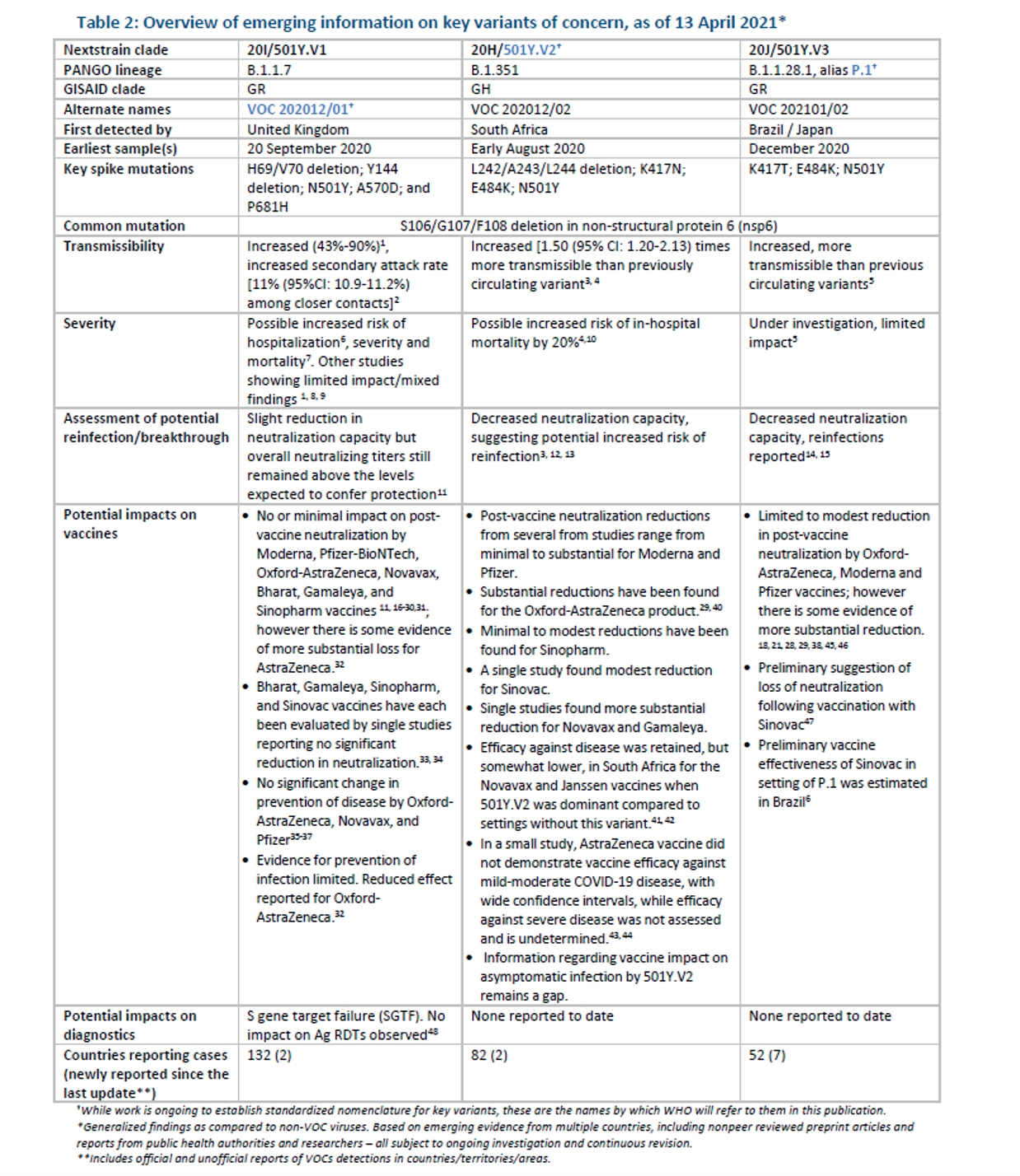
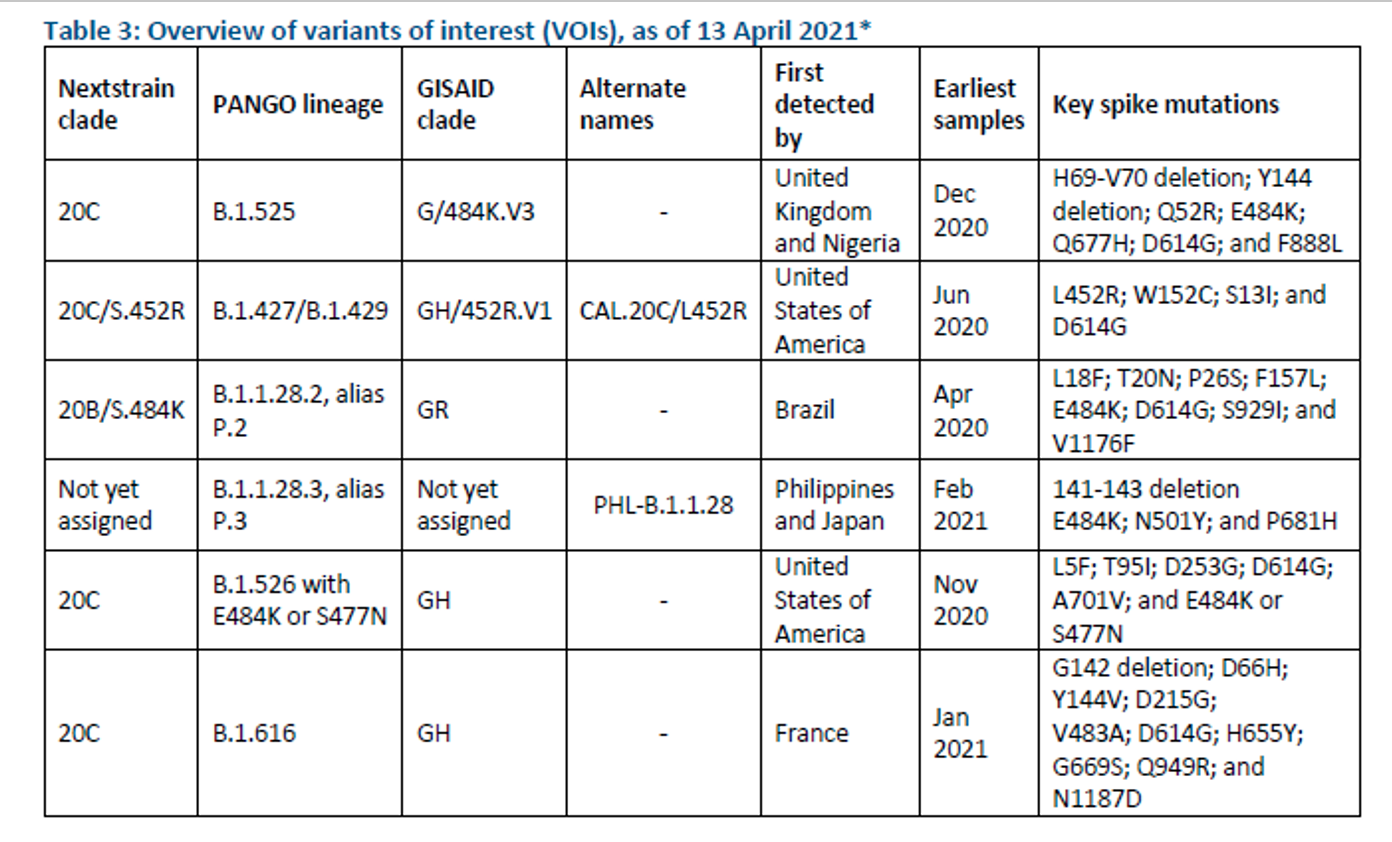
Globally, new COVID-19 cases rose for a seventh consecutive week, with over 4.5 million new cases reported in the last week. The number of new deaths increased for the fourth consecutive week, increasing by 7% compared to last week, with over 76 000 new deaths reported.
In this edition, a special focus update is provided on SARS-CoV-2 variants.

WHO – COVID Vaccines EUAL, Prequalification

Milestones :: Perspectives :: Research


WHO – COVID Vaccines EUAL, Prequalification

Draft landscape and tracker of COVID-19 candidate vaccines
16 April 2021 | Publication
The COVID-19 candidate vaccine landscape and tracker database compiles detailed information on COVID-19 vaccine candidates in development.
The landscape is updated regularly – twice a week (Tuesday and Friday, 17:00 CET).
Download: https://cdn.who.int/media/docs/default-source/blue-print/12.03.2021-novel-coronavirus_landscape_covid-19.xlsx.zip?sfvrsn=c2a25511_3&download=true


::::::

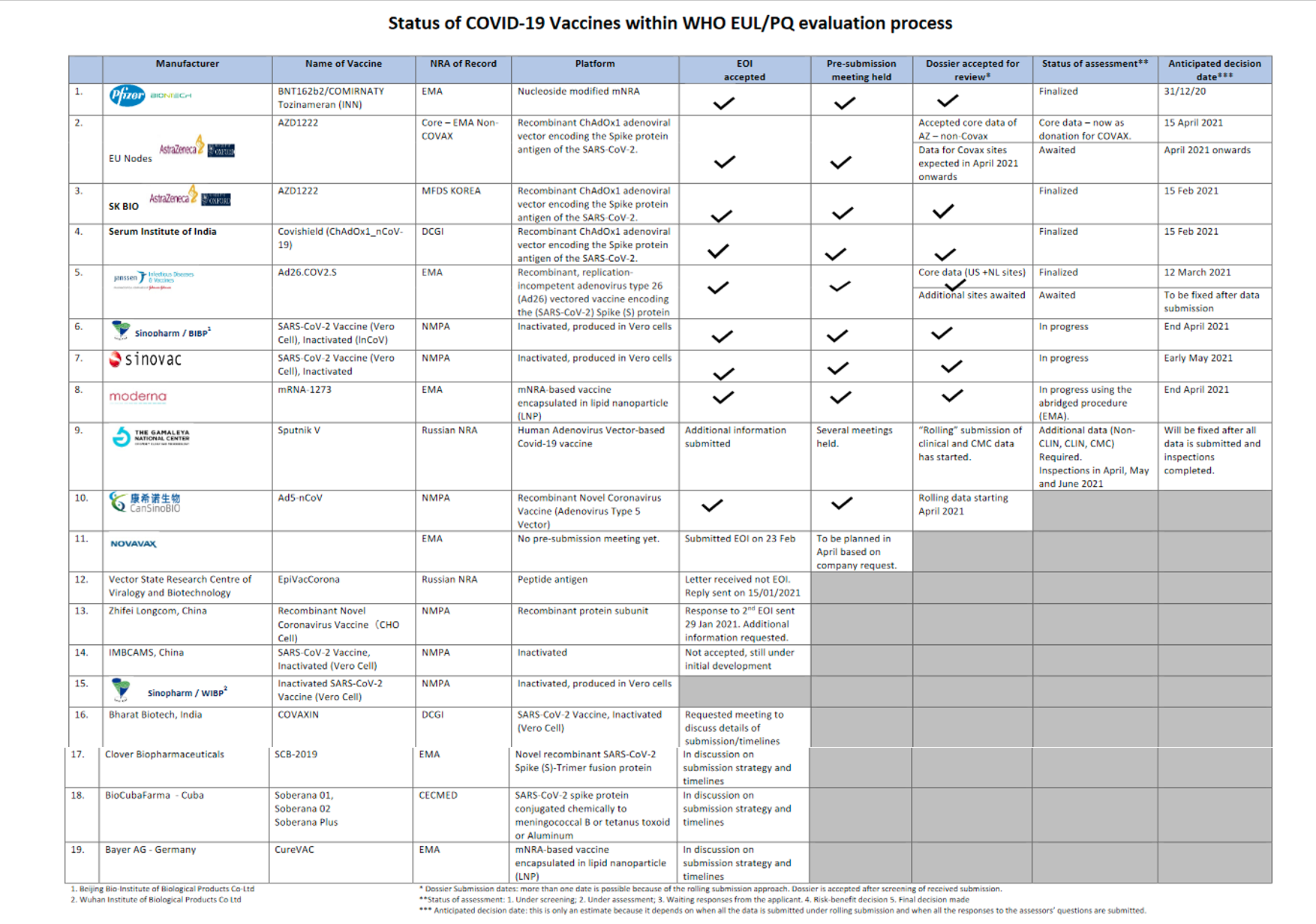
Status of COVID-19 Vaccines within WHO EUL/PQ evaluation process 14 April 2021
For 19 vaccine candidates, presents Manufacturer, Name of Vaccine, NRA of Record, Platform, EOI Accepted Status, Pre-submission Meeting Held Status, Dossier Accepted for Review, Status of Assessment; Anticipated/Completed Decision Date
[click on the link above for full scale view]

COVID Vaccine Developer/Manufacturer Announcements [organizations from WHO EUL/PQ listing above]

Milestones :: Perspectives :: Research


COVID Vaccine Developer/Manufacturer Announcements [organizations from WHO EUL/PQ listing above]


AstraZeneca
Press Releases – No new digest announcements identified

Bharat Biotech, India
Press Releases – No new digest announcements identified

BioCubaFarma – Cuba
Últimas Noticias
Actualización del proceso de vacunación en Cuba durante los ensayos clínicos en curso
14/04/2021

…Como parte del Ensayo clínico Fase III con Soberana 02, se ha aplicado la segunda dosis a 4 534 sujetos y en el Ensayo Clínico Fase III con Abdala, 22 108 sujetos, ya tienen aplicada la segunda dosis.


CanSinoBIO
News – No new digest announcements identified

Clover Biopharmaceuticals – China
News – No new digest announcements identified


Gamaleya National Center
Latest News and Events – No new digest announcements identified [See Russia/RFID below]

IMBCAMS, China
Home – No new digest announcements identified


Janssen/JNJ
Press Releases
Apr 14, 2021 United States
Johnson & Johnson Statement on CDC Advisory Committee Meeting on Company COVID-19 Vaccine
NEW BRUNSWICK, N.J., April 14, 2021 – The U.S. Centers for Disease Control and Prevention (CDC) Advisory Committee on Immunization Practices (ACIP) convened today to consider reports of an extremely rare disorder involving blood clots in combination with low platelets observed in a small number of individuals following vaccination with the Johnson & Johnson COVID-19 vaccine.
“The safety and well-being of the people who use our products is our number one priority, and we strongly support awareness of the signs and symptoms of this extremely rare event to ensure the correct diagnosis, appropriate treatment and expedited reporting by health care professionals,” said Paul Stoffels, M.D., Vice Chairman of the Executive Committee and Chief Scientific Officer at Johnson & Johnson. “We continue to believe in the positive benefit-risk profile of our vaccine. We value the consideration of the Advisory Committee, and we will continue to collaborate with medical experts and global health authorities, including the CDC, U.S. Food and Drug Administration (FDA), European Medicines Agency and the World Health Organization, as we work toward continuing vaccinations to end the global pandemic.”
Out of an abundance of caution, the CDC and FDA have recommended a pause in the use of our vaccine. The Company has made the decision to proactively delay the rollout of our vaccine in Europe and pause vaccinations in all Janssen COVID-19 vaccine clinical trials while we update guidance for investigators and participants.
The CDC and FDA have made information available about proper recognition and management due to the unique treatment required with this type of blood clot. The health authorities advise that people who have received our COVID-19 vaccine and develop severe headache, abdominal pain, leg pain, or shortness of breath within three weeks after vaccination should contact their health care provider.


Moderna
Press Releases
April 14, 2021
Moderna Announces Clinical Progress from its Industry-Leading mRNA Vaccine Franchise and Continues Investments to Accelerate Pipeline Development
:: CMV 7-month data shows all GMT measures at or above CMV seropositive baselines; pivotal Phase 3 study of at least 8,000 participants expected to begin in 2021
:: First interim analysis of Phase 1 RSV vaccine candidate (mRNA-1345) shows >11- fold increase in RSV neutralizing antibodies in younger adults (ages 18-49 years); both 50 μg and 100 μg dose levels generally well-tolerated
:: Phase 1 clinical study of mRNA flu vaccine candidate expected to begin in 2021
:: Phase 1 study evaluating HIV mRNA vaccines with novel strategy expected to begin in 2021

April 13, 2021
Moderna Provides Clinical and Supply Updates on COVID-19 Vaccine Program Ahead of 2nd Annual Vaccines Day
:: Phase 3 COVE Study: Updated cases show continued strong efficacy, including greater than 90% against cases of COVID-19 and greater than 95% against severe cases of COVID-19, with approximately 6 months median follow-up post dose 2
:: Antibody persistence data out to 6 months published in The New England Journal of Medicine
:: New preclinical data shows variant-specific booster vaccine candidates (mRNA-1273.351 and mRNA-1273.211) increase neutralizing titers against SARS-CoV-2 variants of concern
:: Supply Update: As of April 12, approximately 132 million doses have been delivered globally


Novavax
Press Releases
Novavax to Participate in University of Oxford Com-COV2 Study Comparing Mixed COVID-19 Vaccine Combinations
– Study to explore heterologous regimen of COVID-19 vaccines from different manufacturers
– Will assess potential for flexibility in the delivery of COVID-19 vaccines
GAITHERSBURG, Md., April 14, 2021 /PRNewswire/ — Novavax, Inc. (Nasdaq: NVAX), a biotechnology company developing next-generation vaccines for serious infectious diseases, today announced its participation in a newly expanded investigator-initiated Phase 2 clinical trial called Comparing COVID-19 Vaccine Schedule Combinations – Stage 2 (Com-COV2), to be conducted by the University of Oxford and supported by the UK Vaccines Taskforce. Novavax’ recombinant protein vaccine candidate, NVX-CoV2373, is one of four COVID-19 vaccines that will be studied to evaluate the potential for combined regimens that mix vaccines from different manufacturers to achieve immune protection against COVID-19…


Pfizer
Recent Press Releases – No new digest announcements identified


Serum Institute of India
NEWS & ANNOUNCEMENTS – No new digest announcements identified


Sinopharm/WIBPBIBP
News – No new digest announcements identified


Sinovac
Press Releases – No new digest announcements identified


Vector State Research Centre of Viralogy and Biotechnology
Home – No new digest announcements identified

Zhifei Longcom, China
[Anhui Zhifei Longcom Biologic Pharmacy Co., Ltd.]
[No website identified]

U.S.: COVID-19 Vaccines – Announcements/Regulatory Actions/Deployment

Milestones :: Perspectives :: Research


U.S.: COVID-19 Vaccines – Announcements/Regulatory Actions/Deployment


White House [U.S.]
Briefing Room
Press Briefing by White House COVID-19 Response Team and Public Health Officials
April 16, 2021 • Press Briefings

Fact Sheet: Biden Administration Announces $1.7 Billion Investment to Fight COVID-19 Variants
April 16, 2021 • Statements and Releases
…Today’s announcement includes:
:: $1 billion to expand genomic sequencing:  This funding will help CDC, states, and other jurisdictions improve their capacity to identify COVID mutations and monitor circulation of variants. Specifically, it will allow CDC and jurisdictional health departments to conduct, expand, and improve activities to sequence genomes and identify mutations in SARS-CoV-2. Much of this work is done through CDC partnerships with the laboratory community and through state laboratories, and the funding will support the collection of COVID specimens, the sequencing of COVID viruses, and the sharing of the resultant data. A state-by-state breakdown of the initial $240 million in jurisdictional funding support is below.
:: $400 million to support innovation initiatives including the launch of new innovative Centers of Excellence in Genomic Epidemiology:  The funding will establish six Centers of Excellence in Genomic Epidemiology. These centers of excellence will operate as partnerships between state health departments and academic institutions, and today’s funding will fuel cutting-edge research into genomic epidemiology. For example, the partnerships could focus on developing new genomic surveillance tools to better track pathogens of public health interest with the objective of developing surveillance methods to be used more widely in the public health system.  Areas of focus will likely include bioinformatic workflows and the critical integration of genomic and epidemiologic data.
:: $300 million to build and support a National Bioinformatics Infrastructure: One of the challenges of building out the nation’s sequencing capacity is having the data system necessary to quickly and effectively access information and turn it into concrete actions to prevent the spread of viruses. Experts use bioinformatics and complex computing to connect the dots between how pathogens spread and mutate to help solve outbreaks. This investment will support bioinformatics throughout the U.S. public health system, creating a unified system for sharing and analyzing sequence data in a way that protects privacy but allows more informed decisionmaking. This funding also will support training to increase sequencing in clinical settings and expand CDC’s Bioinformatics Fellowship program…

Press Briefing by White House COVID-19 Response Team and Public Health Officials
April 14, 2021 • Press Briefings

Press Briefing by Press Secretary Jen Psaki, NIAID Director and Chief Medical Advisor to the President Dr. Anthony Fauci, and COVID-19 Response Coordinator Jeff Zients, April 13, 2021
April 13, 2021 • Press Briefings

Statement from Jeff Zients, White House COVID-19 Response Coordinator on Johnson & Johnson Vaccine
April 13, 2021 • Statements and Releases

Press Briefing by White House COVID-19 Response Team and Public Health Officials
April 12, 2021 • Press Briefings


::::::

COVID Data Tracker April 3, 2021

Europe: COVID-19 Vaccines – Announcements/Regulatory Actions/Deployment

Milestones :: Perspectives :: Research


Europe: COVID-19 Vaccines – Announcements/Regulatory Actions/Deployment


European Medicines Agency
News & Press Releases
News: EMA starts review of VIR-7831 for treating patients with COVID-19 (new)
CHMP, Last updated: 15/04/202
EMA is reviewing currently available data on the use of the monoclonal antibody VIR-7831 (also known as GSK4182136) in the treatment of patients with COVID-19. EMA is starting this review to support national authorities who may decide on the use of this medicine for COVID-19 prior to marketing authorisation


News: AstraZeneca’s COVID-19 vaccine: EMA to provide further context on risk of very rare blood clots with low blood platelets (new)
CHMP, Last updated: 14/04/2021


News: COVID-19 Vaccine Janssen: assessment of very rare cases of unusual blood clots with low platelets continues (new)
PRAC, Last updated: 14/04/2021


European Commission
Statement 14 April 2021
Statement by President von der Leyen on developments in the Vaccines Strategy
The COVID-19 pandemic remains a severe threat to people’s health and livelihoods. We are in a race against time. The faster we reach our target of having 70% of adults in the European Union vaccinated, the better chances we have of containing the virus.
And the good news is: Vaccination is picking up speed across Europe! Member States have received over 126 million doses of vaccines as of yesterday. And I am happy to say that today we have reached 100 million vaccinations in the EU. This is a milestone that we can be proud of. Of these 100 million vaccinations, more than a quarter are second doses – which means that we have now more than 27 million people fully vaccinated.
This is good news. But as we can see with the announcement by Johnson & Johnson yesterday, there are still many factors that can disrupt the planned delivery schedule of vaccines. It is therefore important to act swiftly, anticipate and adjust whenever possible. We are doing everything in our power to support Europe’s vaccination roll-out, also by increasing the supply of vaccines in the coming weeks and months.
This is why I am pleased to announce that we have reached an agreement with BioNTech-Pfizer to, once again, speed up the delivery of vaccines. 50 million additional doses of BioNTech-Pfizer vaccines will be delivered in quarter 2 of this year, starting in April. Those 50 million doses were initially foreseen for delivery in the fourth quarter of 2021. Now, they are available in quarter 2.
This will bring the total doses delivered by BioNTech-Pfizer to 250 million doses in the second quarter. These doses will be distributed pro-rata to the population, among all the Member States. This will substantially help consolidate the roll-out of our vaccination campaigns. I want to thank BioNTech-Pfizer. It has proven to be a reliable partner. It has delivered on its commitments, and it is responsive to our needs. This is to the immediate benefit of EU citizens.
But let me also focus on the medium term. To prepare for the future, we are drawing the lessons from the first phase of our answer to the pandemic. It is clear that to defeat the virus decisively, we will need to be prepared for the following: At a certain point in time, we might need booster jabs to reinforce and prolong immunity; and if escape-variants occur, we will need to develop vaccines that are adapted to new variants; and we will need them early and in sufficient quantities. Having this in mind we need to focus on technologies that have proven their worth. mRNA vaccines are a clear case in point.
Based on all this, we are now entering into a negotiation with BioNTech-Pfizer for a third contract. This contract will foresee the delivery of 1.8 billion doses of vaccine over the period of 2021 to 2023. And it will entail that not only the production of the vaccines, but also all essential components, will be based in the EU.
The negotiations we are launching today – and hope to conclude very rapidly – are a further important step in Europe’s response to the pandemic. Other contracts, with other companies, may follow. We are in this together. And we will win this fight against the pandemic together…Thank you.

Africa: COVID-19 Vaccines – Announcements/Regulatory Actions/Deployment

Milestones :: Perspectives :: Research


Africa: COVID-19 Vaccines – Announcements/Regulatory Actions/Deployment

CEPI and the African Union join forces to boost African vaccine R&D and manufacturing
Oslo, Norway, and Addis Ababa, Ethiopia; April 13, 2021—The Coalition for Epidemic Preparedness Innovations (CEPI) and the African Union Commission have today announced the signing of an memorandum of understanding, which aims to strengthen ties between the organisations and the Africa CDC—a specialised institution of the African Union responsible for the prevention and control of diseases in Africa—to enhance vaccine R&D and manufacturing in Africa.

This collaboration forms a major part of CEPI’s longer term epidemic and pandemic strategy, announced in March, 2021. As part of this strategy, CEPI aims to work with low-income and middle income countries to develop the infrastructure and expertise to undertake the epidemiological and clinical studies needed to advance vaccine development, support technology transfer, and develop national and regional manufacturing capacity that will enable these countries to take full ownership of their national health security.

Scope of the collaboration
As part of the expanded relationship, CEPI, the African Union, the Africa CDC will work to:
:: Strengthen pandemic and outbreak preparedness on the continent, building on key lessons from the COVID-19 and the procurement and distribution of vaccines through COVAX and African Vaccine Acquisition Task Team (AVATT), established and endorsed by the AU Bureau of Heads of State and Government on 20th of August, 2020;
:: Invest in vaccine R&D innovations to enable faster and easier production of vaccines in Africa;
:: Invest in capacity building and training to foster the development of local expertise needed to boost vaccine R&D and manufacturing in Africa;
:: Strengthen institutions that enhance enabling science need for vaccine development—for example, through investments in regional laboratory and research hubs across Africa
:: Build partnerships that enable the sustainable expansion of vaccine manufacturing in Africa…

Russia: COVID-19 Vaccines – Announcements/Regulatory Actions/Deployment

Milestones :: Perspectives :: Research


Russia: COVID-19 Vaccines – Announcements/Regulatory Actions/Deployment


Russia: Sputnik V – “the first registered COVID-19 vaccine”
https://sputnikvaccine.com/newsroom/pressreleases/
Press Releases
RDIF, GL Rapha and ISU ABXIS to cooperate for production of Sputnik V in Korea
Press release, 15.04.2021
The Russian Direct Investment Fund (RDIF, Russia’s sovereign wealth fund), GL Rapha, one of the leading South Korean bio-tech companies, and ISU ABXIS (a subsidiary of ISU GROUP) have signed an agreement for technology transfer and production of the Russian Sputnik V vaccine against coronavirus in Korea…

Production of Sputnik V launched in Serbia
Press release, 14.04.2021

The Gamaleya Center statement
Press release, 14.04.2021
A comprehensive analysis of adverse events during clinical trials and over the course of mass vaccinations with the Sputnik V vaccine showed that there were no cases of cerebral venous sinus thrombosis (CVST)…

Sputnik V vaccine authorized in India
Press release, 12.04.2021

POLIO Public Health Emergency of International Concern (PHEIC)

Emergencies

POLIO
Public Health Emergency of International Concern (PHEIC)

Polio this week as of 13 April 2021
:: Dr Hamid Jafari, Director of Polio Eradication for WHO’s Eastern Mediterranean Region, declared Somalia’s outbreak of circulating vaccine-derived poliovirus type 3 (cVDPV3) closed a full 28 months after this strain of polio was last detected in Somalia. Read more

Summary of new WPV and cVDPV viruses this week (AFP cases and ES positives):
:: Afghanistan: four cVDPV2 cases
:: Pakistan: one WPV1 positive environmental sample
:: Burkina Faso: one cVDPV2 case
:: Congo: one cVDPV2 case
:: Côte d’Ivoire: one cVDPV2 case
:: Democratic Republic of the Congo: one cVDPV2 case
:: Guinea: five cVDPV2 cases
:: Liberia: one cVDPV2 positive environmental sample
:: Mali: two cVDPV2 cases
:: Senegal: one cVDPV2 case
:: Sierra Leone: two cVDPV2 cases
:: Yemen: three cVDPV1 cases

::::::
::::::

WHO/OCHA Emergencies

Editor’s Note:
Continuing with this edition, we include information about the last apparent update evident on the WHO emergency country webpages, recognizing almost universal and significant interims since last update regardless of the level of the emergency listed.

WHO Grade 3 Emergencies [to 17 Apr 2021]

Democratic Republic of the Congo – No new digest announcements [Last apparent update: 12 Jan 2021]
Mozambique floods – No new digest announcements identified [Last apparent update: 3 November 2020]
Nigeria – No new digest announcements identified [Last apparent update: 29 Jun 2020]
Somalia – No new digest announcements identified [Last apparent update: 17 July 2020]
South Sudan – No new digest announcements identified [Last apparent update: 4 February 2020]
Syrian Arab Republic – No new digest announcements identified [Last apparent update: 24 October 2020]
Yemen – No new digest announcements identified [Last apparent update: 30 June 2020]

::::::

WHO Grade 2 Emergencies [to 17 Apr 2021]
Iraq
:: WHO confirms the safety and efficacy of COVID-19 vaccines and urges Iraqis to register and vaccinate to help defeat the pandemic
Baghdad – 11 April 2021. The World Health Organization (WHO) in Iraq refutes the fabricated statement recently circulated in an unofficial social media platform to undermine the citizens’ confidence in the safety and efficacy of COVID-19 vaccines…

Niger
:: Le Niger a reçu 355 000 doses du vaccins Aztra Zeneca contre la COVID-19 expédiés par le mécanisme COVAX
16 avril 2021

Afghanistan – No new digest announcements identified [Last apparent update: 5 July 2020]
Angola – No new digest announcements identified [Last apparent update: 16 March 2021]
Burkina Faso – No new digest announcements identified [Last apparent update: 01 avril 2021]
Burundi – No new digest announcements identified [Last apparent update: 04 July 2019]
Cameroon – No new digest announcements identified [Last apparent update: 22 August 2019]
Central African Republic – No new digest announcements identified [Last apparent update: 12 June 2018]
Ethiopia – No new digest announcements identified [Last apparent update: 22 August 2019]
Iran floods 2019 – No new digest announcements identified [Last apparent update: 2 March 2020]
Libya – No new digest announcements identified [Last apparent update: 7 October 2019]
Malawi – No new digest announcements identified [Last apparent update: 07 April 2021]
Measles in Europe – No new digest announcements identified [Last apparent update: 16-12-2020]
MERS-CoV – No new digest announcements identified [Last apparent update: 8 July 2019]
Mozambique – No new digest announcements identified [Last apparent update: 03 November 2020]
Myanmar – No new digest announcements identified [Last apparent update: 29 March 2021]
occupied Palestinian territory – No new digest announcements identified [Last apparent update: 4 September 2019]
HIV in Pakistan – No new digest announcements identified [Last apparent update: 27 August 2019]
Sao Tome and Principe Necrotizing Cellulitis (2017) – No new digest announcements
Sudan – No new digest announcements identified [Last apparent update: 24 June 2020]
Ukraine – No new digest announcements identified [Last apparent update: 1 May 2019]
Zimbabwe – No new digest announcements identified [Last apparent update: 10 May 2019]

::::::

WHO Grade 1 Emergencies [to 17 Apr 2021]

Chad – No new digest announcements identified [Last apparent update: 30 June 2018]
Djibouti – No new digest announcements identified [Last apparent update: 25 novembre 2020]
Kenya – No new digest announcements identified [Last apparent update: 06 March 2021]
Mali – No new digest announcements identified [Last apparent update: 3 May 2017]
Namibia – viral hepatitis – No new digest announcements identified [Last apparent update: 20 July 2018]
Tanzania – No new digest announcements identified [Last apparent update: 21 October 2020]

::::::
::::::

UN OCHA – Current Emergencies
COVID-19 – No new unique digest announcements identified

::::::
::::::


WHO & Regional Offices [to 17 Apr 2021]

WHO & Regional Offices [to 17 Apr 2021]
16 April 2021 Departmental news
Update of the WHO guidance on the treatment of drug susceptible tuberculosis

16 April 2021 Statement
Global Advisory Committee on Vaccine Safety (GACVS) review of latest evidence of rare adverse blood coagulation events with AstraZeneca COVID-19 Vaccine (Vaxzevria and Covishield)

15 April 2021 Departmental news
Global shortage of innovative antibiotics fuels emergence and spread of drug-resistance

14 April 2021 News release
New WHO Global Compact to speed up action to tackle diabetes

14 April 2021 Departmental news
Digital technologies for health financing:

14 April 2021 News release
WHO and the International Organisation of the Francophonie (IOF) sign Memorandum of Understanding to strengthen access to health in Francophone countries

14 April 2021 Departmental news
WHO calls for comprehensive, equitable access to healthcare for every Chagas disease patient

13 April 2021 Departmental news
Benefits of continuing to provide life-saving HIV services outweigh the risk of COVID-19 transmission by 100 to 1

12 April 2021 Departmental news
US$ 1.4 trillion lost every year to tobacco use – New tobacco tax manual shows ways to save lives, money and build back better after COVID-19


::::::

Weekly Epidemiological Record, Vol. 96, No. 15, pp. 117–124 16 April 2021
:: Progress in monitoring immunization safety –worldwide, 2010–2019


::::::

WHO Regional Offices
Selected Press Releases, Announcements
WHO African Region AFRO
No new digest content identified

WHO Region of the Americas PAHO
No new digest content identified

WHO South-East Asia Region SEARO
:: Apply all tools, take urgent action to prevent further COVID-19 infections: WHO 16 April 2021 SEAR/PR/1752

WHO European Region EURO
:: Surging pandemic surpasses 1 million deaths in the WHO European Region 15-04-2021
:: Youth organizations, have your say! Shape tomorrow by speaking up today! 15-04-2021
:: New WHO Centre of Excellence for Quality of Care and Patient Safety opens in Athens 15-04-2021
:: Reducing harm due to alcohol: success stories from 3 countries 15-04-2021
:: Alcohol policies for the European Region: new WHO research reveals eastern Member States are leading the way 15-04-2021

WHO Eastern Mediterranean Region EMRO
:: WHO confirms the safety and efficacy of COVID-19 vaccines and urges Iraqis to register and vaccinate to help defeat the pandemic 11 April 2021.

WHO Western Pacific Region
No new digest content identified