Journal of Health Care for the Poor and Underserved (JHCPU)
Volume 32, Number 2, May 2021 Supplement https://muse.jhu.edu/issue/44396
Table of Contents Overview of the Issue Kevin B. Johnson, Tiffani J. Bright, Cheryl R. Clark
…The importance of techquity—defined as the strategic development and deployment of technology in health care and health to advance health equity—was even more apparent after the events of 2020. COVID-19 upended access to care and illuminated the impact of structural racism as a cause for a widening gap of access during the pandemic. Black Lives Matter became more than a trending hashtag on Twitter, or a movement resulting in peaceful protests and calls for policy reform: it put additional focus on the issue of race as a social and not a biological construct and called into question the rationale for common practices in health care that were triggered by race. A notable example was the emerging realization that kidney function assessment was tied to race and hardwired into many of our electronic health records. The real-world evidence around our lack of techquity was incontrovertible.
This Supplemental Issue of JHCPU provides articles that describe challenges to techquity, frameworks to improve the role of technology in care, and examples of how technology can transform health, public health, and health care…
Extended essays Justice in COVID-19 vaccine prioritisation: rethinking the approach (9 June, 2021) Free
Rosamond Rhodes Abstract
Policies for the allocation of COVID-19 vaccine were implemented in early 2021 as soon as vaccine became available. Those responsible for the planning and execution of COVID-19 vaccination had to make choices about who received vaccination first while numerous authors offered their own recommendations. This paper provides an account of how such decisions should be made by focusing on the specifics of the situation at hand. In that light, I offer an argument for prioritising those who are likely vectors of the disease and a criticism of the victim-focused priority proposals put forward by the US Centers for Disease Control and Prevention, the National Academies of Sciences, Engineering, and Medicine, the UK National Health Service, and others. I also offer thoughts on how those authors may have gone astray.
Comment Optimising SARS-CoV-2 vaccination schedules
Cristobal Belda-Iniesta
… In summary, the question to be answered is whether the data published by Liu and colleagues, in combination with those previously published by Borobia and colleagues,3 are enough evidence to initiate the modification of vaccination schedules. Alternatively, large academic phase 3 clinical trials could explore the protection against severe disease, intensive care unit admission, and SARS-CoV-2 mortality using heterologous schedules, but the time and effort that this work would entail should be carefully balanced against the potential benefits.
Perspective Fundamentals of Public Health: Population Health and Human RightsJ. Frenk and O. Gómez-Dantés
The way a society protects and promotes human rights shapes public policies, determines the distribution of resources and access to services, and ultimately affects population health. Scholarship and action on human rights have been foundational to the public health field.
Original Articles Effectiveness of an Inactivated SARS-CoV-2 Vaccine in Chile A. Jara and Others
Mass vaccination campaigns to prevent coronavirus disease 2019 (Covid-19) are occurring in many countries; estimates of vaccine effectiveness are urgently needed to support decision making. A countrywide mass vaccination campaign with the use of an inactivated severe acute respiratory syndrome coronavirus 2 (SARS-CoV-2) vaccine (CoronaVac) was conducted in Chile starting on February 2, 2021
Articles Maternal Vaccination and Infant Influenza and Pertussis
Stacey L. Rowe, Karin Leder, Kirsten P. Perrett, Nicole Romero, Terry M. Nolan, Nicola Stephens, Benjamin C. Cowie, Allen C. Cheng
Pediatrics, Sep 2021, 148 (3) e2021051076
medRxiv medRxiv is a free online archive and distribution server for complete but unpublished manuscripts (preprints) in the medical, clinical, and related health sciences. Preprints are preliminary reports of work that have not been certified by peer review. They should not be relied on to guide clinical practice or health-related behavior and should not be reported in news media as established information. medRxiv is for the distribution of preprints – complete but unpublished manuscripts – that describe human health research conducted, analyzed, and interpreted according to scientific principles… https://www.medrxiv.org/content/about-medrxiv
[Accessed 04 Sep 2021]
Projected resurgence of COVID-19 in the United States in July—December 2021 resulting from the increased transmissibility of the Delta variant and faltering vaccination
Shaun Truelove, Claire P. Smith, Michelle Qin, Luke C. Mullany, Rebecca K. Borchering, Justin Lessler, Katriona Shea, Emily Howerton, Lucie Contamin, John Levander, Jessica Salerno, Harry Hochheiser, Matt Kinsey, Kate Tallaksen, Shelby Wilson, Lauren Shin, Kaitlin Rainwater-Lovett, Joseph C. Lemaitre, Juan Dent, Joshua Kaminsky, Elizabeth C. Lee, Javier Perez-Saez, Alison Hill, Dean Karlen, Matteo Chinazzi, Jessica T. Davis, Kunpeng Mu, Xinyue Xiong, Ana Pastore y Piontti, Alessandro Vespignani, Ajitesh Srivastava, Przemyslaw Porebski, Srinivasan Venkatramanan, Aniruddha Adiga, Bryan Lewis, Brian Klahn, Joseph Outten, James Schlitt, Patrick Corbett, Pyrros Alexander Telionis, Lijing Wang, Akhil Sai Peddireddy, Benjamin Hurt, Jiangzhuo Chen, Anil Vullikanti, Madhav Marathe, Stefan Hoops, Parantapa Bhattacharya, Dustin Machi, Shi Chen, Rajib Paul, Daniel Janies, Jean-Claude Thill, Marta Galanti, Teresa Yamana, Sen Pei, Jeffrey Shaman, Nicholas G. Reich, Jessica M. Healy, Rachel B. Slayton, Matthew Biggerstaff, Michael A. Johansson, Michael C. Runge, Cécile Viboud
medRxiv 2021.08.28.21262748; doi: https://doi.org/10.1101/2021.08.28.21262748
COVID-19-associated hospitalizations among vaccinated and unvaccinated adults ≥18 years – COVID-NET, 13 states, January 1 – July 24, 2021
Fiona P. Havers, Huong Pham, Christopher A. Taylor, Michael Whitaker, Kadam Patel, Onika Anglin, Anita K. Kambhampati, Jennifer Milucky, Elizabeth Zell, Shua J. Chai, Pam Daily Kirley, Nisha B. Alden, Isaac Armistead, Kimberly Yousey-Hindes, James Meek, Kyle P. Openo, Evan J. Anderson, Libby Reeg, Alexander Kohrman, Ruth Lynfield, Kathryn Como-Sabetti, Elizabeth M. Davis, Cory Cline, Alison Muse, Grant Barney, Sophrena Bushey, Christina B. Felsen, Laurie M. Billing, Eli Shiltz, Melissa Sutton, Nasreen Abdullah, H. Keipp Talbot, William Schaffner, Mary Hill, Andrea George, Bhavini Patel Murthy, Meredith McMorrow
medRxiv 2021.08.27.21262356; doi: https://doi.org/10.1101/2021.08.27.21262356
Vaccines and Global Health: The Week in Review is a weekly digest summarizing news, events, announcements, peer-reviewed articles and research in the global vaccine ethics and policy space. Content is aggregated from key governmental, NGO, international organization and industry sources, key peer-reviewed journals, and other media channels. This summary proceeds from the broad base of themes and issues monitored by the Center for Vaccine Ethics & Policy in its work: it is not intended to be exhaustive in its coverage. You are viewing the blog version of our weekly digest, typically comprised of between 30 and 40 posts below all dated with the current issue date
.– Request anEmail Summary:Vaccines and Global Health : The Week in Review is published as a single email summary, scheduled for release each Saturday evening before midnight (EDT in the U.S.). If you would like to receive the email version, please send your request to david.r.curry@centerforvaccineethicsandpolicy.org.
– pdf version: A pdf of the current issue is available here:
– blog edition: comprised of the approx. 35+ entries posted below.
– Twitter:Readers can also follow developments on twitter: @vaxethicspolicy. . – Links: We endeavor to test each link as we incorporate it into any post, but recognize that some links may become “stale” as publications and websites reorganize content over time. We apologize in advance for any links that may not be operative. We believe the contextual information in a given post should allow retrieval, but please contact us as above for assistance if necessary.
Support this knowledge-sharing service:Your financial support helps us cover our costs and to address a current shortfall in our annual operating budget. Click here to donate and thank you in advance for your contribution.
. David R. Curry, MS Executive Director Center for Vaccine Ethics and Policy
Editor’s Note:
As is obvious to all, the sheer volume of strategic announcements, regulatory actions, country program decisions, commentary, and, indeed, misinformation around COVID response continues at extraordinary levels. Our weekly digest strives to present a coherent and comprehensive snapshot, but cannot be exhaustive, If you recognize a missed strategic development, a new source of rigorous analysis, or an insight/commentary that would benefit our common understanding, please advise me…we will review all suggestions and consider for inclusion in a subsequent edition: david.r.curry@ge2p2global.org
We are seeking access to modelling which engages scenarios and articulates imperatives around a pandemic end-game through at least a 2025 horizon. We assess that WHO must be conducting or contracting for such modeling – or should recognize an imperative to be doing so in its global health governance role. If we have missed such modeling in progress, we would be delighted to be advised of it and will include it in our coverage.
Joint Statement of the Multilateral Leaders Taskforce on Scaling COVID-19 Tools A Crisis of Vaccine Inequity [Editor’s text bolding]
WASHINGTON, 27 August 2021—At its third meeting, the Multilateral Leaders Taskforce on COVID-19 (MLT) – the heads of the International Monetary Fund, World Bank Group, World Health Organization and World Trade Organization -met with the leaders of the African Vaccine Acquisition Trust (AVAT), Africa CDC, Gavi and UNICEF to tackle obstacles to rapidly scale-up vaccines in low- and lower middle-income countries, particularly in Africa, and issued the following statement:
“The global rollout of COVID-19 vaccines is progressing at two alarmingly different speeds. Less than 2% of adults are fully vaccinated in most low-income countries compared to almost 50% in highincome countries.
These countries, the majority of which are in Africa, simply cannot access sufficient vaccine to meet even the global goals of 10% coverage in all countries by September and 40% by end 2021, let alone the African Union’s goal of 70% in 2022.
This crisis of vaccine inequity is driving a dangerous divergence in COVID-19 survival rates and in the global economy. We appreciate the important work of AVAT and COVAX to try and address this unacceptable situation.
However, effectively tackling this acute vaccine supply shortage in low- and lower middle-income countries, and fully enabling AVAT and COVAX, requires the urgent cooperation of vaccine manufacturers, vaccine-producing countries, and countries that have already achieved high vaccination rates.
To ensure all countries achieve the global goals of at least 10% coverage by September and 40% by end-2021: We call on countries that have contracted high volumes of vaccines to swap near-term delivery schedules with COVAX and AVAT.
We call on vaccine manufacturers to immediately prioritize and fulfill their contracts to COVAX and AVAT, and to provide regular, clear supply forecasts.
We urge G7 and all dose-sharing countries to fulfill their pledges urgently, with enhanced pipeline visibility, product shelf life and support for ancillary supplies, as barely 10% of nearly 900 million committed doses have so far been shipped.
We call on all countries to eliminate export restrictions and any other trade barriers on COVID-19 vaccines and the inputs involved in their production.
We are in parallel intensifying our work with COVAX and AVAT to tackle persistent vaccine delivery, manufacturing and trade issues, notably in Africa, and mobilize grants and concessional financing for these purposes. We will also explore financing mechanisms to cover future vaccine needs as requested by AVAT. We will advocate for better supply forecasts and investments to increase country preparedness and absorptive capacity. And we will continue to enhance our data, to identify gaps and improve transparency in the supply and use of all COVID-19 tools.
The time for action is now. The course of the pandemic—and the health of the world—are at stake.”
Editor’s Note: We include the full text of the U.S. Intelligence Community Assessment, the associated White House statement, and the response by the Chinese Embassy in Washington. We assess that successful completion of a robust and transparent investigation of COVID-19 origins is critical to effective and coherent global response to the current pandemic as well as the effective functioning of the IHR for future pandemics, PHEICs, and health emergencies generally.
August 27, 2021
The Office of the Director of National Intelligence (ODNI) today released an unclassified summary of the Intelligence Community assessment on COVID-19 origins:
UNCLASSIFIED Key Takeaways[Editor’s text bolding]
The IC assesses that SARS-CoV-2, the virus that causes COVID-19, probably emerged and
infected humans through an initial small-scale exposure that occurred no later than November
2019 with the first known cluster of COVID-19 cases arising in Wuhan, China in December
2019. In addition, the IC was able to reach broad agreement on several other key issues. We
judge the virus was not developed as a biological weapon. Most agencies also assess with low confidence that SARS-CoV-2 probably was not genetically engineered; however, two agencies believe there was not sufficient evidence to make an assessment either way. Finally, the IC assesses China’s officials did not have foreknowledge of the virus before the initial outbreak of COVID-19 emerged.
After examining all available intelligence reporting and other information, though, the IC
remains divided on the most likely origin of COVID-19. All agencies assess that two hypotheses
are plausible: natural exposure to an infected animal and a laboratory-associated incident.
:: Four IC elements and the National Intelligence Council assess with low confidence that the initial SARS-CoV-2 infection was most likely caused by natural exposure to an animal infected with it or a close progenitor virus—a virus that probably would be more than 99 percent similar to SARS-CoV-2. These analysts give weight to China’s officials’ lack of foreknowledge, the numerous vectors for natural exposure, and other factors.
:: One IC element assesses with moderate confidence that the first human infection with SARS-CoV-2 most likely was the result of a laboratory-associated incident, probably involving experimentation, animal handling, or sampling by the Wuhan Institute of Virology. These analysts give weight to the inherently risky nature of work on coronaviruses.
:: Analysts at three IC elements remain unable to coalesce around either explanation without additional information, with some analysts favoring natural origin, others a laboratory origin, and some seeing the hypotheses as equally likely.
:: Variations in analytic views largely stem from differences in how agencies weigh intelligence reporting and scientific publications, and intelligence and scientific gaps.
The IC judges they will be unable to provide a more definitive explanation for the origin of
COVID-19 unless new information allows them to determine the specific pathway for initial
natural contact with an animal or to determine that a laboratory in Wuhan was handling SARS-
CoV-2 or a close progenitor virus before COVID-19 emerged.
:: The IC—and the global scientific community—lacks clinical samples or a complete
understanding of epidemiological data from the earliest COVID-19 cases. If we
obtain information on the earliest cases that identified a location of interest or
occupational exposure, it may alter our evaluation of hypotheses.
China’s cooperation most likely would be needed to reach a conclusive assessment of the origins of COVID-19. Beijing, however, continues to hinder the global investigation, resist sharing information and blame other countries, including the United States. These actions reflect, in part, China’s government’s own uncertainty about where an investigation could lead as well as its frustration the international community is using the issue to exert political pressure on China.
::::::
Statement by President Joe Biden on the Investigation into the Origins of COVID-19
August 27, 2021 :: Statements and Releases
This week, I received the report on the 90-day sprint I asked our intelligence community to conduct into the origins of the COVID-19 pandemic. I am grateful for the thorough, careful, and objective work of our intelligence professionals, and while this review has concluded, our efforts to understand the origins of this pandemic will not rest. We will do everything we can to trace the roots of this outbreak that has caused so much pain and death around the world, so that we can take every necessary precaution to prevent it from happening again.
Critical information about the origins of this pandemic exists in the People’s Republic of China, yet from the beginning, government officials in China have worked to prevent international investigators and members of the global public health community from accessing it. To this day, the PRC continues to reject calls for transparency and withhold information, even as the toll of this pandemic continue to rise. We needed this information rapidly, from the PRC, while the pandemic was still new. Since taking office, my administration has renewed U.S. leadership in the World Health Organization and rallied allies and partners to renew focus on this critical question. The world deserves answers, and I will not rest until we get them. Responsible nations do not shirk these kinds of responsibilities to the rest of the world. Pandemics do not respect international borders, and we all must better understand how COVID-19 came to be in order to prevent further pandemics.
The United States will continue working with like-minded partners around the world to press the PRC to fully share information and to cooperate with the World Health Organization’s Phase II evidence-based, expert-led determination into the origins of COVID-19 – including by providing access to all relevant data and evidence. We will also continue to press the PRC to adhere to scientific norms and standards, including sharing information and data from the earliest days of the pandemic, protocols related to biosafety, and information from animal populations. We must have a full and transparent accounting of this global tragedy. Nothing less is acceptable.
::::::
Statement by the Chinese Embassy in the United States on the “COVID-19 Origin-Tracing” Report of the U.S. Side
2021/08/27
On August 27, the Office of the Director of National Intelligence of the United States released a summary of the intelligence community assessment on COVID-19 origins, which does not rule out either natural exposure or laboratory accident as the origin of SARS-CoV-2. The report wrongly claims that China “continues to hinder the global investigation, resist sharing information and blame other countries”. The statement by the White House issued on the same day also purported that China tries to hold back international investigation and rejects calls for transparency. It urges like-minded partners to exert pressure on China. The Chinese side expresses its firm opposition and strong condemnation to this.
First, a report fabricated by the U.S. intelligence community is not scientifically credible. The origin-tracing is a matter of science; it should and can only be left to scientists, not intelligence experts. There has been no lack of “masterpieces” by the U.S. intelligence community, such as using a tube of laundry powder to convict Iraq of possessing weapons of mass destruction, or staging the “white helmets” video as evidence for chemical weapon attack in Syria. Now, the US side is using its old trick again. Ignoring the Report by the WHO-China joint mission, it chooses to have its intelligence community put together a report instead. How can this possibly be science-based and reliable origin-tracing?
Second, the assertion of lack of transparency on the part of China is only an excuse for its politicizing and stigmatizing campaign. Since the outbreak of COVID-19, China has taken an open, transparent and responsible attitude. We have released information, shared the genome sequencing of the virus, and carried out international cooperation to fight the disease, all done at the earliest possible time. On December 27, 2019, Wuhan authorities made the first reporting of suspected cases. On December 30, emergency notices were issued on the treatment of pneumonia of unknown cause. On December 31, China informed the WHO China Country Office of cases of pneumonia of unknown cause detected in Wuhan. On January 3, 2020, China began sending regular updates about the novel coronavirus to the WHO and other countries, including the United States. On origin-tracing, China has followed a science-based, professional, serious and responsible approach. We are the first to cooperate with the WHO on global origin-tracing, and we have invited WHO experts to conduct the investigations twice in China. We were completely open, transparent and cooperative when the experts were in China. They visited every site on their list, met every individual they asked for, and were provided with all the data they wanted. The formulation of the Report of the WHO-China joint mission issued on March 30, 2021 follows WHO procedures and adopts a scientific approach. It is authoritative and science-based. The openness and transparency China has displayed has won full recognition from international experts.
Third, the report by the U.S. intelligence community shows that the U.S. is bent on going down the wrong path of political manipulation. The U.S. has registered the most infections and death cases from COVID-19 in the world, and the American people have paid a heavy price. The report by the intelligence community is based on presumption of guilt on the part of China, and it is only for scapegoating China. Such a practice will only disturb and sabotage international cooperation on origin-tracing and on fighting the pandemic, and has been widely opposed by the international community. Over 300 political parties, social organizations and think tanks from more than 100 countries and regions have submitted a joint statement to the WHO Secretariat, firmly opposing politicization of origin-tracing. Doesn’t the U.S. side feel it necessary to listen to what they have to say?
Finally, the U.S. has been shying away from tracing the origin in the United States and closing the door on any such possibility. If the US.. side is “transparent and responsible”, it should make public and examine the data of its early cases. The timeline of the outbreak in the United States has been revised to earlier dates several times. In at least five American states, there had been infections before the first confirmed case in the U.S. was announced. According to a latest coverage from American media, the first COVID-19 death in the U.S. was in early January 2020, several weeks earlier than previously announced by the authorities, which was early February.
In addition, Wuhan Institute of Virology has received two visits from WHO experts and the WHO-China joint study report has reached the clear conclusion that introduction through a lab accident in Wuhan is “extremely unlikely”. If the US insists on the lab leak theory, isn’t it necessary for the U.S. side to invite WHO experts to Fort Detrick and the University of North Carolina (UNC) for investigation? Fort Detrick has long been engaged in coronavirus research and modification. After its shutdown in 2019 because of serious safety incidents, disease with symptoms similar to COVID-19 broke out in the U.S. The team of Professor Ralph Baric in the UNC possesses extremely mature capability in synthesizing and modifying coronavirus. From January 2015 to June 2020, the UNC reported to the National Institutes of Health 28 lab incidents involving genetically engineered organisms. Six of them involved coronaviruses including SARS, MERS and SARS-CoV-2. However, instead of finding out what happened in its own labs first, the U.S. keeps slinging mud at others.
China’s position on global origin-tracing is consistent and clear. This is a matter of science. China always supports and will continue to participate in science-based origin-tracing. What we are against is political manipulation, presumption of guilt and putting blame on others. Any Phase II origins study must be a comprehensive extension of Phase I and conducted in multiple places and countries to find out the truth.
The report by the U.S. intelligence community has not produced an exact answer the U.S. side wants. Continuing such an effort will also be in vain, because its subject is simply non-existent and anti-science.
::::::
Nature
Volume 596 Issue 7873, 26 August 2021 https://www.nature.com/nature/volumes/596/issues/7873 Comment | 25 August 2021 Origins of SARS-CoV-2: window is closing for key scientific studies Authors of the March WHO report into how COVID-19 emerged warn that further delay makes crucial inquiry biologically difficult.
Marion Koopmans, Peter Daszak, John Watson
Our group was convened by the World Health Organization (WHO) in October 2020. We have been the designated independent international members of a joint WHO–China team tasked with understanding the origins of SARS-CoV-2. Our report was published this March1. It was meant to be the first step in a process that has stalled. Here we summarize the scientific process so far, and call for action to fast-track the follow-up scientific work required to identify how COVID-19 emerged, which we set out in this article.
The window of opportunity for conducting this crucial inquiry is closing fast: any delay will render some of the studies biologically impossible. Understanding the origins of a devastating pandemic is a global priority, grounded in science…
::::::
WHO: Call for experts to join Scientific Advisory Group for the Origins of Novel Pathogens
20 August 2021 News release Issued on: 20 August Deadline: 10 September
The World Health Organization (WHO) today issued an open call for experts to serve as members of the new WHO Scientific Advisory Group for the Origins of Novel Pathogens (SAGO).
The SAGO will advise WHO on technical and scientific considerations regarding the origins of emerging and re-emerging pathogens of epidemic and pandemic potential, and will be composed of a wide range of experts acting in their personal capacity. SAGO will also guide WHO on next steps for understanding the SARS-CoV-2 origins…
Multilateral Leaders Task Force on COVID-19 [IMF, World Bank Group, WHO, WTO]
A joint initiative from the International Monetary Fund, World Bank Group, World Health Organization, and World Trade Organization to accelerate access to COVID-19 vaccines, therapeutics and diagnostics by leveraging multilateral finance and trade solutions, particularly in low- and middle-income countries. Data to help track, coordinate, and advance delivery of COVID-19 health tools to developing countries and to mobilize relevant stakeholders and national leaders to remove critical roadblocks – in support of the priorities set out by the WBG, IMF, WHO, and WTO.
Global COVID-19 Figures: 214M total confirmed cases; 4.5M total confirmed deaths Global vaccines administered: 5.13B
Number of Countries: 26 [26]
COVAX Allocations Round 4-6 (Number of Doses): 120M
COVAX Delivered (Number of Doses): 68M [53M week ago]
Other Delivered (Number of Doses): 98M [93M week ago]
Total Delivered (Number of Doses): 170M [150M week ago]
Total Administered (Number of Doses): 140M [110M week ago]
27 August 2021 Speech WHO Director-General’s opening remarks at Member State Information Session on COVID-19 – 27 August 2021
…We are now seeing more than 650 thousand new cases a day.
Of course, the situation remains very different around the world, with steep increases and overwhelmed hospitals in some regions and countries, and welcome declines in others.
There are no shortcuts. The Secretariat continues to recommend a comprehensive, risk-based approach of proven public health and social measures, in combination with equitable vaccination.
Our global targets are to support every country to vaccinate at least 10% of its population by the end of September, at least 40% by the end of this year, and 70% of the world’s population by the middle of next year.
We are making progress. Globally, 140 countries have vaccinated at least 10% of their populations. But in many parts of the world, vaccination coverage is still under two percent. This is unacceptable.
That is why we have called for a global moratorium on booster doses at least until the end of September.
Our 10% target is still achievable, but only if all Member States work together in solidarity. The Secretariat is working directly with producers, countries with high vaccination levels, and producing countries, to solve this problem.
Between now and the end of the year, we expect the volume of vaccines to increase substantially. That makes it crucial that all countries step up their preparations to roll out vaccines.
Just as the pandemic has highlighted the need for improved mechanisms to share vaccines, it has also shown that the world needs better systems for collecting, analyzing and sharing information on pandemic and epidemic threats.
Currently, WHO assesses 4,500 events every month for epidemic and pandemic risk. With the availability of new technologies and the fast-moving global information landscape, we have an opportunity to identify and understand risks much more quickly and comprehensively…
25 August 2021 Speech WHO Director-General’s opening remarks at the media briefing on COVID-19 – 25 August 2021
24 August 2021Remarks Director-General’s opening remarks at the Seventy-first session of the Regional Committee for Africa
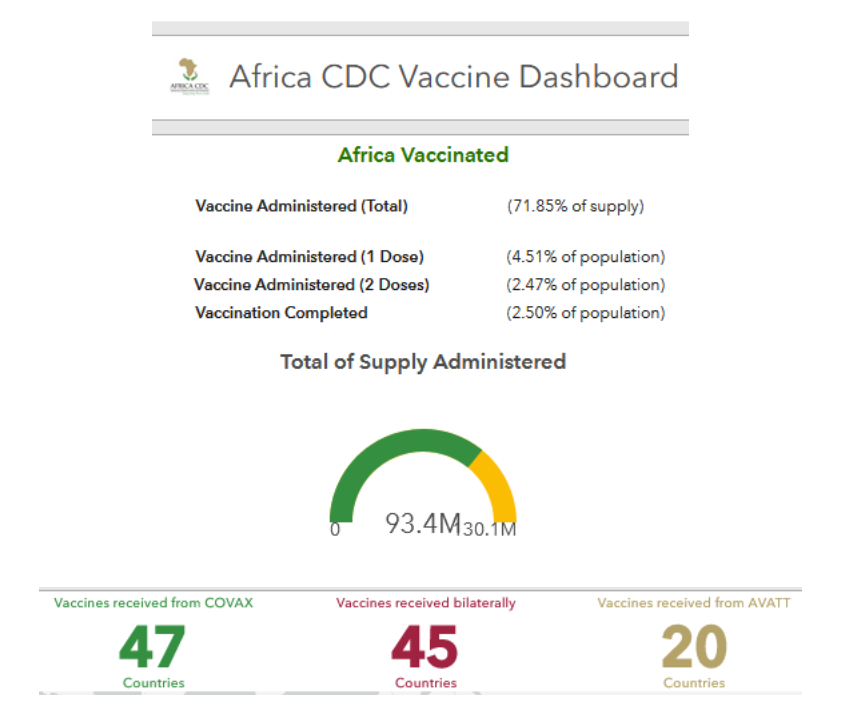
…But I don’t need to tell you that the distribution of vaccines has been terribly unfair. We’re all disappointed by the injustice. More than 4.8 billion doses of vaccine have been administered globally. Just 87 million doses have been administered in the African region – less than 2 percent of the global total.
Globally, 140 countries have vaccinated at least 10% of their populations, but in our continent, only four countries have been able to reach that target, owing to the shocking disparity in access to vaccines.
WHO’s global targets are to support every country to vaccinate at least 10% of its population by the end of September, at least 40% by the end of this year, and 70% of the world’s population by the middle of next year.
WHO and our partners are doing everything we can to find ways of scaling up production as much as possible, as fast as possible, as Tshidi said. More than 44 million doses have been distributed to 40 AFRO countries through COVAX, and we’re pleased to see that COVAX is picking up speed. More doses were shipped in July than in the previous 5 months. COVAX aims to deliver around 475 million more doses in the region by the end of December.
I also recognize and congratulate the African Union’s African Vaccine Acquisition Trust, AVAT, which was established under the leadership of President Ramaphosa. This will be a very innovative and important complement to COVAX for achieving our targets, and we are committed to working with African Union Special Envoy Strive Masiyiwa to make AVAT a success. Africa should invest in this continental initiative.
I’m pleased that the first shipments started this month, using Johnson & Johnson vaccines that were filled in Africa. We have also made progress towards increasing production in Africa, through the recent establishment of a technology transfer hub for mRNA vaccines in South Africa, and through our work with many countries including Rwanda and Senegal to boost local production.
Between now and the end of the year, we expect the volume of vaccines coming to Africa to increase substantially. That makes it crucial that all countries step up their preparations to roll out vaccines. The vaccine crisis illustrates the fundamental weakness at the root of the pandemic: the lack of global solidarity and sharing – sharing of information and data, biological samples, resources, technology and tools.
That’s why there is now an emerging global consensus for the idea of an international treaty or other legal instrument, to provide the basis for improved international cooperation to prepare for, detect and respond to epidemics and pandemics. At the World Health Assembly in May, Member States agreed to discuss this idea at a Special Session of the Assembly in November.
We seek the support of all African Member States for this very important initiative….
Weekly operational update on COVID-19 – 23 August 2021 Overview
In this edition of the COVID-19 Weekly Operational Update, highlights of country-level actions and WHO support to countries include:
Restoring essential health services in Haiti post-earthquake
Strengthening Infection Prevention Control with the Georgian ambulance service
Delivering critical health services in Afghanistan
Lao People’s Democratic Republic receives 616,820 doses of the COVID-19 vaccine through the COVAX facility
All-women teams trek miles to vaccinate in Meghalaya, India
Progress on a subset of indicators from the SPRP 2021 Monitoring and Evaluation Framework
Updates on WHO’s financing to support countries in SPRP 2021 implementation and provision of critical supplies
Weekly epidemiological update on COVID-19 – 24 August 2021 Overview
With over 4.5 million new cases reported this week (16-22 August), the number of new cases reported globally seems to be plateauing after increasing for nearly two months (since mid-June). The Regions of the Americas and Western Pacific reported an increase in new cases in the past week, 8% and 20% respectively. Globally, the number of deaths reported this week remained similar to last week, with over 68 000 new deaths reported. Two Regions, Europe and the Americas, reported an increase in new deaths, 11% and 10% respectively. As of the 22 August, the cumulative number of cases reported globally is now over 211 million and the cumulative number of deaths is just over 4.4 million.
In this edition, one special focus update is provided:
:: A detailed description of the phenotypic characteristics (transmissibility, disease severity, and vaccine effectiveness) of SARS-CoV-2 Variants of Concern (VOCs) Alpha, Beta, Gamma and Delta. It also includes updates on the geographic distribution of VOCs.
Status of COVID-19 Vaccines within WHO EUL/PQ evaluation process 19 August 2021
For 22 vaccine candidates, presents Manufacturer, Name of Vaccine, NRA of Record, Platform, EOI Accepted Status, Pre-submission Meeting Held Status, Dossier Accepted for Review, Status of Assessment; Anticipated/Completed Decision Date [No updates since 19 Aug 2021] ::::::
COVID Vaccine Developer/Manufacturer Announcements [relevant press releases/announcement from organizations from WHO EUL/PQ listing above]
AstraZeneca Press Releases– No new digest announcements identified
BioCubaFarma – Cuba Últimas Noticias– [Website not responding at inquiry; receiving 403=Forbidden message]
CanSinoBIO News– [Website not responding at inquiry]
Clover Biopharmaceuticals – China News – No new digest announcements identified
Curevac [Bayer Ag – Germany] News – No new digest announcements identified
Gamaleya National Center Latest News and Events – No new digest announcements identified [See Russia/RFID below]
IMBCAMS, China Home– – [Website not responding at inquiry; receiving 502 Bad Gateway]
Janssen/JNJ Press Releases Johnson & Johnson Announces Data to Support Boosting its Single-Shot COVID-19 Vaccine Johnson & Johnson COVID-19 vaccine booster, after single dose primary regimen, provided rapid and robust increase in spike-binding antibodies New studies build on data demonstrating strong durability through eight months after immunization
NEW BRUNSWICK, N.J., August 25, 2021 – Johnson & Johnson today announced data supporting the use of its COVID-19 vaccine as a booster shot for people previously vaccinated with the single-shot Johnson & Johnson vaccine.
In July, the Company reported interim Phase 1/2a data published in the New England Journal of Medicine that demonstrated neutralizing antibody responses generated by the Johnson & Johnson single-shot COVID-19 vaccine were strong and stable through eight months after immunization.
In anticipation of the potential need for boosters, the Company conducted two Phase 1/2a studies in individuals previously vaccinated with its single-shot vaccine. New interim data from these studies demonstrate that a booster dose of the Johnson & Johnson COVID-19 vaccine generated a rapid and robust increase in spike-binding antibodies, nine-fold higher than 28 days after the primary single-dose vaccination. Significant increases in binding antibody responses were observed in participants between ages 18 and 55, and in those 65 years and older who received a lower booster dose. The study summaries were submitted to medRxiv on August 24…
Moderna Press Releases
August 25, 2021 Moderna Completes Submission of Biologics License Application to the U.S. Food and Drug Administration for its COVID-19 Vaccine Final blinded analysis of Phase 3 COVE study of the Moderna COVID-19 vaccine shows 93% efficacy; efficacy remains durable through six months after second dose
CAMBRIDGE, Mass.–(BUSINESS WIRE)–Aug. 25, 2021– Moderna, Inc. (Nasdaq: MRNA), a biotechnology company pioneering messenger RNA (mRNA) therapeutics and vaccines, today announced it has completed the rolling submission process for its Biologics License Application (BLA) to the U.S. Food and Drug Administration (FDA) for the full licensure of the Moderna COVID-19 Vaccine for active immunization to prevent COVID-19 in individuals 18 years of age and older. As part of the completed BLA submission, Moderna has requested Priority Review designation…
Novavax Press Releases– No new digest announcements identified Novavax to Participate in OCTAVE-DUO Study to Evaluate Third Dose of Vaccine in Participants with Impaired Immune Systems
GAITHERSBURG, Md., Aug. 25, 2021 /PRNewswire/ — Novavax, Inc. (Nasdaq: NVAX), a biotechnology company developing next-generation vaccines for serious infectious diseases, today announced that Novavax’ recombinant nanoparticle protein vaccine candidate is being studied in OCTAVE-DUO, now underway in the UK to evaluate the safety and immunogenicity of a third COVID-19 vaccine dose in participants with impaired immune systems.
Funded by the UK government’s Vaccines Taskforce and the UK Research and Innovation (UKRI), the study is being led by the University of Glasgow and University of Birmingham. It is a follow-on to OCTAVE (Observational Cohort Trial -T-cells Antibodies and Vaccine Efficacy in SARS-CoV-2), which evaluated the immune response to COVID-19 vaccines in participants with impaired immune systems due to cancer, inflammatory arthritis, kidney or liver diseases, or a stem cell transplant…
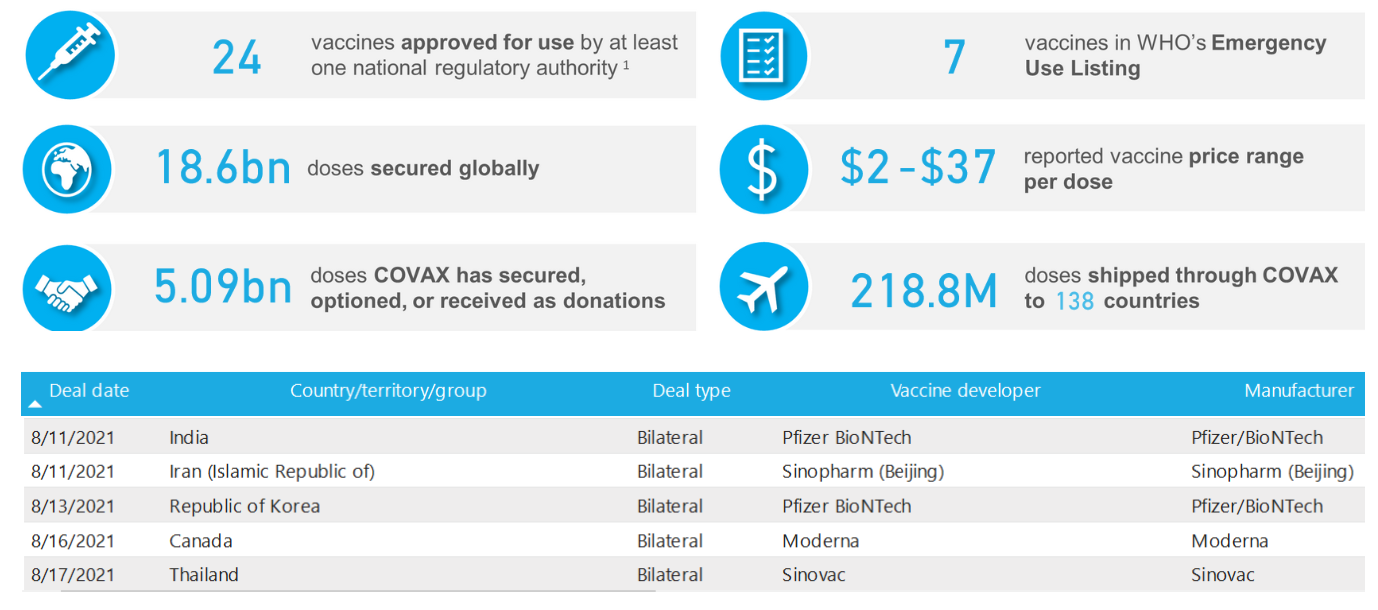
The Race for Global COVID-19 Vaccine Equity
A flurry of nearly 200 COVID-19 vaccine candidates are moving forward through the development and clinical trials processes at unprecedented speed; more than ten candidates are already in Phase 3 large-scale trials and several have received emergency or limited authorization. Our team has aggregated and analyzed publicly available data to track the flow of procurement and manufacturing and better understand global equity challenges. We developed a data framework of relevant variables and conducted desk research of publicly available information to identify COVID vaccine candidates and status, deals and ongoing negotiations for procurement and manufacturing, COVID burden by country, and allocation and distribution plans. We have also conducted interviews with public officials in key countries to better understand the context and challenges facing vaccine allocation and distribution [accessed 24 July 2021] See our COVID Vaccine Purchases research See our COVID Vaccine Manufacturing research See our COVID Vaccine Donations & Exports research
Global Dashboard on COVID-19 Vaccine Equity
The Dashboard is a joint initiative of UNDP, WHO and the University of Oxford with cooperation across the UN system, anchored in the SDG 3 Global Action Plan for Healthy Lives and Well-being for All.
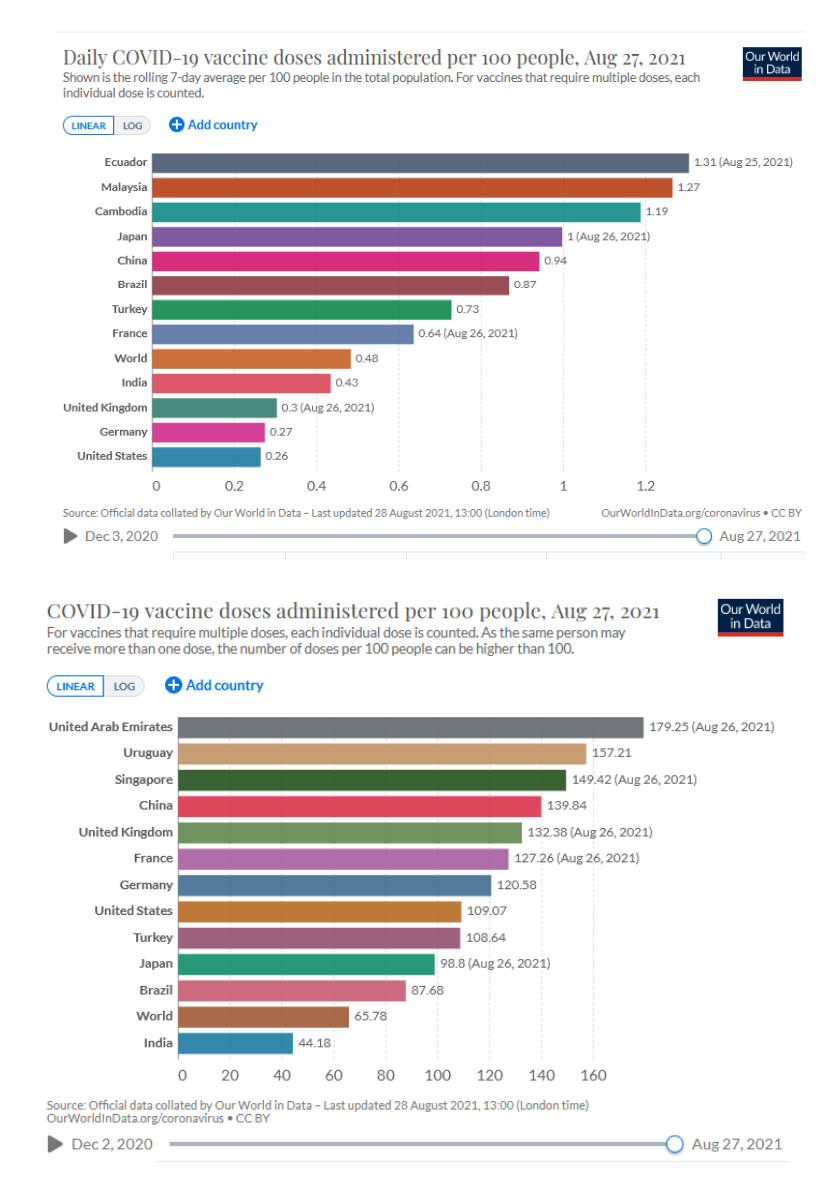
Our World in Data Coronavirus (COVID-19) Vaccinations[Accessed 28 Aug 2021] 33.2% of the world population has received at least one dose of a COVID-19 vaccine. 5.18 billion doses have been administered globally, and 38.02 million are now administered each day.
Only 1.6% of people in low-income countries have received at least one dose.
FDA Approves First COVID-19 Vaccine Approval Signifies Key Achievement for Public Health
August 23, 2021 [Text bolding from original]
Today, the U.S. Food and Drug Administration approved the first COVID-19 vaccine. The vaccine has been known as the Pfizer-BioNTech COVID-19 Vaccine, and will now be marketed as Comirnaty (koe-mir’-na-tee), for the prevention of COVID-19 disease in individuals 16 years of age and older. The vaccine also continues to be available under emergency use authorization (EUA), including for individuals 12 through 15 years of age and for the administration of a third dose in certain immunocompromised individuals.
“The FDA’s approval of this vaccine is a milestone as we continue to battle the COVID-19 pandemic. While this and other vaccines have met the FDA’s rigorous, scientific standards for emergency use authorization, as the first FDA-approved COVID-19 vaccine, the public can be very confident that this vaccine meets the high standards for safety, effectiveness, and manufacturing quality the FDA requires of an approved product,” said Acting FDA Commissioner Janet Woodcock, M.D. “While millions of people have already safely received COVID-19 vaccines, we recognize that for some, the FDA approval of a vaccine may now instill additional confidence to get vaccinated. Today’s milestone puts us one step closer to altering the course of this pandemic in the U.S.”
Since Dec. 11, 2020, the Pfizer-BioNTech COVID-19 Vaccine has been available under EUA in individuals 16 years of age and older, and the authorization was expanded to include those 12 through 15 years of age on May 10, 2021. EUAs can be used by the FDA during public health emergencies to provide access to medical products that may be effective in preventing, diagnosing, or treating a disease, provided that the FDA determines that the known and potential benefits of a product, when used to prevent, diagnose, or treat the disease, outweigh the known and potential risks of the product…
European Medicines Agency News & Press Releases News: Increase in vaccine manufacturing capacity for COVID-19 vaccines from BioNTech / Pfizer and Moderna (new) CHMP, Last updated: 24/08/2021 Additional manufacturing site and scaled-up process for Comirnaty CHMP has approved an additional manufacturing site for the production of Comirnaty, the COVID-19 vaccine developed by BioNTech and Pfizer. The site, located in Saint Rémy sur Avre, France, is operated by Delpharm and will manufacture finished product. The site will allow to provide approximately up to 51 million additional doses in 2021.
EMA has also approved a new manufacturing line at BioNTech’s manufacturing site in Marburg, Germany which increases the active substance manufacturing capacity by approximately 410 million doses in 2021. Additional manufacturing site for Spikevax CHMP has also approved an additional manufacturing site for the production of Spikevax, the COVID-19 vaccine developed by Moderna.
The site, located in Bloomington, Indiana, United States (US), is operated by Catalent. The site will perform finished product manufacturing.
In addition to the new manufacturing facility for this vaccine, CHMP has also approved several alternative sites responsible for batch control/testing and packaging of the finished product manufactured by Catalent…
Xi eyes deeper vaccine cooperation with Russia
2021-08-26
BEIJING — Chinese President Xi Jinping said Wednesday that China is ready to work with Russia to deepen cooperation on vaccine development and production and ensure the safety and stability of the global supply chain for vaccines…
POLIO Public Health Emergency of International Concern (PHEIC)
No new digest content identified
:::::: ::::::
WHO/OCHA Emergencies
Editor’s Note: WHO has apparently reorganized and fundamentally shifted how it judges and tracks “emergencies”. We found no announcement of descriptive information to share and present the webpage structure as encountered below. Obviously, the dates associated with some of these emergencies suggest that this is an archival platform as well as a current emergencies resource.
Health emergencies list– WHO
“The health emergencies list details the disease outbreaks, disasters and humanitarian crises where WHO plays an essential role in supporting countries to respond to and recover from emergencies with public health consequences.”
CDC-ACIP Meeting – August 30-31, 2021, 10:00 a.m. – 4:00 p.m. is a virtual COVID-19 meeting.
No registration is required. Webcast [No agenda identified on ACIP pages]
Africa CDC [to 28 Aug 2021] http://www.africacdc.org/ News Press Releases Africa CDC and the IFRC ramp up COVID-19 response in Africa
25 August 2021
Addis Ababa, 25 August 2021 – The Africa Centres for Disease Control and Prevention (Africa CDC) and the International Federation of Red Cross and Red Crescent Societies (IFRC) today launched a new collaboration to strengthen community resilience and response to public health emergencies at community level. The two institutions have signed a Memorandum of Understanding to ramp up pandemic response—including testing support to countries; community mobilization; advocacy and scaling up of contact tracing. In addition to COVID-19, the collaboration includes other areas of public health.
Africa CDC and IFRC will strengthen investments in locally-led action—for prevention and response purposes—while working with governments to ensure they intensify efforts to roll out the COVID-19 vaccination. Additionally, Africa CDC and IFRC will scale up advocacy against vaccine wastage…






 vaccines and global health :: ethics and policy