Decolonising global health: transnational research partnerships under the spotlight

International Health
Volume 12, Issue 6, November 2020
https://academic.oup.com/inthealth/issue/12/6


ORIGINAL ARTICLES
Decolonising global health: transnational research partnerships under the spotlight
David S Lawrence, Lioba A Hirsch
International Health, Volume 12, Issue 6, November 2020, Pages 518–523, https://doi.org/10.1093/inthealth/ihaa073
Abstract
There are increasing calls to decolonise aspects of science, and global health is no exception. The decolonising global health movement acknowledges that global health research perpetuates existing power imbalances and aims to identify concrete ways in which global health teaching and research can overcome its colonial past and present. Using the context of clinical trials implemented through transnational research partnerships (TRPs) as a case study, this narrative review brings together perspectives from clinical research and social science to lay out specific ways in which TRPs build on and perpetuate colonial power relations. We will explore three core components of TRPs: participant experience, expertise and infrastructure, and authorship. By combining a critical perspective with recently published literature we will recommend specific ways in which TRPs can be decolonised. We conclude by discussing decolonising global health as a potential practice and object of research. By doing this we intend to frame the decolonising global health movement as one that is accessible to everyone and within which we can all play an active role.

Participant compensation in global health research: a case study

International Health
Volume 12, Issue 6, November 2020
https://academic.oup.com/inthealth/issue/12/6


Participant compensation in global health research: a case study
Compensation for research participants can be provided for reasons including reimbursement of costs; compensation for time lost, discomfort or inconvenience; or expression of appreciation for participation. This compensation involves numerous ethical complexities, at times entailing competing risks. In the context of transnational research, often incorporating contexts of economic inequality, power differentials and post-colonialism, these issues extend into wider questions of ethical research conduct.
Sepeedeh Saleh, Henry Sambakunsi, Deborah Nyirenda, Moses Kumwenda, Kevin Mortimer
International Health, Volume 12, Issue 6, November 2020, Pages 524–532, https://doi.org/10.1093/inthealth/ihaa064

Towards a fair and transparent research participant compensation and reimbursement framework in Vietnam

International Health
Volume 12, Issue 6, November 2020
https://academic.oup.com/inthealth/issue/12/6


Towards a fair and transparent research participant compensation and reimbursement framework in Vietnam
Providing compensation for participants in clinical research is well established and while international guidelines exist, defining a context-specific and fair compensation for participants in low-resource settings is challenging due to ethical concerns and the lack of practical, national compensation and reimbursement frameworks.
Lucy J Sansom, Trang Pham Nguyen Minh, Iona E Hill, Quyen Nguyen Than Ha, Thuan Dang Trong
International Health, Volume 12, Issue 6, November 2020, Pages 533–540, https://doi.org/10.1093/inthealth/ihaa066

Participant understanding of informed consent in a multidisease community-based health screening and biobank platform in rural South Africa

International Health
Volume 12, Issue 6, November 2020
https://academic.oup.com/inthealth/issue/12/6


Participant understanding of informed consent in a multidisease community-based health screening and biobank platform in rural South Africa
In low- and middle-income settings, obtaining informed consent for biobanking may be complicated by socio-economic vulnerability and context-specific power dynamics. We explored participants experiences and perceptions of the research objectives in a community-based multidisease screening and biospecimen collection platform in rural KwaZulu-Natal, South Africa.
Nothando Ngwenya, Manono Luthuli, Resign Gunda, Ntombizonke A Gumede, Oluwafemi Adeagbo
International Health, Volume 12, Issue 6, November 2020, Pages 560–566, https://doi.org/10.1093/inthealth/ihaa072

Preprint Servers’ Policies, Submission Requirements, and Transparency in Reporting and Research Integrity Recommendations

JAMA
November 10, 2020, Vol 324, No. 18, Pages 1805-1916
https://jamanetwork.com/journals/jama/currentissue


Research Letter
Preprint Servers’ Policies, Submission Requirements, and Transparency in Reporting and Research Integrity Recommendations
Mario Malički, MD, MA, PhD; Ana Jerončić, MSc, PhD; Gerben ter Riet, MD, PhD; et al.
JAMA. 2020;324(18):1901-1903. doi:10.1001/jama.2020.17195
This study describes the policies, submission requirements, and transparency in reporting and research integrity recommendations of academic preprint servers.

Submissions and Downloads of Preprints in the First Year of medRxiv

JAMA
November 10, 2020, Vol 324, No. 18, Pages 1805-1916
https://jamanetwork.com/journals/jama/currentissue


Submissions and Downloads of Preprints in the First Year of medRxiv
Harlan M. Krumholz, MD, SM; Theodora Bloom, PhD; Richard Sever, PhD; et al.
JAMA. 2020;324(18):1903-1905. doi:10.1001/jama.2020.17529
This study describes submissions, postings, abstract views, downloads, comments, and withdrawals on the medRxiv preprint server from June 2019 to June 2020 and compares submissions and postings before and after COVID-19.

Sensible Medicine—Balancing Intervention and Inaction During the COVID-19 Pandemic

JAMA
November 10, 2020, Vol 324, No. 18, Pages 1805-1916
https://jamanetwork.com/journals/jama/currentissue


Viewpoint
Sensible Medicine—Balancing Intervention and Inaction During the COVID-19 Pandemic
Christopher W. Seymour, MD, MSc; Erin K. McCreary, PharmD; Jacob Stegenga, PhD
free access has active quiz has audio
JAMA. 2020;324(18):1827-1828. doi:10.1001/jama.2020.20271
This Viewpoint discusses the tensions between rapid adoption of interventions for coronavirus disease 2019 (COVID-19) before adequate evidence justifies their use and therapeutic nihilism, and argues for sensible medicine between the 2, which favors usual care, disfavors unnecessary interventions, but embraces rapid scientific evaluation with clinical translation of options proven effective.

Reflections on the Importance of Community-Partnered Research Strategies for Health Equity in the Era of COVID-19

Journal of Health Care for the Poor and Underserved (JHCPU)
Volume 31, Number 4, November 2020
https://muse.jhu.edu/issue/42831


Table of Contents
Reflections on the Importance of Community-Partnered Research Strategies for Health Equity in the Era of COVID-19
Savanna L. Carson, Cynthia Gonzalez, Sylvia Lopez, D’Ann Morris, Norma Mtume, Aziza Lucas-Wright, Stefanie D. Vassar, Keith C. Norris, Arleen F. Brown
pp. 1515-1519

High time to prioritize rabies prevention—a new paradigm

Journal of Travel Medicine
Volume 27, Issue 7, October 2020
https://academic.oup.com/jtm/issue/27/7


Editorial
High time to prioritize rabies prevention—a new paradigm
Robert Steffen, MD, Davidson H Hamer, MD
Journal of Travel Medicine, Volume 27, Issue 7, October 2020, taaa173, https://doi.org/10.1093/jtm/taaa173
Almost 500 patients consulted a GeoSentinel clinic annually for post-exposure prophylaxis after a potential rabies exposure as compared to approximately 20 for hepatitis A and 40 for typhoid fever. Travellers’ response after potential rabies exposure is alarmingly inadequate. Thus, rabies pre-exposure prophylaxis should now become the #1 travel vaccine intervention.

A risk scoring system to identify travellers who qualify for pre-exposure rabies vaccination

Journal of Travel Medicine
Volume 27, Issue 7, October 2020
https://academic.oup.com/jtm/issue/27/7


A risk scoring system to identify travellers who qualify for pre-exposure rabies vaccination
Mieke Croughs, MD PhD, Patrick Soentjens, MD PhD
Journal of Travel Medicine, Volume 27, Issue 7, October 2020, taaa168, https://doi.org/10.1093/jtm/taaa168
We want to introduce a free online scoring system to identify high risk travellers who qualify for pre-travel rabies vaccination. The system uses evidence based risk predictors and the probable availability of HRIG at the destination.

The Riyadh Declaration: the role of digital health in fighting pandemics

The Lancet
Nov 14, 2020 Volume 396 Number 10262 p1535-1606, e83-e88
https://www.thelancet.com/journals/lancet/issue/current


Comment
The Riyadh Declaration: the role of digital health in fighting pandemics
Bandar Al Knawy, et al.
The COVID-19 pandemic has exposed weaknesses in health and care systems and global public health responses, some of which can be addressed through data and digital science. The Riyadh Declaration on Digital Health was formulated during the Riyadh Global Digital Health Summit, Aug 11–12, 2020, a landmark forum that highlighted the importance of digital technology, data, and innovation for resilient global health and care systems.

Our panel of 13 experts articulated seven key priorities and nine recommendations (below) for data and digital health that need to be adopted by the global health community to address the challenges of the COVID-19 pandemic and future pandemics.

Recommendations from the Riyadh Global Digital Health Summit
1 Implement data-driven and evidence-based protocols for clear and effective communication with common messaging to build citizens’ trust
2 Work with global stakeholders to confront propagation of misinformation or disinformation through social media platforms and mass media
3 Implement a standard global minimum dataset for public health data reporting and a data governance structure tailored to communicable diseases
4 Ensure countries prioritise digital health, particularly, improving digital health infrastructure and reaching digital maturity
5 Enable health and care organisations by providing the necessary technology to collect high-quality data in a timely way and promote sharing to create health intelligence
6 Cultivate a health and care workforce with the knowledge, skills, and training in data and digital technologies required to address current and future public health challenges
7 Ensure surveillance systems combine an effective public health response with respect for ethical and privacy principles
8 Develop digital personal tools and services to support comprehensive health programmes (in disease prevention, testing, management, and vaccination) globally
9 Maintain, continue to fund, and innovate surveillance systems as a core component of the connected global health system for rapid preparedness and optimal global responses

The first priority is for the health and care sectors to adopt applied health intelligence (HI). HI represents a systematic approach and comprehensive methodology applied to the collection, linkage, analysis, and use of appropriate health data. HI is used for the surveillance, monitoring, and improvement of population and patient outcomes, and for assessing the efficiency and effectiveness of policies, programmes, and services.1

The second priority relates to interoperable digital technology and for this technology to be scaled up and sustainable. Digital health tools and services require a secure, trusted flow of data with scalability and interoperability support. The advent of commercial cloud computing services and distributed systems has paved the way for scalable, cost-effective service provision.

The third priority is to support the adoption of artificial intelligence (AI). Use of AI in health systems demands rapid access to various data types, often not possible in health-care settings with slow data flows.2 AI also requires vast amounts of high-quality data to achieve acceptable accuracy and validity. Health-care organisations and systems need to provide the necessary technology to collect and share high-quality data.

Effective communication about public health crises and risk is the fourth priority. Such communication requires an understanding of risk and the timely dissemination of information; seamless digital integration of case reports and deaths; and effective data visualisation tools such as map-based dashboards.3Effective communication to change knowledge, attitudes, and behaviours mandates the systematic exploration of diverse digital channels and the innovative design of digital tools for citizen engagement.4

The fifth priority concerns health data governance, quality, policy, regulation, and use. Passively generated digital location data from mobile phones and internet services provide crucial information about human mobility and interactions.5

However, ethics and privacy are essential and must be adhered to when using these ubiquitous data. Projections about disease epidemics require human mobility and interaction data that are aggregated in time and space to reconstruct population-level behaviour.6

The sixth priority relates to the quality and effectiveness of digital technology for improved patient and population outcomes. Digital technologies offer many opportunities to improve the quality and effectiveness of care, patient outcomes, and population health.7

Digital health systems should be designed and implemented to maximise data quality and access for clinicians and patients and these systems should be interoperable.
The seventh priority is research and innovation. Investing in, conducting, publishing, and promoting transparent research are foundational to digital health advances that leverage data, analytics, and AI.8

It can take an average of 17 years to translate a major medical research discovery to widespread delivery.9

The competitive, commercial culture of technology revolves around disruptive innovation, iterative discoveries, and the delivery of new technologies over months, not years. To translate life-saving innovations in digital health into widespread applications, collaboration across the best of research and innovation in health and technology is essential.

The Riyadh Declaration on Digital Health is a call to action to create the infrastructure needed to share effective digital health evidence-based practices and high-quality, real-time data locally and globally to provide actionable information to more health systems and countries. Digital and data technologies have a role in promoting the coordinated development of shared global public health policies and resilient health and care systems. These technologies can support health systems and governments to perform better in future pandemics and other global health challenges. We call on state actors to ensure that digital technology and innovation become the cornerstone of a resilient global health and care system that places individual and population health at the forefront of our future endeavours.
SARS-CoV-2 immunity: review and applications to phase 3 vaccine candidates

The Lancet
Nov 14, 2020 Volume 396 Number 10262 p1535-1606, e83-e88
https://www.thelancet.com/journals/lancet/issue/current


Review
SARS-CoV-2 immunity: review and applications to phase 3 vaccine candidates
Gregory A Poland, Inna G Ovsyannikova, Richard B Kennedy
Summary
Understanding immune responses to severe acute respiratory syndrome coronavirus 2 is crucial to understanding disease pathogenesis and the usefulness of bridge therapies, such as hyperimmune globulin and convalescent human plasma, and to developing vaccines, antivirals, and monoclonal antibodies. A mere 11 months ago, the canvas we call COVID-19 was blank. Scientists around the world have worked collaboratively to fill in this blank canvas. In this Review, we discuss what is currently known about human humoral and cellular immune responses to severe acute respiratory syndrome coronavirus 2 and relate this knowledge to the COVID-19 vaccines currently in phase 3 clinical trials.

US president-elect Joe Biden must quickly restore science to government

Nature
Volume 587 Issue 7833, 12 November 2020
http://www.nature.com/nature/current_issue.html


Editorial | 09 November 2020
US president-elect Joe Biden must quickly restore science to government
The election of Biden and Kamala Harris is a win for facts, research and empathy. Each of these must be deployed to fight the pandemic, combat misinformation, mitigate climate change and rebuild the United States’ global relationships.

A comparative genomics multitool for scientific discovery and conservation

Nature
Volume 587 Issue 7833, 12 November 2020
http://www.nature.com/nature/current_issue.html


Analysis | 11 November 2020
A comparative genomics multitool for scientific discovery and conservation
A whole-genome alignment of 240 phylogenetically diverse species of eutherian mammal—including 131 previously uncharacterized species—from the Zoonomia Project provides data that support biological discovery, medical research and conservation.
Diane P. Genereux, Aitor Serres[…] & Elinor K. Karlsson

The Covid-19 Vaccine-Development Multiverse

New England Journal of Medicine
November 12, 2020 Vol. 383 No. 20
http://www.nejm.org/toc/nejm/medical-journal


Editorial
The Covid-19 Vaccine-Development Multiverse
Penny M. Heaton, M.D.
Leaving in its wake more than 12 million infections, over 550,000 deaths, and an economic toll in the trillions of dollars to date,1 the SARS-CoV-2 pandemic has devastated the most vulnerable in our society — adults 65 years of age or older, persons with underlying conditions, and the economically deprived.2 A vaccine is urgently needed to prevent Covid-19 and thereby stem complications and deaths resulting from transmission of the disease.

Jackson et al. now report in the Journal preliminary findings from a phase 1 trial to evaluate the safety and immunogenicity of an mRNA SARS-CoV-2 vaccine.3 Phase 1 involves 45 healthy adults, 18 to 55 years of age, who were assigned to receive the candidate vaccine at one of three dose levels (25 μg, 100 μg, or 250 μg) given as two vaccinations 28 days apart. These preliminary findings represent the first of three reports of data from a phase 1 study of this candidate vaccine; a second report including similar data from adults older than 55 years of age and a final report summarizing the safety and durability of immunity for both study cohorts are also planned.

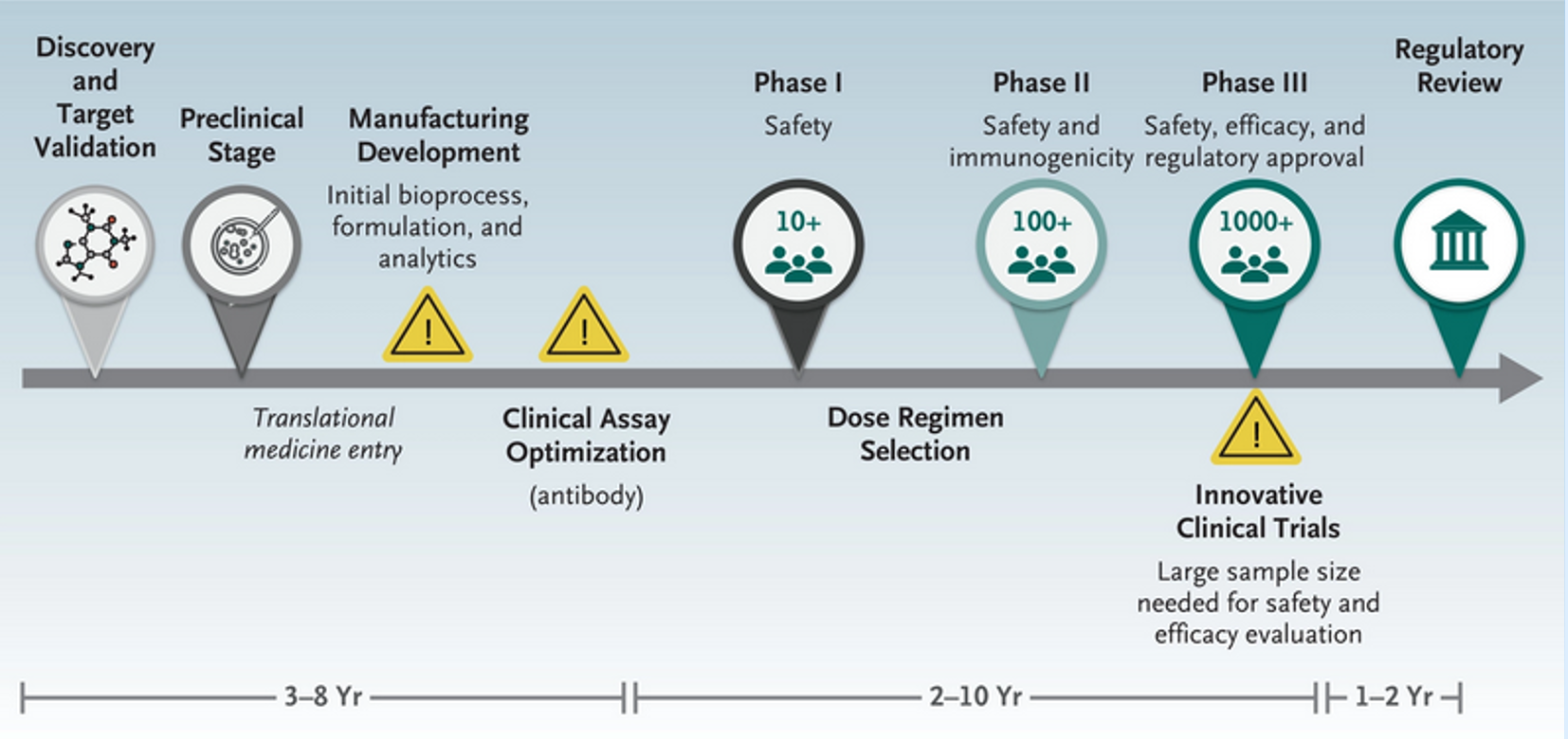
The speed with which this vaccine has been developed is remarkable — from publication of the first SARS-CoV-2 sequences through phase 1 in 6 months, as compared with a typical timeline of 3 to 9 years (Figure 1). The rapid pace of development of vaccines against Covid-19 is enabled by several factors: prior knowledge of the role of the spike protein in coronavirus pathogenesis and evidence that neutralizing antibody against the spike protein is important for immunity4,5; the evolution of nucleic acid vaccine technology platforms that allow creation of vaccines and prompt manufacture of thousands of doses once a genetic sequence is known6; and development activities that can be conducted in parallel, rather than sequentially, without increasing risks for study participants.

The safety and immunogenicity data in this preliminary report are promising, and they support continued development of this vaccine. However, we must bear in mind the complexity of vaccine development and the work still to be done before Covid-19 vaccines are widely available.

Many phase 3 studies fail because of incorrect identification of the dose that best balances safety and efficacy.7 The dosing regimen for this mRNA vaccine is still under study. The 250-μg dose did not appear to be associated with markedly higher antibody titers than the 100-μg dose, but it was associated with a higher proportion of severe systemic adverse events. As the investigators indicate, it is prudent to evaluate doses of 100 μg and lower to define the regimen that provides the most appropriate benefit–risk profile for this vaccine. Another special dosing consideration in this case is age: the immune functions that decline with age and that are likely to be responsible for the greater risk of severe Covid-19 in older adults may also lead to poor vaccine responses. Will a high-dose Covid-19 vaccine be needed for effective protection of older adults, as observed with influenza vaccines?8

The clinical significance of SARS-CoV-2 binding and neutralizing antibody titers and their ability to predict efficacy will need to be confirmed. These measures are currently being used to guide dose selection before being verified; they are the best tools available and are supported by findings in nonhuman primates.9 Confirmation of the correlation between antibody titers and protection against Covid-19 will be possible only in a large clinical efficacy study. In the meantime, the validity of the assays for measuring antibody will also need to be documented. These assays are notoriously variable because they use live virus or protein expression in cell culture with a readout that relies on an in vitro biologic reaction (i.e., serum antibodies binding or killing viral antigen). Optimization of the performance characteristics of these assays will be invaluable in streamlining further development and supporting bridging across varied populations and manufacturing processes.

The authors indicate that a planned phase 3 trial of this mRNA SARS-CoV-2 vaccine is imminent; the trial will require thousands of subjects in order to confirm the safety of the vaccine and to show statistically robust efficacy in preventing Covid-19. The operational complexity inherent in a large study is compounded by the undulations of the pandemic; efficacy can be determined only if there is a match between the location of vaccinated participants and pandemic hot spots. Uncertainty regarding the expected efficacy profile also drives complexity; the profiles observed for other viral vaccines suggest that efficacy against severe Covid-19 may be higher than efficacy against mild disease. Careful selection of primary end points and event-driven study designs with the possibility of sample size reestimation should be considered.

Accelerating the development of Covid-19 vaccine candidates beyond phase 1 depends on continued parallel tracking of activities and fulsome resources. The world has now witnessed the compression of 6 years of work into 6 months. Can the vaccine multiverse do it again, leading to a reality of a safe, efficacious Covid-19 vaccine for the most vulnerable in the next 6?

Figure 1. Traditional Vaccine Development Pathway.

Covid-19 Vaccine Trials and Incarcerated People — The Ethics of Inclusion

New England Journal of Medicine
November 12, 2020 Vol. 383 No. 20
http://www.nejm.org/toc/nejm/medical-journal


Perspective
Covid-19 Vaccine Trials and Incarcerated People — The Ethics of Inclusion
Camila Strassle, B.A., et al
… There are three arguments for enrolling incarcerated people in vaccine trials. First, it would offer them early access to a potentially efficacious vaccine. Second, it would provide them with a choice to participate in medical research that will be offered to nonincarcerated people. Third, it could shorten the amount of time needed to study vaccine efficacy, if transmission rates continue to be higher in correctional facilities than elsewhere.
Research involving incarcerated populations is ethically, legally, and logistically complex…

An mRNA Vaccine against SARS-CoV-2 — Preliminary Report

New England Journal of Medicine
November 12, 2020 Vol. 383 No. 20
http://www.nejm.org/toc/nejm/medical-journal


Original Article
An mRNA Vaccine against SARS-CoV-2 — Preliminary Report
Lisa A. Jackson, M.D., M.P.H., et al.
We conducted a first-in-human phase 1 clinical trial in healthy adults to evaluate the safety and immunogenicity of mRNA-1273. Here we report interim results of the trial.
Abstract
Conclusions
The mRNA-1273 vaccine induced anti–SARS-CoV-2 immune responses in all participants, and no trial-limiting safety concerns were identified. These findings support further development of this vaccine. (Funded by the National Institute of Allergy and Infectious Diseases and others; mRNA-1273 ClinicalTrials.gov number, NCT04283461. opens in new tab).
This article was published on July 14, 2020, and updated on August 25, 2020, at NEJM.org.

Decision-making on maternal pertussis vaccination among women in a vaccine-hesitant religious group: Stages and needs

PLoS One
http://www.plosone.org/


Research Article
Decision-making on maternal pertussis vaccination among women in a vaccine-hesitant religious group: Stages and needs
Anne C. de Munter, Wilhelmina L. M. Ruijs, Robert A. C. Ruiter, Dagmar J. J. van Nimwegen, Anke J. M. Oerlemans, Rijk van Ginkel, Marlies E. J. L. Hulscher, Jeannine L. A. Hautvast
Research Article | published 12 Nov 2020 PLOS ONE
https://doi.org/10.1371/journal.pone.0242261

Human Papillomavirus (HPV) and the quadrivalent HPV Vaccine among Brazilian adolescents and parents: Factors associated with and divergences in knowledge and acceptance

PLoS One
http://www.plosone.org/


Human Papillomavirus (HPV) and the quadrivalent HPV Vaccine among Brazilian adolescents and parents: Factors associated with and divergences in knowledge and acceptance
Jéssica Menezes Gomes, Beatriz Machado Silva, Edige Felipe de Sousa Santos, Patricia Jane Kelly, Annielson de Souza Costa, Albertina Duarte Takiuti, Luiz Carlos de Abreu, José Maria Soares Júnior, Edmund Chada Baracat, Isabel Cristina Esposito Sorpreso
Research Article | published 12 Nov 2020 PLOS ONE

Repurposing therapeutics for COVID-19: Rapid prediction of commercially available drugs through machine learning and docking

PLoS One
http://www.plosone.org/


Repurposing therapeutics for COVID-19: Rapid prediction of commercially available drugs through machine learning and docking
Sovesh Mohapatra, Prathul Nath, Manisha Chatterjee, Neeladrisingha Das, Deepjyoti Kalita, Partha Roy, Soumitra Satapathi
Research Article | published 12 Nov 2020 PLOS ONE
https://doi.org/10.1371/journal.pone.0241543

Using a Respectful Approach to Child-centred Healthcare (ReACH) in a paediatric clinical trial: A feasibility study

PLoS One
http://www.plosone.org/


Using a Respectful Approach to Child-centred Healthcare (ReACH) in a paediatric clinical trial: A feasibility study
Analise Nicholl, Kate Evelegh, Kane Evan Deering, Kate Russell, David Lawrence, Philippa Lyons-Wall, Therese Anne O’Sullivan
Research Article | published 09 Nov 2020 PLOS ONE
https://doi.org/10.1371/journal.pone.0241764

Harnessing early life immunity to develop a pediatric HIV vaccine that can protect through adolescence

PLoS Pathogens
http://journals.plos.org/plospathogens/
[Accessed 14 Nov 2020]


Pearls
Harnessing early life immunity to develop a pediatric HIV vaccine that can protect through adolescence
Ria Goswami, Stella J. Berendam, Shuk Hang Li, Ashley N. Nelson, Kristina De Paris, Koen K. A. Van Rompay, Sallie R. Permar, Genevieve G. Fouda
| published 12 Nov 2020 PLOS Pathogens
https://doi.org/10.1371/journal.ppat.1008983

Equity, intercultural approaches and access to information on traditional, complementary and integrative medicines in the Americas

Revista Panamericana de Salud Pública/Pan American Journal of Public Health (RPSP/PAJPH)
https://www.paho.org/journal/en

13 Nov 2020
Equity, intercultural approaches and access to information on traditional, complementary and integrative medicines in the Americas
Current topic | Spanish |
Access to information and intercultural approaches in the field of health are essential for the elimination of inequities in health access and care. Intercultural models such as traditional, complementary and integrative medicine (TCIM) are an important part of health care in most countries and often contribute to expanding access to primary health care. Despite legal recognition and policies to integrate TCIM into health systems, their contribution to health, well-being, and people-centered care to achieve universal health is still underestimated. This article presents the progress (2017-2020) achieved by the Virtual Health Library specialized in the TCIM (VHL TCIM Americas), an initiative created as a tool to reduce the gaps in the production and access to validated information on TCIM. Through collaborative network work, the VHL TCIM Americas contributes to the democratization of health, access to verified scientific data, visibility of non-conventional knowledge, strengthening of research capacities, and exchange of experiences for informed decision-making.

Intentions to Seek Information About the Influenza Vaccine: The Role of Informational Subjective Norms, Anticipated and Experienced Affect, and Information Insufficiency Among Vaccinated and Unvaccinated People

Risk Analysis
Volume 40, Issue 10 Pages: 1887-2111 October 2020
https://onlinelibrary.wiley.com/toc/15396924/current


Original Research Articles
Intentions to Seek Information About the Influenza Vaccine: The Role of Informational Subjective Norms, Anticipated and Experienced Affect, and Information Insufficiency Among Vaccinated and Unvaccinated People
Hang Lu, , Kenneth Winneg, Kathleen Hall Jamieson, Dolores Albarracín
Pages: 2040-2056
First Published: 19 February 2020

What’s next for COVID-19 apps? Governance and oversight

Science
13 November 2020 Vol 370, Issue 6518
http://www.sciencemag.org/current.dtl


Policy Forum
What’s next for COVID-19 apps? Governance and oversight
By Alessandro Blasimme, Effy Vayena
Science13 Nov 2020 : 760-762 Full Access
Adaptive governance can help earn social license
Summary
Many governments have seen digital health technologies as a promising tool to address coronavirus disease 2019 (COVID-19), particularly digital contact tracing (DCT) apps such as Bluetooth-based exposure notification apps that trace proximity to other devices (1) and GPS-based apps that collect geolocation data. But deploying these systems is fraught with challenges, and most national DCT apps have not yet had the expected rate of uptake. This can be attributed to a number of uncertainties regarding general awareness of DCT apps, privacy risks, and the actual effectiveness of DCT, as well as public attitudes toward a potentially pervasive form of digital surveillance. DCT thus appears to face a typical social control dilemma. On one hand, pending widespread uptake, assessing DCT effectiveness is extremely difficult; on the other hand, until DCT effectiveness is proven, its widespread use at a population scale is hard to justify. Recognizing that technological uptake is an open-ended process reliant upon social learning and the piecemeal creation of public trust, we suggest that policy-makers set up mechanisms to test effectiveness, oversee the use of DCT apps, monitor public attitudes, and adapt technological design to socially perceived risks and expectations.

Brighton Collaboration Viral Vector Vaccines Safety Working Group (V3SWG) standardized template for collection of key information for benefit-risk assessment of live-attenuated viral vaccines

Vaccine
Volume 38, Issue 49 Pages 7697-7876 (17 November 2020)
https://www.sciencedirect.com/journal/vaccine/vol/38/issue/49


Review article Open access
Brighton Collaboration Viral Vector Vaccines Safety Working Group (V3SWG) standardized template for collection of key information for benefit-risk assessment of live-attenuated viral vaccines
Marc Gurwith, Richard C. Condit, Jean-Louis Excler, James S. Robertson, … Sonali Kochhar
Pages 7702-7707

The Brighton Collaboration standardized template for collection of key information for benefit-risk assessment of viral vector vaccines

Vaccine
Volume 38, Issue 49 Pages 7697-7876 (17 November 2020)
https://www.sciencedirect.com/journal/vaccine/vol/38/issue/49


Review article Open access
The Brighton Collaboration standardized template for collection of key information for benefit-risk assessment of viral vector vaccines
Richard C Condit, Denny Kim, James S. Robertson, Jean-Louis Excler, … Sonali Kochhar
Pages 7708-7715

Lessons learned in the implementation of supplementary immunization activity (SIA) field guidelines for injectable vaccines – Experiences from Tanzania

Vaccine
Volume 38, Issue 49 Pages 7697-7876 (17 November 2020)
https://www.sciencedirect.com/journal/vaccine/vol/38/issue/49


Research article Abstract only
Lessons learned in the implementation of supplementary immunization activity (SIA) field guidelines for injectable vaccines – Experiences from Tanzania
Nassor Mohamed, Daudi Simba, Alex Mphuru, Dafrossa Lyimo, Furaha Kyesi
Pages 7741-7746

Parents’ and guardians’ views on the acceptability of a future COVID-19 vaccine: A multi-methods study in England

Vaccine
Volume 38, Issue 49 Pages 7697-7876 (17 November 2020)
https://www.sciencedirect.com/journal/vaccine/vol/38/issue/49


Research article Open access
Parents’ and guardians’ views on the acceptability of a future COVID-19 vaccine: A multi-methods study in England
Sadie Bell, Richard Clarke, Sandra Mounier-Jack, Jemma L. Walker, Pauline Paterson
Pages 7789-7798

Influenza vaccination: A qualitative study of practice level barriers from medical practitioners caring for children with special risk medical conditions

Vaccine
Volume 38, Issue 49 Pages 7697-7876 (17 November 2020)
https://www.sciencedirect.com/journal/vaccine/vol/38/issue/49


Research article Full text access
Influenza vaccination: A qualitative study of practice level barriers from medical practitioners caring for children with special risk medical conditions
Jane L Tuckerman, Jessica Kaufman, Margie Danchin, Helen S Marshall
Pages 7806-7814

Global assessment of national mandatory vaccination policies and consequences of non-compliance

Vaccine
Volume 38, Issue 49 Pages 7697-7876 (17 November 2020)
https://www.sciencedirect.com/journal/vaccine/vol/38/issue/49


Research article Open access
Global assessment of national mandatory vaccination policies and consequences of non-compliance
Katie Gravagna, Andy Becker, Robert Valeris-Chacin, Inari Mohammed, … Nicole E. Basta
Pages 7865-7873
Highlights
:: Over 100 countries have a nationwide mandatory vaccination policy requiring one or more vaccines.
:: Of those, 62 countries (59%) also impose one or more penalties against individuals who do not comply.
:: Educational and financial penalties are the most common types of penalties; severity varies.
:: Most educational penalties deny school enrollment until vaccination requirements are met.
Abstract
Background
Declining vaccination coverage and increasing hesitancy is a worldwide concern. Many countries have implemented mandatory vaccination policies to promote vaccination. However, mandatory vaccination policies differ significantly by country. Beyond case studies, no comprehensive study has compared these policies or the penalties for non-compliance on a global scale.
Methods
We conducted extensive keyword, policy, and literature searches to identify mandatory national vaccination policies globally and develop a comprehensive database. A mandatory national vaccination policy was defined as a policy from a national authority that requires individuals to receive at least one vaccination based on age or to access a service. Two reviewers independently evaluated evidence for a mandate and whether non-compliance penalties were incorporated. We categorized penalties into four types, based on the nature of the penalty. These penalties impact an individual’s financial, parental rights, educational (i.e., child’s school entry and access), and liberty status. We rated the severity within each category.
Results
Of 193 countries investigated, 54% (n = 105) had evidence of a nationwide mandate as of December 2018. The frequency, types, and severity of penalties varied widely across all regions. We found that 59% (n = 62) of countries with national mandates defined at least one penalty for non-compliance with a vaccine mandate. Among those, educational penalties (i.e., limiting a child’s entry or ongoing access to school) were the most common (69%; n = 43), with most countries with educational penalties refusing school enrollment until vaccination requirements are met (81%; n = 35).
Conclusion
We undertook a comprehensive assessment of national mandatory vaccination policies and identified a diversity of penalties in place to promote compliance. Our results highlight the need to critically evaluate the implementation of non-compliance penalties in order to determine their effectiveness and to define best practices for sustaining high vaccination uptake worldwide.

Media/Policy Watch

Media/Policy Watch
This watch section is intended to alert readers to substantive news, analysis and opinion from the general media and selected think tanks and similar organizations on vaccines, immunization, global public health and related themes. Media Watch is not intended to be exhaustive, but indicative of themes and issues CVEP is actively tracking. This section will grow from an initial base of newspapers, magazines and blog sources, and is segregated from Journal Watch above which scans the peer-reviewed journal ecology.
We acknowledge the Western/Northern bias in this initial selection of titles and invite suggestions for expanded coverage. We are conservative in our outlook in adding news sources which largely report on primary content we are already covering above. Many electronic media sources have tiered, fee-based subscription models for access. We will provide full-text where content is published without restriction, but most publications require registration and some subscription level.


The Atlantic
http://www.theatlantic.com/magazine/
Accessed 14 Nov 2020
Ideas
For a Vaccine to Save Lives, Society Has to Make Some Decisions
In distributing a coronavirus vaccine, the U.S. needs to learn from past mistakes.
6:00 AM ET
Thomas J. Bollyky, Director of the Global Health Program at the Council on Foreign Relations


BBC
http://www.bbc.co.uk/
Accessed 14 Nov 2020
[No new, unique, relevant content]


The Economist
http://www.economist.com/
Accessed 14 Nov 2020
Leaders Nov 14th 2020 edition
Suddenly, hope…The promise of the new covid-19 vaccine is immense
But don’t underestimate the challenge of getting people vaccinated


Financial Times
https://www.ft.com/
Accessed 14 Nov 2020
US politics & policy
US vaccine tsar calls on White House to allow contact with Biden
November 13, 2020


Forbes
http://www.forbes.com/
Accessed 14 Nov 2020
Breaking  |
5 hours ago
Here’s Why Trump And Cuomo Are Feuding Over A Coronavirus Vaccine
Trump threatened to withhold a vaccine from New York after Cuomo repeatedly declared Trump’s distribution plan and safety measures inadequate.
By Andrew Solender Forbes Staff


Foreign Affairs
http://www.foreignaffairs.com/
Accessed 14 Nov 2020
[No new, unique, relevant content]


Foreign Policy
http://foreignpolicy.com/
Accessed 14 Nov 2020
Vaccine Inequality Fuels Suspicion and Division
The world can’t repeat the mistakes of polio, tuberculosis, and measles.
Argument | Oussama Mezoui November 12, 2020, 12:52 PM


Kremlin Spin Doctors are Leading Russia’s Vaccine Development
With Sputnik V, the country is conflating good headlines with good health.
Argument | Chris Miller November 12, 2020, 12:23 PM


As Vaccine Hopes Grow, Poorer Countries Are Last in Line
A vaccine candidate closely linked with Operation Warp Speed is expected to produce preliminary results similar to the blockbuster Pfizer findings.
Morning Brief | Colm Quinn November 12, 2020, 5:10 AM


The Guardian
http://www.guardiannews.com/
Accessed 14 Nov 2020
[No new, unique, relevant content]


New Yorker
http://www.newyorker.com/
Accessed 14 Nov 2020
Politics and More Podcast
A Nobel Laureate on the Politics of Fighting the Coronavirus
Dr. Harold E. Varmus, a former director of the National Institutes of Health and winner of a Nobel Prize in Medicine, on combating COVID-19 during the Biden Administration.
By Dorothy Wickenden November 12, 2020


New York Times
http://www.nytimes.com/
Accessed 14 Nov 2020
Sunday Review
This Coronavirus Surge Does Not Have to Be So Horrific
America is entering a difficult period. But the outcome is not foregone.
By The Editorial Board

Health
Missing From State Plans to Distribute the Coronavirus Vaccine: Money to Do It
The government has sent billions to drug companies to develop a coronavirus shot but a tiny fraction of that to localities for training, record-keeping and other costs for vaccinating citizens.
By Abby Goodnough and Sheila Kaplan

Health
As the Pandemic Surges, C.D.C. Issues Increasingly Assertive Advice
Agency scientists often contradict the Trump administration now, but critics urge a more public stance.
By Apoorva Mandavilli


Washington Post
https://www.washingtonpost.com/
World · Nov 12, 2020
Analysis
Vaccines have never been distributed equally. A coronavirus vaccine would be no different, history suggests
Ruby Mellen ·

Think Tanks et al

Think Tanks et al

Brookings
http://www.brookings.edu/
Accessed 14 Nov 2020
[No new relevant content]
 
 
Center for Global Development [to 14 Nov 2020]
http://www.cgdev.org/page/press-center
November 12, 2020
Beyond the Rhetoric of Equity: Will the Frontline Healthcare Workers Who Serve the Poor Be Prioritized for the COVID Vaccine?
Healthcare providers, particularly in low- and middle-income countries, are a diverse, fragmented, and loosely regulated population. Will the COVID vaccine plans prioritize them?
Asif Saleh, Maria Khan and Richard A. Cash
 
 
Chatham House [to 14 Nov 2020]
https://www.chathamhouse.org/
Event
Members Event The Virus, the Vaccine and Violence
23 November 2020 — 4:00PM TO 5:15PM
This webinar assesses the potential for conflict-sensitive approaches to COVID-19 with a focus on vaccines.


CSIS
https://www.csis.org/
Accessed 14 Nov 2020
[No new relevant content]


Council on Foreign Relations
http://www.cfr.org/
Accessed 14 Nov 2020
[No new relevant content]


Kaiser Family Foundation
https://www.kff.org/search/?post_type=press-release
Accessed 14 Nov 2020
November 11, 2020 News Release
New Brief Examines COVID-19 Risks and Impacts for Health Care Workers by Race and Ethnicity
New coronavirus cases in the United States have hit daily records multiple times in the past week and hospitalizations are rising in several areas of the country. Health care workers face some of the greatest risk of exposure to the coronavirus and a new KFF brief examines the composition of…

Vaccines and Global Health: The Week in Review :: 07 November 2020

Vaccines and Global Health: The Week in Review is a weekly digest  summarizing news, events, announcements, peer-reviewed articles and research in the global vaccine ethics and policy space. Content is aggregated from key governmental, NGO, international organization and industry sources, key peer-reviewed journals, and other media channels. This summary proceeds from the broad base of themes and issues monitored by the Center for Vaccine Ethics & Policy in its work: it is not intended to be exhaustive in its coverage. You are viewing the blog version of our weekly digest, typically comprised of between 30 and 40 posts below all dated with the current issue date

.– Request an Email Summary: Vaccines and Global Health : The Week in Review is published as a single email summary, scheduled for release each Saturday evening before midnight (EDT in the U.S.). If you would like to receive the email version, please send your request to david.r.curry@centerforvaccineethicsandpolicy.org.

– pdf version A pdf of the current issue is available here: 

– blog edition: comprised of the approx. 35+ entries posted below.

– Twitter:  Readers can also follow developments on twitter: @vaxethicspolicy.
.
– Links:  We endeavor to test each link as we incorporate it into any post, but recognize that some links may become “stale” as publications and websites reorganize content over time. We apologize in advance for any links that may not be operative. We believe the contextual information in a given post should allow retrieval, but please contact us as above for assistance if necessary.

Support this knowledge-sharing service: Your financial support helps us cover our costs and to address a current shortfall in our annual operating budget. Click here to donate and thank you in advance for your contribution.

.
David R. Curry, MS
Executive Director
Center for Vaccine Ethics and Policy

UNICEF and WHO call for emergency action to avert major measles and polio epidemics

Milestones :: Perspectives :: Research


UNICEF and WHO call for emergency action to avert major measles and polio epidemics
As COVID-19 disrupts immunizations, urgent action needed to protect most vulnerable children from deadly and debilitating diseases

GENEVA/ NEW YORK, 6 November 2020 – UNICEF and the World Health Organization (WHO) today issued an urgent call to action to avert major measles and polio epidemics as COVID-19 continues to disrupt immunization services worldwide, leaving millions of vulnerable children at heightened risk of preventable childhood diseases.

The two organizations estimate that US$655 million (US$400 million for polio and US$255 million for measles) are needed to address dangerous immunity gaps in non-Gavi eligible countries and target age groups.

“COVID-19 has had a devastating effect on health services and in particular immunization services, worldwide,” commented Dr Tedros Adhanom Ghebreyesus, WHO Director-General. “But unlike with COVID, we have the tools and knowledge to stop diseases such as polio and measles. What we need are the resources and commitments to put these tools and knowledge into action. If we do that, children’s lives will be saved.”

“We cannot allow the fight against one deadly disease to cause us to lose ground in the fight against other diseases,” said Henrietta Fore, UNICEF Executive Director. “Addressing the global COVID-19 pandemic is critical. However, other deadly diseases also threaten the lives of millions of children in some of the poorest areas of the world. That is why today we are urgently calling for global action from country leaders, donors and partners. We need additional financial resources to safely resume vaccination campaigns and prioritize immunization systems that are critical to protect children and avert other epidemics besides COVID-19.”

In recent years, there has been a global resurgence of measles with ongoing outbreaks in all parts of the world.  Vaccination coverage gaps have been further exacerbated in 2020 by COVID-19. In 2019, measles climbed to the highest number of new infections in more than two decades. Annual measles mortality data for 2019 to be released next week will show the continued negative toll that sustained outbreaks are having in many countries around the world.
At the same time, poliovirus transmission is expected to increase in Pakistan and  Afghanistan and in many under-immunized areas of Africa. Failure to eradicate polio now would lead to global resurgence of the disease, resulting in as many as 200,000 new cases annually, within 10 years.

New tools, including a next-generation novel oral polio vaccine and the forthcoming Measles Outbreak Strategic Response Plan are expected to be deployed over the coming months to help tackle these growing threats in a more effective and sustainable manner, and ultimately save lives. The Plan is a worldwide strategy to quickly and effectively prevent, detect and respond to measles outbreaks.

World Health Assembly charts course for COVID-19 response and global health priorities // Strengthening preparedness for health emergencies: implementation of the International Health Regulations (2005)

Milestones :: Perspectives :: Research


World Health Assembly charts course for COVID-19 response and global health priorities
5 November 2020 News release
The WHA usually takes place in May. This year, given the COVID-19 pandemic, a reduced (de minimis) WHA took place on 18-19 May. The resumed WHA73 will take place virtually from 9-14 November 2020.

As health leaders prepare to gather for a virtual session of the resumed 73rd World Health Assembly (WHA), WHO has three messages to share.


First, we can beat COVID-19 with science, solutions and solidarity.

More than 47 million COVID-19 cases have now been reported to WHO, and more than 1.2 million people have lost their lives.

Although this is a global crisis, many countries and cities have successfully prevented or controlled transmission with a comprehensive, evidence-based approach.

For the first time, the world has rallied behind a plan to accelerate the development of the vaccines, diagnostics and therapeutics we need, and to ensure they are available to all countries on the basis of equity. The Access to COVID-19 Tools (ACT) Accelerator is delivering real results.


Second, we must not backslide on our critical health goals.

The COVID-19 pandemic is a sobering reminder that health is the foundation of social, economic and political stability.

It reminds us why WHO’s ‘triple billion’ targets are so important, and why countries must pursue them with even more determination, collaboration and innovation.


Since May, Member States have adopted a number of decisions – the Immunization Agenda 2030, the Decade of Healthy Ageing 2020-2030, as well as initiatives to tackle cervical cancer, tuberculosis, eye care, food safety, intellectual property and influenza preparedness.

The resumed session will discuss a 10-year-plan for addressing neglected tropical diseases, as well as efforts to address meningitis, epilepsy and other neurological disorders, maternal infant and young child nutrition, digital health, and the WHO Global Code of Practice on the International Recruitment of Health Personnel, adopted in 2010.


Third, we must prepare for the next pandemic now.

We’ve seen this past year that countries with robust health emergency preparedness infrastructure have been able to act quickly to contain and control the spread of the SARS-CoV-2 virus.


The WHA will consider a draft resolution (EB146.R10) that strengthens Member States’ preparedness for health emergencies, such as COVID-19, through more robust compliance with the International Health Regulations (2005).

This resolution calls on the global health community to ensure that all countries are better equipped to detect and respond to cases of COVID-19 and other dangerous infectious diseases.


::::::

Strengthening preparedness for health emergencies: implementation of the International Health Regulations (2005)
WHA 146th session
EB146.R10 Draft Resolution Agenda item 15.2 8 February 2020
[Excerpt] p.4
1. URGES Member States:1
(1) to fully comply with the International Health Regulations (2005), to take actions to implement the unmet obligations thereof, and to continue to build core capacities to detect, assess, report on and respond to public health events as set out in the International Health Regulations (2005), while mindful of the purpose and scope of the regulations to prevent, protect against, control, and provide a public health response to the international spread of disease in ways that are commensurate with and restricted to public health risks, and which avoid unnecessary interference with international traffic and trade…

COVAX Facility convenes first meeting of COVAX Shareholders Council

Milestones :: Perspectives :: Research


COVAX Facility convenes first meeting of COVAX Shareholders Council
3 November 2020
:: The COVAX Shareholders Council, composed of all self-financing participants, forms a key component of Facility governance
:: The AMC Engagement Group, a second governance body comprising economies that are eligible for COVID-19 vaccines through the Gavi COVAX Advance Market Commitment (AMC) will also meet in November
:: Seth Berkley: “Ensuring all participating economies’ perspectives are part of the solution will be critical to shaping and implementing a COVAX Facility that works for everyone, everywhere.”

Geneva, 3 November 2020 – Gavi, the Vaccine Alliance, in its capacity as the legal administrator of the COVAX Facility, yesterday convened the first meeting of the COVAX Shareholders Council. The COVAX Shareholders Council, which is comprised of all self-financing participants and will be self-organising, is a key component of Facility governance. More than 200 participants from 67 countries joined the half-day virtual meeting.

The meeting, which was exceptionally co-chaired by Ngozi Okonjo-Iweala and Andrew Witty pending appointments made by the self-financing participants, discussed, among other things, updates on Facility progress, possible terms of reference (ToRs) for the Council, as well as the process for finalising ToRs and appointments – anticipated to occur over the next few weeks.

“This is a significant milestone for the COVAX Facility,” said Seth Berkley, CEO of Gavi. “In just a few short months we have moved from design to implementation, thanks to unprecedented collaboration from countries and organisations around the world. Reflecting that same spirit of co-creation in governance – ensuring all participating economies’ perspectives are part of the solution – will be critical to shaping and implementing a COVAX Facility that works for everyone, everywhere. We are only safe if we are all safe.”

Following on from a series of briefings for AMC-eligible economies hosted by Gavi and partners last week, the first meeting of the COVAX AMC Engagement Group is anticipated to take place in the coming weeks. The AMC Engagement Group is the Facility governance body comprised of participants and stakeholders in the Gavi COVAX AMC…

WHO-ICMRA joint statement on the need for improved global regulatory alignment on COVID-19 medicines and vaccines

Milestones :: Perspectives :: Research


WHO-ICMRA joint statement on the need for improved global regulatory alignment on COVID-19 medicines and vaccines
6 November 2020 – Statement
The International Coalition of Medicines Regulatory Authorities (ICMRA) and the World Health Organization (WHO) have committed to working together to ensure that patients have access to safe and effective health products against COVID-19 as early as possible, while the existing rigorous scientific standards for the evaluation and safety monitoring of treatments and vaccines are maintained at all times.

In their joint statement, international medicines regulators and WHO reiterate that therapeutics and vaccines against COVID-19 can only be rapidly approved if applications are supported by robust and sound scientific evidence that allows medicine regulators to conclude on a positive benefit-risk balance for these products. ICMRA and WHO also pledge to take concrete actions to ensure equitable access to safe, effective and quality-assured medicines for the treatment or prevention of COVID-19 around the world.

In view of the large number of COVID-19 vaccines and treatments under development, and their potentially imminent roll-out, the World Health Organization (WHO) and the International Coalition of Medicines Regulatory Authorities (ICMRA) have joined forces to uphold and promote the most rigorous, evidence-based regulatory practices by supporting the alignment of regulatory processes across all countries. As in other areas of the pandemic response, multilateral cooperation between regulatory authorities will be critical in ensuring there is a level playing field, that COVID-19 vaccines and medicines are safe, effective and quality-assured, and that all countries may benefit from such products equitably and at the same time.

This joint statement commits each organization to a series of actions to make this happen.

:: ICMRA and WHO continue to join forces in collaborating to address the unprecedented global health challenges related to COVID-19 pandemic, affecting so many people in the world.

:: These challenges are best addressed by working together to ensure existing rigorous scientific standards of review and oversight are maintained, while still giving patients access to safe and effective medical products at the earliest time possible


:: Regulatory authorities for medical products, including medicines and vaccines, have the responsibility to approve quality assured, safe and effective products based on robust and reliable data.

:: The regulatory approval should be based on an independent scientific assessment of the balance of benefits and risks.

:: Robust and reliable data on efficacy and safety to support market approval of medicines and vaccines are best collected through randomized controlled clinical trials which control for bias, meet Good Clinical Practice standards, respect the rights, autonomy and safety of clinical trial participants, and can be audited.

:: To ensure patients have fast access to safe and effective medicines and vaccines, WHO and ICMRA, together with other stakeholders including public health institutions, are committed to the following actions:
…Working to prioritise well-designed clinical trials that will provide robust and reliable results.
Ensuring that there are meaningful and scientifically sound endpoints and safety data of sufficient duration in clinical trials;
…Sharing data between regulators in real time to facilitate multi-country approvals;
…Putting in place processes and policies utilizing the principles of regulatory agility by ICMRA members and WHO member states, providing an agile and rapid response to the global emergency;
…Committing to full transparency of clinical trial results to support regulatory decisions, as well as ensuring public trust in authorities and confidence in vaccines
…Working together to prevent and/or mitigate shortages of critical medicines and vaccines;
…Continue working together once these COVID-19 therapies and vaccines are authorized and used to monitor their use, and identify, communicate and mitigate any safety or efficacy issues which may arise;
…Reduce the risks associated with unproven treatments, potentially fraudulent and false claims, which endanger patients’ lives.

Coronavirus [COVID-19] – Public Health Emergency of International Concern (PHEIC)

EMERGENCIES

Coronavirus [COVID-19]
Public Health Emergency of International Concern (PHEIC)

Weekly Epidemiological and Operational updates
last update: 7 November 2020, 10:30 GMT-4
Confirmed cases :: 49 106 931 [week ago: 45 428 731] [two weeks ago: 42 055 863]
Confirmed deaths :: 1 239 157 [week ago: 1 185 721} [two weeks ago: 1 141 567]
Countries, areas or territories with cases :: 219

::::::

WHO Director-General’s opening remarks at the media briefing on COVID-19 – 6 November 2020
6 November 2020
:: Today, WHO and UNICEF are jointly launching an emergency appeal to rapidly boost measles and polio vaccination. We estimate that $655 million US dollars is needed to address dangerous immunisation gaps in children in non-Gavi eligible countries.
:: As the pandemic unfolds, as countries have reflected, they have used intra action reviews to make their responses stronger.  An Intra-Action Review uses a whole-of-society, multi-sectoral approach, acknowledging the contributions of all relevant stakeholders involved in COVID-19 preparedness and response at the national and sub-national levels.
:: Intra-Action Reviews not only help countries improve their COVID-19 response but also contribute towards their long-term health security. To date, 21 countries have completed them and others are in pipeline.
:: Today we are happy to welcome the Ministers of Health from Indonesia, the Kingdom of Thailand and South Africa to share their experience and lessons from COVID-19.

::::::
::::::

POLIO – Public Health Emergency of International Concern (PHEIC); WHO/OCHA Emergencies

Emergencies

POLIO
Public Health Emergency of International Concern (PHEIC)

Polio this week as of 04 November 2020
:: The Independent Monitoring Board (IMB) for polio eradication will host its 19th meeting via video conference from 17 – 19 November 2020 to discuss overall situation report; ongoing COVID-19 impact, outbreaks and vaccine deployment among other issues. In preparation for the meeting, we have made the necessary meeting documents available here.
:: Fahima Ahmed Hassan is a 25-year-old community mobilizer who goes the extra mile to ensure parents of children under the age of five are well informed of the polio vaccination campaign and ready to vaccinate their children in Somalia. Take a look at this photo essay showing Fahima and other mobilisers lay the groundwork for vaccinators.

Summary of new WPV and cVDPV viruses this week (AFP cases and environmental samples):
:: Afghanistan: 20 cVDPV2 cases
:: Pakistan: one WPV1 case and one WPV1 positive environmental sample
:: Burkina Faso: three cVDPV2 cases
:: Cameroon: one cVDPV2 positive environmental sample
:: Central African Republic: one cVDPV2 case
:: Chad: two cVDPV2 cases
:: Congo: one cVDPV2 case
:: Côte d’Ivoire: one cVDPV2 case
:: Somalia: one cVDPV2 positive environmental sample
:: South Sudan: three cVDPV2 cases

::::::
::::::

WHO Grade 3 Emergencies [to 7 Nov 2020]

Democratic Republic of the Congo – No new digest announcements identified
Mozambique floods – No new digest announcements identified
Nigeria – No new digest announcements identified
Somalia – No new digest announcements identified
South Sudan – No new digest announcements identified
Syrian Arab Republic – No new digest announcements identified
Yemen – No new digest announcements identified

::::::

WHO Grade 2 Emergencies [to 7 Nov 2020]
Afghanistan – No new digest announcements identified
Angola – No new digest announcements identified
Burkina Faso – No new digest announcements identified
Burundi – No new digest announcements identified
Cameroon – No new digest announcements identified
Central African Republic – No new digest announcements identified
Ethiopia – No new digest announcements identified
Iran floods 2019 – No new digest announcements identified
Iraq – No new digest announcements identified
Libya – No new digest announcements identified
Malawi Floods – No new digest announcements identified
Measles in Europe – No new digest announcements identified
MERS-CoV – No new digest announcements identified
Mozambique – No new digest announcements identified
Myanmar – No new digest announcements identified
Niger – No new digest announcements identified
occupied Palestinian territory – No new digest announcements identified
HIV in Pakistan – No new digest announcements identified
Sao Tome and Principe Necrotizing Cellulitis (2017) – No new digest announcements identified
Sudan – No new digest announcements identified
Ukraine – No new digest announcements identified
Zimbabwe – No new digest announcements identified

::::::

WHO Grade 1 Emergencies [to 7 Nov 2020]

Chad – No new digest announcements identified
Djibouti – Page not responding at inquiry
Kenya – No new digest announcements identified
Mali – No new digest announcements identified
Namibia – viral hepatitis – No new digest announcements identified
Tanzania – No new digest announcements identified

::::::
::::::

UN OCHA – L3 Emergencies
The UN and its humanitarian partners are currently responding to three ‘L3’ emergencies. This is the global humanitarian system’s classification for the response to the most severe, large-scale humanitarian crises. 
Syrian Arab Republic – No new digest announcements identified
Yemen – No new digest announcements identified

::::::

UN OCHA – Corporate Emergencies
When the USG/ERC declares a Corporate Emergency Response, all OCHA offices, branches and sections provide their full support to response activities both at HQ and in the field.
COVID-19
:: Coronavirus disease 2019 (COVID-19) Situation Report 51: occupied Palestinian territory, issued 5 November 2020, information for period: 5 March – 5 November 2020

East Africa Locust Infestation – No new digest announcements identified

::::::
::::::

WHO & Regional Offices [to 7 Nov 2020]

WHO & Regional Offices [to 7 Nov 2020]
6 November 2020 News release
UNICEF and WHO call for emergency action to avert major measles and polio epidemics
[See Milestones above for detail]

6 November 2020 Statement
WHO-ICMRA joint statement on the need for improved global regulatory alignment on COVID-19 medicines and vaccines
[See Milestones above for detail]

5 November 2020 News release
World Health Assembly charts course for COVID-19 response and global health priorities
[See Milestones above for detail]

5 November 2020 Departmental news
Neglected tropical diseases and One Health: gearing up against antimicrobial resistance to secure the safety of future generations

4 November 2020 Departmental news
Message from Director SRH/HRP

4 November 2020 Departmental news
WHO publishes series of profiles on climate change and health in island states

2 November 2020 Departmental news
Ensuring medicines work safely for everyone


::::::

Weekly Epidemiological Record, 6 November 2020, vol. 95, 45 (pp. 545–556)
:: Elimination of human onchocerciasis: progress report, 2019–2020
:: Monthly report on dracunculiasis cases, January-August 2020


::::::

WHO Regional Offices
Selected Press Releases, Announcements
WHO African Region AFRO
:: Reinforcing key health services amid COVID-19 05 November 2020
Thousands of vaccinators fanned through villages and towns across 73 districts in Ghana, immunizing more than 4.6 million children against vaccine-derived poliovirus. Mass immunization campaigns, like many key health services, have suffered a heavy jolt dealt by the COVID-19 pandemic.
:: Talk radio, teletherapy expands mental health services in Ethiopia 05 November 2020
The Erq Ma’ed – or ‘reconciliation table’ – social enterprise has mixed talk radio, communications and counselling to boost the mental health and wellbeing of Ethiopians for nearly a decade. With the added pressure due to the COVID-19 pandemic, their journey of innovation to meet people’s mental health needs amid unprecedented times has been further spurred on.
:: Easing COVID-19 impact on key health services 05 November 2020
The COVID-19 pandemic has strained health systems and disrupted essential health services in Africa. Countries are working to restore and strengthen key services to better withstand shocks and ensure quality care. Regina Kamoga, the Executive Director of Uganda’s Community Health and Information Network and Chairperson of the Uganda Alliance of Patients Organizations, speaks about the impact of COVID-19 and solutions to restore essential health services.

WHO Region of the Americas PAHO
No new digest content identified

WHO South-East Asia Region SEARO
No new digest content identified

WHO European Region EURO
:: Mink-strain of COVID-19 virus in Denmark 07-11-2020
:: Albania needs to expand population coverage to move towards universal health coverage 06-11-2020
:: Helicopter paramedic nurse Jacqueline Zbären – providing emergency care in inhospitable terrain 06-11-2020
:: WHO/Europe and Ukrainian government sign Biennial Collaborative Agreement 05-11-2020
:: Regional Director visits newly opened GDO in Istanbul and speaks at Turkic Council on country visit 05-11-2020

WHO Eastern Mediterranean Region EMRO
:: WHO and partners affirm support to end polio in Pakistan 25 October 2020
:: Regional Director arrives in Syria, hands-over medical supplies during his visit to Syria
24 October 2020
:: Health workers celebrated on World Polio Day in Somalia 24 October 2020

WHO Western Pacific Region
No new digest content identified

CDC/ACIP [to 7 Nov 2020]

CDC/ACIP [to 7 Nov 2020]
http://www.cdc.gov/media/index.html
https://www.cdc.gov/vaccines/acip/index.html
Latest News Releases, Announcements
[No new digest content identified]

Coronavirus Disease 2019 (COVID-19)
Selected Resources
:: COVID-19 Science Update released: November 6, 2020 Friday, November 06, 2020
:: Vaccines Wednesday, November 04, 2020
:: Health Equity Monday, November 02, 2020

:: Operational Considerations for Immunization Services during COVID-19 in Non-US Settings Focusing on Low-Middle Income Countries Friday, November 06, 2020
Background
Immunization services have been disrupted significantly during the COVID-19 pandemic, threatening the achievements in the eradication and elimination of major vaccine preventable diseases (VPDs) like polio and measles. More than 80 million children under the age of one are estimated to be affected by disruptions in routine immunization services in more than 68 countries and are at risk of polio, measles, diphtheria, pertussis, tetanus, hepatitis B, Hemophilus influenza type b, pneumococcus, and rotavirus infections 1. As of June 1, 2020, approximately 125 mass vaccination campaigns against polio, measles, meningitis A, yellow fever, typhoid, cholera, and tetanus had been postponed.
In many countries, immunization services have been disrupted as a result of:
:: Unavailability of healthcare workers as a result of their deployment to the COVID-19 response.
:: Lack of personal protective equipment (PPE) to conduct immunization activities during COVID-19.
:: Healthcare workers’ fear about contracting COVID-19.
:: Lack of vaccines due to closure of country borders as a result of COVID-19.
:: Reduced demand for immunization services due to unwillingness or inability of parents to leave their homes due to fear of COVID-19.

Purpose
The purpose of this document is to provide operational considerations for the implementation of immunization services during the COVID-19 pandemic in non-US settings. Its intended users are CDC country offices, immunization program managers, and staff from partner immunization programs. These considerations are meant to supplement—not replace—any local health and safety laws, rules, and regulations.
This document provides a summary of global guidance on immunization services during COVID-19 as of June 12, 2020. It complements and provides reference to more detailed technical guidance from the World Health Organization, UNICEF, and the Global Polio Eradication Initiative including the following:
:: Guiding principles for immunization activities during the COVID-19 pandemic: Interim guidancepdf iconexternal icon
:: Frequently Asked Questions: Immunization in the context of COVID-19 pandemicpdf iconexternal icon
:: Framework for decision-making: implementation of mass vaccination campaigns in the context of COVID-19: Interim guidanceexternal icon
:: Polio eradication programme continuity: implementation in the context of the COVID-19 pandemicpdf iconexternal icon

MMWR News Synopsis Friday, November 6, 2020
:: Network Characteristics and Visualization of COVID-19 Outbreak in a Large Detention Facility in the United States — Cook County, Illinois, 2020
:: Transmission of SARS-COV-2 Infections in Households — Tennessee and Wisconsin, April–September 2020 (Early release October 30, 2020)
:: Birth and Infant Outcomes Following Laboratory-Confirmed SARS-CoV-2 Infection in Pregnancy — SET-NET, 16 Jurisdictions, March 29–October 14, 2020 (Early release November 2, 2020)
:: Update: Characteristics of Symptomatic Women of Reproductive Age with Laboratory-Confird SARS-CoV-2 Infection by Pregnancy Status — United States, January 22–October 3, 2020 (Early release November 2, 2020)
:: Telework Before Illness Onset Among Symptomatic Adults Aged ≥18 Years With and Without COVID-19 in 11 Outpatient Health Care Facilities — United States, July 2020
:: A SARS-CoV-2 Outbreak Illustrating the Challenges in Limiting the Spread of the Virus — Hopi Tribe, May–June 2020