Evidence of disorientation towards immunization on online social media after contrasting political communication on vaccines. Results from an analysis of Twitter data in Italy

PLoS One
http://www.plosone.org/
[Accessed 10 Jul 2021]


Evidence of disorientation towards immunization on online social media after contrasting political communication on vaccines. Results from an analysis of Twitter data in Italy
Samantha Ajovalasit, Veronica Maria Dorgali, Angelo Mazza, Alberto d’Onofrio, Piero Manfredi
Research Article | published 09 Jul 2021 PLOS ONE
https://doi.org/10.1371/journal.pone.0253569

Government responses and COVID-19 deaths: Global evidence across multiple pandemic waves

PLoS One
http://www.plosone.org/
[Accessed 10 Jul 2021]


Government responses and COVID-19 deaths: Global evidence across multiple pandemic waves
Thomas Hale, Noam Angrist, Andrew J. Hale, Beatriz Kira, Saptarshi Majumdar, Anna Petherick, Toby Phillips, Devi Sridhar, Robin N. Thompson, Samuel Webster, Yuxi Zhang
Research Article | published 09 Jul 2021 PLOS ONE
https://doi.org/10.1371/journal.pone.0253116

Optimizing COVID-19 vaccine distribution across the United States using deterministic and stochastic recurrent neural networks

PLoS One
http://www.plosone.org/
[Accessed 10 Jul 2021]


Optimizing COVID-19 vaccine distribution across the United States using deterministic and stochastic recurrent neural networks
Mohammad Reza Davahli, Waldemar Karwowski, Krzysztof Fiok
Research Article | published 06 Jul 2021 PLOS ONE
https://doi.org/10.1371/journal.pone.0253925

The human gut microbiome and health inequities

PNAS – Proceedings of the National Academy of Sciences of the United States of America
June 22, 2021; vol. 118 no. 25
https://www.pnas.org/content/118/25


Perspective
The human gut microbiome and health inequities
Katherine R. Amato, Marie-Claire Arrieta, Meghan B. Azad, Michael T. Bailey, Josiane L. Broussard, Carlijn E. Bruggeling, Erika C. Claud, Elizabeth K. Costello, Emily R. Davenport, Bas E. Dutilh, Holly A. Swain Ewald, Paul Ewald, Erin C. Hanlon, Wrenetha Julion, Ali Keshavarzian, Corinne F. Maurice, Gregory E. Miller, Geoffrey A. Preidis, Laure Segurel, Burton Singer, Sathish Subramanian, Liping Zhao, and Christopher W. Kuzawa
PNAS June 22, 2021 118 (25) e2017947118; https://doi.org/10.1073/pnas.2017947118
Abstract
Individuals who are minoritized as a result of race, sexual identity, gender, or socioeconomic status experience a higher prevalence of many diseases. Understanding the biological processes that cause and maintain these socially driven health inequities is essential for addressing them. The gut microbiome is strongly shaped by host environments and affects host metabolic, immune, and neuroendocrine functions, making it an important pathway by which differences in experiences caused by social, political, and economic forces could contribute to health inequities. Nevertheless, few studies have directly integrated the gut microbiome into investigations of health inequities. Here, we argue that accounting for host–gut microbe interactions will improve understanding and management of health inequities, and that health policy must begin to consider the microbiome as an important pathway linking environments to population health.

Overcoming COVID-19 vaccination resistance when alternative policies affect the dynamics of conformism, social norms, and crowding out

PNAS – Proceedings of the National Academy of Sciences of the United States of America
June 22, 2021; vol. 118 no. 25
https://www.pnas.org/content/118/25


Social Sciences
Open Access
Overcoming COVID-19 vaccination resistance when alternative policies affect the dynamics of conformism, social norms, and crowding out
Katrin Schmelz and Samuel Bowles
PNAS June 22, 2021 118 (25) e2104912118; https://doi.org/10.1073/pnas.2104912118
Significance
We provide a model of policy effectiveness to explore the dynamics of vaccine resistance, drawing on our panel data set. The key ideas motivating the model are that voluntary citizen compliance is essential to policy success even under enforcement and that compliance preferences are endogenous, possibly crowded out by enforcement or enhanced due to conformism as more other citizens comply. Our panel data tracks intraindividual changes in trust in public institutions and vaccine acceptance, allowing inferences about causal effects. Our contribution is the integration of three features: 1) a model of interaction of public policy and citizen preferences, 2) using appropriate data, and 3) allowing insights on how to address the COVID-19 pandemic and other important societal challenges.

ARPA-H: Accelerating biomedical breakthroughs

Science
09 July 2021 Vol 373, Issue 6551
http://www.sciencemag.org/current.dtl


Policy Forum
ARPA-H: Accelerating biomedical breakthroughs
By Francis S. Collins, Tara A. Schwetz, Lawrence A. Tabak, Eric S. Lander
Science09 Jul 2021 : 165-167 Restricted Access
A DARPA-like culture at NIH can drive biomedical and health advances
Summary
The biomedical research ecosystem has delivered advances that not long ago would have been inconceivable, exemplified by highly effective COVID-19 vaccines developed by global partners and approved in less than a year. The United States stands at a moment of unprecedented scientific promise and is challenged to ask: What more can we do to accelerate the pace of breakthroughs to transform medicine and health? Toward that end, President Biden recently proposed to create a new entity, the Advanced Research Projects Agency for Health (ARPA-H), within the National Institutes of Health (NIH) “to develop breakthroughs—to prevent, detect, and treat diseases like Alzheimer’s, diabetes, and cancer,” requesting $6.5 billion in the fiscal year 2022 budget (1). The idea is inspired by the Defense Advanced Research Projects Agency (DARPA), which follows a flexible and nimble strategy, undeterred by the possibility of failure, and has driven breakthrough advances for the Department of Defense (DOD) for more than 60 years. To design ARPA-H, it is critical to understand what is working well within the biomedical ecosystem, where there are crucial gaps, and the key principles of DARPA’s success.

Increasing threats from SARS-CoV-2 variants: Time to establish global surveillance

Science Translational Medicine
07 July 2021 Vol 13, Issue 60
https://stm.sciencemag.org/


Editorial
Increasing threats from SARS-CoV-2 variants: Time to establish global surveillance
By Scott P. Layne, Jeffery K. Taubenberger
Science Translational Medicine07 Jul 2021 Restricted Access
Winning the battle against the deadly airborne virus SARS-CoV-2 demands new political, administrative, and scientific actions, including global surveillance of variants.

Undiagnosed SARS-CoV-2 seropositivity during the first 6 months of the COVID-19 pandemic in the United States

Science Translational Medicine
07 July 2021 Vol 13, Issue 60
https://stm.sciencemag.org/


Report
Undiagnosed SARS-CoV-2 seropositivity during the first 6 months of the COVID-19 pandemic in the United States
By Heather Kalish, Carleen Klumpp-Thomas, Sally Hunsberger, Holly Ann Baus, Michael P. Fay, Nalyn Siripong, Jing Wang, Jennifer Hicks, Jennifer Mehalko, Jameson Travers, Matthew Drew, Kyle Pauly, Jacquelyn Spathies, Tran Ngo, Kenneth M. Adusei, Maria Karkanitsa, Jennifer A. Croker, Yan Li, Barry I. Graubard, Lindsay Czajkowski, Olivia Belliveau, Cheryl Chairez, Kelly R. Snead, Peter Frank, Anandakumar Shunmugavel, Alison Han, Luca T. Giurgea, Luz Angela Rosas, Rachel Bean, Rani Athota, Adriana Cervantes-Medina, Monica Gouzoulis, Brittany Heffelfinger, Shannon Valenti, Rocco Caldararo, Michelle M. Kolberg, Andrew Kelly, Reid Simon, Saifullah Shafiq, Vanessa Wall, Susan Reed, Eric W. Ford, Ravi Lokwani, John-Paul Denson, Simon Messing, Sam G. Michael, William Gillette, Robert P. Kimberly, Steven E. Reis, Matthew D. Hall, Dominic Esposito, Matthew J. Memoli, Kaitlyn Sadtler
Science Translational Medicine07 Jul 2021 Open Access
16.8 million SARS-CoV-2 infections in the US went undiagnosed in the first 6 months of the pandemic compared to 3.5 million diagnosed infections.
Elucidating seroprevalence in COVID-19
Symptoms of SARS-CoV-2 infection range from completely asymptomatic, to those of a common cold, to a drop in oxygen saturation and lung function, and death in some patients. To evaluate the proportion of the U.S. population who had an undiagnosed infection during the first wave of the COVID-19 pandemic, we measured antibody prevalence in study participants who had not previously been diagnosed with a SARS-CoV-2 infection. By mid-July of 2020, 16.8 million people had an undiagnosed SARS-CoV-2 infection, almost five times the rate of diagnosed infections.

Operational research for the safe and effective design of COVID-19 mass vaccination centres

Vaccine
Volume 39, Issue 27 Pages 3537-3644 (16 June 2021)
https://www.sciencedirect.com/journal/vaccine/vol/39/issue/27


Discussion Abstract only
Operational research for the safe and effective design of COVID-19 mass vaccination centres
Richard M. Wood, Ben J. Murch, Simon J. Moss, Joshua M.B. Tyler, … Christos Vasilakis
Pages 3537-3540

Vaccine acceptability, uptake and completion amongst men who have sex with men: A systematic review, meta-analysis and theoretical framework

Vaccine
Volume 39, Issue 27 Pages 3537-3644 (16 June 2021)
https://www.sciencedirect.com/journal/vaccine/vol/39/issue/27


Review article Abstract only
Vaccine acceptability, uptake and completion amongst men who have sex with men: A systematic review, meta-analysis and theoretical framework
Tom Nadarzynski, Miles Frost, Danny Miller, Christopher W. Wheldon, … Carrie Llewellyn
Pages 3565-3581

Immunogenicity and safety of two monovalent rotavirus vaccines, ROTAVAC® and ROTAVAC 5D® in Zambian infants

Vaccine
Volume 39, Issue 27 Pages 3537-3644 (16 June 2021)
https://www.sciencedirect.com/journal/vaccine/vol/39/issue/27


Research article Open access
Immunogenicity and safety of two monovalent rotavirus vaccines, ROTAVAC® and ROTAVAC 5D® in Zambian infants
R. Chilengi, K. Mwila- Kazimbaya, M. Chirwa, N. Sukwa, … N. Rathi
Pages 3633-3640

Non-EPI Vaccine Hesitancy among Chinese Adults: A Cross-Sectional Study

Vaccines — Open Access Journal
http://www.mdpi.com/journal/vaccines


Open Access Article
Non-EPI Vaccine Hesitancy among Chinese Adults: A Cross-Sectional Study
by Jianli Wang et al
Vaccines 2021, 9(7), 772; https://doi.org/10.3390/vaccines9070772 (registering DOI) – 10 Jul 2021
Abstract
Vaccination against coronavirus disease 2019 (COVID-19) is paramount to curtailing the pandemic. However, the impact of the Non-Expanded Program on Immunization (non-EPI) and COVID-19 vaccine hesitancy on vaccine uptake among Chinese adults remain unclear. This study was an online survey performed in Eastern, […]

Prevalence and Determinants of Vaccine Hesitancy and Vaccines Recommendation Discrepancies among General Practitioners in French-Speaking Parts of Belgium

Vaccines — Open Access Journal
http://www.mdpi.com/journal/vaccines


Open Access Article
Prevalence and Determinants of Vaccine Hesitancy and Vaccines Recommendation Discrepancies among General Practitioners in French-Speaking Parts of Belgium
by Cathy Gobert et al.
Vaccines 2021, 9(7), 771; https://doi.org/10.3390/vaccines9070771 (registering DOI) – 10 Jul 2021
Abstract
General practitioners (GPs) play a critical role in patient acceptance of vaccination. Vaccine hesitancy (VH) is a growing phenomenon in the general population but also affects GPs. Few data exist on VH among GPs. The objectives of this analysis of a population of […]

Evaluation of Flu Vaccination Coverage among Healthcare Workers during a 3 Years’ Study Period and Attitude towards Influenza and Potential COVID-19 Vaccination in the Context of the Pandemic

Vaccines — Open Access Journal
http://www.mdpi.com/journal/vaccines


Open access Article
Evaluation of Flu Vaccination Coverage among Healthcare Workers during a 3 Years’ Study Period and Attitude towards Influenza and Potential COVID-19 Vaccination in the Context of the Pandemic
by Giuditta Scardina et al
Vaccines 2021, 9(7), 769; https://doi.org/10.3390/vaccines9070769 – 09 Jul 2021
Abstract
(1) Background: vaccination of healthcare workers (HCWs) against seasonal influenza is considered the most effective way to protect HCWs, ensure patient’s safety and to maintain essential health care services during influenza epidemics. With the present study we aimed to evaluate the efficacy of […

Predictors of COVID-19 Vaccine Hesitancy: Socio-Demographics, Co-Morbidity, and Past Experience of Racial Discrimination

Vaccines — Open Access Journal
http://www.mdpi.com/journal/vaccines


Open Access Article
Predictors of COVID-19 Vaccine Hesitancy: Socio-Demographics, Co-Morbidity, and Past Experience of Racial Discrimination
by Elena Savoia et al.
Vaccines 2021, 9(7), 767; https://doi.org/10.3390/vaccines9070767 – 09 Jul 2021
Viewed by 201
Abstract
The goal of this study is to explore predictors of COVID-19 vaccine hesitancy, including socio-demographic factors, comorbidity, risk perception, and experience of discrimination, in a sample of the U.S. population. We used a cross-sectional online survey study design, implemented between 13–23 December 2020. […

Willingness to Receive the COVID-19 and Seasonal Influenza Vaccines among the Saudi Population and Vaccine Uptake during the Initial Stage of the National Vaccination Campaign: A Cross-Sectional Survey

Vaccines — Open Access Journal
http://www.mdpi.com/journal/vaccines


Open Access Article
Willingness to Receive the COVID-19 and Seasonal Influenza Vaccines among the Saudi Population and Vaccine Uptake during the Initial Stage of the National Vaccination Campaign: A Cross-Sectional Survey
by Amel Ahmed Fayed et al.
Vaccines 2021, 9(7), 765; https://doi.org/10.3390/vaccines9070765 – 08 Jul 2021
Abstract
This study aimed to assess the willingness to receive the coronavirus disease 2019 (COVID-19) and seasonal influenza vaccines and vaccine uptake during the early stage of the national vaccination campaign in Saudi Arabia. A cross-sectional online survey was conducted among adult Saudis between

Exploring Psychological Factors for COVID-19 Vaccination Intention in Taiwan

Vaccines — Open Access Journal
http://www.mdpi.com/journal/vaccines


Open Access Article
Exploring Psychological Factors for COVID-19 Vaccination Intention in Taiwan
by Shih-Yu Lo
Vaccines 2021, 9(7), 764; https://doi.org/10.3390/vaccines9070764 – 08 Jul 2021
Abstract
To underpin the psychological factors for vaccination intention, we explored the variables related to positive and negative attitudes toward COVID-19 vaccination in Taiwan. The data were collected via an online survey platform with a sample size of 1100 in April 2021. We found […]

COVID-19 Pandemic Optimism and Vaccine Willingness among an Online Sample of US Gay, Bisexual, and Other Men Who Have Sex with Men

Vaccines — Open Access Journal
http://www.mdpi.com/journal/vaccines


Open Access Article
COVID-19 Pandemic Optimism and Vaccine Willingness among an Online Sample of US Gay, Bisexual, and Other Men Who Have Sex with Men
by Rob Stephenson et al
Vaccines 2021, 9(7), 745; https://doi.org/10.3390/vaccines9070745 – 05 Jul 2021
Abstract
This paper presents data from an online sample of U.S gay, bisexual, and other men who have sex with men (GBMSM), to explore the factors associated with three dimensions of vaccine beliefs: perception of the likelihood of a COVID-19 vaccine becoming available, perception […

Media/Policy Watch

Media/Policy Watch
This watch section is intended to alert readers to substantive news, analysis and opinion from the general media and selected think tanks and similar organizations on vaccines, immunization, global public health and related themes. Media Watch is not intended to be exhaustive, but indicative of themes and issues CVEP is actively tracking. This section will grow from an initial base of newspapers, magazines and blog sources, and is segregated from Journal Watch above which scans the peer-reviewed journal ecology.
We acknowledge the Western/Northern bias in this initial selection of titles and invite suggestions for expanded coverage. We are conservative in our outlook in adding news sources which largely report on primary content we are already covering above. Many electronic media sources have tiered, fee-based subscription models for access. We will provide full-text where content is published without restriction, but most publications require registration and some subscription level.
The sheer volume of vaccine and pandemic-related coverage is extraordinary. We will strive to present the most substantive analysis and commentary we encounter.


The Atlantic
http://www.theatlantic.com/magazine/
Accessed 10 Jul 2021
[No new, unique, relevant content]


BBC
http://www.bbc.co.uk/
Accessed 10 Jul 2021
[No new, unique, relevant content]


The Economist
http://www.economist.com/
Accessed 10 Jul 2021
How not to do it
Covid-19 deaths in Russia are soaring | The Economist
Hundreds of thousands are dead, partly thanks to the Kremlin’s incompetence
Jul 10th 2021 edition

Global growth
The new fault lines on which the world economy rests
Global growth is coming back fast. But the recovery from the pandemic is uneven and fragile
Jul 10th 2021 edition

The Economist explains
What does Brazil’s vaccine scandal mean for Jair Bolsonaro?
Corruption allegations may further dent the president’s popularity, but his support in Congress is holding
Jul 7th 2021


Financial Times
https://www.ft.com/
The Big Read
England’s reopening: ‘The world is looking at us with disbelief’
…Wuhan virus and can escape some of the protection given by current vaccines. More infections increase the risk of even more dangerous variants evolving, Tedder…
July 9, 2021

Coronavirus Business Update
Delta variant poses growing threat to world recovery
July 9, 2021

http://www.forbes.com/


Forbes
https://www.forbes.com/
Accessed 10 Jul 2021
7 hours ago
Mississippi Has The Lowest Covid-19 Vaccination Rate But The Highest Childhood Vaccination Rate: Here’s Why
Mississippi, the state with the lowest Covid-19 vaccination rate, has the highest childhood vaccination rate. Understanding why may help lead us out of the pandemic.
By Nina Shapiro Contributor


Foreign Affairs
http://www.foreignaffairs.com/
Accessed 10 Jul 2021
[No new, unique, relevant content]


Foreign Policy
http://foreignpolicy.com/
Accessed 10 Jul 2021
Report
U.S. Blunts China’s Vaccine Diplomacy in Latin America
The Biden administration ships millions of vaccines to the region as its public health crisis worsens.
By Robbie Gramer, a diplomacy and national security reporter at Foreign Policy.
July 9, 2021, 4:58 PM


The Hill
https://thehill.com/
Accessed 10 Jul 2021
In the News
Opinion | Beyond Ample Supply, Hurdles Abound in the Race to Vaccinate the Globe via The Hill
By MARK MCCLELLAN, KRISHNA UDAYAKUMAR, MICHAEL MERSON AND GARY EDSON
07/08/2021


New Yorker
http://www.newyorker.com/
Accessed 10 Jul 2021
[No new, unique, relevant content]
New York Times
http://www.nytimes.com/
Accessed 10 Jul 2021
Business
How the I.M.F. plans to build a $650 billion fund to fight the pandemic.
A reserve fund would help developing nations buy vaccines and bolster their health care systems. But where will the money come from?
By Alan Rappeport July 9

Opinion
My Country Did Everything Right on Covid. And the Worst Is Still Here.
As parts of the world reopen, Uganda is locked down. The country needs vaccines, and for other countries to keep their promises.
By Mohammed Lamorde


Washington Post
https://www.washingtonpost.com/
Accessed 10 Jul 2021
[No new, unique, relevant content]

Think Tanks et al

Think Tanks et al
 
 
Brookings
http://www.brookings.edu/
Accessed 10 Jul 2021
[No new digest content identified]
 
 
Center for Global Development [to 10 Jul 2021]
http://www.cgdev.org/page/press-center
Publication
Now and Later: The Urgent Need for Smart Finance and Clear Governance on Pandemic Threats
July 9, 2021
History will not record the world’s handling of COVID-19 as a high point of effective international cooperation. Nor is COVID-19 likely to be a rare event in the future. The frequency of infectious disease outbreaks has been growing and there is a significant risk that in the next fifteen years we will experience another pandemic at least as damaging as this one. How well will the world respond next time—especially if that virus has a 5 percent fatality rate rather than the ~1 percent of COVID-19?
Masood Ahmed and Amanda Glassman

World Bank Budget Support in the Time of COVID: Crisis Finance… with Strings Attached
Publication
July 8, 2021
World Bank budget support projects throughout the COVID-19 global health emergency contain significant policy conditionality. On average, each operation required the recipient government to implement 8 policy reforms to secure funding—a reasonable constraint in “normal” times but at odds with the twin imperatives of speed and flexibility in crisis times.

Pooled Procurement and Essential Medicines: What Can We Learn from the PAHO Strategic Fund Experience?
Event
7/13/21
Ensuring access, affordability, and equity to essential medicines and other health products is critical to strong health systems. COVID-19 has shown how quickly failing to safeguard these principles reverses progress towards universal access to health and universal health coverage. Coordination and distribution of essential medicines and supplies are paramount, especially during health emergencies. However, a combination of rising costs, lack of financial support, limited product availability, and inadequate quality control has made managing and optimizing these required resources increasingly challenging.

Improving Resource Allocation Decisions to Better Prepare for Future Crises Beyond COVID-19
July 6, 2021
In 2020, the global economy was hit by an unprecedented exogenous shock—an event that occurs outside the economic system but which has a great impact on it—in the form of the COVID-19 pandemic. The pandemic forced many countries across the globe to implement economic restrictions and lockdowns to minimize its spread.
Nompumelelo Radebe
 
 
Chatham House [to 10 Jul 2021]
https://www.chathamhouse.org/
Accessed 10 Jul 2021
[No new digest content identified]


CSIS
https://www.csis.org/
Accessed 10 Jul 2021
Blog Post
Balancing Digital India and Vaccine Equity
July 7, 2021


Kaiser Family Foundation
https://www.kff.org/search/?post_type=press-release
[No new digest content identified]

Vaccines and Global Health: The Week in Review :: 03 July 2021

Vaccines and Global Health: The Week in Review is a weekly digest  summarizing news, events, announcements, peer-reviewed articles and research in the global vaccine ethics and policy space. Content is aggregated from key governmental, NGO, international organization and industry sources, key peer-reviewed journals, and other media channels. This summary proceeds from the broad base of themes and issues monitored by the Center for Vaccine Ethics & Policy in its work: it is not intended to be exhaustive in its coverage. You are viewing the blog version of our weekly digest, typically comprised of between 30 and 40 posts below all dated with the current issue date

.– Request an Email Summary: Vaccines and Global Health : The Week in Review is published as a single email summary, scheduled for release each Saturday evening before midnight (EDT in the U.S.). If you would like to receive the email version, please send your request to david.r.curry@centerforvaccineethicsandpolicy.org.

– pdf version A pdf of the current issue is available here: 

– blog edition: comprised of the approx. 35+ entries posted below.

– Twitter:  Readers can also follow developments on twitter: @vaxethicspolicy.
.
– Links:  We endeavor to test each link as we incorporate it into any post, but recognize that some links may become “stale” as publications and websites reorganize content over time. We apologize in advance for any links that may not be operative. We believe the contextual information in a given post should allow retrieval, but please contact us as above for assistance if necessary.

Support this knowledge-sharing service: Your financial support helps us cover our costs and to address a current shortfall in our annual operating budget. Click here to donate and thank you in advance for your contribution.

.
David R. Curry, MS
Executive Director
Center for Vaccine Ethics and Policy

6 million children benefitting from the first ever multi-antigen vaccination campaign

Milestones :: Perspectives :: Research


6 million children benefitting from the first ever multi-antigen vaccination campaign
[Zimbabwe] Harare, 1 July 2021 – UNICEF, Gavi, the Vaccine Alliance and WHO have partnered with the Ministry of Health and Child Care to launch a new vaccine campaign introducing typhoid conjugate vaccine (TCV) into the routine immunisation schedule across the country.

The TCV campaign, the first of its kind in the region, was made possible through funding from Gavi and the multi-donor Health Development Fund (HDF) supported by the European Union, the United Kingdom, Sweden, Irish Aid and Gavi.

“Before the discovery of antibiotics, typhoid would kill as many as one in five people who contracted it,” said Thabani Maphosa, Managing Director of Country Programmes at Gavi. “The rise of extreme drug resistant typhoid risks bringing us back to levels of mortality not seen since the 19th century, posing a risk to all of us. That’s why typhoid conjugate vaccine is so important and why the government of Zimbabwe deserves praise for introducing this lifesaver into its routine immunisation programme.”

The campaign has integrated TCV with the inactivated polio vaccine (IPV) and human papillomavirus (HPV) vaccination. In addition, children aged 6 to 59 months received a vitamin A supplementation. After the initial campaign, TCV will be administered routinely to all children at 9 months of age to protect them from typhoid fever which has become endemic in Zimbabwe with outbreaks continuing to affect communities, particularly children…

Inadequate water sanitation and hygiene infrastructure and persistent water shortages particularly in urban hotspots such as Harare exacerbate the spread of typhoid. In addition, there has been an upsurge in antimicrobial resistance to Salmonella typhi which makes it difficult and expensive to treat typhoid.

Funding from Gavi and HDF covered the procurement of vaccines, distribution, and installation of cold chain equipment to ensure that vaccines are kept under required storage conditions, UNICEF played an integral role in ensuring that caregivers and communities are aware of the benefits of vaccines.

WHO, UNICEF and the Government empowered Village Health Workers (VHW) across the country to advocate for and educate communities, and encourage caregivers to access vaccinations for children. VHWs have become a critical stakeholder in the Expanded Program on Immunisation…

Malaria – China

Milestones :: Perspectives :: Research


Malaria – China

From 30 million cases to zero: China is certified malaria-free by WHO
30 June 2021 News release
Following a 70-year effort, China has been awarded a malaria-free certification from WHO – a notable feat for a country that reported 30 million cases of the disease annually in the 1940s.

“Today we congratulate the people of China on ridding the country of malaria,” said Dr Tedros Adhanom Ghebreyesus, WHO Director-General. “Their success was hard-earned and came only after decades of targeted and sustained action. With this announcement, China joins the growing number of countries that are showing the world that a malaria-free future is a viable goal.”
China is the first country in the WHO Western Pacific Region to be awarded a malaria-free certification in more than 3 decades. Other countries in the region that have achieved this status include Australia (1981), Singapore (1982) and Brunei Darussalam (1987).
“Congratulations to China on eliminating malaria,” said Dr Takeshi Kasai, Regional Director, WHO Western Pacific Regional Office. “China’s tireless effort to achieve this important milestone demonstrates how strong political commitment and strengthening national health systems can result in eliminating a disease that once was a major public health problem. China’s achievement takes us one step closer towards the vision of a malaria-free Western Pacific Region.”
Globally, 40 countries and territories have been granted a malaria-free certification from WHO – including, most recently, El Salvador (2021), Algeria (2019), Argentina (2019), Paraguay (2018) and Uzbekistan (2018)…
Keys to success
China provides a basic public health service package for its residents free of charge. As part of this package, all people in China have access to affordable services for the diagnosis and treatment of malaria, regardless of legal or financial status.

Effective multi-sector collaboration was also key to success. In 2010, 13 ministries in China – including those representing health, education, finance, research and science, development, public security, the army, police, commerce, industry and information technology, customs, media and tourism – joined forces to end malaria nationwide.

In recent years, the country further reduced its malaria caseload through a strict adherence to the timelines of the “1-3-7” strategy. The “1” signifies the one-day deadline for health facilities to report a malaria diagnosis; by the end of day 3, health authorities are required to confirm a case and determine the risk of spread; and, within 7 days, appropriate measures must be taken to prevent further spread of the disease…

HIV, TB, Malaria

Milestones :: Perspectives :: Research


HIV, TB, Malaria

WHO and Global Fund Sign Cooperation Agreement to Scale Up HIV, TB and Malaria Interventions and Strengthen Health Systems
30 June 2021 News release
The World Health Organization and the Global Fund to Fight AIDS, Tuberculosis and Malaria signed a cooperation and financing agreement to implement 10 strategic initiatives to accelerate the end of AIDS, tuberculosis and malaria as epidemics and strengthen systems for health.

This new agreement, which will cover the 2021-2023 implementation period, aims to address some of the persistent challenges that impede progress against the three diseases and protect hard-won gains from new pandemics like COVID-19.


In 2019, a total of 1.4 million people died from tuberculosis and an estimated 409,000 people died from malaria. In 2020, 690,000 people died from AIDS-related illnesses.

Through the new agreement, the strategic initiatives seek to:
Expand TB preventive treatment for people living with HIV in 9 countries across Africa;
Strengthen efforts to provide differentiated HIV service delivery;
Accelerate efforts to find people with TB missed by health systems in 20 countries;
Accelerate introduction of innovation for multi-drug resistant TB treatment through regional operational research in Eastern and Central Europe;
Support 26 countries and territories to eliminate malaria by 2025;
Improve country data collection and use to develop evidence-informed policy;
Foster the rapid uptake of service delivery innovations with South to South Learning;
Improve quality of care;
Encourage rapid uptake of procurement and supply chain management innovation; and
Increase program sustainability, facilitate the transition to domestic financing and improve program efficiency.

WHO and the Global Fund have a long and successful partnership working together to scale up HIV, TB and malaria interventions and strengthen health systems in many countries. Through focused efforts and catalytic investments, this collaboration has contributed to significantly reduce the disease burdens of HIV, TB and malaria worldwide, saving millions of lives since 2002…

COVID

Milestones :: Perspectives :: Research


COVID


Editor’s Note:
As is obvious to all, the sheer volume of strategic announcements, regulatory actions, country program decisions, commentary, and, indeed, misinformation around COVID response continues at extraordinary levels. Our weekly digest strives to present a coherent and comprehensive snapshot, but cannot be exhaustive, If you recognize a missed strategic development, a new source of rigorous analysis, or an insight/commentary that would benefit our common understanding, please advise me…we will review all suggestions and consider for inclusion in a subsequent edition: david.r.curry@ge2p2global.org

We are seeking access to modelling which engages scenarios and articulates imperatives around a pandemic end-game through at least a 2025 horizon. We assess that WHO must be conducting or contracting for such modeling – or should recognize an imperative to be doing so in its global health governance role. If we have missed such modeling in progress, we would be delighted to be advised of it and will include it in our coverage.

World Bank, IMF, WHO, WTO heads call for urgent action to accelerate global vaccine access

Milestones :: Perspectives :: Research


World Bank, IMF, WHO, WTO heads call for urgent action to accelerate global vaccine access
30 June 2021
The heads of the World Bank Group, International Monetary Fund, World Health Organization and the WTO convened on 30 June the first meeting of the Task Force on COVID-19 Vaccines, Therapeutics and Diagnostics for Developing Countries. David Malpass, Kristalina Georgieva, Dr Tedros Adhanom Ghebreyesus and Dr Ngozi Okonjo-Iweala said urgent action is needed to stop the rising human toll due to the pandemic and halt further divergence in the economic recovery between advanced economies and the rest. Following the meeting, they issued a joint statement:


Joint statement
“As many countries are struggling with new variants and a third wave of COVID-19 infections, accelerating access to vaccines becomes even more critical to ending the pandemic everywhere and achieving broad-based growth. We are deeply concerned about the limited vaccines, therapeutics, diagnostics, and support for deliveries available to developing countries. Urgent action is needed now to arrest the rising human toll due to the pandemic, and to halt further divergence in the economic recovery between advanced economies and the rest.

We have formed a Task Force, as a “war room” to help track, coordinate and advance delivery of COVID-19 health tools to developing countries and to mobilize relevant stakeholders and national leaders to remove critical roadblocks — in support of the priorities set out by World Bank Group, IMF, WHO, and WTO including in the joint statements of June 1 and June 3, and in the IMF staff’s $50 billion proposal.

At today’s first meeting, we discussed the urgency of increasing supplies of vaccines, therapeutics, and diagnostics for developing countries. We also looked at practical and effective ways to track, coordinate and advance delivery of COVID-19 vaccines to developing countries.


As an urgent first step, we are calling on G20 countries to
(1) embrace the target of at least 40 percent in every country by end-2021, and at least 60 percent by the first half of 2022,
(2) share more vaccine doses now, including by ensuring at least 1 billion doses are shared with developing countries in 2021 starting immediately,
(3) provide financing, including grants and concessional financing, to close the residual gaps, including for the ACT-Accelerator, and
(4) remove all barriers to export of inputs and finished vaccines, and other barriers to supply chain operations.

In addition, to enhance transparency we agreed to compile data on dose requests (by type and quantity), contracts, deliveries (including through donations), and deployments of COVID-19 vaccines to low and middle-income countries — and make it available as part of a shared country-level dashboard. We also agreed to take steps to address hesitancy, and to coordinate efforts to address gaps in readiness, so countries are positioned to receive, deploy and administer vaccines.”


::::::

WTO technical symposium feeds into continuing efforts to deal with COVID-19 pandemic
29 June 2021
The WTO held a technical symposium on 29 June 2021 to address the main challenges to vaccine supply chain and regulatory transparency in the context of COVID-19. Representatives of the medical and pharmaceutical industry, international organizations and the WTO Secretariat explored new ways to cooperate towards finding practical solutions to scale up the global COVID-19 response and address gaps in the global production and distribution of vaccines, personal protective equipment and other medical technologies…
Panellists called for the WTO to step up its critical role in working with others to defeat the pandemic, stressing that it could look at the entire ecosystem relevant for ramping up manufacturing, transferring technology and know-how, and maintaining the free flow of vaccines, inputs and other technologies…


::::::

A Declaration from Members of the World’s Biotechnology Sector On Global Access to COVID Vaccines & Treatments and the Role of Intellectual Property
June 24, 2021
[Text-bolding from original]
We, the undersigned CEOs of global biotechnology companies and associations have a social responsibility to work with other stakeholders – healthcare providers, governments, multilateral organizations, and non-governmental donor organizations – to ensure that COVID vaccines and treatments get to the patients in the world who most need them. We are working hard to fulfill this responsibility.

:: Our sector must continue to play a constructive, proactive part in developing COVID solutions and the global manufacturing capacity to produce them. In the past year, over 950 global R&D projects have been launched on COVID vaccines, treatments, and biologics, as companies have diverted efforts from other projects [i]. 70 percent of these projects are by small and medium sized companies [ii]. Over 250 global partnerships have been formed to build manufacturing capacity [iii]. And we are working hard to do more.

:: Intellectual property is the foundation of our sector. It is responsible for creating the global biotech network that responded so quickly to the COVID crisis in the first place. It is what gives investors the confidence to fund companies with long time horizons and high risks. It gave companies the assurance that they could quickly pivot during the early days of the pandemic into COVID projects. And it helped ensure the type of global cooperation and partnerships that are driving companies, countries, and manufacturers to quickly scale up the production.

:: We support strong, collaborative efforts like those endorsed by the G-20 [iv] to address the global imbalances in access to COVID vaccines and treatments. Success will require national governments to address legislative or contractual impediments to supplying populations in need, especially in low- and middle- income countries. Bottlenecks and shortages in global supply chains for vaccine production need to be urgently addressed. And strained health-care systems in low-and middle-income countries need significant support to ensure vaccines get to people.

:: The proposed “waiver” of intellectual property rights proposed in the World Trade Organization (WTO) will be ineffective and counterproductive in addressing this crisis. Intellectual property rights are not responsible for the imbalance in COVID vaccine supplies between higher and lower income countries. It will create a long contentious global negotiation that will not urgently address the crisis, and foster more “vaccine nationalism,” exacerbating shortages in an already strained global supply chain. It would divert limited resources from companies that are focused on maximizing current global partnerships while maintaining quality and patient safety. Lastly, it would send a powerful signal to the biotech sector and investors to avoid taking the risks to develop solutions in future public health emergencies.

:: Current estimates are that existing global vaccine manufacturers will produce more than 11 billion doses of COVID vaccines in 2021 [v], and significantly more in the first part of 2022. We are committed to working with other global stakeholders to see that these doses get to those that most need them, wherever they may be.

List of signatories at title link above

Endnotes
i Biotechnology Innovation Organization, COVID -19 Biotracker, https://www.bio.org/policy/human- health/vaccines-biodefense/coronavirus/pipeline-trackerink
ii Ibid.
iii List of Global Vaccine Partnerships, https://www.bio.org/sites/default/files/2021- 05/Industry_Partnerships_on_COVID_BIO.pdf
iv https://global-health-summit.europa.eu/rome-declaration_en
v https://www.bio.org/sites/default/files/2021-05/Airfinity_production.pdf

World Bank Financing for COVID-19 Vaccine Rollout Exceeds $4 Billion for 50 Countries

Milestones :: Perspectives :: Research


World Bank Financing for COVID-19 Vaccine Rollout Exceeds $4 Billion for 50 Countries
WASHINGTON, June 30, 2021 – The World Bank announced today that it is providing over $4 billion for the purchase and deployment of COVID-19 vaccines for 51 developing countries, half of which are in Africa. More than half of the financing comes from the International Development Association (IDA), the Bank’s fund for the world’s poorest countries, and is on grant or highly concessional terms. This financing is part of the Bank’s commitment to help low- and middle-income countries acquire and distribute vaccines and strengthen their health systems.


The World Bank reiterated its call to governments, pharmaceutical companies, and organizations involved in vaccine procurement and delivery to help increase transparency and build greater public information regarding vaccine contracts, options and agreements; vaccine financing and delivery agreements; and doses delivered and future delivery plans. It asked those countries anticipating excess vaccine supplies in the coming months to release their surplus doses and options as soon as possible, in a transparent manner, to developing countries with adequate distribution plans in place.

Since the start of the COVID-19 pandemic, the World Bank Group has approved more than $150 billion to fight the health, economic, and social impacts of the pandemic. Since April 2020, the Bank has scaled up its financing by over 50 percent, helping more than 100 countries meet emergency health needs, strengthen pandemic preparedness, while also supporting countries as they protect the poor and jobs, and jump starting a climate-friendly recovery.

“The World Bank is helping developing countries in every region of the world with vaccine purchase and rollout,” said Axel van Trotsenburg, World Bank Managing Director of Operations. “Significant challenges still remain regarding vaccine deployment and hesitancy. We are taking action on all fronts to tackle these challenges, working in solidarity with international and regional partners to expedite doses to as many people as possible and to enhance disease surveillance, preparedness, and response.”

Full details of World Bank vaccine operations are posted on our vaccine operations portal, with regular updates. The $4 billion is supporting COVID-19 vaccination efforts in Afghanistan, Bangladesh, Benin, Cabo Verde, Cambodia, Comoros, the Republic of Congo, Côte d’Ivoire, Democratic Republic of Congo, Ecuador, El Salvador, Eswatini, Ethiopia, The Gambia, Georgia, Ghana, Guinea, Guinea Bissau, Guyana, Honduras, Indonesia, Jordan, Kenya, Kosovo, the Kyrgyz Republic, Lao PDR, Lebanon, Lesotho, Madagascar, Malawi, Moldova, Mongolia, Mozambique, Nepal, Niger, Pakistan, Papua New Guinea, Philippines, Rwanda, São Tomé e Príncipe, Senegal, Sierra Leone, South Sudan, Sri Lanka, Sudan, Tajikistan, Togo, Tunisia, Ukraine, Yemen, and Zambia.

The Bank’s vaccine finance package is designed to be flexible. It can be used by countries to acquire doses through COVAX, the Africa Vaccine Acquisition Task Team (AVATT) or other sources. It also finances vaccine deployment and health system strengthening, such as vaccine cold-chains, training health workers, data and information systems, and communications and outreach campaigns to key stakeholders which are crucial to ensure vaccination acceptance. The Bank has aligned its eligibility criteria for COVID-19 vaccines with the revised eligibility criteria of COVAX and other multilateral partners.

The World Bank is partnering with the African Union and the World Bank-supported Africa Center for Disease Control to support AVATT initiative with resources to allow countries to purchase and deploy vaccines for up to 400 million people across Africa. The Bank is also convening a task force with the IMF, WHO, WTO, and other partners to track, coordinate, and advance delivery of COVID-19 vaccines to developing countries.


The Bank continues to work with governments and partners (UNICEF, the Global Fund, WHO, and GAVI) to assess the readiness of over 140 developing countries to deploy vaccines. Countries have made good progress since the publication of the effort’s first report. Latest findings show that 95 percent of countries have developed national vaccination plans, 79 percent have safety measures in place, and 82 percent have prioritizations of populations to receive the vaccine. However, only 59 percent have developed plans to train the large number of vaccinators needed and less than half have a plan in place to generate public confidence, trust, and demand for COVID-19 vaccines.

::::::


World Bank Vaccine Operations Portal
https://www.worldbank.org/en/who-we-are/news/coronavirus-covid19/world-bank-support-for-country-access-to-covid-19-vaccines
Countries receiving World Bank support for vaccines
As of July 1, 2021
This list of countries, project documents, and procurement notices and contracts at the link above will be updated as data becomes available.
COVID Vaccines – Migrants, Refugees, “people on the move”

Milestones :: Perspectives :: Research


COVID Vaccines – Migrants, Refugees, “people on the move”

Blind spots continue to prevent access to COVID-19 vaccines for refugees and migrants, new Red Cross and Red Crescent report says
Geneva, 30 June 2021 – New research conducted by the Red Cross Red Crescent Global Migration Lab across more than 50 countries reveals that refugees and migrants continue to face serious obstacles in accessing COVID-19 vaccines. Despite some progress made in policy, the equitable inclusion of refugees and migrants in vaccination strategies and plans is far from universal.

The new study, Sight Unseen: A vision for effective access to COVID-19 vaccines for migrants, takes stock of current global trends in migrants’ access to COVID-19 vaccines and builds on findings of an earlier report released in March 2021 by the Red Cross Red Crescent Global Migration Lab on the impact of COVID-19 on migrants’ access to essential services. Research draws on publicly available data from a wide range of sources, including academic institutions, governments, the United Nations, media and civil society organizations and is complemented by insights and cases studies from a survey of 52 National Red Cross and Red Crescent Societies working directly with migrants and host communities around the world.

Francesco Rocca, President of the International Federation of Red Cross and Red Crescent Societies (IFRC), said: “While some progress has been made on paper to include all migrants in vaccination strategies and plans, research insights indicate that – in practice – some groups, particularly undocumented migrants, are still left out. Ensuring everyone has access to COVID-19 vaccines is not just the right thing to do from a humanitarian perspective; it is also the smart thing to do from a health and socio-economic standpoint.”

Across the global survey, National Red Cross and Red Crescent Societies identified the following main barriers to migrants’ access to COVID-19 vaccines: 90% of respondents pointed to limited information about where and how to get the vaccine; 80% to vaccine hesitancy due to fears of side effects; 67% to language; 60% to lack of required documentation; 50% to fears of arrest, detention or deportation; 50% to limited vaccine supply; and 33% to complex registration processes…


::::::

UNAIDS, IOM: People on the move living with HIV must have access to COVID-19 vaccines
30 June 2021
Migrants, refugees, internally displaced as well as crisis-affected and mobile populations who are living with HIV must have equitable access to COVID-19 vaccines, said the Joint United Nations Programme on HIV/AIDS (UNAIDS) and the International Organization for Migration (IOM).

People on the move are often more vulnerable to diseases, including COVID-19 and HIV. In addition, people living with and/or affected by HIV and migrants often experience significant inequalities. They frequently face health hazards due to sometimes perilous migration processes, substandard living situations, dangerous working conditions, as well as general lack of information, stigma, discrimination and isolation.  Migrants and displaced people also face a great number of administrative, financial, geographic, social and cultural obstacles in accessing health care with regularity or continuity of care across borders – including access to HIV treatment.

During the pandemic, against a backdrop of rising xenophobia and discrimination, some migrants living with HIV found themselves facing a triple stigma related to (1) testing positive for COVID-19, (2) having a positive HIV status, and (3) being a migrant, all of which also often had serious negative consequences on their mental health. For many migrants and displaced persons living with HIV and other autoimmune diseases, or at risk of contracting HIV, risk exposure went up while availability of HIV services went down.

“To end inequalities and get the global response to HIV on-track to reach the 2030 target of ending AIDS as a public health threat, we must act immediately to reduce the inequalities experienced by migrants and mobile populations. This includes full access to HIV prevention and treatment services and to COVID-19 vaccines,” said Winnie Byanyima, Executive Director of UNAIDS ahead of the 48th UNAIDS Programme Coordinating Board Meeting taking place next week in Geneva, Switzerland. A progress report on HIV services for migrant and mobile populations as well as refugees and crisis-affected populations will be presented at the meeting.

“Both the global AIDS response and the COVID-19 response are leaving millions of people behind, including many migrants and forcibly displaced persons,” stated IOM Director General António Vitorino. “We’ve seen that neglecting the health needs of marginalized groups can be devastating for communities. Together, all countries should pledge not to let it happen again.”…


IOM and UNAIDS urgently call on governments to take concrete action to ensure that national COVID-19 vaccination campaigns include all migrants with co-morbidities such as HIV, in line with WHO’s prioritization recommendations, and that every effort is made to remove the barriers many of them still face in accessing health services, including stigma and discrimination…

Vaccine Passports et al

Milestones :: Perspectives :: Research


Vaccine Passports et al

EU Digital COVID Certificate enters into application in the EU
Press release 1 July 2021
As of today, the EU Digital COVID Certificate Regulation enters into application. This means that EU citizens and residents will now be able to have their Digital COVID Certificates issued and verified across the EU. 21 Member States as well as Norway, Iceland and Liechtenstein had already started to issue certificates ahead of today’s deadline, and five EU countries are starting today.

The Commission’s work on the EU Digital COVID Certificates was led by Commissioner Didier Reynders in close cooperation with Vice-Presidents Vera Jourová and Margaritis Schinas and Commissioners Thierry Breton, Stella Kyriakides, and Ylva Johansson.

Welcoming the entry into application of the EU Digital COVID Certificate, President Ursula von der Leyen said: “The European Union is delivering for its citizens. The European Digital COVID Certificate is a symbol of an open and safe Europe that is opening cautiously putting the protection of the health of our citizens first. In March, we promised to have an EU-wide system to facilitate free and safe travel within the EU by the summer holidays. Now we can confirm that the EU Digital COVID Certificate system is up and running. A vast majority of EU Member States are already connected to the system and ready to issue and verify the Certificates. More than 200 million certificates have already been generated. We are helping Europeans get back the freedom they value and cherish so much.”

EU Digital COVID Certificate
The aim of the EU Digital COVID Certificate is to facilitate safe and free movement in the EU during the COVID-19 pandemic. All Europeans have the right to free movement, also without the certificate, but the certificate will facilitate travel, helping to exempt holders from restrictions such as quarantine.

The EU Digital COVID Certificate will be accessible for everyone and it:
:: covers COVID-19 vaccination, test and recovery;
:: is free of charge and available in all EU languages;
:: is available in a digital and paper-based format;
:: is secure and include a digitally signed QR code;

Under the new rules, Member States must refrain from imposing additional travel restrictions on holders of an EU Digital COVID Certificate, unless they are necessary and proportionate to safeguard public health.

In addition, the Commission committed to mobilising €100 million under the Emergency Support Instrument to support Member States in providing affordable tests…


::::::

Joint COVAX statement on the equal recognition of vaccines
GENEVA/NEW YORK/OSLO, 1 July 2021 – “COVAX was built on the principle of equitable access to COVID-19 vaccines to protect the health of people all across the globe. That means protecting their lives and livelihoods, including their ability to travel and conduct trade. As travel and other possibilities begin to open up in some parts of the world, COVAX urges all regional, national and local government authorities to recognise as fully vaccinated all people who have received COVID-19 vaccines that have been deemed safe and effective by the World Health Organization and/or the 11 Stringent Regulatory Authorities (SRAs) approved for COVID-19 vaccines, when making decisions on who is able to travel or attend events.

“Any measure that only allows people protected by a subset of WHO-approved vaccines to benefit from the re-opening of travel into and with that region would effectively create a two-tier system, further widening the global vaccine divide and exacerbating the inequities we have already seen in the distribution of COVID-19 vaccines. It would negatively impact the growth of economies that are already suffering the most.

“Such moves are already undermining confidence in life-saving vaccines that have already been shown to be safe and effective, affecting uptake of vaccines and potentially putting billions of people at risk. At a time when the world is trying to resume trade, commerce and travel, this is counter-effective, both in spirit and outcome.

“COVAX commends countries that have already shown commitment to equity as well as safety by accepting travelers protected by all vaccines validated by WHO Emergency Use Listing (EUL) and/or the 11 Stringent Regulatory Authorities (SRAs) approved for COVID-19 vaccines. We call on other nations and regions to do the same.”


::::::

Product eligibility under the COVAX Facility
Version dated: 29 December 2020
Products procured and/or supplied under the COVAX Facility must be quality assured to ensure positive impact on the population that receive them and to preserve the trust that that has been placed in the Facility. Information about these products should be available to member states to enable them to make quick decisions on their importation and/or use and facilitate their continuous monitoring and oversite.
To achieve this, the COVAX Facility should only consider:
1. products listed by WHO Emergence Use Listing (EUL) or Prequalification (PQ) or,
2. under exceptional circumstances, products approved by a Stringent Regulatory Authority (SRA), hereunder to include Australia-TGA; EU-EMA; Canada-Health Canada; Switzerland-Swissmedic; UK-MHRA and USA-FDA….[Background information follows]

COVID Vaccines – OCHA:: HDX

Milestones :: Perspectives :: Research


COVID Vaccines – OCHA:: HDX

COVID-19 Data Explorer: Global Humanitarian Operations
COVID-19 Vaccine Roll-out
Jul 03, 2021 | COVAX (WHO,GAVI,CEPI), UNDESA, Press Reports | DATA


Global COVID-19 Figures: 182M total confirmed cases; 4.0M total confirmed deaths
Global vaccines administered: 3.13B
Number of Countries: 26 [26]
COVAX First Allocations (Number of Doses): 73M [73M]
COVAX Delivered (Number of Doses): 17M [15M]
Other Delivered (Number of Doses): 49M [37M]
Total Delivered (Number of Doses): 66M [52M]
Total Administered (Number of Doses): 54M [46M]

Coronavirus [COVID-19] – WHO Public Health Emergency of International Concern (PHEIC)

Milestones :: Perspectives :: Research


Coronavirus [COVID-19] – WHO
Public Health Emergency of International Concern (PHEIC)
https://www.who.int/emergencies/diseases/novel-coronavirus-2019


Weekly Epidemiological and Operational updates
Last update: 2 Jul 2021
Confirmed cases :: 182 319 261 [week ago: 179 686 071]
Confirmed deaths :: 3 954 324 [week ago 3 899 172]
Vaccine doses administered: 2 950 104 812 [week ago: 2 624 733 776]


::::::

Weekly operational update on COVID-19 – 28 June 2021
Overview
In this edition of the COVID-19 Weekly Operational Update, highlights of country-level actions and WHO support to countries include:
Building critical care capacities for COVID-19 in Iraq
Building infection prevention control capacity in Azerbaijan
Supporting South African consortium to establish first COVID mRNA vaccine technology transfer hub
Adapting the global Strategic Preparedness and Response Plan 2021 to reinforce the collective response in the WHO Eastern Mediterranean Region
Public Health Laboratories knowledge sharing webinars and online learning opportunities in Viet Nam
Progress on a subset of indicators from the SPRP 2021 Monitoring and Evaluation Framework
Updates on WHO’s financing to support countries in SPRP 2021 implementation and provision of critical supplies

Weekly epidemiological update on COVID-19 – 29 June 2021
Overview
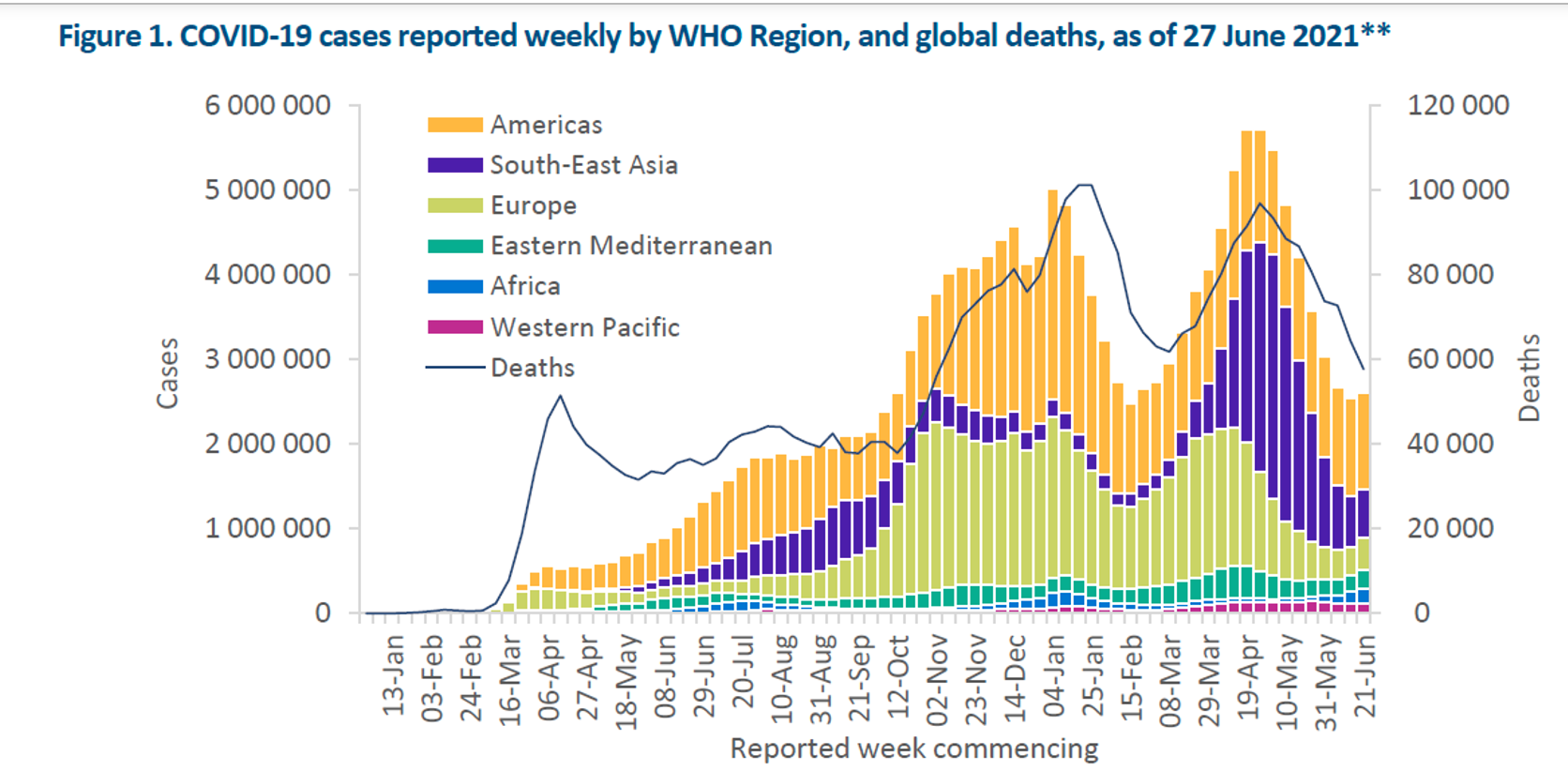
In the past week, the number of new COVID-19 cases remained similar to the previous week, and the number of new deaths continued to decrease, with over 2.6 million new cases and 57 000 new deaths reported globally. This is the lowest weekly mortality figure since those recorded in early November 2020. Globally, COVID-19 incidence remains very high, with an average of over 370 000 cases reported each day over the past week. The cumulative number of cases reported globally now exceeds now 180 million and the number of global deaths is almost 4 million. This week, the African region recorded a sharp increase in incidence (33%) and mortality (42%) when compared to the previous week. All Regions, with the exception of the African Region, reported a decline in the number of new deaths in the past week.
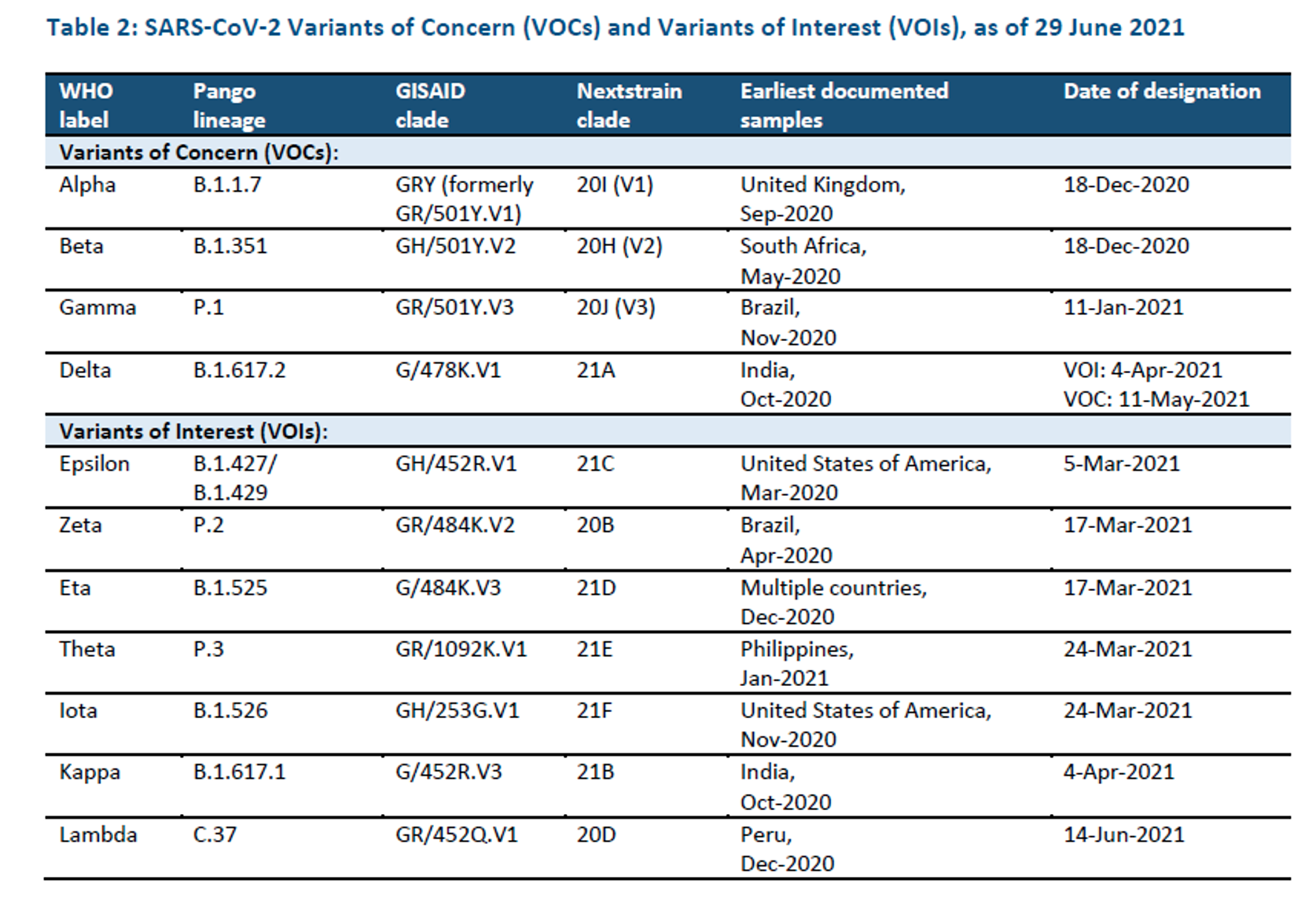
In this edition, a special focus update on the variants is provided, along with the geographical distribution of variants of concern (VOCs) Alpha (B.1.1.7), Beta (B.1.351), Gamma (P.1) and Delta (B.1.617.2). This edition also includes an overview of current challenges in the context of the COVID-19 pandemic, as well as a summary of the WHO global conference on communicating science during health emergencies.

::::::
::::::


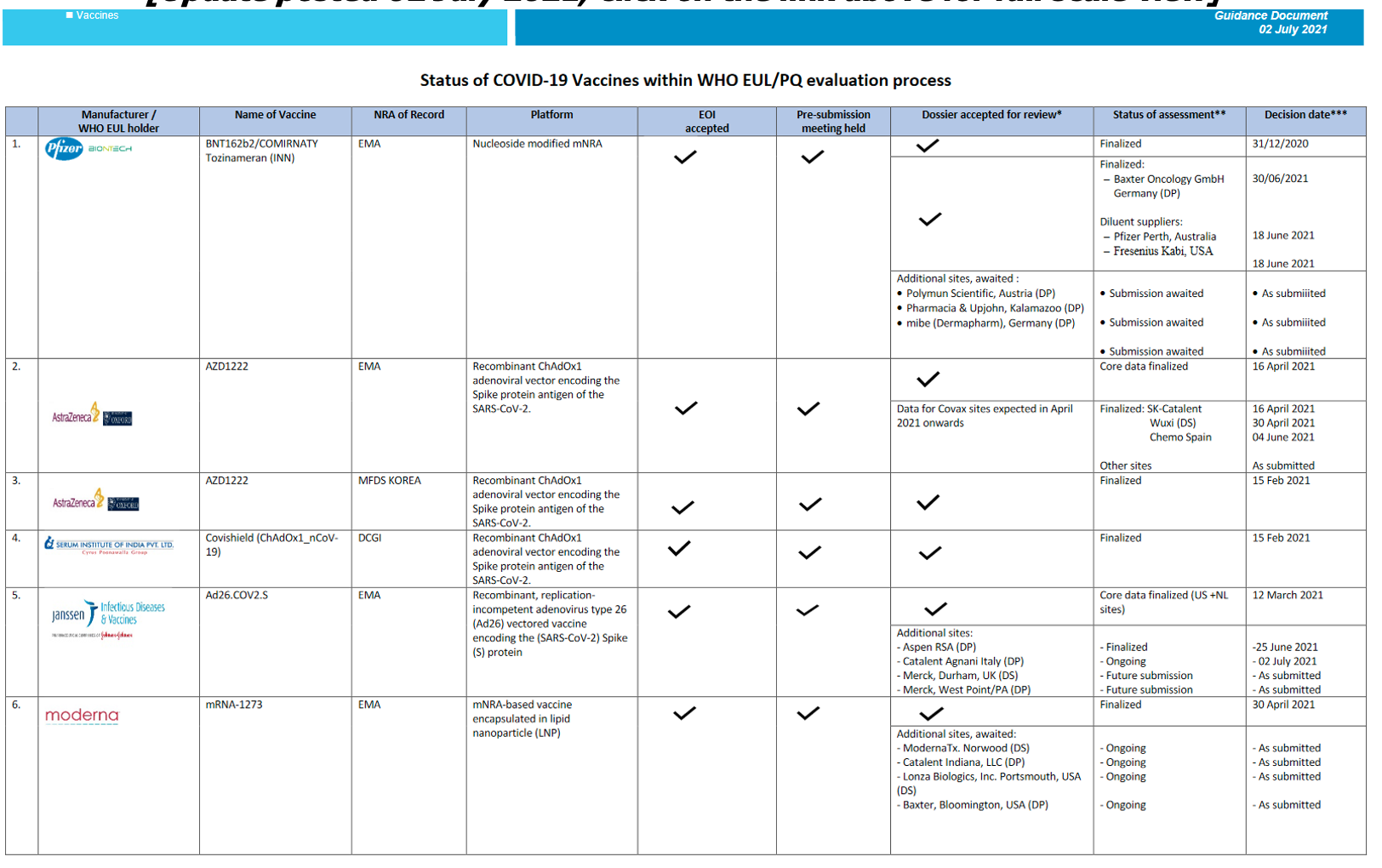
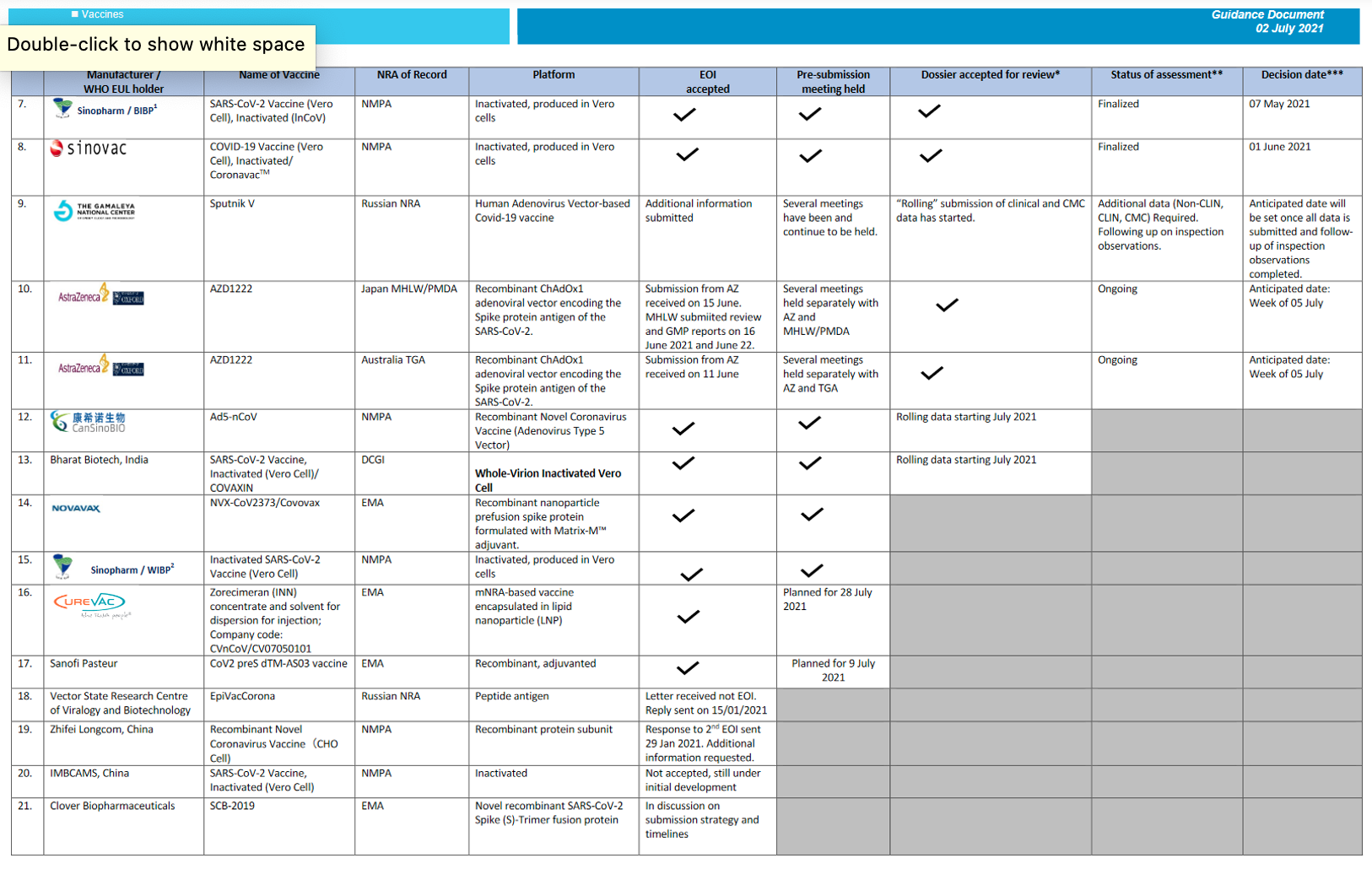
Status of COVID-19 Vaccines within WHO EUL/PQ evaluation process 26 June 2021
For 22 vaccine candidates, presents Manufacturer, Name of Vaccine, NRA of Record, Platform, EOI Accepted Status, Pre-submission Meeting Held Status, Dossier Accepted for Review, Status of Assessment; Anticipated/Completed Decision Date
[Update posted 02 July 2021; click on the link above for full scale view]

COVID Vaccine Developer/Manufacturer Announcements [relevant press releases/announcement from organizations from WHO EUL/PQ listing above]

Milestones :: Perspectives :: Research


COVID Vaccine Developer/Manufacturer Announcements [relevant press releases/announcement from organizations from WHO EUL/PQ listing above]


AstraZeneca
Press Releases
Vaxzevria induced immunity for at least one year following a single dose and strong immune responses following either a late second dose or a third dose
28 June 2021
A sub-analysis from the Oxford-led COV001 and COV002 trials with Vaxzevria induced strong immune responses following either a prolonged second dose interval of up to 45 weeks or following a third boosting dose.
The results, published by the University of Oxford on the pre-print server of The Lancet, demonstrated that antibody levels remain elevated from baseline for at least one year following a single dose…


First COVID-19 variant vaccine AZD2816 Phase II/III trial participants vaccinated
27 June 2021
Trial to enrol approximately 2,250 adults to assess safety and immunogenicity of AZD2816 against the SARS-CoV-2 virus
The first participants in a Phase II/III trial for the new COVID-19 variant vaccine AZD2816 were vaccinated today to assess its safety and immunogenicity in both previously vaccinated and unvaccinated adults.
The trial will recruit approximately 2,250 participants across UK, South Africa, Brazil and Poland.
AZD2816 will be administered to individuals who have previously been fully vaccinated with two doses of Vaxzevria or an mRNA vaccine, at least three months after their last injection. In non-vaccinated individuals, AZD2816 will be given as two doses, four or twelve weeks apart, or given as a second dose following a first dose of Vaxzevria four weeks apart.
AZD2816 has been designed using the same adenoviral vector platform as Vaxzevria, with minor genetic alterations to the spike protein based on the Beta (B.1.351, South African) variant.
Sir Mene Pangalos, Executive Vice President, BioPharmaceuticals R&D, said: “It is important we continue to stay ahead of genetically distinct variants of the coronavirus. AZD2816 should help broaden individuals immune response against emerging variants of concern. Initiating the Phase II/III trial for AZD2816 means we can be prepared should a variant vaccine be required in the future.”…

BioCubaFarma – Cuba
Últimas Noticias
Recibe la vacuna cubana SOBERANA 02 autorizo de uso de emergencia en la República Islámica de Irán
01/07/2021 19:45:41

[google translate: Cuban vaccine SOVEREIGN 02 receives authorization for emergency use in the Islamic Republic of Iran]


CanSinoBIO
News – No new digest announcements identified

Clover Biopharmaceuticals – China
News
Jun 30,2021 Clover Announces Advance Purchase Agreement with Gavi for Over 400 Million Doses of Clover’s COVID-19 Vaccine for the COVAX Facility

Jun 30,2021 Clover and Dynavax Announce Commercial Supply Agreement of Dynavax’s CpG 1018 Adjuvant for Clover’s COVID-19 Vaccine Candidate


Curevac [Bayer Ag – Germany]
News
June 30, 2021
CureVac Final Data from Phase 2b/3 Trial of First-Generation COVID-19 Vaccine Candidate, CVnCoV, Demonstrates Protection in Age Group of 18 to 60
Unique pivotal study conducted in 10 countries in fast changing variant environment; 15 COVID-19 variant strains present for efficacy analysis; original strain almost completely absent
Statistical success criteria for primary endpoint met on basis of 228 adjudicated cases
Vaccine efficacy of 48% against COVID-19 of any severity across all age groups and 15 variants
Significant vaccine efficacy demonstrated in participants aged 18 to 60 and across all 15 variants:
Efficacy of 53% against disease of any severity
Efficacy of 77% against moderate and severe disease
Full protection against hospitalization or death
CureVac in ongoing dialogue with EMA; continuing regulatory submission


Gamaleya National Center
Latest News and Events – No new digest announcements identified [See Russia/RFID below]

IMBCAMS, China
HomeReceiving 502 Bad Gateway message upon inquiry


Janssen/JNJ
Press Releases
Jul 01, 2021 United States
Positive New Data for Johnson & Johnson Single-Shot COVID-19 Vaccine on Activity Against Delta Variant and Long-lasting Durability of Response
Demonstrated strong neutralizing antibody activity against the Delta (B.1.617.2) variant
Persistent immune responses through at least eight months


Moderna
Press Releases
July 1, 2021
Moderna Announces Recipharm Site in France Manufacturing COVID-19 Vaccine Moderna Following Approval by European Medicines Agency

June 29, 2021
Moderna Announces Emergency Use Authorization for its COVID-19 Vaccine Granted by Government of India

June 29, 2021
Moderna Provides a Clinical Update on the Neutralizing Activity of its COVID-19 Vaccine on Emerging Variants Including the Delta Variant First Identified in India
Serum samples from eight participants obtained one week after second dose of the primary series in the Phase 1 clinical trial of the Moderna COVID-19 Vaccine
Serum neutralization assays performed on emerging variants including 2 additional versions of the Beta variant (B.1.351) and 3 lineage variants of B.1.617, including the Kappa (B.1.617.1) and Delta (B.1.617.2) variants


Novavax
Press Releases
Novavax Publishes Results of United Kingdom Phase 3 Clinical Trial in New England Journal of Medicine, Demonstrating High Levels of Efficacy of COVID-19 Vaccine
Jun 30, 2021
-Publication of final analysis highlights the robust safety and efficacy data of NVX-CoV2373 in large, pivotal placebo-controlled trial
…The manuscript published today in NEJM, ‘Safety and Efficacy of NVX-CoV2373 Covid-19 Vaccine,’ provides the final trial analysis, building on an initial interim analysis conducted in January 2021, and the updated analysis announced in March 2021, while additional data from the study was subsequently shared in preprint server medRxiv in May 2021. Today’s publication may be accessed here.

Novavax Statement on Proof of Vaccination for Phase 3 Clinical Trial Participants: Updated June 30, 2021
Jun 30, 2021
The participation of volunteers in clinical trials is critical to medical research, and Novavax is grateful to those who stepped forward to advance COVID-19 vaccine development to help create a safer future for all. Novavax firmly believes that clinical trial participants should not be disadvantaged with respect to providing proof of vaccination. We are actively supporting authorities working to provide proof of vaccination for all who volunteered in our pivotal Phase 3 clinical trials…


Pfizer
Recent Press Releases – No new digest announcements identified


Sanofi Pasteur
Press Releases
June 29 2021 Press releases
Sanofi launches dedicated vaccines mRNA Center of Excellence
Approximately €400million investment annually to accelerate end-to-end R&D of next-generation vaccines, fully financed through resource reallocation
Focus on innovating mRNA vaccines beyond pandemic to routine use in diseases with high unmet need
Expected minimum of six clinical candidates by 2025


Serum Institute of India
NEWS & ANNOUNCEMENTS – No corporate announcements identified
[Last media release still posted dated February 15, 2021; media release of April 21, 2021 apparently removed]


Sinopharm/WIBPBIBP
News – Website not responding at inquiry


Sinovac
Press Releases
The Lancet Inf. Dis. Published Data from Sinovac’s Phase I/II Study, World’s First Published Study on Clinical Trial Results of a COVID-19 Vaccine in Healthy Children
21/07/02


Vector State Research Centre of Viralogy and Biotechnology
Home – No new digest announcements identified

Zhifei Longcom, China
[Anhui Zhifei Longcom Biologic Pharmacy Co., Ltd.]
[No website identified]


::::::

GSK
Press releases for media – No new digest announcements identified


SK Biosciences
Press releases
SK Bioscience Submitted Phase 3 IND for COVID-19 Vaccine
2021. 06. 28
GBP510 submitted for Phase 3 clinical study in Korea and extend to multi-country studies
The COVID-19 vaccine to be supplied globally through COVAX Facility, if proven to be safe and effective.

U.S.: COVID-19 Vaccines – Announcements/Regulatory Actions/Deployment

Milestones :: Perspectives :: Research


U.S.: COVID-19 Vaccines – Announcements/Regulatory Actions/Deployment

Vaccines and Related Biological Products Advisory Committee
:: No meetings scheduled


::::::

White House [U.S.]
Briefing Room – Selected Major COVID Announcements
Press Briefing by White House COVID-19 Response Team and Public Health Officials
July 01, 2021 • Press Briefings

U.S. COVID-19 GLOBALRESPONSE AND RECOVERY FRAMEWORK
July 1, 2021 :: 12 pages
The White House
Executive Summary
More than 600,000 of our fellow Americans, and nearly 4 million people globally, have died due to COVID-19. The devastating impact of the pandemic has been felt at home and abroad, triggering health and economic crises. Globally, we are witnessing the first wide scale increase in extreme poverty in more than twenty years, the loss of decades of development progress, increases in gender-based violence, rising food insecurity, and increased unemployment—particularly among young people and women. Even as we gain confidence in United States (U.S.) domestic COVID-19 vaccination coverage, none of us are safe until all of us are safe. The risk of emergent, dangerous variants where COVID-19 transmission remains high poses a risk to us all.  This disease knows no borders.

The U.S. will work with our partners to intensify the fight against COVID-19 around the world, pave the way to global recovery, and build back better national and global health security. Our first goal is to end the pandemic—at home and abroad. On January 21, 2021, President Biden released the National Strategy for the COVID-19 Response and  Pandemic Preparedness, including Goal 7, which details the Biden-Harris Administration’s comprehensive plan to restore U.S. leadership globally and build better preparedness for future threats; re-engage with the World Health Organization (WHO) and seek to strengthen and reform it; urge the international COVID-19 public health and humanitarian response; restore U.S. leadership to the international COVID-19 response and advance global health security and diplomacy; and build better biopreparedness and expand resilience for biological threats.

In support of that strategy, the U.S. COVID-19 Global Response and Recovery Framework provides a focused set of objectives and lines of effort under which U.S. departments of agencies are executing a whole-of-government response.  This response aims to shorten the lifespan of and ultimately end the COVID-19 pandemic globally; mitigate its wider harms to people and economies and support the global recovery; and build back better to strengthen international readiness for future biological threats. The U.S. Government will pursue five objectives under the U.S. COVID-19 Global Response and Recovery Framework that together constitute a comprehensive approach to managing the immediate global health crisis and ending the pandemic.

The U.S. COVID-19 Global Response and Recovery Framework also supports U.S. commitments to the G7+ Plan to Defeat the COVID-19 Pandemic in 2022 and Prevent the Next Pandemic by supporting vaccination of the world’s most vulnerable populations, supporting last mile vaccination and getting shots in arms, providing personal protective equipment (PPE) and medical supplies where needed, strengthening supply, improving disease surveillance and early warning, supporting recovery, building resilience, and advancing global health security.


GOALS OF THE U.S. COVID-19 GLOBAL RESPONSE AND RECOVERY FRAMEWORK
Overarching Goal:
End the pandemic; mitigate its wider harms to people and societies; and strengthen the global recovery and readiness for future pandemic threats

OBJECTIVES
Accelerate widespread and equitable access to and delivery of safe and effective COVID-19 vaccinations
Reduce morbidity and mortality from COVID-19, mitigate transmission, and strengthen health systems, including to prevent, detect, and respond to pandemic threats
Address acute needs driven by COVID-19, mitigate household shocks, and build resilience
Bolster economies and other critical systems under stress due to COVID-19 to prevent backsliding and enable recovery
Strengthen the international health security architecture to prevent, detect, and respond to pandemic threats

The U.S. cannot do this alone: we will partner with governments, international organizations, philanthropies, nonprofits, the private sector, and -most critically -on the frontlines with affected communities worldwide…

Europe: COVID-19 Vaccines – Announcements/Regulatory Actions/Deployment

Milestones :: Perspectives :: Research


Europe: COVID-19 Vaccines – Announcements/Regulatory Actions/Deployment


European Medicines Agency
News & Press Releases
News: Increased manufacturing capacity for COVID-19 Vaccine Janssen (new)
CHMP, Last updated: 02/07/2021


News: Use of antibiotics in animals is decreasing (new)
Last updated: 30/06/2021


News: Update of EU recommendations for 2021–2022 seasonal flu vaccine composition (new)
CHMP, Last updated: 28/06/2021


::::::

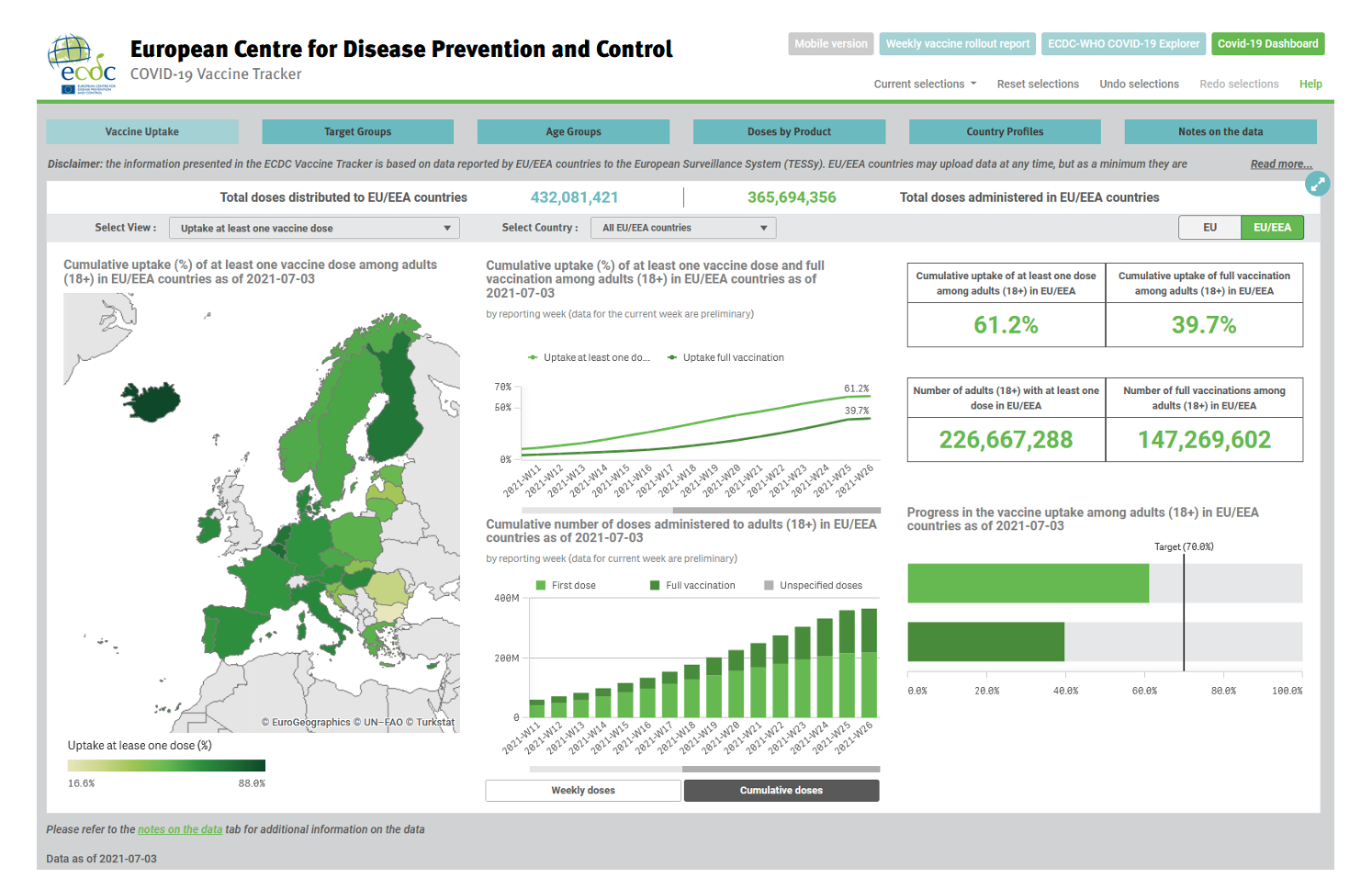
European Centre for Disease Prevention and Control
https://www.ecdc.europa.eu/en
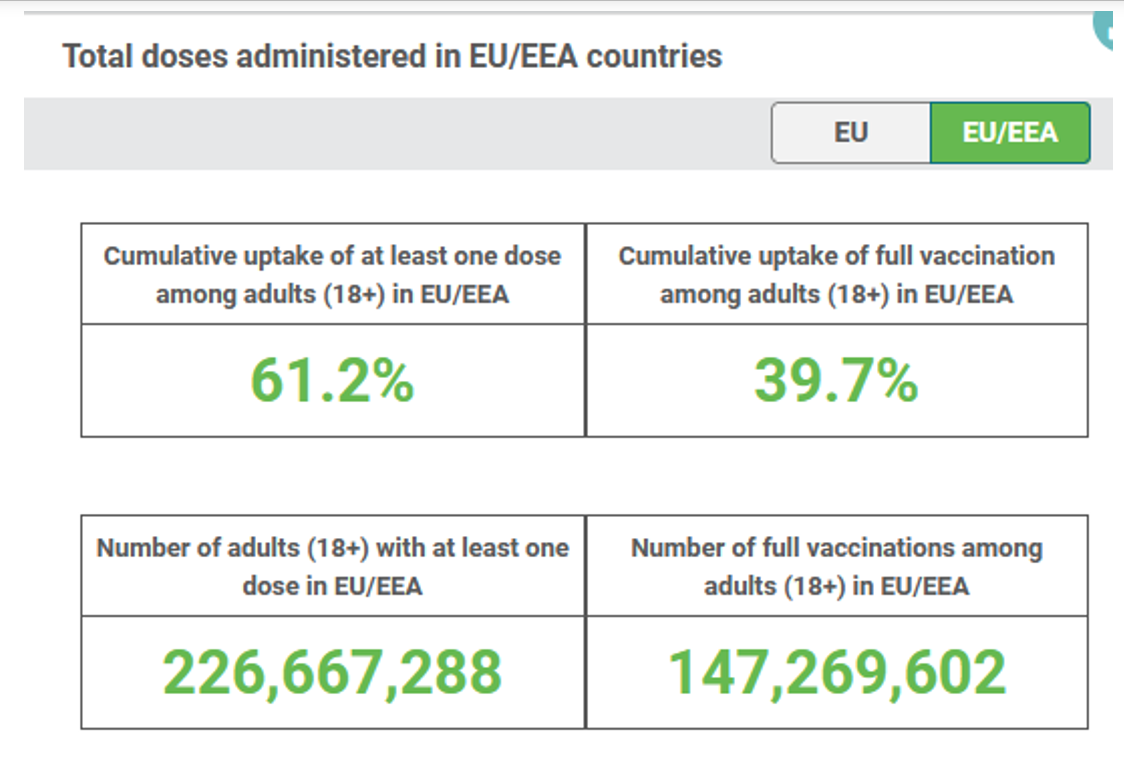
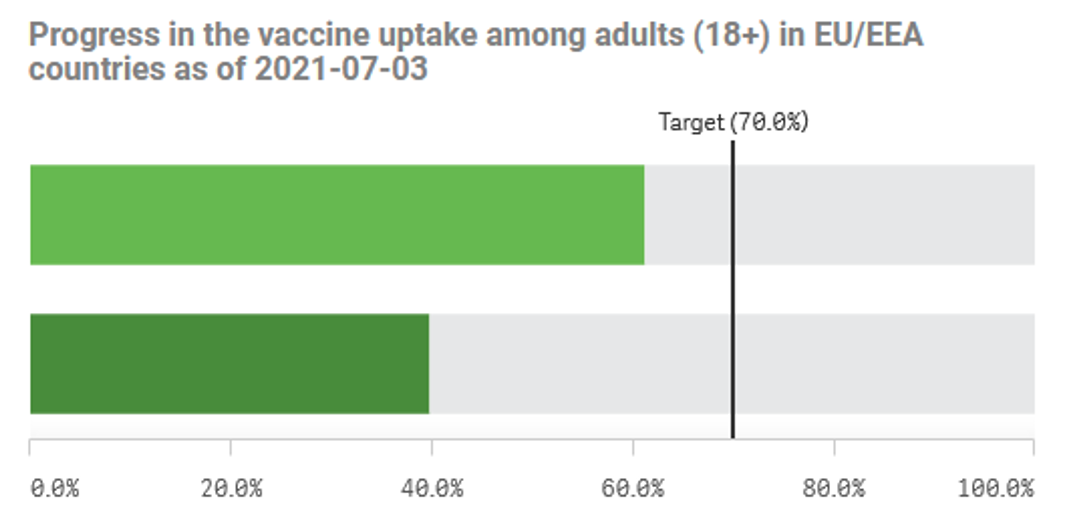
Latest Updates

https://vaccinetracker.ecdc.europa.eu/public/extensions/COVID-19/vaccine-tracker.html#uptake-tab


::::::


European Commission
https://ec.europa.eu/commission/presscorner/home/en
Press release 1 July 2021
EU Digital COVID Certificate enters into application in the EU
As of today, the EU Digital COVID Certificate Regulation enters into application. This means that EU citizens and residents will now be able to have their Digital COVID Certificates issued and verified across the EU. 21 Member States as well as Norway, Iceland and Liechtenstein had already started to issue certificates ahead of today’s deadline, and five EU countries are starting today.

The Commission’s work on the EU Digital COVID Certificates was led by Commissioner Didier Reynders in close cooperation with Vice-Presidents Vera Jourová and Margaritis Schinas and Commissioners Thierry Breton, Stella Kyriakides, and Ylva Johansson.

Welcoming the entry into application of the EU Digital COVID Certificate, President Ursula von der Leyen said: “The European Union is delivering for its citizens. The European Digital COVID Certificate is a symbol of an open and safe Europe that is opening cautiously putting the protection of the health of our citizens first. In March, we promised to have an EU-wide system to facilitate free and safe travel within the EU by the summer holidays. Now we can confirm that the EU Digital COVID Certificate system is up and running. A vast majority of EU Member States are already connected to the system and ready to issue and verify the Certificates. More than 200 million certificates have already been generated. We are helping Europeans get back the freedom they value and cherish so much.”

EU Digital COVID Certificate
The aim of the EU Digital COVID Certificate is to facilitate safe and free movement in the EU during the COVID-19 pandemic. All Europeans have the right to free movement, also without the certificate, but the certificate will facilitate travel, helping to exempt holders from restrictions such as quarantine.

The EU Digital COVID Certificate will be accessible for everyone and it:
covers COVID-19 vaccination, test and recovery;
:: is free of charge and available in all EU languages;
:: is available in a digital and paper-based format;
:: is secure and include a digitally signed QR code;

Under the new rules, Member States must refrain from imposing additional travel restrictions on holders of an EU Digital COVID Certificate, unless they are necessary and proportionate to safeguard public health.

In addition, the Commission committed to mobilising €100 million under the Emergency Support Instrument to support Member States in providing affordable tests…

Press release 29 June 2021
COVID-19: EU helps deliver vaccines to Kosovo
The European Union is helping Norway to deliver over 180,000 doses of COVID-19 vaccine to Kosovo, following Kosovo’s request for assistance via the EU Civil Protection Mechanism.

Questions and answers 29 June 2021
Questions and Answers: COVID-19 Therapeutics Strategy – list of 5 candidate therapeutics

Russia: COVID-19 Vaccines – Announcements/Regulatory Actions/Deployment

Milestones :: Perspectives :: Research


Russia: COVID-19 Vaccines – Announcements/Regulatory Actions/Deployment


Russia: Sputnik V – “the first registered COVID-19 vaccine”
https://sputnikvaccine.com/newsroom/pressreleases/
Press Releases
Sputnik V has demonstrated 97.8% efficacy against COVID cases and 100% efficacy against severe cases of COVID in UAE
Press release, 29.06.2021

India: COVID-19 Vaccines – Announcements/Regulatory Actions/Deployment

Milestones :: Perspectives :: Research


India: COVID-19 Vaccines – Announcements/Regulatory Actions/Deployment


Ministry of Health and Family Welfare
https://www.mohfw.gov.in/


02.07.2021
Operational Guidance for COVID-19 Vaccination of Pregnant Women

Government of India – Press Information Bureau
Latest Press Releases
No new digest content identified.

Indian Council for Medical Research (ICMR)
https://www.icmr.gov.in/media.html
Press Releases
No new digest content identified.

China: COVID-19 Vaccines – Announcements/Regulatory Actions/Deployment

Milestones :: Perspectives :: Research


China: COVID-19 Vaccines – Announcements/Regulatory Actions/Deployment

NMPA holds meeting to review vaccine regulatory quality management system
2021-06-25
The National Medical Products Administration (NMPA) held a vaccine regulatory quality management system review meeting on June 15, to summarize the construction and operation of the system, evaluate its appropriateness, effectiveness and adequacy, and make arrangements for the key tasks of the next stage of its construction…

China-UK drug regulatory cooperation project kicks off
2021-06-21
The meeting adopted the plan for the China-UK drug regulatory cooperation project in 2021 to push forward technical exchanges in areas of drug review, inspection and post-marketing monitoring for better mutual understanding and deeper cooperation….

POLIO Public Health Emergency of International Concern (PHEIC)

Emergencies

POLIO
Public Health Emergency of International Concern (PHEIC)

Polio this week as of 29 June 2021
:: In October 2020, the Fourth meeting between the National Authorities for Containment (NAC) and Containment Working Group for the Global Commission for Certification (GCC-CWG) was convened to discuss global updates on the Containment workstream programme, COVID-19 implications and Containment programme adjustments, among other issues. The meeting report is now available here.
:: “For global programs to meet their goals and improve health, gender must be addressed at every level, from the household and community to management and organizational leadership.”- Conclusion in the recently published research: The influence of gender dynamics on polio eradication efforts. Read more here.

Summary of new WPV and cVDPV viruses this week (AFP cases and ES positives):
:: Nigeria: ten cVDPV2 cases and four cVDPV2 positive environmental samples
:: Egypt: one cVDPV2 positive environmental sample


::::::

Note for the record
Fourth Meeting between the National Authorities for Containment and Containment Working Group for the Global Commission for Certification
Virtual Meeting -Tuesday, Wednesday 27-28 October 2020
Contents
:: Abbreviations and acronyms
:: Update on global poliovirus containment –Daphne Moffett, WHO
:: Update on the auditor qualification and auditor support plan, 2021–2023 –Nicoletta Previsani, WHO
:: Process for revision of the Global Action Plan for Poliovirus Containment (GAPIII, 2014) and development of a tool for identifying and assessing potentially infectious materials and poliovirus –Harpal Singh, WHO
:: Next steps towards certification of containment –James Blaine, Chair, Containment Working Group Task Group
:: Status of containment certification –David Salisbury, Chair, Global Commission for the Certification of the Eradication of Poliomyelitis
:: Outcomes of the survey of national authorities for containment –Harpal Singh, WHO
:: Application for a certificate of participation: lessons learnt and the way forward –Liliane Boualam, WHO
:: Country experience –Lia Haynes Smith, US National Authority for Poliovirus Containment, USA
:: Requirements for containment of novel oral poliovirus vaccine and potentially of S19 –Mark Pallansch, Chair, Advisory Group on mOPV2 provision
:: The way forward –Daphne Moffett, WHO


::::::
::::::

WHO/OCHA Emergencies


Editor’s Note:
WHO has apparently reorganized and fundamentally shifted how it judges and tracks “emergencies”. We found no announcement of descriptive information to share and present the webpage structure as encountered below. Obviously, the dates associated with some of these emergencies suggest that this is an archival platform as well as a current emergencies resource.

Health emergencies list – WHO
“The health emergencies list details the disease outbreaks, disasters and humanitarian crises where WHO plays an essential role in supporting countries to respond to and recover from emergencies with public health consequences.”


Ebola outbreak, Democratic Republic of the Congo, 2021
[Last apparent update: 3 May 2021]

Ebola outbreak outbreak, N’Zerekore, Guinea, 2021 [Last apparent update: 3 May 2021]

Coronavirus disease (COVID-19) pandemic [Last apparent update 3 July 2021; See COVID above]

Ebola outbreak, Equateur Province, Democratic Republic of the Congo, 2020 [Last apparent update: 1 June 2021]

Ebola outbreak, North Kivu, Ituri, Democratic Republic of the Congo, 2018 – 2020 [Last apparent update: 3 May 2021]

Ebola outbreak, Democratic Republic of the Congo, 2018 [Last apparent update: 24 July 2018]

Yemen crisis [Last apparent update: 12 February 2021]

Syria crisis [Last apparent update: 18 June 2021]

Somalia crisis [Last apparent update: 24 March 2018]

Nigeria crisis [Last apparent update: 9 May 2018]

Ebola outbreak, Democratic Republic of the Congo, 2017 [Last apparent update: 3 May 2021]

Zika virus disease outbreak, 2015-2016 [Last apparent update: 24 Jan 2020]

Ebola outbreak: West Africa, 2014-2016 [Last apparent update: 3 May 2021]

Iraq crisis [Last apparent update: 9 Jan 2008]

South Sudan crisis [Last apparent update: 23 Sep 2020]

Avian influenza A (H7N9) virus outbreak [Last apparent update: 21 May 2021]

Middle East respiratory syndrome (MERS-CoV) outbreak [Last apparent update: 8 July 2019]

Influenza A (H1N1) virus, 2009-2010 pandemic [Last apparent update: 10 Aug 2010]


::::::

UN OCHA – Current Emergencies
Current Corporate Emergencies
No new digest content identified


::::::
::::::