The International Patient Decision Aid Standards (IPDAS) Collaboration: Evidence Update 2.0

Medical Decision Making (MDM)
Volume 41 Issue 7, October 2021
http://mdm.sagepub.com/content/current


Editorials
The International Patient Decision Aid Standards (IPDAS) Collaboration: Evidence Update 2.0
Dawn Stacey, Robert J. Volk, for the IPDAS Evidence Update Leads (Hilary Bekker, Karina Dahl Steffensen, Tammy C. Hoffmann, Kirsten McCaffery, Rachel Thompson, Richard Thomson, Lyndal Trevena, Trudy van der Weijden, and Holly Witteman)
First Published August 20, 2021; pp. 729–733

Twenty steps to ingrain power asymmetry in global health biomedical research

PLoS Biology
https://journals.plos.org/plosbiology/
(Accessed 2 Oct 2021)


Perspective
Twenty steps to ingrain power asymmetry in global health biomedical research
Iruka N. Okeke
| published 30 Sep 2021 PLOS Biology
https://doi.org/10.1371/journal.pbio.3001411
Health research in low-income settings must prioritize sustainability to truly impact target diseases in the long term. Here, I satirically summarize how biomedical investigators from high-income countries can collaboratively work to (not) accomplish this.

Drought and child vaccination coverage in 22 countries in sub-Saharan Africa: A retrospective analysis of national survey data from 2011 to 2019

PLoS Medicine
http://www.plosmedicine.org/
(Accessed 2 Oct 2021)


Drought and child vaccination coverage in 22 countries in sub-Saharan Africa: A retrospective analysis of national survey data from 2011 to 2019
Jason M. Nagata, Adrienne Epstein, Kyle T. Ganson, Tarik Benmarhnia, Sheri D. Weiser
Research Article | published 28 Sep 2021 PLOS Medicine
https://doi.org/10.1371/journal.pmed.1003678

Effect of a hospital-wide campaign on COVID-19 vaccination uptake among healthcare workers in the context of raised concerns for life-threatening side effects

PLoS One
http://www.plosone.org/
[Accessed 2 Oct 2021]


Effect of a hospital-wide campaign on COVID-19 vaccination uptake among healthcare workers in the context of raised concerns for life-threatening side effects
Min Hyung Kim, Nak-Hoon Son, Yoon Soo Park, Ju Hyun Lee, Da Ae Kim, Yong Chan Kim
Research Article | published 01 Oct 2021 PLOS ONE
https://doi.org/10.1371/journal.pone.0258236

Global research priorities for COVID-19 in maternal, reproductive and child health: Results of an international survey

PLoS One
http://www.plosone.org/
[Accessed 2 Oct 2021]


Global research priorities for COVID-19 in maternal, reproductive and child health: Results of an international survey
Melanie Etti, Jackeline Alger, Sofía P. Salas, Robin Saggers, Tanusha Ramdin, Margit Endler, Kristina Gemzell-Danielsson, Tobias Alfvén, Yusuf Ahmed, Allison Callejas, Deborah Eskenazi, Asma Khalil, Kirsty Le Doare, On behalf of the Maternal, Newborn and Child Health Working Group of the COVID-19 Clinical Research Coalition
Research Article | published 24 Sep 2021 PLOS ONE
https://doi.org/10.1371/journal.pone.0257516

Citizens from 13 countries share similar preferences for COVID-19 vaccine allocation priorities

PNAS – Proceedings of the National Academy of Sciences of the United States
September 21, 2021; vol. 118 no. 38


https://www.pnas.org/content/118/38
Social Sciences
Open Access
Citizens from 13 countries share similar preferences for COVID-19 vaccine allocation priorities
Raymond Duch, Laurence S. J. Roope, Mara Violato, Matias Fuentes Becerra, Thomas S. Robinson, Jean-Francois Bonnefon, Jorge Friedman, Peter John Loewen, Pavan Mamidi, Alessia Melegaro, Mariana Blanco, Juan Vargas, Julia Seither, Paolo Candio, Ana Gibertoni Cruz, Xinyang Hua, Adrian Barnett, and Philip M. Clarke
PNAS September 21, 2021 118 (38) e2026382118; https://doi.org/10.1073/pnas.2026382118
Significance
How to allocate COVID-19 vaccines is one of the most important decisions currently facing governments. With limited supplies, what is most pressing is deciding who gets priority in the vaccine allocation rollout. Some governments are exploring allowing private purchases of COVID-19 vaccines. Many countries are debating whether COVID-19 vaccines should be mandated. There is little evidence on what policies are preferred by the global public. Our survey of 15,536 adults in 13 countries confirms that priority should be given to health workers and those at high risk but also, to a broad range of key workers and those with lower incomes. The public favors allocating COVID-19 vaccines solely via government programs but was polarized in some countries on mandatory vaccinations.
Abstract
How does the public want a COVID-19 vaccine to be allocated? We conducted a conjoint experiment asking 15,536 adults in 13 countries to evaluate 248,576 profiles of potential vaccine recipients who varied randomly on five attributes. Our sample includes diverse countries from all continents. The results suggest that in addition to giving priority to health workers and to those at high risk, the public favors giving priority to a broad range of key workers and to those with lower income. These preferences are similar across respondents of different education levels, incomes, and political ideologies, as well as across most surveyed countries. The public favored COVID-19 vaccines being allocated solely via government programs but were highly polarized in some developed countries on whether taking a vaccine should be mandatory. There is a consensus among the public on many aspects of COVID-19 vaccination, which needs to be taken into account when developing and communicating rollout strategies.

Life expectancy, healthy life expectancy, and burden of disease in older people in the Americas, 1990–2019: a population-based study

Revista Panamericana de Salud Pública/Pan American Journal of Public Health (RPSP/PAJPH)
https://www.paho.org/journal/en


Selected Articles
29 Sep 2021
Life expectancy, healthy life expectancy, and burden of disease in older people in the Americas, 1990–2019: a population-based study
Original research | English |

Walking the Tightrope: Reevaluating science communication in the era of COVID-19 vaccines

Discussion Full text access
Walking the Tightrope: Reevaluating science communication in the era of COVID-19 vaccines
Matthew Z. Dudley, Roger Bernier, Janesse Brewer, Daniel A. Salmon
Pages 5453-5455

Vaccine
Volume 39, Issue 39 Pages 5453-5726 (15 September 2021)
https://www.sciencedirect.com/journal/vaccine/vol/39/issue/39


Discussion Full text access
Walking the Tightrope: Reevaluating science communication in the era of COVID-19 vaccines
Matthew Z. Dudley, Roger Bernier, Janesse Brewer, Daniel A. Salmon
Pages 5453-5455

Point-of-care vaccinators’ perceptions of vaccine hesitancy drivers: A qualitative study from the cape metropolitan district, South Africa

Vaccine
Volume 39, Issue 39 Pages 5453-5726 (15 September 2021)
https://www.sciencedirect.com/journal/vaccine/vol/39/issue/39


Research article Open access
Point-of-care vaccinators’ perceptions of vaccine hesitancy drivers: A qualitative study from the cape metropolitan district, South Africa
Elizabeth O. Oduwole, Hassan Mahomed, Christina A. Laurenzi, Heidi J. Larson, Charles S. Wiysonge
Pages 5506-5512

Children are the key to the Endgame: A case for routine pediatric COVID vaccination

Vaccine
Volume 39, Issue 39 Pages 5453-5726 (15 September 2021)
https://www.sciencedirect.com/journal/vaccine/vol/39/issue/39


Volume 39, Issue 38 Pages 5333-5452 (7 September 2021)
https://www.sciencedirect.com/journal/vaccine/vol/39/issue/38
Discussion No access
Children are the key to the Endgame: A case for routine pediatric COVID vaccination
Mark R. Schleiss, Chandy C. John, Sallie R. Permar
Pages 5333-5336

Exploring socio-demographic and geospatial variation in human papillomavirus vaccination uptake in Virginia

Vaccine
Volume 39, Issue 39 Pages 5453-5726 (15 September 2021)
https://www.sciencedirect.com/journal/vaccine/vol/39/issue/39


Research article Abstract only
Exploring socio-demographic and geospatial variation in human papillomavirus vaccination uptake in Virginia
Jeanine N. Staples, Samhita L. Nelamangala, Sean Morris, Kristen Wells
Pages 5385-5390

A Rapid Systematic Review of Factors Influencing COVID-19 Vaccination Uptake in Minority Ethnic Groups in the UK

Vaccines
https://www.mdpi.com/journal/vaccines


Open Access Review
A Rapid Systematic Review of Factors Influencing COVID-19 Vaccination Uptake in Minority Ethnic Groups in the UK
by Atiya Kamal, Ava Hodson and Julia M. Pearce
Vaccines 2021, 9(10), 1121; https://doi.org/10.3390/vaccines9101121 (registering DOI) – 01 Oct 2021
Abstract
COVID-19 has disproportionately affected minority ethnic groups in the United Kingdom. To maximise the effectiveness of the vaccination programme, it is important to understand and address disparities in vaccine uptake. The aim of this review was to identify factors influencing COVID-19 vaccination uptake […]

Women’s Empowerment and Children’s Complete Vaccination in the Democratic Republic of the Congo: A Cross-Sectional Analysis

Vaccines
https://www.mdpi.com/journal/vaccines


Open Access Article
Women’s Empowerment and Children’s Complete Vaccination in the Democratic Republic of the Congo: A Cross-Sectional Analysis
by Xinran Lu, Chuchu Fu, Qianyun Wang, Qiwei He, Jiayi Hee, Rie Takesue and Kun Tang
Vaccines 2021, 9(10), 1117; https://doi.org/10.3390/vaccines9101117 (registering DOI) – 01 Oct 2021
Abstract
(1) Background: The empowerment of women contributes to better child health and wellness. This study aimed to examine the association between women’s empowerment and complete vaccination of children, as recommended in the National Expanded Program on Immunization (EPI) in the Democratic Republic of […]

Persuasive Messages Will Not Increase COVID-19 Vaccine Acceptance: Evidence from a Nationwide Online Experiment

Vaccines
https://www.mdpi.com/journal/vaccines


Open Access Article
Persuasive Messages Will Not Increase COVID-19 Vaccine Acceptance: Evidence from a Nationwide Online Experiment
by Raman Kachurka, Michał Krawczyk and Joanna Rachubik
Vaccines 2021, 9(10), 1113; https://doi.org/10.3390/vaccines9101113 (registering DOI) – 30 Sep 2021
Abstract
Although mass vaccination is the best way out of the pandemic, the share of skeptics is substantial in most countries. Social campaigns can emphasize the many arguments that potentially increase acceptance for vaccines: e.g., that they have been developed, tested, and recommended by […

Factors Associated with COVID-19 Vaccine Intentions in Eastern Zimbabwe: A Cross-Sectional Study

Vaccines
https://www.mdpi.com/journal/vaccines


Open Access Article
Factors Associated with COVID-19 Vaccine Intentions in Eastern Zimbabwe: A Cross-Sectional Study
by Lauren McAbee, Oscar Tapera and Mufaro Kanyangarara
Vaccines 2021, 9(10), 1109; https://doi.org/10.3390/vaccines9101109 (registering DOI) – 29 Sep 2021
Abstract
Vaccines are one of the most effective public health strategies to protect against infectious diseases, yet vaccine hesitancy has emerged as a global health threat. Understanding COVID-19 knowledge and attitudes and their association with vaccine intentions can help the targeting of strategies to […]

medRxiv

medRxiv
medRxiv is a free online archive and distribution server for complete but unpublished manuscripts (preprints) in the medical, clinical, and related health sciences. Preprints are preliminary reports of work that have not been certified by peer review. They should not be relied on to guide clinical practice or health-related behavior and should not be reported in news media as established information. medRxiv is for the distribution of preprints – complete but unpublished manuscripts – that describe human health research conducted, analyzed, and interpreted according to scientific principles…
https://www.medrxiv.org/content/about-medrxiv
[Accessed 2 Oct 2021]

Selected Content
Actions for fostering cross-disciplinary global health research
Yan Ding, Ewan Tomeny, Imelda Bates, the IMPALA Consortium
medRxiv 2021.09.30.21264294; doi: https://doi.org/10.1101/2021.09.30.21264294

HPV vaccination of girls in the German model region Saarland: Insurance data-based analysis and identification of starting points for improving vaccination rates
Anna Marthaler, Barbara Berko-Goettel, Juergen Rissland, Jakob Schoepe, Emeline Taurian, Hanna Mueller, Gero Weber, Stefan Lohse, Thomas Lamberty, Bernd Holleczek, Harry Stoffel, Gunter Hauptmann, Martin Giesen, Christiane Firk, Alexandra Schanzenbach, Florian Brandt, Heike Hohmann, Quirin Werthner, Dominik Selzer, Thorsten Lehr, Stefan Wagenpfeil, Sigrun Smola
medRxiv 2021.10.01.21264397; doi: https://doi.org/10.1101/2021.10.01.21264397

Efficacy of COVID-19 vaccines in immunocompromised patients: A systematic review and meta-analysis
Ainsley Ryan Yan Bin Lee, Shi Yin Wong, Louis Yi Ann Chai, Soo Chin Lee, Matilda Lee, Mark Dhinesh Muthiah, Sen Hee Tay, Chong Boon Teo, Benjamin Kye Jyn Tan, Yiong Huak Chan, Raghav Sundar, Yu Yang Soon
medRxiv 2021.09.28.21264126; doi: https://doi.org/10.1101/2021.09.28.21264126

Effectiveness of mRNA-1273 against Delta, Mu, and other emerging variants
Katia Bruxvoort, Lina S. Sy, Lei Qian, Bradley K. Ackerson, Yi Luo, Gina S. Lee, Yun Tian, Ana Florea, Michael Aragones, Julia E. Tubert, Harpreet S. Takhar, Jennifer H. Ku, Yamuna D. Paila, Carla A. Talarico, Hung Fu Tseng
medRxiv 2021.09.29.21264199; doi: https://doi.org/10.1101/2021.09.29.21264199

Effectiveness of mRNA and ChAdOx1 COVID-19 vaccines against symptomatic SARS-CoV-2 infection and severe outcomes with variants of concern in Ontario
Sharifa Nasreen, Hannah Chung, Siyi He, Kevin A. Brown, Jonathan B. Gubbay, Sarah A Buchan, Deshayne B. Fell, Peter C. Austin, Kevin L Schwartz, Maria E. Sundaram, Andrew Calzavara, Branson Chen, Mina Tadrous, Kumanan Wilson, Sarah E. Wilson, Jeffrey C Kwong
medRxiv 2021.06.28.21259420; doi: https://doi.org/10.1101/2021.06.28.21259420

Improving older adults’ vaccination uptake: are existing measures of vaccine hesitancy valid and reliable for older people?
Nicola Cogan, Allyson Gallant, Louise Nicholls, Susan Rasmussen, David Young, Lynn Williams
medRxiv 2021.09.29.21263161; doi: https://doi.org/10.1101/2021.09.29.21263161

Predictors of parents’ intention to vaccinate their children against the COVID-19 in Greece: a cross-sectional study
Petros Galanis, Irene Vraka, Olga Siskou, Olympia Konstantakopoulou, Aglaia Katsiroumpa, Ioannis Moisoglou, Daphne Kaitelidou
medRxiv 2021.09.27.21264183; doi: https://doi.org/10.1101/2021.09.27.21264183

Think Tanks et al

Think Tanks et al
 
 
Brookings [to 2 Oct 2021]
http://www.brookings.edu/
FixGov
For COVID-19 vaccinations, party affiliation matters more than race and ethnicity
William A. Galston
Friday, October 1, 2021
 
 
Center for Global Development [to 2 Oct 2021]
http://www.cgdev.org/page/press-center
Accessed 2 Oct 2021
COVID-19 Vaccines: The Latest Airfinity Estimates
Event 10/4/21
Airfinity is producing the most-referenced, real-time estimates of COVID-19 vaccine production, purchasing, stockpiling, expiry and delivery. As ministers of finance join the World Bank-IMF meetings this week, we discuss Airfinity’s latest estimates showing a rapid upwards trend in production as well as a normalization of vaccine manufacturing and supply chains in the coming months; their work also highlights the extent of stockpiling by high-income country governments, the risks of massive wastage related to expiry dates, as well as the mismatch between vaccine delivery timelines and needs in countries with low vaccination rates and high case fatality rates.
Join us at CGD for a presentation and discussion with Rasmus Hansen, CEO and Founder of Airfinity, on the key facts and issues for finance leaders related to vaccines as they consider priorities over the coming months.

COVID-19 Stocktake and the Hurdles to Vaccine Access Across Africa
Event 10/5/21
The COVID-19 pandemic has pushed up to 40 million Africans into extreme poverty and the continent experienced its first recession in half a century. Global vaccination efforts have left Africa behind: less than two percent of the African population has been vaccinated compared to over 70 percent in the European Union. As Delta and other emerging variants present new challenges for Africa, COVID-19 deaths have surged, hospital admissions have increased rapidly, and countries face shortages of oxygen and intensive care beds. During this high-level event, we will discuss the impact COVID-19 continues to have across Africa and the necessary measures the international community should take to address the emerging dangerous divergence between advanced and lower income economies. We hope to set the tone for conversations surrounding these challenging issues during the World Bank-IMF Annual Meetings.
 
 
Chatham House [to 2 Oct 2021]
https://www.chathamhouse.org/
Accessed 2 Oct 2021
[No new digest content identified]


CSIS
https://www.csis.org/
Accessed 2 Oct 2021
Critical Questions
China Is Exploiting the Pandemic to Advance Its Interests, with Mixed Results
September 30, 2021 | By Bonny Lin, Matthew P. Funaiole , Brian Hart, Hannah Price


Kaiser Family Foundation
https://www.kff.org/search/?post_type=press-release
September 30, 2021 News Release
Nearly Half of Parents of Adolescents Ages 12-17 Say Their Child Got a COVID-19 Vaccine Already; a Third of Parents of Children Ages 5-11 Say Their Child Will Get Vaccinated “Right Away” Once Eligible
Nearly half (48%) of parents of vaccine-eligible children ages 12-17 now say their child has received at least one dose of a COVID-19 vaccine, a new KFF Vaccine Monitor report shows. Another 15% of those parents now say they want to “wait and see” how the vaccine works for others…

September 28, 2021 News Release
Surging Delta Variant Cases, Hospitalizations, and Deaths Are Biggest Drivers Of Recent Uptick in U.S. COVID-19 Vaccination Rates
Large Majorities of Americans, Both Vaccinated and Not, Say COVID-19 is Likely to Persist at Lower Levels and Be Something the U.S. Will “Learn to Live With” like Seasonal Flu More than 7 in 10 adults (72%) in the U.S. now report that they are at least partially vaccinated against…

September 27, 2021 News Release
As PEPFAR Nears its Two-Decade Mark, New Analysis Finds That Mortality Declined Substantially in PEPFAR Countries Over the Course of the Program
A new KFF analysis finds the President’s Emergency Plan for AIDS Relief (PEPFAR) program was associated with large declines in mortality in PEPFAR recipient countries since its creation in 2003. The new analysis takes a closer look at PEPFAR’s health impact by assessing the all-cause mortality rate in 90 PEPFAR…
 
 
Rockefeller Foundation [to 2 Oct 2021]
https://www.rockefellerfoundation.org/
Selected Reports/Press Releases
Sep 23 2021
Press Releases
Pastors, Partners and Pop-ups: Report Shows Best Practices for Covid-19 Vaccination, Testing in Underserved Communities
Public health professionals in seven U.S. cities and states share how they increased vaccination and testing rates among their communities where rates were lowest New York | September 23, 2021 — …

Vaccines and Global Health: The Week in Review :: 25 September 2021

Vaccines and Global Health: The Week in Review is a weekly digest  summarizing news, events, announcements, peer-reviewed articles and research in the global vaccine ethics and policy space. Content is aggregated from key governmental, NGO, international organization and industry sources, key peer-reviewed journals, and other media channels. This summary proceeds from the broad base of themes and issues monitored by the Center for Vaccine Ethics & Policy in its work: it is not intended to be exhaustive in its coverage. You are viewing the blog version of our weekly digest, typically comprised of between 30 and 40 posts below all dated with the current issue date

.– Request an Email Summary: Vaccines and Global Health : The Week in Review is published as a single email summary, scheduled for release each Saturday evening before midnight (EDT in the U.S.). If you would like to receive the email version, please send your request to david.r.curry@centerforvaccineethicsandpolicy.org.

– pdf version A pdf of the current issue is available here:

– blog edition: comprised of the approx. 35+ entries posted below.

– Twitter:  Readers can also follow developments on twitter: @vaxethicspolicy.
.
– Links:  We endeavor to test each link as we incorporate it into any post, but recognize that some links may become “stale” as publications and websites reorganize content over time. We apologize in advance for any links that may not be operative. We believe the contextual information in a given post should allow retrieval, but please contact us as above for assistance if necessary.

Support this knowledge-sharing service: Your financial support helps us cover our costs and to address a current shortfall in our annual operating budget. Click here to donate and thank you in advance for your contribution.

.
David R. Curry, MS
Executive Director
Center for Vaccine Ethics and Policy

COVID

Milestones :: Perspectives :: Research


COVID


Editor’s Note:
As is obvious to all, the sheer volume of strategic announcements, regulatory actions, country program decisions, commentary, and, indeed, misinformation around COVID response continues at extraordinary levels. Our weekly digest strives to present a coherent and comprehensive snapshot, but cannot be exhaustive, If you recognize a missed strategic development, a new source of rigorous analysis, or an insight/commentary that would benefit our common understanding, please advise me…we will review all suggestions and consider them for inclusion in a subsequent edition: david.r.curry@ge2p2global.org

We are seeking access to modelling which engages scenarios and articulates imperatives around a COVID-19 pandemic end-game through at least a 2025 horizon. We assess that WHO must be conducting or contracting for such modeling – or should recognize an imperative to be doing so in its global health governance role. If we have missed such modeling in progress, we would be delighted to be advised of it and will include it in our coverage.

Secretary-General’s address to the 76th Session of the UN General Assembly

Milestones :: Perspectives :: Research


Editor’s Note:
We include this extended excerpt from the Secretary General’s address to the UN General Assembly earlier this week, noting his characterization of current state of COVID vaccine equity: “…This is a moral indictment of the state of our world. It is an obscenity…”

Secretary-General’s address to the 76th Session of the UN General Assembly
António Guterres, UN Secretary General
21 September 2021
[Editor’s text bolding]
Mr. President of the General Assembly, Excellencies,
I am here to sound the alarm:  The world must wake up. We are on the edge of an abyss — and moving in the wrong direction.

Our world has never been more threatened. Or more divided. We face the greatest cascade of crises in our lifetimes.

The COVID-19 pandemic has supersized glaring inequalities. The climate crisis is pummeling the planet. Upheaval from Afghanistan to Ethiopia to Yemen and beyond has thwarted peace.


A surge of mistrust and misinformation is polarizing people and paralyzing societies. Human rights are under fire. Science is under assault. And economic lifelines for the most vulnerable are coming too little and too late — if they come at all.

Solidarity is missing in action — just when we need it most.

Perhaps one image tells the tale of our times. The picture we have seen from some parts of the world of COVID-19 vaccines … in the garbage.  Expired and unused.

On the one hand, we see the vaccines developed in record time — a victory of science and human ingenuity. On the other hand, we see that triumph undone by the tragedy of a lack of political will, selfishness and mistrust. A surplus in some countries.  Empty shelves in others. A majority of the wealthier world vaccinated.  Over 90 percent of Africans still waiting for their first dose.


This is a moral indictment of the state of our world. It is an obscenity. We passed the science test. But we are getting an “F” in ethics…

Excellencies,
COVID and the climate crisis have exposed profound fragilities as societies and as a planet.
Yet instead of humility in the face of these epic challenges, we see hubris. Instead of the path of solidarity, we are on a dead end to destruction.


At the same time, another disease is spreading in our world today:  a malady of mistrust.

When people see promises of progress denied by the realities of their harsh daily lives…
When they see their fundamental rights and freedoms curtailed…
When they see petty — as well as grand — corruption around them…
When they see billionaires joyriding to space while millions go hungry on earth…
When parents see a future for their children that looks even bleaker than the struggles of today…And when young people see no future at all…


The people we serve and represent may lose faith not only in their governments and institutions — but in the values that have animated the work of the United Nations for over 75 years.
Peace.  Human rights.  Dignity for all.  Equality.  Justice.  Solidarity.

Like never before, core values are in the crosshairs. A breakdown in trust is leading to a breakdown in values. 

Promises, after all, are worthless if people do not see results in their daily lives. Failure to deliver creates space for some of the darkest impulses of humanity. It provides oxygen for easy fixes, pseudo-solutions and conspiracy theories. It is kindling to stoke ancient grievances.  Cultural supremacy.  Ideological dominance.  Violent misogyny.  The targeting of the most vulnerable including refugees and migrants.

Excellencies,
We face a moment of truth. Now is the time to deliver. Now is the time to restore trust. Now is the time to inspire hope.

And I do have hope.

The problems we have created are problems we can solve. Humanity has shown that we are capable of great things when we work together. That is the raison d’être of our United Nations.

But let’s be frank.  Today’s multilateral system is too limited in its instruments and capacities, in relation to what is needed for effective governance of managing global public goods. It is too fixed on the short-term.

We need to strengthen global governance.  We need to focus on the future.  We need to renew the social contract.  We need to ensure a United Nations fit for a new era.

That is why I presented my report on Our Common Agenda in the way I did. It provides a 360 degree analysis of the state of our world, with 90 specific recommendations that take on the challenges of today and strengthen multilateralism for tomorrow.

Our Common Agenda builds on the UN Charter, the Universal Declaration of Human Rights, the 2030 Agenda for Sustainable Development, and the Paris Climate Agreement. It is in line with the mandate I was given by the UN75 Declaration to seek a pathway to a better world.
But to reach that land of our promises, we must bridge Great Divides…

Excellencies,
I see 6 Great Divides — 6 Grand Canyons — that we must bridge now.

First, we must bridge the peace divide…
Second, we must bridge the climate divide…
Third, we must bridge the gap between rich and poor, within and among countries…
Fourth, we must bridge the gender divide…
Fifth, restoring trust and inspiring hope means bridging the digital divide…
Sixth, and finally, we need to bridge the divide among generations…

[Full text at title link above]

Global leaders commit further support for global equitable access to COVID-19 vaccines and COVAX

Milestones :: Perspectives :: Research


Editor’s Note
We observe the restraint in quotations from COVAX leaders below, with the exception, perhaps, of the WHO DG.

Global leaders commit further support for global equitable access to COVID-19 vaccines and COVAX
A joint statement from COVAX partners: CEPI, Gavi, WHO, UNICEF
09/23/2021
:: Leaders pledge financing, dose donations, support for country readiness and delivery and scale up of global manufacturing, to enable equitable access to COVID-19 vaccines

:: To improve access for lower-income economies, the United States will contribute an additional 500 million doses of Pfizer vaccine to be delivered through COVAX, beginning in 2022, and Sweden will provide an additional SEK 2.1 billion (approximately US$243 million) through 2021 and 2022

:: New dose commitments from the European Union, including Italy and Spain, as well as Sweden, Denmark, and Japan mean further doses will be available to COVAX participants in 2021 and 2022

Geneva/New York/Oslo 23 September 2021 – Global leaders attending the Global COVID-19 Summit hosted by the United States have again underlined their commitment to ensuring equitable access to COVID-19 vaccines for all countries through COVAX – noting that equitable access is essential to end the acute stage of the pandemic. Building on the momentum and global solidarity generated over the past eighteen months by various commitments including at summits organised by the European Commission, the G20 under the Saudi and Italian presidencies, the United Kingdom (UK), including the G7 under the UK presidency, the United States, and the Prime Minister of Japan, yesterday’s Summit saw further pledges made to COVAX and equitable access.

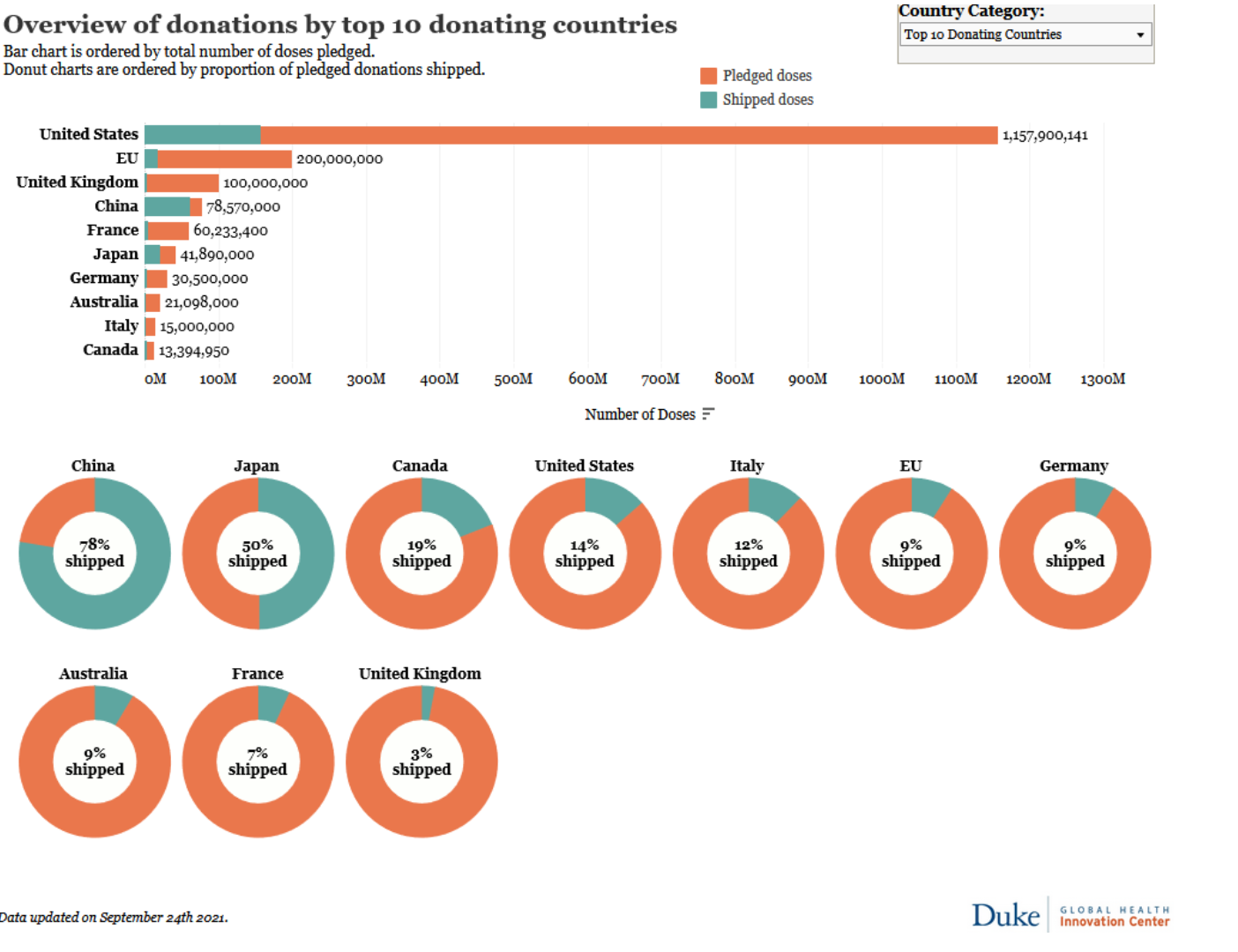
As the host of the Summit, the United States presented a target to vaccinate the world and as part of its commitment, pledged an additional 500 million doses of Pfizer vaccine to be delivered to low- and lower-middle-income countries through COVAX. These doses are in addition the deal for 500 million Pfizer doses facilitated by the United States, announced in June, and more than 90 million surplus doses shared through COVAX, bringing the US total doses to be provided through COVAX to nearly 1.1 billion doses. With deliveries of previously pledged doses underway, these additional doses will be made available beginning in January 2022. In addition, the US International Development Finance Corporation (DFC) will provide more than $383 million in political risk insurance to Gavi, the Vaccine Alliance (Gavi) to facilitate shipments around the world.

The United States and the European Union announced a joint agenda for combatting the global pandemic, reemphasising commitments to share doses with COVAX and support critical readiness activities, and calling on other nations to do the same – particularly emphasising the importance of predictable and effective dose-sharing to maximize sustainability of the process and minimize wastage of doses. Building on previous pledges, Team Europe committed to share 500 million doses by mid-2022.

Emphasising the close partnership between the African Union / AVAT and COVAX in delivering doses to African countries, South African President Cyril Ramaphosa called on higher-income countries to trade places in production queues and to support the AU and COVAX in their shared goal of increasing coverage across the African continent.

In addition to the US$ 285 million Sweden has already pledged to the Gavi COVAX Advance Market Commitment (AMC), the financing mechanism which enables access to fully donor-funded doses for 92 lower-income economies, Sweden announced that a new pledge of SEK 2.1 billion (approximately US$ 243 million) in cash contributions and dose donations, will be made available to support equitable access to COVID-19 vaccines to AMC-eligible economies through 2021 and 2022.

Alongside these commitments, several countries pledged additional dose donations to be made available to countries around the world, including through COVAX, with Spain pledging an additional 7.5 million doses, Italy pledging an additional 30 million doses to be made available by the end of the year, and Japan, which hosted the “One World Protected” Gavi COVAX AMC Summit in June 2021, pledging approximately 60 million doses. In addition, Denmark announced during the United Nations General Assembly this week that it would be doubling its dose donation commitment, bringing the total to 6 million doses pledged to be shared.

José Manuel Barroso, Chair of the Gavi Board, said: “This Summit marks a major step forward in the global response against COVID-19 and a major step forward for multilateralism. I would like to thank President Biden and all leaders for their commitment to global access to vaccines and urge all partners and stakeholders to increase their support of COVAX, so that we can meet our objective of ending the acute phase of this pandemic as quickly as possible.”

Dr Richard Hatchett, CEO of the Coalition for Epidemic Preparedness Innovations (CEPI) “Science has made huge progress in the fight to save lives, restore the global economy, and end the pandemic. Now we must redress the central moral failing of the world’s response to the pandemic, which is the lack of equitable access to the life-saving tools we have developed. This will require continued investment in R&D so we are able to deploy more vaccines, more effectively and create equity between countries of all income levels with regard to access to these life-saving vaccines.”


Dr Tedros Adhanom Ghebreyesus, WHO Director-General, said: “I am grateful to President Biden and world leaders for the commitment they have shown to vaccinate the world. However, what we need to succeed is truly sustainable, ironclad support that gets delivered now – not in 6 months or 12 months time. If we are to meet the targets we have set of vaccinating 10% of the population of all countries by the end of this month, 40% by the end of 2021 and 70% by mid next-year, we need to drastically scale up access to vaccines now.”

UNICEF Executive Director Henrietta Fore said: “We welcome world leaders’ renewed commitment to provide vaccine doses to low-income countries. We laud the US pledge of 500 million additional doses next year, as well as the announcements made by the European Union, Denmark, Japan, Italy and Spain, and hope to see these promises fulfilled urgently. With only 12 per cent of the pledges made earlier this year turning into actual doses, low-income countries can no longer wait. We urge dose-sharing countries to accelerate their donation plans.” 

Dr Seth Berkley, CEO of Gavi, said: “With the rise of variants and the current gap in equitable access to COVID-19 vaccines we must urgently vaccinate those most at risk everywhere in the world. We cannot afford further delays in getting vaccines to the most vulnerable – to do so will mean a continuation of this pandemic and its impact on all of our lives.”

COVAX has recently published an updated supply forecast, which indicates that while COVAX deliveries to countries are accelerating and will continue to ramp up dramatically through the end of year, significant risks remain.

As a result COVAX partners have issued an urgent call to action – for the lifting of all export restrictions, for manufacturers to deliver on their commitments to COVAX and provide transparency on delivery schedules and queues. COVAX also calls for countries who are ahead in manufacturers’ queues and have already achieved high coverage to give up their place in the queue to COVAX and the low and middle-income participants it supports, and for the expansion, acceleration and systemization of dose donations to provide greater volumes, lead times, and shelf lives, allowing countries to better prepare for rollouts.

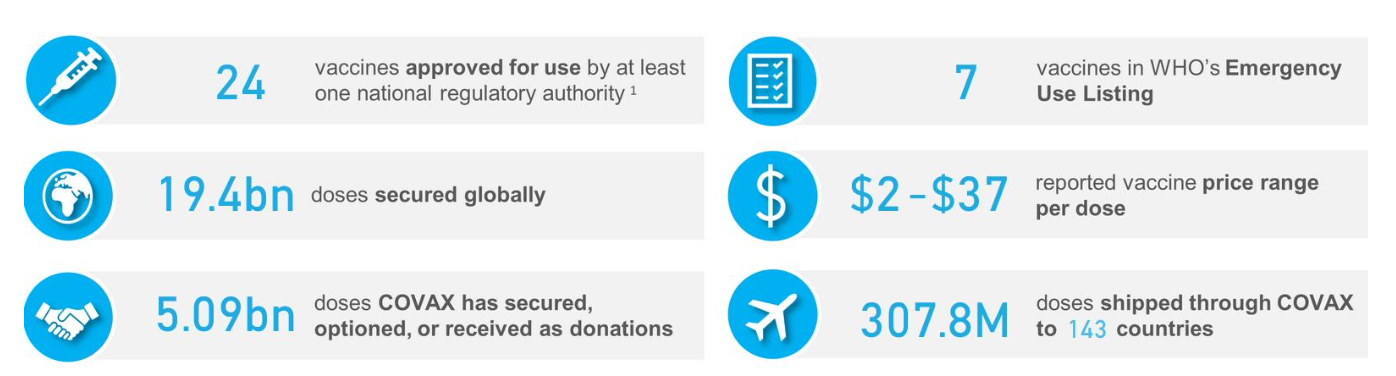
So far COVAX has delivered more than 300 million doses to 142 economies, and according to the latest forecast, a total of approximately 1.2 billion doses will be available for the lower income economies supported by the COVAX Advance Market Commitment (AMC) by the end of 2021. This is enough to protect 20% of the population, or 40% of all adults, in all 92 AMC economies with the exception of India. The key COVAX milestone of two billion doses released for delivery is now expected to be reached in the first quarter of 2022.

FACT SHEET: Targets for Global COVID-⁠19 Summit

Milestones :: Perspectives :: Research


Editor’s Note:
This statement is presented in the form of an invitation “to all Global COVID-19 Summit participants to join us in aligning around the global targets and taking the associated required actions to end the COVID-19 pandemic and build back better.” The statement presents, with varying detail and sometimes no detail, a number of targets and (aspirational) requests to different sectors. The first target is presented from the original text below. We also note that the Biden Administration’s stated goal [bullet one below] around vaccinating 70% of the world’s population by the next UNGA in late September 2022 does not seem to align with the WHO statements about a 70% target by “middle of next year” (WHO DG statement of Sep 23, 2021 below).


White House, USA
FACT SHEET: Targets for Global COVID-⁠19 Summit
September 22, 2021 • Statements and Releases
[Fact Sheet Excerpt]
TARGETS: VACCINATE THE WORLD
Vaccinate the world: Support the WHO’s goal of at least 70 percent of the population fully vaccinated with quality, safe, and effective vaccines in every country and income category by UNGA 2022.
Deliver doses urgently: Endorse the G20 target of, “in line with the World Health Organization (WHO), we support the goal to vaccinate at least 40 percent by the end of 2021 of the global population.”
Manufacture doses over the medium and long-term: Additional doses and adequate supplies are available to all countries in 2022. As scientific evidence develops, make sufficient financing available for production of additional doses for future booster needs in LIC/LMICs.


Asks for Governments & International Institutions with Relevant Capabilities: Fall 2021
Close the financing and supply gap for low-income countries (LICs)/ low middle-income countries (LMICs) to reach 70 percent coverage by providing funds, purchasing or donating 1 billion additional doses of quality, safe and effective COVID-19 vaccines, including through COVAX to support global equitable distribution.
Accelerate vaccination in LIC/LMICs in 2021 by expediting delivery of approximately 2.0 billion already committed doses of quality, safe and effective COVID-19 vaccines, including by converting existing dose sharing pledges into near-term deliveries, swapping delivery dates to secure earlier delivery of doses to LIC/LMICs, and eliminating cross-border bottlenecks in the supply of vaccines and critical inputs.
Get shots into arms by making available at least $3 billion in 2021 and $7 billion in 2022 in financing for LIC/LMICs for vaccine readiness and effective deployment, including supporting the health workforce needed to deliver vaccines, combatting hesitancy, addressing legal and contractual requirements, and procuring ancillary supplies.
Make doses available for the medium and long-term by supporting sufficient global and regional production, as well as financing for possible booster needs and future vaccine production; expanding mRNA, viral vector, and protein subunit vaccine manufacturing (if authorized) and technology transfer; and procuring up to 3 billion additional doses of quality, safe and effective vaccines for LIC/LMICs if boosters become recommended by WHO.
Enhance accountability and coordination by establishing a robust vaccine, consumables, and ancillary supplies global dashboard in 2021, taking into account existing efforts toward this goal.


Proposed Private Sector Commitments: Fall 2021
Launch COVID-19 Corps for vaccine readiness & delivery.
Enhance transparency on the volume of actual and projected manufacture of vaccines; provide data on production projections and delivery sequencing for vaccine dashboard, in order to prioritize delivery for LIC/LMICs.
Expand global and regional manufacturing for mRNA, viral vector, and/or protein subunit COVID-19 vaccines, with a plan for development and financing…

Africa CDC, IFRC, and USAU call for Equitable Vaccine Coverage in Africa

Milestones :: Perspectives :: Research


Africa CDC, IFRC, and USAU call for Equitable Vaccine Coverage in Africa
Press Releases
Addis Ababa, 23 September 2021— The Africa Centres for Disease Control and Prevention (Africa CDC), the International Federation of Red Cross and Red Crescent Societies (IFRC) and the United States Mission to the African Union (USAU) called on partners and governments to do more to end vaccine inequity.

This call was made today, during a high-level event entitled “Saving Lives, Saving Livelihoods: Achieving high-level, equitable, COVID-19 vaccine coverage in African Union (AU) Member States”, aimed to follow-up the Global COVID-19 summit convened by U.S. President Joseph R. Biden on September 22 with local African partners on the margins of the United Nations General Assembly (UNGA).

Much of the population of Africa is being left behind, even as other parts of the world begin their path to recovery from this deadly pandemic. The deep inequities in vaccine distribution are also linked to the devastating socio-economic impacts of COVID-19. According to a report released in April 2021, economic disruption is likely to persist in Africa due to COVID-19 restrictions—and the slow pace of vaccine rollouts. Worryingly, Africa has been facing multiple, chronic crises, including poverty and food insecurity, which have been exacerbated by COVID-19.

Africa CDC, IFRC and USAU warned that, in addition to slow vaccine rollouts, the presence of several crises, including COVID-19, in many African countries, is resulting in the continued loss of lives and livelihoods. The three institutions also indicated that having the vaccine doses alone won’t be enough.


“As we call for the end of vaccine equity, we know that the work doesn’t end there. We also need to be able to deliver those vaccines to the communities; ensure that people are prepared to be vaccinated and that the doses are being delivered where they are needed. It is crucial to continue working more closely with communities.” Dr John Nkengasong, Director of Africa CDC emphasized.

The response to COVID-19 has been made more complex by decreasing perceptions of risk, pandemic fatigue, vaccine hesitancy and mistrust of authorities. The IFRC and member National Societies have been tackling the spread of misinformation by providing educational materials, running radio campaigns and information hotlines for the community.

…With increasing concerns that the secondary impacts of COVID-19 could have long-lasting affects across Africa, particularly for those living in poverty, IFRC is increasing its focus on livelihood support, particularly through cash-transfer programming where appropriate. But the humanitarian organisation warned that the COVID-19 pandemic could not be defeated unless more vaccine doses reached the arms of the most vulnerable on the continent.

H.E. Ellen Johnson-Sirleaf, former President of the Republic of Liberia, delivered a keynote address during the COVID-19 Summit today. She said: “Vaccine inequity is putting many lives and livelihood in danger. There has been a lot of talking, but now we must see these words turned into action. We call upon governments, partners and vaccine manufacturers to pull out all the stops to ensure that everyone has access to COVID-19 vaccines without any further delay.”

The Africa CDC joins the Global Citizen Live concert to push for vaccine equity.

Milestones :: Perspectives :: Research


The Africa CDC joins the Global Citizen Live concert to push for vaccine equity.
25 September 2021
Director of the Africa Centers for Disease Control and Prevention, Dr John Nkengasong, and Head of the Africa Vaccine Acquisition Task Team, Strive Masiyiwa to Address Vaccine Equity and Production Needs to Tackle COVID-19. Ms Bonang Matheba and Nomzamo Mbatha to are set to host the Global Citizen Live on the Great Lawn in Central Park on Sept. 25, 2021.

They join a list of incredible hosts donating their time and talent to this once-in-a-generation, 24-hour worldwide event. This announcement sees the continuation of our partnership between our Global Advocates and the organization, which recently included the Vax Live campaign and global broadcast, which secured 26 million COVID-19 vaccine doses for those who need it most.

Also appearing as part of the global broadcast event are United Nations Deputy Secretary General Amina Mohammed, World Health Organization Director-General Dr. Tedros Adhanom Ghebreyesus, Director of Africa Centres for Disease Control and Prevention Dr John Nkengasong, African Union Special Envoy and Head of the Africa Vaccine Acquisition Task Team Strive Masiyiwa, Executive Director of the World Food Programme David Beasley, Education Cannot Wait Director Yasmine Sherif, Vivek Maru CEO of Namati, Rotary President-elect Jennifer Jones, SDG Champion and Advocate Eddie Ndopu, President of the Ford Foundation Darren Walker, President of the Paris Peace Forum Steering Committee Trisha Shetty, Hip Hop Caucus President and CEO Rev. Lennox Yearwood Jr., U.N. Next Generation fellow Valeria Colunga, advocate Eunice Akoth and more.

Global Citizen Live calls on leaders to deliver by September:
1 billion trees planted and preserved to help prevent global temperatures from rising beyond 1.5ºC above pre-industrial levels by curbing emissions and supporting 1t.org
1 billion vaccines to the poorest countries
Meals for the 41 million people on the brink of famine

Global Citizen Live events will be broadcast across Africa from Sept. 25, 2021 on television, radio, and online.

COVID Vaccines – OCHA:: HDX

Milestones :: Perspectives :: Research


COVID Vaccines – OCHA:: HDX

COVID-19 Data Explorer: Global Humanitarian Operations
COVID-19 Vaccine Roll-out
Sep 25, 2021 | COVAX (WHO,GAVI,CEPI), UNDESA, Press Reports | DATA
Global COVID-19 Figures: 230M total confirmed cases; 4.7M total confirmed deaths
Global vaccines administered: 6.10B
Number of Countries: 29 [29 week ago]
COVAX Allocations Round 4-6 (Number of Doses): 120M [120M week ago]
COVAX Delivered (Number of Doses): 93M [87M week ago]
Other Delivered (Number of Doses): 140M [130M week ago]
Total Delivered (Number of Doses): 230M [200M week ago]
Total Administered (Number of Doses): 210M [190M week ago]

Milestones :: Perspectives :: Research


World Bank Vaccine Operations Portal
https://www.worldbank.org/en/who-we-are/news/coronavirus-covid19/world-bank-support-for-country-access-to-covid-19-vaccines
As of July 29, 2021, the World Bank approved operations to support vaccine rollout in 54 countries amounting to $4.6 billion. See the latest project financing, project documents and procurement information in the list below:

Countries receiving World Bank support for vaccines
As of September 9, 2021, the World Bank approved operations to support vaccine rollout in 55 countries amounting to $4.6 billion. See the latest project financing, project documents and procurement information in the list here.

Milestones :: Perspectives :: Research


Multilateral Leaders Task Force on COVID-19 [IMF, World Bank Group, WHO, WTO]
A joint initiative from the International Monetary Fund, World Bank Group, World Health Organization, and World Trade Organization to accelerate access to COVID-19 vaccines, therapeutics and diagnostics by leveraging multilateral finance and trade solutions, particularly in low- and middle-income countries. Website accessed 25 Sep 2021: https://data.covid19taskforce.com/data The global view below is complemented by country-specific dashboards here.

Coronavirus [COVID-19] – WHO Public Health Emergency of International Concern (PHEIC)

Milestones :: Perspectives :: Research

Coronavirus [COVID-19] – WHO

Public Health Emergency of International Concern (PHEIC)

https://www.who.int/emergencies/diseases/novel-coronavirus-2019


Weekly Epidemiological and Operational updates

Last update: 10 Sep 2021

Confirmed cases ::                         230 418 451     [226 844 344 week ago]

Confirmed deaths ::                          4 724 876               [4 666 334 week ago]

Vaccine doses administered:    5 874 934 542   [5 634 533 040 week ago]


::::::

::::::


WHO Director-General’s remarks at the Member State Information Session on COVID-19

Remarks

23 September 2021

[Excerpt]

…Yesterday I had the honour of speaking at the Global COVID-19 Summit hosted by the United States of America, on the margins of the United Nations General Assembly.


I welcome the support from so many Member States for the Secretariat’s global targets to vaccinate 40% of the population of every country by the end of this year, and 70% by the middle of next year.

And I thank President Biden, not only for hosting, but also for the pledges of 500 million doses, which is significant.


As you know, earlier this year we also set a target to see 10% of the population of every country vaccinated by the end of September. Almost 90% of wealthier countries have now reached the 10% target. But 50 countries will not get there, mostly in Africa.


At yesterday’s summit, Secretary-General Antonio Guterres repeated his call for a global vaccination plan. I’m pleased to say that the WHO Secretariat has developed that plan. Today, Dr Bruce Aylward and Dr Kate O’Brien will present the WHO Strategy for achieving our 70% goal by mid-2022.


Reaching this target requires 11 billion doses of vaccines. So far, 6 billion doses have been administered worldwide. Global production has been scaling up, and we estimate there is enough supply, but we are failing to provide equitable access.


But about 80 percent of the vaccines have gone to high and upper-middle income countries. Low income countries have received less than 1%. Let’s be clear: COVID-19 cannot be beaten one country at a time.


My friends, the investment needed to achieve global vaccination coverage is substantial, but compared to the costs we face if this is not brought under control, it is peanuts. Let’s get this finished…


:::::::


Weekly epidemiological update on COVID-19 – 21 September 2021

Overview

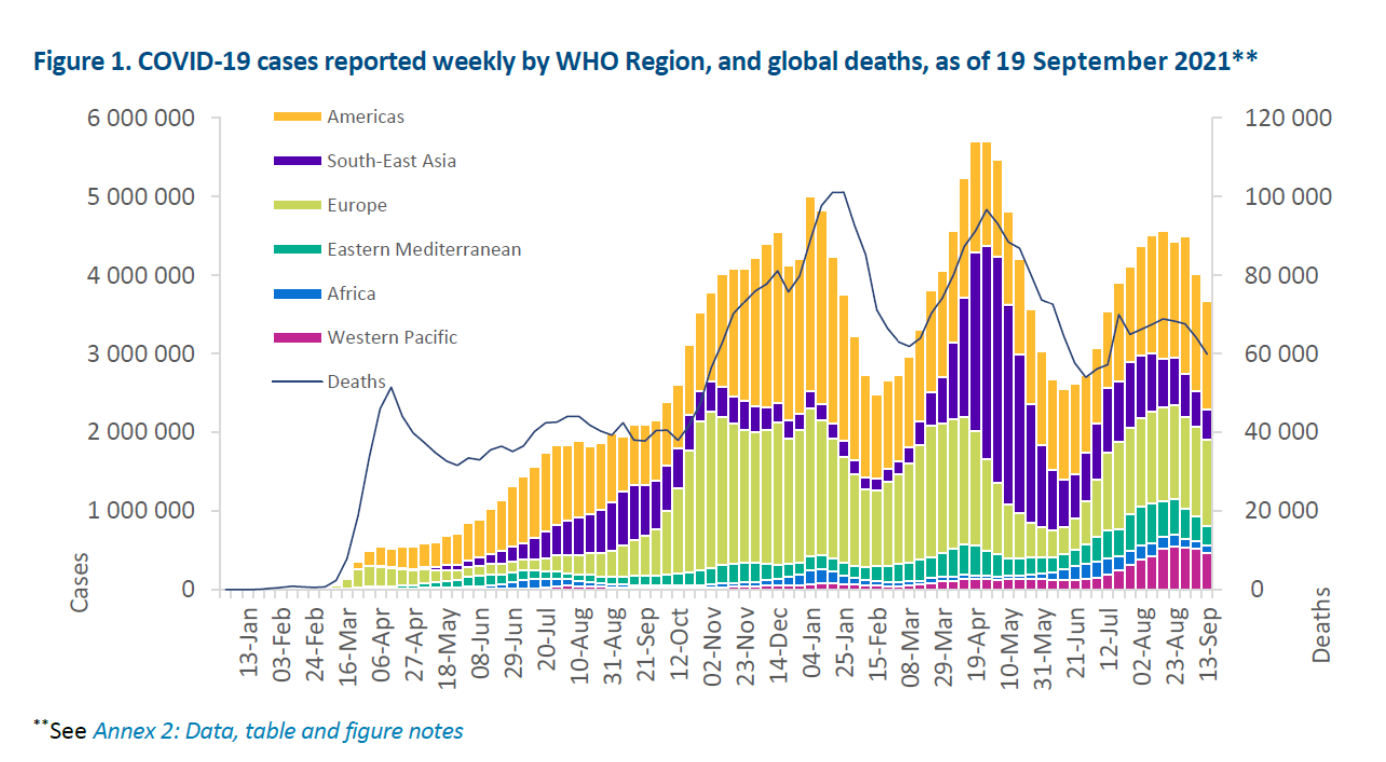
   The numbers of weekly COVID-19 cases and deaths globally continued to decline this week, with over 3.6 million cases and just under 60 000 deaths reported between 13-19 September. This brings the cumulative numbers of confirmed cases and deaths globally to nearly 228 million and over 4.6 million respectively. While the Region of the Americas as well as the Eastern Mediterranean, South-East Asia and Western Pacific regions reported a decrease in weekly case incidence, the African and European regions reported a similar number of deaths as compared to the previous week. Similarly, COVID-19 weekly mortality decreased in the African, Eastern Mediterranean and South-East Asian regions over the past week, with the South-East Asia Region reporting the largest percentage decrease (27%). In contrast, the Western Pacific Region reported an increase (7%) in the number of deaths while the Region of the Americas and the European Region reported a similar number of deaths as compared to the previous week.

   In this edition, we provide updates on the impacts of the phenotypic characteristics (transmissibility, disease severity, risk of reinfection, and impacts on diagnostics and vaccine performance) of SARS-CoV-2 Variants of Concern (VOCs), the geographic distribution of VOCs as well as changes to VOI classifications.


Status of COVID-19 Vaccines within WHO EUL/PQ evaluation process  19 August 2021


For 22 vaccine candidates, presents Manufacturer, Name of Vaccine, NRA of Record, Platform, EOI Accepted Status, Pre-submission Meeting Held Status, Dossier Accepted for Review, Status of Assessment; Anticipated/Completed Decision Date
[No updates since 19 Aug 2021]
::::::


COVID Vaccine Developer/Manufacturer Announcements

COVID Vaccine Developer/Manufacturer Announcements
[relevant press releases/announcement from organizations from WHO EUL/PQ listing above]


AstraZeneca
Press Releases
AstraZeneca to discover and develop self-amplifying RNA therapeutics in new collaboration with VaxEquity
23 September 2021
AstraZeneca will invest in VaxEquity, an Imperial College spin-off
AstraZeneca has reached an agreement to collaborate with VaxEquity for the discovery, development and commercialisastion of the proprietary self-amplifying RNA (saRNA) therapeutics platform developed at Imperial College London.
The strategic, long-term research collaboration aims to optimise and validate VaxEquity’s saRNA platform and apply it to advance novel therapeutic programmes. AstraZeneca will support VaxEquity with research and development funding and should AstraZeneca advance any of the research programmes into its pipeline, VaxEquity could receive development, approval and sales based milestones totalling up to $195 million and royalties in the mid-single digits per programme.
AstraZeneca has the option to collaborate with VaxEquity on up to 26 drug targets and will also make an investment in VaxEquity to further the development of the saRNA platform. VaxEquity was founded by Imperial College London and Morningside in 2020 based on the innovative saRNA technology developed by Professor Robin Shattock and his colleagues at Imperial College London, UK…


AstraZeneca to invest $360m in advanced manufacturing facility in Ireland
21 September 2021

BioCubaFarma – Cuba
Últimas Noticias – [Website not responding at inquiry; receiving 403-Forbidden]


CanSinoBIO
News – [Website not responding at inquiry]

Clover Biopharmaceuticals – China
News
Sep 22,2021
Clover’s COVID-19 Vaccine Candidate Demonstrates 79% Efficacy Against Delta in Global Phase 2/3 SPECTRA Trial Dominated by Variants of Concern and Interest
Trial enrolled over 30,000 adult & elderly participants across 4 continents; 100% of SARS-CoV-2 strains observed in efficacy analysis were variants (Delta was predominant strain)
Primary and secondary efficacy endpoints were successfully met
100% efficacy against severe COVID-19 & hospitalization and 84% efficacy against moderate-to-severe COVID-19 caused by any strain of SARS-CoV-2 in SPECTRA
79% efficacy against COVID-19 of any severity caused by the globally dominant Delta variant
Favorable safety profile; no significant differences in systemic adverse events or severe/serious adverse events compared to placebo
First COVID-19 vaccine to demonstrate significantly reduced risk of COVID-19 disease in previously infected individuals


Curevac [Bayer Ag – Germany]
News – No new digest announcements identified


Gamaleya National Center
Latest News and Events – No new digest announcements identified [See Russia/RFID below]

IMBCAMS, China
Home – No new digest announcements identified


Janssen/JNJ
Press Releases
Sep 21, 2021 United States
Johnson & Johnson Announces Real-World Evidence and Phase 3 Data Confirming Strong and Long-Lasting Protection of Single-Shot COVID-19 Vaccine in the U.S.
Additional data show a booster increases protection 94 percent protection in the U.S. with booster given at two months Four-fold increase in antibodies when given at two months 12-fold increase in antibodies when booster given at six months


Moderna
Press Releases
September 24, 2021
Moderna Announces Supply Agreement with Peru for 20 Million Doses of Its COVID-19 Vaccine


Novavax
Press Releases
Novavax and Serum Institute of India Announce Submission to World Health Organization for Emergency Use Listing of Novavax’ COVID-19 Vaccine
Sep 23, 2021
Novavax and Serum Institute of India file regulatory submission for World Health Organization Emergency Use Listing of Novavax’ recombinant nanoparticle protein-based COVID-19 vaccine
GAITHERSBURG, Md., Sept. 23, 2021 /PRNewswire/ — Novavax, Inc. (Nasdaq: NVAX), a biotechnology company dedicated to developing and commercializing next-generation vaccines for serious infectious diseases, with its partner, Serum Institute of India Pvt. Ltd. (SII), today announced a regulatory submission to the World Health Organization (WHO) for emergency use listing (EUL) of Novavax’ recombinant nanoparticle protein-based COVID-19 vaccine candidate with Matrix-M™ adjuvant. The submission to WHO is based on the companies’ previous regulatory submission to the Drugs Controller General of India (DCGI).
“Today’s submission of our protein-based COVID-19 vaccine to WHO for emergency use listing is a significant step on the path to accelerating access and more equitable distribution to countries in great need around the world,” said Stanley C. Erck, President and Chief Executive Officer, Novavax. “It represents another major milestone in Novavax’ transformation into a commercial global vaccine company and reinforces the value of global collaboration and need for multiple approaches to help control the pandemic.”…


Pfizer
Recent Press Releases
09.22.2021
Pfizer and BioNTech Receive First U.S. FDA Emergency Use Authorization of a COVID-19 Vaccine Booster
Emergency Use Authorization (EUA) granted for individuals 65 years of age and older, and individuals ages 18 through 64 within certain high-risk groups
EUA is supported by clinical data showing a booster dose of the Pfizer-BioNTech vaccine elicits high neutralization titers against SARS-CoV-2 and all currently tested variants
Reactogenicity profile within seven days of the booster dose was typically mild to moderate, with frequency of reactions similar to or lower than after the primary vaccination series
A booster dose given at least six months after completion of the primary vaccination series may help preserve a high level of protection against COVID-19

09.22.2021
Pfizer and BioNTech Expand Collaboration with U.S. to Provide 500 Million Additional COVID-19 Vaccine Doses at Not-for-Profit Price for Donation to Poorest Countries
Expanded agreement brings the total number of COVID-19 vaccine doses to be supplied to the U.S. government for donation to one billion
Effort contributes to companies’ pledge to deliver two billion COVID-19 vaccine doses to low- and middle-income countries by the end of 2022
NEW YORK & MAINZ, Germany–(BUSINESS WIRE)– Pfizer Inc. (NYSE: PFE) and BioNTech SE (Nasdaq: BNTX) today announced plans to expand their agreement with the U.S. government by providing an additional 500 million doses of the companies’ COVID-19 vaccine at a not-for-profit price for donation to low- and lower-middle-income countries and the organizations that support them. This expanded agreement brings the total number of doses to be supplied to the U.S. government for donation to these countries to one billion…


Sanofi Pasteur
Press Releases – No new digest announcements identified


Serum Institute of India
NEWS & ANNOUNCEMENTS – No new digest announcements identified


Sinopharm/WIBPBIBP
News – [Website not responding at inquiry]


Sinovac
Press Releases – No new digest announcements identified


Vector State Research Centre of Viralogy and Biotechnology
Home – No new digest announcements identified

Zhifei Longcom, China
[Anhui Zhifei Longcom Biologic Pharmacy Co., Ltd.]
[No website identified]


::::::

GSK
Press releases for media
22 September 2021
Changing attitudes to vaccination after the COVID-19 pandemic could increase adult vaccination rates, improving health outcomes over the longer term
GSK-sponsored Kantar survey shows that people 50 years of age and older value good health and improved quality of life significantly more than financial security in a post-pandemic world.
Public health messaging to encourage vaccination could be more successful if it focused on immune fitness rather than age.


SK Biosciences
Press releases – No new digest announcements identified


PAHO
BioManguinhos and Sinergium Biotech selected by PAHO to develop COVID-19 mRNA vaccines
Washington DC, September 21, 2021 (PAHO) – The Pan American Health Organization (PAHO) has announced the selection of Sinergium Biotech, in Argentina and Bio-Manguinhos, in Brazil, as regional hubs for the development and production of mRNA-based vaccines in Latin America in a bid to tackle COVID-19 and future infectious-disease challenges.
The Bio-Manguinhos Institute of Technology on Immunobiologicals at the Oswaldo Cruz Foundation (FIOCRUZ) has a long tradition in vaccine manufacturing and has made promising advances in the development of an innovative mRNA vaccine against COVID-19. Sinergium Biotech, a private sector biopharmaceutical company, will partner with pharmaceutical mAbxience, to develop and manufacture active vaccine ingredients. The two companies have extensive experience in the production and development of vaccines and biotechnological medicines..

Duke – Launch and Scale Speedometer

Milestones :: Perspectives :: Research


Duke – Launch and Scale Speedometer

The Race for Global COVID-19 Vaccine Equity
A flurry of nearly 200 COVID-19 vaccine candidates are moving forward through the development and clinical trials processes at unprecedented speed; more than ten candidates are already in Phase 3 large-scale trials and several have received emergency or limited authorization. Our team has aggregated and analyzed publicly available data to track the flow of procurement and manufacturing and better understand global equity challenges. We developed a data framework of relevant variables and conducted desk research of publicly available information to identify COVID vaccine candidates and status, deals and ongoing negotiations for procurement and manufacturing, COVID burden by country, and allocation and distribution plans. We have also conducted interviews with public officials in key countries to better understand the context and challenges facing vaccine allocation and distribution
[accessed 24 July 2021]
See our COVID Vaccine Purchases research
See our COVID Vaccine Manufacturing research
See our COVID Vaccine Donations & Exports research

Global Dashboard on COVID-19 Vaccine Equity

Milestones :: Perspectives :: Research


Global Dashboard on COVID-19 Vaccine Equity
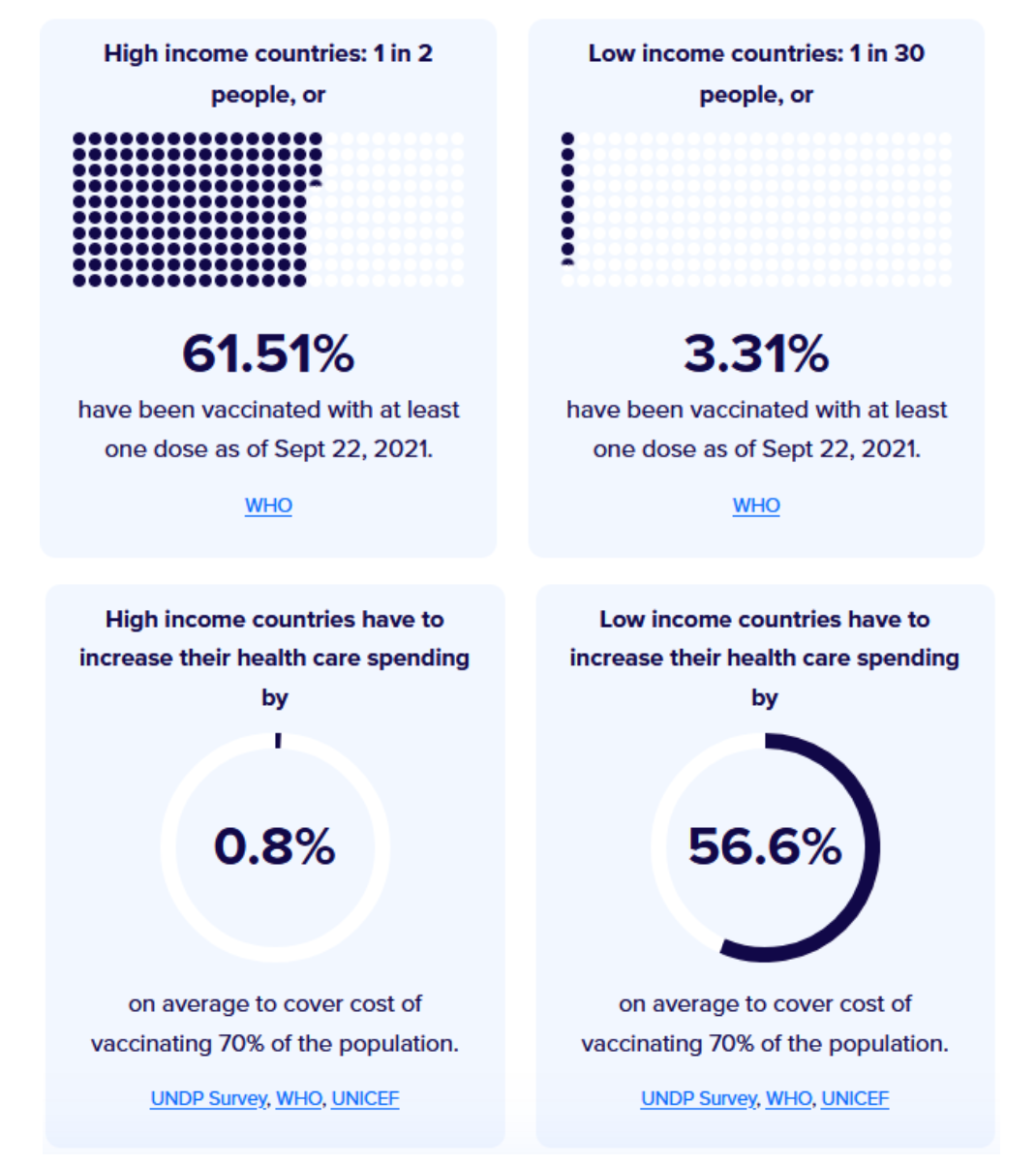
The Dashboard is a joint initiative of UNDP, WHO and the University of Oxford with cooperation across the UN system, anchored in the SDG 3 Global Action Plan for Healthy Lives and Well-being for All.

Dashboard on Vaccine Equity [accessed 25 Sep 2021]: https://data.undp.org/vaccine-equity/
See also visualization on Vaccine Access and Vaccine Affordability

Coronavirus (COVID-19) Vaccinations [Accessed 25 Sep 2021]

Milestones :: Perspectives :: Research


Our World in Data
Coronavirus (COVID-19) Vaccinations [Accessed 25 Sep 2021]
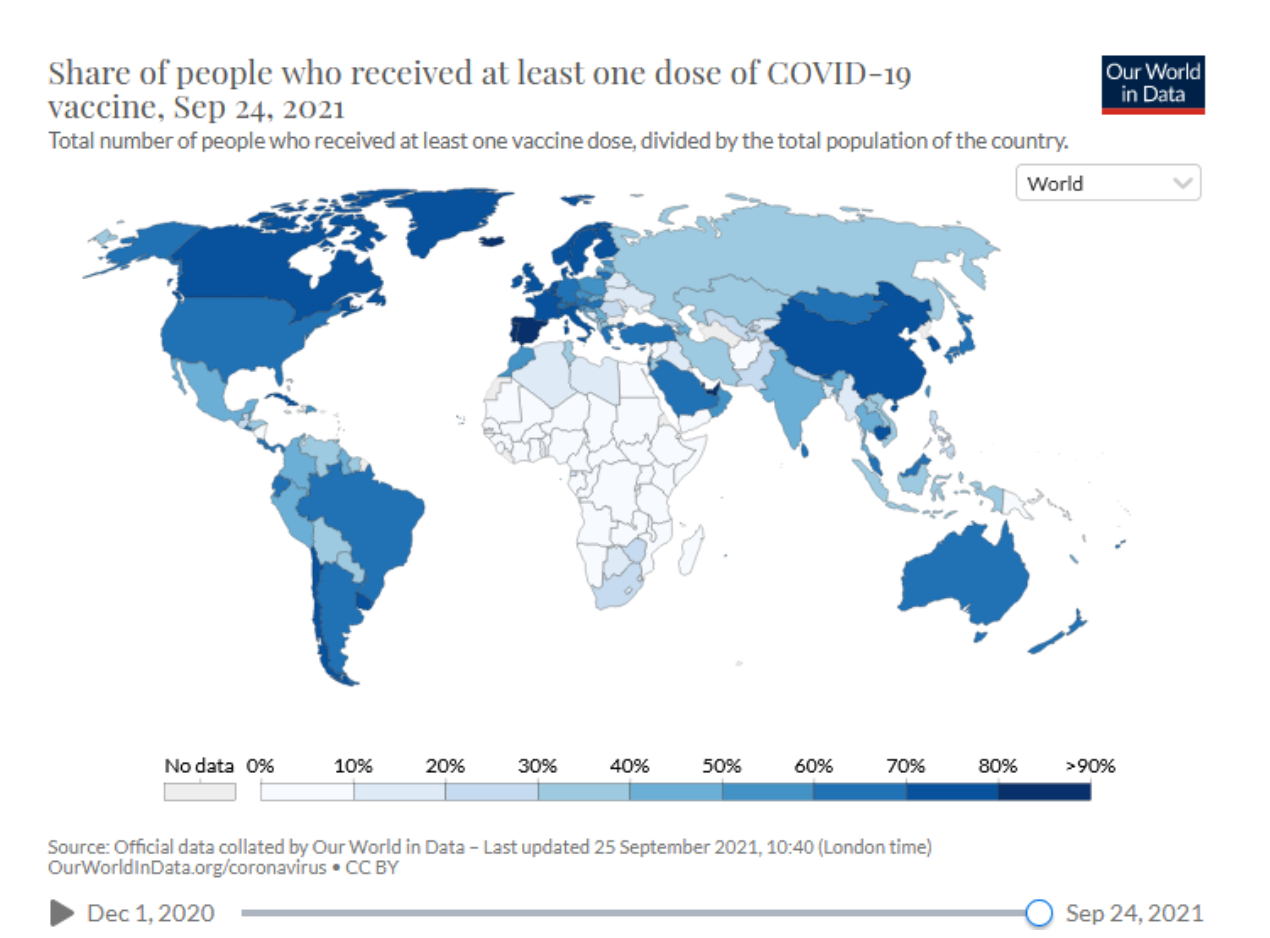
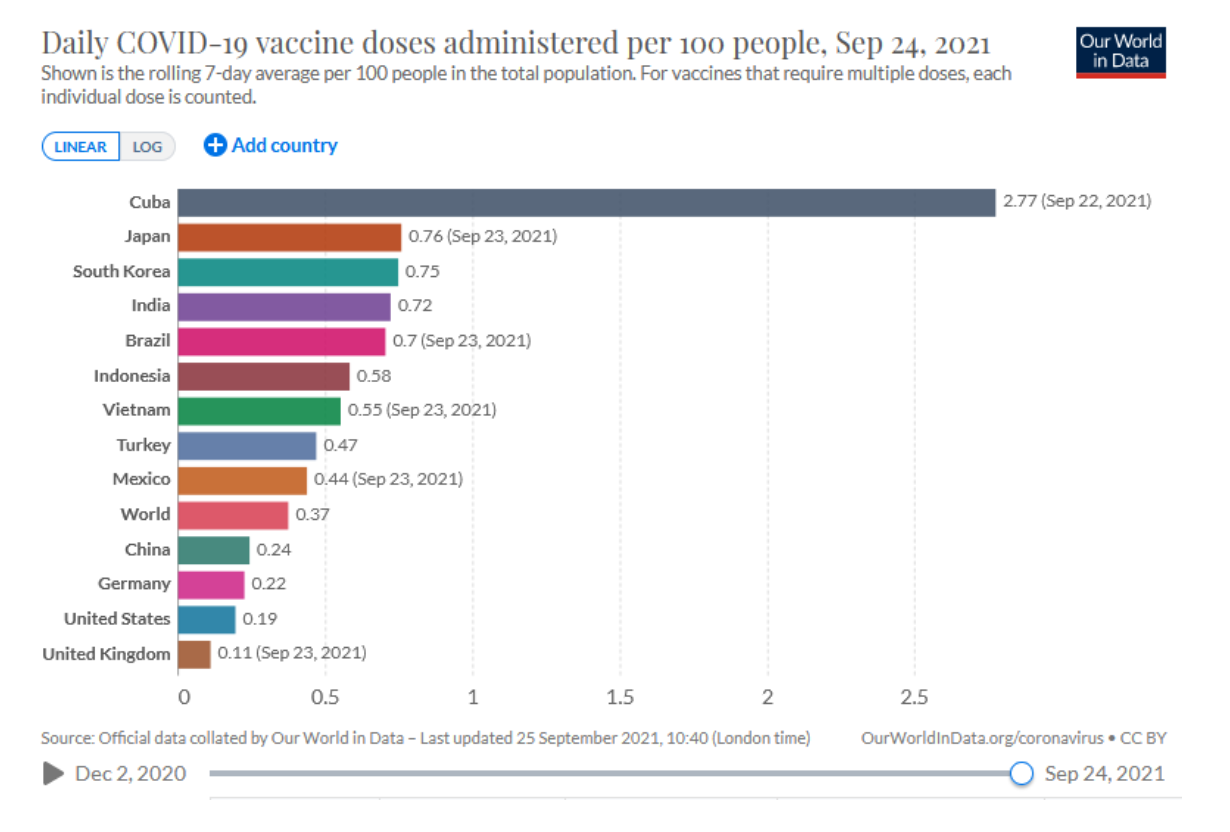
:: 44.3% of the world population has received at least one dose of a COVID-19 vaccine.
:: 6.1 billion doses have been administered globally, and 29.41 million are now administered each day.
:: Only 2.2% of people in low-income countries have received at least one dose.

U.S.: COVID-19 Vaccines – Announcements/Regulatory Actions/Deployment

U.S.: COVID-19 Vaccines – Announcements/Regulatory Actions/Deployment


CDC [ACIP]

CDC Statement on ACIP Booster Recommendations

Friday, September 24, 2021

Today, CDC Director Rochelle P. Walensky, M.D., M.P.H., endorsed the CDC Advisory Committee on Immunization Practices’ (ACIP) recommendation for a booster shot of the Pfizer-BioNTech COVID-19 vaccine in certain populations and also recommended a booster dose for those in high risk occupational and institutional settings. The Food and Drug Administration’s (FDA) authorization and CDC’s guidance for use are important steps forward as we work to stay ahead of the virus and keep Americans safe.

This updated interim guidance from CDC allows for millions of Americans who are at highest risk for COVID-19 to receive a Pfizer-BioNTech COVID-19 booster shot to help increase their protection.

CDC recommends:

  • people 65 years and older and residents in long-term care settings should receive a booster shot of Pfizer-BioNTech’s COVID-19 vaccine at least 6 months after their Pfizer-BioNTech primary series,
  • people aged 50–64 years with underlying medical conditionsshould receive a booster shot of Pfizer-BioNTech’s COVID-19 vaccine at least 6 months after their Pfizer-BioNTech primary series,
  • people aged 18–49 years with underlying medical conditionsmay receive a booster shot of Pfizer-BioNTech’s COVID-19 vaccine at least 6 months after their Pfizer-BioNTech primary series, based on their individual benefits and risks, and
  • people aged 18-64 years who are at increased risk for COVID-19 exposure and transmission because of occupational or institutional setting may receive a booster shot of Pfizer-BioNTech’s COVID-19 vaccine at least 6 months after their Pfizer-BioNTech primary series, based on their individual benefits and risks.

Many of the people who are now eligible to receive a booster shot received their initial vaccine early in the vaccination program and will benefit from additional protection. With the Delta variant’s dominance as the circulating strain and cases of COVID-19 increasing significantly across the United States, a booster shot will help strengthen protection against severe disease in those populations who are at high-risk for exposure to COVID-19 or the complications from severe disease.

CDC will continue to monitor the safety and effectiveness of COVID-19 vaccines to ensure appropriate recommendations to keep all Americans safe. We will also evaluate with similar urgency available data in the coming weeks to swiftly make additional recommendations for other populations or people who got the Moderna or Johnson & Johnson vaccines.

The following is attributable to Dr. Walensky:

As CDC Director, it is my job to recognize where our actions can have the greatest impact. At CDC, we are tasked with analyzing complex, often imperfect data to make concrete recommendations that optimize health. In a pandemic, even with uncertainty, we must take actions that we anticipate will do the greatest good.

I believe we can best serve the nation’s public health needs by providing booster doses for the elderly, those in long-term care facilities, people with underlying medical conditions, and for adults at high risk of disease from occupational and institutional exposures to COVID-19. This aligns with the FDA’s booster authorization and makes these groups eligible for a booster shot. Today, ACIP only reviewed data for the Pfizer-BioNTech vaccine. We will address, with the same sense of urgency, recommendations for the Moderna and J&J vaccines as soon as those data are available.

While today’s action was an initial step related to booster shots, it will not distract from our most important focus of primary vaccination in the United States and around the world. I want to thank ACIP for their thoughtful discussion and scientific deliberation on the current data which informed my recommendation.

::::::


Changes in booster shot guidance lead to confusion for doctors, patients

Washington Post, 9/25/2021

The muddle came to a head with this week’s showdown between the CDC’s advisers and its director. Health care providers are now trying to get answers to patients’ questions — and their own.

By Carissa Wolf, Frances Stead Sellers, Ashley Cusick and Kim Mueller

…Confusion over boosters, which has been brewing for months, heightened over the past week as government regulators and advisers met to hash out the pros and cons of administering third doses.

Hours of meetings culminated in a showdown Thursday: The Centers for Disease Control and Prevention’s advisory group narrowed the Food and Drug Administration’s recommendation for who should get a third Pfizer shot, only to be overruled in a late-night announcement by the CDC director: Along with Americans 65 and older, nursing home residents and people ages 50 to 64 with underlying medical conditions, who the advisory panel had suggested should get shots, Rochelle Walensky added the people in high-risk jobs.

“It’s a communications crisis,” said Robert Murphy, executive director of the Institute for Global Health at Northwestern University Feinberg School of Medicine, who said he received worried calls Thursday evening from health-care workers who thought they would not be eligible for the shots, followed by messages Friday from colleagues wondering when and where to get them…

::::::

Vaccines and Related Biological Products Advisory Committee- FDA


Vaccines and Related Biological Products Advisory Committee September 30, 2021 Meeting Announcement

Agenda
Under Topic I, the committee will meet in open session to hear an overview of the research programs in the Laboratory of Bacterial Polysaccharides (LBP), Division of Bacterial, Parasitic, and Allergenic Products (DBPAP), Office of Vaccines Research and Review (OVRR), Center for Biologics Evaluation and Research (CBER).

Also, on September 30, 2021, under Topic II, the Center for Biologics Evaluation and Research’s (CBER) VRBPAC will meet in open session to discuss and make recommendations on the selection of strains to be included in the influenza virus vaccines for the 2021 to 2022 southern hemisphere influenza season.

YouTube recording: https://youtu.be/VeknygU5MKM

::::::

White House [U.S.]
Briefing Room – Selected Major COVID Announcements
Press Briefing by White House COVID-⁠19 Response Team and Public Health Officials
September 24, 2021 • Press Briefings

Global COVID-⁠19 Summit: Ending the Pandemic and Building Back Better
September 24, 2021 • Statements and Releases
Editor’s Note:
This statement provides the U.S. narrative on the “Virtual Global COVID-19 Summit” as further detailed by the speeches, statement and releases below. It includes quotations attributable to and a list of “more than 100 governments and other partners” which participated and the “more than 100 International Organizations, non-governmental organizations, private sector, and philanthropies” which participated. We recognize the limited alignment between this statement and the tone and detail of the COVAX partners announcement on the Biden Summit above.

Remarks by President Biden on the COVID-⁠19 Response and the Vaccination Program
September 24, 2021 • Speeches and Remarks

Remarks by Vice President Harris At Virtual Global COVID-⁠19 Summit
September 22, 2021 • Speeches and Remarks

Remarks by President Biden at Virtual Global COVID-⁠19 Summit
September 22, 2021 • Speeches and Remarks

A U.S.-EU Agenda for Beating the Global Pandemic Vaccinating the World, Saving Lives Now, and Building Back Better Health Security
September 22, 2021 • Statements and Releases

United States–European Commission Joint Statement
September 22, 2021 • Statements and Releases
Editor’s Note:
This statement provides details on the launch of the joint COVID-19 Manufacturing and Supply Chain Taskforce first announced in June. This week, the Taskforce met in Washington, D.C., to finalize the Mission Statement of this Taskforce, which will focus on the following three priority “work strands” including: [1] Monitor global supply chains for COVID-19 vaccines and therapeutics through assessment of global demand and supply of these items and their production and ancillary supplies, and through identification of supply chain bottlenecks; [2] Address critical supply chain bottlenecks and other disruptive factors for global COVID-19 vaccine and therapeutics production, and [3] Coordinate initiatives to boost global production of COVID-19 vaccines, therapeutics, and their production and ancillary supplies.

FACT SHEET: President Biden’s Global COVID-⁠19 Summit: Ending the Pandemic and Building Back Better
September 22, 2021 • Statements and Releases

FACT SHEET: Targets for Global COVID-⁠19 Summit
September 22, 2021 • Statements and Releases
[See Milestones above for detail]

Europe: COVID-19 Vaccines – Announcements/Regulatory Actions/Deployment

Europe: COVID-19 Vaccines – Announcements/Regulatory Actions/Deployment


European Medicines Agency
News & Press Releases
No new digest content identified


::::::


European Centre for Disease Prevention and Control
https://www.ecdc.europa.eu/en
Latest Updates
Publication
Overview of the implementation of COVID-19 vaccination strategies and deployment plans in the EU/EEA
Technical report – 23 Sep 2021
This report provides an updated overview of the progress of national COVID-19 vaccination strategies in EU/EEA countries, including updates on: vaccine uptake overall and by target group; current vaccination phases and priority groups, as well as any adjustments made to priority groups during the rollout; vaccination strategies and policies in place; and the use of vaccination certificates and challenges countries face with the rollout and good practices to mitigate these challenges.

Publication
Protocol for a focused after-action review on evidence-based decision-making for selected COVID-19 response measures
Technical report – 22 Sep 2021
This ECDC protocol for a focused after-action review (AAR) on evidence-based decision-making (EBDM) for selected COVID-19 response measures uses the standard AAR/IAR approach but focuses on a single category or function – EBDM – as opposed to a whole range of activities. We consider the decision (or group of decisions) made as the event to be reviewed, whereby the event comprises both the process that leads to the decision outcome and the impact of that outcome. It follows a case study-based research design. In the social sciences, a case study approach looks at one selected event in depth and explores what can be learned about broader, systemic interrelationships and linkages. Due to the complex impact of COVID-19 on all aspects of society, an investigation of the intricacies of EBDM demands a focused approach.


::::::

Data as of 2021-09-24
https://vaccinetracker.ecdc.europa.eu/public/extensions/COVID-19/vaccine-tracker.html#uptake-tab


::::::


European Commission
https://ec.europa.eu/commission/presscorner/home/en
Press release 17 September 2021
Statement 25 September 2021
Statement by President von der Leyen at the Global Citizen live event ‘A Recovery Plan for the World’

Press release 23 September 2021
Europeans strongly support science and technology according to new Eurobarometer survey
A new Eurobarometer survey on ‘European citizens’ knowledge and attitudes towards science and technology’ released today shows that 9 in 10 EU citizens (86%) think that the overall influence of science and technology is positive.

Statement 22 September 2021
United States–European Commission Joint Statement: Launch of the joint COVID-19 Manufacturing and Supply Chain Taskforce

Statement 22 September 2021
An U.S.-EU Agenda for Beating the Global Pandemic: Vaccinating the World, Saving Lives Now, and Building Back Better Health Security

India: COVID-19 Vaccines – Announcements/Regulatory Actions/Deployment

India: COVID-19 Vaccines – Announcements/Regulatory Actions/Deployment


Ministry of Health and Family Welfare
https://www.mohfw.gov.in/

Latest Updates
No new digest content identified


Government of India – Press Information Bureau
Latest Press Releases
No new digest content identified


Indian Council for Medical Research (ICMR)
https://www.icmr.gov.in/media.html
Press Releases
No new digest content identified

POLIOPublic Health Emergency of International Concern (PHEIC)

Emergencies

POLIO
Public Health Emergency of International Concern (PHEIC)
https://polioeradication.org/polio-today/polio-now/this-week/

Polio this week as of 23 September 2021
:: “Afghanistan is one of two countries in the world where polio remains endemic. With only one case of wild poliovirus reported so far this year, compared to 56 in 2020, there has never been a better time to eradicate polio. However, the polio programme will struggle to respond if the basic immunization infrastructure begins to collapse around it.” – Dr Tedros Adhanom Ghebreyesus, Director-General of the World Health Organization, and Dr Ahmed Al-Mandhari, WHO Regional Director for the Eastern Mediterranean on their visit to Kabul. Read more


Summary of new WPV and cVDPV viruses this week (AFP cases and ES positives):
No new WPV and cVDPV cases reported this week


::::::

Event – Eradicating Polio: What more Is Needed?
WFPHA – World Federation of Public Health Associations
Sep 22, 2021
Polio cases have fallen 99.9% since 1988. In 2020 Africa was certified polio free by the World Health Organization. However, polio will remain a key public health concern until such time as there are no wild… On October 12, 2021, at 10:00 – 11:00 (CEST), “Eradicating Polio: What more Is Needed?” webinar will be held to focus on the barriers, challenges and leverages to reach every child and eradicate polio globally. Register


::::::
::::::

WHO/OCHA Emergencies


Editor’s Note:
WHO has apparently reorganized and fundamentally shifted how it judges and tracks “emergencies”. We found no announcement of descriptive information to share and present the webpage structure as encountered below. Obviously, the dates associated with some of these emergencies suggest that this is an archival platform as well as a current emergencies resource.

Health emergencies list – WHO
“The health emergencies list details the disease outbreaks, disasters and humanitarian crises where WHO plays an essential role in supporting countries to respond to and recover from emergencies with public health consequences.”

Crisis in Tigray, Ethiopia [Last apparent update: 5 Aug 2021]

Ebola outbreak, Democratic Republic of the Congo, 2021 [Last apparent update: 17 Aug 2021]

Ebola outbreak outbreak, N’Zerekore, Guinea, 2021 [Last apparent update: 17 Aug 2021]

Coronavirus disease (COVID-19) pandemic [See COVID above]


Ebola outbreak, Equateur Province, Democratic Republic of the Congo, 2020
[Last apparent update: 17 Aug 2021]

Ebola outbreak, North Kivu, Ituri, Democratic Republic of the Congo, 2018 – 2020
[Last apparent update: 17 Aug 2021]

Ebola outbreak, Democratic Republic of the Congo, 2018 [Last apparent update: 24 July 2018]

Yemen crisis [Last apparent update: 12 February 2021]

Syria crisis [Last apparent update: 18 June 2021]

Somalia crisis [Last apparent update: 24 March 2018]

Nigeria crisis [Last apparent update: 9 May 2018]

Ebola outbreak, Democratic Republic of the Congo, 2017 [Last apparent update: 17 Aug 2021]

Zika virus disease outbreak, 2015-2016 [Last apparent update: 24 Jan 2020]

Ebola outbreak: West Africa, 2014-2016 [Last apparent update: 17 Aug 2021]

Iraq crisis [Last apparent update: 9 Jan 2008]

South Sudan crisis [Last apparent update: 23 Sep 2020]

Avian influenza A (H7N9) virus outbreak [Last apparent update: 13 September 2021]

Middle East respiratory syndrome (MERS-CoV) outbreak [Last apparent update: 8 July 2019]

Influenza A (H1N1) virus, 2009-2010 pandemic [Last apparent update: 10 Aug 2010]


::::::

UN OCHA – Current Emergencies
Current Corporate Emergencies
Afghanistan
Afghanistan: Humanitarian Snapshot (As of 24 September 2021)
OVERVIEW
Forty years of war, recurrent natural disasters, chronic poverty, drought and the COVID-19 pandemic have devastated the people of Afghanistan. The recent escalation in conflict and resulting upheaval has only exacerbated needs and further complicated an extremely challenging operational context. Even prior to the events of 15 August, the humanitarian situation in Afghanistan was one of the worst in the world. By the mid-year mark, nearly half of the population — some 18.4m people — were already in need of humanitarian and protection assistance in 2021.

Northern Ethiopia
Ethiopia – Northern Ethiopia Humanitarian Update Situation Report, 23 Sept 2021


::::::
::::::