Localisation and local humanitarian action

Humanitarian Exchange Magazine
Number 79, May 2021
https://odihpn.org/magazine/inclusion-of-persons-with-disabilities-in-humanitarian-action-what-now/


Localisation and local humanitarian action
by HPN October 2020
The theme of this edition of Humanitarian Exchange is localisation+ and local humanitarian action. Five years ago this week, donors, United Nations (UN) agencies,  non-governmental organisations (NGOs), the International Committee of the Red Cross (ICRC) and International Federation of Red Cross and Red Crescent Societies (IFRC) committed within the Grand Bargain to increase multi-year investments in the institutional capacities of local and national responders, and to provide at least 25% of humanitarian funding to them as directly as possible. Since then, there is increasing consensus at policy and normative level, underscored by the Covid-19 pandemic, that local leadership should be supported.  Localisation has gone from a fringe conversation among policy-makers and aid agencies in 2016 to a formal priority under the Grand Bargain. Wider global movements on anti-racism and decolonisation have also brought new momentum to critical reflections on where power, knowledge and capacity reside in the humanitarian system. Yet progress has been slow and major gaps remain between the rhetoric around humanitarian partnerships, funding and coordination and practices on the ground.

Overview of the Issue

Journal of Health Care for the Poor and Underserved (JHCPU)
Volume 32, Number 2, May 2021 Supplement
https://muse.jhu.edu/issue/44396


Table of Contents
Overview of the Issue
Kevin B. Johnson, Tiffani J. Bright, Cheryl R. Clark
…The importance of techquity—defined as the strategic development and deployment of technology in health care and health to advance health equity—was even more apparent after the events of 2020. COVID-19 upended access to care and illuminated the impact of structural racism as a cause for a widening gap of access during the pandemic. Black Lives Matter became more than a trending hashtag on Twitter, or a movement resulting in peaceful protests and calls for policy reform: it put additional focus on the issue of race as a social and not a biological construct and called into question the rationale for common practices in health care that were triggered by race. A notable example was the emerging realization that kidney function assessment was tied to race and hardwired into many of our electronic health records. The real-world evidence around our lack of techquity was incontrovertible.
This Supplemental Issue of JHCPU provides articles that describe challenges to techquity, frameworks to improve the role of technology in care, and examples of how technology can transform health, public health, and health care…

The “Legal Epidemiology” of Pandemic Control

New England Journal of Medicine
May 27, 2021 Vol. 384 No. 21
http://www.nejm.org/toc/nejm/medical-journal


Perspective
The “Legal Epidemiology” of Pandemic Control
Scott Burris, J.D., Evan D. Anderson, J.D., Ph.D., and Alexander C. Wagenaar, M.S.W., Ph.D.
The centrality of law as a public health intervention has been undeniable during the Covid-19 pandemic. In just the first half of 2020, more than 1000 laws and orders were issued by federal, state, and local authorities in the United States in an effort to reduce disease transmission. Legal interventions include stay-at-home orders, mask mandates, and travel restrictions, as well as more particular rules for business operations, alcohol sales, curfews, and health care. Given their heavy use, importance, and obvious socioeconomic side effects, and the social and behavioral complexities of their implementation, one might have expected the National Institutes of Health (NIH), other research funders, and the research community to jump to the work of determining the right mix, intensity, and enforcement approaches of legal restrictions to control transmission with the least and most equitably distributed harms. No organized research program emerged…

A Hidden Opportunity — Medicaid’s Role in Supporting Equitable Access to Clinical Trials

New England Journal of Medicine
May 27, 2021 Vol. 384 No. 21
http://www.nejm.org/toc/nejm/medical-journal


Perspective
A Hidden Opportunity — Medicaid’s Role in Supporting Equitable Access to Clinical Trials
Samuel U. Takvorian, M.D., M.S.H.P., Carmen E. Guerra, M.D., M.S.C.E., and William L. Schpero, Ph.D.
Hidden deep within the $2.3 trillion omnibus spending and relief package passed by Congress in December 2020 lies a little-known but powerful provision intended to promote equitable access to clinical trials. Beginning in January 2022, coverage of the “routine costs” associated with clinical trial participation will be guaranteed for all Medicaid beneficiaries for the first time in the program’s history. The absence of federal policy in this area until now has most likely suppressed the representation of low-income and minority populations in the clinical research that underlies therapeutic advances, thereby limiting equitable access to potentially state-of-the-art therapies and compromising the generalizability of research findings…

The impact of the COVID-19 pandemic on rabies reemergence in Latin America: The case of Arequipa, Peru

PLoS Neglected Tropical Diseases
http://www.plosntds.org/
(Accessed 29 May 2021)


The impact of the COVID-19 pandemic on rabies reemergence in Latin America: The case of Arequipa, Peru
Brinkley Raynor, Elvis W. Díaz, Julianna Shinnick, Edith Zegarra, Ynes Monroy, Claudia Mena, Micaela De la Puente-León, Michael Z. Levy, Ricardo Castillo-Neyra
Research Article | published 21 May 2021 PLOS Neglected Tropical Diseases
https://doi.org/10.1371/journal.pntd.0009414

Impact of influenza vaccination in the Netherlands, 2007–2016: Vaccinees consult their general practitioner for clinically diagnosed influenza, acute respiratory infections, and pneumonia more often than non-vaccinees

PLoS One
http://www.plosone.org/
[Accessed 29 May 2021]


Impact of influenza vaccination in the Netherlands, 2007–2016: Vaccinees consult their general practitioner for clinically diagnosed influenza, acute respiratory infections, and pneumonia more often than non-vaccinees
Saverio Caini, John Paget, Peter Spreeuwenberg, Joke C. Korevaar, Adam Meijer, Mariëtte Hooiveld
Research Article | published 28 May 2021 PLOS ONE
https://doi.org/10.1371/journal.pone.0249883

Willingness to participate in COVID-19 vaccine trials; a survey among a population of healthcare workers in Uganda

PLoS One
http://www.plosone.org/
[Accessed 29 May 2021]


Willingness to participate in COVID-19 vaccine trials; a survey among a population of healthcare workers in Uganda
Jonathan Kitonsa, Onesmus Kamacooko, Ubaldo Mushabe Bahemuka, Freddie Kibengo, Ayoub Kakande, Anne Wajja, Vincent Basajja, Alfred Lumala, Edward Ssemwanga, Robert Asaba, Joseph Mugisha, Benjamin F. Pierce, Robin Shattock, Pontiano Kaleebu, Eugene Ruzagira
Research Article | published 27 May 2021 PLOS ONE
https://doi.org/10.1371/journal.pone.0251992

Booster immunization of meningococcal meningitis vaccine among children in Hangzhou, China, 2014-2019

PLoS One
http://www.plosone.org/
[Accessed 29 May 2021]


Booster immunization of meningococcal meningitis vaccine among children in Hangzhou, China, 2014-2019
Xinren Che, Yan Liu, Jun Wang, Yuyang Xu, Xuechao Zhang, Wenwen Gu, Wei Jiang, Jian Du, Xiaoping Zhang
Research Article | published 25 May 2021 PLOS ONE
https://doi.org/10.1371/journal.pone.0251567

Factors indicating intention to vaccinate with a COVID-19 vaccine among older U.S. adults

PLoS One
http://www.plosone.org/
[Accessed 29 May 2021]


Factors indicating intention to vaccinate with a COVID-19 vaccine among older U.S. adults
Janeta Nikolovski, Martin Koldijk, Gerrit Jan Weverling, John Spertus, Mintu Turakhia, Leslie Saxon, Mike Gibson, John Whang, Troy Sarich, Robert Zambon, Nnamdi Ezeanochie, Jennifer Turgiss, Robyn Jones, Jeff Stoddard, Paul Burton, Ann Marie Navar
Research Article | published 24 May 2021 PLOS ONE
https://doi.org/10.1371/journal.pone.0251963

A megastudy of text-based nudges encouraging patients to get vaccinated at an upcoming doctor’s appointment

PNAS – Proceedings of the National Academy of Sciences of the United States of America
May 11, 2021; vol. 118 no. 19
https://www.pnas.org/content/118/19


Brief Reports Open Access
A megastudy of text-based nudges encouraging patients to get vaccinated at an upcoming doctor’s appointment
Katherine L. Milkman, Mitesh S. Patel, Linnea Gandhi, Heather N. Graci, Dena M. Gromet, Hung Ho, Joseph S. Kay, Timothy W. Lee, Modupe Akinola, John Beshears, Jonathan E. Bogard, Alison Buttenheim, Christopher F. Chabris, Gretchen B. Chapman, James J. Choi, Hengchen Dai, Craig R. Fox, Amir Goren, Matthew D. Hilchey, Jillian Hmurovic, Leslie K. John, Dean Karlan, Melanie Kim, David Laibson, Cait Lamberton, Brigitte C. Madrian, Michelle N. Meyer, Maria Modanu, Jimin Nam, Todd Rogers, Renante Rondina, Silvia Saccardo, Maheen Shermohammed, Dilip Soman, Jehan Sparks, Caleb Warren, Megan Weber, Ron Berman, Chalanda N. Evans, Christopher K. Snider, Eli Tsukayama, Christophe Van den Bulte, Kevin G. Volpp, and Angela L. Duckworth
PNAS May 18, 2021 118 (20) e2101165118; https://doi.org/10.1073/pnas.2101165118

Socioeconomic inequalities in HIV knowledge, HIV testing, and condom use among adolescent and young women in Latin America and the Caribbean

Revista Panamericana de Salud Pública/Pan American Journal of Public Health (RPSP/PAJPH)
https://www.paho.org/journal/en


25 May 2021
Socioeconomic inequalities in HIV knowledge, HIV testing, and condom use among adolescent and young women in Latin America and the Caribbean
Original research | English |

Resurgence of SARS-CoV-2: Detection by community viral surveillance

Science
28 May 2021 Vol 372, Issue 6545
http://www.sciencemag.org/current.dtl


Reports
Resurgence of SARS-CoV-2: Detection by community viral surveillance
By Steven Riley, Kylie E. C. Ainslie, Oliver Eales, Caroline E. Walters, Haowei Wang, Christina Atchison, Claudio Fronterre, Peter J. Diggle, Deborah Ashby, Christl A. Donnelly, Graham Cooke, Wendy Barclay, Helen Ward, Ara Darzi, Paul Elliott
Science28 May 2021 : 990-995 Open Access
Representative community antigen sampling can improve situational awareness and help evaluate interventions at low SARS-CoV-2 prevalence.

Evidence on collaboration of traditional and biomedical practitioners in the management of antimicrobial resistance in sub-Saharan Africa over 15 years: a systematic review protocol

Systematic Reviews
https://systematicreviewsjournal.biomedcentral.com/articles
[Accessed 29 May 2021]


Evidence on collaboration of traditional and biomedical practitioners in the management of antimicrobial resistance in sub-Saharan Africa over 15 years: a systematic review protocol
The overuse of prescribed antimicrobials, concurrent use of traditional medicine, and prescribed antimicrobials have led to antimicrobial resistance. The absence of collaboration between traditional health pra…
Authors: Aganze Gloire-Aimé Mushebenge, Mukanda Gedeon Kadima, Tivani Mashamba-Thompson and Manimbulu Nlooto
Citation: Systematic Reviews 2021 10:158
Content type: Protocol
Published on: 28 May 2021

Ethics and execution of developing a 2nd wave COVID vaccine – Our interim phase I/II VSV-SARS-CoV2 vaccine experience

Vaccine
Volume 39, Issue 21 Pages 2811-2906 (18 May 2021)
https://www.sciencedirect.com/journal/vaccine/vol/39/issue/21


Discussion Full text access
Ethics and execution of developing a 2nd wave COVID vaccine – Our interim phase I/II VSV-SARS-CoV2 vaccine experience
Yotam Levin, Noa Madar Balakirski, Yoseph Caraco, Eytan Ben-Ami, … Hadar Marcus
Pages 2821-2823

Vaccination willingness, vaccine hesitancy, and estimated coverage at the first round of COVID-19 vaccination in China: A national cross-sectional study

Vaccine
Volume 39, Issue 21 Pages 2811-2906 (18 May 2021)
https://www.sciencedirect.com/journal/vaccine/vol/39/issue/21


Research article Full text access
Vaccination willingness, vaccine hesitancy, and estimated coverage at the first round of COVID-19 vaccination in China: A national cross-sectional study
Chao Wang, Bingfeng Han, Tianshuo Zhao, Hanyu Liu, … Fuqiang Cui
Pages 2833-2842

Incorporating equity in infectious disease modeling: Case study of a distributional impact framework for measles transmission

Vaccine
Volume 39, Issue 21 Pages 2811-2906 (18 May 2021)
https://www.sciencedirect.com/journal/vaccine/vol/39/issue/21


Research article Open access
Incorporating equity in infectious disease modeling: Case study of a distributional impact framework for measles transmission
Tigist Ferede Menkir, Abdulrahman Jbaily, Stéphane Verguet
Pages 2894-2900

Vaccine Production Process: How Much Does the General Population Know about This Topic? A Web-Based Survey

Vaccines — Open Access Journal
http://www.mdpi.com/journal/vaccines


(Accessed 29 May 2021)
Open Access Article
Vaccine Production Process: How Much Does the General Population Know about This Topic? A Web-Based Survey
by Angela Bechini et al
Vaccines 2021, 9(6), 564; https://doi.org/10.3390/vaccines9060564 (registering DOI) – 29 May 2021
Abstract
Background: Vaccine hesitancy has been recognized as a major global health threat by the World Health Organization. Many studies have investigated vaccine safety as a determinant for vaccine hesitancy; however, not much attention has been paid to vaccine production and quality control during […]

Side Effects and Perceptions Following COVID-19 Vaccination in Jordan: A Randomized, Cross-Sectional Study Implementing Machine Learning for Predicting Severity of Side Effects

Vaccines — Open Access Journal
http://www.mdpi.com/journal/vaccines


Open Access Article
Side Effects and Perceptions Following COVID-19 Vaccination in Jordan: A Randomized, Cross-Sectional Study Implementing Machine Learning for Predicting Severity of Side Effects
by Ma’mon M. Hatmal et al
Vaccines 2021, 9(6), 556; https://doi.org/10.3390/vaccines9060556 – 26 May 2021
Abstract
Background: Since the coronavirus disease 2019 (COVID-19) was declared a pandemic, there was no doubt that vaccination is the ideal protocol to tackle it. Within a year, a few COVID-19 vaccines have been developed and authorized. This unparalleled initiative in developing vaccines created […]

Maternal Vaccination in Uganda: Exploring Pregnant Women, Community Leaders and Healthcare Workers’ Perceptions

Vaccines — Open Access Journal
http://www.mdpi.com/journal/vaccines


Open Access Article
Maternal Vaccination in Uganda: Exploring Pregnant Women, Community Leaders and Healthcare Workers’ Perceptions
By Phiona Nalubega
Vaccines 2021, 9(6), 552; https://doi.org/10.3390/vaccines9060552 – 25 May 2021
Abstract
Background: We investigated pregnant women, community leaders, healthcare workers (HCWs) and programme managers’ perceptions of maternal vaccination in Kampala, Uganda. Methods: We conducted focus group discussions, key informant interviews and in-depth discussions with HCWs (3), community leaders (3), pregnant women (8) and programme […]

Factors Influencing Public Attitudes towards COVID-19 Vaccination: A Scoping Review Informed by the Socio-Ecological Model

Vaccines — Open Access Journal
http://www.mdpi.com/journal/vaccines


Open Access Review
Factors Influencing Public Attitudes towards COVID-19 Vaccination: A Scoping Review Informed by the Socio-Ecological Model
by Ghadir Fakhri Al-Jayyousi
Vaccines 2021, 9(6), 548; https://doi.org/10.3390/vaccines9060548 – 24 May 2021
Abstract
Major hindrances to getting a COVID-19 vaccine include vaccine hesitancy, skepticism, refusal, and anti-vaccine movements. Several studies have been conducted on attitudes of the public towards COVID-19 vaccines and the potential influencing factors. The purpose of this scoping review is to summarize the […

Media/Policy Watch

Media/Policy Watch
This watch section is intended to alert readers to substantive news, analysis and opinion from the general media and selected think tanks and similar organizations on vaccines, immunization, global public health and related themes. Media Watch is not intended to be exhaustive, but indicative of themes and issues CVEP is actively tracking. This section will grow from an initial base of newspapers, magazines and blog sources, and is segregated from Journal Watch above which scans the peer-reviewed journal ecology.
We acknowledge the Western/Northern bias in this initial selection of titles and invite suggestions for expanded coverage. We are conservative in our outlook in adding news sources which largely report on primary content we are already covering above. Many electronic media sources have tiered, fee-based subscription models for access. We will provide full-text where content is published without restriction, but most publications require registration and some subscription level.
The sheer volume of vaccine and pandemic-related coverage is extraordinary. We will strive to present the most substantive analysis and commentary we encounter.


The Atlantic
http://www.theatlantic.com/magazine/
Accessed 29 May 2021
[No new, unique, relevant content]


BBC
http://www.bbc.co.uk/
Accessed 29 May 2021
[No new, unique, relevant content]


The Economist
http://www.economist.com/
Accessed 29 May 2021
Possible, but far from proven – Assessing the theory that covid-19 leaked from a Chinese lab
The evidence so far is circumstantial
May 29th 2021 edition


Financial Times
https://www.ft.com/
Accessed 29 May 2021
Malaysia announces ‘total lockdown’ after surge in cases and deaths
May 28, 2021

Covid-19 vaccines
WHO reboots IP sharing scheme for Covid shots, drugs and tests
May 27, 2021
Top of Form
Bottom of Form


Forbes
http://www.forbes.com/
Accessed 29 May 2021
May 29, 2021
Some Countries With The Highest Vaccination Rates Are Facing A Surge In Covid Deaths And Infections–Experts Say Complacency Is Partly To Blame
Countries with much higher vaccination rates than the U.S. are experiencing deadly outbreaks of Covid-19.
By Robert Hart Forbes Staff

May 28, 2021
Employers Can Require Workers To Get Vaccinated, Government Says
The Equal Employment Opportunity Commission also said employers can offer vaccine incentives to their workers, such as cash stipends.
By Jack Brewster Forbes Staff


Foreign Affairs
http://www.foreignaffairs.com/
Accessed 29 May 2021
Snapshot May 26, 2021
India’s Cascading COVID-19 Failures
The staggering cost of an unscientific response to the pandemic.
Ramanan Laxminarayan


Foreign Policy
http://foreignpolicy.com/
Accessed 29 May 2021
Latin America’s Vaccine Stars and Struggles
Technology transfers to produce shots are slowly underway in the region.
By Catherine Osborn May 21, 2021


New Yorker
http://www.newyorker.com/
Accessed 29 May 2021
Annals of Inquiry
The Sudden Rise of the Coronavirus Lab-Leak Theory
Scientists and political commentators are no longer dismissing the possibility that COVID-19 emerged from a Chinese laboratory. What changed?
By Benjamin Wallace-Wells
May 27, 2021


New York Times
http://www.nytimes.com/
Accessed 29 May 2021
Europe
Hundreds Protest Vaccine Passports in London
Demonstrators opposing coronavirus vaccines and the idea of vaccine passports gathered in central London on Saturday.
By The Associated Press and Reuters
May 29, 2021

Americas
‘Like a Dream’: Latin Americans Head to U.S. for Covid Shots
Frustrated with the lagging pace of vaccinations at home, well-off Latin Americans have been flying north for a shot — and feeling guilty about those left behind.
By Ernesto Londoño, Daniel Politi and Santi Carneri
May 29, 2021

U.S.
California to Give $116.5 million to Vaccinated Residents
Gov. Gavin Newsom of California announced on Thursday a $116.5 million giveaway to residents who have received a coronavirus vaccination in an effort to motivate people to get a shot.

Asia Pacific
Japan extends a state of emergency until one month before the Olympics.
With infections still high, restrictions in nine prefectures will remain in place until at least June 20, casting more doubt on the start of the Summer Games in Tokyo.
By Hisako Ueno and Motoko Rich
May 28, 2021

Opinion
Vaccinate the World! The Best Investment Ever.
Here’s a way for Biden to assert United States leadership to benefit the world and safeguard the American economy.
By Nicholas Kristof
PRINT EDITION May 27, 2021, Page A18

Business
Influencers Say They Were Urged to Criticize Pfizer Vaccine
A disinformation effort to reduce public confidence in Covid-19 vaccines tried to enroll social media commentators in France and Germany.
By Liz Alderman

Opinion Guest Essay
This Is the Wrong Way to Distribute Badly Needed Vaccines
May 24, 2021
By Ezekiel J. Emanuel and Govind Persad
…But to be fair and successful, Covax must abandon its purely population-based distribution formula, developed by W.H.O., which has led to precious vaccine doses being destroyed or left sitting in freezers in countries without many cases or which lack the ability to distribute them effectively. Fair distribution of vaccines must be based primarily on need…
…Need should be the principal criterion for distributing vaccines among countries, but not the only one. Before vaccines are sent, countries must be able to distribute and administer them. Vaccinations — not vaccines — are what save lives. Support must be provided to countries like South Sudan, Malawi and Ivory Coast to upgrade their capacity to distribute vaccines…
..As the global supply of vaccines expands, vaccine manufacturers and nations expecting to have extra doses, including the United States and Britain, must decide which countries to help and how many doses to send to global organizations like Covax.
But if Covax’s distribution criteria remain unresponsive to need, countries with spare doses should bypass the organization and distribute them where they will reduce deaths the most. It would be morally indefensible to give vaccines to Covax to send to countries with few cases or that are unable to deliver vaccines, while outbreaks rage elsewhere…

How to Allocate Vaccines Fairly: Covax’s View
May 27, 2021 Letter to the Editor:
Re “The Wrong Way to Distribute Vaccines,” by Ezekiel J. Emanuel and Govind Persad (Opinion guest essay, May 25):
The suggestion that it is unethical to allocate vaccines equitably across all nations when some countries are faring worse against the ravages of Covid-19 than others misses one crucial fact: Vaccines are at their most effective when preventing surges of the virus, not combating them once they have taken hold.
When outbreaks occur, the critical tools available to governments are of the nonpharmaceutical variety, such as lockdowns, distancing and mask wearing. Vaccines are also a part of the solution, but with up to three months needed for a two-dose Oxford/AstraZeneca vaccination, followed by a two-week wait in order to achieve full protection, they are not an acute intervention even if there are enough to go around.
We don’t know where the next surge will hit or when the next variant will emerge, which is why Covax’s goal to protect the most vulnerable everywhere is, at this stage of the pandemic, the right thing to do. This not only means maximizing the chances of survival for the health workers, elderly and vulnerable whose lives are most at risk, but also minimizing the chances that new, more dangerous variants will come along.
The real issue with vaccines today is not how to divvy up a small slice of the pie for less wealthy nations but how to make their slice bigger, which is why governments and manufacturers of vaccines must do everything in their power to get as many doses as possible to Covax now.
Seth Berkley
Soumya Swaminathan
Richard Hatchett

Dr. Berkley is chief executive of Gavi, the Vaccine Alliance. Dr. Swaminathan is chief scientist of the World Health Organization. Dr. Hatchett is chief executive of the Coalition for Epidemic Preparedness Innovations. Their organizations co-lead Covax.


Washington Post
https://www.washingtonpost.com/
Accessed 29 May 2021
[No new, unique, relevant content]

Think Tanks et al

Think Tanks et al
 
 
Brookings
http://www.brookings.edu/
Accessed 29 May 2021
Future Development
COVID-19 is a developing country pandemic
Indermit Gill and Philip Schellekens
Thursday, May 27, 2021
 
 
Center for Global Development [to 29 May 2021]
http://www.cgdev.org/page/press-center
Event
Developing a Plan to Vaccinate the World
6/2/21
While vaccine R&D stands out as a success in the ongoing response to COVID-19, there is still a long way to go to meet vaccination needs, particularly in low- and middle-income countries

To Increase Vaccine Manufacturing in LMICs, We Also Need to Strengthen Regulatory Capacity
May 25, 2021
A lot of recent discussions focus on how to expand COVID-19 vaccine manufacturing capacity in low- and middle-income countries (LMICs). The conversations highlight the importance of technology transfer and the capability of the tech transfer receiving sites (the facilities in these countries that would then produce vaccines locally), including having specialized equipment and personnel.
Javier Guzman and Prashant Yadav
 
 
Chatham House [to 29 May 2021]
https://www.chathamhouse.org/
Accessed 29 May 2021
[No new digest content]


CSIS
https://www.csis.org/
Accessed 29 May 2021
[No new digest content]


Kaiser Family Foundation
https://www.kff.org/search/?post_type=press-release
Accessed 29 May 2021
May 28, 2021 News Release
Vaccine Monitor: Vaccination Rates Continue to Inch Upwards Across Groups, Especially Amo ng Hispanic Adults, But Few Who Are Eager to Get a Shot Remain Unvaccinated
4 in 10 Parents Say Their Adolescent Children Have Already Gotten a Shot or Will Do So Right Away; One Quarter of Parents of Children Under 12 Will Get Them Vaccinated as Soon as They Are Eligible Few Unvaccinated Adults Say that CDC’s Guidelines for Vaccinated Adults Make Them More…

May 26, 2021 News Release
The Pandemic’s Impact on Children’s Mental Health
The pandemic has taken a heavy toll on the nation’s mental health, and a new issue brief shows that children are also facing worsening emotional and cognitive health. The brief examines factors contributing to worsening mental health and substance use outcomes among children and adolescents during the pandemic, looking closely…

Vaccines and Global Health: The Week in Review :: 22 May 2021

Vaccines and Global Health: The Week in Review is a weekly digest  summarizing news, events, announcements, peer-reviewed articles and research in the global vaccine ethics and policy space. Content is aggregated from key governmental, NGO, international organization and industry sources, key peer-reviewed journals, and other media channels. This summary proceeds from the broad base of themes and issues monitored by the Center for Vaccine Ethics & Policy in its work: it is not intended to be exhaustive in its coverage. You are viewing the blog version of our weekly digest, typically comprised of between 30 and 40 posts below all dated with the current issue date

.– Request an Email Summary: Vaccines and Global Health : The Week in Review is published as a single email summary, scheduled for release each Saturday evening before midnight (EDT in the U.S.). If you would like to receive the email version, please send your request to david.r.curry@centerforvaccineethicsandpolicy.org.

– pdf version A pdf of the current issue is available here: 

– blog edition: comprised of the approx. 35+ entries posted below.

– Twitter:  Readers can also follow developments on twitter: @vaxethicspolicy.
.
– Links:  We endeavor to test each link as we incorporate it into any post, but recognize that some links may become “stale” as publications and websites reorganize content over time. We apologize in advance for any links that may not be operative. We believe the contextual information in a given post should allow retrieval, but please contact us as above for assistance if necessary.

Support this knowledge-sharing service: Your financial support helps us cover our costs and to address a current shortfall in our annual operating budget. Click here to donate and thank you in advance for your contribution.

.
David R. Curry, MS
Executive Director
Center for Vaccine Ethics and Policy

World Health Assembly

Milestones :: Perspectives :: Research


World Health Assembly

Seventy-fourth World Health Assembly #WHA74
24 May to 1 June 2021
Theme: Ending this pandemic, preventing the next: building together a healthier, safer and fairer world.
:: Provisional agenda
:: Watch live WHA74 sessions
:: Documents

World Health Assembly to focus on ending COVID-19 pandemic and preparing for next one
News release 19 May 2021
In a year when COVID-19 threatens the health and well-being of everyone on the planet, the seventy-fourth session of the World Health Assembly (WHA) will stress the urgency of ending the current pandemic and preventing the next one by building a healthier, safer and fairer world…
This year’s World Health Assembly will play a vital role in shaping the global health architecture of the future, and in strengthening WHO to fulfil its mission and mandate”, added Dr Tedros.
The Assembly’s agenda will focus on the health-related Sustainable Development Goals and WHO’s Triple Billion targets of one billion more people benefitting from universal health coverage; one billion more better protected from health emergencies; and one billion more enjoying better health and well-being…

Extraordinary meeting of the Strategic Advisory Group of Experts on Immunization (SAGE) – 27 May 2021

Milestones :: Perspectives :: Research


Extraordinary meeting of the Strategic Advisory Group of Experts on Immunization (SAGE) – 27 May 2021
27 May 2021
This extraordinary virtual meeting for the Strategic Advisory Group of Experts on Immunization (SAGE) will take place on Thursday 27 May 2021 to propose recommendations to WHO on the use of COVID-19 vaccine(s).
:: Agenda

COVID – Multilateral Action

Milestones :: Perspectives :: Research


COVID – Multilateral Action

Global leaders adopt agenda to overcome COVID-19 crisis and avoid future pandemics
Press release 21 May 2021
Leaders of the G20 committed today to a series of actions to accelerate the end of the COVID-19 crisis everywhere and better prepare for future pandemics, at a summit co-hosted by European Commission President Ursula von der Leyen and Italian Prime Minister Mario Draghi, as G20 chair.

President Ursula von der Leyen said: “This very first G20 summit on health marks the beginning of a new chapter in global health policy. World leaders strongly committed to multilateralism and global cooperation in health. This means, no export bans, keeping global supply chains open and working to extend production capacity everywhere. If we live up to these principles, the world will be better prepared for pandemics.”

The G20 underlined the importance of increased and diversified manufacturing and recognised the role of intellectual property in ensuring equity, both through voluntary licensing and knowledge transfer, as well as in the context of the flexibilities provided by the TRIPS agreement. In that respect, the EU intends to facilitate the implementation of those flexibilities, in particular the use of compulsory licenses including for exports to all countries that lack manufacturing capacity.*

The EU will come forward with a proposal in the WTO focusing on:
:: clarifying and facilitating the use of compulsory licences in crisis times like this pandemic;
:: supporting the expansion of production;
:: trade facilitation and limiting export restrictions.


All G20 members also acknowledged the need to address the funding gap of the ACT-Accelerator, a global collaboration to accelerate development, production, and equitable access to COVID-19 tests, treatments, and vaccines, and launched by the WHO, the European Commission, France and the Bill & Melinda Gates Foundation. And agreed to extend its mandate to the end of 2022.

The leaders further agreed on the need for early warning information, surveillance and trigger systems, which will be interoperable. These will cover new viruses, but also variants. They will enable countries to detect much quicker and to act to nip in the bud outbreaks, before they become pandemics.


G20 clearly stressed the need to ensure equitable access to vaccines and to support low and middle-income countries…

G20 Scientific Expert Panel, Co-Chaired by NAM President, Identifies Key Recommendations to Address Global Health Crises

Milestones :: Perspectives :: Research


G20 Scientific Expert Panel, Co-Chaired by NAM President, Identifies Key Recommendations to Address Global Health Crises
May 21, 2021
Today, the Global Health Summit Scientific Expert Panel, established by the G20 and European Commission, co-chaired by NAM president Victor J. Dzau, presented key recommendations and characteristics of effective systems for health threat prevention, preparedness, and response at the Global Health Summit to G20 members, heads of international and regional organizations, and representatives of global health bodies.

The Panel’s Report provided COVID-19-informed, evidence-based principles that aim to offer forward-looking structural changes to prepare and respond to future global health emergencies. Key areas of the Panel’s report address global equitable access to supplies, research, and innovation; integrated disease surveillance and data-sharing; sustainable health; and more. To achieve these principles, the Panel emphasized the importance of sourcing and allocating appropriate funding to protect the world’s collective health.

“In order to effectively address the current and future threats to our global health, we need scientifically-driven solutions, international cooperation, and structures and resources to ensure equitable access to vaccines, therapeutics, and other resources to combat pandemic diseases,” said Dzau.


The Panel identified ten evidence-based areas in need of urgent action:
:: End the acute stage of the pandemic and leave no one behind: Ensure equitable access to medical tools to fight COVID-19;
:: Invest in scientific research & development before, during, and in between health crises;
:: Actively and genuinely involve research groups in low- and middle-income countries;
:: Strengthen integrated disease surveillance, data collection, analysis, and sharing at all levels;
Strengthen and protect science advice;
:: Be ready for the next health crisis: Invest in standing systems and workforce for preparedness and response;
:: Strengthen regional manufacturing capacities and hubs;
:: Empower and earn the trust of people;
:: Collaborate & coordinate at all levels: Strengthen relevant governance structures and leadership, and ensure adequate financing; and
:: Address the problem at the root: Reduce risks through more sustainable ways of living

Findings presented at the G20 Global Health Summit will help shape the creation of a “Rome Declaration:” a set of guiding principles for mid- to long-term structural change, which, along with joint global action, can address and prevent future global health crises.

The Panel, consisting of 27 eminent international scientists and experts,  was co-chaired by Professor Peter Piot, Special adviser to the President of the European Commission Ursula von der Leyen; Professor Silvio Brusaferro, President of the Italian National Institute of Health; Professor Victor Dzau, President of the United States National Academy of Medicine; Professor Yee-Sin Leo, Director of the National Centre for Infectious Diseases in Singapore; Professor John Nkengasong, Director of the Africa Centers for Disease Control and Prevention. The complete list of Panel members is available here.

Read the Panel’s full report here.

COVID Vaccines/Immunization – Equity/Access/Dose Sharing

Milestones :: Perspectives :: Research


COVID Vaccines/Immunization – Equity/Access/Dose Sharing


Editor’s Note:
We aggregate below a number of announcements and calls-to-action from the past week around equity/access/dose sharing.

Gavi – Global leaders renew their commitment to address urgency of COVID-19 pandemic
:: At today’s Global Health Summit, hosted by the European Commission and Italy as chair of the G20, leaders pledged their support to the Gavi COVAX Advance Market Commitment (AMC)
:: Italy committed EUR 300 million to the Gavi COVAX AMC, which will count towards COVAX’s goal of procuring 1.8 billion COVID-19 vaccine doses for lower-income economies in 2021.
:: In addition, France, Germany, Italy, The Netherlands, Norway, Spain and Switzerland – as part of Team Europe – pledged to share a combined total of over 100 million vaccine doses with middle- and low-income economies, boosting short term supplies.

Geneva, 21 May 2021 – The Global Health Summit, hosted by the European Commission and Italy as chair of the G20, saw governments announce support to the Gavi COVAX Advance Market Commitment (AMC), including a pledge of EUR 300 million from Italy. The commitment brings the total amount of funds raised for the  Gavi COVAX AMC, the funding mechanism to finance doses of COVID-19 vaccines for 92 lower-income economies within the COVAX Facility, to over US$ 7 billion.


In addition, Team Europe announced the largest dose sharing donation to date, with 100 million doses of COVID-19 vaccines going to lower-income economies with a majority of them through the COVAX AMC. Donors include France and Germany who stated they would be sharing 30 million surplus doses each and Italy who will be donating 15 million doses by the end of 2021.

This additional funding comes at a time when COVAX is looking to secure a total of US$8.3 billion from sovereign donors and the private sector for 2020-21 in order to accelerate access to 1.8 billion COVID-19 vaccine doses for lower-income economies. In addition, to support AMC eligible economies’ that want to buy additional doses through COVAX, a further US$1 billion is being sought from multilateral development banks to support a cost-sharing initiative.

The campaign will culminate at the virtual Gavi COVAX Advance Market Commitment (AMC) Summit – One World Protected – Committed to Deliver on the 2nd June, which will be co-hosted by Japanese Prime Minister H.E. Yoshihide Suga together with José Manuel Barroso, Chair of the Gavi Board.

“COVAX has built the systems to deliver vaccines to low and lower middle income countries; we welcome the support of the G-20 countries to help us scale up volumes and reduce vaccine inequities.  Today’s funding, especially the very generous commitment from Italy and dose donation pledges demonstrate that global leadership understands that it’s time to unleash COVAX’s full potential to bring the acute phase of this pandemic to an end,” said Dr Seth Berkley, CEO of Gavi, the Vaccine Alliance. “Funding the AMC and sharing doses with COVAX are among the most effective interventions a country can make to control COVID-19 and we urge all governments to work with us in protecting people everywhere.”

Securing 1.8 billion doses would enable the Gavi COVAX AMC to protect nearly 30% of the population in 92 lower-income countries, or roughly half the adult population. The additional funds will also help diversify the portfolio in times of supply uncertainty; secure access to doses for delivery in 2021 and early 2022; and plan the scenarios and strategy to meet public health needs for 2022 and beyond…


::::::

The COVAX Facility will deliver its 65 millionth vaccine dose this week. It should’ve been at least its 170 millionth. The time to donate excess doses is now
Statement by UNICEF Executive Director Henrietta Fore, as G7 countries gear up for June summit
[Editor’s text bolding] Editor’s text bolding]
NEW YORK, 17 MAY 2021 – “The COVAX Facility – the global COVID vaccine equity scheme – will deliver its 65 millionth dose in the coming days. It should have been at least its 170 millionth. By the time G7 leaders gather in the UK next month, and as a deadly second wave of COVID-19 will likely continue to sweep across India and many of its South Asian neighbours, the shortfall will near 190 million doses.

“We have issued repeated warnings of the risks of letting down our guard and leaving low- and middle-income countries without equitable access to vaccines, diagnostics and therapeutics. We are concerned that the deadly spike in India is a precursor to what will happen if those warnings remain unheeded. While the situation in India is tragic, it is not unique. Cases are exploding and health systems are struggling in countries near – like Nepal, Sri Lanka and Maldives – and far, like Argentina and Brazil. The cost for children and families will be incalculable.

“The longer the virus continues to spread unchecked, the higher the risk of more deadly or contagious variants emerging.


“The clearest pathway out of this pandemic is a global, equitable distribution of vaccines, diagnostics and therapeutics. COVAX, led by the WHO, Gavi and CEPI, with UNICEF as implementing partner, represents such a pathway. But COVAX is undersupplied.

“Among the global consequences of the situation in India, a global hub for vaccine production, is a severe reduction in vaccines available to COVAX. Soaring domestic demand has meant that 140 million doses intended for distribution to low- and middle-income countries through the end of May cannot be accessed by COVAX. Another 50 million doses are likely to be missed in June. This, added to vaccine nationalism, limited production capacity and lack of funding, is why the roll-out of COVID vaccines is so behind schedule.

“G7 leaders will be meeting next month with a potential emergency stop-gap measure readily available. New data analysis provided by Airfinity, the life sciences research facility, and commissioned by the UK National Committee for UNICEF, indicates that G7 nations and ‘Team Europe’ group of European Union Member States could donate around 153 million vaccine doses if they shared just 20 per cent of their available supply over June, July and August. Critically, they could do so while still meeting their commitments to vaccinate their own populations.

“While some G7 members have greater supply than others, and some have further advanced domestic rollouts, an immediate collective commitment to pool excess supply and share the burden of responsibility could buttress vulnerable countries against becoming the next global hotspot.

“Ultimately, the global vaccination race will be won when Member States make sustainable plans to fully fund and supply the COVAX Advance Market Commitment, while supporting the expansion of vaccine manufacturing capacity, including through proactive Intellectual Property licensing and technological transfer. These measures are critical, but they won’t change anything overnight. Sharing immediately available excess doses is a minimum, essential and emergency stop-gap measure, and it is needed right now.”


::::::

DG Okonjo-Iweala calls on WTO members to tackle vaccine inequity
Speaking to G20 leaders and the heads of international organizations on 21 May, Director-General Ngozi Okonjo-Iweala said WTO members could contribute to greater equity in the global distribution of COVID-19 vaccines by lowering supply chain barriers, fully using existing production capacity, and addressing issues related to intellectual property, access and innovation.
[No speech transcript posted; Editor’s text bolding]

DG Okonjo-Iweala, who has described equitable access to COVID-19 vaccines, diagnostics and therapeutics as “the moral and economic issue of our time,” told the Global Health Summit, co-hosted by the European Commission and the Italian G20 Presidency, that the pandemic had made clear that “policymakers need to think of preparedness, response, and resilience as one interconnected package”.

International cooperation on trade is important for all three elements of this package, she said, arguing that trade has been a “force for good” in the pandemic by enabling access to much-needed medical supplies. Even as the value of global merchandise trade shrank by more than 7% last year, trade in medical supplies increased by 16%, and by 50% for personal protective equipment, she noted.

With regards to the WTO’s role in addressing the global vaccine scarcity, DG Okonjo-Iweala said members could act on three fronts.

“First, tackling supply chain issues holding back vaccine production, from export restrictions and excessive customs bureaucracy to problems accessing raw materials or hiring skilled workers. The WTO can help with supply chain monitoring and transparency.”

The second action is helping manufacturers scale up by “keeping supply lines open and matching underused capacity with unmet needs,” which DG Okonjo-Iweala declared as “necessary to save lives now”.

In the longer run, especially if COVID is with us for years, we need a more geographically diversified global vaccine manufacturing base. … Having less than 0.2% of capacity in Africa is not a recipe for supply resilience.”

The Director-General said the WTO would work with the World Health Organization, Gavi and the Coalition for Epidemic Preparedness Innovations on the COVAX vaccine manufacturing taskforce to advance equitable access.

Finally, DG Okonjo-Iweala said WTO members “must address issues related to technology transfer, knowhow and intellectual property,” including the proposed temporary waiver from WTO intellectual property rules for vaccines and other pandemic-related products.

“We must act now to get all our ambassadors to the table to negotiate a text,” she urged. “This is the only way we can move forward quickly, we can’t move forward with speeches and polemics.”

“I am hopeful that by July we can make progress on a text and by our Twelfth Ministerial Conference in December, WTO members can agree on a pragmatic framework that offers developing countries near automaticity in access to health technologies, whilst also preserving incentives for research and innovation.”


::::::

IFRC – Asia: Vaccines run dry as COVID surges in Asia to new record death levels
Asia Pacific, Bangladesh, India, Malaysia, Nepal, Philippines
Kuala Lumpur/Kathmandu/Delhi/Geneva, 21 May 2021 – Instant action is needed by governments and pharmaceutical companies to fix a COVID-19 vaccine supply crisis in Asia as countries run out of stocks while suffering grim record daily death tolls.  Nepal …
21 May 2021

IFRC – Red Cross Red Crescent: We need new extraordinary steps to increase access to COVID-19 vaccines and we need them now
The following statement can be attributed to the President of the International Federation of Red Cross and Red Crescent Societies, Francesco Rocca, and to the President of the International Committee of Red Cross, Peter Maurer: The Internationa …
18 May 2021


::::::

Despite Positive Efforts, Too Many Migrants Face Challenges Accessing COVID-19 Vaccines
IOM / International Organization for Migration
2021-05-18 09:33
Geneva – Government policies, operational realities and administrative requirements like identification cards and residency permits may be impeding access to national vaccination efforts for some migrants in 53 of the more than 160 countries where the International Organization for Migration (IOM) has collected information on access so far. Irregular and undocumented migrants and those forcibly displaced are at particular risk.

“We have been impressed with efforts made in dozens of countries to make vaccination roll-outs as equitable as possible, but barriers to health services have been systemic since before the pandemic and remain a reality for too many migrants in too many places,” said IOM Director General António Vitorino.

“What we are seeing in some cases is a disconnect between what is being committed to on paper and what is actually happening in practice.”


Some 47 countries have already taken concrete steps to ensure that migrants, including those in irregular situations, can access the vaccine. Many nations are still awaiting doses to begin their vaccination roll-outs. Even when they start, IOM has identified more than 53 countries, territories or areas where current policies and operational realities will make vaccine access unattainable for the most vulnerable.  

Administrative, communication and logistical hurdles 
IOM notes with particular concern close to 40 countries where administrative processes – such as requirements to present a national ID or valid residence permit, or to pre-register with national insurance schemes – may present an obstacle for some categories of migrants and forcibly displaced persons.


Other types of barriers have been identified in several locations, including prioritization of citizens and exclusion of non-nationals from vaccination campaigns; the lack of a “firewall” between health providers and immigration authorities which leads many migrants in irregular situations to fear arrest or deportation should they seek immunization; general vaccine hesitancy due to insufficient targeted outreach through linguistically and culturally appropriate channels; continued mobility as a challenge for vaccines requiring two doses, and the need to have a smartphone, a computer or an internet connection to enroll…

The report Migrant Inclusion in Covid-19 Vaccination Campaigns is available here.


::::::

Five Steps to Urgently Advance COVID-19 Vaccine Equity
The following was released jointly by PhRMA, ABPI, BIO, EFPIA, ICBA, IFPMA and Vaccines Europe.

WASHINGTON, D.C. (May 19, 2021) – Innovative vaccine manufacturers and biotech companies are at the forefront of the global effort to develop and manufacture COVID-19 vaccines. This massive effort is succeeding. After more than 200 clinical trials and nearly 300 partnerships and collaborations among manufacturers worldwide, production has increased, in just a few months from zero to 2.2 billion COVID-19 vaccine doses by the end of May with an astounding estimate of 11 billion doses by the end of 2021 (Airfinity data here). This will be enough doses to vaccinate the world’s adult population.
Critically, however, COVID-19 vaccines currently are not equally reaching all priority populations worldwide.


Manufacturers, governments, and non-governmental organizations must work together to take urgent steps to further address this inequity. Immediate action must focus on stepping up responsible dose sharing and maximizing production without compromising quality or safety. To do so, innovative vaccine manufacturers and biotech companies commit to: 
STEP UP DOSE SHARING:
:: Immediately work with governments that have significant domestic supplies of COVID-19 vaccine doses to share a meaningful proportion of their doses with low- and lower-middle-income countries in a responsible and timely way through COVAX or other efficient established mechanisms;
:: Expend every effort to make additional uncommitted COVID-19 vaccine doses available to low- and lower-middle income countries, through COVAX or other efficient established mechanisms.


CONTINUE TO OPTIMIZE PRODUCTION:
:: Undertake all practicable efforts to maximize COVID-19 vaccine output without compromising safety and quality, including through additional collaborations with partners that can produce significant quantities;
:: Work with governments and individual suppliers of raw materials and components to determine how to quickly and safely facilitate scale up needed for COVID-19 vaccine manufacturing.


CALL OUT TRADE BARRIERS TO BE ELIMINATED:
:: Identify trade barriers for critical input materials and support Coalition for Epidemic Preparedness Innovations’ (CEPI’s) effort to create an independent platform that would identify and address gaps in these inputs and facilitate voluntary matchmaking for fill and finish capacity through the newly established COVAX Supply Chain and Manufacturing Task Force
:: Urge governments, in coordination with the World Trade Organization (WTO), to eliminate all trade and regulatory barriers to export and to adopt policies that facilitate and expedite the cross-border supply of key raw materials, essential manufacturing materials, vaccines along with the prioritized movement of skilled workforce needed for COVID-19 vaccine manufacturing.


SUPPORT COUNTRY READINESS:
:: Partner with governments on COVID-19 vaccine deployment, particularly in low- and lower-middle income countries, to ensure that they are ready and able to deploy available doses within their shelf life;
:: Mitigate the risks to the production and deployment of other vaccines that remain vital to public health worldwide.


DRIVE FURTHER INNOVATION:
:: Prioritize the development of new COVID-19 vaccines, including vaccines effective against variants of concern;
:: Urge governments to guarantee unhindered access to pathogens (e.g. samples and sequences) of any COVID-19 variants to support the development of new vaccines and treatments.
Supply Chain/Procurement

Milestones :: Perspectives :: Research


Supply Chain/Procurement

World Bank – Remarks of Mamta Murthi, Vice President for Human Development, at an Event on Vaccine Supply Chain and Manufacturing
Date: May 19, 2021 Statement
[Editor’s text bolding]
Thank you for giving me this opportunity and organizing this very informative and valuable summit. I was asked to give a perspective from the World Bank on the COVID-19 vaccine supply chain challenges. I will say five things, mostly from the perspective of low- and middle-income countries (LICs/LMICs) who the World Bank finances.

First, I want to say that we are very concerned about vaccine access for LICs/LMICs. Most available supply has been booked by rich countries. I want to reiterate the need to donate doses and do this in an equitable way. COVAX could play a role in allocating these doses.

Second, countries need to support manufacturing and supply chains by allowing free flow of final products and supplies. In this context, all free flow “inhibitors” should be done away with.

Third, lack of clarity around demand has to do with lack of transparency around contracts. Countries and manufacturers need to agree to be transparent around what has been committed to whom to clarify the true level of committed demand and what is open to discussion and negotiation.

Greater transparency into vaccine suppliers’ supply chain plans, such as reviewed and approved manufacturing sites, intended or approved affiliates (e.g., CMOs), and other contracting and licensing arrangements, would help facilitate contract discussions and a greater understanding of challenges facing suppliers during delivery phases. This would ultimately support the design of the best possible approaches.

Fourth, there is little grant funding (whether on the “push” or “pull” side) to “unblock” (through funding) constraints within the supply chain and for improving access to the vaccines in low income countries. The International Finance Corporation has been in discussions with various parties to encourage leveraging of grant funding through innovative and blended finance mechanisms. Investments from Multilateral Development Banks in potential bottleneck elements of the supply chain, e.g. production of glass vials and lipids, can make a huge difference.

Fifth, standardization. There was a lot of discussion about how standardization of regulatory reviews, vials, doses per vial, GMP approvals, and labelling could help. To this, we would add standardization of contracts. Developing standardized contracts, delivery and price terms for each supplier can help minimize bespoke contract efforts, normalize expectations across countries, and help improve transparency.

In the short term, there is a need to expand the existing production capacities, including repurposing of existing capacities targeted at delivering quality vaccines to the lower income economies. However, it is clear that the current concentrated nature of the vaccine supply chains poses a great risk to low-income countries in accessing the vaccines, not only to fight the COVID-19 pandemic but also to continue the fight against the other existing communicable disease challenges (HIV, etc.).

In the medium term, to increase resilience in developing countries, production and distribution capacities in emerging markets need to be strengthened. Less than 5% of the vaccine manufacturing capacity is in Africa and Latin America.  Engaging stakeholders to co-create commercially viable vaccine manufacturing especially in Africa needs to be a priority

Committee on Tourism Ethics Recommends Responsible Use of Travel Certificates

Milestones :: Perspectives :: Research


COVID Vaccination Documentation

Committee on Tourism Ethics Recommends Responsible Use of Travel Certificates
14 May 2021
World Tourism Organization (UNWTO)
Recommendation on COVID-19 Certificates for International Travel
The World Committee on Tourism Ethics, an independent and impartial body of the General Assembly of the World Tourism Organization (UNWTO), responsible for the promotion of the UNWTO Global Code of Ethics for Tourism, as well as the evaluation and monitoring of the implementation of its principles;
…Recognizing the urgent need to restart tourism in view of the summer tourist season in the Northern Hemisphere, which precedes the tourist season on the Southern Hemisphere, in order to mitigate the negative economic and social effects on tourism destinations, local populations and tourism workers;
Acknowledging the existence of various initiatives concerning health or COVID-19 related certificates and passports as well as a number of bilateral agreements between states with a view to facilitating the entry of vaccinated persons into their respective territories;
Considering international cooperation and global coordination as well as interoperability to be of highest importance for the implementation of these certificates worldwide;
Taking into account the right of national authorities to regulate the use of these certificates within their territories, in line with the principle of subsidiarity;
Calling upon the relevant national and international authorities to achieve a broad vaccine distribution and roll-out, by all useful means, while deploying a high degree of solidarity towards less advantaged countries and protecting local populations in this regard;
Noting that technological, sanitary, and legal matters related to COVID-19 certificates do not fall under the remit of this Committee.
Acknowledging the applicability to this context of the International Health Regulations (IHR) (2005), and the temporary recommendations issued by World Health Organization (WHO)under the IHR in reference to the public health emergency of international concern, encouraging States Parties to “implement coordinated, time-limited, risk-based, and evidence-based approaches for health measures in relation to international traffic” while considering the “limited (although growing) evidence about the performance of vaccines in reducing transmission”.
Having in mind the principles and rules protective of personal data, which are of particular importance in the matter of health protection, notably the Article 12 of the Universal Declaration of Human Rights;…

Recommends that any COVID-19 certificate for international travel would have to meet the following conditions:
1. The certificate should be a unique document, containing information on the vaccination status, and/or diagnostic (molecular, PCR and antigen)and/or information about recovery status;

2. The certificate should be limited in duration and its use should be discontinued as soon as the World Health Organization no longer considers COVID-19 a Public Health Emergency of International Concern (PHEIC);

3. The certificate should be used primarily for international mobility;

4. For a maximum accessibility, the certificate should be available both in digital and paper format;

5. The certificate must ensure, in both formats, data protection and security, as well as the privacy of the holder. Said certificate must also provide a guarantee of authenticity to avoid fraud and misuses;

6. The certificate should be free of charge; international cooperation and governments should ensure the population’s wide access to free vaccines and affordable tests;

7. The provision of vaccines and related certificates at destination countries should not form part of package tours or other similar products nor should such initiatives be supported by governments.


::::::

EU Digital COVID Certificate: European Parliament and Council reach agreement on Commission proposal
Press release 20 May 2021
The Commission welcomes today’s provisional political agreement between the European Parliament and the Council on the Regulation governing the EU Digital COVID Certificate.

…President Ursula von der Leyen said: “We are delivering on our commitment to have the EU Digital COVID Certificate up and running before the summer. European citizens are looking forward to travelling again, and today’s agreement means they will be able to do so safely very soon.

The EU Digital COVID Certificate is free of charge, secure and accessible to all. It will cover vaccination, test and recovery offering different options to the citizens. It fully respects citizens’ fundamental rights, including protection of personal data.

All EU citizens have a fundamental right to free movement in the EU. The EU Digital COVID Certificate, available in paper or digital format, will make it easier for Europeans to travel – whether to see their families and loved ones or to get some well-deserved rest…


The EU Digital COVID Certificate – key features
Following the agreement reached by the European Parliament and the Council, the EU Digital COVID Certificate:
:: will cover vaccination, test and recovery;
:: will be available in a digital and paper-based format, depending on the choice of the recipients, and contain a digitally signed QR code;
:: will be free of charge, be obtained easily and also available to persons vaccinated before the EU Digital COVID Certificate Regulation has entered into force;
:: may also be used by Member States for national purposes, if this is provided for in national law.
:: Member States shall refrain from imposing additional travel restrictions on the holders of an EU Digital COVID Certificate, unless they are necessary and proportionate to safeguard public health.
:: The Commission will also mobilise €100 million to support Member States in providing affordable tests.

Next Steps
The political agreement will now have to be formally adopted by the European Parliament and the Council. The Regulation will enter into force on 1 July, with a phasing-in period of six weeks for the issuance of certificates for those Member States that need additional time…

COVID-19 Data Explorer: Global Humanitarian Operations

Milestones :: Perspectives :: Research


COVID Vaccines – OCHA:: HDX

COVID-19 Data Explorer: Global Humanitarian Operations
COVID-19 Vaccine Roll-out
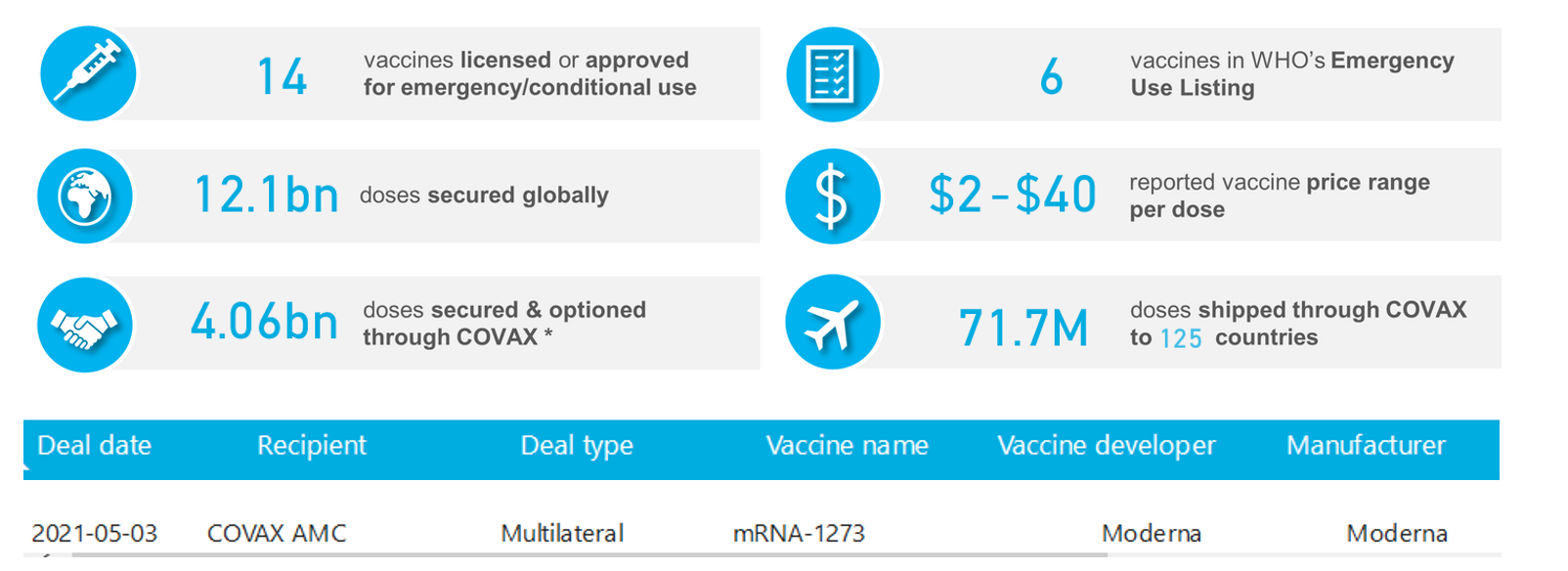
May 22, 2021 | COVAX (WHO,GAVI,CEPI), UNDESA, Press Reports | DATA
Global COVID-19 Figures: 165M total confirmed cases; 3.4M total confirmed deaths
Global vaccines administered: 1.59B
Number of Countries: 26
COVAX First Allocations (Number of Doses): 73M
COVAX Delivered (Number of Doses): 15M
Other Delivered (Number of Doses): 24M
Total Delivered (Number of Doses): 40M
Total Administered (Number of Doses): 23M

Coronavirus [COVID-19] – WHO Public Health Emergency of International Concern (PHEIC)

Milestones :: Perspectives :: Research

Coronavirus [COVID-19] – WHO
Public Health Emergency of International Concern (PHEIC)
https://www.who.int/emergencies/diseases/novel-coronavirus-2019

Weekly Epidemiological and Operational updates
Last update: 22 May 2021
Confirmed cases :: 165 772 430 [week ago: 161 513 458]
Confirmed deaths :: 3 437 545 [week ago: 3 352 109]
Vaccine doses administered: 1 448 242 899

::::::

Weekly operational update on COVID-19 – 17 May 2021
In this edition of the COVID-19 Weekly Operational Update, highlights of country-level actions and WHO support to countries include:
:: Surge capacity and procurement support in India
:: Strengthening ambulance services as a part of the emergency response in Syria
:: Contact tracing training in Kosovo
:: Fiji boost its COVID-19 testing capabilities
:: Supporting countries in the Americas to cope with oxygen supply and health worker shortages
:: Monitoring implementation of Intra-Action Review recommendations in Indonesia
:: Regular updates on WHO’s resource requirements and funds received to support countries in implementing the COVID-19 Strategic Preparedness and Response Plan 2021, WHO/PAHO procurement of critical supplies, and implementation of the Unity Studies

Weekly epidemiological update on COVID-19 – 18 May 2021
Overview
Globally, in the past week, the number of new cases and deaths continued to decrease, although overall counts for both remained high with just over 4.8 million new cases and nearly 86 000 new deaths reported in the past week. All regions reported a decline in new cases this week with the exception of the Western Pacific where the number of new cases were similar to the previous week.
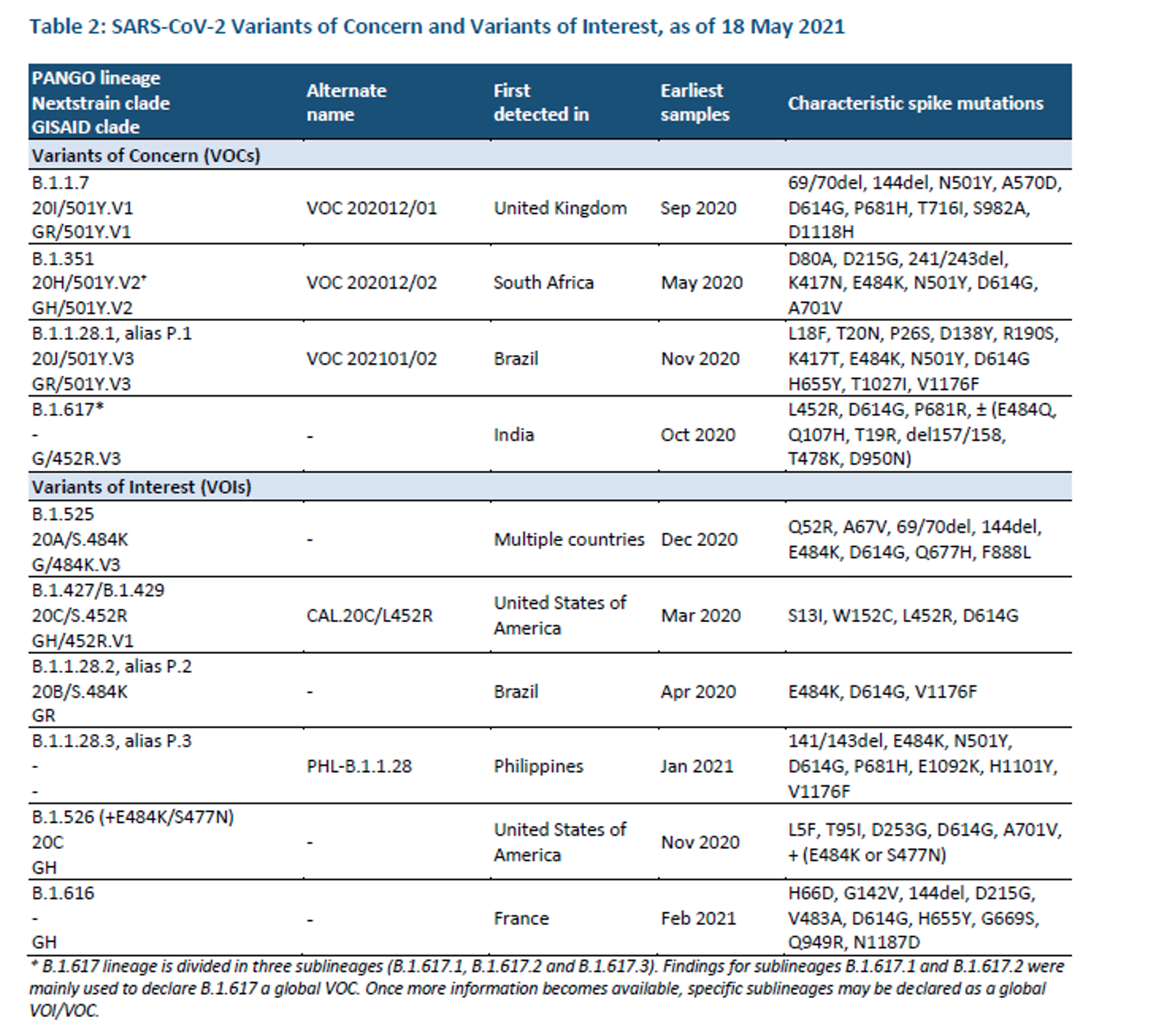
In this edition, a special focus update is provided on SARS-CoV-2 Variants of Interest (VOIs) and Variants of Concern (VOCs), including updates on the geographic distribution of VOCs B.1.1.7, B.1.351, P.1, and B.1.617.

::::::
::::::


Draft landscape and tracker of COVID-19 candidate vaccines
21 May 2021 | Publication
The COVID-19 candidate vaccine landscape and tracker database compiles detailed information on COVID-19 vaccine candidates in development.
The landscape is updated regularly – twice a week (Tuesday and Friday, 17:00 CET).
Download: https://cdn.who.int/media/docs/default-source/blue-print/07.05.2021-novel-coronavirus_landscape_covid-19.xlsx.zip?sfvrsn=23955096_3&download=true

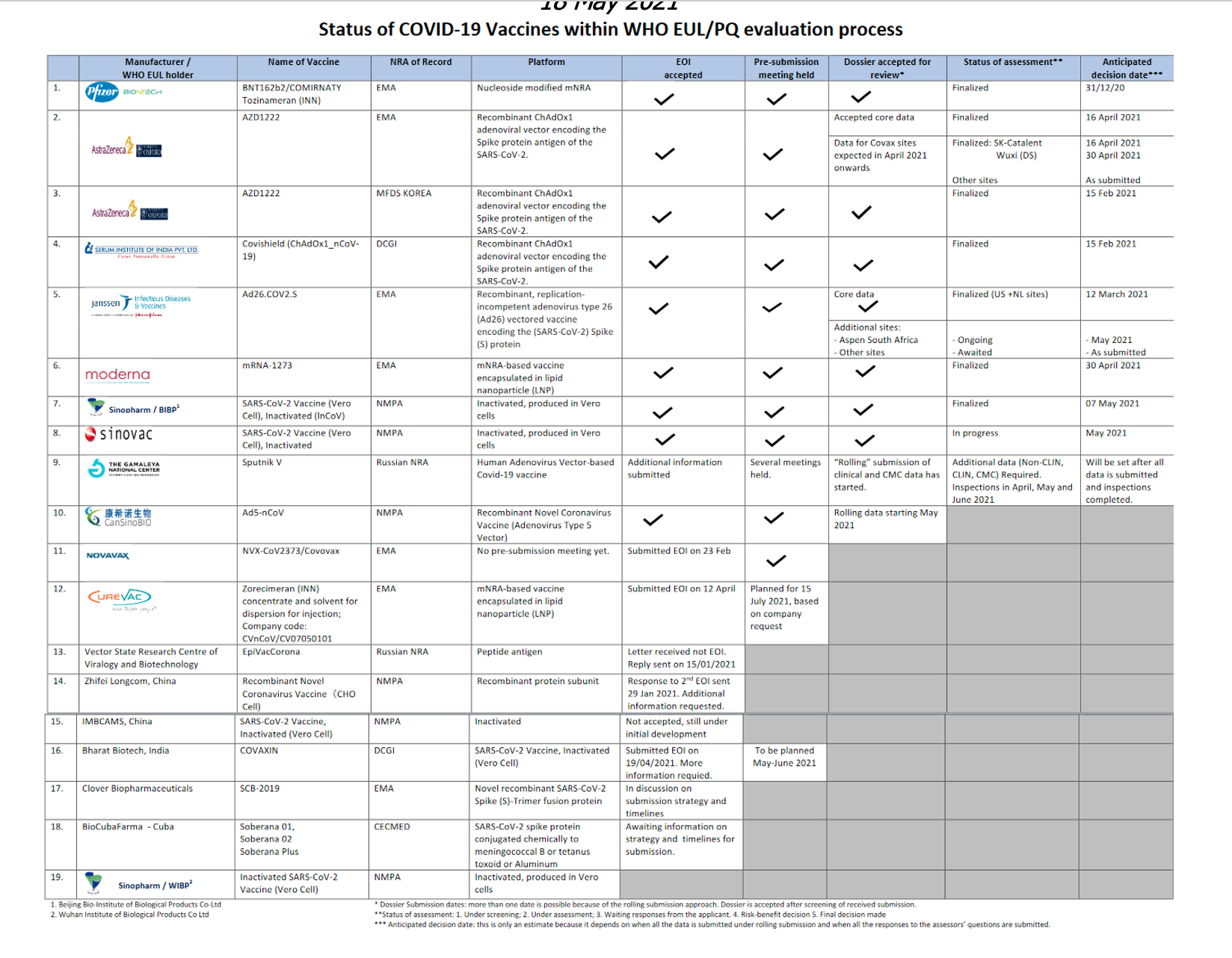
Status of COVID-19 Vaccines within WHO EUL/PQ evaluation process 23 April 2021
For 19 vaccine candidates, presents Manufacturer, Name of Vaccine, NRA of Record, Platform, EOI Accepted Status, Pre-submission Meeting Held Status, Dossier Accepted for Review, Status of Assessment; Anticipated/Completed Decision Date
[click on the link above for full scale view]
18 May 2021

Statement of the COVID-19 subcommittee of the WHO Global Advisory Committee on Vaccine Safety (GACVS) on safety signals related to the Johnson & Johnson/Janssen COVID-19 vaccine

Milestones :: Perspectives :: Research


Statement of the COVID-19 subcommittee of the WHO Global Advisory Committee on Vaccine Safety (GACVS) on safety signals related to the Johnson & Johnson/Janssen COVID-19 vaccine
19 May 2021 Statement
….The GACVS COVID-19 subcommittee met virtually on 11 May 2021 to review available information and data on thromboembolic events (blood clots) and thrombocytopenia (low platelets) after vaccination with the adenoviral vectored J&J vaccine. This condition is referred to as thrombosis with thrombocytopenia syndrome (TTS). Current evidence suggests a plausible causal association between the J&J COVID-19 vaccine and TTS. Clinically, the features of TTS following vaccination with this vaccine appear similar to those observed following another adenoviral vectored vaccine, the AstraZeneca COVID-19 vaccine. TTS does not appear to be associated with the mRNA COVID-19 vaccines. The exact mechanism by which this rare condition occurs is not fully understood. (1)  To date, the only possible risks factors identified are age and gender (with more cases reported in women).

The subcommittee reviewed detailed surveillance data from the United States, which included stimulated passive surveillance and a small active surveillance cohort.

Based on a careful scientific review of the available information, the subcommittee came to the following conclusions and recommendations [nine recommendations at title link above]:

– The benefits of the J&J COVID-19 vaccine continue to outweigh the risks of TTS. As the only single dose COVID-19 vaccine approved for use to date, the vaccine may be an important tool for accessing difficult-to-reach populations, thus playing a key role in preventing infections and reducing deaths across the world…

The GACVS COVID-19 subcommittee will continue to review the safety data from all COVID-19 vaccines and update any advice as necessary. Open, transparent, and evidence-based communication about the potential benefits and risks to recipients and the community is essential to maintain trust. WHO is carefully monitoring the rollout of all COVID-19 vaccines and will continue to work closely with countries to manage potential risks, and to use science and data to drive the response and update recommendations…

COVID Vaccine Developer/Manufacturer Announcements [organizations from WHO EUL/PQ listing above]

Milestones :: Perspectives :: Research


COVID Vaccine Developer/Manufacturer Announcements [organizations from WHO EUL/PQ listing above]


AstraZeneca
Press Releases
:: AstraZeneca COVID-19 vaccine Vaxzevria authorised for emergency use in Japan
21 May 2021
AstraZeneca’s COVID-19 vaccine, Vaxzevria (ChAdOx1-S [Recombinant]), formerly AZD1222, has been granted a special approval for emergency use in Japan for active immunisation of individuals aged 18 years and older, to prevent COVID-19 caused by SARS-CoV-2.
The Japanese Ministry of Health, Labour and Welfare granted the approval based on positive Phase III efficacy and safety data from the Oxford University-led clinical trial programme in the UK, Brazil and South Africa, and a Phase I/II trial in Japan…

Bharat Biotech, India
Press Releases – Website not responding at inquiry

BioCubaFarma – Cuba
Últimas Noticias
Intervención sanitaria en La Habana: Por todos y para el bien de todos
Resumen:  Tras la presentación voluntaria de sujetos entre los 19 y 60 años, comenzó esta semana la intervención sanitaria con el candidato vacunal Abdala en los municipios Regla, Guanabacoa, Habana del Este y San Miguel del Padrón.
[Google translate: Summary: After the voluntary presentation of subjects between the ages of 19 and 60, the health intervention with the vaccine candidate Abdala began this week in the municipalities of Regla, Guanabacoa, Habana del Este and San Miguel del Padrón.]


CanSinoBIO
News
:: CanSinoBIO Receives EU GMP Certificate
Tianjin, May 21, 2021
CanSino Biologics Inc. (“CanSinoBIO”) (SHSE: 688185, HKEX: 06185)  today announced that its Recombinant Novel Coronavirus Vaccine, (Adenovirus Type 5 Vector) (“Ad5-nCoV”, trade name: Convidecia), has been issued a Good Manufacturing Practice (GMP) certificate by the Hungarian National Institute of Pharmacy and Nutrition (OGYÉI
The GMP certificate recognizes that CanSinoBIO’s manufacturing facilities and quality control system meet the European Union’s standards and guidelines, which paves the way for Convidecia™ to enter more markets globally…

Clover Biopharmaceuticals – China
News
:: Clover Announces Positive Preclinical Data for Second-Generation Protein-Based COVID-19 Vaccine Candidate Demonstrating Broad Neutralization Against Variants of Concern May 18,2021


Curevac [Bayer Ag – Germany]
News – No new digest announcements identified


Gamaleya National Center
Latest News and Events – No new digest announcements identified [See Russia/RFID below]

IMBCAMS, China
Home – No new digest announcements identified


Janssen/JNJ
Press Releases – No new digest announcements identified


Moderna
Press Releases
Moderna and Samsung Biologics Announce Agreement for Fill-Finish Manufacturing of Moderna’s COVID-19 Vaccine May 22, 2021

Moderna and South Korea Explore Collaboration on mRNA Vaccines May 22, 2021

Ministry of Food and Drug Safety of South Korea (MFDS) Authorizes Moderna’s COVID-19 Vaccine May 21, 2021

Japan’s Ministry of Health, Labour and Welfare (MHLW) Approves Moderna’s COVID-19 Vaccine May 21, 2021


Novavax
Press Releases
Novavax Announces Memorandum of Understanding to Explore Expansion of COVID-19 Vaccine Activities in South Korea 5/22/2021

Novavax Statement on Proof of Vaccination for Phase 3 Clinical Trial Participants in the United Kingdom 5/22/2021

Novavax Statement on Participation in Mix-and-Match COVID-19 Vaccine Booster Trial in the United Kingdom 5/2212021

Complete Trial Results Manuscript of Novavax COVID-19 Investigational Vaccine Posted to Preprint Server medRxiv 5/21/2021


Pfizer
Recent Press Releases
Pfizer and BioNTech to Supply the European Union With up to 1.8 Billion Additional Doses of COMIRNATY®
Thursday, May 20, 2021 – 05:00am
:: New agreement to supply 900 million doses to the European Commission (EC), with option to request up to an additional 900 million doses
:: Additional dose deliveries beginning December 2021 through 2023
:: Pfizer and BioNTech have now committed a total of up to 2.4 billion doses of COMIRNATY® to the EC since the beginning of the pandemic


Serum Institute of India
NEWS & ANNOUNCEMENTS – No corporate announcements identified [Last release April 21.2021]

New York Times May 19, 2021
A vaccine maker in India signals it won’t export doses before year’s end, slowing aid to the world’s poorest.
By Sameer Yasir
The vaccination woes of some of the world’s poorest nations will continue as the Serum Institute of India, a crucial manufacturing pillar in the plan to supply two billion doses of Covid-19 vaccines to low-income countries, signaled that it would not be able to provide vaccines beyond India before the year’s end.
The revelation, tucked into a statement by the vaccine manufacturing giant that attempted to deflect mounting criticism, was another setback for Covax, the global vaccine partnership for the poor. It is already more than 140 million doses behind schedule, and the Serum Institute’s announcement suggested it was all but impossible to meet the goal of two billion doses by the end of the year.
The announcement once again underscored the glaring contrast of inequality: As some of the richer nations tout levels of vaccinations that allow them to reopen their society, most of the poorer nations have barely gotten a start.
“We continue to scale up manufacturing and prioritize India,” the Serum Institute of India said in the statement on Tuesday. “We also hope to start delivering to Covax and other countries by the end of this year.”…


Sinopharm/WIBPBIBP
News – No new digest announcements identified


Sinovac
Press Releases – No new digest announcements identified


Vector State Research Centre of Viralogy and Biotechnology
Home – No new digest announcements identified

Zhifei Longcom, China
[Anhui Zhifei Longcom Biologic Pharmacy Co., Ltd.]
[No website identified]

U.S.: COVID-19 Vaccines – Announcements/Regulatory Actions/Deployment

Milestones :: Perspectives :: Research


U.S.: COVID-19 Vaccines – Announcements/Regulatory Actions/Deployment

Vaccines and Related Biological Products Advisory Committee
:: Vaccines and Related Biological Products Advisory Committee June 10, 2021 Meeting Announcement


FDA
https://www.fda.gov/NewsEvents/Newsroom/PressAnnouncements/default.htm
Press Announcements /Selected Details
May 21, 2021 – Coronavirus (COVID-19) Update: May 21, 2021

May 19, 2021 – FDA In Brief: FDA Authorizes Longer Time for Refrigerator Storage of Thawed Pfizer-BioNTech COVID-19 Vaccine Prior to Dilution, Making Vaccine More Widely Available

May 19, 2021 – FDA In Brief: FDA Advises Against Use of SARS-CoV-2 Antibody Test Results to Evaluate Immunity or Protection From COVID-19, Including After Vaccination

May 18, 2021 – Coronavirus (COVID-19) Update: May 18, 2021


::::::

White House [U.S.]
Briefing Room – Selected Major COVID Announcements
Press Briefing by White House COVID-19 Response Team and Public Health Officials
May 21, 2021 • Press Briefings

Remarks by President Biden at Signing of the COVID-19 Hate Crimes Act
May 20, 2021 • Speeches and Remarks

Press Briefing by White House COVID-19 Response Team and Public Health Officials
May 18, 2021 • Press Briefings

FACT SHEET: Biden-Harris Administration is Providing at least 80 million COVID-19 Vaccines for Global Use, Commits to Leading a Multilateral Effort toward Ending the Pandemic
May 17, 2021 • Statements and Releases
Today, the President reaffirmed his commitment to leading an international and coordinated vaccination effort, announcing that the U.S. will donate 80 million U.S. vaccines – the 60 million doses of AstraZeneca vaccines previously announced and at least an additional 20 million doses of U.S. authorized vaccines by the end of June. The U.S. will continue to donate from our excess supply as that supply is delivered to us…

Remarks by President Biden on the COVID-19 Response and the Vaccination Program
May 17, 2021 • Speeches and Remarks


::::::

COVID Data Tracker [U.S.] May 8, 2021

Europe: COVID-19 Vaccines – Announcements/Regulatory Actions/Deployment

Milestones :: Perspectives :: Research


Europe: COVID-19 Vaccines – Announcements/Regulatory Actions/Deployment


European Medicines Agency
News & Press Releases
News: EMA issues advice on use of sotrovimab (VIR-7831) for treating COVID-19 (new)
CHMP, Last updated: 21/05/2021


News: Meeting highlights from the Committee for Medicinal Products for Human Use (CHMP) 17-20 May 2021 (new)
CHMP, Last updated: 21/05/2021


News: More flexible storage conditions for BioNTech/Pfizer’s COVID-19 vaccine (new)
CHMP, Last updated: 17/05/2021


European Centre for Disease Prevention and Control
https://www.ecdc.europa.eu/en
Latest Updates
ECDC releases new dashboard on SARS-CoV-2 variants
News – 19 May 2021
A new dashboard released by ECDC now provides an overview of the proportion of SARS-CoV-2 variants of concern and variants of interest among sequenced samples in European Union (EU) and European Economic Area (EEA) countries, as well as sequencing volumes. It complements the data published in ECDC’s weekly country overview report.
Data are sourced from The European Surveillance System (TESSy) (weekly reports submitted to ECDC by countries) and the GISAID EpiCoV database (extracted weekly). The maps within the dashboard will be updated every Thursday afternoon, and the data behind the dashboard are available to download.


European Commission
https://ec.europa.eu/commission/presscorner/home/en
News
Statement 21 May 2021
Statement by President von der Leyen following the Global Health Summit

Press release 21 May 2021
Team Europe launches new financing platform to support health security and resilience in Africa

Speech 21 May 2021
Speech by Commissioner Reynders on the provisional political agreement on the EU Digital COVID Certificate

Press release 21 May 2021
Global leaders adopt agenda to overcome COVID-19 crisis and avoid future pandemics
Leaders of the G20 committed today to a series of actions to accelerate the end of the COVID-19 crisis everywhere and better prepare for future pandemics, at a summit co-hosted by European Commission President Ursula von der Leyen and Italian Prime Minister Mario Draghi,.

Press release 21 May 2021
€1 billion Team Europe initiative on manufacturing and access to vaccines, medicines and health technologies in Africa
European Commission President Ursula von der Leyen announced today at the G20 Global Health Summit in Rome a Team Europe initiative on manufacturing and access to vaccines, medicines and health technologies in Africa.

Press release 20 May 2021
EU Digital COVID Certificate: European Parliament and Council reach agreement on Commission proposal
The Commission welcomes today’s provisional political agreement between the European Parliament and the Council on the Regulation governing the EU Digital COVID Certificate.

Press release 20 May 2021
Coronavirus: Commission signs a third contract with BioNTech-Pfizer for an additional 1.8 billion doses
Today, the European Commission signed a third contract with the pharmaceutical companies BioNTech and Pfizer.

Russia: COVID-19 Vaccines – Announcements/Regulatory Actions/Deployment

Milestones :: Perspectives :: Research


Russia: COVID-19 Vaccines – Announcements/Regulatory Actions/Deployment


Russia: Sputnik V – “the first registered COVID-19 vaccine”
https://sputnikvaccine.com/newsroom/pressreleases/
Press Releases
Single-dose Sputnik Light vaccine approved for use in Nicaragua
Press release, 20.05.2021
The Russian Direct Investment Fund (RDIF, Russia’s sovereign wealth fund) announces the approval of the Russian single-dose Sputnik Light vaccine against coronavirus by the Ministry of Health of the Republic of Nicaragua.
Sputnik Light is the first component (recombinant human adenovirus serotype number 26 (rAd26)) of Sputnik V. Sputnik Light demonstrated 79.4% efficacy according to analyzed data taken from 28 days after the injection was administered.
The data was obtained from Russians vaccinated with a single injection, having not received the second one for any reason during the mass vaccination program between December 5, 2020 and April 15, 2021…