Gaps in health security related to wildlife and environment affecting pandemic prevention and preparedness, 2007–2020

Bulletin of the World Health Organization
Volume 99, Number 5, May 2021, 321-404
https://www.who.int/bulletin/volumes/99/5/en/


RESEARCH
Gaps in health security related to wildlife and environment affecting pandemic prevention and preparedness, 2007–2020
— Catherine Machalaba, Marcela Uhart, Marie-Pierre Ryser-Degiorgis & William B Karesh
http://dx.doi.org/10.2471/BLT.20.272690

Violence against healthcare in conflict: a systematic review of the literature and agenda for future research

Conflict and Health
http://www.conflictandhealth.com/
[Accessed 8 May 2021]


Violence against healthcare in conflict: a systematic review of the literature and agenda for future research
Attacks on health care in armed conflict, including those on health workers, facilities, patients and transports, represent serious violations of human rights and international humanitarian law. Information ab…
Authors: Rohini J. Haar, Róisín Read, Larissa Fast, Karl Blanchet, Stephanie Rinaldi, Bertrand Taithe, Christina Wille and Leonard S. Rubenstein
Citation: Conflict and Health 2021 15:37
Content type: Review
Published on: 7 May 2021

Strength is in engagement: The rise of an online scientific community during the COVID‐19 pandemic

EMBO Reports
Volume 22 Issue 5 5 May 2021
https://www.embopress.org/toc/14693178/current


Science & Society 5 May 2021 Open Access
Strength is in engagement: The rise of an online scientific community during the COVID‐19 pandemic
Christine E Cucinotta, Benjamin J E Martin, Melvin Noé González, Pravrutha Raman, Vladimir B Teif, Hanneke Vlaming
Many scientists, confined to home office by COVID‐19, have been gathering in online communities, which could become viable alternatives to physical meetings and conferences.

Latin American forum on immunization services during the COVID-19 pandemic

Expert Review of Vaccines
Vol 20 (3) 2021
https://www.tandfonline.com/toc/ierv20/current


Article
Latin American forum on immunization services during the COVID-19 pandemic
María L. Ávila-Agüero, Sebastián Ospina-Henao, María C. Pirez, Ángela Gentile, Soraya Araya, José Brea, Lourdes Mendoza & Luiza H. Falleiros-Arlant
Pages: 231-234
Published online: 20 Feb 2021

Disability inclusion in humanitarian action

Humanitarian Exchange Magazine
Number 78, October 2020
https://odihpn.org/magazine/inclusion-of-persons-with-disabilities-in-humanitarian-action-what-now/


Disability inclusion in humanitarian action
by HPN October 2020
The theme of this edition of Humanitarian Exchange, co-edited with Sherin Alsheikh Ahmed from Islamic Relief Worldwide, is disability inclusion in humanitarian action. Persons with disabilities are not only disproportionately impacted by conflicts, disasters and other emergencies, but also face barriers to accessing humanitarian assistance. At the same time, global commitments and standards and the IASC Guidelines on the inclusion of persons with disabilities in humanitarian action all emphasise how persons with disabilities are also active agents of change. Disability and age-focused organisations have led on testing and demonstrating how inclusion can be done better. Yet despite this progress, challenges to effective inclusion remain.

As Kirstin Lange notes in the lead article, chief among these challenges is humanitarian agencies’ lack of engagement with organisations of persons with disabilities. Simione Bula, Elizabeth Morgan and Teresa Thomson look at disability inclusion in humanitarian response in the Pacific, and Kathy Al Jubeh and Alradi Abdalla argue for a ‘participation revolution’, building on learning from the gender movement. Tchaurea Fleury and Sulayman AbdulMumuni Ujah outline how the Bridge Article 11 training initiative is encouraging constructive exchange between humanitarian and disability actors. The lack of good, disaggregated data is highlighted by Sarah Collinson; Frances Hill, Jim Cranshaw and Carys Hughes emphasise the need for training resources in local languages and accessible formats; and Sophie Van Eetvelt and colleagues report on a review of the evidence on inclusion of people with disabilities and older people.

Rebecca Molyneux and co-authors analyse the findings of a review of a DFID programme in north-east Nigeria, while Carolin Funke highlights the importance of strategic partnerships between disability-focused organisations, drawing on her research in Cox’s Bazar. Sherin Alsheikh Ahmed describes Islamic Relief Worldwide’s approach to mainstreaming protection and inclusion, while Pauline Thivillier and Valentina Shafina outline IRC’s Client Responsive Programming. The edition ends with reflections by Mirela Turcanu and Yves Ngunzi Kahashi on CAFOD’s SADI approach.

Association Between Vaccination With BNT162b2 and Incidence of Symptomatic and Asymptomatic SARS-CoV-2 Infections Among Health Care Workers

JAMA
Online First


May 6, 2021
Original Investigation
Association Between Vaccination With BNT162b2 and Incidence of Symptomatic and Asymptomatic SARS-CoV-2 Infections Among Health Care Workers
Yoel Angel, MD, MBA; Avishay Spitzer, MD; Oryan Henig, MD; et al.
free access
JAMA. Published online May 6, 2021. doi:10.1001/jama.2021.7152
This cohort study estimates the association between Pfizer-BioNTech BNT162b2 vaccination and symptomatic and asymptomatic SARS-CoV-2 infections among health care workers more than 7 days after receipt of a second vaccine dose.

Asymptomatic and Symptomatic SARS-CoV-2 Infections After BNT162b2 Vaccination in a Routinely Screened Workforce

JAMA
Online First


Research Letter
Asymptomatic and Symptomatic SARS-CoV-2 Infections After BNT162b2 Vaccination in a Routinely Screened Workforce
Li Tang, PhD; Diego R. Hijano, MD, MSc; Aditya H. Gaur, MD, MBBS; et al.
free access
JAMA. Published online May 6, 2021. doi:10.1001/jama.2021.6564
This study aims to describe an association between the Pfizer-BioNTech (BNT162b2) vaccine and decreased risk of symptomatic and asymptomatic infections with SARS-CoV-2 in hospital employees.
May 5, 2021

Antibody Response to 2-Dose SARS-CoV-2 mRNA Vaccine Series in Solid Organ Transplant Recipients

JAMA
May 4, 2021, Vol 325, No. 17, Pages 1703-1804
https://jamanetwork.com/journals/jama/currentissue


Research Letter
Antibody Response to 2-Dose SARS-CoV-2 mRNA Vaccine Series in Solid Organ Transplant Recipients
Brian J. Boyarsky, MD, PhD; William A. Werbel, MD; Robin K. Avery, MD; et al.
free access
JAMA. Published online May 5, 2021. doi:10.1001/jama.2021.7489
This follow-up study measures the antibody response following the second dose of SARS-CoV-2 mRNA vaccine in recipients of solid organ transplants.

Revised UNAIDS/WHO Ethical Guidance for HIV Prevention Trials

JAMA
May 4, 2021, Vol 325, No. 17, Pages 1703-1804
https://jamanetwork.com/journals/jama/currentissue


Viewpoint
Revised UNAIDS/WHO Ethical Guidance for HIV Prevention Trials
Rieke van der Graaf, PhD; Andreas Reis, MD, MSc; Peter Godfrey-Faussett, MBBS
free access
JAMA. 2021;325(17):1719-1720. doi:10.1001/jama.2021.0258
This Viewpoint summarizes updates to the UNAIDS/WHO document on ethical guidance for HIV prevention trials, emphasizing the importance of collaboration among trialists, sponsors, participants, and community members if the world is to reach a target of fewer than 200 000 new infections per year by 2030.

Experts Discuss COVID-19—Variants and Vaccine Efficacy, Immunosuppressed Patients, and More

JAMA
May 4, 2021, Vol 325, No. 17, Pages 1703-1804
https://jamanetwork.com/journals/jama/currentissue


JAMA Live Highlights
Experts Discuss COVID-19—Variants and Vaccine Efficacy, Immunosuppressed Patients, and More
free access has active quiz has audio
JAMA. 2021;325(17):1711-1712. doi:10.1001/jama.2021.5938
JAMA Live Highlights features comments from livestream interviews with experts in clinical care, public health, and health policy on critical issues related to the COVID-19 pandemic. Comments have been edited for clarity.

Novel Variant Findings and Challenges Associated With the Clinical Integration of Genomic TestingAn Interim Report of the Genomic Medicine for Ill Neonates and Infants (GEMINI) Study

JAMA Pediatrics
May 2021, Vol 175, No. 5, Pages 449-544
https://jamanetwork.com/journals/jamapediatrics/currentissue


Original Investigation
Novel Variant Findings and Challenges Associated With the Clinical Integration of Genomic TestingAn Interim Report of the Genomic Medicine for Ill Neonates and Infants (GEMINI) Study
Jill L. Maron, MD, MPH; Stephen F. Kingsmore, MD; Kristen Wigby, MD; et al.
online only
JAMA Pediatr. 2021;175(5):e205906. doi:10.1001/jamapediatrics.2020.5906
This comparative effectiveness study reports interim variants and associated interpretations of an ongoing study comparing rapid whole-genomic sequencing with a novel targeted genomic platform.

India’s COVID-19 emergency

The Lancet
May 08, 2021 Volume 397 Number 10286 p1683-1780
https://www.thelancet.com/journals/lancet/issue/current


Editorial
India’s COVID-19 emergency
India must now pursue a two-pronged strategy. First, the botched vaccination campaign must be rationalised and implemented with all due speed. There are two immediate bottlenecks to overcome: increasing vaccine supply (some of which should come from abroad) and setting up a distribution campaign that can cover not just urban but also rural and poorer citizens, who constitute more than 65% of the population (over 800 million people) but face a desperate scarcity of public health and primary care facilities. The government must work with local and primary health-care centres that know their communities and create an equitable distribution system for the vaccine.
Second, India must reduce SARS-CoV-2 transmission as much as possible while the vaccine is rolled out. As cases continue to mount, the government must publish accurate data in a timely manner, and forthrightly explain to the public what is happening and what is needed to bend the epidemic curve, including the possibility of a new federal lockdown. Genome sequencing needs to be expanded to better track, understand, and control emerging and more transmissible SARS-CoV-2 variants. Local governments have begun taking disease-containment measures, but the federal government has an essential role in explaining to the public the necessity of masking, social distancing, halting mass gatherings, voluntary quarantine, and testing. Modi’s actions in attempting to stifle criticism and open discussion during the crisis are inexcusable.
The Institute for Health Metrics and Evaluation estimates that India will see a staggering 1 million deaths from COVID-19 by Aug 1. If that outcome were to happen, Modi’s Government would be responsible for presiding over a self-inflicted national catastrophe. India squandered its early successes in controlling COVID-19. Until April, the government’s COVID-19 taskforce had not met in months. The consequences of that decision are clear before us, and India must now restructure its response while the crisis rages. The success of that effort will depend on the government owning up to its mistakes, providing responsible leadership and transparency, and implementing a public health response that has science at its heart.

COVID-19 vaccine coverage in health-care workers in England and effectiveness of BNT162b2 mRNA vaccine against infection (SIREN): a prospective, multicentre, cohort study

The Lancet
May 08, 2021 Volume 397 Number 10286 p1683-1780
https://www.thelancet.com/journals/lancet/issue/current


Articles
COVID-19 vaccine coverage in health-care workers in England and effectiveness of BNT162b2 mRNA vaccine against infection (SIREN): a prospective, multicentre, cohort study
Victoria Jane Hall, et al and the SIREN Study Group

India, Brazil and the human cost of sidelining science

Nature
Volume 593 Issue 7857, 6 May 2021
https://www.nature.com/nature/volumes/593/issues/7857


Editorial | 04 May 2021
India, Brazil and the human cost of sidelining science
Governments that ignore or delay acting on scientific advice are missing out on a crucial opportunity to control the pandemic.
Last week, Brazil’s total death toll from COVID-19 passed 400,000. In India, the pandemic is taking around 3,500 lives every day and has prompted a global response, with offers of oxygen, ventilators, intensive-care beds and more. Although these two countries are thousands of miles apart, the crises in both are the result of political failings: their leaders have either failed or been slow to act on researchers’ advice. This has contributed to an unconscionable loss of life.

Brazil’s biggest failing is that its president, Jair Bolsonaro, has consistently mischaracterized COVID-19 as a “little flu” and has refused to follow scientific advice in setting policy, such as enforcing mask-wearing and limiting contact between people.

India’s leaders have not acted as decisively as was needed. They have, for example, allowed — and, in some cases, encouraged — large gatherings. Such a situation isn’t new. As we saw during the administration of former US president Donald Trump, ignoring evidence of the need to maintain physical distancing to combat COVID-19 has catastrophic consequences. The United States has recorded more than 570,000 deaths from the disease — still the world’s largest COVID-19 death toll in absolute terms.

As Nature reports in a World View article, India’s leaders became complacent after daily COVID-19 cases peaked at nearly 96,000 in September before slowly declining— to around 12,000 at the beginning of March. During this time, businesses reopened. Large gatherings followed, including protests against controversial new farm laws that brought thousands of farmers to New Delhi’s borders. Election rallies and religious gatherings also continued during March and April.

Data difficulties

Nature
Volume 593 Issue 7857, 6 May 2021
https://www.nature.com/nature/volumes/593/issues/7857


Data difficulties
And India has other problems. One is that it’s not easy for scientists to access data for COVID-19 research. That, in turn, prevents them from providing accurate predictions and evidence-based advice to the government. Even in the absence of such data, researchers warned the government last September to be cautious about relaxing COVID-19 restrictions (Lancet 396, 867; 2020). And as late as the start of April, they warned that a second wave could see 100,000 COVID-19 cases a day by the end of the month.

On 29 April, more than 700 scientists wrote to Prime Minister Narendra Modi, asking for better access to data such as COVID-19 test results and clinical outcomes of patients in hospitals (see go.nature.com/3vc1svt), as well as a large-scale genome-surveillance programme to identify new variants (see go.nature.com/3vd7fak). The following day, Krishnaswamy Vijayraghavan, the government’s principal scientific adviser, acknowledged these concerns and clarified the ways in which researchers outside the government can access these data. This move has been welcomed by the letter’s signatories, but they have told Nature that some aspects of data access remain unclear.
A letter of protest shouldn’t have been necessary in the first place. By identifying themselves, the signatories took a risk: in the past, the Modi government has not reacted well to researchers organizing to question its policies. Two years ago, a letter from more than 100 economists and statisticians urging an end to political interference in official statistics was not well received by officials. The letter was written after the resignations of senior officials from India’s National Statistical Commission over what they saw as interference in the timing of the release of government data.

It’s never good when research communities have a difficult relationship with their national governments. But this can be fatal in the middle of a pandemic — when decisions need to be swift and evidence-based. By sidelining their scientists, the governments of Brazil and India have missed out on a crucial opportunity to reduce the loss of life.

During a pandemic, we all need our governments to succeed. However, it’s difficult to make good decisions quickly, more so with incomplete information — which is why health data need to be both accurate and accessible to researchers and clinicians. Denying or obscuring such access risks prolonging the pandemic.

Strategies for delivering therapeutics across the blood–brain barrier

Nature Reviews Drug Discovery
Volume 20 Issue 5, May 2021
https://www.nature.com/nrd/volumes/20/issues/5


Review Article | 01 March 2021
Strategies for delivering therapeutics across the blood–brain barrier
The blood–brain barrier is a perennial challenge for the delivery of therapeutics to the central nervous system. In their Review, Terstappen and colleagues discuss non-invasive approaches to brain delivery, particularly for biopharmaceuticals, some of which are now in clinical testing.
Georg C. Terstappen, Axel H. Meyer, Wandong Zhang

A Half-Century of Progress in Health: The National Academy of Medicine at 50: Understanding and Mitigating Health Inequities — Past, Current, and Future Direction.

New England Journal of Medicine
May 6, 2021 Vol. 384 No. 18
http://www.nejm.org/toc/nejm/medical-journal


Perspective
A Half-Century of Progress in Health: The National Academy of Medicine at 50: Understanding and Mitigating Health Inequities — Past, Current, and Future Direction.
Risa J. Lavizzo-Mourey, M.D., M.B.A., Richard E. Besser, M.D., and David R. Williams, Ph.D., M.P.H.

Designing an Independent Public Health Agency

New England Journal of Medicine
May 6, 2021 Vol. 384 No. 18
http://www.nejm.org/toc/nejm/medical-journal


Perspective Free Preview
Designing an Independent Public Health Agency
Jacqueline Salwa, B.A., and Christopher Robertson, J.D., Ph.D.
The Covid-19 pandemic has revealed the importance of having trustworthy and competent institutions to protect public health. Just as the United States has independent commissions in other important domains, it could benefit from an independent public health agency.

Repurposing existing medications for coronavirus disease 2019: protocol for a rapid and living systematic review

Systematic Reviews
https://systematicreviewsjournal.biomedcentral.com/articles
[Accessed 8 May 2021]


Repurposing existing medications for coronavirus disease 2019: protocol for a rapid and living systematic review
Coronavirus disease 2019 (COVID-19) has no confirmed specific treatments. However, there might be in vitro and early clinical data as well as evidence from severe acute respiratory syndrome and Middle Eastern …
Authors: Benjamin P. Geisler, Lara Zahabi, Adam Edward Lang, Naomi Eastwood, Elaine Tennant, Ljiljana Lukic, Elad Sharon, Hai-Hua Chuang, Chang-Berm Kang, Knakita Clayton-Johnson, Ahmed Aljaberi, Haining Yu, Chinh Bui, Tuan Le Mau, Wen-Cheng Li, Debbie Teodorescu…
Citation: Systematic Reviews 2021 10:143
Content type: Protocol
Published on: 7 May 2021

A systematic literature review of attitudes towards secondary use and sharing of health administrative and clinical trial data: a focus on consent

Systematic Reviews
https://systematicreviewsjournal.biomedcentral.com/articles
[Accessed 8 May 2021]


A systematic literature review of attitudes towards secondary use and sharing of health administrative and clinical trial data: a focus on consent
We aimed to synthesise data on issues related to stakeholder perceptions of consent for the use of secondary data. To better understand the current literature available, we conducted a systematic literature re…
Authors: Elizabeth Hutchings, Max Loomes, Phyllis Butow and Frances M. Boyle
Citation: Systematic Reviews 2021 10:132
Content type: Research
Published on: 4 May 2021

Comparison of equivalent fractional vaccine doses delivered by intradermal and intramuscular or subcutaneous routes: A systematic review

Travel Medicine and Infectious Diseases
Volume 41 May–June 2021
https://www.sciencedirect.com/journal/travel-medicine-and-infectious-disease/vol/41/suppl/C


Review article Open access
Comparison of equivalent fractional vaccine doses delivered by intradermal and intramuscular or subcutaneous routes: A systematic review
Jenny L. Schnyder, Hannah M. Garcia Garrido, Cornelis A. De Pijper, Joost G. Daams, … Martin P. Grobusch
Article 102007

Cross-sectional analysis of COVID-19 vaccine intention, perceptions and hesitancy across Latin America and the Caribbean

Travel Medicine and Infectious Diseases
Volume 41 May–June 2021
https://www.sciencedirect.com/journal/travel-medicine-and-infectious-disease/vol/41/suppl/C


Research article Full text access
Cross-sectional analysis of COVID-19 vaccine intention, perceptions and hesitancy across Latin America and the Caribbean
Diego Urrunaga-Pastor, Guido Bendezu-Quispe, Percy Herrera-Añazco, Angela Uyen-Cateriano, … Vicente A. Benites-Zapata
Article 102059

COVID-19 vaccination campaign in Nepal, emerging UK variant and futuristic vaccination strategies to combat the ongoing pandemic

Travel Medicine and Infectious Diseases
Volume 41 May–June 2021
https://www.sciencedirect.com/journal/travel-medicine-and-infectious-disease/vol/41/suppl/C


Short communication Full text access
COVID-19 vaccination campaign in Nepal, emerging UK variant and futuristic vaccination strategies to combat the ongoing pandemic
Ranjit Sah, Asmita Priyadarshini Khatiwada, Sunil Shrestha, K.C. Bhuvan, … Alfonso J. Rodriguez-Morales
Article 102037

Behavioural interventions to address rational use of antibiotics in outpatient settings of low‐income and lower‐middle‐income countries

Tropical Medicine & International Health
Volume 26, Issue 5 Pages: i-iv, 503-608 May 2021
https://onlinelibrary.wiley.com/toc/13653156/current


Systematic Review Open Access
Behavioural interventions to address rational use of antibiotics in outpatient settings of low‐income and lower‐middle‐income countries
Mohit M. Nair, Raman Mahajan, Sakib Burza, Maurice P. Zeegers
Pages: 504-517
First Published: 16 January 2021

Health System Barriers and Facilitators to Delivering Additional Vaccines through the National Immunisation Programme in China: A Qualitative Study of Provider and Service-User Perspectives

Vaccines — Open Access Journal
http://www.mdpi.com/journal/vaccines


(Accessed 8 May 2021)
Open Access Article
Health System Barriers and Facilitators to Delivering Additional Vaccines through the National Immunisation Programme in China: A Qualitative Study of Provider and Service-User Perspectives
by Dan Gong, et al
Vaccines 2021, 9(5), 476; https://doi.org/10.3390/vaccines9050476 (registering DOI) – 08 May 2021
Abstract
In China, there are two categories of vaccines available from the Chinese Center for Disease Control and associated public health agencies. Extended Program of Immunization (EPI) vaccines are government-funded and non-EPI vaccines are voluntary and paid for out-of-pocket. The government plans to transition […]

A Comparison of the Level of Acceptance and Hesitancy towards the Influenza Vaccine and the Forthcoming COVID-19 Vaccine in the Medical Community

Vaccines — Open Access Journal
http://www.mdpi.com/journal/vaccines


Open Access Article
A Comparison of the Level of Acceptance and Hesitancy towards the Influenza Vaccine and the Forthcoming COVID-19 Vaccine in the Medical Community
by Magdalena Grochowska et al
Vaccines 2021, 9(5), 475; https://doi.org/10.3390/vaccines9050475 (registering DOI) – 08 May 2021
Abstract
Despite research conducted worldwide, there is no treatment specifically targeting SARS-CoV-2 infection with efficacy proven by randomized controlled trials. A chance for a breakthrough is vaccinating most of the global population. Public opinion surveys on vaccine hesitancy prompted our team to investigate Polish […

Attitudes towards COVID-19 Vaccination among Hospital Staff—Understanding What Matters to Hesitant People

Vaccines — Open Access Journal
http://www.mdpi.com/journal/vaccines


Open Access Article
Attitudes towards COVID-19 Vaccination among Hospital Staff—Understanding What Matters to Hesitant People
by Anne Spinewine et al
Vaccines 2021, 9(5), 469; https://doi.org/10.3390/vaccines9050469 – 06 May 2021
Abstract
Hospital staff are a priority target group in the European COVID-19 vaccination strategy. Measuring the extent of COVID-19 vaccination hesitancy and understanding the reasons behind it are essential to be able to tailor effective communication campaigns. Using the Health Belief Model (HBM) as […]

Hesitancy of Arab Healthcare Workers towards COVID-19 Vaccination: A Large-Scale Multinational Study

Vaccines — Open Access Journal
http://www.mdpi.com/journal/vaccines


Open Access Article
Hesitancy of Arab Healthcare Workers towards COVID-19 Vaccination: A Large-Scale Multinational Study
by Eyad Qunaibi et al
Vaccines 2021, 9(5), 446; https://doi.org/10.3390/vaccines9050446 – 02 May 2021
Abstract
Background: Health care workers (HCWs) are at increased risk of acquiring and transmitting COVID-19 infection. Moreover, they present role models for communities with regards to attitudes towards COVID-19 vaccination. Hence, hesitancy of HCWs towards vaccination can crucially affect the efforts aiming to contain […]

Media/Policy Watch

Media/Policy Watch
This watch section is intended to alert readers to substantive news, analysis and opinion from the general media and selected think tanks and similar organizations on vaccines, immunization, global public health and related themes. Media Watch is not intended to be exhaustive, but indicative of themes and issues CVEP is actively tracking. This section will grow from an initial base of newspapers, magazines and blog sources, and is segregated from Journal Watch above which scans the peer-reviewed journal ecology.
We acknowledge the Western/Northern bias in this initial selection of titles and invite suggestions for expanded coverage. We are conservative in our outlook in adding news sources which largely report on primary content we are already covering above. Many electronic media sources have tiered, fee-based subscription models for access. We will provide full-text where content is published without restriction, but most publications require registration and some subscription level.
The sheer volume of vaccine and pandemic-related coverage is extraordinary. We will strive to present the most substantive analysis and commentary we encounter.


The Atlantic
http://www.theatlantic.com/magazine/
Accessed 8 May 2021
[No new, unique, relevant content]


BBC
http://www.bbc.co.uk/
Accessed 8 May 2021
Covid: Macron calls on US to drop vaccine export bans
8 May 2021


The Economist
http://www.economist.com/
Accessed 8 May 2021
Home brewing
Covid-19 has exposed Africa’s dependence on vaccines from abroad
There is a big push to change this
Middle East & Africa May 8th 2021 edition

Paper tiger
India’s national government looks increasingly hapless
Confronted with catastrophe, the state has melted away
May 8th 2021 edition

Daily chart
Global herd immunity is still out of reach
Vaccine hesitancy threatens the pandemic response
May 8th 2021 edition

Daily chart
Covid-19 vaccine donations have yet to take off
Less than one dose for every 100 of the world’s people has been given away


Financial Times
https://www.ft.com/
Accessed 8 May 2021
News in-depth
Serum Institute of India
How the world’s top vaccine maker struggled to meet the moment
Adar Poonawalla and Serum Institute have come under withering criticism as Covid ravages India

Stephanie Findlay in New Delhi and Benjamin Parkin in Bangalore
yesterday
…But four months on, Poonawalla is facing a reckoning as India staggers under a brutal second wave of infections. Despite warning that it would take until 2024 to inoculate the world, his company has been vilified over allegations of price gouging and its failure to meet its overseas vaccine demands. His decision to decamp to his London mansion before the UK barred flights from India was condemned across his home country.
The Serum Institute has also been hit by lawsuits from global governments for failing to meet contractual agreements for supplies, while Poonawalla said threats had been made against him. The Indian government has provided him with security guards.
Poonawalla was also blamed for just 2 per cent of India being fully vaccinated. But he has pointed out that the government had not placed enough orders ahead of the second wave. “I’m just the manufacturer,” he told the Financial Times after claiming he had been “victimised” over the stuttering vaccine campaign. “I don’t decide these policies.”
He admitted though that he has had “to grow a thicker skin”.
“History will have to judge the work that the company has done, and whether we have profited here, or whether we have served the nation,” he said…

Interview
Melinda Gates: vaccines, inequality and caregiving
…But if you look at the current system, the AstraZeneca vaccine, we’ve been deeply involved in the tech transfer that happened to Serum Institute in India, they are pumping out millions of doses every month…
May 4, 2021
Top of Form
Bottom of Form

The FT View The editorial board
How to step up vaccine supplies to poorer countries
May 4, 2021


Forbes
http://www.forbes.com/
Accessed 8 May 2021
May 7, 2021
Patent Waivers Won’t Impact Big Pharma’s Bottom Line—But Could Slow Covid Vaccine Rollouts
Analysts say intellectual property waivers won’t affect vaccine makers Moderna, Pfizer or Novavax—but could paradoxically risk slowing down vaccine production.
By Alex Knapp Forbes Staff

May 6, 2021
May U.S. Travel Restrictions By State: Vaccinations, Quarantine, Covid-19 Test Requirements
The state-by-state picture of U.S. travel restrictions, quarantine and Covid-19 testing requirements for May 2021 shows a country increasingly vaccinated, optimistic and on the move.
By Alex Ledsom Senior Contributor


Foreign Affairs
http://www.foreignaffairs.com/
Accessed 8 May 2021
[No new, unique, relevant content]


Foreign Policy
http://foreignpolicy.com/
Accessed 8 May 2021
Voice
Stopping Drug Patents Has Stopped Pandemics Before
Loosening property rules over coronavirus vaccines is likely to accelerate—not stifle—the pharmaceutical industry’s creativity.
| Laurie Garrett May 7, 2021, 12:00 PM


New Yorker
http://www.newyorker.com/
Accessed 8 May 2021
Medical Dispatch
Inside India’s COVID-19 Surge
At a hospital in New Delhi, supplies and space are running out, but the patients keep coming.
By Dhruv Khullar
May 4, 2021


New York Times
http://www.nytimes.com/
Accessed 8 May 2021
World
India and Its Vaccine Maker Stumble Over Their Pandemic Promises
The Serum Institute vowed to protect the country from Covid-19 and inoculate the world’s poor, but India’s crisis has pushed it past its limits.
By Emily Schmall and Karan Deep Singh May 7

World
Baltimore Vaccine Plant’s Troubles Ripple Across 3 Continents
Millions of doses of Johnson & Johnson’s Covid-19 vaccine produced by Emergent BioSolutions have been held back in Europe, South Africa and Canada as a precaution.
By Chris Hamby, Sharon LaFraniere and Sheryl Gay Stolberg May 6


Washington Post
https://www.washingtonpost.com/
Accessed 8 May 2021
[No new, unique, relevant content]

Think Tanks et al

Think Tanks et al

Brookings
http://www.brookings.edu/
Accessed 8 May 2021
Future Development
How AI-powered poverty maps can increase equity in the COVID-19 response
Laura McGorman, Guanghua Chi, and Han Fang
Friday, May 7, 2021

Future Development
How big of a vaccine surplus will the US have?
Simon J. Evenett
Tuesday, May 4, 2021
 
 
Center for Global Development [to 8 May 2021]
http://www.cgdev.org/page/press-center
May 7, 2021
IP and COVID-19 Vaccines: Unpacking a Fraught Debate
The United States made waves earlier this week when it backed a request—originally proposed by South Africa and India, and now supported by over 100 countries—to temporarily waive international intellectual property (IP) protections on COVID-19 vaccines and other health technologies
Rachel Silverman

Time to Create the President’s Emergency Plan for Pandemic Preparedness and Response (PEPPPR)
May 5, 2021
In 2003, an estimated 3 million people died of HIV/AIDS globally. In May of that year, galvanized by the growing number of preventable deaths given the availability of an effective medicine, the President’s Emergency Plan for AIDS Relief—PEPFAR—was signed into law.
Amanda Glassman

Expanding Vaccine Access and Humanitarian Financing Should Be Urgent Objectives for the World Bank and IMF
May 4, 2021
Shortly before the Spring Meetings of the World Bank and the International Monetary Fund, we set out how they could be a turning point in addressing the consequences of the pandemic.
Masood Ahmed and Mark Lowcock

How Biden Can End “Vaccine Apartheid”
May 3, 2021
Building on spectacular scientific achievements, the rich world’s vaccine response to the pandemic within its borders has been (with notable exceptions) commendable. But the response of the international community has been mystifyingly myopic and unconscionably delinquent. We’re headed toward global “vaccine apartheid.” Visibly leading the charge to vaccinate the world, with significant political and financial commitments, offers the US the chance to regain considerable soft power.
Justin Sandefur and Arvind Subramanian
 
 
Chatham House [to 8 May 2021]
https://www.chathamhouse.org/
Accessed 8 May 2021
[No new digest content]


CSIS
https://www.csis.org/
Accessed 8 May 2021
Upcoming Event
Building Resilience: Primary Health Care and Immunizations in the Covid-19 Context
May 18, 2021

Upcoming Event
Preventing the Next Pandemic: A Conversation with Peter J. Hotez
May 12, 2021

Report
Why Vaccine Confidence Matters to National Security
May 7, 2021 | By Katherine E. Bliss, J. Stephen Morrison, Heidi J. Larson

Commentary
International Financial Institutions’ Covid-19 Approvals through Q1 2021 Surpass $260 Billion
May 4, 2021 | By Stephanie Segal, Dylan Gerstel


Kaiser Family Foundation
https://www.kff.org/search/?post_type=press-release
Accessed 8 May 2021
May 6, 2021 News Release
Vaccine Monitor: Eagerness to Get Vaccinated Begins to Level Off as Most People Who Want a Vaccine Have Gotten One; But Republicans Show Biggest Shift Toward Vaccination
Parents’ Eagerness for Their Children to Get Vaccinated Mirrors Their Own Intentions, with 3 in 10 Ready to Vaccinate Their Children as Soon as It’s Available Most adults (56%) nationally say they have gotten at least one dose of a COVID-19 vaccine, and few (9%) say they haven’t but want…

May 4, 2021 News Release
Which States are Hitting the COVID-19 Vaccine Tipping Point?
As of April 19, COVID-19 vaccine eligibility opened up to adults in all states, leaving many to wonder when supply will surpass vaccine demand. A recent brief examined when COVID-19 vaccine supply might outstrip demand in the U.S. nationally, estimating that the U.S. will reach this point within a few…

Rand [to 8 May 2021]
https://www.rand.org/pubs.html
Selected Research Reports, Featured Journal Articles
Research Brief
Promising Practices from Law Enforcement’s COVID-19 Response: Protecting the Public
This brief highlights the challenges that the coronavirus disease 2019 pandemic posed for law enforcement agencies, how they adapted to those challenges, and a discussion of which adaptations might hold promise after the pandemic.
Apr 30, 2021
Brian A. Jackson, Michael J. D. Vermeer, Dulani Woods, Duren Banks, Sean E. Goodison, Joe Russo, Jeremy D. Barnum, Camille Gourdet, Lynn Langton, Michael G. Planty, Shoshana R. Shelton, Siara I. Sitar, Amanda R. Witwer

Research Brief
Promising Practices from the Institutional Corrections System’s COVID-19 Response: Managing Safety and Security on the Inside
This brief highlights the challenges the COVID-19 pandemic created, shows how corrections agencies adapted to the challenges, describes which adaptations may hold promise, and provides evaluations to demonstrate the efficacy of such adaptations.
Apr 30, 2021
Brian A. Jackson, Michael J. D. Vermeer, Dulani Woods, Duren Banks, Sean E. Goodison, Joe Russo, Jeremy D. Barnum, Camille Gourdet, Lynn Langton, Michael G. Planty, Shoshana R. Shelton, Siara I. Sitar, Amanda R. Witwer

Report
Messaging Strategies for Mitigating COVID-19 Through Vaccination and Nonpharmaceutical Interventions
This Perspective addresses matching the message, the audience, and the sender in encouraging people to get a COVID-19 vaccine and discusses how to deal with misinformation.
Apr 30, 2021
Luke J. Matthews, Andrew M. Parker, Monique Martineau, Courtney A. Gidengil, Christine Chen, Jeanne S. Ringel

Report
Detecting Conspiracy Theories on Social Media: Improving Machine Learning to Detect and Understand Online Conspiracy Theories
Using linguistic and rhetorical theory, researchers developed an improved model of machine-learning technology to detect conspiracy theory language. This report describes the results and suggests ways to counter effects of online conspiracy theories.
Apr 29, 2021
William Marcellino, Todd C. Helmus, Joshua Kerrigan, Hilary Reininger, Rouslan I. Karimov, Rebecca Ann Lawrence

Superspreaders of Malign and Subversive Information on COVID-19: Russian and Chinese Efforts Targeting the United States
This report, part of the Truth Decay initiative, is one in a series describing malign and subversive information efforts related to the coronavirus disease 2019 (COVID-19) that Russian and Chinese outlets appear to have used to target U.S. audiences.
Apr 29, 2021
Miriam Matthews, Katya Migacheva, Ryan Andrew Brown

Vaccines and Global Health: The Week in Review :: 1 May 2021

Vaccines and Global Health: The Week in Review is a weekly digest  summarizing news, events, announcements, peer-reviewed articles and research in the global vaccine ethics and policy space. Content is aggregated from key governmental, NGO, international organization and industry sources, key peer-reviewed journals, and other media channels. This summary proceeds from the broad base of themes and issues monitored by the Center for Vaccine Ethics & Policy in its work: it is not intended to be exhaustive in its coverage. You are viewing the blog version of our weekly digest, typically comprised of between 30 and 40 posts below all dated with the current issue date

.– Request an Email Summary: Vaccines and Global Health : The Week in Review is published as a single email summary, scheduled for release each Saturday evening before midnight (EDT in the U.S.). If you would like to receive the email version, please send your request to david.r.curry@centerforvaccineethicsandpolicy.org.

– pdf version A pdf of the current issue is available here: 

– blog edition: comprised of the approx. 35+ entries posted below.

– Twitter:  Readers can also follow developments on twitter: @vaxethicspolicy.
.
– Links:  We endeavor to test each link as we incorporate it into any post, but recognize that some links may become “stale” as publications and websites reorganize content over time. We apologize in advance for any links that may not be operative. We believe the contextual information in a given post should allow retrieval, but please contact us as above for assistance if necessary.

Support this knowledge-sharing service: Your financial support helps us cover our costs and to address a current shortfall in our annual operating budget. Click here to donate and thank you in advance for your contribution.

.
David R. Curry, MS
Executive Director
Center for Vaccine Ethics and Policy

New global partnership launched to fight future pandemics

Milestones :: Perspectives :: Research


Pandemic Preparedness

New global partnership launched to fight future pandemics
The Government will launch a new Pandemic Preparedness Partnership (PPP) to save lives from future diseases and prevent another global pandemic.
Updated: 20 April 2021
:: International Pandemic Preparedness Partnership (PPP) will support PM’s target to slash the time to develop vaccines for new diseases to 100 days
:: Partnership will be chaired by UK Chief Scientific Adviser Sir Patrick Vallance and will report to leaders at June’s G7 Summit
:: New £16m funding to Coalition for Epidemic Preparedness Innovations (CEPI) will also support global vaccine supply and development

The [U.K.] Government launched a new Pandemic Preparedness Partnership (PPP) to save lives from future diseases and prevent another global pandemic.

The PPP will advise the UK G7 Presidency on how to meet the Prime Minister’s ambition to slash the time to develop and deploy high quality vaccines for new diseases from 300 to 100 days, backed by additional funding to support CEPI’s work on global vaccine supply. It will be chaired by the Government’s Chief Scientific Adviser Sir Patrick Vallance.

The public-private partnership will bring together industry, international organisations and leading experts. They will provide recommendations for delivering ambitious targets to more quickly develop vaccines, therapeutics and diagnostics through greater global co-operation on research and development, manufacturing, clinical trials and data-sharing.

The £16 million investment will fund global vaccine manufacturing capacity and critical research and development to rapidly respond to the threat of new strains, supporting the development of new variant-specific vaccines. CEPI’s work to coordinate research, development and manufacturing of vaccines will aid efforts to have millions of doses of vaccine available for emergency use 100 days from a variant of concern being identified.

The PPP is meeting formally for the first time today at a two day virtual Pandemic Preparedness Partnership Conference, taking place under the UK’s Presidency of the G7…

…There 20 members of the PPP include WHO Vaccines Envoy Sir Andrew Witty, Professor of Medicine at the University of Oxford & member of the Bill & Melinda Gates Foundation Scientific Advisory Committee, Sir John Bell, Managing Director of the COVAX Facility Gavi, Aurelia Nguyen, and Chief Executive Officer of the Coalition for Epidemic Preparedness Innovations (CEPI) Richard Hatchett.

Industry members include representatives from leading vaccine developers and life sciences companies such as Head of Global Drug Development and Chief Medical Officer at Novartis, John Tsai, Executive Vice President Biopharmaceuticals R&D at AstraZeneca, Sir Mene Pangalos, Chief Scientific Officer at Pfizer, Mikael Dolsten and Chief Scientific Officer at Johnsen & Johnsen, Paul Stoffels.

These experts will be joined by scientific advisers from our G7 partners, who will play a key role in shaping the recommendations into an actionable roadmap over the next two months through a series of meetings ahead of the June Leader’s Summit…


Full list of PPP Steering Group members:
Chair – Sir Patrick Vallance – UK Government Chief Scientific Adviser
Sir Andrew Witty – CEO, United Health Group
Sir John Bell – Regius Professor of Medicine, University of Oxford and member of the Bill & Melinda Gates Foundation Scientific Advisory Committee
Martin Landray – Professor of Medicine and Epidemiology, University of Oxford.
Dame Anne Johnson – Professor of Infectious Disease Epidemiology UCL
Lord Jim O’Neill – Former Chairman of Goldman Sachs Asset Management & Former Commercial Secretary to the Treasury
Baroness Minouche Shafik – Director LSE and former Deputy Governor of the Bank of England
Aurelia Nguyen – Managing Director Office of the COVAX Facility, Gavi
Sir Jeremy Farrar – Director Wellcome Trust & Chair of the Scientific Advisory Group of the WHO R&D Blueprint.
John-Arne Rottingen – Co-chair ACT-A, member of the G20 High Level Independent Panel (HLIP) on financing for pandemic preparedness and response & ambassador for Global Health, Norwegian Ministry of Foreign Affairs.
Peter Sands – Executive Director – Global Fund
Richard Hatchett – Chief Executive Officer CEPI
Sergio Carmona – Acting Chief Executive Officer and Chief Medical Officer FIND
Soumya Swaminathan – Chief Scientist WHO
John Tsai – Head of Global Drug Development and Chief Medical Officer, Novartis
Sir Mene Pangalos – Executive Vice President Biopharmaceuticals R&D, AstraZeneca
Mikael Dolsten – Chief Scientific Officer, Pfizer
Paul Stoffels – Vice Chairman and Chief Scientific Officer, J&J
Roger Connor – President Global Vaccines, GSK
June Raine – Chief Executive, MHRA

Immunization Agenda 2030 [IA 2030] Launch

Milestones :: Perspectives :: Research


Immunization Agenda 2030 [IA 2030] Launch

Immunization services begin slow recovery from COVID-19 disruptions, though millions of children remain at risk from deadly diseases – WHO, UNICEF, Gavi
Ambitious new global strategy aims to save over 50 million lives through vaccination
GENEVA/NEW YORK, 26 April 2021 — While immunization services have started to recover from disruptions caused by COVID-19, millions of children remain vulnerable to deadly diseases, the World Health Organization (WHO), UNICEF and Gavi, the Vaccine Alliance warned today during World Immunization Week, highlighting the urgent need for a renewed global commitment to improve vaccination access and uptake.

“Vaccines will help us end the COVID-19 pandemic but only if we ensure fair access for all countries, and build strong systems to deliver them,” said Dr Tedros Adhanom Ghebreyesus, WHO’s Director-General. “And if we’re to avoid multiple outbreaks of life-threatening diseases like measles, yellow fever and diphtheria, we must ensure routine vaccination services are protected in every country in the world.”

A WHO survey has found that, despite progress when compared to the situation in 2020, more than one third of respondent countries (37%) still report experiencing disruptions to their routine immunization services.


Mass immunization campaigns are also disrupted. According to new data, 60 of these lifesaving campaigns are currently postponed in 50 countries, putting around 228 million people – mostly children – at risk for diseases such as measles, yellow fever and polio. Over half of the 50 affected countries are in Africa, highlighting protracted inequities in people’s access to critical immunization services.

Campaigns to immunize against measles, which is one of the most contagious diseases and can result in large outbreaks wherever people are unvaccinated, are the most impacted. Measles campaigns account for 23 of the postponed campaigns, affecting an estimated 140 million people. Many have now been delayed for over a year.

“Even before the pandemic, there were worrying signs that we were beginning to lose ground in the fight against preventable child illness, with 20 million children already missing out on critical vaccinations,” said Henrietta Fore, UNICEF Executive Director. “The pandemic has made a bad situation worse, causing millions more children to go unimmunized. Now that vaccines are at the forefront of everyone’s minds, we must sustain this energy to help every child catch up on their measles, polio and other vaccines. We have no time to waste. Lost ground means lost lives.”

As a result of gaps in vaccination coverage, serious measles outbreaks have recently been reported in countries including the Democratic Republic of the Congo, Pakistan and Yemen, while likely to occur elsewhere as growing numbers of children miss out on lifesaving vaccines, the agencies warn. These outbreaks are happening in places already grappling with conflict situations as well as service disruptions due to ongoing response measures to COVID-19.

The supply of vaccines and other equipment is also essential for child vaccinations. Due to disruptions at the onset of the COVID -19 pandemic, UNICEF delivered 2.01 billion vaccine doses in 2020, compared to 2.29 billion in 2019.

“Millions of children across the world are likely to miss out on basic vaccines as the current pandemic threatens to unravel two decades of progress in routine immunization”, said Dr Berkley, CEO of Gavi, the Vaccine Alliance. “To support the recovery from COVID-19 and to fight future pandemics, we will need to ensure routine immunization is prioritized as we also focus on reaching children who do not receive any routine vaccines, or zero-dose children. To do this, we need to work together – across development agencies, governments and civil society – to ensure that no child is left behind”.


New global immunization strategy aims to save over 50 million lives
To help tackle these challenges and support the recovery from the COVID-19 pandemic, WHO UNICEF, Gavi and other partners today launched the Immunization Agenda 2030 (IA2030), an ambitious new global strategy to maximize the lifesaving impact of vaccines through stronger immunization systems.

The Agenda focuses on vaccination throughout life, from infancy through to adolescence and older age. If fully implemented, it will avert an estimated 50 million deaths, according to WHO – 75% of them in low- and lower-middle income countries.


Targets to be achieved by 2030 include:
:: Achieve 90% coverage for essential vaccines given in childhood and adolescence[i]
:: Halve the number of children completely missing out on vaccines
:: Complete 500 national or subnational introductions of new or under-utilized vaccines  – such as those for COVID-19, rotavirus, or human papillomavirus (HPV)


Urgent action needed from all immunization stakeholders
To achieve IA2030’s ambitious goals, WHO, UNICEF, Gavi and partners are calling for bold action:
:: World leaders and the global health and development community should make explicit commitments to IA2030 and invest in stronger immunization systems, with tailored approaches for fragile and conflict-affected countries. Immunization is a vital element of an effective health care system, central to pandemic preparedness and response, and key to preventing the burden of multiple epidemics as societies reopen
:: All countries should develop and implement ambitious national immunization plans that align with the IA2030 framework, and increase investments to make immunization services accessible to all
:: Donors and governments should increase investments in vaccine research and innovation, development, and delivery, focused on the needs of underserved populations
:: The pharmaceutical industry and scientists, working with governments and funders, should continue to accelerate vaccine R&D, ensure a continuous supply of affordable vaccines to meet global needs, and apply lessons from COVID-19 to other diseases


::::::

UNICEF Executive Director Henrietta Fore’s remarks at the special press briefing with WHO and Gavi on the impact of COVID-19 on immunization
As prepared for delivery
NEW YORK, 26 April 2021 – “This week is World Immunization Week. But effectively, this year has become World Immunization Year.

“Because after a year of lockdowns, empty classrooms, missed vaccinations, virtual birthday parties, and cancelled family dinners, people all over the world are now getting a COVID-19 vaccine or anxiously awaiting the moment when they will.

“Those of us in global development understand how important vaccines are. But this year, every single person on the planet knows it.

“Whether you’ve just had a tearful reunion with loved ones for the first time in over a year. Or you’re anxiously awaiting the moment when your turn will come. This year, more than any other, has reminded us that vaccines bring us together.


“But while COVID-19 vaccines represent our best hope of returning to “normal” lives, we need to remind ourselves that millions of children all over the world have no access to vaccines for any preventable diseases whatsoever. This is not a ‘normal’ to which we should return.

“Even before the pandemic, we were losing ground in the fight against preventable child illness. 20 million children were already missing out on critical vaccinations.

“And now, a year into the COVID-19 pandemic, we are still making up lost ground. While there has been progress from the peak of the global lockdowns, routine immunization services remained disrupted in 37 per cent of responding countries in the first quarter of 2021.

“Disruptions as a result of COVID-19 have made this problem worse.

“In 2020, UNICEF, the largest global procurer and supplier of vaccines, delivered 2.01 billion vaccine doses, down from 2.29 billion doses the previous year. Considering the unprecedented global lockdowns and their impact on supply delivery, this was a remarkable achievement.

“UNICEF also managed to deliver 912.7 million syringes for immunization and 10 million safety boxes to 83 countries. And we installed 18,340 cold fridges in health facilities in 25 countries. Another remarkable achievement.


“Over the past few months, we have repeatedly expressed our deep concern about the inequitable distribution of COVID-19 vaccines. WHO said last week that of the over 890 million COVID-19 vaccine doses that have been administered globally, more than 81 per cent have been given in high- and upper-middle-income countries.

“This is not only unfair — it is also unwise, because a threat anywhere is a threat everywhere, especially with the worrying rise in variants.

“But for the people living in the countries where 20 million children are already missing out on life-saving vaccines, it is also unsurprising. Vaccines have always been inequitably distributed.

“Now is the time to change this. We can use this unique moment in time to spur long-term momentum towards finally achieving universal access to routine immunizations and broader primary health care.

“That’s why I am pleased to join my fellow panellists in launching Immunization Agenda 2030 – a comprehensive plan to maximize the impact of vaccination over the next decade.

“IA2030 is an ambitious global strategy to maximize the impact of vaccines. We’re aiming to save an estimated 50 million lives…to halve the number of children receiving zero vaccine doses…and to achieve 90% coverage for key vaccines over the next decade.

“As part of our engagement in IA2030 and World Immunization Week, UNICEF is calling on governments to prioritize strengthening health systems in the poorest countries.

“We need to increase global and domestic investment to continue delivering vaccinations and other critical services for the most vulnerable children, and to guarantee universal, accessible and quality care for the long run.

“We call on governments to protect aid budgets and fulfil existing commitments, which support lifesaving child health services including routine immunization, nutrition and maternal health.
“Donors should also increase investments in vaccine research and innovation, development, and delivery, focusing on the needs of the underserved.

“The pharmaceutical industry and scientists, working with governments and funders, should continue to accelerate vaccine research and development, ensure a continuous supply of affordable vaccines to meet global needs, and apply lessons from COVID-19 to other diseases.

“Finally, we need to take steps to make sure parents and caregivers trust health workers and heed their advice on vaccinating their children against preventable diseases.

“Later this week, UNICEF will be joining the Yale Institute for Global Health and Public Good Projects to announce a new initiative to equip country teams with tools to counter misinformation and mistrust related to all vaccines. We will be sure to make those details available soon.

The stage is set for 2021 to be a pivotal year for immunization. Through COVAX and other global efforts to make COVID-19 vaccines available for all, we are embarking on an unprecedented global immunization campaign. But this campaign cannot come at the cost of childhood vaccinations. We cannot trade one global health crisis for another.

“In a year when vaccines are at the forefront of everyone’s minds, we must sustain this energy to accelerate efforts on all three fronts – providing equitable access to COVID-19 vaccines, catching up on missed vaccinations due to pandemic lockdowns, and critically, extending immunization efforts to all children currently missing out on vaccines entirely.

“We have no time to waste. Lost ground means lost lives. Thank you.”
COVID – “Vaccination Financing”

Milestones :: Perspectives :: Research


COVID – “Vaccination Financing”


Editor’s Note:
In one of more unusual WHO documents generated in the pandemic context, we note the “Departmental News” item below which has no authors identified and no further attribution. We limited our excerpt to the first “question & answer” – extraordinary for its proscriptive closing point.

WHO :: COVID-19 Vaccination Financing and Budgeting Q&A
27 April 2021 Departmental news
[Excerpt from 10 questions & answers]
What is the overall recommendation with regards to financing?
:: The evolution of the COVID-19 pandemic has demonstrated the unpredictable nature of the virus, with new variants shifting the epicenter of the disease and countries experiencing multiple waves of infections and economic impact. Achieving high vaccination coverage in all countries is the only way to disrupt the pandemic globally and win the race against the virus.

:: The substantial impact that COVID-19 has had on the health and wellbeing of everyone plus its crippling effect on economies across the world means that COVID-19 vaccination will serve two critical functions: an essential health intervention (reducing mortality and morbidity) plus much-needed economic stimulus (allowing economies to re-open). Vaccination can also become a public good: once a critical mass of people have been vaccinated, the herd immunity that results is enjoyed by all.

:: It should follow, then, that financing COVID-19 vaccination is a government-wide responsibility and that governments need to explore how best it should be financed. The very large positive externalities (i.e., the health and economic benefits of vaccination are both at the individual and societal level) arising.


:: Sources of funding for COVID-19 vaccination should not come at the expense of other essential health or social services keeping in mind that said funding, because of its very large positive externalities, is an overall economic decision taken by government and is certainly not limited by the reprogramming of existing MOH budgets. In the case that existing funds are reprogrammed to COVID-19 vaccination from other activities or investments (at the government-wide level), priority should be given to identifying areas of non-productive spending or non-essential activities that can be delayed without negatively impacting population welfare….

COVID-19 Data Explorer: Global Humanitarian Operations

Milestones :: Perspectives :: Research


COVID Vaccines – OCHA:: HDX

COVID-19 Data Explorer: Global Humanitarian Operations
COVID-19 Vaccine Roll-out
Apr 30, 2021 | COVAX (WHO,GAVI,CEPI), UNDESA, Press Reports | DATA
Global COVID-19 Figures: 149M total confirmed cases; 3.1M total confirmed deaths
Global vaccines administered: 1.09B
Number of Countries: 26
COVAX First Allocations (Number of Doses): 73M
COVAX Delivered (Number of Doses): 14M
Other Delivered (Number of Doses): 21M
Total Delivered (Number of Doses): 35M
Total Administered (Number of Doses): 12M

Coronavirus [COVID-19] – WHO Public Health Emergency of International Concern (PHEIC)

Milestones :: Perspectives :: Research

Coronavirus [COVID-19] – WHO
Public Health Emergency of International Concern (PHEIC)
https://www.who.int/emergencies/diseases/novel-coronavirus-2019

Weekly Epidemiological and Operational updates
Last update: 1 May 2021
Confirmed cases :: 150 989 419 [week ago: 145 216 414]
Confirmed deaths :: 3 173 576 [week ago: 3 079 390]
Vaccine doses administered: 1 011 457 859

::::::

Weekly operational update on COVID-19 – 26 April 2021
Overview
In this edition of the Weekly Operational Update on COVID-19, highlights of country-level actions and WHO support to Member States include:
:: The delivery of COVID-19 vaccine doses to the Syrian Arab Republic via the COVAX Facility
:: Delivery of life-saving oxygen concentrators to the Philippines
:: A joint technical support mission to Albania
:: One year of the pandemic learning response: benefits and performance of the OpenWHO platform during the pandemic
:: Empowering populations to address the COVID-19 infodemic globally and the Africa Infodemic Response Alliance launch of Viral Facts Africa
:: The Strategic Preparedness and Response Plan (SPRP) 2021 resource requirements and progress made to continue investing in the COVID-19 response and for building the architecture to prepare for, prevent and mitigate future health emergencies
:: Updates on WHO/PAHO procured items, Partners Platform, implementation of the Unity Studies, and select indicators from the COVID-19 Monitoring and Evaluation Framework

Weekly epidemiological update on COVID-19 – 27 April 2021
Overview
Globally, new COVID-19 cases increased for the ninth consecutive week, with nearly 5.7 million new cases reported in the last week – surpassing previous peaks. The number of new deaths increased for the sixth consecutive week, with over 87 000 new deaths reported.
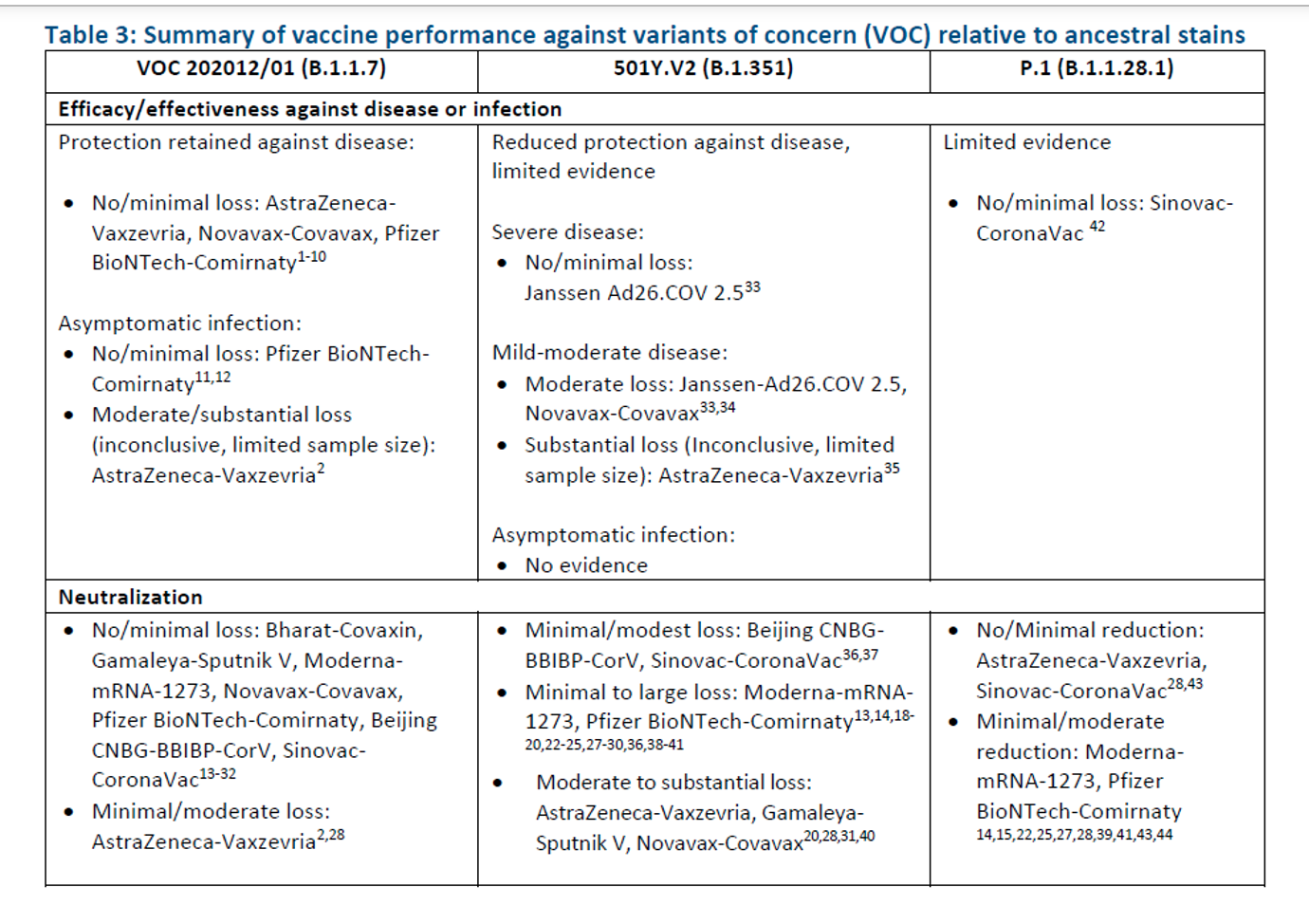
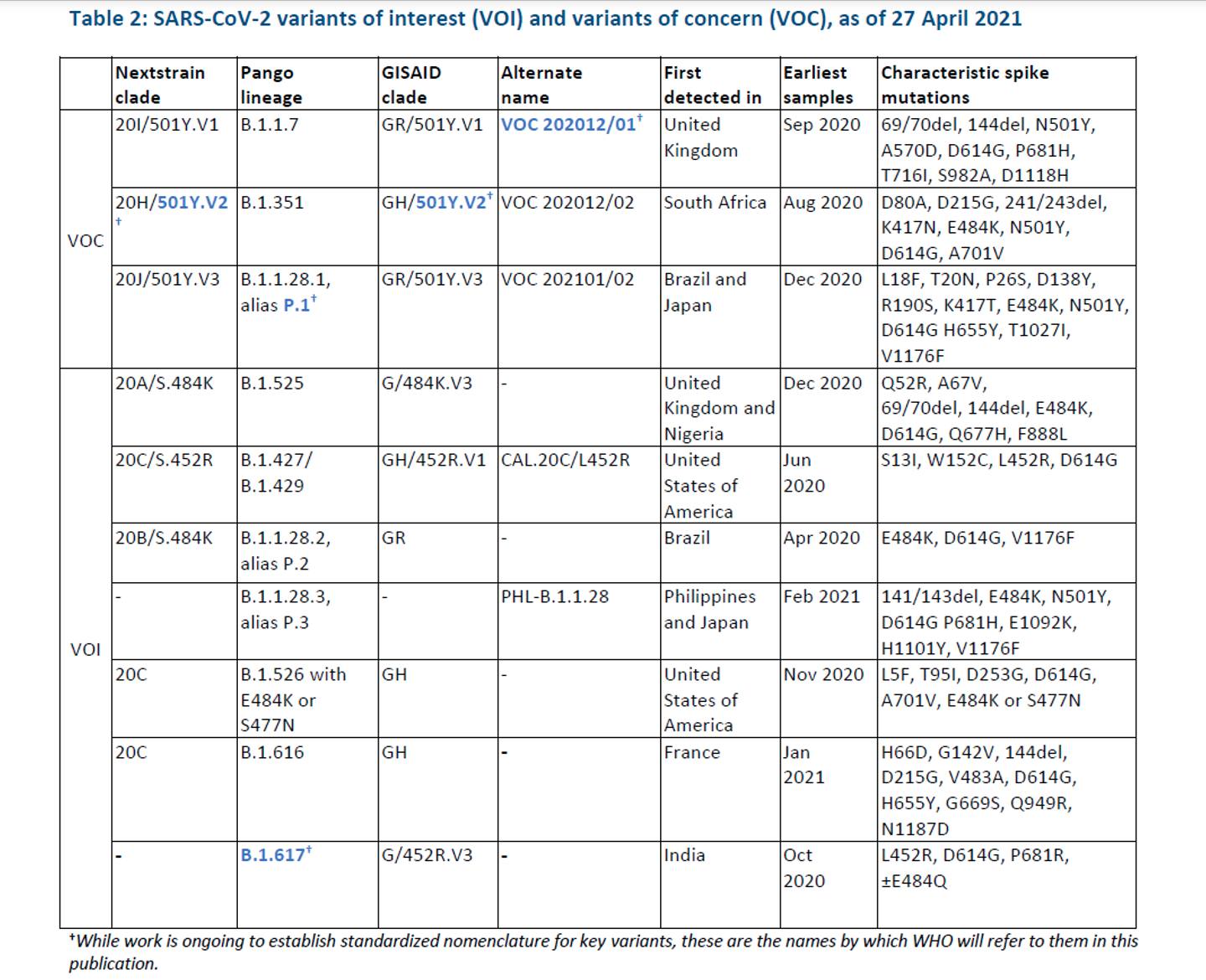
In this edition, a special focus update is provided on SARS-CoV-2 variants.

WHO – COVID Vaccines EUAL, Prequalification, SAGE Meetings/Recommendations

Milestones :: Perspectives :: Research


WHO – COVID Vaccines EUAL, Prequalification, SAGE Meetings/Recommendations


Extraordinary meeting of the Strategic Advisory Group of Experts on Immunization (SAGE) – 29 April 2021
Draft Agenda [Evidence Review/Recommendations: Sinopharm [IBP-CoV] and SinoVac [CoronaVac]]


::::::

Draft landscape and tracker of COVID-19 candidate vaccines
30 April 2021 | Publication
The COVID-19 candidate vaccine landscape and tracker database compiles detailed information on COVID-19 vaccine candidates in development.
The landscape is updated regularly – twice a week (Tuesday and Friday, 17:00 CET).
Download: https://cdn.who.int/media/docs/default-source/blue-print/30.04.2021-novel-coronavirus_landscape_covid-19.xlsx.zip?sfvrsn=695af576_3&download=true


::::::

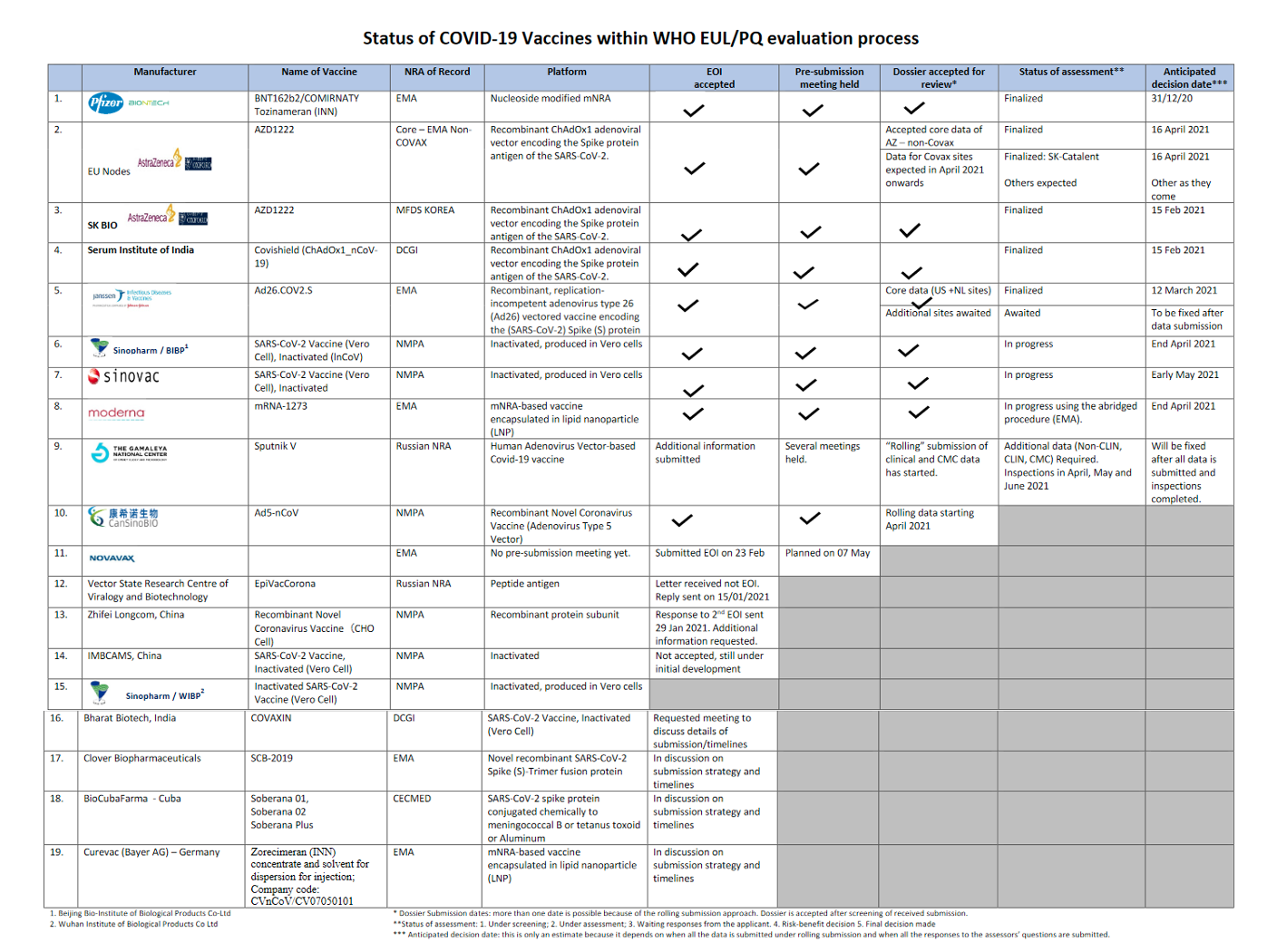
Status of COVID-19 Vaccines within WHO EUL/PQ evaluation process 23 April 2021
For 19 vaccine candidates, presents Manufacturer, Name of Vaccine, NRA of Record, Platform, EOI Accepted Status, Pre-submission Meeting Held Status, Dossier Accepted for Review, Status of Assessment; Anticipated/Completed Decision Date
[click on the link above for full scale view]