Funding of Pharmaceutical Innovation During and After the COVID-19 Pandemic

JAMA
March 2, 2021, Vol 325, No. 9, Pages 805-898
https://jamanetwork.com/journals/jama/currentissue


Funding of Pharmaceutical Innovation During and After the COVID-19 Pandemic
James C. Robinson, PhD, MPH
free access has active quiz has audio
JAMA. 2021;325(9):825-826. doi:10.1001/jama.2020.25384
This Viewpoint considers whether the shift away from private investment toward government funding of drug and vaccine development and commercialization during the coronavirus disease 2019 (COVID-19) pandemic is sustainable, arguing that the same or greater level of public investment will be necessary if drug prices are to remain affordable and if the US wants to maintain its global leadership position.
Conversations with Dr Bauchner: Funding of Pharmaceutical Innovation During and After the COVID-19 Pandemic

Vaccine Distribution—Equity Left Behind?

JAMA
March 2, 2021, Vol 325, No. 9, Pages 805-898
https://jamanetwork.com/journals/jama/currentissue


Editorial
Vaccine Distribution—Equity Left Behind?
Muriel Jean-Jacques, MD, MAPP; Howard Bauchner, MD
free access has multimedia has audio
JAMA. 2021;325(9):829-830. doi:10.1001/jama.2021.1205
The health disparities laid bare by the COVID-19 pandemic have not been surprising in their direction. Likewise, the inequities that are likely to manifest when a limited supply of vaccine is rolled out to a large number of eligible individuals are predictable. As local communities roll out vaccine distribution to those aged 65 and older it is important to consider potential challenges and to proactively plan for ways to mitigate likely disparities.
[1] Prioritize vaccine distribution to zip codes that have been most severely affected by COVID-19 and that have high indexes of economic hardship.
[2] Partner with local health care institutions, community organizations, and other trusted sources to promote vaccine awareness and uptake within local communities, with particular attention to institutions and organizations that serve communities who have borne the brunt of COVID-19 exposure, illness, and death.
[3] Prioritize vaccine distribution to those who face mobility or other transportation barriers to receipt of the vaccine (eg, vans to deliver vaccine to homebound older persons, vaccination sites that are near public transportation, and hours of operation that are accessible to those who work or who rely on those who work during standard business hours).
[4] Simplify registration procedures. Ensure registration options that do not require the internet or digital platforms (such as phone or in-person registration). Ensure registration is accessible to those with limited English proficiency or limited literacy. Registration should not require nonessential documentation, such as proof of citizenship, that is likely to deter individuals from immigrant communities from seeking vaccination. Offer vaccination options that do not require preregistration (eg, at local community centers, schools, houses of worship, or other highly frequented and trusted sites in the community)…
Conversations with Dr Bauchner: Who Gets Coronavirus Vaccine First?
Conversations with Dr Bauchner: Prioritizing Racial and Ethnic Minority Populations for Coronavirus Vaccination
Conversations with Dr Bauchner: Coronavirus Vaccine Update From the CDC With Nancy E. Messonnier, MD

Experts Discuss COVID-19—Vaccine Doses, Virus Variants, and More

JAMA
March 2, 2021, Vol 325, No. 9, Pages 805-898
https://jamanetwork.com/journals/jama/currentissue


JAMA Live Highlights
Experts Discuss COVID-19—Vaccine Doses, Virus Variants, and More
free access has multimedia has audio
JAMA. 2021;325(9):812-813. doi:10.1001/jama.2021.1101
JAMA Live Highlights features comments from livestream interviews by JAMA Network Editor in Chief Howard Bauchner, MD. His discussions with experts in clinical care, public health, and health policy focus on critical issues related to the coronavirus disease 2019 (COVID-19) pandemic. Comments have been edited for clarity.

Number of Childhood and Adolescent Vaccinations Administered Before and After the COVID-19 Outbreak in Colorado

JAMA Pediatrics
March 2021, Vol 175, No. 3, Pages 225-332
https://jamanetwork.com/journals/jamapediatrics/currentissue


Research Letter
Number of Childhood and Adolescent Vaccinations Administered Before and After the COVID-19 Outbreak in Colorado
Sean T. O’Leary, MD, MPH; Lynnsay Trefren, MSN, RN; Heather Roth, MA; et al.
free access has active quiz
JAMA Pediatr. 2021;175(3):305-307. doi:10.1001/jamapediatrics.2020.4733
This study assesses the association of social distancing due to coronavirus disease 2019 (COVID-19) with immunizations administered by age category (0-2 years, 3-9 years, and 10-17 years) in Colorado.

COVID-19 Vaccination Hesitancy in the United States: A Rapid National Assessment

Journal of Community Health
Volume 46, issue 2, April 2021
https://link.springer.com/journal/10900/volumes-and-issues/46-2


Original Paper
COVID-19 Vaccination Hesitancy in the United States: A Rapid National Assessment
Authors (first, second and last of 6) Jagdish Khubchandani, Sushil Sharma, Fern J. Webb
Published: 03 January 2021
Pages: 270 – 277

Increasing HPV Vaccination Support Through a Pilot Film-Based Community Engagement

Journal of Community Health
Volume 46, issue 2, April 2021
https://link.springer.com/journal/10900/volumes-and-issues/46-2


Increasing HPV Vaccination Support Through a Pilot Film-Based Community Engagement
Authors (first, second and last of 7) Shamly Austin, Katharine Wooten, Haiyan Qu
Content type: Original Paper
Published: 14 September 2020
Pages: 343 – 348

Knowledge, Beliefs, and Practices Among U. S. College Students Concerning Papillomavirus Vaccination

Journal of Community Health
Volume 46, issue 2, April 2021
https://link.springer.com/journal/10900/volumes-and-issues/46-2


Knowledge, Beliefs, and Practices Among U. S. College Students Concerning Papillomavirus Vaccination
Authors – Bulaporn Natipagon-Shah, Eunice Lee, Shin-Young Lee
Content type: Original Paper
Published: 16 September 2020
Pages: 380 – 388

Identification of the Knowledge Level of Students Receiving Health Education About the Human Papilloma Virus, Screening Tests, and Human Papilloma Virus Vaccination

Journal of Community Health
Volume 46, issue 2, April 2021
https://link.springer.com/journal/10900/volumes-and-issues/46-2


Identification of the Knowledge Level of Students Receiving Health Education About the Human Papilloma Virus, Screening Tests, and Human Papilloma Virus Vaccination
Authors – Gulpinar Aslan, Ayse Berivan Bakan, Content type: Original Paper
Published: 18 July 2020
Pages: 428 – 433

Institutional Distrust among African Americans and Building Trustworthiness in the COVID-19 Response: Implications for Ethical Public Health Practice

Journal of Health Care for the Poor and Underserved (JHCPU)
Volume 32, Number 1, February 2021
https://muse.jhu.edu/issue/43951


Table of Contents
Institutional Distrust among African Americans and Building Trustworthiness in the COVID-19 Response: Implications for Ethical Public Health Practice
Alicia L. Best, Faith E. Fletcher, Mika Kadono, Rueben C. Warren
pp. 90-98

Do we care about who cares?

The Lancet
Mar 06, 2021 Volume 397 Number 10277 p853-940
https://www.thelancet.com/journals/lancet/issue/current


Editorial
Do we care about who cares?
The Lancet
… As countries look to post-COVID-19 recovery, there is an urgent need for institutions and governments to redesign economies more equitably. They should be based on feminist, intersectional, and anti-racist principles that generate understanding of the inextricable link between, and need for social systems of, child care, value, and pay for domestic labour. Several pandemic recovery plans that espouse those principles have emerged. Recovery from the pandemic also calls us to think about the importance of investing in health and social care more generally, which will have the effect of freeing up the time of women who are the main producers of the unpaid care and unpaid caregiving by alleviating the burden of non-communicable disease and other long-term conditions and disabilities.
COVID-19 has harmed the health and economic security of women worldwide. But the pandemic has also made the invisible contribution of women to health care much more apparent and provided important momentum to advocate for its measurement, recognition, and fair compensation with no disparities due to sex. This opportunity must be seized.

Single-dose Oxford–AstraZeneca COVID-19 vaccine followed by a 12-week booster

The Lancet
Mar 06, 2021 Volume 397 Number 10277 p853-940
https://www.thelancet.com/journals/lancet/issue/current


Comment
Single-dose Oxford–AstraZeneca COVID-19 vaccine followed by a 12-week booster
Ivan F N Hung, Gregory A Poland
… Important study limitations include the fact that these studies were not prospectively designed to establish whether vaccine efficacy would differ by dose interval; therefore, these post-hoc exploratory findings could be biased. Other limitations are that participants were not randomised to dosing interval, only one of the four trials was double-blind, and the single-dose recipients were self-selected. Furthermore, baseline characteristics between the single-dose and two-dose cohorts were substantially different, with an older median age, higher proportion of men and non-white participants, and a smaller proportion of health or social care workers in the two-dose cohort than in the single-dose cohort. Also, worth considering is whether these results would hold up with widespread circulation of more transmissible and lethal viral variants.
Overall, the value of this study is in providing evidence that a single dose of the ChAdOx1 nCoV-19 vaccine is highly efficacious in the 90 days after vaccination, that a longer prime-boost interval results in higher vaccine efficacy, and that protection against symptomatic COVID-19 is maintained despite a longer dosing interval. It offers much-needed evidence for the UK policy of extending the dosing interval to 12 weeks and for rapid mass-immunisation campaigns worldwide. Further studies are warranted to assess whether a longer-interval strategy would also offer higher vaccine efficacy against the new variants8 and could be applicable to other types of COVID-19 vaccines. 91011

Single-dose administration and the influence of the timing of the booster dose on immunogenicity and efficacy of ChAdOx1 nCoV-19 (AZD1222) vaccine: a pooled analysis of four randomised trials

The Lancet
Mar 06, 2021 Volume 397 Number 10277 p853-940
https://www.thelancet.com/journals/lancet/issue/current


Articles
Single-dose administration and the influence of the timing of the booster dose on immunogenicity and efficacy of ChAdOx1 nCoV-19 (AZD1222) vaccine: a pooled analysis of four randomised trials
Merryn Voysey, et al. on behalf of the Oxford COVID Vaccine Trial Group
Open Access
The ChAdOx1 nCoV-19 (AZD1222) vaccine has been approved for emergency use by the UK regulatory authority, Medicines and Healthcare products Regulatory Agency, with a regimen of two standard doses given with an interval of 4–12 weeks. The planned roll-out in the UK will involve vaccinating people in high-risk categories with their first dose immediately, and delivering the second dose 12 weeks later. Here, we provide both a further prespecified pooled analysis of trials of ChAdOx1 nCoV-19 and exploratory analyses of the impact on immunogenicity and efficacy of extending the interval between priming and booster doses. In addition, we show the immunogenicity and protection afforded by the first dose, before a booster dose has been offered.

Improving lung health in low-income and middle-income countries: from challenges to solutions

The Lancet
Mar 06, 2021 Volume 397 Number 10277 p853-940
https://www.thelancet.com/journals/lancet/issue/current


Review
Improving lung health in low-income and middle-income countries: from challenges to solutions
Jamilah Meghji, et al.
Summary
Low-income and middle-income countries (LMICs) bear a disproportionately high burden of the global morbidity and mortality caused by chronic respiratory diseases (CRDs), including asthma, chronic obstructive pulmonary disease, bronchiectasis, and post-tuberculosis lung disease. CRDs are strongly associated with poverty, infectious diseases, and other non-communicable diseases (NCDs), and contribute to complex multi-morbidity, with major consequences for the lives and livelihoods of those affected. The relevance of CRDs to health and socioeconomic wellbeing is expected to increase in the decades ahead, as life expectancies rise and the competing risks of early childhood mortality and infectious diseases plateau. As such, the World Health Organization has identified the prevention and control of NCDs as an urgent development issue and essential to the achievement of the Sustainable Development Goals by 2030. In this Review, we focus on CRDs in LMICs. We discuss the early life origins of CRDs; challenges in their prevention, diagnosis, and management in LMICs; and pathways to solutions to achieve true universal health coverage.

Genetic mechanisms of critical illness in COVID-19

Nature
Volume 591 Issue 7848, 4 March 2021


Article | 11 December 2020
Genetic mechanisms of critical illness in COVID-19
A genome-wide association study of critically ill patients with COVID-19 identifies genetic signals that relate to important host antiviral defence mechanisms and mediators of inflammatory organ damage that may be targeted by repurposing drug treatments.
Erola Pairo-Castineira, Sara Clohisey & J. Kenneth Baillie

Endemic SARS-CoV-2 will maintain post-pandemic immunity

Nature Reviews Immunology
Volume 21 Issue 3, March 2021
https://www.nature.com/nri/volumes/21/issues/3


Comment | 05 January 2021
Endemic SARS-CoV-2 will maintain post-pandemic immunity
Here, Veldhoen and Simas discuss why immunity to SARS-CoV-2 in populations may ultimately be driven by the endemic presence of the virus and not rely on continued mass vaccination programmes.
Marc Veldhoen & J. Pedro Simas

Supporting a data-driven approach to regulatory intelligence

Nature Reviews Drug Discovery
Volume 20 Issue 3, March 2021
https://www.nature.com/nrd/volumes/20/issues/3


Comment | 28 May 2020
Supporting a data-driven approach to regulatory intelligence
Drug developers are increasingly applying data-driven analysis of the actions of regulatory agencies to gain insights into their expectations and applications of regulatory policy, but such strategies can be limited by the availability and quality of regulatory datasets. Here, we discuss how establishing a single, robust, accessible database of FDA regulatory actions could help address this limitation.
Andrew S. Robertson, Alexis Reisin Miller & Felipe Dolz

Improving Influenza Vaccination in Children With Comorbidities: A Systematic Review

Pediatrics
Vol. 147, Issue 3 1 Mar 2021
https://pediatrics.aappublications.org/


Review Articles
Improving Influenza Vaccination in Children With Comorbidities: A Systematic Review
Daniel A. Norman, Rosanne Barnes, Rebecca Pavlos, Mejbah Bhuiyan, Kefyalew Addis Alene, Margie Danchin, Holly Seale, Hannah C. Moore, Christopher C. Blyth
Pediatrics, Mar 2021, 147 (3) e20201433

Allocating epidemic response teams and vaccine deliveries by drone in generic network structures, according to expected prevented exposures

PLoS One
http://www.plosone.org/
[Accessed 6 Mar 2021]


Allocating epidemic response teams and vaccine deliveries by drone in generic network structures, according to expected prevented exposures
Dean Matter, Linke Potgieter
Research Article | published 05 Mar 2021 PLOS ONE
https://doi.org/10.1371/journal.pone.0248053

The exposure risk to COVID-19 in most affected countries: A vulnerability assessment model

PLoS One
http://www.plosone.org/
[Accessed 6 Mar 2021]


The exposure risk to COVID-19 in most affected countries: A vulnerability assessment model
Adriana Nascimento Santos Cartaxo, Francisco Iran Cartaxo Barbosa, Paulo Henrique de Souza Bermejo, Marina Figueiredo Moreira, David Nadler Prata
Research Article | published 04 Mar 2021 PLOS ONE
https://doi.org/10.1371/journal.pone.0248075

Oral health care professionals recommending and administering the HPV vaccine: Understanding the strengths and assessing the barriers

PLoS One
http://www.plosone.org/
[Accessed 6 Mar 2021]


Oral health care professionals recommending and administering the HPV vaccine: Understanding the strengths and assessing the barriers
Denise Guadiana, Nolan M. Kavanagh, Cristiane H. Squarize
Research Article | published 04 Mar 2021 PLOS ONE
https://doi.org/10.1371/journal.pone.0248047

Trust and Risk Perception: A Critical Review of the Literature

Risk Analysis
Volume 41, Issue 3 Pages: 407-557 March 2021
https://onlinelibrary.wiley.com/toc/15396924/current


Special Issue:40 Years of Social Sciences in Risk Research Reconsidered
Original Research Articles
Trust and Risk Perception: A Critical Review of the Literature
Michael Siegrist
Pages: 480-490
First Published: 02 May 2019
Abstract
Many studies in the field of risk perception and acceptance of hazards include trust as an explanatory variable. Despite this, the importance of trust has often been questioned. The relevant issue is not only whether trust is crucial but also the form of trust that people rely on in a given situation. In this review, I discuss various trust models and the relationship between trust and affect heuristics. I conclude that the importance of trust varies by hazard and respondent group. Most of the studies use surveys that provide limited information about causality. Future research should focus more on experiments that test whether trust is a consequence of people’s attitudes or influences their attitudes toward a technology. Furthermore, there is a need for a better understanding about the factors that determine which heuristics people rely on when evaluating hazards.

Editorial Science’s new frontier

Science
05 March 2021 Vol 371, Issue 6533
http://www.sciencemag.org/current.dtl


Editorial
Science’s new frontier
By Aaron F. Mertz, Abhilash Mishra
Science05 Mar 2021 : 96
Summary
The year 2020 saw a reusable rocket launch two astronauts into space, multiple COVID-19 vaccines developed in record time, and a robot that could write a persuasive op-ed. In the United States, the year also saw public distrust of science contribute to the worst health crisis in modern history. This contrast highlights a sharp dichotomy in the role of science in American public life: breathtaking discovery and innovation alongside growing distrust of scientific evidence and recommendations. How can the country reconcile this dissociation?

Human embryo research beyond the primitive streak

Science
05 March 2021 Vol 371, Issue 6533
http://www.sciencemag.org/current.dtl


Policy Forum
Human embryo research beyond the primitive streak
By Insoo Hyun, Annelien L. Bredenoord, James Briscoe, Sigal Klipstein, Tao Tan
Science05 Mar 2021 : 998-1000 Restricted Access
It is time to revisit the “14-day limit”
Summary
Since the first successful birth resulting from in vitro fertilization (IVF) in the late 1970s, human embryo research has been subject to limits of time and developmental benchmarks. National guidelines, laws, and international norms have prohibited scientists from culturing embryos for research beyond 14 consecutive days, or beyond the appearance of a structure called the “primitive streak,” which defines the beginning of the formation of the principal tissues of the body and the end of the period when an embryo can divide into identical twins (1). At the time this limit was put in place 40 years ago, there were no methods to culture embryos in a dish for anywhere close to 14 days. But research since 2016 (2, 3) shows that it is likely possible to culture human research embryos past the 2-week limit and suggests that doing so will yield scientific insights that could prove important for human health and fertility (4). We thus urge policy-makers and the International Society for Stem Cell Research (ISSCR), which will soon release updated guidelines for stem cell and embryo research, to consider a cautious, stepwise approach to scientific exploration beyond the 14-day limit.

Infectious diseases and social distancing in nature

Science
05 March 2021 Vol 371, Issue 6533
http://www.sciencemag.org/current.dtl


Review
Infectious diseases and social distancing in nature
By Sebastian Stockmaier, Nathalie Stroeymeyt, Eric C. Shattuck, Dana M. Hawley, Lauren Ancel Meyers, Daniel I. Bolnick
Science05 Mar 2021
Nature’s “responsible” response to disease
With the emergence of the COVID-19 pandemic, there have been global calls for the implementation of “social distancing” to control transmission. Throughout the world, some have resisted this requirement with the unfounded argument that it is unnecessary or ineffective. Social distancing, however, is a natural consequence of disease across animals, both human and nonhuman. Stockmaier et al. reviewed responses to disease across animal taxa and reveal how these responses naturally limit disease transmission. Understanding such natural responses and their impacts on pathogenic transmission provides epidemiological insight into our own responses to pandemic challenges.
Abstract
Spread of contagious pathogens critically depends on the number and types of contacts between infectious and susceptible hosts. Changes in social behavior by susceptible, exposed, or sick individuals thus have far-reaching downstream consequences for infectious disease spread. Although “social distancing” is now an all too familiar strategy for managing COVID-19, nonhuman animals also exhibit pathogen-induced changes in social interactions. Here, we synthesize the effects of infectious pathogens on social interactions in animals (including humans), review what is known about underlying mechanisms, and consider implications for evolution and epidemiology.

Improving COVID-19 vaccine acceptance: Including insights from human decision-making under conditions of uncertainty and human-centered design

Vaccine
Volume 39, Issue 11 Pages 1547-1666 (12 March 2021)
https://www.sciencedirect.com/journal/vaccine/vol/39/issue/11


Editorial Full text access
Improving COVID-19 vaccine acceptance: Including insights from human decision-making under conditions of uncertainty and human-centered design
Caroline M. Poland, Allison K.S. Matthews, Gregory A. Poland
Pages 1547-1550

Situational assessment of adult vaccine preventable disease and the potential for immunization advocacy and policy in low- and middle-income countries

Vaccine
Volume 39, Issue 11 Pages 1547-1666 (12 March 2021)
https://www.sciencedirect.com/journal/vaccine/vol/39/issue/11

Review article Open access
Situational assessment of adult vaccine preventable disease and the potential for immunization advocacy and policy in low- and middle-income countries
Molly Sauer, Prarthana Vasudevan, Ankita Meghani, Karuna Luthra, … Lois Privor-Dumm
Pages 1556-1564

Acceptability of a COVID-19 Vaccine among the Saudi Population

Vaccines — Open Access Journal
http://www.mdpi.com/journal/vaccines
(Accessed 6 Mar 2021)


Open Access Article
Acceptability of a COVID-19 Vaccine among the Saudi Population
by Eman Ibrahim Alfageeh et al.
Vaccines 2021, 9(3), 226; https://doi.org/10.3390/vaccines9030226 – 05 Mar 2021
Abstract
To investigate the associated factors underlying vaccination intentions for Coronavirus Disease 2019 (COVID-19), an online cross-sectional survey was conducted among adults 18 years or over in the Kingdom of Saudi Arabia. Data were collected between 8 and 14 December 2020. A logistic regression […] R

Attitude and Behaviors towards SARS-CoV-2 Vaccination among Healthcare Workers: A Cross-Sectional Study from Poland

Vaccines — Open Access Journal
http://www.mdpi.com/journal/vaccines
(Accessed 6 Mar 2021)


Open Access Article
Attitude and Behaviors towards SARS-CoV-2 Vaccination among Healthcare Workers: A Cross-Sectional Study from Poland
by Bartosz Szmyd et al
Vaccines 2021, 9(3), 218; https://doi.org/10.3390/vaccines9030218 – 04 Mar 2021
Abstract
Healthcare workers are particularly exposed to biological risk during their daily occupational activities. Nowadays, severe acute respiratory syndrome coronavirus 2 (SARS-CoV-2) has become one of the most widespread infectious agents. In the current study, we performed a survey on the attitude and behavior […]

Acceptance of a COVID-19 Vaccine in Japan during the COVID-19 Pandemic

Vaccines — Open Access Journal
http://www.mdpi.com/journal/vaccines
(Accessed 6 Mar 2021)


Open Access Article
Acceptance of a COVID-19 Vaccine in Japan during the COVID-19 Pandemic
by Masaki Machida et al.
Vaccines 2021, 9(3), 210; https://doi.org/10.3390/vaccines9030210 – 03 Mar 2021
Abstract
Vaccination could be a key protective measure against coronavirus disease 2019 (COVID-19), and it is important to understand the acceptability of the COVID-19 vaccine among the general public. However, there is no study on the acceptance of a COVID-19 vaccine in Japan. Therefore, […]

COVID-19 Vaccine Acceptance among an Online Sample of Sexual and Gender Minority Men and Transgender Women

Vaccines — Open Access Journal
http://www.mdpi.com/journal/vaccines
(Accessed 6 Mar 2021)


Open Access Article
COVID-19 Vaccine Acceptance among an Online Sample of Sexual and Gender Minority Men and Transgender Women
by Daniel Teixeira da Silva et al
Vaccines 2021, 9(3), 204; https://doi.org/10.3390/vaccines9030204 – 01 Mar 2021
Abstract
Sexual and gender minority (SGM) populations are particularly vulnerable to poor COVID-19 outcomes and are more likely to experience stigma and medical mistrust that may impact COVID-19 vaccine acceptance. This study examined the prevalence of COVID testing and diagnosis and assessed COVID-19 vaccine […]

Media/Policy Watch

Media/Policy Watch
This watch section is intended to alert readers to substantive news, analysis and opinion from the general media and selected think tanks and similar organizations on vaccines, immunization, global public health and related themes. Media Watch is not intended to be exhaustive, but indicative of themes and issues CVEP is actively tracking. This section will grow from an initial base of newspapers, magazines and blog sources, and is segregated from Journal Watch above which scans the peer-reviewed journal ecology.
We acknowledge the Western/Northern bias in this initial selection of titles and invite suggestions for expanded coverage. We are conservative in our outlook in adding news sources which largely report on primary content we are already covering above. Many electronic media sources have tiered, fee-based subscription models for access. We will provide full-text where content is published without restriction, but most publications require registration and some subscription level.


The Atlantic
http://www.theatlantic.com/magazine/
Accessed 6 Mar 2021
Ideas
America’s Legalistic Culture Is About to Become a Problem
The vaccine rollout will create new clashes between conflicting rights.
March 4, 2021
Jamal Greene, Professor at Columbia Law School
As vaccine production and distribution accelerate, a new set of challenges around what Americans can and should demand of one another is emerging. And we’re not ready for them. The public has been told for the past year that we need to mask up, physically distance, and lock down for the greater good. Now that vaccines are here, does that same greater good mean that society can discriminate against the unvaccinated? Do Americans have a right not to get vaccinated? If so, how far does that right go?


BBC
http://www.bbc.co.uk/
Accessed 6 Mar 2021
[No new, unique, relevant content]


The Economist
http://www.economist.com/
Accessed 6 Mar 2021
Bartleby
How companies should handle vaccines
Balancing the rights of stakeholders
THE PANDEMIC is throwing up a new set of ethical issues for businesses. The premise of “stakeholder capitalism” is not just that firms should consider the interests of employees and customers, as well as shareholders. It is that, by doing so, everyone gains; shareholders will prosper if workers and customers are treated decently. But the pandemic may put different groups at odds. For example, customers may want companies to insist that all employees are vaccinated, while not wanting the same rule to apply to themselves.
Mar 6th 2021


Financial Times
https://www.ft.com/
Accessed 6 Mar 2021
Covid-19 vaccines
EU turns to US in scramble for Oxford/AstraZeneca vaccine
Move is part of bloc’s effort to boost faltering immunisation programme
Sam Fleming and Michael Peel in Brussels, and Kiran Stacey in Washington
March 6
The EU will urge the US to permit the export of millions of doses of AstraZeneca’s Covid-19 vaccine to Europe as Brussels scrambles to bridge supply shortfalls that have hobbled its inoculation drive.
The European Commission plans to raise the matter in forthcoming transatlantic discussions aimed at boosting collaboration on the fight against Covid-19, EU officials said.
The EU also wants Washington to ensure the free flow of shipments of crucial vaccine ingredients needed in European production, including for groundbreaking mRNA technology vaccines…

Coronavirus:
Germany urges EU coordination after Italy blocks vaccine shipment
Germany has urged caution on vaccines, after France backed Italy’s decision to block a shipment of jabs to Australia.
The German health minister on Friday said that such unilateral steps were unhelpful and could disrupt supply chains, adding that Europe should act in a more coordinated way when it comes to such export restrictions.
March 5, 2021

Bottom of Form


Forbes
http://www.forbes.com/
Accessed 6 Mar 2021
Mar 6, 2021
Europe’s Vaccine Struggle Will Change Its Politics
France and much of Europe has fallen behind with vaccinating its citizens, this may lead to political stress down the line and raises questions as to what countries are ready for the post COVID world.
By Mike O’Sullivan Senior Contributor

Mar 5, 2021
How Pfizer’s Head Of Vaccine Development Made Covid-19 Vaccine In Record Time And Led A Large Team
Kathrin Jansen has made waves in healthcare having led the development of Gardasil, now the Covid-19 vaccine and others. She leads with strength, organization and often, creativity and gut instincts. During the pandemic she led hundreds of people on this mission to develop an effective vaccine.
By Monica Haider Contributor

Mar 5, 2021
Fauci Says Military Who Refuse Covid-19 Vaccine Are ‘Part Of The Problem’ After High Rate Of Service Members Refuse Jab
Pentagon officials have said one in three military troops are refusing to take the optional Covid-19 shot.
By Robert Hart Forbes Staff


Foreign Affairs
http://www.foreignaffairs.com/
Accessed 6 Mar 2021
[No new, unique, relevant content]


Foreign Policy
http://foreignpolicy.com/
Accessed 6 Mar 2021
Argument
To Democratize Vaccine Access, Democratize Production
U.S. and European COVID-19 shots aren’t enough. It is time to tap into Africa, Asia, and Latin America’s enormous production capacity.
By Matthew M. Kavanagh, Mara Pillinger, Renu Singh, Katherine Ginsbach


The Guardian
http://www.guardiannews.com/
Accessed 6 Mar 2021
[No new, unique, relevant content]


New Yorker
http://www.newyorker.com/
Accessed 6 Mar 2021
Annals of Populism
The Vaccine Resisters
Why do so many people say that they won’t be immunized against COVID-19?
By Benjamin Wallace-Wells
March 5, 2021


New York Times
http://www.nytimes.com/
Accessed 6 Mar 2021
The Interpreter
Vaccine Passports, Covid’s Next Political Flash Point
A world divided between the vaccinated and unvaccinated promises relief for economies and families, but the ethical and practical risks are high.
March 2, 2021


Washington Post
https://www.washingtonpost.com/
Accessed 6 Mar 2021
Tibetan spiritual leader Dalai Lama gets vaccine shot
Associated Press · Mar 6, 2021

After days of halting statements about vaccine morality, multiple Catholic leaders call the shots urgent, important
Michelle Boorstein · Religion · Mar 5, 2021

WHO head pushes for waiver of some intellectual property rights for coronavirus vaccines, in bid to broaden access
Miriam Berger · World · Mar 5, 2021

France backs Italy in vaccine ban as EU defends mechanism
BRUSSELS — Europe’s vaccine solidarity got a boost on Friday after France said it could emulate Italy’s move to block coronavirus vaccine exports outside the European Union if that’s what is needed to enforce the bloc’s own contracts with drugs manufacturers.·
Mar 5, 2021
Think Tanks et al

Think Tanks et al

Brookings
http://www.brookings.edu/
Accessed 6 Mar 2021
Coronavirus (COVID-19)
One year in, COVID-19’s uneven spread across the US continues
William H. Frey
Friday, March 5, 2021

FixGov
Getting the COVID-19 vaccine: Progress, and equity questions for the next phase
Elaine Kamarck and William A. Galston
Thursday, March 4, 2021

Coronavirus (COVID-19)
Examining and addressing COVID-19 racial disparities in Detroit
Rashawn Ray, Jane Fran Morgan, Lydia Wileden, Samantha Elizondo, and Destiny Wiley-Yancy
Tuesday, March 2, 2021

Center for Global Development [to 6 Mar 2021]
http://www.cgdev.org/page/press-center
Publication
Equity and Scale in Global Immunization: New Evidence from Nigeria on Cash Transfers for Vaccination
Event
3/10/21
Even prior to COVID-19, full immunization for age was vastly unequal in large middle-income countries like Nigeria. As the COVID-19 crisis deepens, routine immunization has plummeted, and world leaders are seeking ways to regain ground and trust, even while considering how to roll out a COVID-19 vaccine.

Global Trends in 2021: How COVID-19 Is Transforming International Development
Publication
3/2/21
In this note, we explore some of the changes and trends in development agency strategic direction brought about by the pandemic, as well as fundamental challenges that bilateral development agencies will need to address in the years to come.

Chatham House [to 6 Mar 2021]
https://www.chathamhouse.org/
Accessed 6 Mar 2021
[No new digest content identified]


CSIS
https://www.csis.org/
Accessed 6 Mar 2021
Upcoming Event
A Conversation with Dr. Anthony Fauci and Professor Paul Kelly
March 9, 2021

Transcript
A Global Approach to COVID-19 Vaccination
March 4, 2021


Kaiser Family Foundation
https://www.kff.org/search/?post_type=press-release
Accessed 6 Mar 2021
March 4, 2021 News Release
THE CONVERSATION: Between Us, About Us, A New Campaign By Black Health Care Workers for Black People about the COVID-19 Vaccines
March 4, 2021 – THE CONVERSATION: Between Us, About Us. is a new campaign to provide Black communities with credible information about the COVID-19 vaccines co-developed by KFF (Kaiser Family Foundation) and the Black Coalition Against COVID. Black doctors, nurses and researchers dispel misinformation and provide accessible facts in 50…

March 3, 2021 News Release
KFF Tracking Poll: More Than a Third of Americans Say They’ve Struggled to Pay Living Expenses Since December; 6 in 10 Families Hit by COVID Have Lost A Job or Income
Majorities Favor Provisions to Expand Marketplace Tax Credits and Encourage States to Expand Medicaid As Congress considers an additional $1.9 trillion COVID-19 relief plan, more than a third (37%) of Americans say that someone in their household has had trouble paying basic living expenses over the past three months, the…

March 1, 2021 News Release
Many Nonelderly People With Disabilities Face COVID-19 Risks Similar to Those of the Elderly in Nursing Homes, But Do Not Have Equal Footing When it Comes to Vaccine Priority
While the toll of COVID-19 on nursing home residents has been well documented, less noticed has been the experience of nonelderly people with disabilities who rely on long-term care services and supports outside of nursing homes. In many ways the two groups face similar health risks from the virus, but…

March 1, 2021 News Release
Analysis: Spending on Health Care Would Drop by an Estimated $352 Billion in 2021 if Private Insurance Used Medicare Rates to Reimburse Hospitals and Other Health Care Providers
Total health care spending for people with private health insurance would be an estimated $352 billion lower in 2021 if private insurers used Medicare rates to pay hospitals and other health care providers, rather than the substantially higher rates they currently pay, a new KFF analysis finds. That would represent…

Urban Institute [to 6 Mar 2021]
https://www.urban.org/publications
Publications
Reforming Long-Term Care with Lessons from the COVID-19 Pandemic
In October 2020, the Urban Institute hosted a roundtable of leading experts to discuss how the US cares for older adults in the wake of the COVID-19 pandemic. Participants highlighted key areas for reform and identified potential improvements. These included redesigning Medicaid; creating a strong foundation for home- and community-based services; integrating medical care and long-term services and
Howard Gleckman, Melissa M. Favreault
March 2, 2021
Brief

World Economic Forum [to 6 Mar 2021]
https://agenda.weforum.org/news/
Media
[No new relevant content]

Vaccines and Global Health: The Week in Review :: 27 February 2021

Vaccines and Global Health: The Week in Review is a weekly digest  summarizing news, events, announcements, peer-reviewed articles and research in the global vaccine ethics and policy space. Content is aggregated from key governmental, NGO, international organization and industry sources, key peer-reviewed journals, and other media channels. This summary proceeds from the broad base of themes and issues monitored by the Center for Vaccine Ethics & Policy in its work: it is not intended to be exhaustive in its coverage. You are viewing the blog version of our weekly digest, typically comprised of between 30 and 40 posts below all dated with the current issue date

.– Request an Email Summary: Vaccines and Global Health : The Week in Review is published as a single email summary, scheduled for release each Saturday evening before midnight (EDT in the U.S.). If you would like to receive the email version, please send your request to david.r.curry@centerforvaccineethicsandpolicy.org.

– pdf version A pdf of the current issue is available here: 

– blog edition: comprised of the approx. 35+ entries posted below.

– Twitter:  Readers can also follow developments on twitter: @vaxethicspolicy.
.
– Links:  We endeavor to test each link as we incorporate it into any post, but recognize that some links may become “stale” as publications and websites reorganize content over time. We apologize in advance for any links that may not be operative. We believe the contextual information in a given post should allow retrieval, but please contact us as above for assistance if necessary.

Support this knowledge-sharing service: Your financial support helps us cover our costs and to address a current shortfall in our annual operating budget. Click here to donate and thank you in advance for your contribution.

.
David R. Curry, MS
Executive Director
Center for Vaccine Ethics and Policy

Immunization Agenda 2030

Milestones :: Perspectives :: Research


Immunization Agenda 2030

New dedicated website: www.immunizationagenda2030.org
On the website you will find:
:: IA2030 Vision and Strategy in all six UN languages
:: Strategic Priority technical annexes (translation available shortly)
:: Core Principle annexes (translation available shortly)
:: IA2030 Framework for Action
:: Other IA2030 annexes and companion documents

Important work is now ongoing to finalise a Monitoring and Evaluation (M&E) Framework and an Ownership & Accountability mechanism for IA2030.
A key effort is also underway to prepare for the IA2030 launch planned to take place in the run up to World Immunization Week in April and WHA in May.

COVAX – Ghana, Cote Ivoire

Milestones :: Perspectives :: Research


COVAX – Ghana, Cote Ivoire

COVID-19 vaccine doses shipped by the COVAX Facility head to Ghana, marking beginning of global rollout
Press release 02/24/2021
:: COVAX announces 600,000 doses of the AstraZeneca/Oxford vaccine licensed to Serum Institute of India have arrived in Accra, Ghana; further deliveries to Abidjan, Cote d’Ivoire are expected this week
:: Final first round of allocations for doses of AstraZeneca/Oxford and Pfizer-BioNTech vaccines, to the majority of countries and economies participating in the COVAX Facility, anticipated to be published in the coming days
:: Beginning of global rollout means that, as readiness criteria are met and doses produced, vaccines will be shipped to Facility participants on a rolling basis

GENEVA/NEW YORK/OSLO, 24 February 2021 – Today, Ghana became the first country outside India to receive COVID-19 vaccine doses shipped via the COVAX Facility. This is a historic step towards our goal to ensure equitable distribution of COVID-19 vaccines globally, in what will be the largest vaccine procurement and supply operation in history. The delivery is part of a first wave of arrivals that will continue in the coming days and weeks.

On 23 February, COVAX shipped 600,000 doses of the AstraZeneca/ Oxford vaccine, from the Serum Institute of India (SII) from Pune, India to Accra, Ghana, arriving on the morning of 24 February.  The arrival in Accra is the first batch shipped and delivered in Africa by the COVAX Facility as part of an unprecedented effort to deliver at least 2 billion doses of COVID-19 vaccines by the end of 2021…


::::::

Ghana becomes recipient of historic first shipment of COVAX vaccine
Statement by UNICEF Representative in Ghana, Anne-Claire Dufay and WHO Representative to Ghana, Dr Francis Kasolo on the arrival of the first COVID-19 vaccines in Accra
ACCRA, 24 February 2021 – “After a year of disruptions due to the COVID-19 pandemic, with more than 80,700 Ghanaians getting infected with the virus and over 580 lost lives, the path to recovery for the people of Ghana can finally begin.

“This is a momentous occasion, as the arrival of the COVID-19 vaccines into Ghana is critical in bringing the pandemic to an end. The only way out of this crisis is to ensure that vaccinations are available for all. We thank all partners that are supporting the COVAX Facility to deliver safe and effective COVID-19 vaccines to all countries quickly and fairly.

“These 600,000 COVAX vaccines are part of an initial tranche of deliveries of the AstraZeneca / Oxford vaccine licensed to the Serum Institute of India, which represent part of the first wave of COVID vaccines headed to several low and middle-income countries.

“The shipments also represent the beginning of what should be the largest vaccine procurement and supply operation in history. The COVAX Facility plans to deliver close to 2 billion doses of COVID-19 vaccines this year. This is an unprecedented global effort to make sure all citizens have access to vaccines.

“We are pleased that Ghana has become the first country to receive the COVID-19 vaccines from the COVAX Facility. We congratulate the Government of Ghana – especially the Ministry of Health, Ghana Health Service, and Ministry of Information – for its relentless efforts to protect the population. As part of the UN Country Team in Ghana, UNICEF and WHO reiterate our commitment to support the vaccination campaign and contain the spread of the virus, in close cooperation with all partners, including Gavi and the Coalition for Epidemic Preparedness Innovations (CEPI)…

COVAX: Vaccine Supply

Milestones :: Perspectives :: Research

COVAX: Vaccine Supply

UNICEF signs COVID-19 vaccine supply agreement with AstraZeneca
COPENHAGEN/NEW YORK, 25 February 2021 – UNICEF and AstraZeneca this week signed a long-term agreement for the supply of COVID-19 Vaccine AstraZeneca on behalf of the COVAX Facility.
Through the supply agreement, UNICEF, along with procurement partners including the Pan-American Health Organization (PAHO), will have access to up to 170 million doses of vaccines for around 85 countries. This is the third such agreement for COVID-19 vaccines, following previously announced agreements with Pfizer and the Serum Institute of India.
The AstraZeneca/Oxford vaccine received WHO Emergency Use Listing (EUL) on 15 February…

COVAX – Injury Compensation

Milestones :: Perspectives :: Research


COVAX – Injury Compensation

No-fault compensation programme for COVID-19 vaccines is a world first
:: New programme makes compensation available to eligible individuals in 92 low- and middle-income countries without need to resort to law courts
:: This is the first and only global vaccine injury compensation mechanism
:: The programme is funded by a small levy on each dose supported by the Gavi COVAX AMC
22 February 2021
The World Health Organization (WHO) and Chubb Limited (NYSE: CB), through ESIS Inc., a Chubb company, signed an agreement on behalf of the COVAX Facility on 17 February 2021 for the administration of a no-fault compensation programme for the 92 low- and middle-income countries and economies eligible for support via the Gavi COVAX Advance Market Commitment (AMC) of the COVAX Facility.

As the first and only vaccine injury compensation mechanism operating on an international scale, the programme will offer eligible individuals in AMC-eligible countries and economies a fast, fair, robust and transparent process to receive compensation for rare but serious adverse events associated with COVAX-distributed vaccines until 30 June 2022.

By providing a no-fault lump-sum compensation in full and final settlement of any claims, the COVAX programme aims to significantly reduce the need for recourse to the law courts, a potentially lengthy and costly process.

ESIS, as the independent administrator of the programme, was selected in accordance with WHO’s procurement rules and procedures, and charges no fees to applicants.

All vaccines procured or distributed through the COVAX Facility receive regulatory approval or an emergency use authorization to confirm their safety and efficacy.

But, as with all medicines, even vaccines that are approved for general use may, in rare cases, cause serious adverse reactions.

“The unprecedented nature of the COVID-19 pandemic has been matched by the largest ever rollout of new vaccines under the ACT-Accelerator and its vaccines pillar, COVAX. This no-fault compensation mechanism helps to ensure that people in AMC-eligible countries and economies can benefit from the cutting-edge science that has delivered COVID-19 vaccines in record time,” said Dr Tedros Adhanom Ghebreyesus, WHO Director-General. “We are pleased to be collaborating with Chubb, which has the capabilities to support the COVAX facility through its global network and claims handling ability. WHO’s agreement with Chubb offers further protection and confidence in the life-saving power of vaccines.”

“The No-Fault Compensation fund is a massive boost for COVAX’s goal of equitable global access to vaccines: by providing a robust, transparent and independent mechanism to settle serious adverse events it helps those in countries who might have such effects, manufacturers to roll out vaccines to countries faster, and is a key benefit for lower-income governments procuring vaccines through the Gavi COVAX AMC,” said Dr Seth Berkley, CEO of Gavi.

The COVAX no-fault compensation programme will be operationalized through its web portal (www.covaxclaims.com) by 31 March 2021, which will include resources such as the programme’s protocol, Frequently Asked Questions (FAQs) and information on how to submit an application.

Eligible individuals may apply for compensation under the programme once the portal becomes operational, even if a COVAX-distributed vaccine is administered to them before 31 March 2021.

The programme is financed initially through Gavi COVAX AMC donor funding, calculated as a levy charged on all doses of COVID-19 vaccines distributed through the COVAX Facility to the AMC eligible economies until 30 June 2022.

WHO is working with Chubb to secure insurance coverage for the programme with Chubb as lead insurer…

About ESIS, a Chubb company
ESIS, Inc. provides claim and risk management services to a wide variety of commercial clients. Our innovative best-in-class approach to program design, integration, and achievement of results aligns with the needs and expectations of our clients’ unique risk management needs. With more than 66 years of experience and offerings in both the U.S. and globally, ESIS provides one of the industry’s broadest selections of risk management solutions covering both pre- and post-loss services

Coronavirus [COVID-19] – WHO Public Health Emergency of International Concern (PHEIC)

Milestones :: Perspectives :: Research


Coronavirus [COVID-19] – WHO
Public Health Emergency of International Concern (PHEIC)
https://www.who.int/emergencies/diseases/novel-coronavirus-2019


Weekly Epidemiological and Operational updates
Last update: 23 January 2021
Confirmed cases :: 113 076 707 [week ago: 110 384 747] [two weeks ago: 107 838 255]
Confirmed deaths :: 2 512 272 [week ago: 2 446 008] [two weeks ago: 2 373 398]
Countries, areas or territories with cases :: 223

Weekly epidemiological update – 25 February 2021
Overview
This special edition is supplementary to the 23 February Weekly Epidemiological Update.
In this edition, we provide working definitions for SARS-CoV-2 variants of interest and variants of concern and the associated actions WHO will take to support Member States, their national public health institutes and reference laboratories, along with the recommended actions Member States should take.

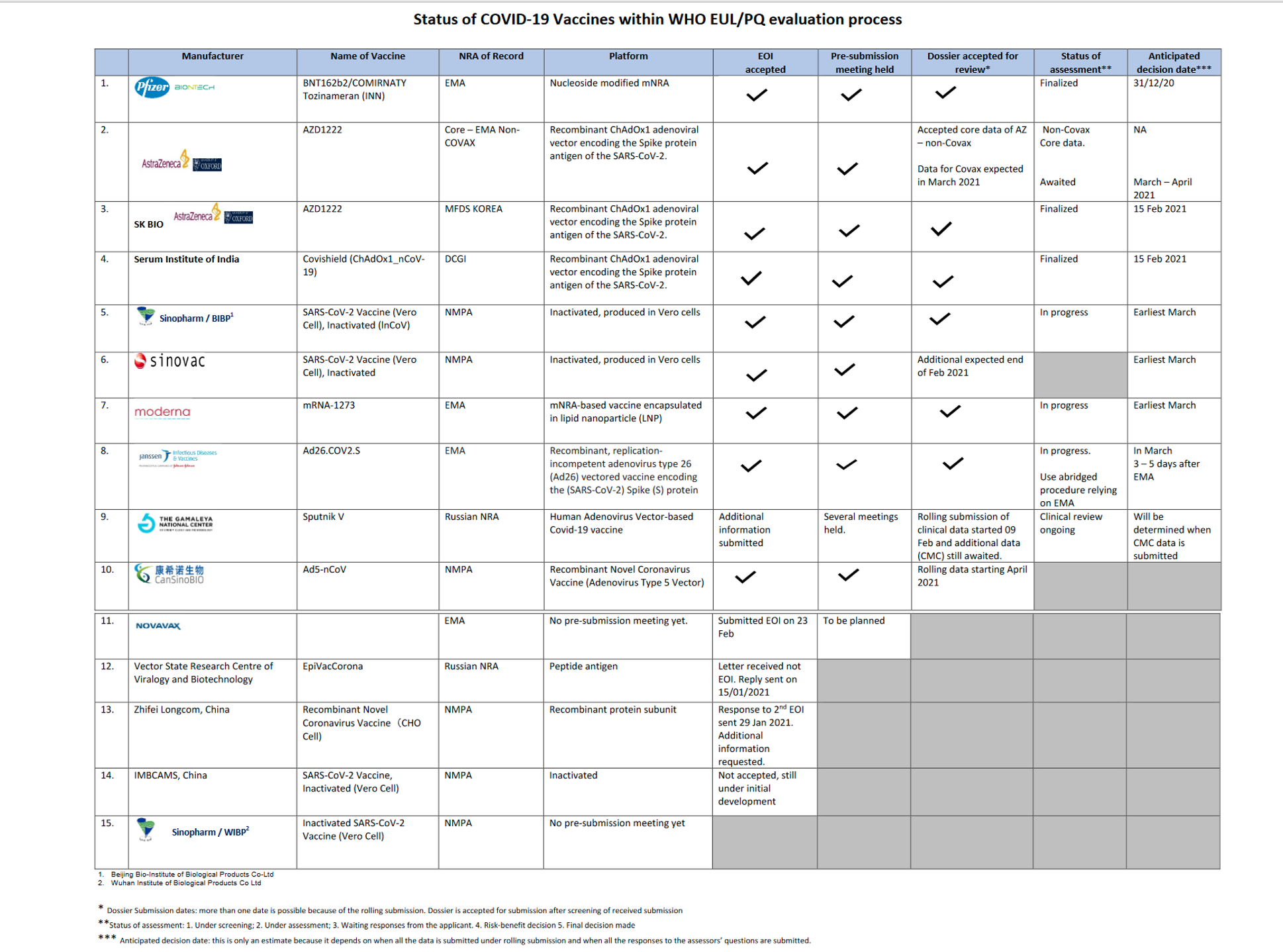
Status of COVID-19 Vaccines within WHO EUL/PQ evaluation process 24 Feb 2021

Milestones :: Perspectives :: Research


WHO: Regulation and Prequalification

Status of COVID-19 Vaccines within WHO EUL/PQ evaluation process 24 Feb 2021
For 16 vaccine candidates, the presents Manufacturer, Name of Vaccine, NRA of Record, Platform, EOI Accepted Status, Pre-submission Meeting Held Status, Dossier Accepted for Review, Status of Assessment; Anticipated/Completed Decision Date
[click on the link above for full scale view]

Coronavirus (COVID-19) Vaccinations

Milestones :: Perspectives :: Research

Our World in Data
Coronavirus (COVID-19) Vaccinations
Our World in Data and the SDG-Tracker are collaborative efforts between researchers at the University of Oxford, who are the scientific editors of the website content; and the non-profit organization Global Change Data Lab, who publishes and maintains the website and the data tools that make our work possible. At the University of Oxford we are based at the Oxford Martin Programme on Global Development.

Research and data: Hannah Ritchie, Esteban Ortiz-Ospina, Diana Beltekian, Edouard Mathieu, Joe Hasell, Bobbie Macdonald, Charlie Giattino, and Max Roser
Web development: Breck Yunits, Ernst van Woerden, Daniel Gavrilov, Matthieu Bergel, Shahid Ahmad, Jason Crawford, and Marcel Gerber