Physicians’ attitudes towards accelerated access to medicines

Health Economics, Policy and Law 
Volume 16 – Issue 2 – April 2021
https://www.cambridge.org/core/journals/health-economics-policy-and-law/latest-issue


Article
Physicians’ attitudes towards accelerated access to medicines
Jessica Pace, Ian Kerridge, Sallie Pearson, Wendy Lipworth
Published online by Cambridge University Press: 31 October 2019, pp. 154-169
Abstract
In recent years, a variety of ‘accelerated access’ schemes have been introduced by pharmaceutical regulators and funders globally. These schemes aim to overcome perceived regulatory and reimbursement barriers to accessing medicines – particularly for patients with limited time or therapeutic options. However, patient access to approved medicines is mediated by a number of third parties including regulators and payers, and physicians who act both as gatekeepers and guides to prescribed medications. It is therefore essential to know how physicians think about accelerated access as they are responsible for advising patients on and prescribing medicines made available via these pathways. We conducted semi-structured interviews with 18 Australian physicians focusing on their attitudes towards accelerated access. We identified three ‘archetypes’ of physicians: ‘confident accelerators’, ‘cautious accelerators’, and ‘decelerators’. Although all acknowledged the potential risks and benefits of accelerated access, they disagreed on their magnitude and extent and how they should be balanced in both policy formation and clinical practice. Overall, our results illustrate the diversity of clinical opinions in this area and the importance of monitoring both the prescribing and clinical outcomes that result from accelerated access programmes to ensure that these are both clinically and morally acceptable.

Disability inclusion in humanitarian action

Humanitarian Exchange Magazine
Number 78, October 2020
https://odihpn.org/magazine/inclusion-of-persons-with-disabilities-in-humanitarian-action-what-now/


Disability inclusion in humanitarian action
by HPN October 2020
The theme of this edition of Humanitarian Exchange, co-edited with Sherin Alsheikh Ahmed from Islamic Relief Worldwide, is disability inclusion in humanitarian action. Persons with disabilities are not only disproportionately impacted by conflicts, disasters and other emergencies, but also face barriers to accessing humanitarian assistance. At the same time, global commitments and standards and the IASC Guidelines on the inclusion of persons with disabilities in humanitarian action all emphasise how persons with disabilities are also active agents of change. Disability and age-focused organisations have led on testing and demonstrating how inclusion can be done better. Yet despite this progress, challenges to effective inclusion remain.

As Kirstin Lange notes in the lead article, chief among these challenges is humanitarian agencies’ lack of engagement with organisations of persons with disabilities. Simione Bula, Elizabeth Morgan and Teresa Thomson look at disability inclusion in humanitarian response in the Pacific, and Kathy Al Jubeh and Alradi Abdalla argue for a ‘participation revolution’, building on learning from the gender movement. Tchaurea Fleury and Sulayman AbdulMumuni Ujah outline how the Bridge Article 11 training initiative is encouraging constructive exchange between humanitarian and disability actors. The lack of good, disaggregated data is highlighted by Sarah Collinson; Frances Hill, Jim Cranshaw and Carys Hughes emphasise the need for training resources in local languages and accessible formats; and Sophie Van Eetvelt and colleagues report on a review of the evidence on inclusion of people with disabilities and older people.

Rebecca Molyneux and co-authors analyse the findings of a review of a DFID programme in north-east Nigeria, while Carolin Funke highlights the importance of strategic partnerships between disability-focused organisations, drawing on her research in Cox’s Bazar. Sherin Alsheikh Ahmed describes Islamic Relief Worldwide’s approach to mainstreaming protection and inclusion, while Pauline Thivillier and Valentina Shafina outline IRC’s Client Responsive Programming. The edition ends with reflections by Mirela Turcanu and Yves Ngunzi Kahashi on CAFOD’s SADI approach.

COVID-19 vaccines under the International Health Regulations – We must use the WHO International Certificate of Vaccination or Prophylaxis

International Journal of Infectious Diseases
March 2021 Volume 104 p1-754
https://www.ijidonline.com/current


Editorial
COVID-19 vaccines under the International Health Regulations – We must use the WHO International Certificate of Vaccination or Prophylaxis
Eskild Petersen, et al
Published online: January 19, 2021
p175-177
… We propose that persons who have completed a full course of immunisation with an approved SARS-CoV-2 vaccine by an authorised provider should be allowed to travel freely for a specified period of time after completion of the last dose of immunisation…. In conclusion, standardized documentation of vaccination of travellers against SARS-COV -2 should be considered under the IHR. A number of questions will need to be answered in order to enable adoption by IHR. It is recommended when people are immunized against SARS-COV-2, they bring their WHO Yellow Card with them and ask the provider to enter the vaccine name and batch, date, sign and stamp. If a person does not have a WHO Yellow Card, she/he should obtain a proof of vaccination card with this important information. Immunisation certificates issued by national authorities using approved vaccines should be accepted as proof of immunity by airlines and national authorities.

The US Regulatory System and COVID-19 Vaccines – The Importance of a Strong and Capable FDA

JAMA
March 23/30, 2021, Vol 325, No. 12, Pages 1125-1234
https://jamanetwork.com/journals/jama/currentissue


Viewpoint
The US Regulatory System and COVID-19 Vaccines – The Importance of a Strong and Capable FDA
Joshua M. Sharfstein, MD; Jesse L. Goodman, MD, MPH; Luciana Borio, MD
free access has active quiz
JAMA. 2021;325(12):1153-1154. doi:10.1001/jama.2021.1961
This Viewpoint examines the important role of the Food and Druf Administration (FDA) in facilitating the rapid development of coronavirus disease 2019 (COVID-19) vaccines.

The Time for COVID-19 Vaccination

Journal of Virology
April 2021; Volume 95, Issue 8
http://jvi.asm.org/content/current


Commentary
The Time for COVID-19 Vaccination
The composition and dynamics of viral mutant spectra in infected individuals advise that to avoid selection of severe acute respiratory syndrome coronavirus 2 (SARS-CoV-2) escape mutants, vaccination campaigns for coronavirus disease 2019 (COVID-19) should be launched when disease incidence is low.
Esteban Domingo, Celia Perales

Announcing the Lancet Commission on Vaccine Refusal, Acceptance, and Demand in the USA

Comment

Announcing the Lancet Commission on Vaccine Refusal, Acceptance, and Demand in the USA

Commissioners of the Lancet Commission on Vaccine Refusal, Acceptance, and Demand in the USA

Vaccines are one of the most effective tools for the prevention of infectious diseases.1 However, the success of immunisation programmes depends on widespread acceptance and high coverage of vaccination.2 Over the past decade, vaccine refusal has accelerated in the USA, with increased non-medical exemptions to school immunisation requirements that have been linked to outbreaks of vaccine-preventable diseases.3 Although vaccine refusal is not uniformly spread across the USA and national childhood vaccination rates remain high, vaccination has declined in many communities and school districts that are consequently at increased risk of outbreaks of vaccine-preventable diseases.4

Achieving optimal and uniform vaccine acceptance is a complex challenge, especially because early evidence suggests that key factors affecting vaccine acceptance may have shifted over the past few years. Anti-vaccine activities are prominent,5 but are only a part of why vaccine refusal has increased. Other factors include ongoing distrust of the medical community, particularly among socially vulnerable communities, and poor or inconsistent public communications on the safety of vaccines to prevent emerging pandemic threats.

Organised anti-vaccine activities are a concern. In the past, the US anti-vaccine movement generally operated at the fringes of society, but it has now expanded its reach through increased political activities and amplification on the internet, social media, and e-commerce platforms.5 Homegrown anti-vaccine organisations at the state and national levels, combined with weaponised health attacks from some foreign nations, now dominate the internet through coordinated disinformation.5678

One recent study found that just two homegrown anti-vaccine organisations were responsible for more than half of all anti-vaccine advertisements on Facebook.9 National and international organisations now host regular anti-vaccine conferences and stage rallies.7 Additionally, in many states, such as California, Oklahoma, and Texas, political action committees influence or lobby state legislatures, often through libertarian or far-right legislators touting so-called health freedom.7 This movement has built on a growing interest in non-pharmaceutical interventions and alternative medicine, and heightened scepticism of the drug industry.10

The repercussions of these efforts cost lives. The number of measles cases in the USA increased in the past few years;11 in 2019, there were more than 1200 cases of measles and multiple hospitalisations and intensive care unit admissions. 12 Adolescents are also unnecessarily placed at risk for human papillomavirus cancers as are adults,13 and many Americans die every year from influenza.14

The USA is potentially facing frequent and costly public health crises due to outbreaks of infectious diseases arising from low vaccine acceptance…

Racial, ethnic, and economic disparities are issues that need to be addressed in efforts to build vaccine acceptance. COVID-19 transmission, morbidity, and mortality have disproportionately affected essential workers, Americans living in low-income neighbourhoods, and communities of colour, which reflects the effects of systemic racism.15..

The Lancet has established the Commission for Vaccine Refusal, Acceptance, and Demand in the USA to design a multisectoral plan for public policy to support high acceptance of safe and effective vaccines in the USA. Our goal is to understand and report on the state of vaccine acceptance and its potential link to vaccine hesitancy. Additionally, we will work to identify and predict future trends in vaccine acceptance and impacts on the public health community. We will also identify and assess demand-side vaccine uptake interventions and solutions to counter anti-vaccine information.

Similar disparate health outcomes have occurred in other pandemics, such as the H1N1 influenza pandemic in 2009, and they are likely to arise in future disease outbreaks…

The Commission had its first meeting in 2020, and we aim for a first interim report on COVID-19 vaccines in the coming months. We expect to present a comprehensive report on broader vaccine acceptance and hesitancy in the USA by 2022. We will post updates about the Commission’s ongoing work on the Commission website. We are hopeful that confidence in and acceptance of vaccines in the USA can be improved through a cooperative strategy…

COVID-19: building a stronger Europe

The Lancet
Mar 27, 2021 Volume 397 Number 10280 p1157-1236
https://www.thelancet.com/journals/lancet/issue/current


Editorial
COVID-19: building a stronger Europe
The Lancet
Europe is facing serious third waves of COVID-19 and vaccine roll-out has been fraught. But while much of the focus has been on western Europe, little attention has been paid to central and eastern Europe. This region is large, politically diverse, and historically complex, spanning EU member countries like the Czech Republic, Bulgaria, and the Baltic states, the non-EU western Balkans, and Ukraine further east. It is unclear how some of these countries managed to keep cases low during the first part of 2020. By mid-March 2021, six of the top ten countries globally with the highest death rates per 100 000 people were in central and eastern Europe (up to 230·34 in Czech Republic). This fact raises questions about the general state of health across the region. It also gives urgency to the issue of how Europe as a whole can best ensure its collective health security and prosperity. As COVID-19 brings immediate crises to Europe, health could be a unifying force to strengthen the ties between countries both within and outside the EU….

Assessment of protection against reinfection with SARS-CoV-2 among 4 million PCR-tested individuals in Denmark in 2020: a population-level observational study

The Lancet
Mar 27, 2021 Volume 397 Number 10280 p1157-1236
https://www.thelancet.com/journals/lancet/issue/current


Articles
Assessment of protection against reinfection with SARS-CoV-2 among 4 million PCR-tested individuals in Denmark in 2020: a population-level observational study
Christian Holm Hansen, Daniela Michlmayr, Sophie Madeleine Gubbels, Kåre Mølbak, Steen Ethelberg
Our findings could inform decisions on which groups should be vaccinated and advocate for vaccination of previously infected individuals because natural protection, especially among older people, cannot be relied on.

Urgent lessons from COVID 19: why the world needs a standing, coordinated system and sustainable financing for global research and development

The Lancet
Mar 27, 2021 Volume 397 Number 10280 p1157-1236
https://www.thelancet.com/journals/lancet/issue/current


Health Policy
Urgent lessons from COVID 19: why the world needs a standing, coordinated system and sustainable financing for global research and development
Nicole Lurie, Gerald T Keusch, Victor J Dzau
Summary
The research and development (R&D) ecosystem has evolved over the past decade to include pandemic infectious diseases, building on experience from multiple recent outbreaks. Outcomes of this evolution have been particularly evident during the COVID-19 pandemic with accelerated development of vaccines and monoclonal antibodies, as well as novel clinical trial designs. These products were developed, trialled, manufactured, and authorised for use in several countries within a year of the pandemic’s onset. Many gaps remain, however, that must be bridged to establish a truly efficient and effective end-to-end R&D preparedness and response ecosystem. Foremost among them is a global financing system. In addition, important changes are required for multiple aspects of enabling sciences and product development. For each of these elements we identify priorities for improved and faster functionality. There will be no better time than now to seriously address these needs, however difficult, as the ravages of COVID-19 continue to accelerate with devastating health, social, and economic consequences for the entire community of nations.

Vaccine Efficacy of ALVAC-HIV and Bivalent Subtype C gp120–MF59 in Adults G.E. Gray and Others

New England Journal of Medicine
March 25, 2021 Vol. 384 No. 12
http://www.nejm.org/toc/nejm/medical-journal


Original Articles
Vaccine Efficacy of ALVAC-HIV and Bivalent Subtype C gp120–MF59 in Adults G.E. Gray and Others
A safe, effective vaccine is essential to eradicating human immunodeficiency virus (HIV) infection. A canarypox–protein HIV vaccine regimen (ALVAC-HIV plus AIDSVAX B/E) showed modest efficacy in reducing infection in Thailand. An analogous regimen using HIV-1 subtype C virus showed potent humoral and cellular responses in a phase 1–2a trial in South Africa. Efficacy data and additional safety data were needed for this regimen in a larger population in South Africa….The ALVAC–gp120 regimen did not prevent HIV-1 infection among participants in South Africa despite previous evidence of immunogenicity.

Double drives and private alleles for localised population genetic control

PLoS Genetics
https://journals.plos.org/plosgenetics/
(Accessed 27 Mar 2021)


Double drives and private alleles for localised population genetic control
Katie Willis, Austin Burt
Research Article | published 23 Mar 2021 PLOS Genetics
https://doi.org/10.1371/journal.pgen.1009333
Author summary
Some disease vectors, invasive species, and other pests cannot be satisfactorily controlled with existing interventions, and new methods are required. Synthetic gene drive systems that are able to spread though populations because they are inherited at a greater-than-Mendelian rate have the potential to form the basis for new, highly efficient pest control measures. The most efficient such strategies use natural gene flow to spread a construct throughout a species’ range, but if control is only desired in a particular location then these approaches may not be appropriate. As some of the most promising gene drive designs use nucleases to target specific DNA sequences, it ought to be possible to exploit sequence differences between target and non-target populations to restrict the spread and impact of a gene drive. In this paper we propose using two-construct “double drive” designs that exploit pre-existing sequence differences between target and non-target populations. Our approaches maintain the efficiencies associated with only small release rates being needed and can work if the differentiated locus is selectively neutral and if the differentiation is far from complete, and therefore expand the range of options to be considered in developing genetic approaches to control pest species.

Influenza vaccine effectiveness against influenza A in children based on the results of various rapid influenza tests in the 2018/19 season

PLoS One
http://www.plosone.org/
[Accessed 27 Mar 2021]


Influenza vaccine effectiveness against influenza A in children based on the results of various rapid influenza tests in the 2018/19 season
Masayoshi Shinjoh, Norio Sugaya, Yoshio Yamaguchi, Ichiro Ookawara, Yuji Nakata, Atsushi Narabayashi, Munehiro Furuichi, Naoko Yoshida, Akinobu Kamei, Yuu Kuramochi, Akimichi Shibata, Motoko Shimoyamada, Hisataka Nakazaki, Naohiko Maejima, Erika Yuasa, Eriko Araki, Naonori Maeda, Takuma Ohnishi, Mitsuhiro Nishida, Nobuhiko Taguchi, Makoto Yoshida, Kenichiro Tsunematsu, Meiwa Shibata, Yasuhiro Hirano, Shinichiro Sekiguchi, Chiharu Kawakami, Keiko Mitamura, Takao Takahashi
Research Article | published 26 Mar 2021 PLOS ONE
https://doi.org/10.1371/journal.pone.0249005

COVID-19 vaccine hesitancy and resistance: Correlates in a nationally representative longitudinal survey of the Australian population

PLoS One
http://www.plosone.org/
[Accessed 27 Mar 2021]


COVID-19 vaccine hesitancy and resistance: Correlates in a nationally representative longitudinal survey of the Australian population
Ben Edwards, Nicholas Biddle, Matthew Gray, Kate Sollis
Research Article | published 24 Mar 2021 PLOS ONE
https://doi.org/10.1371/journal.pone.0248892

Volatility of vaccine confidence

Science
26 March 2021 Vol 371, Issue 6536
http://www.sciencemag.org/current.dtl


Editorial
Volatility of vaccine confidence
By Heidi J. Larson, David A. Broniatowski
Science26 Mar 2021 : 1289
Summary
Last week, the European Medicines Agency declared the AstraZeneca COVID-19 vaccine safe and effective, after several European Union member states had suspended its use because of blood clot concerns. Will the public trust this message? This week’s news could help—a U.S. phase 3 clinical trial of the vaccine shows promising efficacy in preventing symptomatic COVID-19. But sentiments toward vaccines are volatile and reflect external events—such as recent concern about AstraZeneca’s efficacy data—as well as internal emotions.

Age groups that sustain resurging COVID-19 epidemics in the United States

Science
26 March 2021 Vol 371, Issue 6536
http://www.sciencemag.org/current.dtl


Research Articles
Age groups that sustain resurging COVID-19 epidemics in the United States
By Mélodie Monod, Alexandra Blenkinsop, Xiaoyue Xi, Daniel Hebert, Sivan Bershan, Simon Tietze, Marc Baguelin, Valerie C. Bradley, Yu Chen, Helen Coupland, Sarah Filippi, Jonathan Ish-Horowicz, Martin McManus, Thomas Mellan, Axel Gandy, Michael Hutchinson, H. Juliette T. Unwin, Sabine L. van Elsland, Michaela A. C. Vollmer, Sebastian Weber, Harrison Zhu, Anne Bezancon, Neil M. Ferguson, Swapnil Mishra, Seth Flaxman, Samir Bhatt, Oliver Ratmann, on behalf of the Imperial College COVID-19 Response Team
Science26 Mar 2021 Open Access
More targeted interventions in the 20-to-49 age group could bring epidemic waves under control and facilitate the safe reopening of schools.
Age-specific contact
How can the resurgent epidemics of severe acute respiratory syndrome coronavirus 2 (SARS-CoV-2) during 2020 be explained? Are they a result of students going back to school? To address this question, Monod et al. created a contact matrix for infection based on data collected in Europe and China and extended it to the United States. Early in the pandemic, before interventions were widely implemented, contacts concentrated among individuals of similar age were the highest among school-aged children, between children and their parents, and between middle-aged adults and the elderly. However, with the advent of nonpharmaceutical interventions, these contact patterns changed substantially. By mid-August 2020, although schools reopening facilitated transmission, the resurgence in the United States was largely driven by adults 20 to 49 years of age. Thus, working adults who need to support themselves and their families have fueled the resurging epidemics in the United States.

Reproducibility in machine learning for health research: Still a ways to go

Science Translational Medicine
17 March 2021 Vol 13, Issue 585
https://stm.sciencemag.org/


Perspective
Reproducibility in machine learning for health research: Still a ways to go
By Matthew B. A. McDermott, Shirly Wang, Nikki Marinsek, Rajesh Ranganath, Luca Foschini, Marzyeh Ghassemi
Science Translational Medicine24 Mar 2021 Restricted Access
Abstract
Machine learning for health must be reproducible to ensure reliable clinical use. We evaluated 511 scientific papers across several machine learning subfields and found that machine learning for health compared poorly to other areas regarding reproducibility metrics, such as dataset and code accessibility. We propose recommendations to address this problem.

Associations of COVID-19 risk perception with vaccine hesitancy over time for Italian residents

Social Science & Medicine
Volume 272 March 2021
https://www.sciencedirect.com/journal/social-science-and-medicine/vol/272/suppl/C


Research article Full text access
Associations of COVID-19 risk perception with vaccine hesitancy over time for Italian residents
Marta Caserotti, Paolo Girardi, Enrico Rubaltelli, Alessandra Tasso, … Teresa Gavaruzzi
Article 113688

Can a COVID-19 vaccine live up to Americans’ expectations? A conjoint analysis of how vaccine characteristics influence vaccination intentions

Social Science & Medicine
Volume 272 March 2021
https://www.sciencedirect.com/journal/social-science-and-medicine/vol/272/suppl/C


Research article Full text access
Can a COVID-19 vaccine live up to Americans’ expectations? A conjoint analysis of how vaccine characteristics influence vaccination intentions
Matt Motta
Article 113642

Variants, vaccines and vaccination passports: Challenges and chances for travel medicine in 2021

Travel Medicine and Infectious Diseases
Volume 40 March–April 2021
https://www.sciencedirect.com/journal/travel-medicine-and-infectious-disease/vol/40/suppl/C


Editorial Full text access
Variants, vaccines and vaccination passports: Challenges and chances for travel medicine in 2021
Patricia Schlagenhauf, Dipti Patel, Alfonso J. Rodriguez-Morales, Philippe Gautret, … Karin Leder
Article 101996

Mass religious gatherings events and COVID-19 –easing of COVID-19 restrictions and a staged approach to scaling up the Umrah Pilgrimage

Travel Medicine and Infectious Diseases
Volume 40 March–April 2021
https://www.sciencedirect.com/journal/travel-medicine-and-infectious-disease/vol/40/suppl/C


Editorial Full text access
Mass religious gatherings events and COVID-19 –easing of COVID-19 restrictions and a staged approach to scaling up the Umrah Pilgrimage
J.A. Al-Tawfiq, Z.A. Memish, A. Zumla
Article 101986

A validated modification of the vaccine hesitancy scale for childhood, influenza and HPV vaccines

Vaccine
Volume 39, Issue 13 Pages 1797-1876 (26 March 2021)
https://www.sciencedirect.com/journal/vaccine/vol/39/issue/13


Research article Abstract only
A validated modification of the vaccine hesitancy scale for childhood, influenza and HPV vaccines
Laura J. Helmkamp, Peter G. Szilagyi, Gregory Zimet, Alison W. Saville, … Allison Kempe
Pages 1831-1839

Effectiveness of a universal vaccination program with an HPV quadrivalent vaccine in young Brazilian women

Vaccine
Volume 39, Issue 13 Pages 1797-1876 (26 March 2021)
https://www.sciencedirect.com/journal/vaccine/vol/39/issue/13


Research article Open access
Effectiveness of a universal vaccination program with an HPV quadrivalent vaccine in young Brazilian women
Eliana M. Wendland, Natália Luiza Kops, Marina Bessel, Juliana Comerlato, … Gerson Fernando Mendes Pereira
Pages 1840-1845

Achieving Influenza Vaccine Uptake Target in Canada via a Pharmacy-Led Telephone Discussion during the 2019–2020 Season

Vaccines — Open Access Journal
http://www.mdpi.com/journal/vaccines
(Accessed 27 Mar 2021)


Open Access Article
Achieving Influenza Vaccine Uptake Target in Canada via a Pharmacy-Led Telephone Discussion during the 2019–2020 Season
by William David Strain, James Mansi, Constantina Boikos, Michael Boivin and William A. Fisher
Vaccines 2021, 9(4), 312; https://doi.org/10.3390/vaccines9040312 – 26 Mar 2021
Abstract
Older adults (≥65 years) are at elevated risk of influenza-related morbidity and mortality. Many developed countries do not achieve the World Health Organization influenza immunization target of 75% in people ≥65 years. We aimed to determine whether a brief pharmacy phone call could […]

COVID-19 Vaccine Hesitancy among French People Living with HIV

Vaccines — Open Access Journal
http://www.mdpi.com/journal/vaccines
(Accessed 27 Mar 2021)


Open Access Article
COVID-19 Vaccine Hesitancy among French People Living with HIV
by Alexandre Vallée, Erwan Fourn, Catherine Majerholc, Pauline Touche and David Zucman
Vaccines 2021, 9(4), 302; https://doi.org/10.3390/vaccines9040302 – 24 Mar 2021
Abstract
People living with HIV are a high-risk population concerning the coronavirus 19 (COVID-19) infection, with a poorer prognosis. It is important to achieve high COVID-19 vaccination coverage rates in this group as soon as possible. This project used self-reporting to assess vaccine hesitancy […

Factors Associated with COVID-19 Vaccine Hesitancy

Vaccines — Open Access Journal
http://www.mdpi.com/journal/vaccines
(Accessed 27 Mar 2021)


Open Access Article
Factors Associated with COVID-19 Vaccine Hesitancy
by Patricia Soares, João Victor Rocha, Marta Moniz, Ana Gama, Pedro Almeida Laires, Ana Rita Pedro,
Sónia Dias, Andreia Leite and Carla Nunes
Vaccines 2021, 9(3), 300; https://doi.org/10.3390/vaccines9030300 – 22 Mar 2021
Abstract
It is critical to develop tailored strategies to increase acceptability of the COVID-19 vaccine and decrease hesitancy. Hence, this study aims to assess and identify factors associated with COVID-19 vaccine hesitancy in Portugal. We used data from a community-based survey, “COVID-19 Barometer: Social […]

Media/Policy Watch

Media/Policy Watch
This watch section is intended to alert readers to substantive news, analysis and opinion from the general media and selected think tanks and similar organizations on vaccines, immunization, global public health and related themes. Media Watch is not intended to be exhaustive, but indicative of themes and issues CVEP is actively tracking. This section will grow from an initial base of newspapers, magazines and blog sources, and is segregated from Journal Watch above which scans the peer-reviewed journal ecology.
We acknowledge the Western/Northern bias in this initial selection of titles and invite suggestions for expanded coverage. We are conservative in our outlook in adding news sources which largely report on primary content we are already covering above. Many electronic media sources have tiered, fee-based subscription models for access. We will provide full-text where content is published without restriction, but most publications require registration and some subscription level.
The sheer volume of vaccine and pandemic-related coverage is extraordinary. We will strive to present the most substantive analysis and commentary we encounter.


The Atlantic
http://www.theatlantic.com/magazine/
Accessed 27 Mar 2021
Ideas
Democracies Keep Vaccines for Themselves
President Biden’s pledge to Mexico is an exception from a stark pattern.
3/27/2021
Thomas J. Bollyky
Director of the Global Health Program at the Council on Foreign Relations


BBC
http://www.bbc.co.uk/
Accessed 27 Mar 2021
Covid-19: Vaccines and vaccine passports being sold on darknet
By Joe Tidy
Cyber reporter
March 23, 2021
Covid-19 vaccines, vaccine passports and faked negative test papers are being sold on the darknet.
Prices range between $500 (£360) and $750 for doses of AstraZeneca, Sputnik, Sinopharm or Johnson & Johnson jabs.
Fake vaccination certificates are also being sold by anonymous traders for as little as $150.
Researchers say they have seen a “sharp increase” in vaccine-related darknet adverts, while the BBC has been unable to verify if the vaccines are real.
The darknet, also known as the dark web, is a portion of the internet that is only accessible through specific browser tools…


The Economist
http://www.economist.com/
Accessed 27 Mar 2021
Fighting the P.1 variant
Brazil’s mismanagement of covid-19 threatens the world
Jair Bolsonaro has a lot to answer for
Mar 27th 2021 edition

Banyan
India and China are finding vaccine diplomacy tricky
Helping both their own citizens and foreigners is an immense task
Mar 27th 2021 edition


Financial Times
https://www.ft.com/
Accessed 27 Mar 2021
Pascal Soriot
Pascal Soriot: the pharma CEO navigating a vaccine storm
March 27, 2021

Covid-19 vaccines
Europe warns hospitals at ‘breaking point’ as third Covid wave hits
March 26, 2021
Top of Form
Bottom of Form

Covid-19 vaccines
India rethinks vaccine export plans as infections surge
Government says it is ‘calibrating’ supply schedules to suit domestic needs
March 26, 2021

Bottom of Form


Forbes
http://www.forbes.com/
Accessed 27 Mar 2021
Mar 27, 2021
New York Just Launched A Digital Vaccine Pass To Restart Concerts, Sports Events And Other Activities
The Excelsior Pass aims to be a ticket back to a life that looks and feels a lot more normal.
By Suzanne Rowan Kelleher Forbes Staff
New York Governor Andrew Cuomo has announced the launch of the Excelsior Pass — a free, voluntary digital app developed in partnership with IBM that will verify if an individual user is fully vaccinated against Covid-19 or has recently tested negative for the illness.
The platform is intended to fast-track the reopening of sports arenas, music venues, restaurants and other businesses with capacity limitations due to Covid-19 in accordance with New York State Department of Health guidelines.
New York is the first state in the U.S. to formally launch a digital passport for Covid-19. The launch follows two successful pilot demonstrations and a beta test that included thousands of New Yorkers in a limited rollout…

Mar 25, 2021
Rutgers Becomes First Major University To Require Covid-19 Vaccination
There will be medical and religious exemptions, and students attending school online will not be subject to the requirement.
By Alison Durkee Forbes Staff


Foreign Affairs
http://www.foreignaffairs.com/
Accessed 27 Mar 2021
[No new, unique, relevant content]


Foreign Policy
http://foreignpolicy.com/
Accessed 27 Mar 2021
Argument
At China’s Borders, “Vaccine Passports” Just Got Real
In announcing it would prioritize travelers who had received Chinese-made vaccines, Beijing sparked outrage in countries where those aren’t available.
By Rajni George
| March 25, 2021, 4:09 PM


New Yorker
http://www.newyorker.com/
Accessed 27 Mar 2021
[No new, unique, relevant content]


New York Times
http://www.nytimes.com/
Accessed 27 Mar 2021
Asia Pacific
India’s case surge hits highs not seen in months as festival season begins.
Infections are soaring in the country, which has severely curtailed exports of Covid-19 vaccines as it tries to prevent a second wave.
By Sameer Yasir Mar 27

World
Argentina delays second doses to focus on broader vaccinations with first dose, fearing a variant-fueled wave.
The country plans to defer second shots for three months to give more residents first doses as variants drive case surges in neighboring Brazil, Chile and Paraguay.
By Daniel Politi and Andrew E. Kramer Mar 27

World
Kenya imposes sharp restrictions on Nairobi and surrounding counties as a surge builds.
Several variants have been found in the country, but there is little data on whether they are playing a role in the rapid increase in infections and hospitalizations.
By Declan Walsh Mar 26


Washington Post
https://www.washingtonpost.com/
Accessed 27 Mar 2021
[No new, unique, relevant content]

Think Tanks et al

Think Tanks et al

Brookings
http://www.brookings.edu/
Accessed 27 Mar 2021
Coronavirus (COVID-19)
Behavior and the dynamic of epidemics
Andrew G. Atkeson
Wednesday, March 24, 2021
 
 
Center for Global Development [to 27 Mar 2021]
http://www.cgdev.org/page/press-center
Publication
March 26, 2021
How Can We Encourage COVID-19 Vaccine Developers to Expand Manufacturing Capacity?
Safe and efficacious vaccines are our best tools for defeating COVID-19. An unprecedented research and development effort has led to 12 vaccines with full or limited use emergency authorizations globally, but vaccinating everyone in the world as quickly as possible will require additional production capacity. Currently, there is not enough manufacturing capacity globally to accelerated immunization around the world in the next six months.
Burak Kazaz, Scott Webster and Prashant Yadav

Incentivizing COVID-19 Vaccine Developers to Expand Manufacturing Capacity
Publication
3/26/21
Safe and efficacious vaccines are our best tools for defeating COVID-19, and an unprecedented research and development effort has led to 12 vaccines being approved for full, emergency, or limited use, globally. But to vaccinate the global population as quickly as possible requires additional production capacity. The available global production capacity may be sufficient in aggregate across all vaccine manufacturing platforms over an 18- to 24-month window.

March 23, 2021
COVID-19 Vaccination and the Multilateral Development Banks: Moving Towards a More Systematic and Strategic Approach
How should the MDB vaccine effort intersect with global efforts like COVAX, or indeed plans to share or donate vaccine amongst countries? In this blog, we look at two issues raised by the World Bank’s approach so far and offer options for a better way forward.
Amanda Glassman, Erin Collinson and Janeen Madan Keller
 
 
Chatham House [to 27 Mar 2021]
https://www.chathamhouse.org/
Accessed 27 Mar 2021
[No new digest content identified]


CSIS
https://www.csis.org/
Accessed 27 Mar 2021
Upcoming Event
Trusting a Covid-19 Vaccine: What’s Next?
April 9, 2021

Transcript
Intersecting Pandemics: Adrian Thomas of J&J on Tuberculosis (TB) & Covid-19
March 24, 2021

Commentary
Serbia’s Vaccine Influence in the Balkans
March 24, 2021 |
By Heather A. Conley, Dejana Saric


Kaiser Family Foundation
https://www.kff.org/search/?post_type=press-release
Accessed 27 Mar 2021
March 22, 2021 News Release
From Accessing Health Care to Work, Childcare, and Caregiving, the COVID-19 Pandemic Continues to Disproportionately Impact Women
Since the start of the COVID-19 pandemic, gender-based disparities have been amplified, particularly for women of color and those who are low-income. Two new issue briefs, using data from the 2020 KFF Women’s Health Survey that took place in November and December of 2020, examine women’s experiences during COVID-19. Women’s…
 
 
World Economic Forum [to 27 Mar 2021]
https://agenda.weforum.org/news/
Media
Accessed 27 Mar 2021
[No new digest content identified]

Vaccines and Global Health: The Week in Review :: 20 March 2021

Vaccines and Global Health: The Week in Review is a weekly digest  summarizing news, events, announcements, peer-reviewed articles and research in the global vaccine ethics and policy space. Content is aggregated from key governmental, NGO, international organization and industry sources, key peer-reviewed journals, and other media channels. This summary proceeds from the broad base of themes and issues monitored by the Center for Vaccine Ethics & Policy in its work: it is not intended to be exhaustive in its coverage. You are viewing the blog version of our weekly digest, typically comprised of between 30 and 40 posts below all dated with the current issue date

.– Request an Email Summary: Vaccines and Global Health : The Week in Review is published as a single email summary, scheduled for release each Saturday evening before midnight (EDT in the U.S.). If you would like to receive the email version, please send your request to david.r.curry@centerforvaccineethicsandpolicy.org.

– pdf version A pdf of the current issue is available here: 

– blog edition: comprised of the approx. 35+ entries posted below.

– Twitter:  Readers can also follow developments on twitter: @vaxethicspolicy.
.
– Links:  We endeavor to test each link as we incorporate it into any post, but recognize that some links may become “stale” as publications and websites reorganize content over time. We apologize in advance for any links that may not be operative. We believe the contextual information in a given post should allow retrieval, but please contact us as above for assistance if necessary.

Support this knowledge-sharing service: Your financial support helps us cover our costs and to address a current shortfall in our annual operating budget. Click here to donate and thank you in advance for your contribution.

.
David R. Curry, MS
Executive Director
Center for Vaccine Ethics and Policy

Assessing Country Readiness for COVID-19 Vaccines – First Insights from the Assessment Rollout

Milestones :: Perspectives :: Research


Assessing Country Readiness for COVID-19 Vaccines – First Insights from the Assessment Rollout
World Bank – Publication :: March 11, 2021 :: 28 pages
PDF: http://documents1.worldbank.org/curated/en/467291615997445437/pdf/Assessing-Country-Readiness-for-COVID-19-Vaccines-First-Insights-from-the-Assessment-Rollout.pdf

Executive Summary
The global COVID-19 vaccination campaign, the largest public health initiative ever undertaken, presents challenges unprecedented in scale, speed and specificities, especially in low and middle-income countries. In November 2020, anticipating the availability of safe and effective vaccines for COVID-19, the World Bank together with WHO, UNICEF, the Global Fund, and Gavi rolled out readiness assessments in more than 100 low and middle-income countries. The key insights from the assessments to date present a high-level snapshot of country readiness to deploy COVID-19 vaccines based on initial findings from ongoing assessments in 128 countries. The World Bank is providing $12 billion for developing countries to purchase and distribute COVID-19 vaccines, tests and treatments and strengthen health and vaccination systems to ensure that vaccines get to those who need them. The assessments provide highly valuable insights into countries’ preparedness and will feed into World Bank projects.

Initial findings from the ongoing assessments show that the world’s poorest countries are at varying degrees of readiness for the massive undertaking of vaccinating their populations against the deadly COVID-19 disease.


The assessments reveal that while 85% of countries have developed national vaccination plans and 68% have vaccine safety systems, only 30% have developed processes to train the large number of vaccinators who will be needed for the campaign and only 27% have created social mobilization and public engagement strategies to encourage people to get vaccinated. Given the worrying vaccine hesitancy levels, strategies to generate confidence, acceptance and demand for the vaccine are urgently needed.

The assessments further show that most countries are focusing on strengthening essential aspects of the vaccine delivery chain – enough to advance vaccination schedules and begin inoculating their populations. The pandemic’s devastating toll on health and economies, fear of highly contagious variants and public pressure to start vaccinations have prompted many countries to prepare aggressive vaccine delivery schedules. Although countries have many gaps in readiness, most have prepared well enough in select essential areas to begin inoculating their populations as soon as vaccines become available. Most countries are approaching the COVID-19 vaccine rollout as an emergency and are emphasizing speed and expediency over deliberative system-strengthening. As a result, they are missing out on the benefits of long-lasting improvements that a systems approach could bring.

The assessments show that COVID-19 vaccination campaigns offer unique opportunities for countries to develop specialized digital systems to track vaccines and vaccinated individuals, and monitor vaccine safety and report adverse reactions. In addition, the large-scale vaccination mobilization provides
opportunities to countries to sustainably strengthen the cold chain and introduce environmentally-friendly options that could be of use well beyond the current crisis.

Finally, it is noteworthy that in most countries the assessments have succeeded in elevating the importance of readiness to the highest levels of decision-making. The assessments have brought together government officers, healthcare professionals, the private sector and communities as well as global partners in the largest vaccination campaign in history, and have generated an unprecedented momentum as countries begin inoculating large swathes of the adult population to overcome the virus that has redefined the world in the last fifteen months.


MAIN REPORT FINDINGS
[1] As countries ramp up efforts to vaccinate their populations against the deadly COVID-19 disease, the world’s poorest countries show varying degrees of readiness for this massive undertaking.

[2] The existence of well-functioning child immunization systems is not a strong predictor of country readiness to deliver COVID-19 vaccines.

[3] Most countries are focusing on strengthening essential aspects of the vaccine delivery chain –enough to advance vaccination schedules and begin inoculating their populations.


[4] Few countries are using the opportunity provided by the deployment of COVID-19 vaccines to strengthen health systems and find long-lasting solutions for similar future challenges

[5] COVID-19 vaccination campaigns offer unique opportunities for countries to digitize their information systems for tracking vaccines and monitoring vaccinations

[6] The COVID-19 vaccine rollout is an opportunity to create environmentally friendly cold chain that could be of use well beyond the current crisis


[7] More countries are using indicative top-down methodologies instead of the new assessment framework and associated tools to cost gaps in readiness.

Media Release
Gaps Remain in Countries Readiness to Deploy COVID-19 Vaccines
Assessments by World Bank and partners provide insights into more than 120 countries’ readiness to safely distribute vaccines
WASHINGTON, March 18, 2021 – As countries undertake the largest vaccination campaign in history, the World Bank has worked with governments, WHO, UNICEF, the Global Fund and GAVI on assessing countries’ readiness to safely deploy COVID-19 vaccines in 128 low- and middle-income countries. The results indicate that income level and other economic indicators correlate weakly with vaccine preparedness. The report focuses on ten key indicators, including cold chain & logistics, population prioritization, budgeting, training of healthcare personnel, and safety surveillance, among others.

Initial findings show that 85% of countries that participated in the assessments have developed national vaccination plans and 68% have safety measures in place, including systems for reporting adverse reactions. However, only 30% have developed plans to train the large number of vaccinators who will be needed and only 27% have created social mobilization and public engagement strategies to encourage people to get vaccinated. Given worrying  vaccine hesitancy, strategies to generate confidence, acceptance and demand for vaccines are urgently needed. Countries affected by conflict and fragility (37 out of 128) scored lower than other countries on almost all indicators.

“Many developing countries are in the midst of preparing aggressive COVID19 vaccine delivery plans,” said Mamta Murthi, Vice President for Human Development at the World Bank. “While most countries are well enough prepared to begin inoculating their populations, there are still important gaps that must urgently be addressed for wide, large scale vaccination rollouts to succeed.”

The World Bank is providing $12 billion for developing countries to purchase and distribute COVID-19 vaccines, tests, and treatments and strengthen health and vaccination systems to ensure that vaccines get to those who need them. Our vaccination programs will reach over 40 countries in the near-term, amounting to $3 billion out of the $12 billion available. The readiness assessments will inform our projects and help governments and healthcare professionals better understand and manage the complex task of vaccinating large adult populations in a very short timeframe…
Coronavirus [COVID-19] – WHO Public Health Emergency of International Concern (PHEIC)

Milestones :: Perspectives :: Research


Coronavirus [COVID-19] – WHO
Public Health Emergency of International Concern (PHEIC)
https://www.who.int/emergencies/diseases/novel-coronavirus-2019


Weekly Epidemiological and Operational updates
Last update: 23 January 2021
Confirmed cases :: 121 969 223 [week ago: 118 754 336] [two weeks ago: 115 653 459]
Confirmed deaths :: 2 694 094 [week ago: 2 634 370] [two weeks ago: 2 571 823]
Countries, areas or territories with cases :: 223


1

6 March 2021
Weekly epidemiological update on COVID-19 –  16 March 2021
Overview
In the past week, new cases continued to rise globally, increasing by 10% in the past week to over 3 million new reported cases. After peaking in early January 2021 when there were just under 5 million cases, new cases then declined to around 2.5 million in the week commencing 15 February 2021 but in the past three weeks have increased again. This week, the Americas and Europe continue to account for over 80% of new cases and new deaths, with rises in new cases seen in all regions apart from Africa, where a decrease by 4% has been reported.
In this edition, special focus updates are provided on:
:: Building and maintaining trust – what countries should do to prepare communities for a COVID-19 vaccine, treatment, or a new test; and
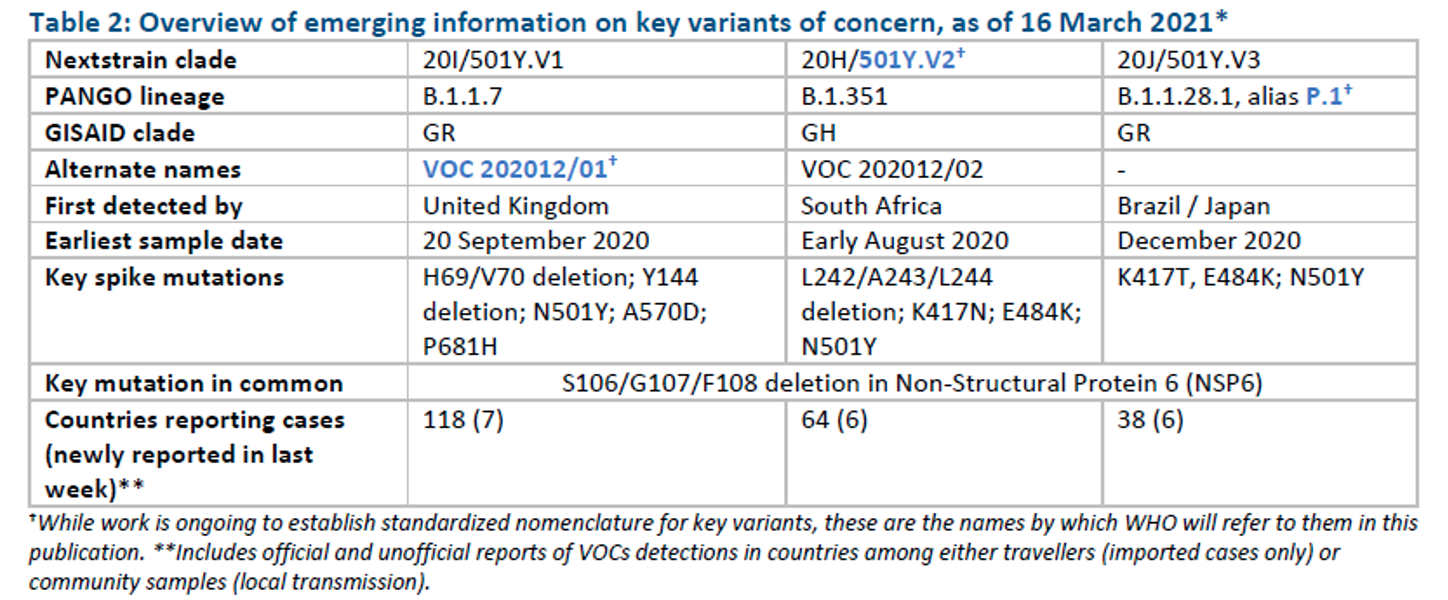
:: SARS-CoV-2 variants of concern:

16 March 2021
Weekly operational update on COVID-19 – 16 March 2021
Overview
In this edition of the Weekly Operational Update on COVID-19, highlights of country-level actions and WHO support to Member States include:
:: Historic roll-out of shipments from COVAX facility gathers pace globally
:: International Women’s Day 2021: Challenging barriers women face accessing life-saving knowledge for COVID-19 response
:: Vaccination data now available on the WHO COVID-19 dashboard
:: Preparedness activities including enriched Intra-Action Reviews, WHO facilitated learning on safe hospitals and reviewing preparedness assessment tools for enhancements
:: The Strategic Preparedness and Response Plan (SPRP) 2021 Operational Planning Guidelines, resource requirements and progress made to continue investing in the COVID-19 response and for building the architecture to prepare for, prevent and mitigate future health emergencies
:: Updates on WHO/PAHO procured items, participation in the Unity Studies, and select indicators from the COVID-19 Monitoring and Evaluation Framework

WHO – COVID Vaccines EUAL, Prequalification

Milestones :: Perspectives :: Research


WHO – COVID Vaccines EUAL, Prequalification

Statement of the WHO Global Advisory Committee on Vaccine Safety (GACVS) COVID-19 subcommittee on safety signals related to the AstraZeneca COVID-19 vaccine
19 March 2021 Statement
The GACVS COVID-19 subcommittee met virtually on 16 and 19 March 2021 to review available information and data on thromboembolic events (blood clots) and thrombocytopenia (low platelets) after vaccination with the AstraZeneca COVID-19 vaccine.

The subcommittee reviewed clinical trial data and reports based on safety data from Europe, the United Kingdom, India, and Vigibase, the WHO global database of individual case safety reports.

Based on a careful scientific review of the available information, the subcommittee came to the following conclusions and recommendations:
:: The AstraZeneca COVID-19 vaccine (including Covishield) continues to have a positive benefit-risk profile, with tremendous potential to prevent infections and reduce deaths across the world.
:: The available data do not suggest any overall increase in clotting conditions such as deep venous thrombosis or pulmonary embolism following administration of COVID-19 vaccines. Reported rates of thromboembolic events after COVID-19 vaccines are in line with the expected number of diagnoses of these conditions. Both conditions occur naturally and are not uncommon. They also occur as a result of COVID-19.  The observed rates have been fewer than expected for such events.
:: While very rare and unique thromboembolic events in combination with thrombocytopenia, such as cerebral venous sinus thrombosis (CVST), have also been reported following vaccination with the AstraZeneca COVID-19 vaccine in Europe, it is not certain that they have been caused by vaccination. The European Medicines Agency’s Pharmacovigilance and Risk Assessment Committee has reviewed 18 cases of CVST out of a total of more than 20 million vaccinations with the AstraZeneca COVID-19 vaccine in Europe. A causal relationship between these rare events has not been established at this time (1).
:: Adequate education should be provided to health-care professionals and persons being vaccinated to recognize the signs and symptoms of all serious adverse events after vaccinations with all COVID-19 vaccines, so that people may seek and receive prompt and relevant medical care and treatment.
:: The GACVS subcommittee recommends that countries continue to monitor the safety of all COVID-19 vaccines and promote reporting of suspected adverse events.
:: The GACVS subcommittee also agrees with the European Medicines Agency’s plans to further investigate and monitor for these events.

The GACVS COVID-19 subcommittee will continue to review the safety data from all COVID-19 vaccines and update any advice as necessary. The WHO COVID-19 vaccine safety surveillance manual provides guidance to countries on the safety monitoring and adverse events data sharing for the new COVID-19 vaccines, and can be accessed here
[See EMA and European Commission announcement below under “Europe”]

17 March 2021 Statement
WHO statement on AstraZeneca COVID-19 vaccine safety signals
At this time, WHO considers that the benefits of the AstraZeneca vaccine outweigh its risks and recommends that vaccinations continue.


::::::

Draft landscape and tracker of COVID-19 candidate vaccines
12 March 2021  | Publication
The COVID-19 candidate vaccine landscape and tracker database compiles detailed information on COVID-19 vaccine candidates in development.
The landscape is updated regularly – twice a week (Tuesday and Friday, 17:00 CET).
Download: https://cdn.who.int/media/docs/default-source/blue-print/12.03.2021-novel-coronavirus_landscape_covid-19.xlsx.zip?sfvrsn=c2a25511_3&download=true


::::::

Status of COVID-19 Vaccines within WHO EUL/PQ evaluation process 17 Mar 2021
For 16 vaccine candidates, the presents Manufacturer, Name of Vaccine, NRA of Record, Platform, EOI Accepted Status, Pre-submission Meeting Held Status, Dossier Accepted for Review, Status of Assessment; Anticipated/Completed Decision Date
[click on the link above for full scale view]

U.S.: COVID-19 Vaccines – Announcements/Regulatory Actions/Deployment

Milestones :: Perspectives :: Research


U.S.: COVID-19 Vaccines – Announcements/Regulatory Actions/Deployment


White House [U.S.]
Briefing Room
Remarks by President Biden and Vice President Harris During a Briefing at the Centers for Disease Control and Prevention
March 19, 2021 • Speeches and Remarks

Press Briefing by White House COVID-19 Response Team and Public Health Officials
March 19, 2021 • Press Briefings

Readout of the First Principals Committee Meeting on Advancing Equity
March 18, 2021 • Statements and Releases

Remarks by President Biden on the 100 Million Shot Goal
March 18, 2021 • Speeches and Remarks

Press Briefing by White House COVID-19 Response Team and Public Health Officials
March 17, 2021 • Press Briefings

Press Briefing by White House COVID-19 Response Team and Public Health Officials
March 15, 2021 • Press Briefings

COVID Data Tracker Friday, March 20, 2021

Europe: COVID-19 Vaccines – Announcements/Regulatory Actions/Deployment

Milestones :: Perspectives :: Research


Europe: COVID-19 Vaccines – Announcements/Regulatory Actions/Deployment


EMA
News: COVID-19 Vaccine AstraZeneca: benefits still outweigh the risks despite possible link to rare blood clots with low blood platelets (updated)
PRAC, Last updated: 19/03/2021
EMA’s safety committee, PRAC, concluded its preliminary review of a signal of blood clots in people vaccinated with COVID-19 Vaccine AstraZeneca at its extraordinary meeting of 18 March 2021.

The Committee confirmed that:
:: the benefits of the vaccine in combating the still widespread threat of COVID-19 (which itself results in clotting problems and may be fatal) continue to outweigh the risk of side effects;
:: the vaccine is not associated with an increase in the overall risk of blood clots (thromboembolic events) in those who receive it;
:: there is no evidence of a problem related to specific batches of the vaccine or to particular manufacturing sites;
:: however, the vaccine may be associated with very rare cases of blood clots associated with thrombocytopenia, i.e. low levels of blood platelets (elements in the blood that help it to clot) with or without bleeding, including rare cases of clots in the vessels draining blood from the brain (CVST).

These are rare cases – around 20 million people in the UK and EEA had received the vaccine as of March 16 and EMA had reviewed only 7 cases of blood clots in multiple blood vessels (disseminated intravascular coagulation, DIC) and 18 cases of CVST. A causal link with the vaccine is not proven, but is possible and deserves further analysis.

The PRAC involved experts in blood disorders in its review, and worked closely with other health authorities including the UK’s MHRA which has experience with administration of this vaccine to around 11 million people. Overall the number of thromboembolic events reported after vaccination, both in studies before licensing and in reports after rollout of vaccination campaigns (469 reports, 191 of them from the EEA), was lower than that expected in the general population. This allows the PRAC to confirm that there is no increase in overall risk of blood clots. However, in younger patients there remain some concerns, related in particular to these rare cases.

The Committee’s experts looked in extreme detail at records of DIC and CVST reported from Member States, 9 of which resulted in death. Most of these occurred in people under 55 and the majority were women. Because these events are rare, and COVID-19 itself often causes blood clotting disorders in patients, it is difficult to estimate a background rate for these events in people who have not had the vaccine. However, based on pre-COVID figures it was calculated that less than 1 reported case of DIC might have been expected by 16 March among people under 50 within 14 days of receiving the vaccine, whereas 5 cases had been reported. Similarly, on average 1.35 cases of CVST might have been expected among this age group whereas by the same cut-off date there had been 12. A similar imbalance was not visible in the older population given the vaccine.

The Committee was of the opinion that the vaccine’s proven efficacy in preventing hospitalisation and death from COVID-19 outweighs the extremely small likelihood of developing DIC or CVST. However, in the light of its findings, patients should be aware of the remote possibility of such syndromes, and if symptoms suggestive of clotting problems occur patients should seek immediate medical attention and inform healthcare professionals of their recent vaccination. Steps are already being taken to update the product information for the vaccine to include more information on these risks.

The PRAC will undertake additional review of these risks, including looking at the risks with other types of COVID-19 vaccines (although no signal has been identified from monitoring so far). Close safety monitoring of reports of blood clotting disorders will continue, and further studies are being instituted to provide more laboratory data as well as real-world evidence.  EMA will communicate further as appropriate…


European Commission
Statement following the European Medicines Agency review of the COVID-19 vaccine AstraZeneca
Statement 18 March 2021
… “Security and trust in vaccines is key for vaccinations. The priority of the Commission has always been the safety and the efficacy of any COVID-19 vaccine authorised for use in the EU. This is why we have ensured that all vaccines, before being administered, go through the rigorous and independent safety scrutiny of the European Medicines Agency. This has always been non-negotiable for us. The EU conditional marketing authorisation also requires a robust pharmacovigilance system to ensure that any possible medicine related problem, however rare it is, does not go undetected.
“ As the European Medicines Agency has clearly stated today, the benefits of the vaccine in combating COVID-19 continue to outweigh the risks of side effects. It is an effective and safe vaccine that greatly contributes to the efforts to address the impact of COVID-19 and the very serious health risks of an infection. Vaccination is one of our strongest means to put an end to the pandemic and we must all continue our efforts to ensure that the roll-out is proceeding as quickly as possible whilst ensuring that the rigorous safety monitoring continues as part of the EU pharmacovigilance process.”

Statement 16 March 2021
Commission Statement on BioNTech-Pfizer top-up for Quarter 2 deliveries

Statement 13 March 2021
Statement of the European Commission on the methodology used to determine the allocation of doses of vaccines under the Advance Purchase Agreements

Africa: COVID-19 Vaccines – Announcements/Regulatory Actions/Deployment

Milestones :: Perspectives :: Research


Africa: COVID-19 Vaccines – Announcements/Regulatory Actions/Deployment

Statement to African Union Member States on the deployment of the AstraZeneca COVID-19 Vaccine to the continent and concerns about adverse event reports coming from Europe
19 March 2021
Africa CDC’s recommendations to AU Member States and health authorities
COVID-19 vaccines remain a strategic approach for the prevention of severe cases of and COVID-19 related deaths. Africa CDC encourages AU member States to facilitate rapid access to safe and effective vaccines that reduce COVID-19 severity and COVID-19 related hospitalizations. This is strategic for the control of the epidemic and the rapid return of the growth and development of the continent.
On Tuesday 16th of March, Africa CDC called for a special session of the African Taskforce for Coronavirus (AFTCOR), which include experts from across Africa and the world, to review the AstraZeneca situation. From the evidence available and discussed during the AFTCOR special session, Africa CDC concluded that the benefits accruable from the AstraZeneca COVID-19, continue to outweigh its risks. Accordingly, Africa CDC recommends:
:: AU Member States continue to roll-out the AstraZeneca vaccine as part of their vaccination campaigns.
:: AU Member States ensure the routine monitoring, reporting and evaluation of Adverse Events Following Immunization.
:: Policy decisions pertaining to vaccination roll-out be based on evidence and thorough regulatory review processes.
Africa CDC will continue to monitor the adverse events following immunization with all the COVID-19 vaccines and provide evidence-based recommendations as the situation evolves.
Download the PDF Version: Statement to AU Member States on the deployment of the AstraZeneca COVID-19 Vaccine

Russia: COVID-19 Vaccines – Announcements/Regulatory Actions/Deployment

Milestones :: Perspectives :: Research


Russia: COVID-19 Vaccines – Announcements/Regulatory Actions/Deployment


Russia: Sputnik V – “the first registered COVID-19 vaccine”
https://sputnikvaccine.com/newsroom/pressreleases/
Press Releases
Sputnik V authorized in Seychelles
Press release, 19.03.2021

Cameroon approves Sputnik V
Press release, 19.03.2021

RDIF and Stelis Biopharma partner to supply 200 million doses of the Sputnik V vaccine
Press release, 19.03.2021
The Russian Direct Investment Fund (RDIF, Russia’s sovereign wealth fund), and Stelis Biopharma Pvt. Ltd., the biopharmaceutical division of Strides, a global pharmaceutical company headquartered in India, have partnered to produce and supply a minimum of 200 million doses of the Russian Sputnik V vaccine against coronavirus sufficient to vaccinate 100 million people. The agreement between RDIF and Stelis Biopharma was reached under the aegis of Enso Healthcare LLP (part of Enso Group), RDIF’s coordination partner for sourcing Sputnik V vaccines in India…
The parties intend to commence supplies from the Q3 of 2021. Stelis will also continue to work with the RDIF to provide additional supply volumes beyond the initial agreement…

Sputnik V registered in Philippines
Press release, 19.03.2021

RDIF thanks Mexico for seizing illegal shipment of fake Sputnik V vaccine
Press release, 18.03.2021
The Russian Direct Investment Fund (RDIF, Russia’s sovereign wealth fund) expresses gratitude to the Government of Mexico, its Customs and Armed Forces for seizure of a batch of fake Russian Sputnik V vaccine against coronavirus.
Earlier today Mexican authorities seized a batch of vaccines designed and packaged as Sputnik V. For more details please see the official statement by the Government of Mexico:
https://www.gob.mx/sat/prensa/aduanas-y-ejercito-mexicano-decomisan-vacunas-sputnik-v-en-aeronave-privada-en-la-aduana-de-campeche-043-2021
Analysis of the photographs of the seized batch, including the design of containers and labels, suggests that it is a fake substance which has nothing to do with the original vaccine…

China: COVID-19 Vaccines – Announcements/Regulatory Actions/Deployment

Milestones :: Perspectives :: Research


China: COVID-19 Vaccines – Announcements/Regulatory Actions/Deployment

National Medical Products Administration – PRC [to 20 Mar 2021]
http://english.nmpa.gov.cn/news.html
News
China’s recombinant protein vaccine to aid global fight against COVID-19: Expert
2021-03-08
China’s homegrown recombinant protein COVID-19 vaccine, recently approved for use in Uzbekistan, is expected to be another “powerful weapon” in fighting the global pandemic, a senior Chinese CDC official has said.

Scientists should bolster defense against COVID-19 strains, senior biomedical engineer says
2021-03-08
The country’s scientific community should continue its rigorous and intensive research on COVID-19, and bolster the nation’s preparedness by developing vaccines and diagnostic kits against mutated strains of SARS-CoV-2, a senior biomedical engineer said during the second plenary meeting of the fourth session of the 13th National Committee of the Chinese People’s Political Consultative Conference on March 7