Identification of neoantigens for individualized therapeutic cancer vaccines

Nature Reviews Drug Discovery
Volume 21 Issue 4, April 2022
https://www.nature.com/nrd/volumes/21/issues/4


Review Article | 01 February 2022
Identification of neoantigens for individualized therapeutic cancer vaccines
Mutations in cancer cells can generate tumour-specific neoepitopes, which are attractive targets for anticancer vaccines. This Review discusses the mechanisms of neoantigen T cell recognition and computational approaches to predict which neoantigens might confer proficient antitumour immunity in a given clinical context.
Franziska Lang, Barbara Schrörs, Ugur Sahin

Population Immunity and Covid-19 Severity with Omicron Variant in South Africa

New England Journal of Medicine
April 7, 2022 Vol. 386 No. 14
https://www.nejm.org/toc/nejm/medical-journal


Original Articles
Population Immunity and Covid-19 Severity with Omicron Variant in South Africa S.A. Madhi and Others
Widespread underlying SARS-CoV-2 seropositivity was observed in Gauteng before the omicron-dominant wave of Covid-19. Epidemiologic data showed a decoupling of hospitalizations and deaths from infections while omicron was circulating.

Prenatal influenza vaccination and allergic and autoimmune diseases in childhood: A longitudinal, population-based linked cohort study

PLoS Medicine
http://www.plosmedicine.org/
(Accessed 09 Apr 2022)


Prenatal influenza vaccination and allergic and autoimmune diseases in childhood: A longitudinal, population-based linked cohort study
Damien Foo, Mohinder Sarna, Gavin Pereira, Hannah C. Moore, Annette K. Regan
Research Article | published 05 Apr 2022 PLOS Medicine
https://doi.org/10.1371/journal.pmed.1003963

Awareness, attitudes and acceptability of the HPV vaccine among female university students in Morocco

PLoS One
http://www.plosone.org/
[Accessed 09 Apr 2022]


Awareness, attitudes and acceptability of the HPV vaccine among female university students in Morocco
A. Yacouti, N. Elkhoudri, A. El got, A. Benider, F. Hadrya, R. Baddou, A. Forster, M. Mouallif
Research Article | published 08 Apr 2022 PLOS ONE
https://doi.org/10.1371/journal.pone.0266081

COVID-19 vaccine acceptance, hesitancy, and associated factors among medical students in Sudan

PLoS One
http://www.plosone.org/
[Accessed 09 Apr 2022]


COVID-19 vaccine acceptance, hesitancy, and associated factors among medical students in Sudan
Saud Mohammed Raja, Murwan Eissa Osman, Abdelmageed Osman Musa, Asim Abdelmoneim Hussien, Kabirat Yusuf
Research Article | published 07 Apr 2022 PLOS ONE
https://doi.org/10.1371/journal.pone.0266670

The COVID-19 Vaccine: Trust, doubt, and hope for a future beyond the pandemic in Germany

PLoS One
http://www.plosone.org/
[Accessed 09 Apr 2022]


The COVID-19 Vaccine: Trust, doubt, and hope for a future beyond the pandemic in Germany
Amelia Fiske, Franziska Schönweitz, Johanna Eichinger, Bettina Zimmermann, Nora Hangel, Anna Sierawska, Stuart McLennan, Alena Buyx
Research Article | published 07 Apr 2022 PLOS ONE
https://doi.org/10.1371/journal.pone.0266659

Knowledge, attitude, and practice of seasonal influenza and influenza vaccine immunization among people visiting primary healthcare centers in Riyadh, Saudi Arabia

PLoS One
http://www.plosone.org/
[Accessed 09 Apr 2022]


Knowledge, attitude, and practice of seasonal influenza and influenza vaccine immunization among people visiting primary healthcare centers in Riyadh, Saudi Arabia
Norah Alhatim, Ahmad M. Al-Bashaireh, Ola Alqudah
Research Article | published 04 Apr 2022 PLOS ONE
https://doi.org/10.1371/journal.pone.0266440

A single-shot vaccine approach for the universal influenza A vaccine candidate M2e

PNAS – Proceedings of the National Academy of Sciences of the United States
March 29, 2022 | vol. 119 | no. 13
https://www.pnas.org/toc/pnas/119/13


Research Article
March 23, 2022
A single-shot vaccine approach for the universal influenza A vaccine candidate M2e
Influenza, commonly referred to as “flu,” is a major global public health concern and a huge economic burden to societies. Current influenza vaccines need to be updated annually to match circulating strains, resulting in low take-up rates and poor …
Ranmali Kavishna, Tha Yang Kang, […] Sylvie Alonso

The Serbian COVID-19 Stress Scale and vaccine acceptance: is there a place for COVID-19-related distress in explaining attitudes towards vaccination?

Public Health
Volume 205 Pages e1-e30, 1-216 (April 2022)
https://www.sciencedirect.com/journal/public-health/vol/205/suppl/C


Research article Full text access
The Serbian COVID-19 Stress Scale and vaccine acceptance: is there a place for COVID-19-related distress in explaining attitudes towards vaccination?
L. Mihić, Z. Terzić-Šupić, J. Todorović, N.P. Marić
Pages 37-42

Building the concept for WHO Evidence Considerations for Vaccine Policy (ECVP): Tuberculosis vaccines intended for adults and adolescents as a test case

Vaccine
Volume 40, Issue 12 Pages 1681-1912 (15 March 2022)
https://www.sciencedirect.com/journal/vaccine/vol/40/issue/12


Conference info Open access
Building the concept for WHO Evidence Considerations for Vaccine Policy (ECVP): Tuberculosis vaccines intended for adults and adolescents as a test case
Sonali Kochhar, Draurio Barreira, Pauline Beattie, Marco Cavaleri, … Birgitte Giersing
Pages 1681-1690

Projecting the cost of introducing typhoid conjugate vaccine (TCV) in the national immunization program in Malawi using a standardized costing framework

Vaccine
Volume 40, Issue 12 Pages 1681-1912 (15 March 2022)
https://www.sciencedirect.com/journal/vaccine/vol/40/issue/12


Research article Open access
Projecting the cost of introducing typhoid conjugate vaccine (TCV) in the national immunization program in Malawi using a standardized costing framework
Frédéric Debellut, Rouden Mkisi, Vincent Masoo, Mike Chisema, … Clint Pecenka
Pages 1741-1746

Impact of the COVID-19 pandemic on routine immunization coverage in children under 2 years old in Ontario, Canada: A retrospective cohort study

Vaccine
Volume 40, Issue 12 Pages 1681-1912 (15 March 2022)
https://www.sciencedirect.com/journal/vaccine/vol/40/issue/12


Research article Open access
Impact of the COVID-19 pandemic on routine immunization coverage in children under 2 years old in Ontario, Canada: A retrospective cohort study
Catherine Ji, Pierre-Philippe Piché-Renaud, Jemisha Apajee, Ellen Stephenson, … Karen Tu
Pages 1790-1798

Exploring the attitudes, concerns, and knowledge regarding COVID-19 vaccine by the parents of children with rheumatic disease: Cross-sectional online survey

Vaccine
Volume 40, Issue 12 Pages 1681-1912 (15 March 2022)
https://www.sciencedirect.com/journal/vaccine/vol/40/issue/12


Research article Full text access
Exploring the attitudes, concerns, and knowledge regarding COVID-19 vaccine by the parents of children with rheumatic disease: Cross-sectional online survey
Özlem Akgün, Gülşah Kavrul Kayaalp, Fatma Gül Demirkan, Figen Çakmak, … Nuray Aktay Ayaz
Pages 1829-1836

The role of perceived social norms in college student vaccine hesitancy: Implications for COVID-19 prevention strategies

Vaccine
Volume 40, Issue 12 Pages 1681-1912 (15 March 2022)
https://www.sciencedirect.com/journal/vaccine/vol/40/issue/12


Research article Full text access
The role of perceived social norms in college student vaccine hesitancy: Implications for COVID-19 prevention strategies
Anna E. Jaffe, Scott Graupensperger, Jessica A. Blayney, Jennifer C. Duckworth, Cynthia A. Stappenbeck
Pages 1888-1895

Conspiracy beliefs and distrust of science predicts reluctance of vaccine uptake of politically right-wing citizens

Vaccine
Volume 40, Issue 12 Pages 1681-1912 (15 March 2022)
https://www.sciencedirect.com/journal/vaccine/vol/40/issue/12


Research article Full text access
Conspiracy beliefs and distrust of science predicts reluctance of vaccine uptake of politically right-wing citizens
T. Winter, B.C. Riordan, D. Scarf, P.E. Jose
Pages 1896-1903

Pre-Print Servers

Pre-Print Servers


Gates Open Research
https://gatesopenresearch.org/browse/articles

Open Letter metrics AWAITING PEER REVIEW
Enabling evidence to tackle everyday diseases to mitigate another pandemic [version 1; peer review: awaiting peer review]
Trudie Lang
Peer Reviewers Invited
Funders
Bill and Melinda Gates Foundation
Wellcome
PUBLISHED 07 Apr 2022

Research Article metrics
Revised
Asymptomatic COVID-19 in the elderly: dementia and viral clearance as risk factors for disease progression. [version 2; peer review: 2 approved]
Ignacio Esteban, Georgina Bergero, Camila Alves, Micaela Bronstein, Valeria Ziegler, Cristian Wood, Mauricio T. Caballero, Diego Wappner, Romina Libster, Gonzalo Perez Marc, Fernando P. Polack
Peer Reviewers Carlota Dobaño; Kirsten E. Wiens
Funder
Bill and Melinda Gates Foundation
LATEST VERSION PUBLISHED 04 Apr 2022


medRxiv
https://www.medrxiv.org/content/about-medrxiv
medRxiv is a free online archive and distribution server for complete but unpublished manuscripts (preprints) in the medical, clinical, and related health sciences. Preprints are preliminary reports of work that have not been certified by peer review. They should not be relied on to guide clinical practice or health-related behavior and should not be reported in news media as established information. medRxiv is for the distribution of preprints – complete but unpublished manuscripts – that describe human health research conducted, analyzed, and interpreted according to scientific principles…

Reports of myocarditis and pericarditis following mRNA COVID-19 vaccines: A systematic review of spontaneously reported data from the UK, Europe, and the US and of the literature
Samantha Lane, Alison Yeomans, Saad Shakir
medRxiv 2021.09.09.21263342; doi: https://doi.org/10.1101/2021.09.09.21263342 Revision

Vaccine effectiveness of BNT162b2 against Omicron and Delta outcomes in adolescents
Sarah A. Buchan, Lena Nguyen, Sarah E. Wilson, Sophie A. Kitchen, Jeffrey C. Kwong
medRxiv 2022.04.07.22273319; doi: https://doi.org/10.1101/2022.04.07.22273319

COVID-19: Knowledge, Perception of Risk, Preparedness and Vaccine Acceptability among Healthcare Workers in Kenya
Hafso Mohamed Abdulle, Moses Muia Masika, Julius Otieno Oyugi
medRxiv 2021.10.19.21264712; doi: https://doi.org/10.1101/2021.10.19.21264712 Revision

COVID-19 vaccination coverage by company size and the effects of socioeconomic factors and workplace vaccination in Japan: a cohort study
Koji Mori, Takahiro Mori, Tomohisa Nagata, Hajime Ando, Ayako Hino, Seiichiro Tateishi, Mayumi Tsuji, Keiji Muramatsu, Yoshihisa Fujino, the CORoNa Work Project
medRxiv 2022.03.30.22273203; doi: https://doi.org/10.1101/2022.03.30.22273203 Revision

Trans-border transfer of human biological materials in collaborative biobanking research: Perceptions and experiences of researchers in Uganda
Erisa Sabakaki Mwaka, Ian Guyton Munabi
medRxiv 2022.04.01.22273073; doi: https://doi.org/10.1101/2022.04.01.22273073

Effectiveness of a nation-wide COVID-19 vaccination program in Mexico
Omar Yaxmehen Bello-Chavolla, Neftali Eduardo Antonio-Villa, Sergio Iván Valdés-Ferrer, Carlos A. Fermín-Martínez, Luisa Fernández-Chirino, Daniel Ramírez-García, Javier Mancilla-Galindo, Ashuin Kammar-García, José Alberto Ávila-Funes, Clemente Humberto Zúñiga-Gil, Miguel García-Grimshaw, Santa Elizabeth Ceballos-Liceaga, Guillermo Carbajal-Sandoval, José Antonio Montes-González, Christian Arturo Zaragoza-Jiménez, Gabriel García-Rodríguez, Ricardo Cortés-Alcalá, Gustavo Reyes-Terán, Hugo López-Gatell, Luis Miguel Gutiérrez-Robledo
medRxiv 2022.04.04.22273330; doi: https://doi.org/10.1101/2022.04.04.22273330

The trustworthiness and impact of trial preprints for COVID-19 decision-making: A methodological study
Dena Zeraatkar, Tyler Pitre, Gareth Leung, Ellen Cusano, Arnav Agarwal, Faran Khalid, Zaira Escamilla, Matthew Cooper, Maryam Ghadimi, Ying Wang, Francisca Verdugo, Gabriel Rada, Elena Kum, Anila Qasim, Jessica J Bartoszko, Reed Siemieniuk, Chirag J. Patel, Gordon Guyatt, Romina Brignardello-Petersen
medRxiv 2022.04.04.22273372; doi: https://doi.org/10.1101/2022.04.04.22273372

Wastewater sequencing uncovers early, cryptic SARS-CoV-2 variant transmission
Smruthi Karthikeyan, Joshua I Levy, Peter De Hoff, Greg Humphrey, Amanda Birmingham, Kristen Jepsen, Sawyer Farmer, Helena M. Tubb, Tommy Valles, Caitlin E Tribelhorn, Rebecca Tsai, Stefan Aigner, Shashank Sathe, Niema Moshiri, Benjamin Henson, Adam M. Mark, Abbas Hakim, Nathan A Baer, Tom Barber, Pedro Belda-Ferre, Marisol Chacón, Willi Cheung, Evelyn S Cresini, Emily R Eisner, Alma L Lastrella, Elijah S Lawrence, Clarisse A Marotz, Toan T Ngo, Tyler Ostrander, Ashley Plascencia, Rodolfo A Salido, Phoebe Seaver, Elizabeth W Smoot, Daniel McDonald, Robert M Neuhard, Angela L Scioscia, Alysson M. Satterlund, Elizabeth H Simmons, Dismas B. Abelman, David Brenner, Judith C. Bruner, Anne Buckley, Michael Ellison, Jeffrey Gattas, Steven L. Gonias, Matt Hale, Faith Hawkins, Lydia Ikeda, Hemlata Jhaveri, Ted Johnson, Vince Kellen, Brendan Kremer, Gary Matthews, Ronald W. McLawhon, Pierre Ouillet, Daniel Park, Allorah Pradenas, Sharon Reed, Lindsay Riggs, Alison Sanders, Bradley Sollenberger, Angela Song, Benjamin White, Terri Winbush, Christine M Aceves, Catelyn Anderson, Karthik Gangavarapu, Emory Hufbauer, Ezra Kurzban, Justin Lee, Nathaniel L Matteson, Edyth Parker, Sarah A Perkins, Karthik S Ramesh, Refugio Robles-Sikisaka, Madison A Schwab, Emily Spencer, Shirlee Wohl, Laura Nicholson, Ian H Mchardy, David P Dimmock, Charlotte A Hobbs, Omid Bakhtar, Aaron Harding, Art Mendoza, Alexandre Bolze, David Becker, Elizabeth T Cirulli, Magnus Isaksson, Kelly M Schiabor Barrett, Nicole L Washington, John D Malone, Ashleigh Murphy Schafer, Nikos Gurfield, Sarah Stous, Rebecca Fielding-Miller, Richard S. Garfein, Tommi Gaines, Cheryl Anderson, Natasha K. Martin, Robert Schooley, Brett Austin, Duncan R. MacCannell, Stephen F Kingsmore, William Lee, Seema Shah, Eric McDonald, Alexander T. Yu, Mark Zeller, Kathleen M Fisch, Christopher Longhurst, Patty Maysent, David Pride, Pradeep K. Khosla, Louise C. Laurent, Gene W Yeo, Kristian G Andersen, Rob Knight
medRxiv 2021.12.21.21268143; doi: https://doi.org/10.1101/2021.12.21.21268143 Revision

Wellcome Open Research [to 09 Apr 2022]
https://wellcomeopenresearch.org/browse/articles
[Accessed 09 Apr 2022]

Wellcome Open Research provides all Wellcome researchers with a place to rapidly publish any results they think are worth sharing. All articles benefit from rapid publication, transparent peer review and editorial guidance on making all source data openly available.

Research Article metrics
Revised
A survey to gather perspectives of DBT/Wellcome Trust India Alliance-funded researchers on public engagement with science [version 2; peer review: 2 approved with reservations]
Sarah Iqbal, Banya Kar
Peer Reviewers Marina Joubert; Mary Chambers and Han Dong Thai Tran
Funder
DBT/Wellcome Trust India Alliance
LATEST VERSION PUBLISHED 08 Apr 2022

Systematic Review metrics
Revised
Incentivising research data sharing: a scoping review [version 2; peer review: 3 approved]
Helen Buckley Woods, Stephen Pinfield
Peer Reviewers Cameron Neylon; Carol Tenopir; Birgit Schmidt
Funder
Wellcome
LATEST VERSION PUBLISHED 06 Apr 2022

Study Protocol metrics
Revised
“AMR Dialogues”: a public engagement initiative to shape policies and solutions on antimicrobial resistance (AMR) in Thailand [version 2; peer review: 1 approved, 1 approved with reservations]
Tassawan Poomchaichote, Anne Osterrieder, Ravikanya Prapharsavat, Bhensri Naemiratch, Supanat Ruangkajorn, Chaiwat Thirapantu, Karnjariya Sukrung, Niyada Kiatying-Angsulee, Nithima Sumpradit, Sirima Punnin, Direk Limmathurotsakul, Phaik Yeong Cheah
Peer Reviewers David Kaawa-Mafigiri; Papreen Nahar
Funder
Wellcome Trust
LATEST VERSION PUBLISHED 07 Apr 2022

Think Tanks

Think Tanks
 
 
Brookings
http://www.brookings.edu/
Accessed 09 Apr 2022
[No new digest content identified]
 
 
Center for Global Development [to 09 Apr 2022]
https://www.cgdev.org/
Research [Selected]
CGD NOTES
Policy Actions for the US Government to Accelerate Access to Oral Antivirals for COVID-19 in Low- and Middle-Income Countries
Javier Guzman et al.
April 07, 2022
While oral antivirals are not a substitute for vaccination, they are key to preventing severe illness, saving lives, and preserving health systems. Vaccination rates continue to be low in low-income countries; only 14 percent of the population in low-income countries has received one dose of the vac…
 
 
Chatham House [to 09 Apr 2022]
https://www.chathamhouse.org/
Accessed 09 Apr 2022
[No new digest content identified]


CSIS
https://www.csis.org/
Accessed 09 Apr 2022
[No new digest content identified]


Kaiser Family Foundation
https://www.kff.org/search/?post_type=press-release
Accessed 09 Apr 2022
April 8, 2022 News Release
Ending COVID-19 Emergency Declarations Will Bring an End to Flexibilities that Aided Patients, Providers, Insurers, and Public Programs in Responding to the Pandemic
When the federal government ends COVID-19 emergency declarations that were declared in the early days of the pandemic, it will bring to a close several changes that were enacted temporarily to enable the U.S. health care system to better deal with the crisis. A new KFF resource details a number…

April 6, 2022 News Release
As the COVID-19 Pandemic Enters the Third Year Most Adults Say They Have Not Fully Returned to Pre-Pandemic ‘Normal’
People of Color, Lower Income Adults, and Those With Chronic Conditions Are More Vigilant About COVID-19 Precautions Like Masking, and Want Others to Continue Them as Well The Public Is Divided About Public Transportation Mask Requirement, With Half Wanting the Mandate Extended and the Other Half Wanting to Let it…
 
 
ODI [Overseas Development Institute] [to 09 Apr 2022]
https://odi.org/en/publications/
Publications
Monitoring G20 contributions to global Covid-19 vaccine equity: issues and options
28 March 2022
Briefing/policy papers
Key messages
A focus on the systematic monitoring of G20 country policy responses to Covid-19 facilitates better understanding of the extent to which they have supported health equity globally and where they fall short and highlights actions G20 countries can take to place equity at the front and centre of recovery efforts.
Any efforts to construct a composite index must consider carefully how to treat the indicators, weight indicators and dimensions, and aggregate the data; the brief outlines options and their implications.
Efforts to monitor G20’s Covid-19 response are beset by limitations, not least the absence of indicators on actions no member country has taken, such as compelling pharmaceutical companies to share vaccines, knowledge and patents with poorer countries.
The available data reveals huge variation in G20 country performance, irrespective of their incomes, and between what countries have done and what they could have done to advance equity.
 
 
Rand [to 09 Apr 2022]
https://www.rand.org/pubs.html
Reports, Selected Journal Articles
[No new digest content identified]

Vaccines and Global Health: The Week in Review :: 2 April 2022

Vaccines and Global Health: The Week in Review is a weekly digest  summarizing news, events, announcements, peer-reviewed articles and research in the global vaccine ethics and policy space. Content is aggregated from key governmental, NGO, international organization and industry sources, key peer-reviewed journals, and other media channels. This summary proceeds from the broad base of themes and issues monitored by the Center for Vaccine Ethics & Policy in its work: it is not intended to be exhaustive in its coverage. You are viewing the blog version of our weekly digest, typically comprised of between 30 and 40 posts below all dated with the current issue date

.– Request an Email Summary: Vaccines and Global Health : The Week in Review is published as a single email summary, scheduled for release each Saturday evening before midnight (EDT in the U.S.). If you would like to receive the email version, please send your request to david.r.curry@centerforvaccineethicsandpolicy.org.

– pdf version A pdf of the current issue is available here:

– blog edition: comprised of the approx. 35+ entries posted below.

– Twitter:  Readers can also follow developments on twitter: @vaxethicspolicy.
.
– Links:  We endeavor to test each link as we incorporate it into any post, but recognize that some links may become “stale” as publications and websites reorganize content over time. We apologize in advance for any links that may not be operative. We believe the contextual information in a given post should allow retrieval, but please contact us as above for assistance if necessary.

Support this knowledge-sharing service: Your financial support helps us cover our costs and to address a current shortfall in our annual operating budget. Click here to donate and thank you in advance for your contribution.

.
David R. Curry, MS
Executive Director
Center for Vaccine Ethics and Policy

Emergency in Ukraine: external situation report #5, published 31 March 2022: reporting period: 24–30 March 2022

Ukraine


Emergency in Ukraine: external situation report #5, published 31 March 2022: reporting period: 24–30 March 2022

Key updates
On 24 March WHO started the establishment of a logistics hub in the city of Dnipro in collaboration with the United Nations High Commissioner for Refugees (UNHCR), the United Nations Office for the Coordination of Humanitarian Affairs (OCHA) and other United Nations (UN) partners, to facilitate the delivery of medical supplies and humanitarian assistance to areas in eastern Ukraine most severely affected by the ongoing conflict.
WHO has developed tools to estimate the need for antiviral treatment and burden of tuberculosis (TB) among refugees from Ukraine to other countries. Both these tools are meant to support resource planning for the refugee-hosting countries. Based on the preliminary estimates, more than 30 000 people living with HIV may need HIV services in refugee-hosting countries.
In Poland WHO conducted a joint mission to assess the availability and accessibility of health services in the border region of Lublin on 25–26 March.
In the Republic of Moldova, WHO and the MoH conducted a rapid assessment of the health services available to refugees on 27 March…

[Excerpts]
“…Vaccination for COVID-19 has been disrupted. Prior to the conflict at least 50 000 people per day were receiving vaccination. This number has dropped significantly, with only 175 000 people being vaccinated between 24 February and 15 March despite suboptimal vaccination coverage. Between 23 February and 30 March, the overall number of beds available and beds occupied by patients with COVID-19 has decreased by 29% and 85% respectively, reflecting potential challenges in accessing hospitals, limited data reporting, and a potential decrease in actual hospitalizations following the peak of the Omicron wave earlier in February…

“…Suboptimal vaccination coverage for routine and childhood immunizations, including measles and poliomyelitis (polio), increases the risk of re-emergence and transmission of vaccine-preventable diseases. Notably, two cases of circulating vaccine-derived poliovirus type 2 (cVDPV2) were reported in Ukraine in 2021. On 1 February 2022 a national supplemental polio immunization campaign targeting nearly 140 000 children was launched, but due to the current situation it has been deprioritized and significantly slowed down.3 …”

Filling the gaps

Featured Journal Content


Science
Volume 376| Issue 6588| 1 Apr 2022
https://www.science.org/toc/science/current
Special issue – Completing the human genome
Introduction to Special Issue
Filling the gaps
BY Laura M. Zahn
31 Mar 2022: 42-43
A fully sequenced human genome was triumphantly announced more than 20 years ago. However, owing to technological limitations, some genomic regions remained unresolved. Here, Science presents research by the Telomere-to-Telomere (T2T) Consortium, reporting on the endeavor to complete a comprehensive human reference genome. Generated primarily by long-read sequencing of a hydatidiform mole, a doubly haploid growth, this effort adds ∼200 megabases of genetic information—a full chromosome’s worth—to the human genome.

Through the resolution of previously unsequenceable and unalignable regions, mostly composed of highly repetitive sequences, this reference genome allows for a detailed characterization of the centromeric satellite repeats, transposable elements, and segmental duplications. Mapping of genomic sequences, including those from previously published studies, resolves aspects of human genetic diversity, including evolutionary comparisons with our primate relatives. Furthermore, it allows for identification of how changes in methylation density differ within and among centromeres and how epigenetics can affect the transcription of repeat sequences.

These investigations have only begun to tease apart how the T2T reference genome influences the detection of biomedically relevant variants and the evolution of genomic regions that determine human traits. Although much remains to be discovered, the T2T reference genome provides another celebratory benchmark to observe as we continue to delve into the genetics that underlie our complete selves.//

The complete sequence of a human genome
BY Sergey Nurk et al [89 authors]
31 Mar 2022: 44-53
Abstract
Since its initial release in 2000, the human reference genome has covered only the euchromatic fraction of the genome, leaving important heterochromatic regions unfinished. Addressing the remaining 8% of the genome, the Telomere-to-Telomere (T2T) Consortium presents a complete 3.055 billion–base pair sequence of a human genome, T2T-CHM13, that includes gapless assemblies for all chromosomes except Y, corrects errors in the prior references, and introduces nearly 200 million base pairs of sequence containing 1956 gene predictions, 99 of which are predicted to be protein coding. The completed regions include all centromeric satellite arrays, recent segmental duplications, and the short arms of all five acrocentric chromosomes, unlocking these complex regions of the genome to variational and functional studies.


::::::

NIH – Researchers generate the first complete, gapless sequence of a human genome
Completion is critical for understanding the full spectrum of human genomic variation and for understanding the genetic contributions to certain diseases.
March 31, 2022 — Scientists have published the first complete, gapless sequence of a human genome, two decades after the Human Genome Project produced the first draft human genome sequence.
According to researchers, having a complete, gap-free sequence of the roughly 3 billion bases (or “letters”) in our DNA is critical for understanding the full spectrum of human genomic variation and for understanding the genetic contributions to certain diseases.
The work was done by the Telomere to Telomere (T2T) consortium, which included leadership from researchers at the National Human Genome Research Institute (NHGRI), part of the National Institutes of Health; University of California, Santa Cruz; and University of Washington, Seattle. NHGRI was the primary funder of the study.
Analyses of the complete genome sequence will significantly add to our knowledge of chromosomes, including more accurate maps for five chromosome arms, which opens new lines of research. This helps answer basic biology questions about how chromosomes properly segregate and divide. The T2T consortium used the now-complete genome sequence as a reference to discover more than 2 million additional variants in the human genome. These studies provide more accurate information about the genomic variants within 622 medically relevant genes.
“Generating a truly complete human genome sequence represents an incredible scientific achievement, providing the first comprehensive view of our DNA blueprint,” said Eric Green, M.D., Ph.D., director of NHGRI. “This foundational information will strengthen the many ongoing efforts to understand all the functional nuances of the human genome, which in turn will empower genetic studies of human disease.”…
The full sequencing builds upon the work of the Human Genome Project, which mapped about 92% of the genome, and research undertaken since then. Thousands of researchers have developed better laboratory tools, computational methods and strategic approaches to decipher the complex sequence. Six papers encompassing the completed sequence appear in Science(link is external), along with companion papers in several other journals.
That last 8% includes numerous genes and repetitive DNA and is comparable in size to an entire chromosome. Researchers generated the complete genome sequence using a special cell line that has two identical copies of each chromosome, unlike most human cells, which carry two slightly different copies. The researchers noted that most of the newly added DNA sequences were near the repetitive telomeres (long, trailing ends of each chromosome) and centromeres (dense middle sections of each chromosome).
“Ever since we had the first draft human genome sequence, determining the exact sequence of complex genomic regions has been challenging,” said Evan Eichler, Ph.D., researcher at the University of Washington School of Medicine and T2T consortium co-chair. “I am thrilled that we got the job done. The complete blueprint is going to revolutionize the way we think about human genomic variation, disease and evolution.”…
According to consortium co-chair Adam Phillippy, Ph.D., whose research group at NHGRI led the finishing effort, sequencing a person’s entire genome should get less expensive and more straightforward in the coming years.
“In the future, when someone has their genome sequenced, we will be able to identify all of the variants in their DNA and use that information to better guide their healthcare,” Phillippy said. “Truly finishing the human genome sequence was like putting on a new pair of glasses. Now that we can clearly see everything, we are one step closer to understanding what it all means.”
Many early-career researchers and trainees played pivotal roles, including researchers from Johns Hopkins University, Baltimore; University of Connecticut, Storrs; University of California, Davis; Howard Hughes Medical Institute, Chevy Chase, Maryland; and the National Institute of Standards and Technology, Gaithersburg, Maryland. The package of six papers reporting this accomplishment appears in today’s issue of Science, along with companion papers in several other journals.
For more, visit Genome.gov/T2T(link is external) and follow @Genome_gov(link is external).

WHO releases 10-year strategy for genomic surveillance of pathogens

Featured Journal Content


WHO releases 10-year strategy for genomic surveillance of pathogens
One in three countries do not have the capacity to use this critical tool
30 March 2022 News release
…Genomic surveillance is the process of constantly monitoring pathogens and analyzing their genetic similarities and differences. It helps researchers, epidemiologists and public health officials to monitor the evolution of infectious diseases agents, alert on the spread of pathogens, and develop counter measures like vaccines.

The Global genomic surveillance strategy for pathogens with pandemic and epidemic potential 2022–2032 is not specific to a single pathogen or disease threat. It provides a high-level unifying framework to leverage existing capacities, address barriers and strengthen the use of genomic surveillance worldwide.

Data collected by WHO show that in March 2021, 54% of countries had this capacity. By January 2022, thanks to the major investments made during the COVID-19 pandemic, the number had increased to 68%. Even greater gains were made in the public sharing of sequence data: in January 2022, 43% more countries published their sequence data compared to a year before.

Despite this fast progress, much remains to be done. Any new technology comes with the risk of increasing inequity, which is one of the gaps this strategy targets. Various public health programmes – from Ebola to cholera – use genomic surveillance to understand a pathogen at its molecular level, but COVID-19 has highlighted the challenges of bringing genomics to scale.

Dr Tedros Adhanom Ghebreyesus, WHO Director-General, said, “The complexities of genomics and the challenges of sustaining capacities in different settings, including workforce needs, means that most countries cannot develop these capabilities on their own. The global strategy helps keep our eyes on the horizon and provides a unifying framework for action. WHO looks forward to working with countries and partners in this important and highly dynamic field,” said Dr Tedros Adhanom Ghebreyesus, WHO Director-General. “We will do best if we work together.”…


Global genomic surveillance strategy for pathogens with pandemic and epidemic potential, 2022–2032 [WHO]
28 March 2022 32 pages
The Strategy provides a high-level unifying framework to leverage existing capacities, address barriers and strengthen the use of genomic surveillance in the detection, monitoring and response to public health threats. Genomic surveillance is part of the broader surveillance and laboratory system, and its implementation should reinforce end-to-end capacities including sample collection, diagnostics, data sharing and analysis. The strategy aims to facilitate the connectivity between different disease control programs and surveillance networks. This interoperability will strengthen the cross-cutting essential public health laboratory functions underpinning genomics holistically. The strategy articulates the overarching goal, objectives and strategic actions needed. These are dependent on commitments from countries, partners and WHO for their implementation.

The Concept of Classical Herd Immunity May Not Apply to COVID-19

Featured Journal Content


The Journal of Infectious Diseases
Accepted manuscript
The Concept of Classical Herd Immunity May Not Apply to COVID-19
David M Morens, Gregory K Folkers, Anthony S Fauci
jiac109, https://doi.org/10.1093/infdis/jiac109
Published: 31 March 2022
PDF only: https://academic.oup.com/jid/advance-article-pdf/doi/10.1093/infdis/jiac109/43207935/jiac109.pdf
[Opening Paragraphs]
There has been speculation about when in the COVID-19 pandemic we will be able to live with the virus in a manner that does not disrupt most peoples’ lives. Much of this discussion has focused on herd immunity thresholds:

A herd immunity threshold is the proportion of a population with immunity against a communicable disease agent (resulting from innate immunity, natural infection, or vaccination) above which transmission of the agent is largely prevented, except for sporadic outbreaks in under-vaccinated or otherwise incompletely protected subsets of individuals.

As commonly understood [1-7], herd immunity thresholds are reached when a sufficient proportion of the population is vaccinated or has recovered from natural infection with a pathogen such that its community circulation is reduced below the level of significant public health threat. For example, this threshold has been met with polio and measles circulation in the United States.

However, SARS-CoV-2, the virus that causes COVID-19, is so different from polio and measles that classical herd immunity may not readily apply to it. Important differences include the phenotypic stability of polio and measles viruses, and their ability to elicit long-term protective immunity, compared to SARS-CoV-2. For these and other reasons, controlling COVID-19 by increasing herd immunity may be an elusive goal…

[Closing Section]
HERD IMMUNITY AND COVID-19.
There are significant obstacles to achieving complete herd immunity with COVID-19. “Classical” herd immunity, leading to disease eradication or elimination, almost certainly is an unattainable goal. As noted, mass vaccination and aggressive public health approaches have struggled to control other (seemingly more controllable) respiratory infectious diseases, such as smallpox, measles, and rubella, all caused by viruses with limited phenotypic evolution. Controlling SARS-CoV-2 and its cycles of new variants presents a much more formidable challenge *23+. Like influenza, SARS-CoV-2 mutates continually into new variants that can escape immunity derived from infections and vaccines. It also can be transmitted asymptomatically and without pathognomonic signs, impeding public health control. SARS-CoV-2 appears not to substantially engage the systemic immune system, as do viruses such as smallpox, measles, and rubella that consistently have a pronounced viremic phase. Moreover, neither infection nor vaccination appears to induce prolonged protection against SARS-CoV-2 in many or most people. Finally, the public health community has encountered substantial resistance to efforts to control the spread of SARS-CoV-2 by vaccination, mask wearing, and other interventions.

If vaccine- or infection-induced immunity to SARS-CoV-2 indeed proves to be short-lived, or if escape mutants continue to emerge, viral spread may continue indefinitely, albeit hopefully at a low endemic level. This notably has occurred with the 1918 pandemic influenza virus, whose viral descendants still are causing seasonal outbreaks and occasional pandemics 104 years later (pandemic H2N2 in 1957, H3N2 in 1968, and H1N1 in 2009) (24), and which we have been unable, after more than 80 years of trying, to fully control with vaccines. Such factors probably make SARS-CoV-2 impossible to eradicate (only one human virus – smallpox — has ever been eradicated), difficult to eliminate over long periods within large geographic areas, and difficult to satisfactorily control even with good vaccines.

Thus, COVID-19 is likely to be with us, even if at a very low level of endemic community spread and with lower severity, for the foreseeable future. Like influenza, any level of herd protection against SARS-CoV-2 potentially can be overcome by ever-changing levels of immunity among countless sub-populations, by human movement, crowding, changes in social or prevention behaviors, by demographics, by vaccination levels, by variations in durability of infection- or vaccine-induced immunity, and by evolution of viral variants, among many other variables.

But encouragingly, after more than two years of viral circulation, and more than a year of vaccines with boosters, we now have a high degree of background population immunity to SARS-CoV-2, as well as medical countermeasures such as antiviral drugs and monoclonal antibodies to prevent progression of disease, and widely available diagnostic tests. With these interventions we can aspire to, and very likely will succeed in achieving, substantial control of community spread without the disruptions of society caused by COVID-19 over the past 2 years. We no longer need the elusive concept of “herd immunity” as an aspirational goal: COVID-19 control is already within our grasp.

Looking forward, more broadly protective vaccines could play important roles in controlling SARS-CoV-2 and its inevitable variants. Developing “universal” coronavirus vaccines (or at least universal SARS-CoV-2 vaccines that elicit durable and broadly protective immunity against multiple SARS-CoV-2 variants) is an important goal for the immediate future (23). Meanwhile, optimal COVID-19 control will require both classic, non-pharmacologic public health approaches and vaccination of many more people globally with the SARS-CoV-2-specific vaccines we already have, with booster shots and with updates to vaccine antigens if needed.

Living with COVID is best considered not as reaching a numerical threshold of immunity, but as optimizing population protection without prohibitive restrictions on our daily lives. Effective tools for prevention and control of COVID-19 (vaccines, prevention measures) are available; if utilized, the road back to normality is achievable even without achieving classical herd immunity.

Coronavirus [COVID-19] – WHO Public Health Emergency of International Concern (PHEIC)

Featured Journal Content

::::::


Coronavirus [COVID-19] – WHO
Public Health Emergency of International Concern (PHEIC)
https://www.who.int/emergencies/diseases/novel-coronavirus-2019


Weekly Epidemiological and Operational updates
Last update: 01 Apr 2022
Confirmed cases :: 486 761 597
Confirmed deaths :: 6 142 735
Vaccine doses administered: 11 054 362 790


::::::

Weekly epidemiological update on COVID-19 – 29 March 2022
Overview
Between the end of January and early March 2022, there was a consistent decreasing trend in the number of new COVID-19 cases, which was followed by two consecutive weeks of increase in cases. During the week of 21 through 27 March 2022, the number of new cases declined again with a 14% decrease as compared to the previous week. On the other hand, during the same period, the number of new weekly deaths has increased by 43%, driven by changes in the definition of COVID-19 deaths in countries in the Region of the Americas (Chile and the United States of America) and retrospective adjustments reported from India in the South-East Asia Region.

Across the six WHO regions, over 10 million new cases and over 45 000 new deaths were reported. All regions reported decreasing trends in the number of new weekly cases and four regions reported a decreasing trend in new weekly deaths. As of 27 March 2022, over 479 million confirmed cases and over 6 million deaths have been reported globally.

In this edition, we provide updates on the geographic distribution of circulating SARS-CoV-2 variants of concern (VOCs), including information on recombinant variants.

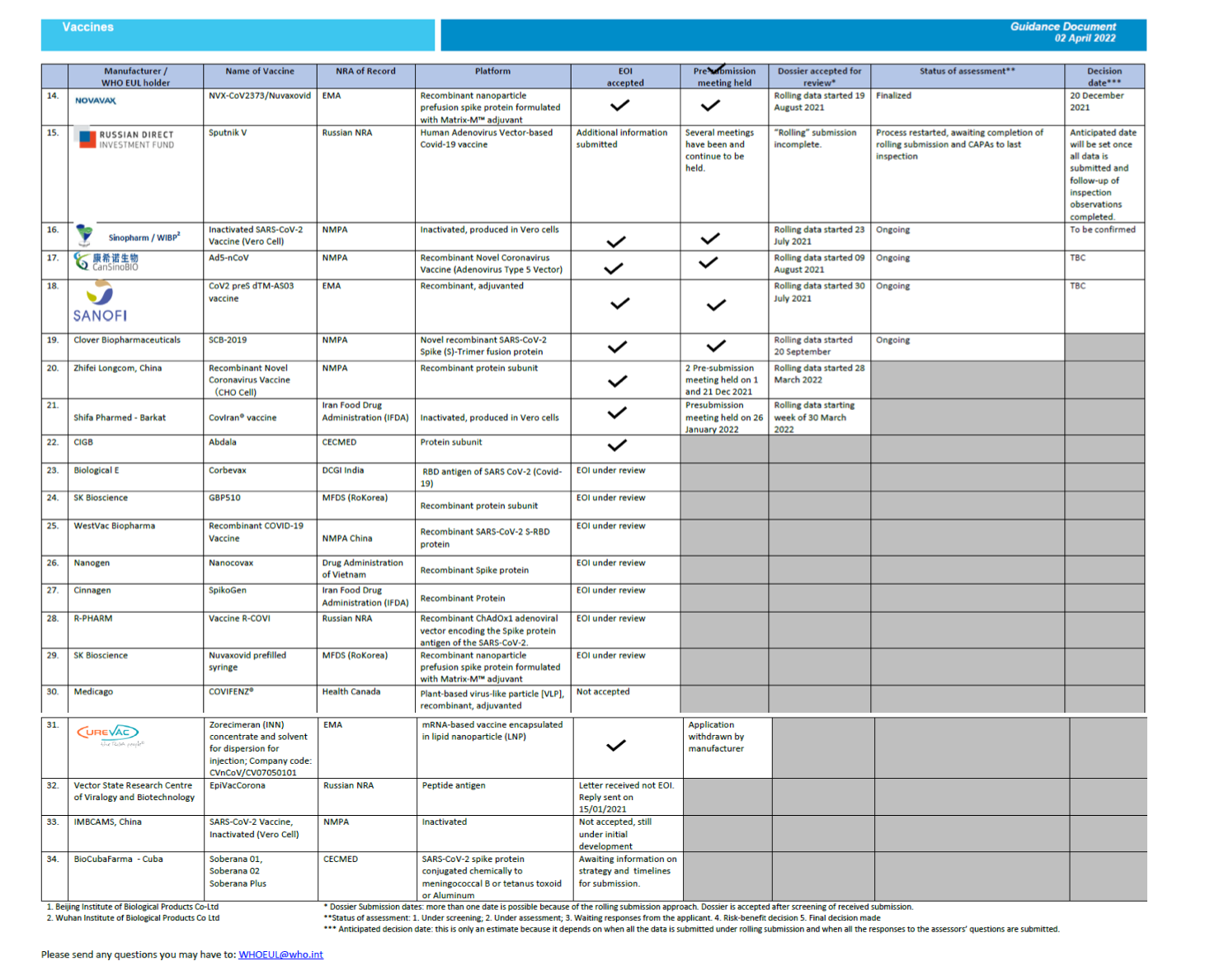
COVID Vaccines/Therapeutics – Developer/Manufacturer Announcements

Featured Journal Content


COVID Vaccines/Therapeutics – Developer/Manufacturer Announcements
[Selected press releases/announcements from organizations from WHO EUL/PQ listing above and other organizations]


AstraZeneca
Press Releases
Evusheld long-acting antibody combination approved in the EU for pre-exposure prophylaxis (prevention) of COVID-19 in a broad population
28 March 2022

Bharat Biotech
Press Releases No new digest announcements identified

BioCubaFarma – Cuba
Últimas Noticias – Website not leading at inquiry


Biological E
NewsNo new digest announcements identified


Biontech
Press Releases
Pfizer and BioNTech Receive Expanded U.S. Emergency Use Authorization for an Additional COVID-19 Vaccine Booster in Individuals Aged 50 Years and Older
29 Mar 2022


CanSinoBIO
News – Website not responding at inquiry


CIGB
Latest News
Purity and efficacy of Mambisa, the first anti-covid nasal vaccine (Part I)
09 Mar 2022


Cinagen
Recent NewsNo new digest announcements identified

Clover Biopharmaceuticals – China
NewsNo new digest announcements identified


Curevac [Bayer Ag – Germany]
News
March 30, 2022
CureVac and GSK Start Clinical Development of Second-Generation COVID-19 Vaccine Candidate, CV2CoV
Phase 1 dose-escalation study started at clinical sites in the U.S.
Milestone demonstrates CureVac’s and GSK’s continued execution on comprehensive clinical program of second-generation vaccine candidates for infectious diseases


Gamaleya National Center
Latest News and Events – See Russia below.

IMBCAMS, China
Home – Website not responding at inquiry


Janssen/JNJ
Press Releases
Mar 29, 2022 United States
U.S. FDA Approves CABENUVA (cabotegravir and rilpivirine) for Adolescents, Expanding the Indication of the First and Only Complete Long-Acting Injectable HIV Regimen


Medicago
Media
February 24, 2022
Medicago and GSK announce the approval by Health Canada of COVIFENZ®, an Adjuvanted Plant-Based COVID-19 Vaccine


Moderna
Press Releases
March 29, 2022
Moderna Receives FDA Approval for Emergency Use Authorization of 2nd Booster Dose of Its COVID-19 Vaccine, mRNA-1273


Nanogen
News – No new digest announcements identified


Novavax
Press Releases
Novavax Statement on Arrival of its COVID-19 Vaccine in Canada
Mar 31, 2022

Novavax Submits Request to Expand Conditional Marketing Authorization of COVID-19 Vaccine in the European Union to Adolescents (Ages 12-17)
Mar 31, 2022


Pfizer
Recent Press Releases
03.29.2022
Pfizer and BioNTech Receive Expanded U.S. Emergency Use Authorization for an Additional COVID-19 Vaccine Booster in Individuals Aged 50 Years and Older


R-Pharm
https://rpharm-us.com/index.php
[No news or media page identified]


Sanofi Pasteur
Press Releases – No new digest announcements identified


Serum Institute of India
NEWS & ANNOUNCEMENTS – No new digest announcements identified

Shifa Pharmed [Iran]
http://shafapharmed.com/
No news page identified.


Sinopharm/WIBPBIBP
News – No new digest announcements identified


Sinovac
Press Releases – No new digest announcements identified


Vector State Research Centre of Viralogy and Biotechnology
Home – No new digest announcements identified


WestVac Biopharma
Media – No new digest announcements identified

Zhifei Longcom, China
[Anhui Zhifei Longcom Biologic Pharmacy Co., Ltd.]
[No website identified]


::::::

GSK
Press releases for media – No new digest announcements identified


Merck
News releases – No new digest announcements identified


Novartis
News – No new digest announcements identified


SK Biosciences
Press releases – Website not responding at inquiry


Valneva
Press Releases – No new digest announcements identified

COVID-19 Global Targets and Progress Tracker – IMF

Featured Journal Content


COVID-19 Global Targets and Progress Tracker – IMF
The COVID-19 Global Targets and Progress Tracker presents a consolidated view of the progress towards global COVID-19 targets, barriers in access to COVID-19 tools, and delivery of donor pledges.

The global targets presented in the Tracker are based on an alignment of the targets identified in the IMF Pandemic Proposal, ACT-A Strategic Plan & Budget, and the US-hosted Global C19 Summit, and as such have been reaffirmed by multilateral institutions and global leaders. We will continue to enhance the tracker as we improve our data collection efforts.

Global Dashboard on COVID-19 Vaccine Equity

Featured Journal Content


Global Dashboard on COVID-19 Vaccine Equity
The Dashboard is a joint initiative of UNDP, WHO and the University of Oxford with cooperation across the UN system, anchored in the SDG 3 Global Action Plan for Healthy Lives and Well-being for All.

Dashboard on Vaccine Equity [accessed 02 Apr 2022]: https://data.undp.org/vaccine-equity/
See also visualization on Vaccine Access and Vaccine Affordability


The Race for Global COVID-19 Vaccine Equity

Featured Journal Content


Duke – Launch and Scale Speedometer
The Race for Global COVID-19 Vaccine Equity
A flurry of nearly 200 COVID-19 vaccine candidates are moving forward through the development and clinical trials processes at unprecedented speed; more than ten candidates are already in Phase 3 large-scale trials and several have received emergency or limited authorization. Our team has aggregated and analyzed publicly available data to track the flow of procurement and manufacturing and better understand global equity challenges. We developed a data framework of relevant variables and conducted desk research of publicly available information to identify COVID vaccine candidates and status, deals and ongoing negotiations for procurement and manufacturing, COVID burden by country, and allocation and distribution plans. We have also conducted interviews with public officials in key countries to better understand the context and challenges facing vaccine allocation and distribution
[accessed 24 July 2021]
See our COVID Vaccine Purchases research
See our COVID Vaccine Manufacturing research
See our COVID Vaccine Donations & Exports research

Multilateral Leaders Task Force on COVID-19 [IMF, World Bank Group, WHO, WTO]

Featured Journal Content


Multilateral Leaders Task Force on COVID-19 [IMF, World Bank Group, WHO, WTO]
https://data.covid19taskforce.com/data
A global effort to help developing countries access and deliver COVID-19 vaccines, testing, and therapeutics, as they work to end the pandemic and boost economic recovery.
The International Monetary Fund, World Bank Group, World Health Organization and World Trade Organization have joined forces to accelerate access to COVID-19 vaccines, therapeutics and diagnostics by leveraging multilateral finance and trade solutions, particularly in low- and middle-income countries.
Website accessed 02 Apr 2022: https://data.covid19taskforce.com/data The global view below is complemented by country-specific dashboards here.

U.S.: COVID-19 Vaccines – Announcements/Regulatory Actions/Deployment

Featured Journal Content


U.S.: COVID-19 Vaccines – Announcements/Regulatory Actions/Deployment


HHS
News
Statement from HHS Secretary Xavier Becerra on FDA and CDC Expanding Booster Eligibility for the Most Vulnerable
March 29, 2022 | News Release

BARDA – U.S. Department of HHS [to 02 Apr 2022]
https://aspr.hhs.gov/newsroom/Pages/NewsRoomHome.aspx
News
ASPR Announcement – New COVID-19 Treatment Locator Now Available!
Wednesday, March 30, 2022


::::::

FDA
Press Announcements
March 29, 2022 – Coronavirus (COVID-19) Update: FDA Authorizes Second Booster Dose of Two COVID-19 Vaccines for Older and Immunocompromised Individuals


Vaccines and Related Biological Products Advisory Committee– FDA
https://www.fda.gov/advisory-committees/blood-vaccines-and-other-biologics/vaccines-and-related-biological-products-advisory-committee
Calendar
Vaccines and Related Biological Products Advisory Committee Meeting April 6, 2022 Announcement – 04/06/2022
The committee will meet in open session to discuss considerations for use of COVID-19 vaccine booster doses and the process for COVID-19 vaccine strain selection to address current and emerging variants.


::::::

White House [U.S.] [to 02 Apr 2022]
Briefing Room – Selected Major COVID Announcements
Remarks by President Biden on the Status of the Country’s Fight Against COVID-⁠19
March 30, 2022 • Speeches and Remarks

Fact Sheet: Biden Administration Launches COVID.gov, a New One-Stop Shop Website for Vaccines, Tests, Treatments, Masks, and the Latest COVID-⁠19 Information
March 30, 2022 • Statements and Releases

U.S. Department of State [to 02 Apr 2022]
https://www.state.gov/coronavirus/releases/
Press Statement – COVID Context
No new digest content identified.

USAID [to 02 Apr 2022]
https://www.usaid.gov/news-information/press-releases
Selected Press Releases, Statements, Announcements
Humanitarian Convoys Transport Emergency Food Aid for More Than 100,000 People in Tigray and Afar
April 1, 2022
This week, two humanitarian convoys from U.S. Agency for International Development (USAID) partner UN World Food Program (WFP) transported emergency food aid to the Tigray and Afar regions of northern Ethiopia, including the first convoy to Tigray in more than three and a half months. This emergency food aid will support more than 100,000 people in northern Ethiopia. The arrival of the convoys is an important development in the effort to provide life-saving assistance to the people of Tigray and Afar, as only road transport can deliver the scale of assistance needed across northern Ethiopia. USAID commends the federal and regional Ethiopian authorities, as well as local communities, which worked together to make this first step possible. USAID urges all parties to ensure sustained and significant access for the delivery of life-saving assistance in these regions, as well as the neighboring Amhara region.

The U.S. Strategy to Prevent Conflict and Promote Stability: Priority Countries and Region
April 1, 2022
The U.S. government is moving forward in the spirit of partnership with four countries and a regional grouping of countries to implement the ten-year U.S. Strategy to Prevent Conflict and Promote Stability.  This represents an important milestone and next step in the realization of the goals of the landmark Global Fragility Act, which continues to enjoy strong bipartisan Congressional support for innovative efforts to foster a more peaceful and stable world.  In light of the horrific events unfolding in Ukraine caused by Putin’s unprovoked and brutal war, the United States reaffirms its commitment to strengthen global resiliency and democratic renewal, and promote peaceful, self-reliant nations that become U.S. economic and security partners.

The United States Provides Nearly $204 Million in New Funding to Address the Humanitarian Crisis in Afghanistan
March 31, 2022
Today at the United Nations Office for the Coordination of Humanitarian Affairs, United Kingdom, Germany, and Qatar-hosted virtual pledging conference, the United States announced it is providing nearly $204 million in additional humanitarian assistance for the people of Afghanistan. This funding includes over $70 million through the U.S. Agency for International Development (USAID), and continues America’s enduring support of the Afghan people, bringing the total U.S. humanitarian assistance for Afghanistan to more than $4.6 billion since 2002, the largest amount of assistance from any country.

The United States Announces More Than $152 Million in Additional Humanitarian Assistance for the People of Burma and Bangladesh
March 29, 2022
Today, the United States announced more than $152 million in additional humanitarian assistance for the Rohingya humanitarian crisis, including support for those affected by ongoing violence in Burma, refugees from Burma in Bangladesh, and Bangladeshi host communities. This funding includes more than $101 million from the U.S. Agency for International Development (USAID) and nearly $51 million from the U.S. Department of State. It brings the total U.S. humanitarian assistance to the crisis to more than $1.7 billion since August 2017.