Cognitive Factors Influencing COVID-19 Vaccination Intentions: An Application of the Protection Motivation Theory Using a Probability Community Sample

Vaccines
https://www.mdpi.com/journal/vaccines


Open Access Article
Cognitive Factors Influencing COVID-19 Vaccination Intentions: An Application of the Protection Motivation Theory Using a Probability Community Sample
by Kwok Kit Tong et al.
Vaccines 2021, 9(10), 1170; https://doi.org/10.3390/vaccines9101170 – 12 Oct 2021
Abstract
COVID-19 vaccines, as one of the effective ways of dealing with the COVID-19 pandemic, can lower COVID-19 risk and protect against severe disease and death; however, substantial individual differences in vaccination intentions have hindered the realization of a high vaccination rate among the [..

Determinants of COVID-19 Vaccine Hesitancy in Portuguese-Speaking Countries: A Structural Equations Modeling Approach

Vaccines
https://www.mdpi.com/journal/vaccines


Open Access Article
Determinants of COVID-19 Vaccine Hesitancy in Portuguese-Speaking Countries: A Structural Equations Modeling Approach
by Álvaro Francisco Lopes de Sousa et al.
Vaccines 2021, 9(10), 1167; https://doi.org/10.3390/vaccines9101167 (registering DOI) – 12 Oct 2021
Abstract
COVID-19 vaccine hesitancy (VH) has caused concerns due to the possible fluctuations that may occur directly impacting the control of the pandemic. In this study, we aimed to estimate the prevalence and factors associated with COVID-19 VH in Portuguese-speaking countries. We developed a […

medRxiv

medRxiv
medRxiv is a free online archive and distribution server for complete but unpublished manuscripts (preprints) in the medical, clinical, and related health sciences. Preprints are preliminary reports of work that have not been certified by peer review. They should not be relied on to guide clinical practice or health-related behavior and should not be reported in news media as established information. medRxiv is for the distribution of preprints – complete but unpublished manuscripts – that describe human health research conducted, analyzed, and interpreted according to scientific principles…
https://www.medrxiv.org/content/about-medrxiv
[Accessed 16 Oct 2021]

Selected Content
Evaluation of COVID-19 vaccine breakthrough infections among immunocompromised patients fully vaccinated with BNT162b2
Manuela Di Fusco, Mary M Moran, Alejandro Cane, Daniel Curcio, Farid Khan, Deepa Malhotra, Andy Surinach, Amanda Miles, David Swerdlow, John M McLaughlin, Jennifer L Nguyen
medRxiv 2021.10.12.21264707; doi: https://doi.org/10.1101/2021.10.12.21264707

Effects of Side-Effect Risk Framing Strategies on COVID-19 Vaccine Intentions in the United States and the United Kingdom: A Randomized Controlled Trial
Nikkil Sudharsanan, Caterina Favaretti, Violetta Hachaturyan, Till Baernighausen, Alain Vandormael
medRxiv 2021.10.12.21264877; doi: https://doi.org/10.1101/2021.10.12.21264877

Breakthrough SARS-CoV-2 infections in 620,000 U.S. Veterans, February 1, 2021 to August 13, 2021
Barbara A Cohn, Piera M Cirillo, Caitlin C Murphy, Nickilou Y Krigbaum, Arthur W Wallace
medRxiv 2021.10.13.21264966; doi: https://doi.org/10.1101/2021.10.13.21264966

Breastfeeding infants receive neutralizing antibodies and cytokines from mothers immunized with a COVID-19 mRNA vaccine
Vignesh Narayanaswamy, Brian Pentecost, Corina N Schoen, Dominique Alfandari, Sallie S Schneider, Ryan Baker, Kathleen F Arcaro
medRxiv 2021.10.12.21264890; doi: https://doi.org/10.1101/2021.10.12.21264890

A Third Dose of SARS-CoV-2 Vaccine Increases Neutralizing Antibodies Against Variants of Concern in Solid Organ Transplant Recipients
Andrew H. Karaba, Xianming Zhu, Tao Liang, Kristy H. Wang, Alex G. Rittenhouse, Olivia Akinde, Yolanda Eby, Jessica E. Ruff, Joel N. Blankson, Aura T. Abedon, Jennifer L. Alejo, Andrea L. Cox, Justin R. Bailey, Elizabeth A. Thompson, Sabra L. Klein, Daniel S. Warren, Jacqueline M. Garonzik-Wang, Brian J. Boyarsky, Ioannis Sitaras, Andrew Pekosz, Dorry L. Segev, Aaron A.R. Tobian, William A. Werbel
medRxiv 2021.08.11.21261914; doi: https://doi.org/10.1101/2021.08.11.21261914

Comparative immunogenicity and effectiveness of mRNA-1273, BNT162b2 and Ad26.COV2.S COVID-19 vaccines
Vivek Naranbhai, Wilfredo F. Garcia-Beltran, Christina C. Chang, Cristhian Berrios Mairena, Julia C. Thierauf, Grace Kirkpatrick, Maristela L. Onozato, Ju Cheng, Kerri J. St. Denis, Evan C. Lam, Clarety Kaseke, Rhoda Tano-Menka, Diane Yang, Maia Pavlovic, Wendy Yang, Alexander Kui, Tyler E. Miller, Michael G. Astudillo, Jennifer E. Cahill, Anand S. Dighe, David J. Gregory, Mark C. Poznansky, Gaurav D. Gaiha, Alejandro B. Balazs, A. John Iafrate
medRxiv 2021.07.18.21260732; doi: https://doi.org/10.1101/2021.07.18.21260732

The impact of mandatory COVID-19 certificates on vaccine uptake: Synthetic Control Modelling of Six Countries
Melinda C. Mills, Tobias Rüttenauer
medRxiv 2021.10.08.21264718; doi: https://doi.org/10.1101/2021.10.08.21264718

Efficacy and Safety of NVX-CoV2373 in Adults in the United States and Mexico
Lisa M. Dunkle, Karen L. Kotloff, Cynthia L. Gay, Germán Áñez, Jeffrey M. Adelglass, Alejandro Q. Barrat Hernández, Wayne L. Harper, Daniel M. Duncanson, Monica A. McArthur, Diana F. Florescu, R. Scott McClelland, Veronica Garcia-Fragoso, Robert A. Riesenberg, David B. Musante, David L. Fried, Beth E. Safirstein, Mark McKenzie, Robert J. Jeanfreau, Jeffrey K. Kingsley, Jeffrey A. Henderson, Dakotah C. Lane, Guillermo M. Ruíz-Palacios, Lawrence Corey, Kathleen M. Neuzil, Robert W. Coombs, Alex L. Greninger, Julia Hutter, Julie A. Ake, Katherine Smith, Wayne Woo, Iksung Cho, Gregory M. Glenn, Filip Dubovsky, for the 2019nCoV-301 Study Group
medRxiv 2021.10.05.21264567; doi: https://doi.org/10.1101/2021.10.05.21264567

Think Tanks et al

Think Tanks et al
 
 
Brookings [to 16 Oct 2021]
http://www.brookings.edu/
Report
Amid the pandemic, Black and Latino men have experienced the largest drop in life expectancy
Andre M. Perry, Ariel Gelrud Shiro, Anthony Barr, and Carl Romer
Monday, October 11, 2021
 
 
Center for Global Development [to 16 Oct 2021]
http://www.cgdev.org/page/press-center
Accessed 16 Oct 2021
Four Pandemic Asks for IDA20 Replenishment at the World Bank
October 13, 2021
The World Bank’s International Development Association (IDA), the largest single source of concessional financing for development in lower-income countries, is under-utilized in the world’s fight against pandemics, and can deploy its resources and expertise to play a much more significant role in the COVID-19 response and beyond as part of its upcoming replenishment, known as IDA20.
Amanda Glassman

The Roots of Policy Incoherence: Domestic Policy, Global Public Goods, and International Development
Publication
October 12, 2021
Governments make policy to affect three domains: domestic outcomes, outcomes in foreign countries, and shared global challenges. This note sets out how the conceptual and analytical incoherence of policy set in developed countries across these three domains undermines their own effectiveness—most notably on international development and shared global challenges.
 
 
Chatham House [to 16 Oct 2021]
https://www.chathamhouse.org/
Accessed 16 Oct 2021
[No new digest content identified]


CSIS
https://www.csis.org/
Accessed 16 Oct 2021
Transcript
Allied Infrastructure Strategy in the Indo-Pacific
October 15, 2021

Transcript
What Next? Looking Beyond the Covid-19 Summit
October 14, 2021


Kaiser Family Foundation
https://www.kff.org/search/?post_type=press-release
[No new digest content identified]


ODI [Overseas Development Institute] [to 16 Oct 2021]
https://odi.org/en/publications/
Publications
What MDBs (and their shareholders) can do for vaccine equity
06 October 2021
In late 2020 the World Bank and the Asian Development Bank (AsDB) announced large-scale financing packages to help the rollout of Covid-19 vaccines in low- and middle-income countries. But despite the urgency of doing this to bring the global pandemic to an end, the uptake of these financing packages has so far been slow. Why are committed funds sitting idle at the same time that vaccination programmes are a priority in many countries battling new waves of Covid-19 infections? And at the same time as many activists and world leaders call on G7 leaders to ramp up their contributions to the global vaccination effort?

In this long-read we review some of the factors and bottlenecks that can plausibly explain this low uptake of MDB financing for vaccine purchases from governments in low-and middle-income countries. More importantly, we outline what management and shareholders of MDBs should do to ramp up the use of these financing facilities or deploy resources to support the health response against Covid-19. The fundamental issue has been between the country-based lending model of MDBs and the need to finance and procure a global public good (a low-cost vaccine). MDBs thus need a clearer mandate and dedicated grant financing for global public goods, including vaccine procurement.

Vaccines and Global Health: The Week in Review :: 9 October 2021


Vaccines and Global Health: The Week in Review is a weekly digest  summarizing news, events, announcements, peer-reviewed articles and research in the global vaccine ethics and policy space. Content is aggregated from key governmental, NGO, international organization and industry sources, key peer-reviewed journals, and other media channels. This summary proceeds from the broad base of themes and issues monitored by the Center for Vaccine Ethics & Policy in its work: it is not intended to be exhaustive in its coverage. You are viewing the blog version of our weekly digest, typically comprised of between 30 and 40 posts below all dated with the current issue date

.– Request anEmail Summary:Vaccines and Global Health : The Week in Review is published as a single email summary, scheduled for release each Saturday evening before midnight (EDT in the U.S.). If you would like to receive the email version, please send your request to david.r.curry@centerforvaccineethicsandpolicy.org.

– pdf version A pdf of the current issue is available here:


– blog edition: comprised of the approx. 35+ entries posted below.

– Twitter:Readers can also follow developments on twitter: @vaxethicspolicy.
.
– Links:  We endeavor to test each link as we incorporate it into any post, but recognize that some links may become “stale” as publications and websites reorganize content over time. We apologize in advance for any links that may not be operative. We believe the contextual information in a given post should allow retrieval, but please contact us as above for assistance if necessary.

Support this knowledge-sharing service: Your financial support helps us cover our costs and to address a current shortfall in our annual operating budget. Click here to donate and thank you in advance for your contribution.

.
David R. Curry, MS
Executive Director

WHO recommends groundbreaking malaria vaccine for children at risk

Milestones :: Perspectives :: Research


Malaria


WHO recommends groundbreaking malaria vaccine for children at risk
Historic RTS,S/AS01 recommendation can reinvigorate the fight against malaria
6 October 2021 News release
The World Health Organization (WHO) is recommending widespread use of the RTS,S/AS01 (RTS,S) malaria vaccine among children in sub-Saharan Africa and in other regions with moderate to high P. falciparum malaria transmission. The recommendation is based on results from an ongoing pilot programme in Ghana, Kenya and Malawi that has reached more than 800 000 children since 2019.


“This is a historic moment. The long-awaited malaria vaccine for children is a breakthrough for science, child health and malaria control,” said WHO Director-General Dr Tedros Adhanom Ghebreyesus. “Using this vaccine on top of existing tools to prevent malaria could save tens of thousands of young lives each year.”

Malaria remains a primary cause of childhood illness and death in sub-Saharan Africa. More than 260 000 African children under the age of five die from malaria annually. In recent years, WHO and its partners have been reporting a stagnation in progress against the deadly disease.

“For centuries, malaria has stalked sub-Saharan Africa, causing immense personal suffering,” said Dr Matshidiso Moeti, WHO Regional Director for Africa. “We have long hoped for an effective malaria vaccine and now for the first time ever, we have such a vaccine recommended for widespread use. Today’s recommendation offers a glimmer of hope for the continent which shoulders the heaviest burden of the disease and we expect many more African children to be protected from malaria and grow into healthy adults.”


WHO recommendation for the RTS,S malaria vaccine
Based on the advice of two WHO global advisory bodies, one for immunization and the other for malaria, the Organization recommends that:


WHO recommends that in the context of comprehensive malaria control the RTS,S/AS01 malaria vaccine be used for the prevention of P. falciparum malaria in children living in regions with moderate to high transmission as defined by WHO.  RTS,S/AS01 malaria vaccine should be provided in a schedule of 4 doses in children from 5 months of age for the reduction of malaria disease and burden.

Summary of key findings of the malaria vaccine pilots
Key findings of the pilots informed the recommendation based on data and insights generated from two years of vaccination in child health clinics in the three pilot countries, implemented under the leadership of the Ministries of Health of Ghana, Kenya and Malawi. Findings include:
Feasible to deliver: Vaccine introduction is feasible, improves health and saves lives, with good and equitable coverage of RTS,S seen through routine immunization systems. This occurred even in the context of the COVID-19 pandemic.
Reaching the unreached: RTS,S increases equity in access to malaria prevention.
Data from the pilot programme showed that more than two-thirds of children in the 3 countries who are not sleeping under a bednet are benefitting from the RTS,S vaccine.
Layering the tools results in over 90% of children benefitting from at least one preventive intervention (insecticide treated bednets or the malaria vaccine).
Strong safety profile: To date, more than 2.3 million doses of the vaccine have been administered in 3 African countries – the vaccine has a favorable safety profile.
No negative impact on uptake of bednets, other childhood vaccinations, or health seeking behavior for febrile illness. In areas where the vaccine has been introduced, there has been no decrease in the use of insecticide-treated nets, uptake of other childhood vaccinations or health seeking behavior for febrile illness.
High impact in real-life childhood vaccination settings: Significant reduction (30%) in deadly severe malaria, even when introduced in areas where insecticide-treated nets are widely used and there is good access to diagnosis and treatment.
Highly cost-effective: Modelling estimates that the vaccine is cost effective in areas of moderate to high malaria transmission.

Next steps for the WHO-recommended malaria vaccine will include funding decisions from the global health community for broader rollout, and country decision-making on whether to adopt the vaccine as part of national malaria control strategies.


Financial support
Financing for the pilot programme has been mobilized through an unprecedented collaboration among three key global health funding bodies: Gavi, the Vaccine Alliance; the Global Fund to Fight AIDS, Tuberculosis and Malaria; and Unitaid.

Note to editors:
The malaria vaccine, RTS,S, acts against P. falciparum, the most deadly malaria parasite globally, and the most prevalent in Africa.
The Malaria Vaccine Implementation Programme is generating evidence and experience on the feasibility, impact and safety of the RTS,S malaria vaccine in real-life, routine settings in selected areas of Ghana, Kenya and Malawi.
Pilot malaria vaccine introductions are led by the Ministries of Health of Ghana, Kenya and Malawi.
The pilot programme will continue in the 3 pilot countries to understand the added value of the 4th vaccine dose, and to measure longer-term impact on child deaths.
The Malaria Vaccine Implementation Programme is coordinated by WHO and supported by in-country and international partners, including PATH, UNICEF and GSK, which is donating up to 10 million doses of the vaccine for the pilot.
The RTS,S malaria vaccine is the result of 30 years of research and development by GSK and through a partnership with PATH, with support from a network of African research centres.
The Bill & Melinda Gates Foundation provided catalytic funding for late-stage development of RTS,S between 2001 and 2015.


::::::

GSK welcomes WHO recommendation for broad roll-out of its RTS,S/AS01e (RTS,S) malaria vaccine
Issued: 6 October, London UK
Based on the recommendation of its global advisory bodies for immunization and malaria, WHO has recommended the wider use of GSK’s RTS,S malaria vaccine in children living in sub-Saharan Africa and other regions with moderate to high malaria transmission.
Malaria vaccine pilot programmes in Ghana, Kenya and Malawi have shown high impact in real-life childhood vaccination settings, strong community demand and that RTS,S can be effectively delivered through routine child immunization platforms.
Recommendation follows shortly after new data show that RTS,S, in combination with seasonal administration of antimalarials, lowers clinical episodes of malaria, hospital admissions with severe malaria, and deaths by around 70%.

GlaxoSmithKline (GSK) plc welcomes and applauds the WHO recommendation for the broader deployment of GSK’s RTS,S malaria vaccine to reduce childhood illness and deaths from malaria in children living in sub-Saharan Africa and other regions with moderate to high transmission as defined by WHO. RTS,S is the first and only malaria vaccine to have been shown in pivotal long-term clinical trials to significantly reduce malaria in children. The vaccine is the result of over 30 years of research led by GSK, with PATH and other partners.


Thomas Breuer, Chief Global Health Officer, GSK, said: “GSK is proud that RTS,S, our ground-breaking malaria vaccine, developed over decades by our teams and partners, can now be made available to children in sub-Saharan Africa and other regions with moderate to high malaria transmission. This long-awaited landmark decision can reinvigorate the fight against malaria in the region at a time when progress on malaria control has stalled. Both real world evidence and clinical trial data show that RTS,S, alongside other malaria prevention measures, has the potential to save hundreds of thousands of lives.”…

GSK believes that beating malaria is a shared responsibility and demands a range of tools – from accessible testing and treatment to preventative measures like a vaccine, complemented by bed nets as well as trained health workers to support prevention and treatment in the community.

GSK continues active research in malaria as part of its extensive Global Health research and development programme, and also works with partners such as Comic Relief and AMREF Health Africa to increase public health awareness, train health workers in underserved communities to better diagnose and treat malaria, and increase access to testing and medications.


::::::

GAVI, Unitaid and the Global Fund welcome WHO recommendation for world’s first malaria vaccine
WHO recommendation for wider use of the RTS,S malaria vaccine is largely based on data gathered during malaria vaccine pilots which took place in Kenya, Ghana and Malawi
Gavi, the Vaccine Alliance, the Global Fund to Fight AIDS, Tuberculosis and Malaria and global health agency Unitaid have together committed nearly US$ 70 million to fund the pilots
Following the WHO recommendation, global stakeholders, including Gavi, will consider whether and how to finance a new malaria vaccination programme

Geneva, 6 October 2021 – Gavi, the Vaccine Alliance, global health agency Unitaid and the Global Fund to Fight AIDS, Tuberculosis and Malaria welcome the WHO recommendation for wider routine use of the RTS,S malaria vaccine. The recommendation is based on data gathered through the Malaria Vaccine Implementation Programme (MVIP) which took place in Kenya, Ghana and Malawi over a two-year period and a clinical trial around the seasonal delivery of the vaccine in Mali and Burkina Faso, countries that experience high seasonal variation in malaria transmission.

The RTS,S pilots achieved and maintained good coverage levels, despite the COVID-19 pandemic. As of September 2021, over two years after the start of vaccinations, more than 2.3 million RTS,S doses have been administered across the three countries and more than 800,000 children have been reached with at least one dose of the vaccine. The pilots provided an opportunity to evaluate the feasibility of delivering four doses of RTS,S in real-life settings, where the vaccine was successfully rolled into existing immunisation programmes, widely accepted by both caregivers and healthcare workers, and reduced hospitalisations from severe malaria by 30%.

A further clinical trial led by the London School of Hygiene & Tropical Medicine assessed the impact of seasonal delivery of the malaria vaccine alongside seasonal malaria chemoprevention in Mali and Burkina Faso, countries that experience high seasonal variation of malaria transmission. The findings indicated a decrease of more than 70% in severe malaria cases in children when the vaccine was administered in combination with preventive antimalarials.

“Today marks a historic achievement in our fight against malaria,” said Dr Seth Berkley, CEO of Gavi, the Vaccine Alliance. “Malaria still kills over 250,000 children every year. The vaccine is an important additional tool to help control this disease alongside other interventions, such as bed nets, and especially when delivered seasonally in combination with antimalarial medication. I applaud the countries and communities who participated in the trials and pilots to provide this critical new tool for African countries.”


Ministries of Health led the implementation of the vaccine, which was delivered through routine immunisation programmes, with WHO playing a coordinating role, working in collaboration with GlaxoSmithKline, PATH and UNICEF. Following its investment of around US$ 700 million in the development of RTS,S, GSK has donated up to 10 million doses for the pilot programme. Gavi, the Global Fund and Unitaid have together committed nearly US$ 70 million to fund the pilot, which was designed to address several outstanding questions related to the public health use of the vaccine following the Phase 3 trial showing efficacy of RTS,S.

“We welcome this new tool in the fight against malaria,” said Peter Sands, Executive Director of the Global Fund. “In countries where the Global Fund invests, we have reduced malaria deaths by 45% since 2002 with testing, treatment and prevention tools such as mosquito nets. In the vaccine pilots, the RTS,S vaccine was most effective when used together with these existing tools. Significant additional resources will be necessary to enable wide deployment of the vaccine alongside other innovations, and as part of a sustained and comprehensive response in the countries that need it the most.”

“Even before the COVID-19 pandemic hit, progress against malaria was stalling,” said Dr Philippe Duneton, Executive Director of Unitaid. “This vaccine is a welcome new tool that, when used in combination with existing interventions like bed nets, has the potential to drive down malaria and extend protection to children across Africa. Pilot implementation has demonstrated how we can equitably reach children with this life-saving vaccine – now we need to ensure adequate and affordable supply to truly reignite the fight against malaria.”

The data collected through MVIP achieved similar rates of efficacy as seen in the Phase 3 clinical trial conducted from 2009 to 2014. The trial found that among children aged 5–17 months who received four doses of RTS,S, the vaccine prevented approximately 4 in 10 (39%) cases of malaria over 4 years of follow-up, and about 3 in 10 (29%) cases of severe malaria. Significant reductions were also seen in overall hospital admissions as well as in admissions due to malaria or severe anaemia. In addition, the vaccine reduced the need for blood transfusions, which are required to treat life-threatening malaria anaemia, by 29%.

Following the WHO recommendation, global stakeholders, including Gavi, will consider whether and how to finance a new malaria vaccination programme in sub-Saharan Africa. Ahead of this important decision, an innovative financing agreement between Gavi, MedAccess and GSK guarantees continued production of the RTS,S antigen for the malaria vaccine. The partnership aims to address vaccine supply challenges and reduce barriers to initial roll-out in the event that the Gavi Board makes a decision in favour of a Gavi-supported malaria vaccination programme.


The vaccine will be a complementary malaria control tool to be added to the core package of WHO-recommended measures for malaria prevention. This includes the routine use of insecticide-treated bed nets, indoor spraying with insecticides, malaria chemoprevention strategies, and the timely use of malaria testing and treatment.

::::::

PATH applauds WHO recommendation for broader use of first malaria vaccine
Vaccine shown to be cost-effective and trusted by caregivers and health care workers
October 6, 2021 by PATH

COVID – PHEIC

Milestones :: Perspectives :: Research

::::::


COVID – PHEIC

Editor’s Note:
As readers absorb the WHO-UN world COVID vaccination targets announcement just below with its summary of imperatives, we urge a careful reading of the underlying technical document referenced in the concluding Note to Editors : The Global COVID-19 Vaccination – Strategic Vision for 2022 Technical Document [15 September 2021].

This 92-page technical document represents important work to be sure, but our initial assessment is that it lacks any material discussion of scenarios/outcomes beyond 2022 – indeed there seems to be literally no instance where 2023-2025 or beyond is discussed or analyzed [except for a reference to an IMF projection on 2025 economic impacts].


We invite anyone to correct our understanding, but it is entirely unclear what the 2023-25 scenarios may be if, indeed, the 70% vaccination target is achieved at some point during 2022. This is startling…

We repeat our interest in access to modelling which engages scenarios and articulates imperatives around a COVID-19 pandemic end-game through at least a 2025 horizon. If we have missed such modeling in progress, we would be delighted to be advised of it and will include it in our coverage.

WHO, UN set out steps to meet world COVID vaccination targets

Milestones :: Perspectives :: Research


WHO, UN set out steps to meet world COVID vaccination targets
7 October 2021 News release
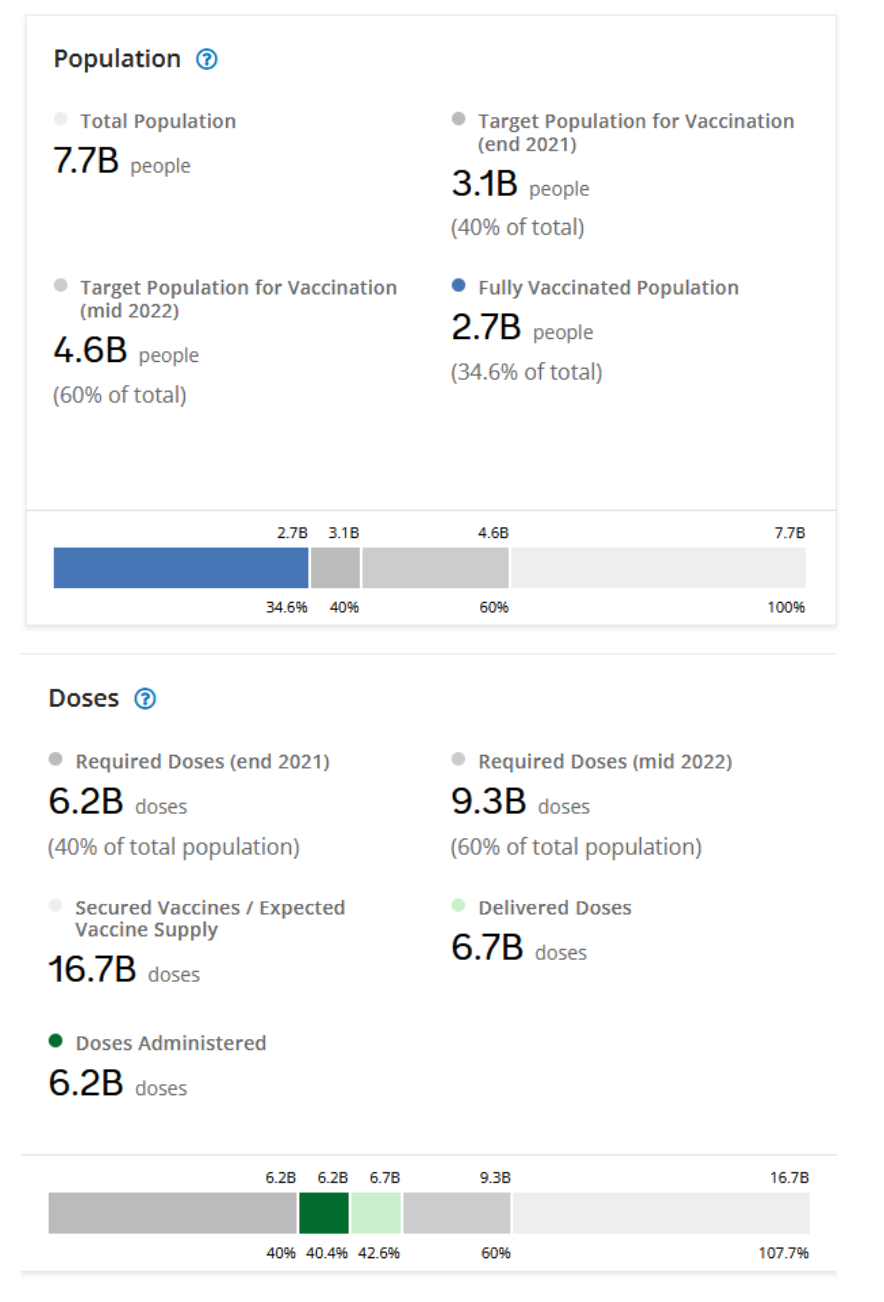
Working with COVAX, African Vaccine Acquisition Trust and other partners – world can and must meet WHO targets to vaccinate 40% of the population of all countries by the end-2021 and 70% by mid-2022
Vaccine supply gaps to COVAX must be closed immediately for countries to reach the 40% year-end target
United Nations Secretary-General and WHO Director-General call on countries and  manufacturers to make good on their commitments without further delays

The World Health Organization has today launched the Strategy to Achieve Global Covid-19 Vaccination by mid-2022 (the Strategy) to help bring an end to what has become a two-track pandemic:  people in poorer countries continue to be at risk while those in richer countries with high vaccination rates enjoy much greater protection.

WHO had set a target to vaccinate 10% of every country, economy and territory by the end of September but by that date 56 countries had not been able to do so, the vast majority of these are countries in Africa and the Middle East.

The new strategy outlines a plan for achieving WHO’s targets to vaccinate 40% of the population of every country by the end of this year and 70% by mid-2022.

Science has played its part by delivering powerful, life-saving tools faster than for any outbreak in history,” said WHO Director-General Dr Tedros Adhanom Ghebreyesus. “But the concentration of those tools in the hands of a few countries and companies has led to a global catastrophe, with the rich protected while the poor remain exposed to a deadly virus. We can still achieve the targets for this year and next, but it will take a level of political commitment, action and cooperation, beyond what we have seen to date.”

“This is a costed, coordinated and credible path out of the COVID-19 pandemic for everyone, everywhere,” said United Nations Secretary-General Antonio Guterres. “Without a coordinated, equitable approach, a reduction of cases in any one country will not be sustained over time. For everyone’s sake, we must urgently bring all countries to a high level of vaccination coverage.”

To achieve the global vaccination targets, there should be a three-step approach to vaccination, with all older adults, health workers, and high-risk groups of all ages, in every country vaccinated first, followed by the full adult age group in every country and lastly extended vaccination of adolescents.

Vaccinating 70% of the global population requires at least 11 billion vaccine doses.   By the end of September, just over 6 billion doses had already been administered worldwide.  With global vaccine production now at nearly 1.5 billion doses per month, there is sufficient vaccine from a supply perspective to achieve the global vaccination targets provided that there is equitable distribution of those doses.

Substantial financing has already been invested to procure most of the required vaccine doses for low- and lower-middle-income countries through COVAX, the African Vaccine Acquisition Trust (AVAT) and bilateral contracts.  There needs to be additional investment to secure the remaining vaccine doses for these countries as well as investment to support in-country delivery.


The Strategy outlines the priority actions needed from the different actors to achieve the targets.
All Countries must:
Establish updated national COVID-19 vaccine targets and plans defining dose requirements to guide manufacturing investment and vaccine redistribution, and financial and programmatic resource needs to guide internal planning and external support;
Monitor vaccine demand and uptake carefully to rapidly adapt services and ensure continuity of vaccine supplies;
Commit to equitable distribution of vaccines in line with the WHO three-step approach;
Revise national vaccination strategies, policies and prioritization as needed to harness emerging evidence to maximize the impact of existing, modified and new vaccines.


Countries with high vaccine coverage must:
Swap vaccine delivery schedules, with COVAX and AVAT to enhance coverage in countries in need;
Fulfil and accelerate vaccine dose-sharing and donation commitments to COVAX in the near term, for those with existing pledges;
Establish new dose-sharing commitments to facilitate progress toward the 70% coverage target in every country.


Vaccine-producing countries must:
Allow the free cross-border flow of finished vaccines and raw materials;
Enable diversified vaccine production, both geographically and technologically, including through non-exclusive, and transparent licensing and sharing of know-how to allow transfer of technology and scale-up of manufacturing.


COVID-19 vaccine manufacturers must:
Prioritize and fulfil COVAX and AVAT contracts as a matter of urgency;
Provide full transparency on the overall monthly production of COVID-19 vaccines and clear monthly schedules for supplies to COVAX, AVAT and low and low-middle income countries, to enable proper global and national-level planning and optimal use of scarce supplies;
Actively engage and work with countries that have high coverage and that have contracted high volumes of vaccines to allow the prioritization of COVAX and AVAT contracts, including through delivery schedule swaps, and facilitate rapid and early dose-sharing;
Commit to share know-how more rapidly, facilitate technology transfer and provide transparent non-exclusive voluntary licenses, to ensure that future vaccine supply is reliable, affordable, available, and deployed to every country in volumes and timing that achieves equitable access.


Civil society, community organizations, and the private sector must:
Advocate locally, nationally and internationally for equitable access to COVID-19 vaccines, tests and treatments, calling for and monitoring in particular the specific actions required of manufacturers, governments and multilateral actors;
Mobilize and empower communities, including through social media and community networks, to generate strong vaccine demand and address misinformation and misperceptions that contribute to vaccine hesitancy;
Provide support to the in-country delivery of vaccination programmes and services.


Global and regional multilateral development banks and institutions must:
Enable countries to more rapidly access the capital and external support needed for in-country vaccine delivery, prioritizing low-income settings and especially targeting support to the technical, logistics and human resources required;
Engage fully with COVAX/ACT-Accelerator and AVAT, with integrated operations and real-time sharing of information to truly support equitable access;
Support international procurement and allocation mechanisms to enable all countries to equitably, efficiently and rapidly achieve the COVID-19 vaccine targets;
Support vaccine distribution plans and a campaign to convey the life-saving importance of approved COVID-19 vaccinations.

For their part, WHO, Gavi, UNICEF and CEPI must work in close collaboration with World Bank, World Trade Organization, International Monetary Fund, Africa CDC, AVAT, and other key partners to monitor progress, identify changes needed to resolve bottlenecks, coordinate information and prioritize actions; continue to co-lead and manage the COVAX Pillar of ACT-Accelerator; support the equitable allocation of available vaccines, particularly to low-, lower-middle-income and lagging countries; directly support countries to develop and sustain rapid, effective, high-quality COVID-19 vaccine delivery programmes that can achieve the global targets; address key research, policy, safety and regulatory issues that will optimize vaccine impact including effective supply, dosing and vaccine schedules, mixing and matching of products, protection against variants, and other issues; and monitor and report monthly on progress towards the global COVID-19 vaccination goals.


Note to Editors:
The Strategy to Achieve Global Covid-19 Vaccination by mid-2022 can be read in its entirety here.
See also:
:: The Global COVID-19 Vaccination – Strategic Vision for 2022 Technical Document
:: Slide deck on the Strategy to Achieve Global Covid-19 Vaccination by mid-2022

Following the WHO declaration of novel coronavirus as a public health emergency of international concern on 30 January 2020, the main global immunization partners developed a global COVID-19 vaccination strategy through the Access to COVID-19 Tools Accelerator (ACT-A) Vaccines Pillar (COVAX). The ACT-A prioritized strategy and budget can be read here. The 2022 Global Vaccination Strategy is intended to complement that strategy.

The immediate goal of the global COVID-19 vaccination strategy is to minimize deaths, severe disease and overall disease burden; curtail the health system impact; fully resume socio-economic activity, and reduce the risk of new variants.

The 2022 Global COVID-19 Vaccination Strategy is based on a technical analysis that established a Conceptual COVID-19 Goal Framework which specifies a sequence of socio-economic and health goals, which could be achieved with various levels of vaccination scope and other interventions. The Conceptual Goal Framework structures the technical analyses of vaccination requirements to achieve ever broader health, social and economic goals and builds upon WHO’s broader COVID-19 Strategic Preparedness and Response Plan (SPRP) first published in 2020 and subsequently updated in 2021. The SPRP’s strategic objectives inform and align with the health and socioeconomic dimensions of the Global COVID-19 Vaccine Strategic Vision Goal Framework.


::::::

WHO, WIPO, WTO Workshop on Innovation in, and Access to, COVID 19 Technologies: Intellectual property licensing, technology transfer, and sharing of know-how and clinical trial information
5 October 2021 Departmental news
On September 27, 2021, the World Health Organization (WHO), the World Intellectual Property Organization (WIPO) and the World Trade Organization (WTO) jointly organized a Workshop on Innovation in, and Access to, COVID-19 Technologies. The workshop focused on intellectual property licensing, technology transfer, and sharing of know-how and clinical trial information. It aimed at strengthening the capacity of policymakers and experts coming from WHO, WIPO and WTO members to address the COVID-19 pandemic. This capacity-building activity was conceived to help members update their knowledge and understanding of how intellectual property (IP), know-how and technology transfer work in actuality.

The activity was agreed in a June 15, 2021 meeting among the Directors General of WHO, WIPO and WTO  in which they underscored their commitment to universal, equitable access to COVID-19 vaccines, therapeutics, diagnostics, and other health technologies.

In three panels, speakers addressed the following themes: realizing global equitable access for vaccines, diagnostics, therapeutics and other COVID-19 health technologies; mechanisms and processes to support technology transfer and IP licensing; and enabling factors and policies for technology transfer…

More than 200 participants from a broad range of members of WHO, WIPO and WTO participated in this training. The program, the full summary of key issues addressed by the workshop, as well as presentations shown during the event are posted on the meeting webpage as they become available.


::::::

Interim statement on booster doses for COVID-19 vaccination
4 October 2021 Statement
WHO, with support of the Strategic Advisory Group of Experts (SAGE) on Immunization and its COVID-19 Vaccines Working Group, continues to review the emerging evidence on the need for and timing of a booster dose for the currently available COVID-19 vaccines which have received Emergency Use Listing (EUL). This statement reflects the current understanding of vaccine performance and supply, as of the time of update…

Rationale for the administration of booster doses
The current primary goal of immunization in the COVID-19 pandemic remains to protect against hospitalization, severe disease and death. Hence, booster doses may only be needed if there is evidence of insufficient protection against these disease outcomes over time.

The degree of waning of immunity and need for booster doses of vaccine may differ between vaccine products, target populations, circulating SARS CoV-2 virus, in particular variants of concern (VoC), and intensity of exposure. For some vaccines, restricted booster indications have been included into the product label of some jurisdictions.

In a period of continued global vaccine supply shortage equity considerations at country, regional and global level remain an essential consideration to assure vaccination of high priority groups in every country. Improving coverage of the primary vaccination series should be prioritized over booster vaccination…

Conclusions
Introducing booster doses should be firmly evidence-driven and targeted to the population groups in greatest need. The rationale for implementing booster doses should be guided by evidence on waning vaccine effectiveness, in particular a decline in protection against severe disease in the general population and in high-risk populations, or due to a circulating VoC. To date, the evidence remains limited and still inconclusive on any widespread need for booster doses following a primary vaccination series.

In the context of ongoing global vaccine supply constraints, broad-based administration of booster doses risks exacerbating inequities in vaccine access by driving up demand and diverting supply while priority populations in some countries, or in subnational settings, have not yet received a primary vaccination series.  The focus remains on urgently increasing global vaccination coverage with the primary series driven by the objective to protect against severe disease.

SAGE will deliberate on the evidence for a booster dose during an upcoming Extraordinary SAGE meeting in November 2021.

COVID-19 VACCINE PRODUCTION AND TARIFFS ON VACCINE INPUTS

Milestones :: Perspectives :: Research


COVID-19 VACCINE PRODUCTION AND TARIFFS ON VACCINE INPUTS
World Trade Organization
08 October 2021 :: 35 pages
INFORMATION NOTE
Key points:
Among the top 27 vaccine manufacturing economies, Switzerland has the lowest verage applied most-favoured-nation (MFN) tariff at 1.5 per cent for vaccine production inputs.
Iran and Cuba have the highest applied MFN tariff at 11.9 per cent and 10.3 per cent, respectively.
Using criteria of at least 5 per cent tariff for the product group as a “choke point” level, Argentina, India and Iran have all 13 product groups of vaccine inputs which can be considered sensitive/critical at varying levels, depending on the share of these product groups relative to total imported vaccine inputs.
Of the 27 top manufacturers, 23 have at least 5 choke points.
In Kazakhstan, the average tariff for the product group “vaccine ingredients” is almost 29 per cent, and this product group accounts for nearly one quarter of imported vaccine inputs.
Among the different product groups, “vaccine ingredients” are the building blocks for vaccines and yet it is a tariff choke point for 17 manufacturing economies. On average, the lowest tariff is for “heat marker vaccine vial monitor”, with the exception of Iran, which levies a tariff of 32 per cent (the highest average product group duty imposed by an individual economy).
Tariffs on critical products to manufacture vaccines remain high, especially in some developing countries, and might impede the flow across borders. This is especially important when a high percentage of these inputs must be imported from other economies.
Member cooperation at the WTO could support the elimination or significant reduction of tariffs on these vaccine inputs to reduce costs and to expand output from vaccine manufacturers meeting acute global needs.

WTO issues papers on vaccine inputs tariffs and bottlenecks on critical COVID-19 products
8 October 2021
The WTO Secretariat has published two information notes on issues relating to the manufacturing of COVID-19 vaccines.

The first one is a new study that focuses on COVID-19 vaccines production and tariffs on vaccine inputs. Based on the Joint Indicative List of Critical COVID-19 Vaccine Inputs for Consultation (Version 1.0), this new report explores the most-favoured nation (MFN) tariffs and imports of these products by the 27 top vaccine manufacturing economies in order to identify possible “sensitive” or choke points. Any product group with an average tariff of at least 5% was deemed a possible “choke point”.

The report concludes that tariffs on critical products to manufacture vaccines remain high, especially in some developing countries, and might impede the flow across borders and/or increase the cost of vaccine manufacturing. It calls for members’ cooperation under the WTO to support the elimination and/or significant reduction of tariffs on these vaccine inputs to reduce costs and expand output from vaccine manufacturers meeting acute global needs. The paper can be found here.

The second paper updates the “Indicative list of trade-related bottlenecks and trade-facilitating measures on critical products to combat COVID-19” that was previously published on 20 July 2021. This revised version is based on issues identified and suggestions made by stakeholders at various events and consultations convened by the WTO, as well as with vaccine manufacturers in the context of meetings organized by the Multilateral Leaders Task Force on COVID-19, which was established by the World Health Organization (WHO), the International Monetary Fund (IMF), the World Bank and the WTO.

One common theme that emerges in this update is that essential goods and inputs need to flow efficiently and expeditiously to support the rapid scaling up of COVID-19 production capacity worldwide. As manufacturers scale-up production and establish new sites in different countries, the production network is not only becoming larger, but also increasingly complex and international. Because the delay of a single component may significantly slow down or even bring to a halt vaccine manufacturing, it follows that inputs need to flow expeditiously, and each node within the supply chain network needs to operate seamlessly with the others.

Intended to be a living document, the revision of the “Indicative List of Trade-Related Bottlenecks and Trade-Facilitating Measures on Critical Products to Combat COVID-19” can be downloaded here. Based on this paper, the WTO Secretariat has also issued the infographic “The Global Race to Vaccinate” , which shows the various steps involved in vaccination after manufacture.


See also the infographic “Developing & delivering COVID-19 vaccines around the world“.

COVID Vaccines – OCHA:: HDX

Milestones :: Perspectives :: Research


COVID Vaccines – OCHA:: HDX

COVID-19 Data Explorer: Global Humanitarian Operations
COVID-19 Vaccine Roll-out
09 Oct 2021 | COVAX (WHO,GAVI,CEPI), UNDESA, Press Reports | DATA
Global COVID-19 Figures: 236M total confirmed cases; 4.8M total confirmed deaths
Global vaccines administered: 6.44B
Number of Countries: 29 [29 week ago]
COVAX Allocations Round 4-6 (Number of Doses): 120M [120M week ago]
COVAX Delivered (Number of Doses): 98M [95M week ago]
Other Delivered (Number of Doses): 160M [140M week ago]
Total Delivered (Number of Doses): 260M [240M week ago]
Total Administered (Number of Doses): 230M [220M week ago]

World Bank Vaccine Operations Portal

Milestones :: Perspectives :: Research


World Bank Vaccine Operations Portal
https://www.worldbank.org/en/who-we-are/news/coronavirus-covid19/world-bank-support-for-country-access-to-covid-19-vaccines
As of September 30, 2021, the World Bank approved operations to support vaccine rollout in 61 countries amounting to $5.8 billion. See the latest project financing, project documents and procurement information in this list. More information will be shared here as it becomes available. 

Multilateral Leaders Task Force on COVID-19 [IMF, World Bank Group, WHO, WTO]

Milestones :: Perspectives :: Research


Multilateral Leaders Task Force on COVID-19 [IMF, World Bank Group, WHO, WTO]
A joint initiative from the International Monetary Fund, World Bank Group, World Health Organization, and World Trade Organization to accelerate access to COVID-19 vaccines, therapeutics and diagnostics by leveraging multilateral finance and trade solutions, particularly in low- and middle-income countries. Website accessed 09 Oct 2021: https://data.covid19taskforce.com/data The global view below is complemented by country-specific dashboards here.

Coronavirus [COVID-19] – WHOPublic Health Emergency of International Concern (PHEIC)

Milestones :: Perspectives :: Research

::::::


Coronavirus [COVID-19] – WHO
Public Health Emergency of International Concern (PHEIC)
https://www.who.int/emergencies/diseases/novel-coronavirus-2019


Weekly Epidemiological and Operational updates
Last update: 09 Oct 2021
Confirmed cases :: 236 599 025 [233 503 524 week ago]
Confirmed deaths :: 4 831 486 [4 777 503 week ago]
Vaccine doses administered: 6 262 445 422 [6 143 369 655 week ago]


:::::::

Weekly epidemiological update on COVID-19 – 5 October 2021
Overview
Globally, the number of weekly COVID-19 cases and deaths continued to decline. This is a trend that has been observed since August. Over 3.1 million new cases and just over 54 000 new deaths were reported during the week of 27 September to 3 October 2021. Cases this week decreased by 9% as compared to the previous week, while deaths remained similar. All regions reported a decline in the number of new cases this week apart from the European Region which remained similar to the week before. The largest decrease in new weekly cases was reported from the African Region (43%), followed by the Eastern Mediterranean Region (21%), the South-East Asia Region (19%), the Region of the Americas (12%) and the Western Pacific (12%). The cumulative number of confirmed cases reported globally is now over 234 million and the cumulative number of deaths is just under 4.8 million.

In this edition, we provide updates on the impacts of the phenotypic characteristics (transmissibility, disease severity, risk of reinfection, and impacts on diagnostics and vaccine performance) of SARS-CoV-2 Variants of Concern (VOCs) and the geographic distribution of VOCs.

Vaccines: The Week in Review

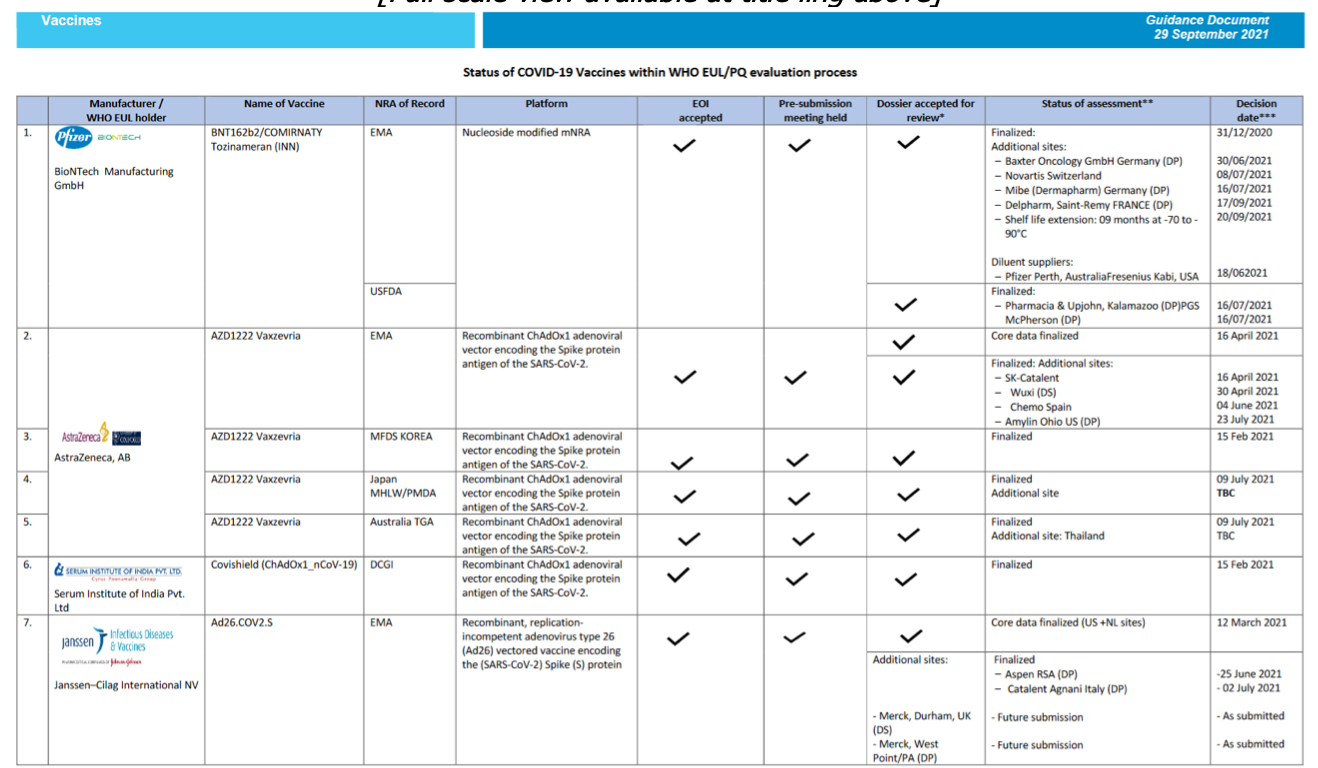
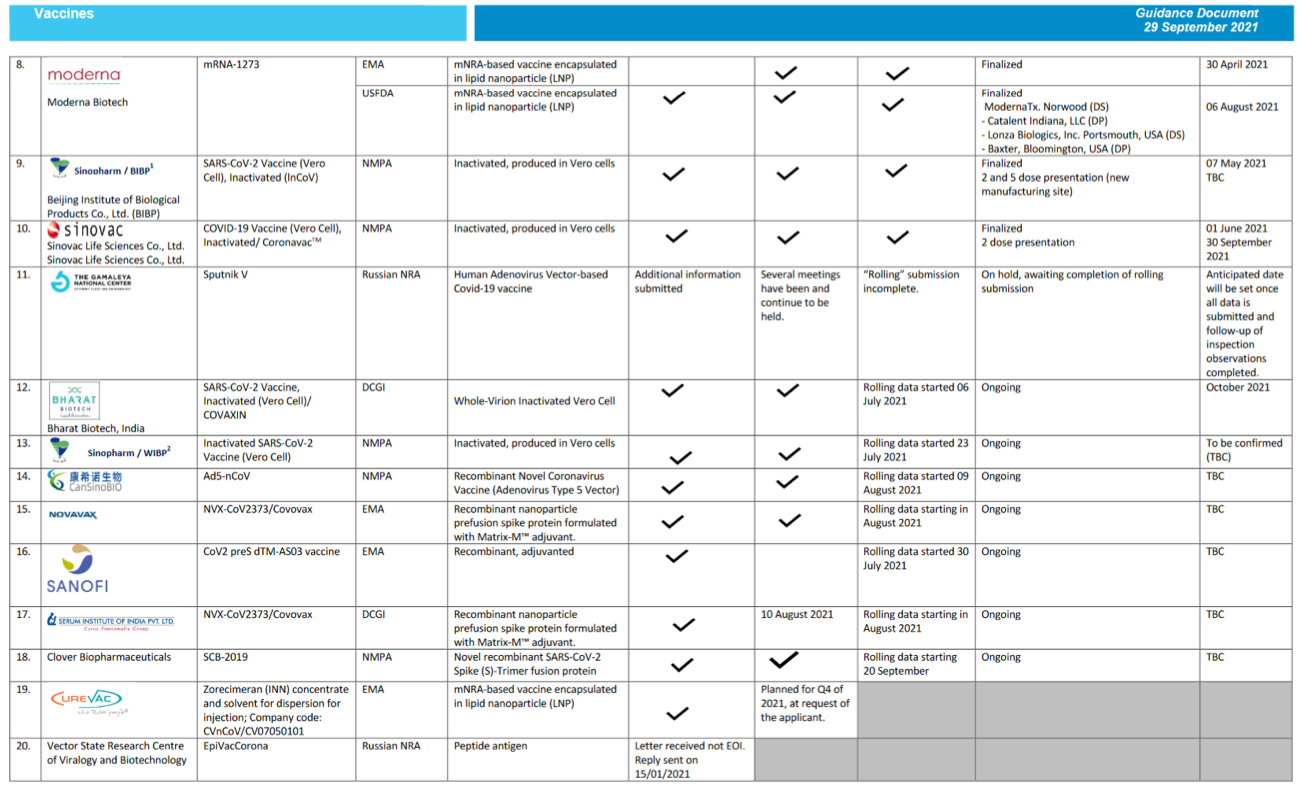
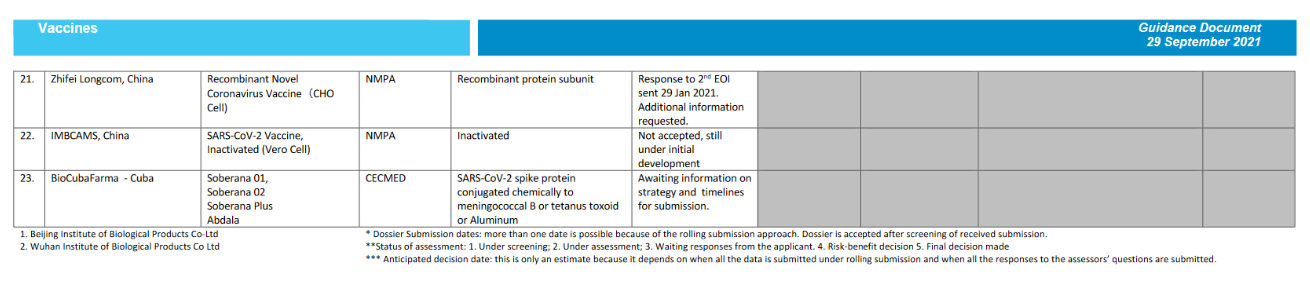
Status of COVID-19 Vaccines within WHO EUL/PQ evaluation process 29 September 2021

For 23 vaccine candidates, presents Manufacturer, Name of Vaccine, NRA of Record, Platform, EOI Accepted Status, Pre-submission Meeting Held Status, Dossier Accepted for Review, Status of Assessment; Anticipated/Completed Decision Date

[Full scale view available at title link above]

Status of COVID-19 Vaccines within WHO EUL/PQ evaluation process 29 September 2021

Milestones :: Perspectives :: Research


Status of COVID-19 Vaccines within WHO EUL/PQ evaluation process 29 September 2021
For 23 vaccine candidates, presents Manufacturer, Name of Vaccine, NRA of Record, Platform, EOI Accepted Status, Pre-submission Meeting Held Status, Dossier Accepted for Review, Status of Assessment; Anticipated/Completed Decision Date

[Full scale view available at title ling above]


::::::

COVID Vaccine Developer/Manufacturer Announcements
[relevant press releases/announcement from organizations from WHO EUL/PQ listing above]


AstraZeneca
Press Releases
AZD7442 request for Emergency Use Authorization for COVID-19 prophylaxis filed in US
05 October 2021
:: Filing includes data from PROVENT Phase III trial showing 77% reduction in risk of developing symptomatic COVID-19 with long-acting antibody combination (non-vaccine)
:: Potential to provide protection for those not expected to mount an adequate immune response following vaccination
AstraZeneca has submitted a request to the US Food and Drug Administration (FDA) for an Emergency Use Authorization (EUA) for AZD7442, its long-acting antibody (LAAB) combination, for prophylaxis of symptomatic COVID-19.
If granted, AZD7442 would be the first LAAB to receive an EUA for COVID-19 prevention. It is the first LAAB with Phase III data demonstrating a statistically significant reduction in the risk of developing symptomatic COVID-19 compared to placebo…

BioCubaFarma – Cuba
Últimas Noticias – [Website not responding at inquiry; receiving 403-Forbidden]


CanSinoBIO
News – [Website not responding at inquiry]

Clover Biopharmaceuticals – China
News – No new digest announcements identified


Curevac [Bayer Ag – Germany]
News – No new digest announcements identified


Gamaleya National Center
Latest News and Events – No new digest announcements identified [See Russia/RFID below]

IMBCAMS, China
Home – No new digest announcements identified


Janssen/JNJ
Press Releases
Oct 06, 2021 Belgium
Janssen Announces Novel Mechanism of Action that Shows Promise Against Dengue in Data Published in Nature

Oct 05, 2021 United States
Johnson & Johnson Announces Submission of Emergency Use Authorization Amendment to the U.S. FDA to Support Booster of its Single-Shot COVID-19 Vaccine
:: Submission includes data showing a booster increased protection to 94 percent against moderate to severe/critical COVID-19 in the U.S.
:: Substantial increase in immune response when booster was given at six months
:: The Company’s single-shot vaccine has demonstrated strong and long-lasting protection and durable immune responses in clinical studies


Moderna
Press Releases
October 7, 2021
Moderna to Build State-of-the-Art mRNA Facility in Africa to Manufacture up to 500 Million Doses Per Year
:: Facility to manufacture drug substance with opportunity for fill/finish and packing capabilities
:: Moderna will invest in building mRNA capabilities in Africa
CAMBRIDGE, Mass.–(BUSINESS WIRE)–Oct. 7, 2021– Moderna, Inc. (Nasdaq: MRNA), a biotechnology company pioneering messenger RNA (mRNA) therapeutics and vaccines, today announced it will build a state-of-the-art mRNA facility in Africa with the goal of producing up to 500 million doses of vaccines each year at the 50 µg dose level. The Company anticipates investing up to $500 million in this new facility which is expected to include drug substance manufacturing with the opportunity for fill/finish and packaging capabilities at the site. The Company expects to begin a process for country and site selection soon…

October 6, 2021
Moderna Announces the Launch of Global Fellowship Program for Young Researchers Exploring mRNA Medicines

October 5, 2021
Moderna Announces European Medicines Agency Authorizes Third Dose of COVID-19 Vaccine for Immunocompromised Individuals Aged 12 Years and Older


Novavax
Press Releases
Novavax Announces Leadership Appointment and Updates Oct 4, 2021
– Denny Kim, M.D. appointed Senior Vice President, Chief Safety Officer
– Raburn Mallory, M.D. promoted to Senior Vice President, Head of Clinical Development
– Marco Cacciuttolo, Ph.D. promoted to Senior Vice President, Process and Analytical Development


Pfizer
Recent Press Releases – No new digest announcements identified


Sanofi Pasteur
Press Releases
Sanofi: Positive results from the first study of high-dose influenza vaccine with a COVID-19 mRNA booster support co-administration recommendations
October 07 2021
:: First study to investigate the safety and immunogenicity of both vaccines when co-administered compared to each vaccine administered separately in adults aged 65 years and older
:: Timely new data for the start of the influenza vaccination campaigns across the Northern Hemisphere


Serum Institute of India
NEWS & ANNOUNCEMENTS – No new digest announcements identified


Sinopharm/WIBPBIBP
News – No new digest announcements identified


Sinovac
Press Releases – No new digest announcements identified


Vector State Research Centre of Viralogy and Biotechnology
Home – No new digest announcements identified

Zhifei Longcom, China
[Anhui Zhifei Longcom Biologic Pharmacy Co., Ltd.]
[No website identified]


::::::

GSK
Press releases for media
06 October 2021 GSK welcomes WHO recommendation for broad roll-out of its RTS,S/AS01e (RTS,S) malaria vaccine
[See Malaria above for detail]

04 October 2021 ViiV Healthcare submits FDA application for first dispersible single tablet regimen containing dolutegravir (DTG) for children living with HIV


Merck
News releases – No new digest announcements identified


SK Biosciences
Press releases
SK bioscience and CEPI Extend Agreement Contract Production of COVID-19 Vaccines by the End of 2022
2021.10. 06
…SK bioscience said, it has entered into extension of its capacity reservation agreement with the Coalition for Epidemic Preparedness Innovations (CEPI), on October 5th in Brussels, Belgium, for extended use of parts of manufacturing capacity in its plant, the L House for the production of COVID-19 vaccines developed by biopharmaceutical companies under the support of CEPI. Further, the two organizations agreed to continue to cooperate closely to overcome the current pandemic situation and support research and development of vaccines against various infectious diseases which have been frequently breaking out recently…

The Race for Global COVID-19 Vaccine Equity

Milestones :: Perspectives :: Research


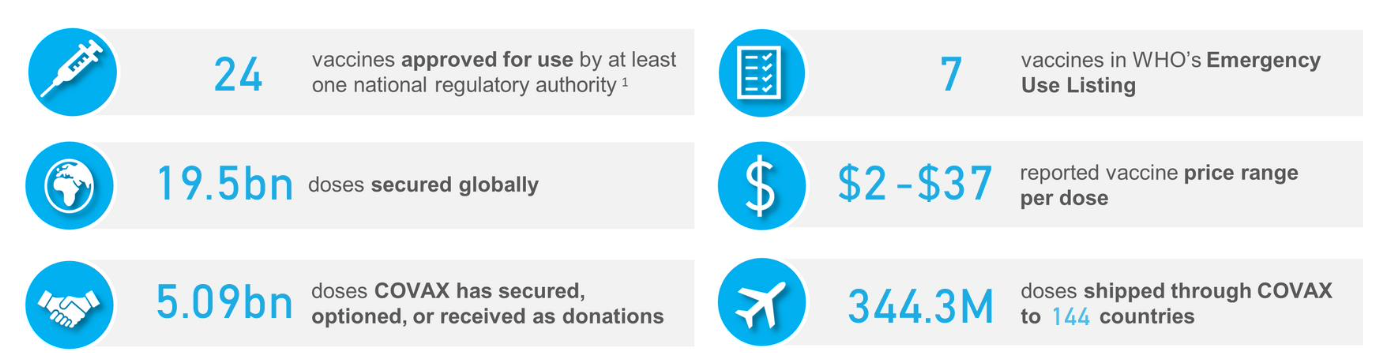
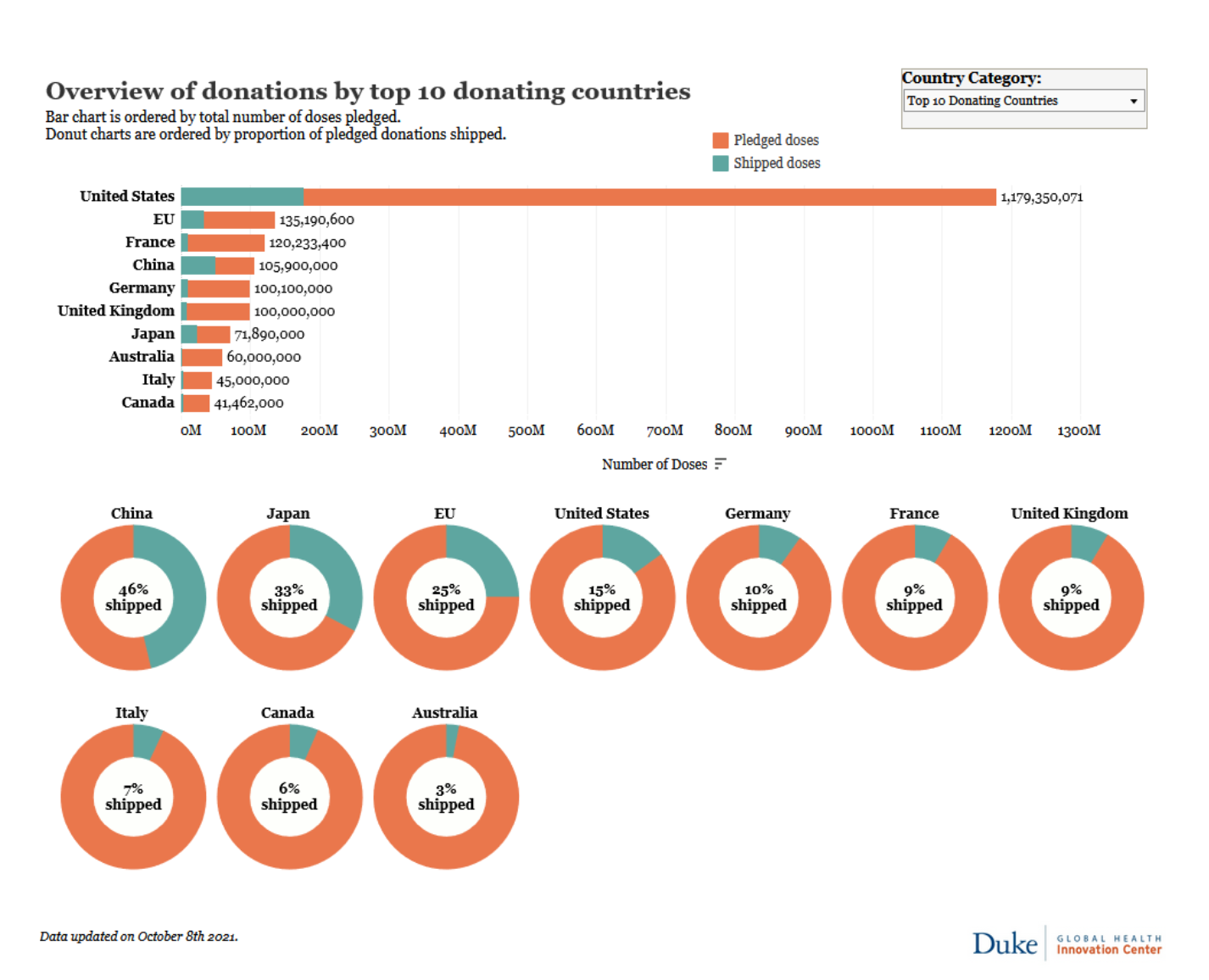
Duke – Launch and Scale Speedometer
The Race for Global COVID-19 Vaccine Equity
A flurry of nearly 200 COVID-19 vaccine candidates are moving forward through the development and clinical trials processes at unprecedented speed; more than ten candidates are already in Phase 3 large-scale trials and several have received emergency or limited authorization. Our team has aggregated and analyzed publicly available data to track the flow of procurement and manufacturing and better understand global equity challenges. We developed a data framework of relevant variables and conducted desk research of publicly available information to identify COVID vaccine candidates and status, deals and ongoing negotiations for procurement and manufacturing, COVID burden by country, and allocation and distribution plans. We have also conducted interviews with public officials in key countries to better understand the context and challenges facing vaccine allocation and distribution
[accessed 24 July 2021]
See our COVID Vaccine Purchases research
See our COVID Vaccine Manufacturing research
See our COVID Vaccine Donations & Exports research

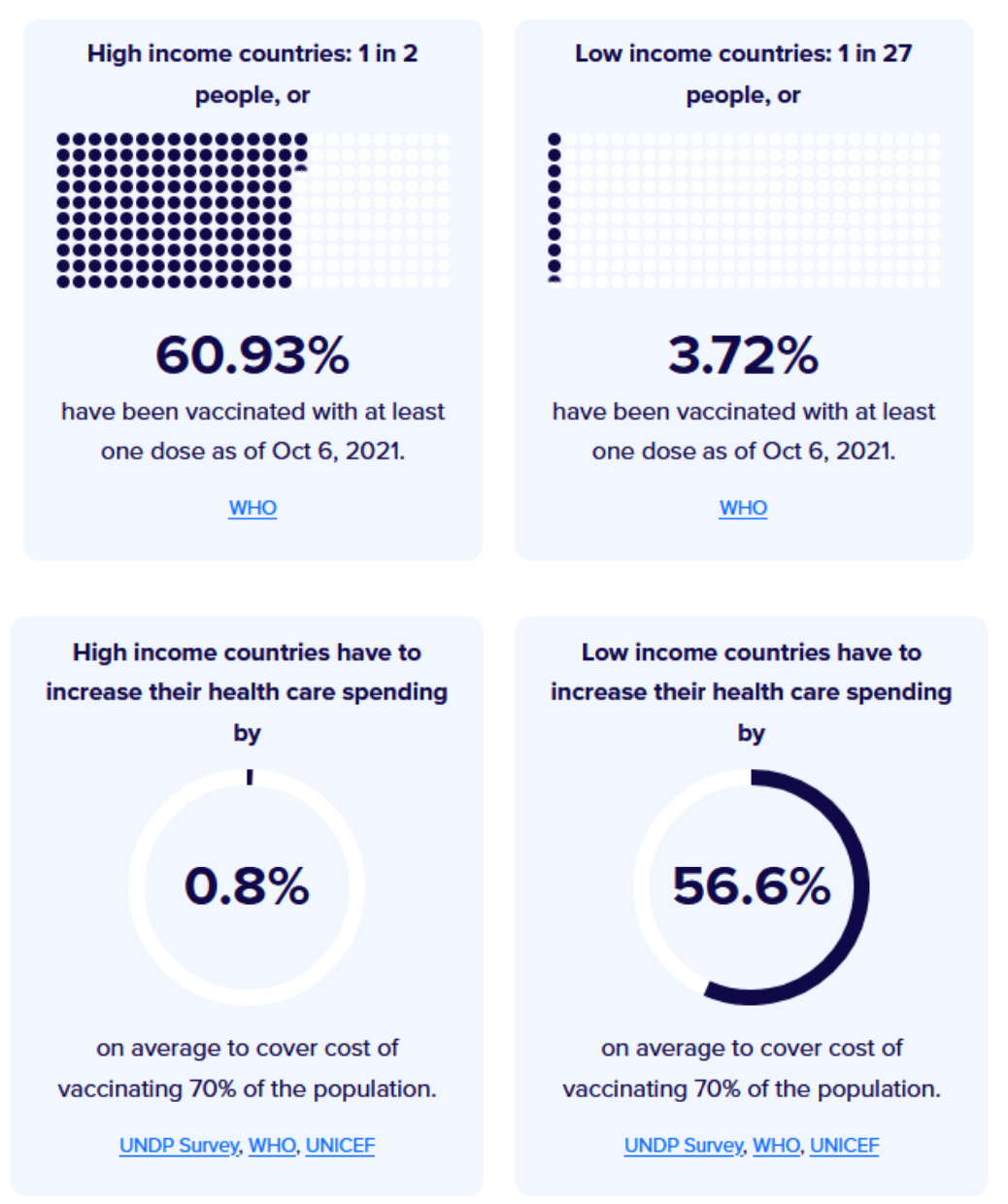
Global Dashboard on COVID-19 Vaccine Equity

Milestones :: Perspectives :: Research


Global Dashboard on COVID-19 Vaccine Equity
The Dashboard is a joint initiative of UNDP, WHO and the University of Oxford with cooperation across the UN system, anchored in the SDG 3 Global Action Plan for Healthy Lives and Well-being for All.

Dashboard on Vaccine Equity [accessed 09 Oct 2021]: https://data.undp.org/vaccine-equity/
See also visualization on Vaccine Access and Vaccine Affordability

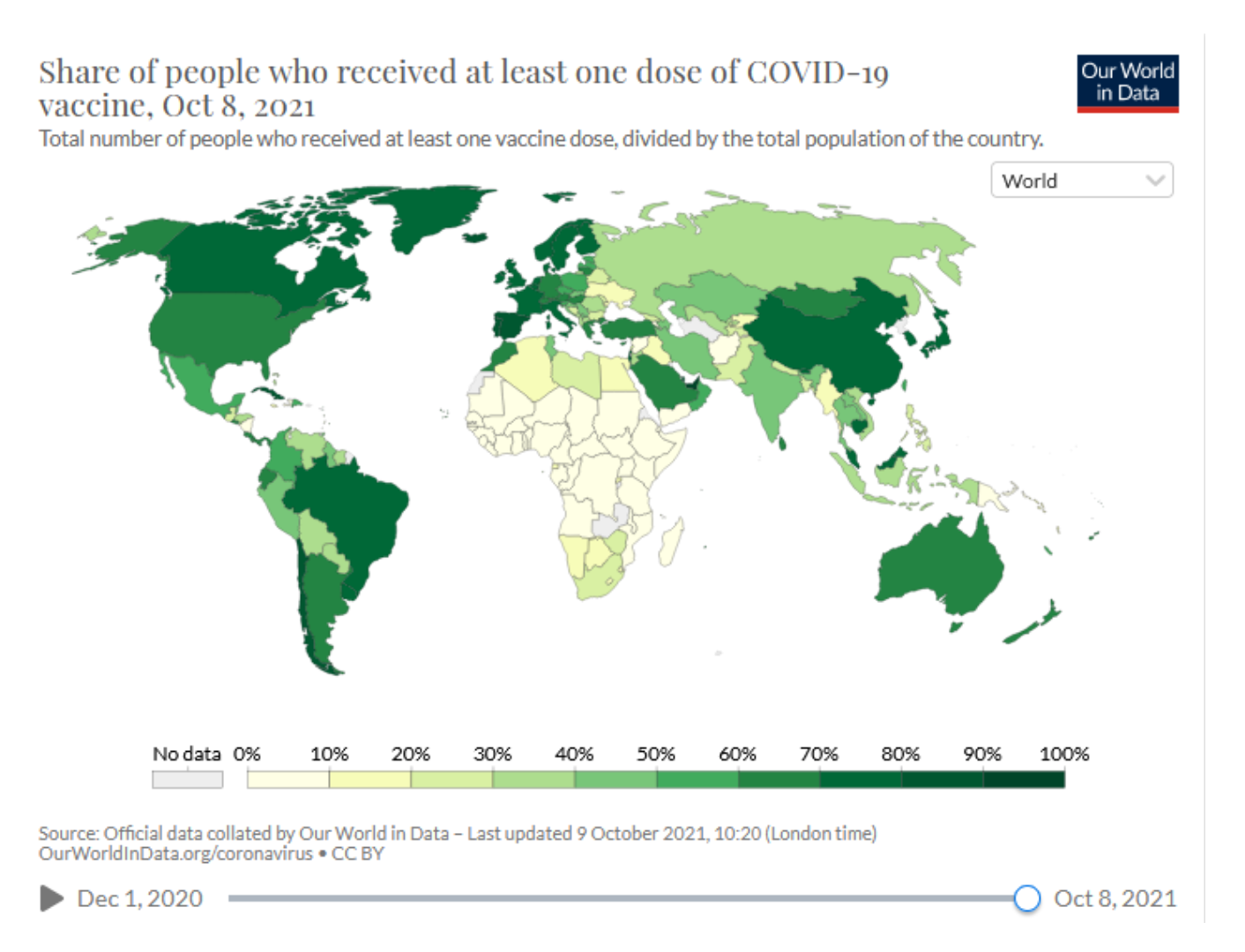
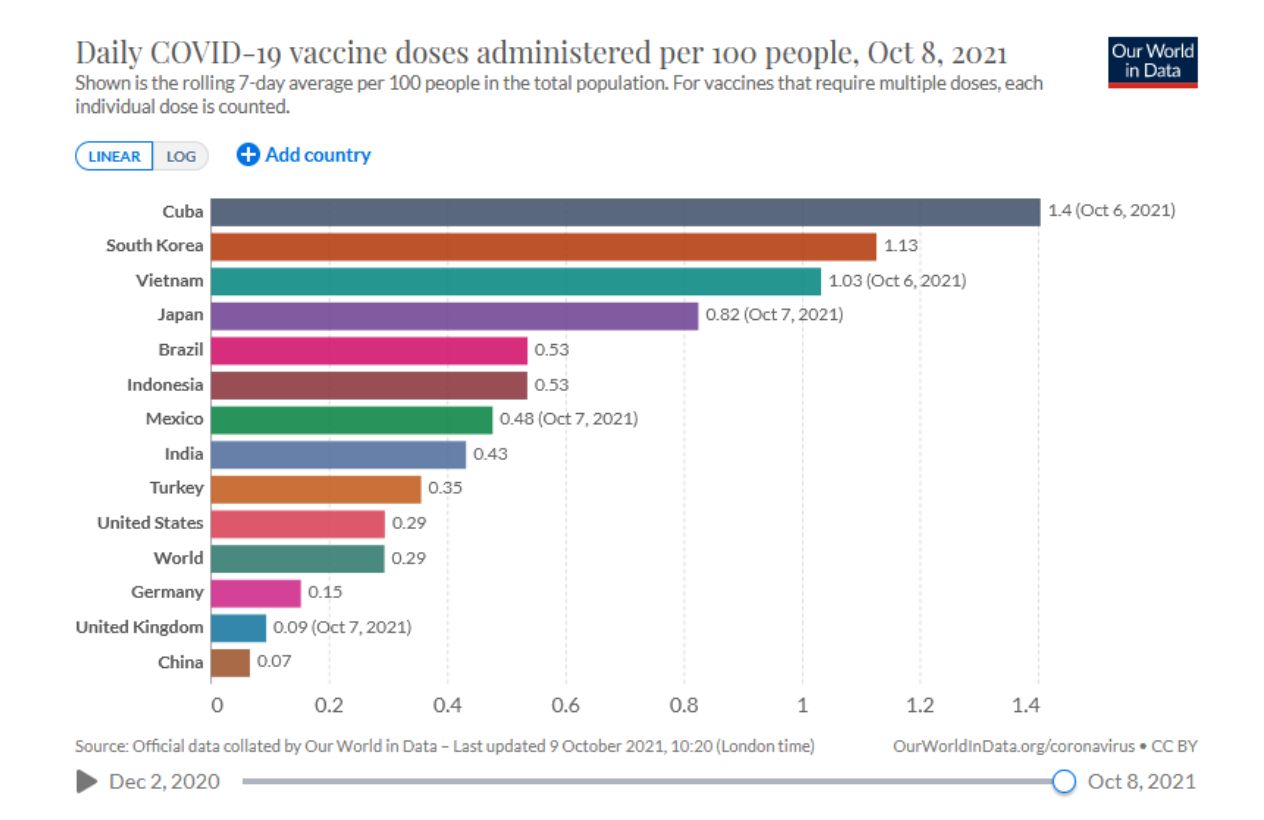
Our World in DataCoronavirus (COVID-19) Vaccinations [Accessed 09 Oct 2021]

Milestones :: Perspectives :: Research


Our World in Data
Coronavirus (COVID-19) Vaccinations [Accessed 09 Oct 2021]
:: 46.4% of the world population has received at least one dose of a COVID-19 vaccine.
:: 6.46 billion doses have been administered globally, and 23.06 million are now administered each day.
:: Only 2.5% of people in low-income countries have received at least one dose.

U.S.: COVID-19 Vaccines – Announcements/Regulatory Actions/Deployment

Milestones :: Perspectives :: Research


U.S.: COVID-19 Vaccines – Announcements/Regulatory Actions/Deployment


::::::

Vaccines and Related Biological Products Advisory Committee– FDA
https://www.fda.gov/advisory-committees/blood-vaccines-and-other-biologics/vaccines-and-related-biological-products-advisory-committee

Vaccines and Related Biological Products Advisory Committee October 14-15, 2021 Meeting Announcement
Agenda
…Under Topic 1, the committee will meet in open session to discuss the Emergency Use Authorization (EUA) of the ModernaTX Inc. COVID-19 vaccine for the administration of an additional dose, or “booster” dose, following completion of the primary series, to individuals 18 years of age and older. On October 15, 2021, under Topic II, the committee will meet in open session to discuss the Emergency Use Authorization (EUA) of the Janssen Biotech Inc. COVID-19 vaccine for the administration of an additional dose, or “booster” dose, to individuals 18 years of age and older.

Vaccines and Related Biological Products Advisory Committee October 26, 2021 Meeting Announcement – 10/26/2021 – 10/26/2021
Agenda
…The committee will meet in open session to discuss Pfizer Inc.’s request to amend its Emergency Use Authorization (EUA) to allow for the use of the Pfizer-BioNTech COVID-19 vaccine in children 5 through 11 years of age.


::::::

White House [U.S.]
Briefing Room – Selected Major COVID Announcements
Remarks by President Biden on the Importance of COVID-⁠19 Vaccine Requirements
October 07, 2021 • Speeches and Remarks

Press Briefing by White House COVID-⁠19 Response Team and Public Health Officials
October 06, 2021 • Press Briefings

Statement by President Joe Biden on Dr. Francis Collins Stepping Down as Director of the National Institutes of Health
October 05, 2021 • Statements and Releases

Statement by President Joe Biden on 700,000 American Deaths from COVID-⁠19
October 02, 2021 • Statements and Releases

Europe: COVID-19 Vaccines – Announcements/Regulatory Actions/Deployment

Milestones :: Perspectives :: Research


Europe: COVID-19 Vaccines – Announcements/Regulatory Actions/Deployment


European Medicines Agency
News & Press Releases
News: Additional manufacturing site for COVID-19 Vaccine Janssen (new)
Last updated: 07/10/2021
EMA’s human medicines committee (CHMP) has approved an additional manufacturing site for the production of COVID-19 Vaccine Janssen, developed by Janssen-Cilag International NV. The site, located in West Point, Pennsylvania in the United States, and operated by Merck Sharp & Dohme Corp, will manufacture finished product. The site is expected to support the continued supply of COVID-19 Vaccine Janssen in the European Union…


News: Comirnaty and Spikevax: EMA recommendations on extra doses and boosters (new)
Last updated: 04/10/2021
EMA’s human medicines committee (CHMP) has concluded that an extra dose of the COVID-19 vaccines Comirnaty (BioNTech/Pfizer) and Spikevax (Moderna) may be given to people with severely weakened immune systems, at least 28 days after their second dose…


News: EMA receives application for marketing authorisation for Regkirona (regdanvimab) for treating patients with COVID-19 (new)
CHMP, PDCO, PRAC, Last updated: 04/10/2021


::::::

European Centre for Disease Prevention and Control
https://www.ecdc.europa.eu/en
Latest Updates
News
ECDC builds study infrastructure to monitor COVID-19 vaccine effectiveness
News story – 8 Oct 2021

Publication
Core protocol for ECDC studies of COVID-19 vaccine effectiveness against hospitalisation with Severe Acute Respiratory Infection laboratory-confirmed with SARS-CoV-2, version 1.0
Technical report – 8 Oct 2021

Publication
Interim analysis of COVID-19 vaccine effectiveness against Severe Acute Respiratory Infection due to laboratory-confirmed SARS-CoV-2 among individuals aged 65 years and older, ECDC multi-country study
Technical report – 8 Oct 2021


::::::

Accessed 09 Oct 2021

https://vaccinetracker.ecdc.europa.eu/public/extensions/COVID-19/vaccine-tracker.html#uptake-tab


::::::
European Commission
https://ec.europa.eu/commission/presscorner/home/en
Press release 7 October 2021
Ethiopia: new EU Humanitarian Air Bridge flight reaches Tigray
The second flight of the EU Humanitarian Air Bridge to Tigray, co-organised by the EU, France and Italy, landed in Mekelle airport on 6 October 2021 delivering an additional 10.6 tons of life-saving cargo for the people affected by the conflict in Tigray, Ethiopia.

Press release 2 October 2021
EU Humanitarian Air Bridge delivers life-saving medical aid to Afghanistan

Russia: COVID-19 Vaccines – Announcements/Regulatory Actions/Deployment

Milestones :: Perspectives :: Research


Russia: COVID-19 Vaccines – Announcements/Regulatory Actions/Deployment
Russia: Sputnik V – “the first registered COVID-19 vaccine”
https://sputnikvaccine.com/newsroom/pressreleases/
Press Releases
RDIF is inviting international scientists and scientific institutions to cooperate on research of real-world data/real-world evidence (RWD/RWE) on safety and efficacy of Sputnik V, Sputnik Light and other vaccines against coronavirus
Moscow, October 7, 2021 – The Russian Direct Investment Fund (RDIF, Russia’s sovereign wealth fund) is inviting independent international researchers and scientific institutions to cooperate on real-world studies of safety and efficacy of coronavirus vaccines, including Sputnik V, Sputnik Light and others.
Key study topics:
Real-world studies on safety and efficacy of Sputnik V and Sputnik Light;
Efficacy factor analysis;
Comparative analysis of real-world data on safety and efficacy of Sputnik V, Sputnik Light and other vaccines;
Analysis of the real-world data on safety and efficacy of Sputnik Light as a booster.
Applicants conducting or planning to start scientific research in the abovementioned areas are kindly invited to contact RDIF and describe areas of interest and specific cooperation proposals via vaccineresearch@rdif.ru

The single-component Sputnik Light vaccine authorized in UAE
Press release, 06.10.2021

India: COVID-19 Vaccines – Announcements/Regulatory Actions/Deployment

Milestones :: Perspectives :: Research


India: COVID-19 Vaccines – Announcements/Regulatory Actions/Deployment


Ministry of Health and Family Welfare
<a


Latest Updates
05.10.2021
Guidelines on Operationalization of Maternal Health Services during the COVID-19 Pandemic


Government of India – Press Information Bureau
Latest Press Releases
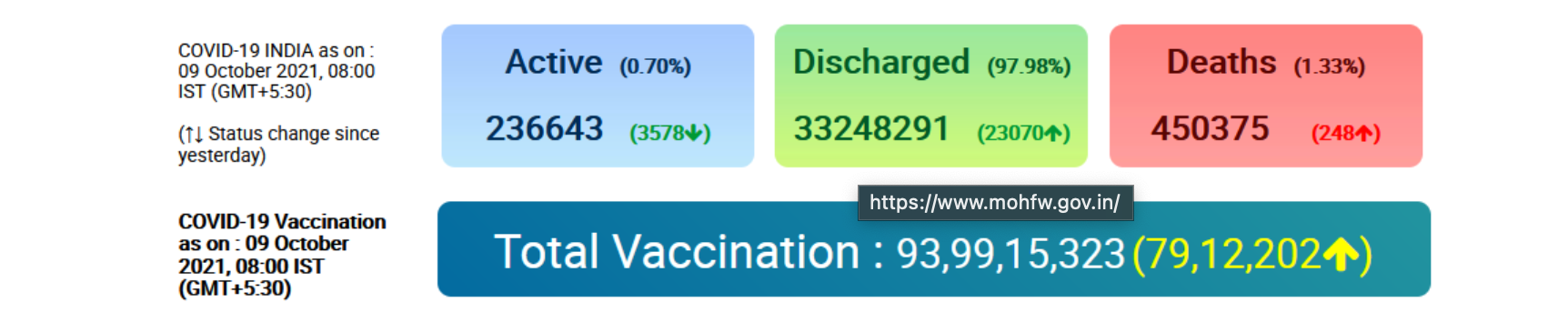
COVID-19 Vaccination Update – Day 267
India’s cumulative vaccination coverage crosses 94.62 crore
More than 60 lakh Vaccine doses administered today till 7 pm

Posted On: 09 OCT 2021 8:44PM by PIB Delhi
In a significant achievement, India’s COVID-19 vaccination coverage has crossed 94.62 Crore (94,62,90,307) today. More than 60 lakh (60,66,412) Vaccine Doses have been administered till 7 pm today.  The daily vaccination tally is expected to increase with the compilation of the final reports for the day by late tonight.


Indian Council for Medical Research (ICMR)
https://www.icmr.gov.in/media.html
Press Releases
No new digest content identified

POLIOPublic Health Emergency of International Concern (PHEIC)

Emergencies

POLIO
Public Health Emergency of International Concern (PHEIC)
https://polioeradication.org/polio-today/polio-now/this-week/

Polio this week as of 06 October 2021
:: The final and official version of the Polio Eradication Strategy 2022-2026: Delivering on a Promise is now available both on the GPEI website and on the WHO IRIS section. The Executive summary of the strategy has also been made available in all UN languages here. Many of the new tactics and strengthened approaches outlined in this plan are already operational, and the plan will officially replace the current Polio Endgame Strategy in January 2022.


Summary of new WPV and cVDPV viruses this week (AFP cases and ES positives):
:: Madagascar: one cVDPV1 case and 3 cVDPV1 positive environmental samples
:: Nigeria:  17 cVDPV2 cases Guinea: one cVDPV2 positive environmental sample


::::::

Event – Eradicating Polio: What more Is Needed?
WFPHA – World Federation of Public Health Associations
Sep 22, 2021
Polio cases have fallen 99.9% since 1988. In 2020 Africa was certified polio free by the World Health Organization. However, polio will remain a key public health concern until such time as there are no wild… On October 12, 2021, at 10:00 – 11:00 (CEST), “Eradicating Polio: What more Is Needed?” webinar will be held to focus on the barriers, challenges and leverages to reach every child and eradicate polio globally. Register


::::::
::::::

WHO/OCHA Emergencies

Health emergencies list – WHO
“The health emergencies list details the disease outbreaks, disasters and humanitarian crises where WHO plays an essential role in supporting countries to respond to and recover from emergencies with public health consequences.”

Crisis in Northern Ethiopia [Last apparent update: 5 Aug 2021]

Ebola outbreak, Democratic Republic of the Congo, 2021 [Last apparent update: 17 Aug 2021]

Ebola outbreak outbreak, N’Zerekore, Guinea, 2021 [Last apparent update: 17 Aug 2021]

Coronavirus disease (COVID-19) pandemic [See COVID above]


Ebola outbreak, Equateur Province, Democratic Republic of the Congo, 2020
[Last apparent update: 17 Aug 2021]

Ebola outbreak, North Kivu, Ituri, Democratic Republic of the Congo, 2018 – 2020
[Last apparent update: 17 Aug 2021]

Ebola outbreak, Democratic Republic of the Congo, 2018 [Last apparent update: 24 July 2018]

Yemen crisis [Last apparent update: 12 February 2021]

Syria crisis [Last apparent update: 18 June 2021]

Somalia crisis [Last apparent update: 24 March 2018]

Nigeria crisis
:: Case study: Pilot implementation in Nigeria and Zambia, SBI COVID-19 data collection tool
1 October 2021

Ebola outbreak, Democratic Republic of the Congo, 2017 [Last apparent update: 17 Aug 2021]

Zika virus disease outbreak, 2015-2016 [Last apparent update: 24 Jan 2020]

Ebola outbreak: West Africa, 2014-2016 [Last apparent update: 17 Aug 2021]

Iraq crisis [Last apparent update: 9 Jan 2008]

South Sudan crisis [Last apparent update: 23 Sep 2020]

Avian influenza A (H7N9) virus outbreak [Last apparent update: 13 September 2021]

Middle East respiratory syndrome (MERS-CoV) outbreak [Last apparent update: 8 July 2019]

Influenza A (H1N1) virus, 2009-2010 pandemic [Last apparent update: 10 Aug 2010]


::::::

UN OCHA – Current Emergencies
Current Corporate Emergencies
Afghanistan
Afghanistan: Weekly Humanitarian Update (27 September – 3 October 2021)


Northern Ethiopia
Ethiopia – Northern Ethiopia Humanitarian Update Situation Report, 07 Oct 2021
HIGHLIGHTS
The overall humanitarian situation in Northern Ethiopia continues to deteriorate.
During the week, 80 trucks of humanitarian supplies arrived in Tigray via Afar.
As per a rapid market survey in Tigray, prices of essential commodities spiked dramatically since mid-June, including by 2,300 per cent for benzine in Shire.
Partners reached more than 444,000 people with food assistance in Amhara and about 72,000 internally displaced people in Afar since early August.
The Government of Ethiopia expelled seven UN officials, including senior humanitarian officials.


::::::
::::::

WHO & Regional Offices [to 09 Oct 2021]

WHO & Regional Offices [to 09 Oct 2021]
https://www.who.int/
15 October 2021 Departmental news
Webinar: “Policies to develop, attract, recruit and retain health workers in rural and remote areas, and promote gender equality for rural women through health workforce policies”

8 October 2021 News release
WHO report highlights global shortfall in investment in mental health

8 October 2021 Departmental news
WHO announces the update of HCV guidelines on testing and treatment

7 October 2021 News release
WHO, UN set out steps to meet world COVID vaccination targets

6 October 2021 Departmental news
2019 Nobel laureate Michael Kremer emphasizes WASH and deworming benefits

6 October 2021 News release
WHO recommends groundbreaking malaria vaccine for children at risk

5 October 2021 Departmental news
WHO, WIPO, WTO Workshop on Innovation in, and Access to, COVID 19 Technologies: Intellectual property licensing, technology transfer, and sharing of know-how and clinical trial information

5 October 2021 Departmental news
New global targets to prevent maternal deaths

4 October 2021 Statement
Interim statement on booster doses for COVID-19 vaccination

4 October 2021 Departmental news
WHO brings vital mental health messages to gamers via digital channels

3 October 2021 Departmental news
Summary Report of Public consultation on the Draft WHO Global Strategy for Food Safety

::::::


WHO Regional Offices
Selected Press Releases, Announcements
WHO African Region AFRO
No new digest content identified

WHO Region of the Americas PAHO
No new digest content identified

WHO South-East Asia Region SEARO
:: Strengthen mental health services: WHO 9 October 2021

WHO European Region EURO
:: Syrian law student Muhammed, paralyzed by a stray bullet, takes first steps towards a brighter future in Turkey 08-10-2021
:: EU-funded project bolsters COVID-19 response in Eastern Partnership countries 08-10-2021
:: WHO/Europe brings mental health out of the shadows with new Pan-European Coalition 05-10-2021
:: Physical activity promoting policies in the era of COVID-19: is Europe on the right track? 04-10-2021

WHO Eastern Mediterranean Region EMRO
:: World Mental Health Day 2021: mental health care for all: let’s make it a reality 10 October 2021
:: WHO helps boost national diagnostic capacity in Islamic Republic of Iran by equipping National Influenza Centre with IT devices 3 October 2021

WHO Western Pacific Region
:: 8 October 2021 | Commentary Battling the Pandemic in South-East Asia
ASEAN countries were among the first to be affected by COVID-19. But for 18 months, we managed to keep the virus’s spread below levels experienced in other regions, accounting for less than 5 per cent of global cases and deaths


::::::

New WHO Publications [Selected]
https://www.who.int/publications/i
Selected Titles
8 October 2021
Mental Health ATLAS 2020

7 October 2021
WHO COVID-19 Excess Mortality Estimation Methodology

6 October 2021
A clinical case definition of post COVID-19 condition by a Delphi consensus, 6 October 2021

6 October 2021
Antigen-detection in the diagnosis of SARS-CoV-2 infection

CDC/ACIP [U.S.] [to 09 Oct 2021]

CDC/ACIP [U.S.] [to 09 Oct 2021]
http://www.cdc.gov/media/index.html
https://www.cdc.gov/vaccines/acip/index.html
Latest News Releases, Announcements
The Hidden U.S. COVID-19 Pandemic: Orphaned Children – More than 140,000 U.S. Children Lost a Primary or Secondary Caregiver Due to the COVID-19 Pandemic
New study highlights stark disparities in caregiver deaths by race and ethnicity, calls for urgent public health response
Thursday, October 7, 2021
… From April 1, 2020 through June 30, 2021, data suggest that more than 140,000 children under age 18 in the United States lost a parent, custodial grandparent, or grandparent caregiver who provided the child’s home and basic needs, including love, security, and daily care. Overall, the study shows that approximately 1 out of 500 children in the United States has experienced COVID-19-associated orphanhood or death of a grandparent caregiver. There were racial, ethnic, and geographic disparities in COVID-19-associated death of caregivers: children of racial and ethnic minorities accounted for 65% of those who lost a primary caregiver due to the pandemic…

CDC Completes Sixty-Day Assessment of Order under 42 U.S.C. 265
Saturday, October 2, 2021
… As specified in that Order, CDC reviewed the latest information regarding the status of the COVID-19 pandemic and associated public health risks to determine whether the Order remains necessary to protect the public health. After examining the current impact of the COVID-19 pandemic throughout the United States and at the U.S. borders, the ongoing risks of transmission and spread of COVID-19 in the congregate settings of facilities at the ports of entry and U.S. Border Patrol stations, the continued threat from the Delta variant, and the availability of testing, vaccination, and other mitigation measures, CDC has determined that the Order continues to be necessary at this time. CDC will continue to reassess the Order.

Next ACIP Meetings
No registration is required to watch the webcast.
:: October 20-21, 2021 – No agenda posted at 09 Oct 2021
:: November 2-3, 2021 – No agenda posted at 09 Oct 2021

MMWR News Synopsis Friday, October 8, 2021
Selected Content
:: HIV Preexposure Prophylaxis Awareness and Referral to Providers Among Hispanic/Latino Persons — United States, 2019
:: Distribution of SARS-CoV-2 Variants in a Large Integrated Health Care System — California, March–July 2021
:: Multicomponent Strategies to Prevent SARS-CoV-2 Transmission — Nine Overnight Youth Summer Camps, United States, June–August 2021
:: COVID-19 Outbreaks at Youth Summer Camps — Louisiana, June–July 2021
:: National and State Trends in Anxiety and Depression Severity Scores Among Adults During the COVID-19 Pandemic — United States, 2020–2021

Coronavirus Disease 2019 (COVID-19)– CDC
Approximately 25 announcements/reports/data summaries.

Africa CDC [to 09 Oct 2021]

Africa CDC [to 09 Oct 2021]
http://www.africacdc.org/
News
Outbreak Brief 90: Coronavirus Disease 2019 (COVID-19) Pandemic
…As of 9 a.m. East African Time (EAT) 5 October 2021, a total of 8,343,967 COVID-19 cases and 212,484 deaths (CFR: 2.5%) have been reported in 55 African Union (AU) Member States. This represents 3.6% of all cases and 4.4% of all deaths reported globally. Twenty-seven (49%) AU Member States are reporting CFRs higher than the global CFR. Since the beginning of the pandemic, 54 (98%) AU Member States have experienced at least a second wave, 44 (80%) have experienced a third wave and seven countries (Algeria, Benin, Egypt, Kenya, Mauritius, Somalia and Tunisia) have experienced a fourth wave of COVID-19 cases. Figure 1 shows the trend of new COVID-19 cases reported per day by AU region from 15 February 2020 to 5 October 2021. The overall daily number of new cases being reported across the continent has continued to decline. More information on COVID-19 situation in Africa is available on the Africa CDC daily dashboard and hotspot dashboard.

China CDC

China CDC http://www.chinacdc.cn/en/

National Health Commission of the People’s Republic of China [to 09 Oct 2021]
http://en.nhc.gov.cn/
News
Oct 9: Daily briefing on novel coronavirus cases in China
On Oct 8, 31 provincial-level regions and the Xinjiang Production and Construction Corps on the Chinese mainland reported 17 new cases of confirmed infections.

National Medical Products Administration – PRC [to 09 Oct 2021]
http://english.nmpa.gov.cn/news.html
News
Over 2.217b COVID-19 vaccine doses administered on Chinese mainland
2021-10-09
More than 2.217 billion doses of COVID-19 vaccine had been administered on the Chinese mainland as of Thursday, data from the National Health Commission showed on Oct 8.

Timeline: Xi on making China’s COVID-19 vaccines a global public good
2021-10-08

CCDC Weekly – Weekly Reports: Current Volume (3)
2021-10-08 / No. 41
View  PDF of this issue
Perspectives: COVID-19 Expands Its Territories from Humans to Animals
Perspectives: Targeted Prevention and Control of Key Links in Airports to Mitigate Public Health Risks
Outbreak Reports: Eleven COVID-19 Outbreaks with Local Transmissions Caused by the Imported SARS-CoV-2 Delta VOC — China, July–August, 2021
Methods and Applications: Braking Force Model on Virus Transmission to Evaluate Interventions Including the Administration of COVID-19 Vaccines — Worldwide, 2019–2021

Organization Announcements

::::::


Organization Announcements
Editor’s Note:
Careful readers will note that the number and range of organizations now monitored in our Announcements section below has grown as the impacts of the pandemic have spread across global economies, supply chains and programmatic activity of multilateral agencies and INGOs.
 
 
Paul G. Allen Frontiers Group [to 09 Oct 2021]
https://alleninstitute.org/what-we-do/frontiers-group/new s-press/
News
No new digest content identified.
 
 
BARDA – U.S. Department of HHS [to 09 Oct 2021]
https://www.phe.gov/about/barda/Pages/default.aspx
News
October 5, 2021
HHS selects Emory University to demonstrate better approach to disaster medical care
Site becomes fourth to illustrate a regional disaster health response system
To demonstrate a unique approach to improving medical surge and clinical specialty care needed to save lives during a national emergency, the U.S. Department of Health and Human Services’ Office of the Assistant Secretary for Preparedness and Response (ASPR) selected Emory University to lead the latest Regional Disaster Health Response System site…
 
 
BMGF – Gates Foundation [to 09 Oct 2021]
https://www.gatesfoundation.org/ideas/media-center
Press Releases and Statements
No new digest content identified.
 
 
Bill & Melinda Gates Medical Research Institute [to 09 Oct 2021]
https://www.gatesmri.org/
The Bill & Melinda Gates Medical Research Institute is a non-profit biotech organization. Our mission is to develop products to fight malaria, tuberculosis, and diarrheal diseases—three major causes of mortality, poverty, and inequality in developing countries. The world has unprecedented scientific tools at its disposal; now is the time to use them to save the lives of the world’s poorest people
No new digest content identified.
 
 
CARB-X [to 09 Oct 2021]
https://carb-x.org/
News
No new digest content identified.
 
 
Center for Vaccine Ethics and Policy – GE2P2 Global Foundation [to 09 Oct 2021]
https://centerforvaccineethicsandpolicy.net/
News/Analysis/Statements
:: Past weekly editions and posting of all segments of Vaccines and Global Health: The Week in Review are available here.
:: [NEW] Informed Consent: A Monthly Review – October 2021 is now posted here
 
 
CEPI – Coalition for Epidemic Preparedness Innovations [to 09 Oct 2021]
http://cepi.net/
Latest News
University of Oxford’s Prof. Dame Sarah Gilbert and CEPI’s Dr. Richard Hatchett: “No one is safe, until we are all safe”
In a jointly authored letter, published in Science Translational Medicine, they call for urgent action to address the ongoing disparity in COVID-19 vaccination levels in low-income countries compared to high-income countries.
06 Oct 2021

Further vaccine R&D is critical to end the devastating COVID-19 pandemic
Increased investment in ongoing vaccine R&D efforts will enable COVAX to deliver on its promises and ensure that our vaccines remain safe and effective against the emerging SARS-CoV-2 strains.
Blog
05 Oct 2021
 
 
DARPA – Defense Advanced Research Projects Agency [to 09 Oct 2021
https://www.darpa.mil/news
News
No new digest content identified.
 
 
Duke Global Health Innovation Center [to 09 Oct 2021]
https://dukeghic.org/
Our Blog
No new digest content identified.
 
 
EDCTP [to 09 Oct 2021]
http://www.edctp.org/
The European & Developing Countries Clinical Trials Partnership (EDCTP) aims to accelerate the development of new or improved drugs, vaccines, microbicides and diagnostics against HIV/AIDS, tuberculosis and malaria as well as other poverty-related and neglected infectious diseases in sub-Saharan Africa, with a focus on phase II and III clinical trials
News
07 October 2021
RTS,S/AS01 malaria vaccine: EDCTP contributions and next steps
EDCTP has supported the development of the RTS,S/AS01 malaria vaccine both directly and indirectly through funding clinical research and capacity strengthening in Mozambique, Tanzania, Kenya, Gabon, Ghana and Burkina Faso
Several EDCTP2-funded RTS,S/AS01-related projects are currently ongoing on product-focused implementation research
New and very promising EDCTP-supported early clinical trial results show 77% efficacy for R21/Matrix-M malaria vaccine candidate
 
 
Emory Vaccine Center [to 09 Oct 2021]
http://www.vaccines.emory.edu/
Vaccine Center News
No new digest content identified.
 
 
European Vaccine Initiative [to 09 Oct 2021]
http://www.euvaccine.eu/
Latest News
No new digest content identified.
 
 
Fondation Merieux [to 09 Oct 2021]
http://www.fondation-merieux.org/
News, Events
No new digest content identified.
 
 
Gavi [to 09 Oct 2021]
https://www.gavi.org/
News releases
6 October 2021
Gavi, Unitaid and the Global Fund welcome WHO recommendation for world’s first malaria vaccine
[See Milestones above for detail]

6 October 2021
Gulf countries unite to support COVAX
Gulf Cooperation Council (GCC) countries have come together to support global equitable access to COVID-19 vaccines, with pledges now totalling US$ 221 million in funding pledges and US$ 50 million in in-kind support from all six Member States, following Bahrain’s recent commitment of US$ 2.5 million in funding for the Gavi COVAX Advance Market Commitment (Gavi COVAX AMC)
The Kingdom of Bahrain’s Minister of Foreign Affairs, Dr Abdullatif bin Rashid Al Zayani: “The collaborative support of COVAX from GCC Member States is testament to the strength of our relations. It is only through engaging with global health partnerships, such as Gavi, that the international community will be able to suppress COVID-19.”
Dr Seth Berkley, CEO of Gavi, the Vaccine Alliance: “We are delighted to see united support from the GCC Member States for COVAX. This builds on years of growing funding and assistance for Gavi’s routine immunisation programmes.”
The first Gulf nations pledge came from the Kingdom of Saudi Arabia during its G20 Saudi Presidency back in 2020, allocating US$ 150 million to support the Gavi COVAX AMC.

GHIT Fund [to 09 Oct 2021]
https://www.ghitfund.org/newsroom/press
GHIT was set up in 212 with the aim of developing new tools to tackle infectious diseases that
No new digest content identified.
 
 
Global Fund [to 09 Oct 2021]
https://www.theglobalfund.org/en/news/
News & Stories
News
Global Fund Crosses US$4 billion Mark in Funding to Support Countries in the Fight Against COVID-19
08 October 2021

News
Global Fund and UNDP Join Efforts to Maintain Access to Essential Health Services in Afghanistan
06 October 2021
On 20 September, the Global Fund and UNDP signed an agreement to provide interim and emergency funding to sustain the delivery of essential health services to the people of Afghanistan. This agreement seeks to provide the resources needed to bridge t…

News
Gavi, Unitaid and the Global Fund Welcome WHO Recommendation for World’s First Malaria Vaccine
06 October 2021
Gavi, the Vaccine Alliance, global health agency Unitaid and the Global Fund to Fight AIDS, Tuberculosis and Malaria welcome the WHO recommendation for wider routine use of the RTS,S malaria vaccine. The recommendation is based on data gathered throu…
[See Milestones above for detail]
 
 
Global Research Collaboration for Infectious Disease Preparedness [GloPID-R] [to 09 Oct 2021]
https://www.glopid-r.org/news/
News
No new digest content identified.
 
 
Hilleman Laboratories [to 09 Oct 2021]
http://www.hillemanlabs.org/
Website reports “under maintenance” at inquiry
 
 
Human Vaccines Project [to 09 Oct 2021]
http://www.humanvaccinesproject.org/
News
No new digest content identified.
 
 
IAVI [to 09 Oct 2021]
https://www.iavi.org/newsroom
Latest News
No new digest content identified.


International Coalition of Medicines Regulatory Authorities [ICMRA]
http://www.icmra.info/drupal/en/news
Selected Statements, Press Releases, Research
No new digest content identified.
 
 
ICRC [to 09 Oct 2021]
https://www.icrc.org/en/whats-new
Selected News Releases, Statements, Reports
No new digest content identified.


IFFIm
http://www.iffim.org/
Press Releases/Announcements
No new digest content identified.
 
 
IFRC [to 09 Oct 2021]
http://media.ifrc.org/ifrc/news/press-releases/
Selected Press Releases, Announcements
08/10/2021
Red Cross set to launch a Humanitarian Logistics Hub in the Southern Cone of the Americas
Buenos Aires, 8 October, 2021 – The Argentine Red Cross (ARC) and the International Federation of Red Cross and Red Crescent Societies (IFRC) will launch a Humanitarian Logistics Hub to expand the Red Cross humanitarian response across Southern Cone countries: Argentina, Bolivia, Brazil, Chile, Paraguay, and Uruguay.
The Humanitarian Hub will have the capacity to pre-position sufficient humanitarian aid to address the needs of up to 10,000 people affected by emergencies and disasters. The Humanitarian Hub is located at Ministro Pistarini International Airport in Buenos Aires…

08/10/2021
Thailand: Nearly 1 million people hit by floods amid COVID surge
 
 
Institut Pasteur [to 09 Oct 2021]
https://www.pasteur.fr/en/press-area
Press Documents
No new digest content identified.
 
 
IOM / International Organization for Migration [to 09 Oct 2021]
http://www.iom.int/press-room/press-releases
News – Selected
No new digest content identified.
 
 
ISC / International Science Council [to 09 Oct 2021]
https://council.science/current/
ISC is a non-governmental organization with a unique global membership that brings together 40 international scientific Unions and Associations and over 140 national and regional scientific organizations including Academies and Research Councils.
News Press
Science as a Global Public Good
The latest position paper published by the International Science Council (ISC) explores the importance of science as a global public good: a source of beneficial and applicable knowledge that is freely available and accessible worldwide, and which can be used by anyone, anywhere, without preventing or impeding its use by others.
PDF: https://council.science/wp-content/uploads/2020/06/Science-as-a-global-public-good_v041021.pdf

IVAC [to 09 Oct 2021]
https://www.jhsph.edu/research/centers-and-institutes/ivac/index.html
Updates; Events
No new digest content identified.
 
 
IVI [to 09 Oct 2021]
http://www.ivi.int/
IVI News & Announcements
Remarks by Dr. Jerome Kim, Director General of IVI, during the 2021 IVI State Forum

IVI’s 2021 State Forum highlights opportunities to bridge global vaccine gaps
October 7, 2021, SEOUL, Republic of Korea — The International Vaccine Institute (IVI) hosted its annual State Forum today, bringing together government officials from IVI’s state parties and partner countries to identify gaps in vaccine supply and delivery and to discuss opportunities for building vaccine research, development, and manufacturing capacity in low- and middle-income countries. This year’s dialogue focused on individual country needs and the spectrum of IVI’s capabilities to help solve shared global health challenges…
 
 
Johns Hopkins Center for Health Security [to 09 Oct 2021]
https://www.centerforhealthsecurity.org/news/center-news/
Center News
New Report: Masks and Respirators for the 21st Century: Policy Changes Needed to Save Lives and Prevent Societal Disruption
October 5, 2021
The Johns Hopkins Center for Health Security at the Bloomberg School of Public Health released a new report outlining how the federal government can introduce policies that promote a sustainable mask market aimed at improving mask quality and supply and to save lives. The approach outlined in the report touches the development, manufacturing, and stockpiling of masks and respirators for healthcare workers, the nonhealthcare workforce, and the public in the U.S.
The new report, Masks and Respirators for the 21st Century: Policy Changes Needed to Save Lives and Prevent Societal Disruption, points out that the ubiquitous disposable masks and disposable N95 respirators used by healthcare workers have not appreciably improved since the mid-1990s. A confluence of factors currently stymie the mask market, including industrial inertia, lack of competition, complacent consumers, regulatory barriers, an uncertain market, and lack of U.S. government policy…
 
 
MSF/Médecins Sans Frontières [to 09 Oct 2021]
http://www.msf.org/
Latest [Selected Announcements]
Democratic Republic of Congo
Healthcare for the community by the community
Project Update 3 Oct 2021
 
 
National Academy of Medicine – USA [to 09 Oct 2021]
https://nam.edu/programs/
Selected News/Programs
NAM member David Julius Receives Nobel Prize in Physiology or Medicine
October 4, 2021
The Nobel Assembly at Karolinska Institutet announced today that they have awarded the 2021 Nobel Prize in Physiology or Medicine jointly to David Julius and Ardem Patapoutian for their for their discoveries of receptors for temperature and touch. Julius is a dual member of the National Academy of Medicine and the National Academy of Sciences, […]
 
 
National Academy of Sciences – USA [to 09 Oct 2021]
http://www.nasonline.org/news-and-multimedia/
News
No new digest content identified.
 
 
National Vaccine Program Office – U.S. HHS [to 09 Oct 2021]
https://www.hhs.gov/vaccines/about/index.html
Upcoming Meetings/Latest Updates
No new digest content identified.
 
 
NIH [to 09 Oct 2021]
http://www.nih.gov/news-events/news-releases
News Releases
More than 140,000 U.S. children lost a primary or secondary caregiver due to the COVID-19 pandemic
October 7, 2021 — New study highlights stark disparities in caregiver deaths by race and ethnicity, calls for urgent public health response.

People with substance use disorders may be at higher risk for SARS-CoV-2 breakthrough infections
October 6, 2021 — Co-occurring health disorders appear to contribute to increased risk, NIH study suggests.

NIH supports 106 grants featuring high-risk, high-reward research
October 5, 2021 — The National Institutes of Health awarded 106 grants to support highly innovative and broadly impactful biomedical or behavioral research by exceptionally creative scientists through the Common Fund’s High-Risk, High-Reward Research program. Supported research this year includes understanding how long-term memory might be encoded in the shape of folded DNA in our neurons, mining data from unconventional sources to reveal social determinants of suicide, establishing new paradigms to address the functional consequences of health disparities in drug development, and looking at the impact of high school and collegiate athlete injuries on long-term health. The 106 awards total approximately $329 million over five years, pending availability of funds.
The High-Risk, High-Reward Research program catalyzes scientific discovery by supporting highly innovative research proposals that, due to their inherent risk, may struggle in the traditional peer-review process despite their transformative potential. Program applicants are encouraged to think “outside the box” and pursue trailblazing ideas in any area of research relevant to the NIH’s mission to advance knowledge and enhance health…

Francis Collins to step down as director of the National Institutes of Health
October 5, 2021 — Francis S. Collins, M.D., Ph.D., today announced his decision to end his tenure as the director of the National Institutes of Health by the end of the year. Dr. Collins is the longest serving presidentially appointed NIH director, having served three U.S. presidents over more than 12 years.
“It has been an incredible privilege to lead this great agency for more than a decade,” said Dr. Collins. “I love this agency and its people so deeply that the decision to step down was a difficult one, done in close counsel with my wife, Diane Baker, and my family. I am proud of all we’ve accomplished. I fundamentally believe, however, that no single person should serve in the position too long, and that it’s time to bring in a new scientist to lead the NIH into the future. I’m most grateful and proud of the NIH staff and the scientific community, whose extraordinary commitment to lifesaving research delivers hope to the American people and the world every day.”…

NCI study highlights pandemic’s disproportionate impact on Black, American Indian/Alaska Native, and Latino adults
October 4, 2021 — Investigators analyzed national surveillance data to better understand the impact of the COVID-19 pandemic on excess deaths by racial and ethnic group.
The global COVID-19 pandemic has taken a toll on Black, American Indian/Alaska Native, and Latino individuals in the United States, causing more deaths by population size, both directly and indirectly, in these groups compared with white or Asian individuals. The findings, from a large surveillance study led by researchers at the National Cancer Institute (NCI), part of the National Institutes of Health (NIH), appeared October 5, 2021, in Annals of Internal Medicine.
“Focusing on COVID-19 deaths alone without examining total excess deaths—that is, deaths due to non-COVID-19 causes as well as to COVID-19—may underestimate the true impact of the pandemic,” said Meredith S. Shiels, Ph.D., M.H.S., senior investigator in the Infections and Immunoepidemiology Branch in NCI’s Division of Cancer Epidemiology and Genetics, who led the study. “These data highlight the profound impact of long-standing inequities.”…
 
 
PATH [to 09 Oct 2021]
https://www.path.org/media-center/
Press Releases
USAID announces new five-year project to detect unknown viruses with pandemic potential
October 8, 2021 by PATH
SEATTLE, WA – The United States Agency for International Development (USAID) has just launched an ambitious new project that will work with partner countries and the global community to build better preparedness for future global health threats. Discovery & Exploration of Emerging Pathogens – Viral Zoonoses (DEEP VZN), a five-year, approximately $125 million project, will strengthen global capacity to detect and understand the risks of viral spillover from wildlife to humans that could cause another pandemic…
DEEP VZN builds on previous work by significantly scaling up USAID’s efforts to understand where and how viruses spillover from animals to humans. The Washington State University Paul Allen School for Global Health will implement the project with a consortium of partners that includes PATH, the University of Washington, FHI 360, and Washington University in St. Louis. DEEP VZN will partner with researchers and institutions in up to 12 targeted countries in Africa, Asia, and Latin America that have both a high risk for viral spillover and the capacity to safely conduct viral discovery.
The project will focus on finding previously unknown pathogens from three viral families that have a large potential for viral spillover from animals to humans: coronaviruses, the family that includes SARS-CoV-2 the virus that causes COVID-19; filoviruses, such as the Ebola virus; and paramyxoviruses which includes the viruses that cause measles and Nipah…

PATH applauds WHO recommendation for broader use of first malaria vaccine
Vaccine shown to be cost-effective and trusted by caregivers and health care workers
October 6, 2021 by PATH
Seattle, WA – PATH applauds the announcement today that the World Health Organization (WHO) has recommended broader use of the world’s first malaria vaccine, RTS,S/AS01E (RTS,S). This historic recommendation means that the vaccine, which is currently in routine use as part of a pilot program in areas of Ghana, Kenya, and Malawi, can soon be available – as an additional malaria control tool – to more children in these three countries, and in other malaria-endemic nations as well…
The pilot program includes evaluation of the vaccine in routine use. As part of this, PATH has been leading studies on the vaccine’s cost-effectiveness and public health impact and on community acceptance of the vaccine. Findings from these studies, in addition to data on the feasibility of administering four doses of RTS,S, the vaccine’s potential in reducing childhood deaths, and its safety in the context of routine use, informed the WHO recommendation. The pilot program will continue through 2023.
“Using all the information generated by the malaria vaccine pilots, modeling groups have shown that RTS,S would be a cost-effective addition to the suite of currently available malaria interventions,” said Dr. Ashley Birkett, Director of PATH’s Malaria Vaccine Initiative. “Additionally, this work has shown the vaccine could have considerable public health impact, averting approximately one death for every 220 children vaccinated with a minimum of three doses in areas of moderate to high malaria transmission.”…

Sabin Vaccine Institute [to 09 Oct 2021]
http://www.sabin.org/updates/pressreleases
Statements and Press Releases
No new digest content identified.
 
 
UNAIDS [to 09 Oct 2021]
http://www.unaids.org/en
Selected Press Releases/Reports/Statements
5 October 2021
Multicountry People Living with HIV Stigma Index 2.0 study launched in Latin America

4 October 2021
Don’t be silent on gender-based violence

4 October 2021
Slow progress on AIDS-related deaths among adolescents

UNHCR Office of the United Nations High Commissioner for Refugees [to 09 Oct 2021]
http://www.unhcr.org/en-us/media-centre.htmlS
Selected News Releases, Announcements
News comment by UN High Commissioner for Refugees Filippo Grandi on solutions for millions of forcibly displaced people from Sudan and South Sudan
5 Oct 2021


Joint Statement by IGAD, UNHCR and the governments of South Sudan and Sudan on the Solutions Initiative for 7 million forcibly displaced people
5 Oct 2021
 
 
UNICEF [to 09 Oct 2021]
https://www.unicef.org/media/press-releases
Press Releases, News Notes, Statements [Selected]
Press release
10/05/2021
Half of Afghanistan’s children under five expected to suffer from acute malnutrition as hunger takes root for millions
UNICEF and WFP representatives sound alarm on nutrition crisis for children and mothers following joint visit to Herat

Press release
10/04/2021
Impact of COVID-19 on poor mental health in children and young people ‘tip of the iceberg’
New analysis indicates lost contribution to economies due to mental disorders among young people estimated at nearly $390 billion a year

Unitaid [to 09 Oct 2021]
https://unitaid.org/
Featured News
06 October 2021
GAVI, Unitaid and the Global Fund welcome WHO recommendation for world’s first malaria vaccine
[See Milestones above for detail]

04 October 2021
New paediatric formulation for HIV treatment hits the ground in six African countries
Geneva, 4 October 2021 – On World AIDS Day 2020, Unitaid and the Clinton Health Access Initiative (CHAI) announced a groundbreaking deal that would see the very best HIV treatment made available to the youngest children for the first time.
Access for the youngest children
1.8 million children around the world live with HIV, the majority in low- and middle-income countries. Only 53% of these children are diagnosed and on treatment, while 80,000 babies and toddlers die each year from AIDS.
Ensuring access to treatments specifically designed for children is a key priority for Unitaid – and the agreement announced on December 1st 2020 saw the price for pediatric HIV treatment reduced by 75% with a new 10mg scored, dispersible formulation of dolutegravir.
Unitaid Executive Director Dr Philippe Duneton said: “To see this new paediatric formulation of DTG hitting the ground in six initial countries – and knowing that so many more are to come – is a huge moment for all the partners involved, and the communities that will benefit. Making the very best treatments available to the youngest children is at the heart of what Unitaid does and is vital if we are to achieve the global goals for HIV.”..

04 October 2021
Innovations in paediatric medicines delivery awarded UnitaidExplore funding
Two new awards announced under Unitaid’s agility mechanism, UnitaidExplore; DelSiTech and FluidPharma will each receive investment for innovations to make medicines easier to give to children
Latest call comes in context of Unitaid’s ground-breaking work on paediatric formulations to treat HIV, TB and malaria
Children in low- and middle-income countries have lower treatment coverage and worse health outcomes than adults – a lack of paediatric formulations is a major contributing factor.
 
 
Vaccine Equity Cooperative [nee Initiative] [to 09 Oct 2021]
https://vaccineequitycooperative.org/news/
News
No new digest content identified.
 
 
Vaccination Acceptance & Demand Initiative [Sabin) [to 09 Oct 2021]
https://www.vaccineacceptance.org/
Announcements
No new digest content identified.
 
 
Vaccine Confidence Project [to 09 Oct 2021]
http://www.vaccineconfidence.org/
News, Research and Reports
Coronavirus global impact
Launched April 2, 2020 and recurring every 3 days, Premise Data is utilizing its global network of Contributors to assess economic, social, and health sentiment surrounding the coronavirus (COVID-19).
 
 
Vaccine Education Center – Children’s Hospital of Philadelphia [to 09 Oct 2021]
http://www.chop.edu/centers-programs/vaccine-education-center
News
No new digest content identified.
 
 
Wellcome Trust [to 09 Oct 2021]
https://wellcome.ac.uk/news
News and reports
Explainer
What treatments are working for Covid-19?
4 October 2021
From existing antivirals to new antibody therapies – researchers are working tirelessly to find the best drugs to treat Covid-19.
 
 
The Wistar Institute [to 09 Oct 2021]
https://www.wistar.org/news/press-releases
Press Releases
No new digest content identified.
 
 
WFPHA: World Federation of Public Health Associations [to 09 Oct 2021]
https://www.wfpha.org/
Latest News
No new digest content identified.
 
 
World Bank [to 09 Oct 2021]
http://www.worldbank.org/en/news/all
Selected News, Announcements
MENA Economic Update: Overconfident: How Economic and Health Fault Lines Left the Middle East and North Africa Ill-Prepared to Face COVID
This edition of the World Bank MENA Economic Update estimates that the Middle East and North Africa (MENA) region’s economies, which contracted by 3.8% in 2020, will grow by 2.8% in 2021. Overall, the…
Date: October 07, 2021 Type: Publication

COVID-19 Stress Tests Region’s Ill-prepared Health Systems: MENA Shows Tenuous, Uneven Recovery in 2021
GDP will grow 2.8% by end 2021 WASHINGTON, October 7, 2021 — Long-term socio-economic trends and underfunded public health systems left the Middle East and North Africa (MENA) region ill-prepared to respond…
Date: October 07, 2021 Type: Press Release

Recovering Growth: Rebuilding Dynamic Post-Covid Economies Amid Fiscal Constraints
Latin America is emerging from the COVID-19 crisis, but the recovery is weaker than expected, and the scars on the economy and society will take years to fade. The need to recover dynamic, inclusive, and…
Date: October 06, 2021 Type: Brief

Urgent reforms needed to boost growth and prevent another Lost Decade in Latin America and the Caribbean
WASHINGTON, October 6, 2021 — The scars from the COVID-19 crisis will take years to fade if countries in Latin America and the Caribbean don’t take immediate steps to boost a lackluster recovery from the…
Date: October 05, 2021 Type: Press Release

New boost to vaccination in Argentina
With almost half of the population having completed their vaccination scheme and the easing of restrictions allowing greater flexibility in social and economic activities, Argentina is beginning to feel…
Date: October 04, 2021 Type: Feature Story
The national vaccination plan recently received a new boost with US$500 million financing from the World Bank, which will allow the purchase of some 40 million vaccines to cover almost 30 percent of the population
 
 
World Customs Organization – WCO [to 09 Oct 2021]
http://www.wcoomd.org/
Latest News – Selected Items
05 October 2021
The Americas and Caribbean region discusses on ethics, transparency and integrity
 
 
World Organisation for Animal Health (OIE) [to 09 Oct 2021]
https://www.oie.int/en/media/news/
Press Releases, Statements
No new digest content identified.
 
 
WTO – World Trade Organisation [to 09 Oct 2021]
http://www.wto.org/english/news_e/news_e.htm
WTO News and Events
WTO issues papers on vaccine inputs tariffs and bottlenecks on critical COVID-19 products
8 October 2021
The WTO Secretariat has published two information notes on issues relating to the manufacturing of COVID-19 vaccines.
[See COVID above for detail]


::::::
 
 
ARM [Alliance for Regenerative Medicine] [to 09 Oct 2021]
https://alliancerm.org/press-releases/
Selected Press Releases
No new digest content identified.
 
 
BIO [to 09 Oct 2021]
https://www.bio.org/press-releases
Press Releases, Letters, Testimony, Comments [Selected]
No new digest content identified.
 
 
DCVMN – Developing Country Vaccine Manufacturers Network [to 09 Oct 2021]
http://www.dcvmn.org/
News; Upcoming events
No new digest content identified.
 
 
ICBA – International Council of Biotechnology Associations [to 09 Oct 2021]
https://internationalbiotech.org/news/
News
No new digest content identified.
 
 
IFPMA [to 09 Oct 2021]
http://www.ifpma.org/resources/news-releases/
Selected Press Releases, Statements, Publications
No new digest content identified.


International Generic and Biosimilar Medicines Association [IGBA]
https://www.igbamedicines.org/
News
Smart use of off-patent medicines will be critical to rebuild healthcare systems successfully post-Covid (October 2021)
07 October, Athens, Greece.
Health systems have been severely jolted by COVID-19, causing widespread disruption to the provision of health care worldwide. As countries shift to investment in healthcare system recovery and ongoing management of COVID-19, off-patent medicines will be critical to their success.

Off-patent medicines provide gold standard care for the majority of patients to manage chronic conditions worldwide. Generic medicines have been a game changer for cardiac, cancer and bacterial infection control, while biosimilar medicines have improved the lives of those living with inflammatory conditions and certain cancers. The future looks personalised with smart innovation on existing molecules, bringing value added medicines to the centre of patient care.

As health systems develop recovery plans from the pandemic, it is essential that off patent medicines become the focal point of pharmaceutical policies. We have learned valuable lessons from economic crises of the past, including the detrimental impact of cost containment measures. As we look to rebuild from COVID-19, only sustainable policies based on medicines use and uptake, and their value for health systems and patients should under pin future reforms.

Speaking at the Medicines for Europe-IGBA annual conference, Medicines for Europe Interim President Rebecca Guntern commented “The off-patent medicines industry mobilised like never before during COVID-19 and we can be truly proud that we kept supplies of critical medicines going in the face of unprecedented challenges. The focus now should be on making sure that the recovery response is equally strong and thought through, integrating the lessons we all learned in the crisis. Off-patent medicines have always been the foundation of ensuring equitable access, but this is even more so now as we work together to rebuild our healthcare systems. We look forward to being an integral part of that discussion, particularly through the new EU Pharma Strategy and EU Beating Cancer plan”…

…IGBA Chair Sudarshan Jain concluded “The issue of global cooperation in health has never been as needed and prolific as it is now. We must keep this momentum going and ensure that all stakeholders in the healthcare systems of all regions collaborate beyond COVID-19. This is also an important moment in history for regulatory harmonisation and reliance, embracing the digital agenda in healthcare and developing smart health and trade policies world wide.”
 
 
International Alliance of Patients’ Organizations – IAPO [to 09 Oct 2021]
https://www.iapo.org.uk/news/topic/6
Press and media [Selected]
No new digest content identified.
 
 
PhRMA [to 09 Oct 2021]
http://www.phrma.org/
Latest News [Selected]
No new digest content identified.
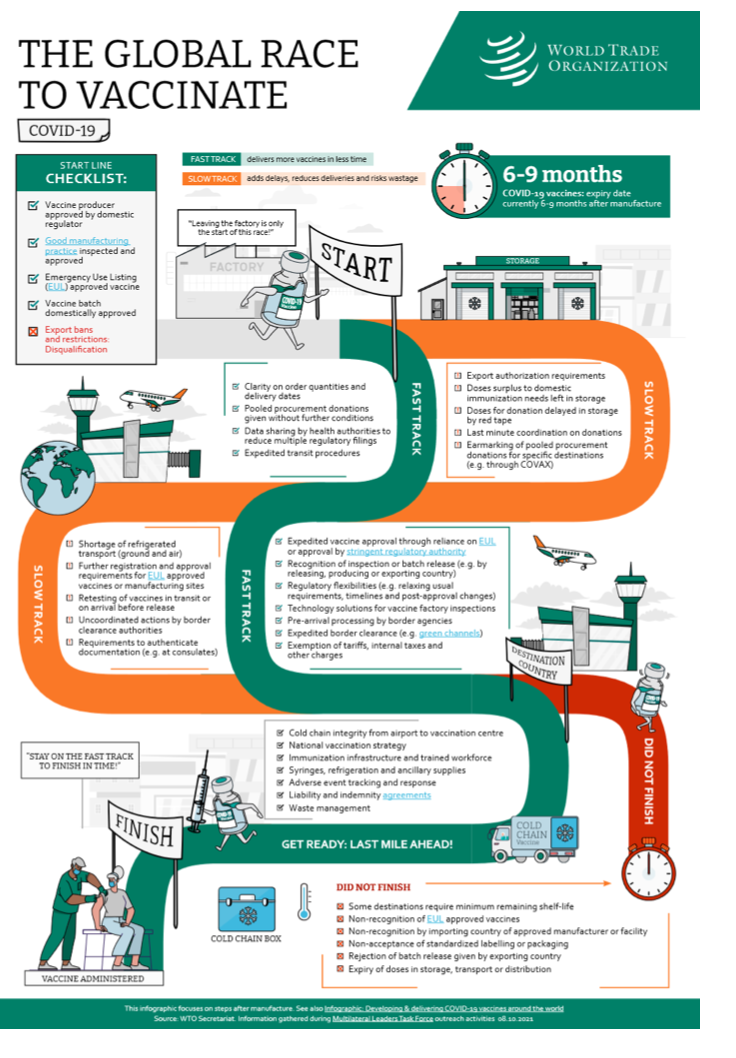
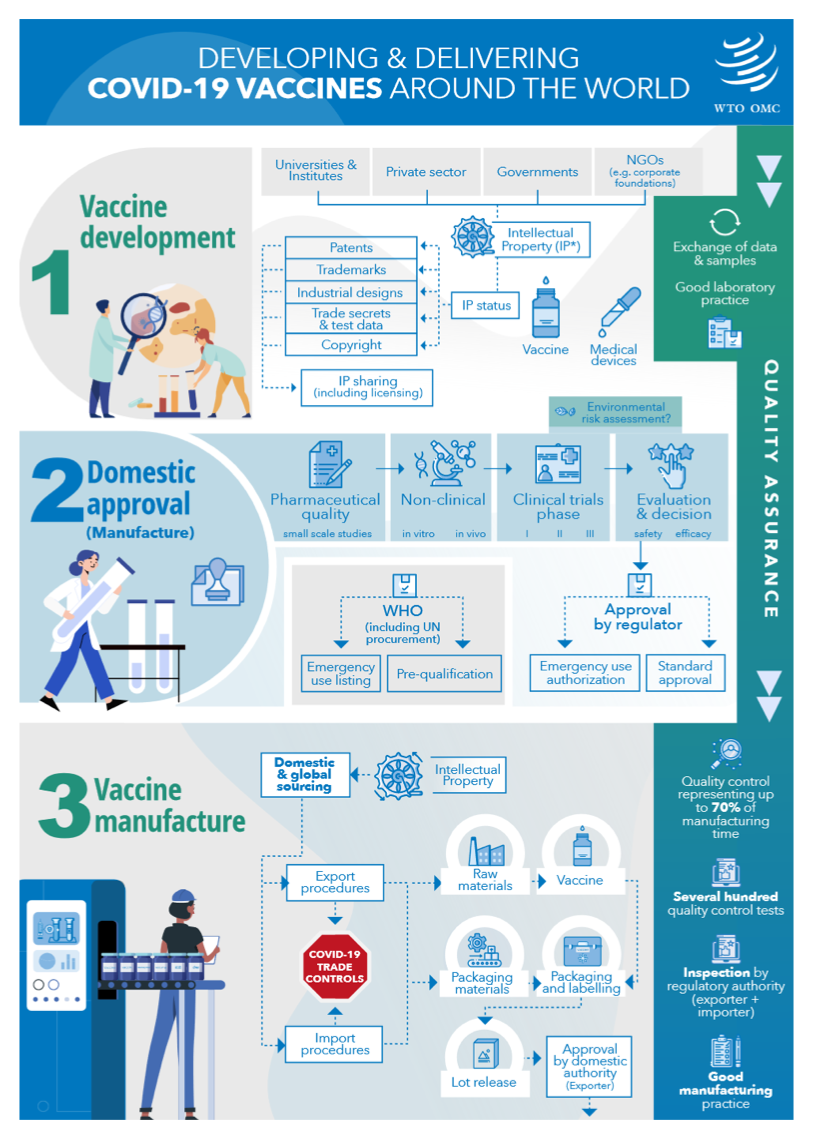
Journal Watch

Journal Watch
Vaccines and Global Health: The Week in Review continues its weekly scanning of key peer-reviewed journals to identify and cite articles, commentary and editorials, books reviews and other content supporting our focu-s on vaccine ethics and policy. Journal Watch is not intended to be exhaustive, but indicative of themes and issues the Center is actively tracking. We selectively provide full text of some editorial and comment articles that are specifically relevant to our work. Successful access to some of the links provided may require subscription or other access arrangement unique to the publisher.
If you would like to suggest other journal titles to include in this service, please contact David Curry at: david.r.curry@centerforvaccineethicsandpolicy.org

Equitable data sharing in epidemics and pandemics

BMC Medical Ethics
http://www.biomedcentral.com/bmcmedethics/content
(Accessed 09 Oct 2021)


Equitable data sharing in epidemics and pandemics
Rapid data sharing can maximize the utility of data. In epidemics and pandemics like Zika, Ebola, and COVID-19, the case for such practices seems especially urgent and warranted. Yet rapidly sharing data widely h…
Authors: Bridget Pratt and Susan Bull
Citation: BMC Medical Ethics 2021 22:136
Content type: Research
Published on: 6 October 2021

European collaborations on medicine and vaccine procurement

Bulletin of the World Health Organization
Volume 99(10);  2021 Oct 1
https://www.ncbi.nlm.nih.gov/pmc/issues/390889/


European collaborations on medicine and vaccine procurement
Sabine Vogler, Manuel A Haasis, Rianne van den Ham, Tifenn Humbert, Sarah Garner, Fatima Suleman
Bull World Health Organ. 2021 Oct 1; 99(10): 715–721. Published online 2021 Aug 20. doi: 10.2471/BLT.21.285761
PMCID: PMC8477421

Violence against children during the COVID-19 pandemic

Bulletin of the World Health Organization
Volume 99(10);  2021 Oct 1
https://www.ncbi.nlm.nih.gov/pmc/issues/390889/


Violence against children during the COVID-19 pandemic
Amiya Bhatia, Camilla Fabbri, Ilan Cerna-Turoff, Ellen Turner, Michelle Lokot, Ajwang Warria, Sumnima Tuladhar, Clare Tanton, Louise Knight, Shelley Lees, Beniamino Cislaghi, Jaqueline Bhabha, Amber Peterman, Alessandra Guedes, Karen Devries
Bull World Health Organ. 2021 Oct 1; 99(10): 730–738. Published online 2021 Aug 13. doi: 10.2471/BLT.20.283051
PMCID: PMC8477433

Alignment of national COVID-19 vaccine recommendations for pregnant and lactating women

Bulletin of the World Health Organization
Volume 99(10);  2021 Oct 1
https://www.ncbi.nlm.nih.gov/pmc/issues/390889/


Alignment of national COVID-19 vaccine recommendations for pregnant and lactating women
Michelle L Giles, Ahinsa Gunatilaka, Kirsten Palmer, Ketaki Sharma, Vijay Roach
Bull World Health Organ. 2021 Oct 1; 99(10): 739–746. Published online 2021 Aug 30. doi: 10.2471/BLT.21.286644
PMCID: PMC8477428

The private sector in the development landscape: partnerships, power, and questionable possibilities

Development in Practice
Volume 31, Issue 7, 2021
http://www.tandfonline.com/toc/cdip20/current


The Private Sector in the Development Landscape.
Guest Editors: Jason Hart, Jo-Anna Russon & Jessica Sklair
Editorial
The private sector in the development landscape: partnerships, power, and questionable possibilities
Jason Hart, Jo-Anna Russon & Jessica Sklair
Pages: 857-871
Published online: 07 Oct 2021
ABSTRACT
In introducing the Special Issue on The Private Sector in the Development Landscape this article focuses upon three key themes all related, in some manner, to the issue of power. These themes are drawn from the critique of partnership amongst conventional development actors and provide a framework for discussion of the six full-length articles and three shorter practice pieces that follow. The first theme for discussion is finance and the impact of its distribution within partnerships involving private and public / third sector actors. We then consider such partnerships in historical context, paying attention to the legacy of colonialism and global North-South dynamics. Finally, we explore the potential for power relations to be renegotiated within partnerships. Considering insights offered by the assembled authors and our own reading of the literature we suggest that partnership involving the private sector appears to do little in shifting development dynamics in a more egalitarian direction. Indeed, it may entrench underlying inequity. We conclude by questioning the extent to which the challenges of partnership with the private sector can be overcome without parallel efforts to bring greater accountability, transparency, and equity to the private sector’s own activities, regardless of its engagement in development.

Supplement: E-Mental-Health: Exploring the Evidence Base and Stakeholders’ Perspectives on Internet-Based Interventions for the Prevention of Mental Health Conditions

The European Journal of Public Health
SUPPLEMENT – Volume 31, Issue Supplement_1, July 2021
https://academic.oup.com/eurpub/issue/31/Supplement_1


Supplement: E-Mental-Health: Exploring the Evidence Base and Stakeholders’ Perspectives on Internet-Based Interventions for the Prevention of Mental Health Conditions
Mental illness represents an enormous personal, social and societal burden for European citizens1 calling for the need to expand existing models of mental healthcare delivery. In Europe, the Internet is a key source of health information,2 and technology-enhanced (psychological) interventions such as Internet- and mobile-delivered applications (‘eHealth’3 and ‘m-Health’4) have become increasingly popular and studied. There is already strong evidence of the efficacy of online interventions for the prevention and treatment of several psychological disorders5,6 and meta-analyses show effect sizes similar to face-to-face interventions.7

Forty days of regulatory emergency use authorisation of COVID-19 vaccines: Interfacing efficacy, hesitancy and SDG target 3.8

Global Public Health
Volume 16, Issue 10 (2021)
http://www.tandfonline.com/toc/rgph20/current


Article
Forty days of regulatory emergency use authorisation of COVID-19 vaccines: Interfacing efficacy, hesitancy and SDG target 3.8
Godwell Nhamo & Mncengeli Sibanda
Pages: 1537-1558
Published online: 09 Jun 2021
ABSTRACT
The year 2020 will be synonymous with the coronavirus disease 2019 (COVID-19) for many global citizens. Millions have died from and tens of millions more have been infected globally by the COVID-19 pandemic. This has led to an urgent search for COVID-19 vaccines and treatments by the scientific and political communities and civil society. Through elements of events study and document and critical discourse analysis, this paper investigates the COVID-19 vaccines’ regulatory emergency use authorisation and/or conditional marketing authorisation (regulatory authorisation) regimes and the contestations thereof. The key finding is that there was a regulatory authorisation rush, with at least 62, mostly high-income countries, doing so in 40 days from 2 December 2020–10 January 2021. This has led to one senior USA official describing the United Kingdom pioneer regulatory authorisation of the Pfizer-BioNTech vaccine as ‘too quick’. Regulatory authorisation regimes took place amid severe civil society contestations and appropriate political pressure. The paper recommends that as the COVID-19 vaccines’ regulatory authorisation continue in 2021, national vaccines and treatments regulatory bodies must be informed by science, with governments, civil society, politicians and other key stakeholders taking responsibility to educate the masses and continue taking the necessary precautions.

Localisation and local humanitarian action

Humanitarian Exchange Magazine
Number 79, May 2021
https://odihpn.org/magazine/localisation-and-local-humanitarian-action/


Localisation and local humanitarian action
by HPN October 2020
The theme of this edition of Humanitarian Exchange is localisation+ and local humanitarian action. Five years ago this week, donors, United Nations (UN) agencies,  non-governmental organisations (NGOs), the International Committee of the Red Cross (ICRC) and International Federation of Red Cross and Red Crescent Societies (IFRC) committed within the Grand Bargain to increase multi-year investments in the institutional capacities of local and national responders, and to provide at least 25% of humanitarian funding to them as directly as possible. Since then, there is increasing consensus at policy and normative level, underscored by the Covid-19 pandemic, that local leadership should be supported.  Localisation has gone from a fringe conversation among policy-makers and aid agencies in 2016 to a formal priority under the Grand Bargain. Wider global movements on anti-racism and decolonisation have also brought new momentum to critical reflections on where power, knowledge and capacity reside in the humanitarian system. Yet progress has been slow and major gaps remain between the rhetoric around humanitarian partnerships, funding and coordination and practices on the ground.

Clinical predictors of severe dengue: a systematic review and meta-analysis

Infectious Diseases of Poverty
http://www.idpjournal.com/content
[Accessed 09 Oct 2021]


Clinical predictors of severe dengue: a systematic review and meta-analysis
Severe dengue is a life-threatening complication; rapid identification of these cases, followed by adequate management is crucial to improve the clinical prognosis. Therefore, this study aimed to identify risk…
Authors: Tsheten Tsheten, Archie C. A. Clements, Darren J. Gray, Ripon K. Adhikary, Luis Furuya-Kanamori and Kinley Wangdi
Citation: Infectious Diseases of Poverty 2021 10:123
Content type: Scoping Review
Published on: 9 October 2021

COVID-19 vaccination intention and vaccine characteristics influencing vaccination acceptance: a global survey of 17 countries

Infectious Diseases of Poverty
http://www.idpjournal.com/content
[Accessed 09 Oct 2021]


COVID-19 vaccination intention and vaccine characteristics influencing vaccination acceptance: a global survey of 17 countries
The availability of various types of COVID-19 vaccines and diverse characteristics of the vaccines present a dilemma in vaccination choices, which may result in individuals refusing a particular COVID-19 vacci…
Authors: Li Ping Wong, Haridah Alias, Mahmoud Danaee, Jamil Ahmed, Abhishek Lachyan, Carla Zi Cai, Yulan Lin, Zhijian Hu, Si Ying Tan, Yixiao Lu, Guoxi Cai, Di Khanh Nguyen, Farhana Nishat Seheli, Fatma Alhammadi, Milkar D. Madhale, Muditha Atapattu…
Citation: Infectious Diseases of Poverty 2021 10:122
Content type: Research Article
Published on: 7 October 2021

How COVID-19 highlighted the need for infection prevention and control measures to become central to the global conversation: experience from the conflict settings of the Middle East

International Journal of Infectious Diseases
October 2021 Volume 111 p1-362
https://www.ijidonline.com/current


Coronavirus (COVID-19) Collection
How COVID-19 highlighted the need for infection prevention and control measures to become central to the global conversation: experience from the conflict settings of the Middle East
Roula El Mouallem, Krystel Moussally, Anita Williams,…Marilyne Menassa, Chiara Martino, Ghassan Abu Sittah
Published online: August 18, 2021

An International Agreement on Pandemic Prevention and Preparedness

JAMA
October 5, 2021, Vol 326, No. 13, Pages 1233-1338
https://jamanetwork.com/journals/jama/currentissue


An International Agreement on Pandemic Prevention and Preparedness
Lawrence O. Gostin, JD; Sam F. Halabi, JD, MPhil; Kevin A. Klock, JD
free access
JAMA. 2021;326(13):1257-1258. doi:10.1001/jama.2021.16104
This Viewpoint discusses international efforts to address the COVID-19 and future pandemics as well as offers steps that the international community can take to fix gaps in pandemic response.
[Excerpt]
Core Content for an International Instrument
The potential breadth of pandemic prevention and preparedness is wide-ranging and negotiations among 194 WHO member states will be challenging. Responding to vast gaps in the COVID-19 pandemic response should include the following.5
Zoonotic Spillovers
The IHR focuses on response to novel outbreaks after they occur. A new instrument could focus also on prevention of naturally occurring zoonoses, which may potentially contribute to an estimated 75% of new human diseases.6 Separating animal and human populations could prevent spillovers, such as through land management, reforestation, and the effective regulation of wild animal trade and markets. Researchers have already generated predictive models to identify where spillovers are likely.
Biosecurity and Biosafety
While SARS-CoV-2 most likely occurred in nature, a laboratory leak at the Wuhan Institute of Virology is an alternative theory of the origin of the virus. Rigorous regulation and inspection of laboratory safety, as well as gain-of-function research, could help prevent unintentional or deliberate release of novel pathogens. The WHO has issued international guidance on biosafety that could be incorporated into a new agreement.7
Monitoring, Inspection, and Compliance
Responding to weak IHR compliance and accountability mechanisms, a new international instrument should enhance WHO or UN authority and legitimacy to independently verify state reports, publish crucial outbreak data without state confirmation, investigate novel outbreaks, and institute remedial actions. Norms are only effective if they are implemented at the national and local levels in a fully transparent and cooperative manner.
Research, Scientific Sharing, and Transparency
Undoubtedly, the greatest success during the pandemic response was the rapid development of vaccines and therapeutics, including with innovative mRNA technologies. Yet, open access and sharing of real-time virus samples, genomic sequencing, and clinical trial and other research data and tools were often lacking. A new legal instrument could channel significant research funding, while promoting open access, full transparency, public/private partnerships, and scientific cooperation.
Health Systems
Underpinning rapid and effective response to novel pathogens requires robust health system capacities, including human resources, surveillance, laboratories, and risk communication. Capacities for testing, contact tracing, and vaccinating populations are crucial. Clinics, community health workers, and hospitals are needed to care for and treat patients during spikes in serious disease, as well as meeting everyday needs such as childhood vaccinations, maternal care, and caring for patients with noncommunicable diseases. An international agreement could address states’ failures to comply with article 44 of the IHR, which calls for international technical and financial assistance to strengthen national public health capacities.8
Domestic and International Equity
The COVID-19 pandemic revealed cavernous divides based on race and ethnicity, sex, disability, and socioeconomic status both in the disproportionate numbers of hospitalizations and deaths and in access to essential medical countermeasures. High-income countries dominated the global market in diagnostics, personal protective equipment, therapeutics, and especially vaccines. The WHO and partners designed the Access to COVID-19 Tools (ACT) Accelerator to accelerate development, production, and equitable access to COVID-19 tests, treatments, and vaccines. Yet, as of September 3, 2021, COVAX (the ACT Accelerator’s vaccine pillar) had shipped only 236 million COVID-19 vaccines to 139 countries, leaving most lower-income health workers and vulnerable populations unprotected.9 Any new international agreement must plan for adequate supplies of medical resources and equitable allocation among countries. This could include securing supply chains, intellectual property waivers, knowledge-sharing and technology transfers, along with ample donation of supplies.10
The compound health, economic, social, and humanitarian crises caused by the novel coronavirus, SARS-CoV-2, provides a compelling justification for a new international agreement on pandemic prevention and preparedness. It is possible to significantly reduce the likelihood of future novel outbreaks and to fortify the response through international cooperation, an empowered and well-funded WHO, and strong domestic health systems.

How Brazil’s President turned the country into a global epicenter of COVID-19

Journal of Public Health Policy
Volume 42, issue 3, September 2021
https://link.springer.com/journal/41271/volumes-and-issues/42-3


How Brazil’s President turned the country into a global epicenter of COVID-19
Authors (first, second and last of 8) Lucas Ferrante, Luiz Duczmal, Philip Martin Fearnside
Content type: Viewpoint
Published: 27 August 2021
Pages: 439 – 451

Ethical considerations for mandating food worker vaccination during outbreaks: an analysis of hepatitis A vaccine

Journal of Public Health Policy
Volume 42, issue 3, September 2021
https://link.springer.com/journal/41271/volumes-and-issues/42-3


Ethical considerations for mandating food worker vaccination during outbreaks: an analysis of hepatitis A vaccine
Authors Janet Fleetwood,
Content type: Viewpoint
Published: 29 June 2021
Pages: 465 – 476