COVID-19 vaccine delivery: an opportunity to set up systems for the future

Gates Open Research
https://gatesopenresearch.org/browse/articles
[Accessed 17 Apr 2021]


Open Letter metrics
Revised
COVID-19 vaccine delivery: an opportunity to set up systems for the future [version 2; peer review: 2 approved with reservations]
Rebecca Weintraub, Stanley Plotkin, Margaret Liu, Jerome Kim, Natalie Garcon, David Bell, Dan Storisteanu, Toby Norman, Eliah Aronoff-Spencer
Peer Reviewers Kristin Nelson; Alan Gelb
Funder
Bill and Melinda Gates Foundation
LATEST VERSION PUBLISHED 14 Apr 2021
Abstract
The race to develop safe and effective SARS-COV-2 vaccines has moved with unprecedented speed. There are now multiple vaccines that have received emergency use authorization from the United States Food and Drug Administration and a host of candidates positioned for approval worldwide. Attention has now turned to allocation, distribution and verification of these vaccines, yet this focus exposes that the underlying infrastructure for global delivery and monitoring is threadbare and unevenly distributed. This presents both a barrier and an opportunity to deploy sustainable infrastructure. Major global stakeholders must convene quickly, collaborate, and collectively invest in global standards, legal models, common vocabularies and interoperable biometric-supported digital health technologies. As the COVID-19 vaccine effort scales, governments, private sector, and NGOs have the chance to place lasting resources needed for equitable and effective delivery that can pay dividends into the future.

Structural barriers to knowledge transfer and exchange among men and women in low-, middle- and high-income countries: an international cross-sectional study with vaccine researchers in 44 countries

Health Research Policy and Systems
http://www.health-policy-systems.com/content
[Accessed 17 Apr 2021]


Structural barriers to knowledge transfer and exchange among men and women in low-, middle- and high-income countries: an international cross-sectional study with vaccine researchers in 44 countries
Globally, women constitute 30% of researchers. Despite an increasing proportion of women in research, they are still less likely to have international collaborations. Literature on barriers to knowledge transfer and exchange (KTE) between men and women remains limited. This study aimed to assess perceived gender barriers to KTE activities in vaccination-related research in low-, middle- and high-income countries.
Authors: Soha El-Halabi, Ronan McCabe, Birger C. Forsberg, Devy L. Elling and Ziad El-Khatib
Content type: Research
12 April 2021

Disability inclusion in humanitarian action

Humanitarian Exchange Magazine
Number 78, October 2020
https://odihpn.org/magazine/inclusion-of-persons-with-disabilities-in-humanitarian-action-what-now/


Disability inclusion in humanitarian action
by HPN October 2020
The theme of this edition of Humanitarian Exchange, co-edited with Sherin Alsheikh Ahmed from Islamic Relief Worldwide, is disability inclusion in humanitarian action. Persons with disabilities are not only disproportionately impacted by conflicts, disasters and other emergencies, but also face barriers to accessing humanitarian assistance. At the same time, global commitments and standards and the IASC Guidelines on the inclusion of persons with disabilities in humanitarian action all emphasise how persons with disabilities are also active agents of change. Disability and age-focused organisations have led on testing and demonstrating how inclusion can be done better. Yet despite this progress, challenges to effective inclusion remain.

As Kirstin Lange notes in the lead article, chief among these challenges is humanitarian agencies’ lack of engagement with organisations of persons with disabilities. Simione Bula, Elizabeth Morgan and Teresa Thomson look at disability inclusion in humanitarian response in the Pacific, and Kathy Al Jubeh and Alradi Abdalla argue for a ‘participation revolution’, building on learning from the gender movement. Tchaurea Fleury and Sulayman AbdulMumuni Ujah outline how the Bridge Article 11 training initiative is encouraging constructive exchange between humanitarian and disability actors. The lack of good, disaggregated data is highlighted by Sarah Collinson; Frances Hill, Jim Cranshaw and Carys Hughes emphasise the need for training resources in local languages and accessible formats; and Sophie Van Eetvelt and colleagues report on a review of the evidence on inclusion of people with disabilities and older people.

Rebecca Molyneux and co-authors analyse the findings of a review of a DFID programme in north-east Nigeria, while Carolin Funke highlights the importance of strategic partnerships between disability-focused organisations, drawing on her research in Cox’s Bazar. Sherin Alsheikh Ahmed describes Islamic Relief Worldwide’s approach to mainstreaming protection and inclusion, while Pauline Thivillier and Valentina Shafina outline IRC’s Client Responsive Programming. The edition ends with reflections by Mirela Turcanu and Yves Ngunzi Kahashi on CAFOD’s SADI approach.

Effect of Ivermectin on Time to Resolution of Symptoms Among Adults With Mild COVID-19A Randomized Clinical Trial

JAMA
April 13, 2021, Vol 325, No. 14, Pages 1369-1480
https://jamanetwork.com/journals/jama/currentissue


Original Investigation
Effect of Ivermectin on Time to Resolution of Symptoms Among Adults With Mild COVID-19A Randomized Clinical Trial
Eduardo López-Medina, MD, MSc; Pío López, MD; Isabel C. Hurtado, MD; et al.
free access has active quiz
JAMA. 2021;325(14):1426-1435. doi:10.1001/jama.2021.3071
This randomized trial compares the effects of ivermectin vs placebo on time to symptom resolution within 21 days among patients with mild COVID-19.

COVID-19 in 2021—Continuing Uncertainty

JAMA
April 13, 2021, Vol 325, No. 14, Pages 1369-1480
https://jamanetwork.com/journals/jama/currentissue


Viewpoint
COVID-19 in 2021—Continuing Uncertainty
Carlos del Rio, MD; Preeti Malani, MD, MSJ
free access has active quiz has multimedia has audio
JAMA. 2021;325(14):1389-1390. doi:10.1001/jama.2021.3760
This Viewpoint summarizes the current best evidence about COVID-19 vaccines, immunity, and whether SARS-CoV-2 will become an endemic or seasonal virus.
Conclusions
The world has transformed in the past year and some aspects of life may remain changed forever. COVID-19 may reoccur seasonally, like other respiratory viruses, most notably influenza. In addition, a substantial number of patients with post-COVID syndromes will experience various degrees of disabilities and symptoms for years. Infection risk aside, it will be essential for public health agencies and society to develop ways to safely continue essential activities, including in-person learning in the K-12 and higher education space. Social gatherings, sporting events, and other community activities will undoubtedly resume but some restrictions will continue depending on evidence of community spread, the proportion of individuals vaccinated, and other factors that will need to be monitored regularly as individuals, institutions, and governments all perform calculations to balance competing risks.

Blockchain, consent and prosent for medical research

Journal of Medical Ethics
April 2021 – Volume 47 – 4
http://jme.bmj.com/content/current


Original research
Blockchain, consent and prosent for medical research (4 May, 2020)
Sebastian Porsdam Mann, Julian Savulescu, Philippe Ravaud, Mehdi Benchoufi
Abstract
Recent advances in medical and information technologies, the availability of new types of medical data, the requirement of increasing numbers of study participants, as well as difficulties in recruitment and retention, all present serious problems for traditional models of specific and informed consent to medical research. However, these advances also enable novel ways to securely share and analyse data. This paper introduces one of these advances—blockchain technologies—and argues that they can be used to share medical data in a secure and auditable fashion. In addition, some aspects of consent and data collection, as well as data access management and analysis, can be automated using blockchain-based smart contracts. This paper demonstrates how blockchain technologies can be used to further all three of the bioethical principles underlying consent requirements: the autonomy of patients, by giving them much greater control over their data; beneficence, by greatly facilitating medical research efficiency and by reducing biases and opportunities for errors; and justice, by enabling patients with rare or under-researched conditions to pseudonymously aggregate their data for analysis. Finally, we coin and describe the novel concept of prosent, by which we mean the blockchain-enabled ability of all stakeholders in the research process to pseudonymously and proactively consent to data release or exchange under specific conditions, such as trial completion.

The ACT Accelerator: heading in the right direction?

The Lancet
Apr 17, 2021 Volume 397 Number 10283 p1419-1518
https://www.thelancet.com/journals/lancet/issue/current


Editorial
The ACT Accelerator: heading in the right direction?
The Lancet
April 24, 2021, marks 1 year since the formation of the Access to COVID-19 Tools Accelerator (ACT-A) partnership. Its mission is to accelerate the development, production, and equitable access to COVID-19 tests, treatments, and vaccines, which is central to ending the acute phase of the COVID-19 pandemic. With the pandemic still raging, has ACT-A been successful so far? And what does the future hold?

ACT-A coordinates the strategy and work of several global health partners under four pillars: diagnostics, therapeutics, vaccines (COVAX), and health systems. Much of the attention has been focused on vaccines. COVAX plans to deliver 2 billion doses of COVID-19 vaccine by the end of the year, but its mission has been hamstrung by political realities and a lack of ambition.

The diagnostics pillar, led by the Foundation for Innovative New Diagnostics (FIND) and the Global Fund, aimed to develop new, affordable, high-quality tests, and to support the procurement and deployment of 500 million tests for low-income and middle-income countries (LMICs). In September, 2020, FIND announced that 120 million rapid diagnostic tests had been made available through ACT-A at a set price for LMICs. But large discrepancies exist in testing rates between high-income countries (620 tests per 100 000 people per day) versus low-income countries (6·5 tests per 100 000 people per day, with a high positivity rate of 13·3%). As with vaccines, individual rich countries can buy up tests directly from manufacturers. Countries with no resources to buy tests are left without. A lack of laboratory facilities for RT-PCR tests and the paucity of trained laboratory specialists leave many LMICs disadvantaged in reaching full testing capacity.

The therapeutics pillar, co-convened by Unitaid and the Wellcome Trust, is tasked with finding effective therapies and their large-scale, equitable distribution. Many potential treatments have unfortunately been found to be ineffective in clinical studies. The RECOVERY trial, co-funded by ACT-A partners, established dexamethasone as the first life-saving therapy for patients admitted to hospital with COVID-19, and ACT-A secured 2·9 million treatment courses for LMICs through advanced purchases. However, this figure is only a fraction of the pillar’s aim to deliver 245 million doses of therapeutics to LMICs. Strict patent and technology transfer regulations have hampered the scale-up of much needed vaccine manufacturing, and the same barriers will likely apply to new treatments such as monoclonal antibodies. ACT-A was also slow to take up the issue of medical oxygen, and other essential medicines for patients with COVID-19 remain in short supply.

The health systems pillar of ACT-A is narrow in scope, largely focused on the effective deployment of COVID-19 vaccines, treatments, and diagnostics and ensuring health-care workers in LMICs have sufficient personal protective equipment. These are unambitious goals. As David Hipgrave points out in a Correspondence, ACT-A neglects to ensure quality primary care and essential public health functions.

ACT-A was a necessary response to an emergency. It was quick to bring together partners and stimulate research and development of new technologies for COVID-19. But ACT-A is, in many ways, a traditional global health entity. Funding follows an international aid model, depending on the benevolence of rich donors. The result is a funding shortfall and a system not based on solidarity but rather one that reinforces inequities. This set-up must be rethought. Thomas Piketty, for example, has proposed a wealth tax of 2% to finance global public health goods. The partners of ACT-A are receiving huge amounts of public money in a global emergency. The minimum to expect in return is transparent and fair pricing, and the sharing of intellectual property, technology, and knowledge.

Furthermore, ACT-A is a vertical programme and heavily focused on technical solutions. Diagnostics, treatments, and vaccines are essential, but too little attention is given to health systems strengthening and systemic drivers of epidemics. The broader implications for ensuring social welfare and cohesion within countries and globally are profound. Any inequities will only prolong the pandemic.

On May 21, at the Global Health Summit in Rome, countries and organisations will discuss financing for the global COVID-19 response. ACT-A may be large in scale, but it suffers from the same shortcomings as countless previous global health initiatives. If ACT-A is to deliver on its goals, these weaknesses need to be confronted and overcome. Only then might it find a worthwhile place in the global health architecture, for this pandemic and beyond.

A genomic catalog of Earth’s microbiomes

Nature Biotechnology
Volume 39 Issue 4, April 2021
https://www.nature.com/nbt/volumes/39/issues/4


Resource | 09 November 2020 | Open Access
A genomic catalog of Earth’s microbiomes
Cataloging microbial genomes from Earth’s environments expands the known phylogenetic diversity of bacteria and archaea.
Stephen Nayfach, Simon Roux & Emiley A. Eloe-Fadrosh
Abstract
The reconstruction of bacterial and archaeal genomes from shotgun metagenomes has enabled insights into the ecology and evolution of environmental and host-associated microbiomes. Here we applied this approach to >10,000 metagenomes collected from diverse habitats covering all of Earth’s continents and oceans, including metagenomes from human and animal hosts, engineered environments, and natural and agricultural soils, to capture extant microbial, metabolic and functional potential. This comprehensive catalog includes 52,515 metagenome-assembled genomes representing 12,556 novel candidate species-level operational taxonomic units spanning 135 phyla. The catalog expands the known phylogenetic diversity of bacteria and archaea by 44% and is broadly available for streamlined comparative analyses, interactive exploration, metabolic modeling and bulk download. We demonstrate the utility of this collection for understanding secondary-metabolite biosynthetic potential and for resolving thousands of new host linkages to uncultivated viruses. This resource underscores the value of genome-centric approaches for revealing genomic properties of uncultivated microorganisms that affect ecosystem processes.

A comprehensive library of human transcription factors for cell fate engineering

Nature Biotechnology
Volume 39 Issue 4, April 2021
https://www.nature.com/nbt/volumes/39/issues/4


Resource | 30 November 2020
A comprehensive library of human transcription factors for cell fate engineering
A library of human transcription factor genes is screened for differentiation of human pluripotent stem cells.
Alex H. M. Ng, Parastoo Khoshakhlagh & George M. Church

The need for a new strategy for Ebola vaccination

Nature Medicine
Volume 27 Issue 4, April 2021
https://www.nature.com/nm/volumes/27/issues/4


Comment | 05 April 2021
The need for a new strategy for Ebola vaccination
News of two new outbreaks of Ebola virus disease in the Democratic Republic of the Congo and Republic of Guinea, on the backdrop of the COVID-19 pandemic, signals the need for a change of direction in vaccination strategies in the area.
Daniel G. Bausch

How medical AI devices are evaluated: limitations and recommendations from an analysis of FDA approvals

Nature Medicine
Volume 27 Issue 4, April 2021
https://www.nature.com/nm/volumes/27/issues/4


Comment | 05 April 2021
How medical AI devices are evaluated: limitations and recommendations from an analysis of FDA approvals
A comprehensive overview of medical AI devices approved by the US Food and Drug Administration sheds new light on limitations of the evaluation process that can mask vulnerabilities of devices when they are deployed on patients.
Eric Wu, Kevin Wu & James Zou

Vaccine development for emerging infectious diseases

Nature Medicine
Volume 27 Issue 4, April 2021
https://www.nature.com/nm/volumes/27/issues/4


Review Article | 12 April 2021
Vaccine development for emerging infectious diseases
Examination of the vaccine strategies and technical platforms used for the COVID-19 pandemic in the context of those used for previous emerging and reemerging infectious diseases and pandemics can offer critical lessons to prepare for future public health emergencies.
Jean-Louis Excler, Melanie Saville & Jerome H. Kim

BNT162b2 mRNA Covid-19 Vaccine in a Nationwide Mass Vaccination Setting

New England Journal of Medicine
April 15, 2021 Vol. 384 No. 15
http://www.nejm.org/toc/nejm/medical-journal


Original Articles
BNT162b2 mRNA Covid-19 Vaccine in a Nationwide Mass Vaccination Setting
Noa Dagan, M.D., et a.
Abstract
Background
As mass vaccination campaigns against coronavirus disease 2019 (Covid-19) commence worldwide, vaccine effectiveness needs to be assessed for a range of outcomes across diverse populations in a noncontrolled setting. In this study, data from Israel’s largest health care organization were used to evaluate the effectiveness of the BNT162b2 mRNA vaccine.
Methods
All persons who were newly vaccinated during the period from December 20, 2020, to February 1, 2021, were matched to unvaccinated controls in a 1:1 ratio according to demographic and clinical characteristics. Study outcomes included documented infection with the severe acute respiratory syndrome coronavirus 2 (SARS-CoV-2), symptomatic Covid-19, Covid-19–related hospitalization, severe illness, and death. We estimated vaccine effectiveness for each outcome as one minus the risk ratio, using the Kaplan–Meier estimator.
Results
Each study group included 596,618 persons. Estimated vaccine effectiveness for the study outcomes at days 14 through 20 after the first dose and at 7 or more days after the second dose was as follows: for documented infection, 46% (95% confidence interval [CI], 40 to 51) and 92% (95% CI, 88 to 95); for symptomatic Covid-19, 57% (95% CI, 50 to 63) and 94% (95% CI, 87 to 98); for hospitalization, 74% (95% CI, 56 to 86) and 87% (95% CI, 55 to 100); and for severe disease, 62% (95% CI, 39 to 80) and 92% (95% CI, 75 to 100), respectively. Estimated effectiveness in preventing death from Covid-19 was 72% (95% CI, 19 to 100) for days 14 through 20 after the first dose. Estimated effectiveness in specific subpopulations assessed for documented infection and symptomatic Covid-19 was consistent across age groups, with potentially slightly lower effectiveness in persons with multiple coexisting conditions.
Conclusions
This study in a nationwide mass vaccination setting suggests that the BNT162b2 mRNA vaccine is effective for a wide range of Covid-19–related outcomes, a finding consistent with that of the randomized trial.

Vaccination coverage estimation in Mexico in children under five years old: Trends and associated factors

PLoS One
http://www.plosone.org/
[Accessed 17 Apr 2021]


Vaccination coverage estimation in Mexico in children under five years old: Trends and associated factors
Maria Jesus Rios-Blancas, Hector Lamadrid-Figueroa, Miguel Betancourt-Cravioto, Rafael Lozano
Research Article | published 16 Apr 2021 PLOS ONE
https://doi.org/10.1371/journal.pone.0250172

Effects of engaging communities in decision-making and action through traditional and religious leaders on vaccination coverage in Cross River State, Nigeria: A cluster-randomised control trial

PLoS One
http://www.plosone.org/
[Accessed 17 Apr 2021]


Effects of engaging communities in decision-making and action through traditional and religious leaders on vaccination coverage in Cross River State, Nigeria: A cluster-randomised control trial
Angela Oyo-Ita, Xavier Bosch-Capblanch, Amanda Ross, Afiong Oku, Ekpereonne Esu, Soter Ameh, Olabisi Oduwole, Dachi Arikpo, Martin Meremikwu
Research Article | published 16 Apr 2021 PLOS ONE
https://doi.org/10.1371/journal.pone.0248236

Impact of 13-valent pneumococcal conjugate vaccine on laboratory-confirmed pneumococcal meningitis and purulent meningitis among children ˂5 years in Cameroon, 2011–2018

PLoS One
http://www.plosone.org/
[Accessed 17 Apr 2021]


Impact of 13-valent pneumococcal conjugate vaccine on laboratory-confirmed pneumococcal meningitis and purulent meningitis among children ˂5 years in Cameroon, 2011–2018
John Njuma Libwea, Mark A. Fletcher, Paul Koki Ndombo, Angeline Boula, Nadesh Taku Ashukem, Madeleine Ngo Baleba, Rachel Sandrine Kingue Bebey, Eric Gaston Nkolo Mviena, Jean Tageube, Marie Kobela Mbollo, Sinata Koulla-Shiro, Shabir Madhi, Berthe-Marie Njanpop-Lafourcade, Ali Mohammad, Elizabeth Begier, Joanna Southern, Rohini Beavon, Bradford Gessner
Research Article | published 15 Apr 2021 PLOS ONE
https://doi.org/10.1371/journal.pone.0250010

Introduction to Special Issue on Risk Assessment, Economic Evaluation, and Decisions

Risk Analysis
Volume 41, Issue 4 Pages: 559-699 April 2021
https://onlinelibrary.wiley.com/toc/15396924/current


Special Issue: Risk Assessment, Economic Evaluation, and Decisions
Perspectives
Introduction to Special Issue on Risk Assessment, Economic Evaluation, and Decisions
James K. Hammitt, Lisa A. Robinson
Abstract
Integrating risk assessment, economic evaluation, and uncertainty to inform policy decisions is a core challenge to risk analysis. In September 2019, the Harvard Center for Risk Analysis, with support from the Society for Risk Analysis Economics and Benefits Analysis Specialty Group and others, convened a workshop to address this issue. The workshop built in part on the recommendations of the 2009 National Research Council report, Science and Decisions: Advancing Risk Assessment. It honored John S. Evans, whose thoughtful and innovative teaching and scholarship have significantly advanced thinking on these issues. This special issue features a profile of Dr. Evans and nine articles that build on work presented at the workshop.

The REPRISE project: protocol for an evaluation of REProducibility and Replicability In Syntheses of Evidence

Systematic Reviews
https://systematicreviewsjournal.biomedcentral.com/articles
[Accessed 17 Apr 2021]


https://stm.sciencemag.org/
Protocol
The REPRISE project: protocol for an evaluation of REProducibility and Replicability In Syntheses of Evidence
Investigations of transparency, reproducibility and replicability in science have been directed largely at individual studies. It is just as critical to explore these issues in syntheses of studies, such as sy…
Authors: Matthew J. Page, David Moher, Fiona M. Fidler, Julian P. T. Higgins, Sue E. Brennan, Neal R. Haddaway, Daniel G. Hamilton, Raju Kanukula, Sathya Karunananthan, Lara J. Maxwell, Steve McDonald, Shinichi Nakagawa, David Nunan, Peter Tugwell, Vivian A. Welch and Joanne E. McKenzie
Citation: Systematic Reviews 2021 10:112
Content type: Protocol
Published on: 16 April 2021

International estimates of intended uptake and refusal of COVID-19 vaccines: A rapid systematic review and meta-analysis of large nationally representative samples

Vaccine
Volume 39, Issue 15 Pages 2017-2182 (8 April 2021)
https://www.sciencedirect.com/journal/vaccine/vol/39/issue/15


Review article Full text access
International estimates of intended uptake and refusal of COVID-19 vaccines: A rapid systematic review and meta-analysis of large nationally representative samples
Eric Robinson, Andrew Jones, India Lesser, Michael Daly
Pages 2024-2034

Social norms and vaccine uptake: College students’ COVID vaccination intentions, attitudes, and estimated peer norms and comparisons with influenza vaccine

Vaccine
Volume 39, Issue 15 Pages 2017-2182 (8 April 2021)
https://www.sciencedirect.com/journal/vaccine/vol/39/issue/15


Research article Full text access
Social norms and vaccine uptake: College students’ COVID vaccination intentions, attitudes, and estimated peer norms and comparisons with influenza vaccine
Scott Graupensperger, Devon A. Abdallah, Christine M. Lee
Pages 2060-2067

Vaccine coverage among children with epilepsy in two Canadian provinces: A Canadian immunization research network study

Vaccine
Volume 39, Issue 15 Pages 2017-2182 (8 April 2021)
https://www.sciencedirect.com/journal/vaccine/vol/39/issue/15


Research article Abstract only
Vaccine coverage among children with epilepsy in two Canadian provinces: A Canadian immunization research network study
Christiaan H. Righolt, Gurpreet Pabla, Jessy Donelle, Paula Brna, … Steven Hawken
Pages 2117-2123

Evidence-informed vaccination decision-making in countries: Progress, challenges and opportunities

Vaccine
Volume 39, Issue 15 Pages 2017-2182 (8 April 2021)
https://www.sciencedirect.com/journal/vaccine/vol/39/issue/15


Research article Open access
Evidence-informed vaccination decision-making in countries: Progress, challenges and opportunities
Christoph A. Steffen, Louise Henaff, Antoine Durupt, Nathalie El Omeiri, … Joachim Hombach
Pages 2146-2152

The potential effects of deploying SARS-Cov-2 vaccines on cold storage capacity and immunization workload in countries of the WHO African Region

Vaccine
Volume 39, Issue 15 Pages 2017-2182 (8 April 2021)
https://www.sciencedirect.com/journal/vaccine/vol/39/issue/15


Research article Open access
The potential effects of deploying SARS-Cov-2 vaccines on cold storage capacity and immunization workload in countries of the WHO African Region
Justin R. Ortiz, Joanie Robertson, Jui-Shan Hsu, Stephen L. Yu, … Kathleen M. Neuzil
Pages 2165-2176

The Perception and Attitudes toward COVID-19 Vaccines: A Cross-Sectional Study in Poland

Vaccines — Open Access Journal
http://www.mdpi.com/journal/vaccines
(Accessed 17 Apr 2021)


Open Access Article
The Perception and Attitudes toward COVID-19 Vaccines: A Cross-Sectional Study in Poland
by Piotr Rzymski, Joanna Zeyland, arbara Poniedziałek, lona Małecka and Jacek Wysocki
Vaccines 2021, 9(4), 382; https://doi.org/10.3390/vaccines9040382 – 14 Apr 2021
Abstract
Vaccine hesitancy is a major threat to the success of COVID-19 vaccination programs. The present cross-sectional online survey of adult Poles (n = 1020) expressing a willingness to receive the COVID-19 vaccine was conducted between February and March 2021 and aimed to […]

Enhancing COVID-19 Vaccines Acceptance: Results from a Survey on Vaccine Hesitancy in Northern Italy

Vaccines — Open Access Journal
http://www.mdpi.com/journal/vaccines
(Accessed 17 Apr 2021)


Open Access Article
Enhancing COVID-19 Vaccines Acceptance: Results from a Survey on Vaccine Hesitancy in Northern Italy
by Chiara Reno, lisa Maietti, Maria Pia Fantini, lena Savoia, Lamberto Manzoli, Marco Montalti and
Davide Gori
Vaccines 2021, 9(4), 378; https://doi.org/10.3390/vaccines9040378 – 13 Apr 2021
Abstract
In March 2021, the coronavirus disease 2019 (COVID-19) pandemic still poses a threat to the global population, and is a public health challenge that needs to be overcome. Now more than ever, action is needed to tackle vaccine hesitancy, especially in light of […]

Would Parents Get Their Children Vaccinated Against SARS-CoV-2? Rate and Predictors of Vaccine Hesitancy According to a Survey over 5000 Families from Bologna, Italy

Vaccines — Open Access Journal
http://www.mdpi.com/journal/vaccines
(Accessed 17 Apr 2021)


Open Access Article
Would Parents Get Their Children Vaccinated Against SARS-CoV-2? Rate and Predictors of Vaccine Hesitancy According to a Survey over 5000 Families from Bologna, Italy
by Marco Montalti, Flavia Rallo, Federica Guaraldi, apo Bartoli, Giulia Po, Michela Stillo, Paola Perrone,
Lorena Squillace, Laura Dallolio, Paolo Pandolfi, Davide Resi, Maria Pia Fantini, Chiara Reno and
Davide Gori
Vaccines 2021, 9(4), 366; https://doi.org/10.3390/vaccines9040366 – 10 Apr 2021
Abstract
In the near future, COVID-19 vaccine efficacy trials in larger cohorts may offer the possibility to implement child and adolescent vaccination. The opening of the vaccination for these strata may play a key role in order to limit virus circulation, infection spreading towards […

Media/Policy Watch

Media/Policy Watch
This watch section is intended to alert readers to substantive news, analysis and opinion from the general media and selected think tanks and similar organizations on vaccines, immunization, global public health and related themes. Media Watch is not intended to be exhaustive, but indicative of themes and issues CVEP is actively tracking. This section will grow from an initial base of newspapers, magazines and blog sources, and is segregated from Journal Watch above which scans the peer-reviewed journal ecology.
We acknowledge the Western/Northern bias in this initial selection of titles and invite suggestions for expanded coverage. We are conservative in our outlook in adding news sources which largely report on primary content we are already covering above. Many electronic media sources have tiered, fee-based subscription models for access. We will provide full-text where content is published without restriction, but most publications require registration and some subscription level.
The sheer volume of vaccine and pandemic-related coverage is extraordinary. We will strive to present the most substantive analysis and commentary we encounter.


The Atlantic
http://www.theatlantic.com/magazine/
Accessed 17 Apr 2021
[No new, unique, relevant content]


BBC
http://www.bbc.co.uk/
Accessed 17 Apr 2021
[No new, unique, relevant content]


The Economist
http://www.economist.com/
Accessed 17 Apr 2021
Politics v public health
China presses Hong Kongers to accept a Chinese vaccine
Apr 17th 2021
Many would prefer a better one, or distrust the whole process


Financial Times
https://www.ft.com/
Accessed 17 Apr 2021
Coronavirus pandemic
Mexicans head for US in hunt for Covid jab
Some residents are flocking north of the border to take advantage of growing vaccine supply
April 17, 2021


Forbes
http://www.forbes.com/
Accessed 17 Apr 2021
Apr 16, 2021
Uninsured Americans Are Half As Likely To Get The Covid-19 Vaccine Even Though It’s Free, New Data Shows
The federal government is providing Covid-19 vaccines free of charge to all people living in the United States, regardless of their immigration or health insurance status.
By Deb Gordon Contributor

Apr 15, 2021
EU Travel: ‘Vaccine Passports’ Can’t Be Requirement For Travel, Says EU
The EU has agreed on plans to roll out a ‘vaccine/health passport’ across Europe to restart travel, but crucially, it won’t become a mandatory requirement for traveling in the summer and beyond. U.S. travelers will be able to apply for one though.
By Alex Ledsom Senior Contributor


Foreign Affairs
http://www.foreignaffairs.com/
Accessed 17 Apr 2021
[No new, unique, relevant content]


Foreign Policy
http://foreignpolicy.com/
Accessed 17 Apr 2021
[No new, unique, relevant content]


New Yorker
http://www.newyorker.com/
Accessed 17 Apr 2021
Annals of Medicine
The Last Time a Vaccine Saved America
Sixty-six years ago, people celebrated the polio vaccine by embracing in the streets. Our vaccine story is both more extraordinary and more complicated.
By Howard Markel
April 12, 2021


New York Times
http://www.nytimes.com/
Accessed 17 Apr 2021
World
Ontario, hit with a virus surge, gives police sweeping new powers.
Canada has inched ahead of the United States in new daily coronavirus cases per capita, and officials warned that worse is to come.
By Ian Austen

World
In a bid to curb the virus, Zimbabwe releases hundreds of prisoners.
At least 320 prisoners were released on Saturday in an effort to ease congestion in the country’s notoriously crowded jails.
By Jeffrey Moyo and Christina Goldbaum

World
Booster shots and re-vaccinations could be needed. Drug companies are planning for it.
Pfizer’s chief executive said a third dose of the company’s Covid-19 vaccine was “likely” to be needed within a year of the initial two-dose inoculation, followed by annual vaccinations.
By Remy Tumin April 16

Health
C.D.C. Panel Keeps Pause on Use of J&J Vaccine, Citing Need to Assess Potential Risks
An advisory committee debated the very few cases of a rare blood disorder and worried about the suspension’s effect on global needs for a one-shot, easy-to-ship vaccine.
By Denise Grady and Carl Zimmer
April 15, 2021, Page A6


Washington Post
https://www.washingtonpost.com/
Accessed 17 Apr 2021
Alaska to offer tourists COVID-19 vaccines starting June 1
Apr 16, 2021

American, Georgetown universities join growing list of campuses to require coronavirus vaccines
Lauren Lumpkin · Education · Apr 16, 2021

Africa CDC urges India to lift COVID vaccine export limits
· Apr 15, 2021

Brazil battles coronavirus with a Chinese vaccine even the Chinese concede could be better
Heloísa Traiano and Terrence McCoy · Americas · Apr 15, 2021

Think Tanks et al

Think Tanks et al

Brookings
http://www.brookings.edu/
Accessed 17 Apr 2021
[No new digest content identified]
 
 
Center for Global Development [to 17 Apr 2021]
http://www.cgdev.org/page/press-center
Publication
[No new digest content identified]
 
 
Chatham House [to 17 Apr 2021]
https://www.chathamhouse.org/
Accessed 17 Apr 2021
[No new digest content identified]


CSIS
https://www.csis.org/
Accessed 17 Apr 2021
Upcoming Event
The Importance of Intellectual Property in Healthcare Innovation during Covid-19
April 22, 2021

Podcast Episode
Vaccine Hesitancy, Distribution and the Next Phase with CSIS’s Steve Morrison
April 14, 2021 | By H. Andrew Schwartz, J. Stephen Morrison

Report
The Time Is Now for U.S. Global Leadership on Covid-19 Vaccines
April 14, 2021 | By J. Stephen Morrison, Katherine E. Bliss, Anna McCaffrey

Commentary
No Evidence That Patents Slow Access to Vaccines
April 14, 2021 | By Andrei Iancu

Transcript
Trusting a COVID-19 Vaccine: What’s Next?
April 13, 2021


Kaiser Family Foundation
https://www.kff.org/search/?post_type=press-release
Accessed 17 Apr 2021
April 16, 2021 News Release
Vaccine Monitor: What We’ve Learned
With nearly all states poised to allow anyone at least 16 years old to get a COVID-19 vaccine, this week’s announcement pausing the distribution of the Johnson & Johnson vaccine to investigate a rare side effect is raising questions about whether and how it will affect the public’s eagerness to…

April 15, 2021 News Release
Vaccine Passports: What We Know and What to Consider
Around the country and in parts of the world, COVID-19 vaccination efforts continue to grow, leaving people wondering about vaccine requirements and ways to certify vaccine status. “Vaccine passports,” a paper or digital form certifying that a person has been vaccinated, have garnered increased interest in recent months, especially as…
 
 
World Economic Forum [to 17 Apr 2021]
https://agenda.weforum.org/news/
Media
Wide Variations in Post-COVID ‘Return to Normal’ Expectations, Survey Finds
News 12 Apr 2021
:: Majority hopeful that the pandemic will be contained within the next year, but expectations vary widely by country
:: China, India, Russia and Saudi Arabia believe it will take a year to return to normal, while Japan, France, Italy and South Korea believe it will take longer
:: 1 out of 2 adults say their emotional and mental health has gotten worse since the beginning of the pandemic, but nearly 1 in 4 said it improved since the start of 2021
:: Read more and view the report

Vaccines and Global Health: The Week in Review :: 10 April 2021

Vaccines and Global Health: The Week in Review is a weekly digest  summarizing news, events, announcements, peer-reviewed articles and research in the global vaccine ethics and policy space. Content is aggregated from key governmental, NGO, international organization and industry sources, key peer-reviewed journals, and other media channels. This summary proceeds from the broad base of themes and issues monitored by the Center for Vaccine Ethics & Policy in its work: it is not intended to be exhaustive in its coverage. You are viewing the blog version of our weekly digest, typically comprised of between 30 and 40 posts below all dated with the current issue date

.– Request an Email Summary: Vaccines and Global Health : The Week in Review is published as a single email summary, scheduled for release each Saturday evening before midnight (EDT in the U.S.). If you would like to receive the email version, please send your request to david.r.curry@centerforvaccineethicsandpolicy.org.

– pdf version A pdf of the current issue is available here: 

– blog edition: comprised of the approx. 35+ entries posted below.

– Twitter:  Readers can also follow developments on twitter: @vaxethicspolicy.
.
– Links:  We endeavor to test each link as we incorporate it into any post, but recognize that some links may become “stale” as publications and websites reorganize content over time. We apologize in advance for any links that may not be operative. We believe the contextual information in a given post should allow retrieval, but please contact us as above for assistance if necessary.

Support this knowledge-sharing service: Your financial support helps us cover our costs and to address a current shortfall in our annual operating budget. Click here to donate and thank you in advance for your contribution.

.
David R. Curry, MS
Executive Director
Center for Vaccine Ethics and Policy

As COVID-19 Reveals Immoral Inequities in Health System, Secretary-General Observance Message Calls for Applying Policies, Assigning Resources to Ensure Everyone Thrives

Milestones :: Perspectives :: Research


As COVID-19 Reveals Immoral Inequities in Health System, Secretary-General Observance Message Calls for Applying Policies, Assigning Resources to Ensure Everyone Thrives
5 April 2021 SG/SM/20672
Following is UN Secretary-General António Guterres’ message for World Health Day, observed on 7 April:
On this World Health Day, we highlight the inequalities and injustices of our health systems.

The COVID-19 crisis has revealed how unequal our societies are.  Within countries, illness and death from COVID-19 has been higher among people and communities that contend with poverty, unfavourable living and working conditions, discrimination and social exclusion.

Globally, the vast majority of vaccine doses administered have been in a few wealthy countries or those producing vaccines.  Thanks to the COVAX initiative, more nations are now beginning to receive vaccine supplies, but most people in low- and middle-income countries still must watch and wait.

Such inequities are immoral, and they are dangerous for our health, our economies and our societies.  As we recover from the COVID-19 pandemic, we must implement policies and allocate resources so all can enjoy the same health outcomes.  That means achieving the Sustainable Development Goals by 2030.  And it means delivering universal health coverage so everyone, everywhere, can thrive.

On this World Health Day, let us commit to work together for a healthy, equitable world.

The world must learn from COVID before diving into a pandemic treaty

Featured Journal Content


Nature
Volume 592 Issue 7853, 8 April 2021
https://www.nature.com/nature/volumes/592/issues/7853
Editorial | 06 April 2021
The world must learn from COVID before diving into a pandemic treaty
A treaty might help countries to prepare for the next pandemic — but first they must study what went wrong during this one.
Last week, 27 world leaders, including the president of the European Council and the director-general of the World Health Organization (WHO), called for the creation of a legally binding treaty so that the world is better prepared for the next pandemic. The European Union helped to initiate the idea, which is backed by countries in the African Union, Asia and South America. The United States and China are not in the founding group.

The leaders envisage a global agreement, organized through the WHO, that will enable nations to equitably share their expertise, equipment and knowledge in controlling and ending pandemics. “Together, we must be better prepared to predict, prevent, detect, assess and effectively respond to pandemics in a highly coordinated fashion,” the leaders wrote in a series of opinion articles published simultaneously in newspapers around the world.

A pandemic treaty, they imply, would be the antidote to the current response, which is the opposite of cooperative. Countries that are doing vaccine research and manufacturing — such as those in the EU, the United States and India — are buying up most of the stock or restricting exports to other countries. Many of the richer nations are, for now, maintaining intellectual-property protection on important technologies. Earlier in the pandemic, countries were outbidding each other to find personal protective equipment and coronavirus testing kits.

Although the objective of a pandemic treaty is compelling, it’s not clear whether, in practice, such an instrument would lead to a more unified and equitable response to a future pandemic. When the 2008 global financial crisis hit, world leaders, finance ministers and leaders of financial institutions worked in concert to stabilize economies. They didn’t need a treaty. Nor should those working to navigate a path out of the pandemic.

It was — and remains — entirely possible for nations to come together and make a few key joint decisions, as many, including this journal, have been advocating. On vaccinations, for example, there could have been an agreement to share know-how and supplies so that all of the world’s most vulnerable people could be protected first. Countries could similarly have cooperated by sharing research and experience to inform criteria for starting and ending lockdowns and for closing and opening borders.

Nonetheless, a pandemic treaty is not an unworkable idea, and multilateralism is infinitely preferable to nations acting alone. But it requires due diligence, alongside studies of the current pandemic response. It will also need a broader constituency of support beyond that of its founding leaders, and it will require patience, and give and take.


So what does a treaty need?
A pandemic treaty needs to meet at least four conditions.

First, international treaties need the world to sign up. So far, only a small number of countries have done so. Different countries will have different reasons for taking part, which will need to be accommodated. A global treaty would also need participation from China and the United States, which is not certain at this time of renewed tensions in East–West relations. And treaty negotiation can take years, if not decades — so prepare for a long haul.

Second, a treaty needs researchers and non-governmental organizations (NGOs) to be actively involved. Historically, both have been crucial in creating treaties. Warnings from researchers helped the world to agree on international treaties on ozone depletion and climate change. NGOs have been instrumental in the creation of biodiversity treaties and the Treaty on the Prohibition of Nuclear Weapons, which entered into force in January. Their voices, along with those of the thousands of clinicians, epidemiologists, geneticists, public-health specialists, virologists and so many more who have been central to the pandemic response, have yet to be heard — and they need to be.

Third, before negotiating a new treaty, nations need to study why existing agreements are not working. Under the EU’s pandemic plan, for example, procured vaccines are placed in a central pool and are released to countries according to priority categories. But this has proved controversial because it has prevented countries from purchasing their own supplies. Some EU countries have contravened the agreement and gone outside the pool to procure vaccines on their own.

The COVAX scheme has some elements of a treaty: countries and funders have promised to contribute funding and vaccines for the most vulnerable people in countries with the greatest need. This is an important initiative, and was designed to ensure that all of the world’s most vulnerable people could be vaccinated first. However, it is clear that donor countries are waiting for vaccines to be rolled out to their own citizens before they release supplies to COVAX for recipient countries.

Clearly, although countries say they are committed to the principle of equitable allocation, this is not actually happening. That means there is a risk that, when the next pandemic strikes, countries will return to competing with each other for supplies, even with a treaty committing them to equitable access.

Fourth, if a new treaty is to be administered by the WHO, nations need to have an honest conversation about whether they will give the agency more powers. The WHO has been offering constant guidance since before it declared a Public Health Emergency of International Concern more than a year ago. Some countries were better able to follow its advice and have had more success at eliminating the virus, others less so. To succeed, a treaty that is administered by the WHO will need every country to respect its instructions.

After the 2008 global financial crisis, world leaders realized that parts of the architecture of international finance needed to be mended. But you cannot fix a broken system in the middle of a crisis. A treaty to fix today’s ills has the potential to be a powerful instrument in a future pandemic, but, with countries still navigating their way out of this one, it’s important to remember that people don’t need an international law to pick up the phone and talk.
COVAX says India’s Serum Institute bound to supply virus vaccines

Featured Journal Content


COVAX

COVAX says India’s Serum Institute bound to supply virus vaccines
By Krishna N. Das
April 9, 2021
NEW DELHI (Reuters) – The Serum Institute of India (SII) is legally compelled to ship coronavirus vaccine to global vaccine sharing facility COVAX, its co-lead Gavi has told Reuters, a provision that could complicate the firm’s efforts to boost domestic supplies.

India, where infections have surged to 13.06 million, suspended all major exports of vaccines last month to fill demand at home, forcing the world’s biggest vaccine maker to divert nearly all its production to the domestic market.

“The agreement is legally binding and served as a basis for the first-round allocation document, which has been communicated to all participating economies,” a Gavi spokeswoman said in an email. The pact specified Gavi would receive from SII 1.1 billion doses of either the AstraZeneca vaccine or that of Novavax, with 200 million committed, and the rest on option.

SII partner AstraZeneca has already issued it a legal notice over delays to other shipments, even as many Indian states have complained of a shortage facing priority recipients.

Gavi said its pact with SII took effect when the World Health Organization approved the AstraZeneca shot on Feb. 15, after a source said SII had originally been supposed to send doses to COVAX only from May.

“SII has pledged that, alongside supplying India, it will prioritise the COVAX multilateral solution for equitable distribution,” Gavi added.

COVAX had expected here a total of more than 100 million doses from SII between February and May, excluding supplies for India, but has so far received here only about 18.2 million.

Serum has sent another 10 million doses to the Indian government through COVAX, Gavi said. Gavi did not respond on Friday to questions about what now lies ahead. SII also did not immediately respond to a request for comment…

COVAX reaches over 100 economies, 42 days after first international delivery

Featured Journal Content


COVAX reaches over 100 economies, 42 days after first international delivery
:: The COVAX Facility has now delivered life-saving vaccines to over 100 economies since making its first international delivery to Ghana on February 24th
:: So far, more than 38 million doses of vaccines from manufacturers AstraZeneca, Pfizer-BioNTech and Serum Institute of India (SII) have now been delivered, including 61 economies eligible for vaccines through the Gavi COVAX Advance Market Commitment
:: COVAX aims to supply vaccines to all participating economies that have requested vaccines, in the first half of 2021, despite some delays in planned deliveries for March and April.

GENEVA/ NEW YORK/ OSLO, 8 April 2021 – More than one hundred economies have received life-saving COVID-19 vaccines from COVAX, the global mechanism for equitable access to COVID-19 vaccines. The milestone comes 42 days after the first COVAX doses were shipped and delivered internationally, to Ghana on February 24th.

COVAX has now delivered more than 38 million doses across six continents, supplied by three manufacturers, AstraZeneca, Pfizer-BioNTech and the Serum Institute of India (SII). Of the over 100 economies reached, 61 are among the 92 lower-income economies receiving vaccines funded through the Gavi COVAX Advance Market Commitment (AMC).

Despite reduced supply availability in March and April – the result of vaccine manufacturers scaling and optimising their production processes in the early phase of the rollout, as well as increased demand for COVID-19 vaccines in India – COVAX expects to deliver doses to all participating economies that have requested vaccines in the first half of the year.

“In under four months since the very first mass vaccination outside a clinical setting anywhere in the world, it is tremendously gratifying that the roll-out of COVAX doses has already reached one hundred countries,” said Dr Seth Berkley, CEO of Gavi, the Vaccine Alliance. “COVAX may be on track to deliver to all participating economies in the first half of the year yet we still face a daunting challenge as we seek to end the acute stage of the pandemic: we will only be safe when everybody is safe and our efforts to rapidly accelerate the volume of doses depend on the continued support of governments and vaccine manufacturers. As we continue with the largest and most rapid global vaccine rollout in history, this is no time for complacency.”

“COVAX has given the world the best way to ensure the fastest, most equitable rollout of safe and effective vaccines to all at-risk people in every country on the planet,” said Dr Tedros Adhanom Ghebreyesus, WHO Director-General. “If we are going to realize this great opportunity, countries, producers and the international system must come together to prioritize vaccine supply through COVAX. Our collective future, literally, depends on it.”

“This is a significant milestone in the fight against COVID-19. Faced with the rapid spread of COVID-19 variants, global access to vaccines is fundamentally important to reduce the prevalence of the disease, slow down viral mutation, and hasten the end of the pandemic,” said Dr Richard Hatchett, CEO of the Coalition for Epidemic Preparedness Innovations (CEPI). “The extraordinary scientific achievements of the last year must now be matched by an unprecedented effort to protect the most vulnerable, so the global community must remain firmly focused on reducing the equity gap in COVID-19 vaccine distribution.”

“In just a month and a half, the ambition of granting countries access to COVID vaccines is becoming a reality, thanks to the outstanding work of our partners in the COVAX Facility,” said Henrietta Fore, UNICEF Executive Director. “However, this is no time to celebrate; it is time to accelerate. With variants emerging all over the world, we need to speed up global rollout. To do this, we need governments, along with other partners, to take necessary steps to increase supply, including by simplifying barriers to intellectual property rights, eliminating direct and indirect measures that restrict exports of COVID-19 vaccines, and donating excess vaccine doses as quickly as possible.”

According to its latest supply forecast, COVAX expects to deliver at least 2 billion doses of vaccines in 2021. In order to reach this goal, the COVAX Facility will continue to diversify its portfolio further, and will announce new agreements with vaccine manufacturers in due course.

Furthermore, in March it was announced that the United States government will host the launch event for the 2021 Gavi COVAX AMC Invest Opportunity to catalyse further commitment and support for accelerated access to vaccines for AMC-supported economies. An additional US$2 billion is required in 2021 to finance and secure up to a total of 1.8 billion donor-funded doses of vaccines. COVAX is also working to secure additional sourcing of vaccines in the form of dose-sharing from higher income countries…

COVID-19 Data Explorer: Global Humanitarian Operations

Featured Journal Content


OCHA:: HDX
COVID-19 Data Explorer: Global Humanitarian Operations
COVID-19 Vaccine Roll-out
Apr 10, 2021 | COVAX (WHO,GAVI,CEPI), UNDESA, Press Reports | DATA
Global COVID-19 Figures: 130M total confirmed cases; 2.9M total confirmed deaths
Global vaccines administered: 730M
Number of Countries: 26
COVAX First Allocations (Number of Doses): 73M
COVAX Delivered (Number of Doses): 12M
Other Delivered (Number of Doses): 11M
Total Delivered (Number of Doses): 23M
Total Administered (Number of Doses): 5.2M

We need speed and simplicity to remove barriers to the acquisition, manufacture and distribution of COVID-19 vaccines globally

We need speed and simplicity to remove barriers to the acquisition, manufacture and distribution of COVID-19 vaccines globally
Statement by UNICEF Executive Director Henrietta Fore
NEW YORK, 6 APRIL 2021
…“But the fight is not yet over. Variants are emerging all over the world, and with each, the risk of a massive global setback.

“At the current rate, there is simply not enough vaccine supply to meet demand. And the supply available is concentrated in the hands of too few. Some countries have contracted enough doses to vaccinate their populations several times, while other countries have yet to receive even their first dose. This threatens us all. The virus and its mutations will win.

“In order to get ahead of the virus, and to shift gears, we must build on a strategy of vaccinating frontline workers but drive towards a strategy that truly enables equitable access for all. We urge governments, businesses and partners to take three urgent actions:

“First, simplify Intellectual Property Rights (IPR) through voluntary and proactive licensing by IPR holders. But this alone won’t increase production. Unlike drug manufacture, vaccine production involves a complex manufacturing process with multiple components and steps. IPR holders would need to provide technology partnerships to accompany IP licenses, proactively share know-how and sub-contract to manufacturers without undue geographic or volume restrictions. This challenge requires not forced IP waivers but proactive partnership and cooperation. Recent manufacturing partnerships such as Pfizer-BioNtech; AZ-SII, J&J- Merck and J&J-Aspen are encouraging examples. UNICEF urges others to follow suit, to increase the scale and geographic diversity of manufacturing capacity.

“While markets alone can’t guarantee innovation benefits all, voluntary licensing, pooled funds and multilateral mechanisms such as COVAX are an effective and realistic way for product developers and manufacturers to collaborate, innovate, and encourage equitable access.

“Second, we need to end vaccine nationalism. Governments should remove direct and indirect export- and import-control measures that block, restrict or slow down exports of COVID-19 vaccines, ingredients and supplies. Viruses respect no borders. Defeating COVID-19 in each of our home countries also means defeating it around the world by ensuring a steady flow of vaccines and supplies to all.

“Finally, Governments that have contracted to receive more ‘future doses’ than required to vaccinate their entire adult populations this year, should immediately loan, release or donate most or all excess contracted doses for 2021 to COVAX, so they can be allocated equitably among other countries.

“In addition, countries with a sufficient, current supply of manufactured doses should consider donating at least 5% of their available manufactured doses right away, and commit to making further contributions on a continued, rolling basis throughout the year, scaling up their contributions in line with rising supply. Confirming these dose-sharing commitments now will enhance predictability, accelerate equitable access, and help stabilize the global vaccine market.

“The COVID-19 pandemic has made clear to us all that no one is safe until everyone is safe. But equitable access to COVID-19 vaccines is within our grasp. We have proven that the world can rally to do the unthinkable, and we need to do it again. The sooner we do, the sooner our lives, and the lives of our children, will go back to normal.”

Coronavirus [COVID-19] – WHO Public Health Emergency of International Concern (PHEIC)

Coronavirus [COVID-19] – WHO
Public Health Emergency of International Concern (PHEIC)
https://www.who.int/emergencies/diseases/novel-coronavirus-2019

Weekly Epidemiological and Operational updates
Last update: 23 January 2021
Confirmed cases :: 134 308 070 [week ago: 129 902 402] [two weeks ago: 125 781 957]
Confirmed deaths :: 2 907 944 [week ago: 2 831 815] [two weeks ago: 2 759 432]
Countries, areas or territories with cases :: 223

::::::

Weekly operational update on COVID-19 – 5 April 2021
Overview
In this edition of the Weekly Operational Update on COVID-19, highlights of country-level actions and WHO support to Member States include:
:: Training on the collection and electronic reporting of COVID-19 data in Burundi
:: Strengthening operational support and logistics in the western Balkans
:: WHO hears from some of the first to be vaccinated in Somalia
:: The Solomon Islands begins their COVID-19 vaccination campaign with doses supplied by the COVAX Facility
:: Outcomes on a global study of digital crisis interaction among Gen Z and Millenials
:: The Strategic Preparedness and Response Plan (SPRP) 2021 resource requirements and progress made to continue investing in the COVID-19 response and for building the architecture to prepare for, prevent and mitigate future health emergencies
:: Updates on WHO/PAHO procured items, Partners Platform, participation in the Unity Studies, and select indicators from the COVID-19 Monitoring and Evaluation Framework

Weekly epidemiological update on COVID-19 – 6 April 2021
Overview
Globally, new COVID-19 cases rose for a sixth consecutive week, with over 4 million new cases reported in the last week. The number of new deaths also increased by 11% compared to last week, with over 71 000 new deaths reported.
[No variants of concern overview included]

WHO – COVID Vaccines EUAL, Prequalification

Featured Journal Content


WHO – COVID Vaccines EUAL, Prequalification

Draft landscape and tracker of COVID-19 candidate vaccines
9 April 2021 | Publication
The COVID-19 candidate vaccine landscape and tracker database compiles detailed information on COVID-19 vaccine candidates in development.
The landscape is updated regularly – twice a week (Tuesday and Friday, 17:00 CET).
Download: https://cdn.who.int/media/docs/default-source/blue-print/12.03.2021-novel-coronavirus_landscape_covid-19.xlsx.zip?sfvrsn=c2a25511_3&download=true


::::::

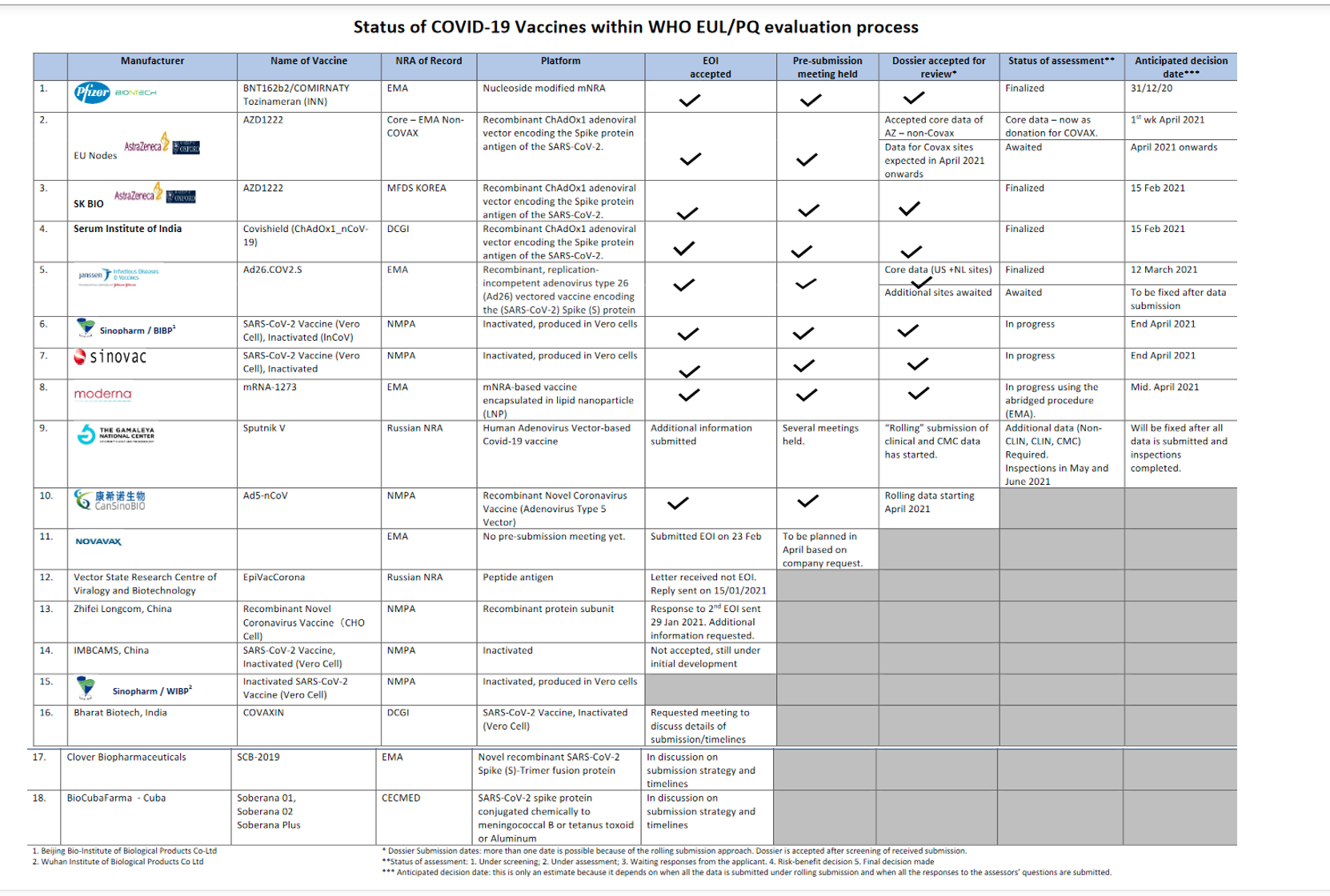
Status of COVID-19 Vaccines within WHO EUL/PQ evaluation process 07 April 2021
For 18 vaccine candidates, the presents Manufacturer, Name of Vaccine, NRA of Record, Platform, EOI Accepted Status, Pre-submission Meeting Held Status, Dossier Accepted for Review, Status of Assessment; Anticipated/Completed Decision Date
[click on the link above for full scale view]

COVID Vaccine Developer/Manufacturer Announcements [organizations from WHO EUL/PQ listing above]

Featured Journal Content


COVID Vaccine Developer/Manufacturer Announcements [organizations from WHO EUL/PQ listing above]


AstraZeneca
Press Releases – No new digest announcements identified

Bharat Biotech, India
Press Releases – No new digest announcements identified

BioCubaFarma – Cuba
Últimas Noticias
Inicia aplicación de la segunda dosis de vacunas cubanas contra la COVID-19 [Application of the second dose of Phase III clinical trials of the vaccine candidates Soberana 02 and Abdala begins]

05/04/2021 13:56:23


CanSinoBIO
News
Apr 08, 2021
CanSinoBIO Announces Approval for its Single-Dose COVID-19 Vaccine Convidecia™ in Chile

Clover Biopharmaceuticals – China
News – No new digest announcements identified


Gamaleya National Center
Latest News and Events – No new digest announcements identified [See Russia/RFID below]

IMBCAMS, China
Home – No new digest announcements identified


Janssen/JNJ
Press Releases
Apr 02, 2021 United States
Johnson & Johnson Expands Phase 2a Clinical Trial of COVID-19 Vaccine Candidate to Include Adolescents
Expansion of ongoing trial to include adolescents 12-17 years of age reflects commitment to people of all ages affected by pandemic


Moderna
Press Releases
April 7, 2021
Moderna Highlights Publication of Antibody Persistence Data of its COVID-19 Vaccine out to 6 Months in the New England Journal of Medicine

April 6, 2021
Moderna and Catalent Announce Long-Term Strategic Collaboration for Dedicated Vial Filling of Moderna’s COVID-19 Vaccine and Clinical Portfolio


Novavax
Press Releases
Novavax Initiates COVID-19 Vaccine Clinical Trial Crossover
Apr 05, 2021 at 4:05 PM EDT
:: Crossover allows participants to continue in trials and remain blinded
:: Ensures that all trial participants receive active vaccine
:: South Africa and UK crossover arms initiated; US/Mexico PREVENT-19 crossover planned


Pfizer
Recent Press Releases – No new digest announcements identified


Serum Institute of India
NEWS & ANNOUNCEMENTS – No new digest announcements identified


Sinopharm/WIBPBIBP
News – No new digest announcements identified


Sinovac
Press Releases
Summary of Clinical Trail Data of Sinovac’s COVID-19 Vaccine (CoronaVac®)
Date: 2021-04-03

Sinovac Announced Buildup of Two Billion Annual Capacity of Its COVID-19 Vaccine
Date: 2021-04-02
… announced that the third production line of CoronaVac®, its COVID-19 vaccine, was completed and put into commercial production. Including this new production line, Sinovac’s annual capacity of CoronaVac® has reached 2 billion doses. At this time, over 200 million doses of CoronaVac have been delivered to over 20 countries, including China. It is estimated that over 100 million doses of CoronaVac have been administered during the vaccination rollout in different countries…


Vector State Research Centre of Viralogy and Biotechnology
Home – No new digest announcements identified

Zhifei Longcom, China
[Anhui Zhifei Longcom Biologic Pharmacy Co., Ltd.]
[No website identified]

U.S.: COVID-19 Vaccines – Announcements/Regulatory Actions/Deployment

Featured Journal Content


U.S.: COVID-19 Vaccines – Announcements/Regulatory Actions/Deployment


White House [U.S.]
Briefing Room
Press Briefing by White House COVID-19 Response Team and Public Health Officials
April 09, 2021 • Press Briefings

Press Briefing by White House COVID-19 Response Team and Public Health Officials
April 07, 2021 • Press Briefings

Remarks by President Biden Marking the 150 Millionth COVID-19 Vaccine Shot
April 06, 2021 • Speeches and Remarks

Press Briefing by White House COVID-19 Response Team and Public Health Officials
April 05, 2021 • Press Briefings


::::::

COVID Data Tracker April 3, 2021