COVID-19 vaccines: modes of immune activation and future challenges

Nature Reviews Immunology
Volume 21 Issue 4, April 2021
https://www.nature.com/nri/volumes/21/issues/4


Comment | 05 March 2021
COVID-19 vaccines: modes of immune activation and future challenges
This Comment outlines how the recently licensed vaccines for COVID-19 activate innate immune mechanisms to promote immune memory to SARS-CoV-2. The authors also consider future challenges that could limit vaccine efficacy.
John R. Teijaro & Donna L. Farber

Signals of hope: gauging the impact of a rapid national vaccination campaign

Nature Reviews Immunology
Volume 21 Issue 4, April 2021
https://www.nature.com/nri/volumes/21/issues/4


Comment | 12 March 2021
Signals of hope: gauging the impact of a rapid national vaccination campaign
Preliminary data from Israel demonstrate real-life effectiveness of their COVID-19 vaccination campaign and provide insights that could inform rollout in other countries.
Smadar Shilo, Hagai Rossman  & Eran Segal

A Half-Century of Progress in Health: The National Academy of Medicine at 50: Emerging Infectious Diseases — Learning from the Past and Looking to the Future

New England Journal of Medicine
April 1, 2021 Vol. 384 No. 13
http://www.nejm.org/toc/nejm/medical-journal


Perspective
A Half-Century of Progress in Health: The National Academy of Medicine at 50: Emerging Infectious Diseases — Learning from the Past and Looking to the Future
Christopher Elias, M.D., M.P.H., John N. Nkengasong, Ph.D., and Firdausi Qadri, Ph.D.
Remarkable progress has been made in preventing deaths from infectious diseases. Now, attention could shift to focusing more resources on pandemic preparedness, including detecting and containing emerging zoonotic threats while they are localized and manageable.

Brief Report: Ebola Virus Transmission Initiated by Relapse of Systemic Ebola Virus Disease

New England Journal of Medicine
April 1, 2021 Vol. 384 No. 13
http://www.nejm.org/toc/nejm/medical-journal


Original Articles
Brief Report: Ebola Virus Transmission Initiated by Relapse of Systemic Ebola Virus Disease
Placide Mbala-Kingebeni, M.D., Ph.D. et al
Summary
During the 2018–2020 Ebola virus disease (EVD) outbreak in North Kivu province in the Democratic Republic of Congo, EVD was diagnosed in a patient who had received the recombinant vesicular stomatitis virus–based vaccine expressing a ZEBOV glycoprotein (rVSV-ZEBOV) (Merck). His treatment included an Ebola virus (EBOV)–specific monoclonal antibody (mAb114), and he recovered within 14 days. However, 6 months later, he presented again with severe EVD-like illness and EBOV viremia, and he died. We initiated epidemiologic and genomic investigations that showed that the patient had had a relapse of acute EVD that led to a transmission chain resulting in 91 cases across six health zones over 4 months. (Funded by the Bill and Melinda Gates Foundation and others.)

Use of seroprevalence to guide dengue vaccination plans for older adults in a dengue non-endemic country

PLoS Neglected Tropical Diseases
http://www.plosntds.org/
(Accessed 3 Apr 2021)


Research Article
Use of seroprevalence to guide dengue vaccination plans for older adults in a dengue non-endemic country
Yi-Hua Pan, Mei-Ying Liao, Yu-Wen Chien, Tzong-Shiann Ho, Hui-Ying Ko, Chin-Rur Yang, Shu-Fen Chang, Chia-Yi Yu, Shu-Yu Lin, Pin-Wei Shih, Pei-Yun Shu, Day-Yu Chao, Chao-Ying Pan, Hong-Ming Chen, Guey-Chuen Perng, Chia-Chi Ku, Chwan-Chuen King
| published 01 Apr 2021 PLOS Neglected Tropical Diseases
https://doi.org/10.1371/journal.pntd.0009312

Rapidly modifiable factors associated with full vaccination status among children in Niamey, Niger: A cross-sectional, random cluster household survey

PLoS One
http://www.plosone.org/
[Accessed 3 Apr 2021]


Rapidly modifiable factors associated with full vaccination status among children in Niamey, Niger: A cross-sectional, random cluster household survey
Mika Kondo Kunieda, Mahamane Laouali Manzo, Akira Shibanuma, Masamine Jimba
Research Article | published 31 Mar 2021 PLOS ONE
https://doi.org/10.1371/journal.pone.0249026

Health and economic impact of the pneumococcal conjugate vaccine in hindering antimicrobial resistance in China

PNAS – Proceedings of the National Academy of Sciences of the United States of America
March 30, 2021; vol. 118 no. 13
https://www.pnas.org/content/118/13


Economic Sciences
Health and economic impact of the pneumococcal conjugate vaccine in hindering antimicrobial resistance in China
Ember (Yiwei) Lu, Hui-Han Chen, Hongqing Zhao, and Sachiko Ozawa
PNAS March 30, 2021 118 (13) e2004933118; https://doi.org/10.1073/pnas.2004933118

Looking to the empirical literature on the potential for financial incentives to enhance adherence with COVID-19 vaccination

Preventive Medicine
Volume 145 April 2021
https://www.sciencedirect.com/journal/preventive-medicine/vol/145/suppl/C


Discussion Full text access
Looking to the empirical literature on the potential for financial incentives to enhance adherence with COVID-19 vaccination
Stephen T. Higgins, Elias M. Klemperer, Sulamunn R.M. Coleman
Article 106421

Expectant parents’ vaccine decisions influenced by the 2018 Chinese vaccine crisis: A cross-sectional study

Preventive Medicine
Volume 145 April 2021
https://www.sciencedirect.com/journal/preventive-medicine/vol/145/suppl/C


Research article Abstract only
Expectant parents’ vaccine decisions influenced by the 2018 Chinese vaccine crisis: A cross-sectional study
Xiaomin Wang, Leesa Lin, Jiayao Xu, Weiyi Wang, Xudong Zhou
Article 106423

The Intersection of Problems, Policy, and Politics: The Adoption of an HPV Vaccine School-Entry Requirement in Puerto Rico

Qualitative Health Research
Volume 31 Issue 5, April 2021
http://qhr.sagepub.com/content/current


Research Articles
The Intersection of Problems, Policy, and Politics: The Adoption of an HPV Vaccine School-Entry Requirement in Puerto Rico
Coralia Vázquez-Otero, Ellen M. Daley, Cheryl A. Vamos, Nancy Romero-Daza, Jason Beckstead, Dinorah Martinez Tyson
First Published March 18, 2021; pp. 859–870

The PRISMA 2020 statement: an updated guideline for reporting systematic reviews

Systematic Reviews
https://systematicreviewsjournal.biomedcentral.com/articles
[Accessed 3 Apr 2021]


https://stm.sciencemag.org/
The PRISMA 2020 statement: an updated guideline for reporting systematic reviews
Authors: Matthew J. Page, Joanne E. McKenzie, Patrick M. Bossuyt, Isabelle Boutron, Tammy C. Hoffmann, Cynthia D. Mulrow, Larissa Shamseer, Jennifer M. Tetzlaff, Elie A. Akl, Sue E. Brennan, Roger Chou, Julie Glanville, Jeremy M. Grimshaw, Asbjørn Hróbjartsson, Manoj M. Lalu, Tianjing Li…
Citation: Systematic Reviews 2021 10:89
Content type: Research
Published on: 29 March 2021

Workplace influenza vaccination to reduce employee absenteeism: An economic analysis from the employers’ perspective

Vaccines — Open Access Journal
http://www.mdpi.com/journal/vaccines
(Accessed 3 Apr 2021)


Research article Abstract only
Workplace influenza vaccination to reduce employee absenteeism: An economic analysis from the employers’ perspective
Frederik Verelst, Philippe Beutels, Niel Hens, Lander Willem
Pages 2005-2015

Awareness, Attitudes and Clinical Practices Regarding Human Papillomavirus Vaccination among General Practitioners and Pediatricians in Switzerland

Vaccines — Open Access Journal
http://www.mdpi.com/journal/vaccines
(Accessed 3 Apr 2021)


Open Access Article
Awareness, Attitudes and Clinical Practices Regarding Human Papillomavirus Vaccination among General Practitioners and Pediatricians in Switzerland
by Levy Jäger, Oliver Senn, Thomas Rosemann and Andreas Plate
Vaccines 2021, 9(4), 332; https://doi.org/10.3390/vaccines9040332 – 01 Apr 2021
Abstract
In Switzerland, the human papillomavirus vaccination (HPVv) coverage rate lies below a desirable threshold. General practitioners (GPs) and pediatricians have been recognized as important providers of the HPVv, but there is little known about their self-attributed role and its relationship with their actual […

COVID-19 Vaccine Hesitancy among Young Adults in Saudi Arabia: A Cross-Sectional Web-Based Study

Vaccines — Open Access Journal
http://www.mdpi.com/journal/vaccines
(Accessed 3 Apr 2021)


Open Access Article
COVID-19 Vaccine Hesitancy among Young Adults in Saudi Arabia: A Cross-Sectional Web-Based Study
by Dalia Almaghaslah, Abdulrhman Alsayari, Geetha Kandasamy and Rajalakshimi Vasudevan
Vaccines 2021, 9(4), 330; https://doi.org/10.3390/vaccines9040330 – 01 Apr 2021
Abstract
Ending the COVID-19 pandemic requires achieving herd immunity, either by previous infection or by vaccination. However, concerns about the COVID-19 vaccine are growing around the globe. The current study was conducted to investigate young the adult population’s hesitancy towards the vaccine. The study [

The Implementation of Mass-Vaccination against SARS-CoV-2: A Systematic Review of Existing Strategies and Guidelines

Vaccines — Open Access Journal
http://www.mdpi.com/journal/vaccines
(Accessed 3 Apr 2021)


Open Access Review
The Implementation of Mass-Vaccination against SARS-CoV-2: A Systematic Review of Existing Strategies and Guidelines
by Tasnim Hasan, Justin Beardsley, Ben J. Marais, Thu Anh Nguyen and Greg J. Fox
Vaccines 2021, 9(4), 326; https://doi.org/10.3390/vaccines9040326 – 01 Apr 2021
Abstract
The global drive to vaccinate against severe acute respiratory syndrome-coronavirus-2 (SARS-CoV-2) began in December 2020 with countries in Europe, Middle East, and North America leading the roll out of a mass-vaccination program. This systematic review synthesised all available English-language guidelines and research regarding […]

Demand Creation for COVID-19 Vaccination: Overcoming Vaccine Hesitancy through Social Marketing

Vaccines — Open Access Journal
http://www.mdpi.com/journal/vaccines
(Accessed 3 Apr 2021)


Open Access Review
Demand Creation for COVID-19 Vaccination: Overcoming Vaccine Hesitancy through Social Marketing
by William Douglas Evans and Jeff French
Vaccines 2021, 9(4), 319; https://doi.org/10.3390/vaccines9040319 – 01 Apr 2021
Abstract
The COVID-19 pandemic has led to millions of deaths and tested the capabilities of the medical and public health systems worldwide. Over the next two years as more approved vaccines are made available and supply meets or exceeds demand, medical and public health […]

Media/Policy Watch

Media/Policy Watch
This watch section is intended to alert readers to substantive news, analysis and opinion from the general media and selected think tanks and similar organizations on vaccines, immunization, global public health and related themes. Media Watch is not intended to be exhaustive, but indicative of themes and issues CVEP is actively tracking. This section will grow from an initial base of newspapers, magazines and blog sources, and is segregated from Journal Watch above which scans the peer-reviewed journal ecology.
We acknowledge the Western/Northern bias in this initial selection of titles and invite suggestions for expanded coverage. We are conservative in our outlook in adding news sources which largely report on primary content we are already covering above. Many electronic media sources have tiered, fee-based subscription models for access. We will provide full-text where content is published without restriction, but most publications require registration and some subscription level.
The sheer volume of vaccine and pandemic-related coverage is extraordinary. We will strive to present the most substantive analysis and commentary we encounter.


The Atlantic
http://www.theatlantic.com/magazine/
Accessed 3 Apr 2021
[No new, unique, relevant content]


BBC
http://www.bbc.co.uk/
Accessed 3 Apr 2021
[No new, unique, relevant content]


The Economist
http://www.economist.com/
Accessed 3 Apr 2021
Briefing
Why the EU’s covid-19 vaccination programme went wrong
The commission should have done much better


Financial Times
https://www.ft.com/
Accessed 3 Apr 2021
The Big Read
Brazil’s coronavirus nightmare: ‘Bolsonaro is more isolated than ever’
April 3, 2021
Top of Form
Bottom of Form

Interview
Lunch with the FT
UK vaccine supremo Kate Bingham: ‘The bickering needs to stop’
…“You need to be sure that the vaccines are safe and that if you take the vaccine, you will get protected….
April 3, 2021

Bottom of Form

Coronavirus latest: Pfizer trial points to vaccine effectiveness against South Africa variant
Italy to make vaccines mandatory for healthcare workers
April 1, 2021


Forbes
http://www.forbes.com/
Accessed 3 Apr 2021
Apr 2, 2021
Florida Gov. Ron DeSantis Bans Vaccine Passports Amid GOP Pushback
Some businesses are already requiring vaccine proof.
By Nicholas Reimann Forbes Staff

Apr 1, 2021
WHO Calls Out Europe For ‘Unacceptably Slow’ Vaccine Rollout, Warns It Will Prolong Pandemic
The global body noted that more than 1.6 million people have contracted Covid-19 in Europe in the past week and the numbers are continuing to rise.
By Siladitya Ray Forbes Staff

Mar 31, 2021
How Counterfeit Covid-19 Vaccines And Vaccination Cards Endanger Us All
As much as 10% of medicines are thought to be counterfeit. The growing trade in falsified and substandard drugs is worsening and endangers us in surprising ways.
By Judy Stone Senior Contributor

Mar 31, 2021
‘World’s First’ Animal Covid-19 Vaccine Registered In Russia – Here’s What That Means
Millions of mink were culled due to widespread outbreaks of Covid-19, sparking fears for the future of the fur industry.
By Robert Hart Forbes Staff


Foreign Affairs
http://www.foreignaffairs.com/
Accessed 3 Apr 2021
[No new, unique, relevant content]


Foreign Policy
http://foreignpolicy.com/
Accessed 3 Apr 2021
Latin America’s COVID-19 Fiasco Is Also a Crisis of Regional Integration
A spat at Mercosur’s 30th birthday marked a low point for regional cooperation.
By Catherine Osborn | April 2, 2021, 8:00 AM


Russia and China Are Exploiting Europe’s Vaccine Shortfalls
Slovakia’s prime minister has resigned over a secret delivery of Moscow’s Sputnik V as Brussels struggles to keep the EU united.
By Tim Gosling | March 31, 2021, 10:30 AM


New Yorker
http://www.newyorker.com/
Accessed 3 Apr 2021
[No new, unique, relevant content]


New York Times
http://www.nytimes.com/
Accessed 3 Apr 2021
World
Kenya, expressing concern about counterfeit vaccines, blocks private imports of doses.
The move comes after private health facilities started administering Russia’s Sputnik V vaccine, charging up to $70 for a shot.
By Abdi Latif Dahir

Americas
Argentina’s President Tests Positive for Coronavirus Despite Vaccination
Alberto Fernández, who received early results on his 62nd birthday, was confirmed to have the virus in a later PCR test. His symptoms were said to be mild.
By Daniel Politi

U.S.
Florida’s governor bans agencies and businesses from requiring ‘vaccine passports.’
The Biden administration has made clear that it will neither issue nor require so-called vaccine passports, but Republicans have seized on the issue as an example of government overreach.
By Patricia Mazzei, Sheryl Gay Stolberg, Eileen Sullivan and Isabella Grullón Paz

Health
Can Vaccinated People Spread the Virus? We Don’t Know, Scientists Say.
Researchers pushed back after the C.D.C. director asserted that vaccinated people “do not carry the virus.”
By Apoorva Mandavilli
PRINT EDITION April 3, 2021


Washington Post
https://www.washingtonpost.com/
Accessed 3 Apr 2021
Vaccine passport efforts draw opposition from GOP lawmakers
Apr 3, 2021

Africa CDC says India vaccine woes could be ‘catastrophic’
Apr 1, 2021

Think Tanks et al

Think Tanks et al

Brookings
http://www.brookings.edu/
Accessed 3 Apr 2021
Future Development
For greater vaccine equity, first fix these misconceptions
Philip Schellekens
Friday, April 2, 2021

Coronavirus (COVID-19)
“Vaccine Passport” certification — Policy and ethical considerations
Mark Hall and David Studdert
Thursday, April 1, 2021
 
 
Center for Global Development [to 3 Apr 2021]
http://www.cgdev.org/page/press-center
Publication
April 2, 2021
A Global Pandemic Needs A Global Response: US Contributions to COVID Relief
The American Rescue Plan—the massive COVID-19 relief package recently signed into law—has featured in plenty of headlines. While the vast majority of the nearly $1.9 trillion package is allocated to domestic relief and response, the legislation provides nearly $11 billion in supplemental international affairs spending. We dug in to see how this new injection of funding compares to emergency foreign assistance provided under previous pandemic-related legislation and share some areas we hope to see USAID and the State Department prioritize as they work to put the new money to good use.
Erin Collinson and Jocilyn Estes

March 30, 2021
The Indirect Health Effects of COVID-19: Emerging Findings from Kenya, the Philippines, South Africa, and Uganda
Much of the initial COVID response focused on limiting cases and deaths, without sufficient attention to the broader indirect impacts. A new CGD series investigates.
Carleigh Krubiner et al.
 
 
Chatham House [to 3 Apr 2021]
https://www.chathamhouse.org/
Accessed 3 Apr 2021
Culture notes: Jabs that started a vaccine fight
Catherine Fieschi on how the world fell out trying to counter a pandemic
The World Today
2 April 2021


CSIS
https://www.csis.org/
Accessed 3 Apr 2021
Upcoming Event
Trusting a Covid-19 Vaccine: What’s Next?
April 9, 2021

Transcript
Africa’s Global Reset: Foreign Relations in a Post-Pandemic Era
March 31, 2021


Kaiser Family Foundation
https://www.kff.org/search/?post_type=press-release
Accessed 3 Apr 2021
March 30, 2021 News Release
Vaccine Monitor: 6 in 10 Adults Have Either Gotten a COVID-19 Vaccine or Want To “as Soon as Possible;” “Wait and See” Group Continues To Shrink
Among Those Who Have Not Been Vaccinated, 3 in 10 Are Unsure if They are Eligible Yet; Hispanic Adults and People with Low Incomes More Likely to Be Unsure The latest KFF COVID-19 Vaccine Monitor report finds enthusiasm for getting a COVID-19 vaccine continuing to grow, with roughly 6 in…

March 29, 2021 News Release
New Analysis Indicates U.S. County Vaccination Rates Do Not Correspond to COVID-19 Impact Thus Far
An analysis of Centers for Disease Control and Prevention (CDC) COVID-19 vaccination data from 72% of all counties in the U.S. shows that counties classified as having “low” COVID-19 community transmission (cases and positive tests) levels have an average vaccination rate greater than the rate in counties with “high” community…
 
 
World Economic Forum [to 3 Apr 2021]
https://agenda.weforum.org/news/
Media
Accessed 3 Apr 2021
[No new digest content identified]

Vaccines and Global Health: The Week in Review :: 27 March 2021

Vaccines and Global Health: The Week in Review is a weekly digest  summarizing news, events, announcements, peer-reviewed articles and research in the global vaccine ethics and policy space. Content is aggregated from key governmental, NGO, international organization and industry sources, key peer-reviewed journals, and other media channels. This summary proceeds from the broad base of themes and issues monitored by the Center for Vaccine Ethics & Policy in its work: it is not intended to be exhaustive in its coverage. You are viewing the blog version of our weekly digest, typically comprised of between 30 and 40 posts below all dated with the current issue date

.– Request an Email Summary: Vaccines and Global Health : The Week in Review is published as a single email summary, scheduled for release each Saturday evening before midnight (EDT in the U.S.). If you would like to receive the email version, please send your request to david.r.curry@centerforvaccineethicsandpolicy.org.

– pdf version A pdf of the current issue is available here: 

– blog edition: comprised of the approx. 35+ entries posted below.

– Twitter:  Readers can also follow developments on twitter: @vaxethicspolicy.
.
– Links:  We endeavor to test each link as we incorporate it into any post, but recognize that some links may become “stale” as publications and websites reorganize content over time. We apologize in advance for any links that may not be operative. We believe the contextual information in a given post should allow retrieval, but please contact us as above for assistance if necessary.

Support this knowledge-sharing service: Your financial support helps us cover our costs and to address a current shortfall in our annual operating budget. Click here to donate and thank you in advance for your contribution.

.
David R. Curry, MS
Executive Director
Center for Vaccine Ethics and Policy

COVAX updates participants on delivery delays for vaccines from Serum Institute of India (SII) and AstraZeneca

Milestones :: Perspectives :: Research


COVAX: Vaccine Supply/Deployment

COVAX updates participants on delivery delays for vaccines from Serum Institute of India (SII) and AstraZeneca
Statement 03/25/2021
[Editor’s text bolding]
:: The COVAX Facility has notified participating economies that deliveries of doses from the Serum Institute of India (SII) will be delayed in March and April
:: Delays in securing supplies of SII-produced COVID-19 vaccine doses are due to the increased demand for COVID-19 vaccines in India
:: Separately, participating economies in the COVAX Facility that have been allocated doses from the AstraZeneca manufacturing network have been notified that some first deliveries anticipated in March will now take place in April

GENEVA/NEW YORK/OSLO, 25 March 2021 – Deliveries of COVID-19 vaccines produced by the Serum Institute of India (SII) to lower-income economies participating in the COVAX Facility will face delays during March and April as the Government of India battles a new wave of COVID-19 infections. COVAX and the Government of India remain in discussions to ensure some supplies are completed during March and April.

According to the agreement between Gavi and the Serum Institute of India (SII), which included funding to support an increase in manufacturing capacity, SII is contracted to provide COVAX with the SII-licensed and manufactured AstraZeneca (AZ)-Oxford vaccine (known as COVISHIELD) to 64 lower-income economies participating in the Gavi COVAX AMC (including India), alongside its commitments to the Government of India.


To date, COVAX has been supplied with 28 million COVISHIELD doses and was expecting an additional 40 million doses to be available in March, and up to 50 million doses in April.

COVAX has notified all affected economies of potential delays. SII has pledged that, alongside supplying India, it will prioritize the COVAX multilateral solution for equitable distribution.

Participating economies have also received WHO guidance on optimizing the national deployment doses of the AstraZeneca-Oxford vaccine in a constrained supply environment.


Separately, the COVAX Facility has informed participants allocated AstraZeneca-manufactured doses of the AstraZeneca-Oxford vaccine that some of the first deliveries due in March are now set to take place in April.

In this early phase of COVID-19 vaccine roll-out, vaccine manufacturers require time to scale and optimize their production processes. AstraZeneca, which uses a novel supply chain network with sites across multiple continents, is working to enable initial supply to 82 countries through COVAX in the coming weeks.

COVAX retains its objective of supplying initial doses of vaccines to all participating economies in the first half of the year before ramping up significantly in the second half of 2021. To date, COVAX has shipped vaccines to over 50 countries and economies.


::::::

Editor’s Note:
No media release or statement on the manufacturing/supply issues above was identified on the Serum Institute website or the AstraZeneca website.

Gavi Board approves COVAX Buffer for high-risk groups in humanitarian settings

Milestones :: Perspectives :: Research


Gavi Board approves COVAX Buffer for high-risk groups in humanitarian settings
:: 5% of the total number of available doses procured through the COVAX Facility will be allocated to the COVAX Buffer
:: The COVAX Buffer will ensure access to vaccines for populations in humanitarian settings
:: José Manuel Barroso: “While the first resort in covering all high-risk groups, irrespective of their legal status, is including them in national vaccination plans, the COVAX Buffer will serve as a safety net to ensure these populations do not get left behind”

Geneva, 23 March 2021 – The Board of Gavi, the Vaccine Alliance has approved the COVAX Buffer to ensure access to COVID-19 vaccines for high-risk populations in humanitarian settings and enable an emergency release of doses for severe outbreaks. The volume of the COVAX Buffer will be up to 5% of doses procured through the COVAX Facility, thus making up to 100 million vaccine doses available by end of 2021.

While national governments are ultimately responsible for providing access to COVID-19 vaccines for all high-risk groups within their respective territory, the COVAX Buffer will be available for use where there are unavoidable gaps in coverage, for example in instances of state-failure and conflict, and in areas controlled by non-state armed groups inaccessible to governments.

The Inter-Agency Standing Committee (IASC) – a forum of UN and non-UN organisations working to improve the delivery of humanitarian assistance to affected populations – estimates that 167 million people are at risk of exclusion from COVID-19 vaccination. Over two-thirds are in economies eligible for support through the Gavi COVAX Advance Market Commitment (AMC), many in non-government-controlled areas and therefore out of reach of national vaccination campaigns.

“Equitable access is the foundational goal of COVAX, and the available doses should be distributed in accordance with humanitarian principles and upholding governments’ obligations towards populations within their territory,” said José Manuel Barroso, who led his first meeting as a Chair of the Gavi Board. “However, we cannot stop there. While the first resort in covering all high-risk groups, irrespective of their legal status, is including them in national vaccination plans, the COVAX Buffer will serve as a safety net to ensure these populations do not get left behind.”

COVAX Buffer will also provide a contingency for severe outbreaks of COVID-19 by enabling emergency release of doses where regular vaccine allocation timelines may not be sufficient. This surge of doses, aimed at addressing acute outbreaks, is only going to be considered once all COVAX Facility participants have been allocated a base amount of vaccine doses. All COVAX Facility participants, both self-financing and AMC-eligible economies, as well as national and international humanitarian agencies will have access to doses through the COVAX Buffer.

“As we have started the rollout of millions of doses of COVID-19 vaccines to COVAX economies, it is essential to also protect high-risk groups caught in crisis settings,” said Dr Seth Berkley, CEO of Gavi, the Vaccine Alliance. “This means not forgetting the millions of people in conflict-affected settings or in settings that are not under the control of national governments, for it is in these last mile communities where the need for equity is most pronounced.”…

World Bank: WBG Vaccine Announcement– Key Facts

Milestones :: Perspectives :: Research


World Bank: WBG Vaccine Announcement– Key Facts
Date: March 23, 2021
COVID-19 vaccines, alongside widespread testing, improved treatment and strong health systems are critical to save lives and strengthen the global economic recovery. To provide relief for vulnerable populations, low- and middle-income countries need fair, broad, and fast access to effective and safe vaccines.

That’s why the World Bank (WB) is building on its initial COVID-19 response with $12 billion to help poor countries purchase and distribute vaccines, tests, and treatments. The first WB-financed operation to support vaccine rollout was approved in January 2021.


Financing:
:: The financing scales up our assistance to help low & middle-income countries procure and get ready to deploy vaccines and strengthen national systems for public health preparedness. This financing is part of the Bank’s initial COVID-19 response announced in April 2020 which is currently supporting more than 110 countries.
:: All Eligible low- and middle-income countries (IBRD/IDA) will be able to access the vaccine financing package within their current lending envelopes for IDA countries and exposure limits for IBRD.
:: The financing package, which is underway and will be rolled out over the next 24 months, helps signal to the research and pharmaceutical industry that people in developing countries need equal access to safe and effective COVID-19 vaccines. Only once the pandemic is contained in all countries will each country be safe from a resurgence.


How it works:
:: The approach draws on the WBG’s significant expertise in supporting large scale immunization programs for vaccine preventable diseases, as well as public health programs to tackle infectious diseases such as HIV, tuberculosis, malaria and neglected tropical diseases.
:: The Bank is working with partners to assess the readiness of countries’ health systems for vaccine deployment and identify gaps and areas for possible investment.  This allows Bank financing to support each country’s priority needs. The assessments involve analysis of policy and regulatory capacities, data and tracking systems, health infrastructure including cold chains and training of health workers. Assessments are already underway in more than 140 countries.
:: Developing countries have flexibility to use the financing in ways that best help them, based on their specific context and needs. The financing can be used for the purchasing of vaccines, the distribution of vaccines and strengthening on health systems or a combination of these financing options to meet countries’ vaccine needs.

Vaccine purchase: The WB provides options for vaccine purchase and financing mechanisms including:
–  Direct purchases by countries from vaccine manufacturers, either individually or jointly with other countries;
–  Purchase of excess stocks from other countries that reserve excess doses;
–  Advance purchase mechanisms, such as participating in COVAX.
Vaccine distribution: To help countries get ready to deploy vaccines and strengthen their health systems, which are key for effective vaccine distribution, WB financing will be used to establish policies for safe and effective deployment, expand storage and building cold chains, develop data and tracking systems, train health workers and build trust in immunizations through citizen and community engagement. The financing can also be used to purchase and distribute COVID-19 tests and treatments.


IFC’s support on vaccines
Another important part of the World Bank Group’s response comes from IFC, our private sector development arm. The $4 billion Global Health Platform supports private companies in delivering health products and services – including vaccines – to developing countries. This includes:
:: Investments in vaccine manufacturers to foster expanded production of COVID-19 vaccines in low- and middle-income countries, with production reserved for emerging markets.
:: Ability to invest in production to address other potential bottlenecks, including vials, needles and syringes, and cold storage capacity.
:: Support for mapping COVID-19 vaccine manufacturing capacity, focusing on potential bottlenecks in manufacturing processes…

COVID Response – Equity

Milestones :: Perspectives :: Research


COVID Response – Equity

New Red Cross and Red Crescent plan to counter “deep and pervasive” inequities in pandemic response
Geneva, 24 March 2021 (ICRC/IFRC) – The International Red Cross and Red Crescent Movement has today launched a new plan that aims to tackle “deep and pervasive” inequities in the global response to the COVID-19 pandemic.

While no one has been spared from the effects of COVID-19, the consequences of this pandemic have not been equally felt. This crisis has been defined by profound and persistent inequities both in terms of who is most at risk, and how the world has responded.

The new Red Cross and Red Crescent analysis released today shows that, although present in all countries, these inequities have been particularly pronounced and damaging for people living in countries affected by humanitarian crises.


According to this analysis:
:: Countries that are not dealing with humanitarian crises have reported carrying out nearly 48 times more COVID-19 tests per capita than countries facing “severe” or “very severe” humanitarian crises.


:: People living in countries facing either no humanitarian crisis or crises that are considered “low” in severity are more than three times as likely to be supported with contact tracing for COVID-19.

:: Less than 2 per cent of COVID-19 vaccine doses globally have reportedly been administered in the 32 countries currently facing “severe” or “very severe” humanitarian crises.

Jagan Chapagain, Secretary General of the International Federation of Red Cross and Red Crescent Societies (IFRC), said: “Since the start of the outbreak, we have seen the virus discriminate through its impacts on the elderly, on people with pre-existing conditions, and on people who do not have the economic resources to isolate and protect themselves. What our data shows is that the response to COVID-19 also discriminates. These deep and pervasive inequities mean that, no matter where they are, people in vulnerable settings are more likely than the general population to be infected, are more likely to die once infected, and are least likely to be appropriately supported through the response, including through vaccination campaigns. The same is also true for vulnerable groups in non-crisis settings.”

Robert Mardini, Director-General of the International Committee of the Red Cross (ICRC), said:
“Communities affected by armed conflict have been among the hardest hit by COVID-19, including those who have been displaced, people separated from their families, those deprived of their livelihoods and people in detention. That is why the ICRC is supporting National Societies, vital health infrastructure, access to health care, efforts to prevent the spread of disease in places of detention, access to clean water, and the safe and dignified management of human remains in places experiencing conflict and violence.”


The revised International Red Cross and Red Crescent Movement plan is designed to counter some of the more severe inequities by expanding care, treatment and support for people in all countries, including those affected by humanitarian crises such as conflict and disasters. The plan also includes a range of measures designed to support and extend COVID-19 immunization campaigns so that marginalized and isolated groups — including people living in conflict zones, migrants and displaced people, people living in urban slums, and isolated communities in non-crisis affected countries — can access vaccines.

In all, the revised International Red Cross and Red Crescent Movement appeal seeks 2.729 billion Swiss francs…

To read the revised Movement plan, click here.

Coronavirus [COVID-19] – WHO Public Health Emergency of International Concern (PHEIC)

Milestones :: Perspectives :: Research


Coronavirus [COVID-19] – WHO
Public Health Emergency of International Concern (PHEIC)
https://www.who.int/emergencies/diseases/novel-coronavirus-2019


Weekly Epidemiological and Operational updates
Last update: 23 January 2021
Confirmed cases :: 125 781 957 [week ago: 121 969 223] [two weeks ago: 118 754 336]
Confirmed deaths :: 2 759 432 [week ago: 2 694 094] [two weeks ago: 2 634 370]
Countries, areas or territories with cases :: 223


::::::

Weekly operational update on COVID-19 – 22 March 2021
Overview
In this edition of the Weekly Operational Update on COVID-19, highlights of country-level actions and WHO support to Member States include:
:: Calls for maintaining essential health services amid disruptions from COVID-19 pandemic
:: The role of traditional leaders for community-based interventions against COVID-19
:: The 1-year anniversary of Partners Platform and the COVID-19 Publication Review Committee
:: Support in minimizing risks from mass gatherings, preparing and supporting a COVID-19 vaccine campaign and support to virology laboratories
:: The Strategic Preparedness and Response Plan (SPRP) 2021 Operational Planning Guidelines, resource requirements and progress made to continue investing in the COVID-19 response and for building the architecture to prepare for, prevent and mitigate future health emergencies is included.
:: Updates on WHO/PAHO procured items, participation in the Unity Studies, and select indicators from the COVID-19 Monitoring and Evaluation Framework


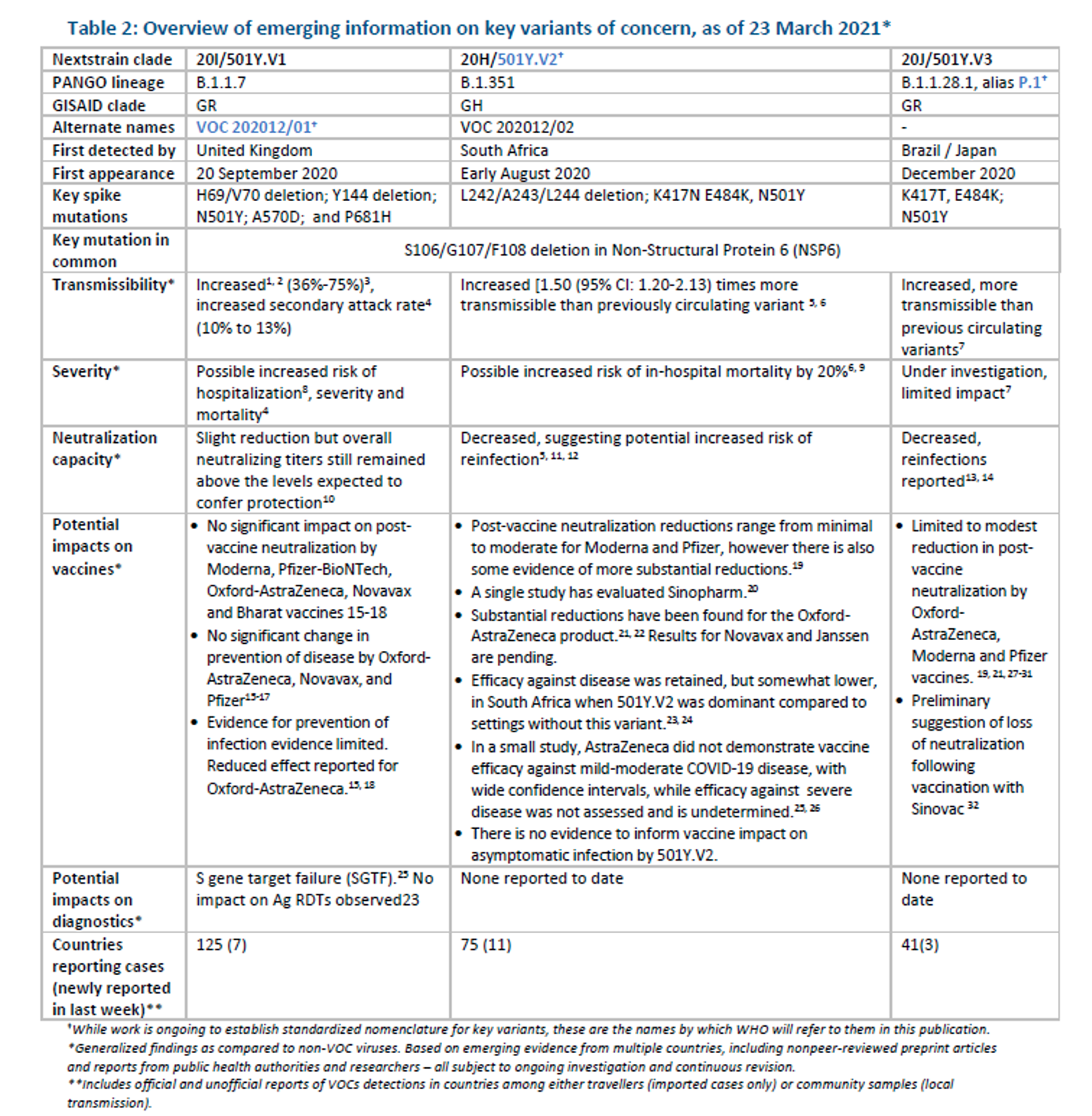
Weekly epidemiological update on COVID-19 – 23 March 2021
Overview
Globally, COVID-19 confirmed cases continued to rise for a fourth consecutive week, with just under 3.3 million new cases reported in the last week . Concurrently, the number of new deaths reported plateaued after a six week decrease, with just over 60 000 new deaths reported. A marked increase in the number of new cases was reported from the South East Asia, Western Pacific, European and Eastern Mediterranean regions, all of which are on an upward trajectory in recent weeks. The European Region and the Region of the Americas continue to account for nearly 80% of all the cases and deaths.

In this edition, special focus updates are provided on:
:: Release of the WHO COVID-19 Detailed Surveillance Dashboard
:: SARS-CoV-2 variants of concern


::::::

::::::

WHO – Feature COVID stories from around the globe
25 March 2021
A virus that respects no borders: protecting refugees and migrants during COVID-19

24 March 2021
Sudan’s community dialogues empower disadvantaged populations to decide on their health priorities

23 March 2021
WHO supports COVID-19 vaccine rollout, highlights women in health and boosts telemedicine during the pandemic thanks to donors

22 March 2021
El Salvador’s President takes the lead in promoting a stringent lockdown against COVID-19 with support from all levels, including the PAHO/WHO country office

WHO – COVID Vaccines EUAL, Prequalification

Milestones :: Perspectives :: Research


WHO – COVID Vaccines EUAL, Prequalification

Draft landscape and tracker of COVID-19 candidate vaccines
12 March 2021  | Publication
The COVID-19 candidate vaccine landscape and tracker database compiles detailed information on COVID-19 vaccine candidates in development.
The landscape is updated regularly – twice a week (Tuesday and Friday, 17:00 CET).
Download: https://cdn.who.int/media/docs/default-source/blue-print/12.03.2021-novel-coronavirus_landscape_covid-19.xlsx.zip?sfvrsn=c2a25511_3&download=true


::::::

Status of COVID-19 Vaccines within WHO EUL/PQ evaluation process 23 Mar 2021
For 16 vaccine candidates, the presents Manufacturer, Name of Vaccine, NRA of Record, Platform, EOI Accepted Status, Pre-submission Meeting Held Status, Dossier Accepted for Review, Status of Assessment; Anticipated/Completed Decision Date
[click on the link above for full scale view]

U.S.: COVID-19 Vaccines – Announcements/Regulatory Actions/Deployment

Milestones :: Perspectives :: Research


U.S.: COVID-19 Vaccines – Announcements/Regulatory Actions/Deployment


White House [U.S.]
Briefing Room
Press Briefing by White House COVID-19 Response Team and Public Health Officials
March 26, 2021 • Press Briefings

FACT SHEET: Biden Administration Announces Historic $10 Billion Investment to Expand Access to COVID-19 Vaccines and Build Vaccine Confidence in Hardest-Hit and Highest-Risk Communities
March 25, 2021 • Statements and Releases

Press Briefing by White House COVID-19 Response Team and Public Health Officials
March 24, 2021 • Press Briefings

Press Briefing by White House COVID-19 Response Team and Public Health Officials
March 22, 2021 • Press Briefings

COVID Data Tracker March 27, 2021


::::::

NIAID Statement on AstraZeneca Vaccine
March 22, 2021 — Late Monday, the Data and Safety Monitoring Board (DSMB) notified NIAID, BARDA, and AstraZeneca that it was concerned by information released by AstraZeneca on initial data from its COVID-19 vaccine clinical trial. The DSMB expressed concern that AstraZeneca may have included outdated information from that trial, which may have provided an incomplete view of the efficacy data. We urge the company to work with the DSMB to review the efficacy data and ensure the most accurate, up-to-date efficacy data be made public as quickly as possible.
Authorization and guidelines for use of the vaccine in the United States will be determined by the Food and Drug Administration and Centers for Disease Control and Prevention after thorough review of the data by independent advisory committees…

::::::

Europe: COVID-19 Vaccines – Announcements/Regulatory Actions/Deployment

EMA
EMA: Increase in vaccine manufacturing capacity and supply for COVID-19 vaccines from AstraZeneca, BioNTech/Pfizer and Moderna
News  26/03/2021
EMA’s human medicines committee (CHMP) has adopted several important recommendations that will increase manufacturing capacity and supply of COVID-19 vaccines in the EU.

New manufacturing site for AstraZeneca’s COVID-19 vaccine
A new manufacturing site has been approved for the production of AstraZeneca’s COVID-19 vaccine active substance. The Halix site is located in Leiden, the Netherlands, and will bring the total number of manufacturing sites licensed for the production of the active substance of the vaccine to four.

New manufacturing site and more flexible storage conditions for BioNTech/Pfizer’s COVID-19 vaccine
A new site has also been approved for the production of Comirnaty, the COVID-19 vaccine developed by BioNTech and Pfizer. The facility, which is in the German city of Marburg, will produce both active substance and the finished product. There are currently three active substance manufacturing sites supplying the EU included in the marketing authorisation.
In addition to the new manufacturing facility for this vaccine, the CHMP has also given a positive opinion to allow transportation and storage of vials of this vaccine at temperatures between -25 to -15˚C (i.e. the temperature of standard pharmaceutical freezers) for a one-off period of two weeks. This is an alternative to the long-term storage of the vials at a temperature between -90 to -60˚C in special freezers. It is expected to facilitate the rapid roll-out and distribution of the vaccine in the EU by reducing the need for ultra-low temperature cold storage conditions throughout the supply chain.

New manufacturing site and scaled-up processes for Moderna’s COVID-19 vaccine
Already last week, the CHMP recommended approving the addition of a new manufacturing site for the production of active substance and finished product intermediates for Moderna’s COVID-19 vaccine. The addition of the new manufacturing lines at the Lonza facility, located in Visp, Switzerland, together with other changes to the manufacturing processes that were greenlighted by the Committee are intended to scale-up production capacity and increase supply of the vaccine for the EU market.

The changes described will be included in the publicly available information on these vaccines on EMA’s website…

::::::

European Commission

Remarks by Executive Vice-President Dombrovskis at the press conference on the export transparency and authorisation mechanism and an accelerated approval of adapted vaccines against COVID-19 variants
Speech 24 March 2021
… Today, the Commission has adopted an implementing regulation to adapt our export authorisation mechanism for vaccines, with the aim of preserving the security of our supply chains.
As you know, the mechanism was introduced on 30 January 2021, and was recently extended until 30 June, with wide support of EU Member States.
The system has introduced much-needed transparency in relation to vaccine deliveries in the EU.
We have used this mechanism in a balanced way.
We have authorised exports on the basis that they did not threaten the commitments undertaken by pharmaceutical companies under their Advance Purchase Agreements. Of 381 requests, 380 have been approved.
Only one request for export authorisation was not granted, since it would have compromised the commitments of AstraZeneca. I remind you that AstraZeneca has only delivered a small portion of its agreed contractual commitments.
Europe has taken every step to act fairly and responsibly, mindful of our global leadership role, since the start of the pandemic. The EU remains the biggest global exporter of vaccines. We are the largest contributor to low and middle income countries in the so-called COVAX facility.
You only have to look at the figures: 43 million vaccines to 33 countries since the end of January.
And that only covers the countries which are subject to export authorisation systems. There are many more vaccines going to other countries. No one else has done as much.
We see, however, that continuing shortfalls in production are not distributed fairly across different contracting countries.
The EU is the only OECD producer that continues to export vaccines to countries that have production capacities of their own. But when these countries do not export to the EU, there is no reciprocity.
The EU still faces a very serious epidemiological situation and continues to export significantly to countries whose epidemiological situation is less serious than ours, or whose vaccination roll-out is more advanced than ours.
To address these imbalances, President von der Leyen last Wednesday called for reciprocity and proportionality to be introduced in our transparency and authorisation regime. Accordingly, we have today adopted two adjustments to the existing mechanism.
These are necessary to achieve our objective of ensuring timely access to COVID-19 vaccines for EU citizens.
Going forward, Member States and the Commission should now consider two additional elements when assessing the impact of planned exports.
First, reciprocity.
If the country of destination, which has a large production capacity, restricts its own exports of vaccines or substances – either by law or other means – it may be appropriate to consider whether exports to this country are justified.
The second element is proportionality – which means finding the right balance:
Member states and the Commission will consider the conditions prevailing in the country of destination, in particular the epidemiological situation, its vaccination rate and the existing availability of COVID-19 vaccines.
Of course, the important consideration to respect Advance Purchasing Agreement remains in place.
It is appropriate that we should distinguish between poorly performing companies and well-performing ones that are on track to meet their contractual obligations.
In addition, the new act includes some countries, previously exempted, in the scope of the regulation. The primary objective of this adjustment is to have more transparency on exports, and to obtain a full picture on what is happening outside the EU, so as to avoid possible circumvention of the rules.
Exports to low- and middle-income countries, supplies through COVAX and exports to EU overseas countries and territories remain unconditionally exempted.
The added value of this proposal is that it should allow us to arrive at a more cooperative approach with our partner countries, especially those in a less dire situation.
This will also help ensure the well-functioning flow of vaccine and ingredients to give predictability to companies to ramp up global production and safeguard a fair distribution of vaccines.
The regulation will help us to meet the expectations of EU citizens, while maintaining our responsibilities to our partners around the world.
The most important thing at this crucial moment is to stabilise and accelerate the delivery of vaccines.
Thank you.
Russia: COVID-19 Vaccines – Announcements/Regulatory Actions/Deployment

Milestones :: Perspectives :: Research


Russia: COVID-19 Vaccines – Announcements/Regulatory Actions/Deployment


Russia: Sputnik V – “the first registered COVID-19 vaccine”
https://sputnikvaccine.com/newsroom/pressreleases/
Press Releases
Antigua and Barbuda authorizes Sputnik V
Press release, 26.03.2021

RDIF and “Torlak” Institute agree to produce Sputnik V vaccine in Serbia
Press release, 25.03.2021

Russia is the most trusted vaccine producer alongside the US, with Sputnik V being the most recognizable vaccine, a YouGov poll shows
Press release, 24.03.2021

Sputnik V approved in Vietnam
Press release, 23.03.2021

Mauritius becomes the 55th country to approve Sputnik V
Press release, 22.03.2021

RDIF and Virchow Biotech partner for production of Sputnik V vaccine in India
Press release, 22.03.2021

India: COVID-19 Vaccines – Announcements/Regulatory Actions/Deployment

Milestones :: Perspectives :: Research


India: COVID-19 Vaccines – Announcements/Regulatory Actions/Deployment


Indian Council for Medical Research (ICMR)
https://www.icmr.gov.in/media.html
No new digest content identified.


Editor’s Note:
See COVAX announcement above on delays in shipments resulting from India’s curtailment of vaccine exports. Media sources report that the Indian government has not formally commented on these export restrictions.

China: COVID-19 Vaccines – Announcements/Regulatory Actions/Deployment

Milestones :: Perspectives :: Research


China: COVID-19 Vaccines – Announcements/Regulatory Actions/Deployment

National Health Commission of the People’s Republic of China [to 27 Mar 2021]
http://en.nhc.gov.cn/
News
March 27: Daily briefing on novel coronavirus cases in China
On March 26, 31 provincial-level regions and the Xinjiang Production and Construction Corps on the Chinese mainland reported 12 new cases of confirmed infections.

Chinese drug firm Sinovac: No vaccine-related abnormality monitored in people aged above 60
2021-03-26

Shanghai starts vaccinating expats
2021-03-24

Xi delivers video speech to Colombian people as Chinese vaccines arrive
2021-03-22

Vaccinated from overseas not exempt from COVID-19 control measures
2021-03-22

Chinese expert says COVID-19 origin research excludes lab leak, denies conflicts within WHO-China team
2021-03-22

National Medical Products Administration – PRC [to 27 Mar 2021]
http://english.nmpa.gov.cn/news.html
News
China approves clinical trials for CanSino’s inhaled COVID-19 vaccine
2021-03-26
China’s drug authority has approved clinical tests for an inhaled COVID-19 vaccine co-developed by domestic company CanSino Biologics, the Agence France-Presse (AFP) reported on March 23.

China’s daily output of COVID-19 vaccines reaches 5m doses
2021-03-25
The daily output of Chinese COVID-19 vaccines has reached 5 million doses, a senior official said.

Nation prepares mass domestic COVID inoculations
2021-03-25
China had administered nearly 82.85 million doses of COVID-19 vaccine as of Tuesday as it prepares a campaign to vaccinate its entire population, the State Council’s Joint Prevention and Control Mechanism said on March 24.

Over 100 mln Chinese vaccine doses administered world wide
2021-03-24
Over 100 million doses of COVID-19 vaccines produced by China have been administered at home and abroad, according to the State Council’s COVID-19 response inter-agency task force.

COVID Vaccine Developer Announcements [selected]

Milestones :: Perspectives :: Research


COVID Vaccine Developer Announcements [selected]


Moderna
Moderna Announces New Supply Agreement with the Philippines for 7 Million Additional Doses of COVID-19 Vaccine Moderna
March 22, 2021


Pfizer
EMA Approves New Storage Option for Pfizer-BioNTech Vaccine, Easing Distribution and Storage of Doses Across European Union
March 26, 2021
:: New stability data show vaccine can be stored at -25°C to -15°C for a total of two weeks and support decentralized distribution plans for vaccination at general practitioners’ offices
:: Label update offers greater flexibility for distributing, storing and administering the vaccine within the European Union

Pfizer Initiates Phase 1 Study of Novel Oral Antiviral Therapeutic Agent Against SARS-CoV-2
March 23, 2021
:: In-vitro studies conducted to date show that the clinical candidate PF-07321332 is a potent protease inhibitor with potent anti-viral activity against SARS-CoV-2
:: This is the first orally administered coronavirus-specific investigational protease inhibitor to be evaluated in clinical studies, and follows Pfizer’s intravenously administered investigational protease inhibitor, which is currently being evaluated in a Phase 1b multi-dose study in hospitalized clinical trial participants with COVID-19


AstraZeneca
Press Releases
AZD1222 US Phase III primary analysis confirms safety and efficacy
25 March 2021


Statement on COVID-19 vaccine supply at Anagni plant in Italy
24 March 2021


Update following statement by NIAID on AZD1222 US Phase III trial data
23 March 2021


AZD1222 US Phase III trial met primary efficacy endpoint in preventing COVID-19 at interim analysis
22 March 2021

COVID Vaccination: Incentives/Mandates/Certificates/Passports

Milestones :: Perspectives :: Research


COVID Vaccination: Incentives/Mandates/Certificates/Passports

WHO – Call for public comments: Interim guidance for developing a Smart Vaccination Certificate – Release Candidate 1
19 March 2021 Call for consultation
Interim Guidance pdf: https://cdn.who.int/media/docs/default-source/documents/interim-guidance-svc_20210319_final.pdf?sfvrsn=b95db77d_11&download=true

In response to the Statement on the sixth meeting of the International Health Regulations (2005) Emergency Committee regarding the coronavirus disease (COVID-19) pandemic, and the need for WHO to support Member States to deliver COVID-19 vaccines, at scale, with digital tools, WHO has developed this guidance and technical specifications document, in collaboration with a multi-disciplinary group of experts. The Guidance aims to support WHO Member States in adopting interoperability standards for digital documentation of vaccination status (i.e. Smart Vaccination Certificates). 

It is critical to reiterate that the Smart Vaccination Certificate (SVC) is not intended to serve as an “immunity passport”. Furthermore, as per the “Interim position paper: considerations regarding proof of COVID-19 vaccination for international travellers”, currently, proof of COVID-19 vaccination is not recommended as a condition of departure or entry for international travel. Countries are advised to take a risk-based approach to international travel in the context of COVID-19. Additionally, along with the digital implementation of SVCs, it is recommended that the COVID-19 vaccination status should still be recorded through the paper-based International Certificate for Vaccination, and Prophylaxis based on the model presented in Annex 6 of the IHR.

Due to the constantly evolving context of the COVID-19 pandemic, this document is intended to have three releases prior to the release of the final version, with public feedback and input considered for all three releases. This document is the first of three releases. Release candidate 1 (this document) contains the key business requirements for an SVC for national adoption that includes the prioritized scenarios of use, use cases, key workflows, a core data set with preferred terminology code sets, and an initial FHIR Implementation Guide for the content in Release Candidate 1. This document will also begin to outline the international trust framework and a high-level overview of a governance mechanism.

As this is Release Candidate 1, which is an initial release of the technical specification for the Smart Vaccination Certificate, no digital solutions have met this specification yet.

As part of the public consultation, you can provide constructive feedback on this document by 12 April 2021. Please use the link to the feedback form to provide your comments. For any additional inquiries, please contact smartvaccination@who.int.


::::::

Africa’s Telecom and Technology Industry Leads the Charge against COVID-19 by Backing AU Covid-Tech & Vaccine Passport System
26 March 2021
Africa CDC obtains highly positive feedback from a  consultative meeting with mobile and technology players on the Africa CDC Trusted Travel Policy.

ADDIS ABABA, ETHIOPIA, 26 March 2021 – More than a year into the global pandemic, the coronavirus disease 2019 (COVID-19) pandemic has shown that health is central to everything we do on the planet. The profound impact of the virus and of the measures which have been necessary to contain it have worsened economic inequalities and social insecurities, and deepened challenges in our already under-pressure health systems on the continent…

The Africa Against COVID-19: Saving Lives, Economies and Livelihoods campaign is part of the African Union Commission’s answer to the challenge of fighting and containing the disease, while at the same time protecting African economies and livelihoods…

A key element of the campaign is the “Trusted Travel Platform”, which automates cross-border verification of health certificates (whether for testing or vaccines). This platform, which went live on 2 October 2020, is an excellent example of the dual goal of preserving lives and livelihoods: By preventing the use of fake certificates, it helps manage the spread of the disease. By facilitating cross-boarder travel, it helps restore travel, tourism and trade – major pillars of our African economies.

The Trusted Travel Platform is also an excellent example of the potential of strategic collaborations between the Africa CDC and private sector technology partners. It was developed in collaboration with the AfroChampions-convened Panabios Consortium and Econet, while an algorithm co-sponsored by the United Nations development Programme (UNDP) and Koldchain has dramatically boosted the ability to screen and onboard international laboratories and transport operators to the scheme.

Indeed, because of the combined efforts of these pan-African stakeholders, two million Africans have already benefitted from Trusted Travel; lab registries in 35 countries in Africa have been digitised; and 10 airlines are currently integrating. More intriguingly, laboratories and travel operators in 17 countries in Europe and North America have enrolled through the Global Haven window for access to the Trusted Travel network.

On 26 March 2021, the Africa CDC convened key leaders to further explore how technology and innovation can and will shape the post-COVID-19 new public health order in Africa. Sixty of Africa’s leading tech and telecom executives and experts, many allied with key partners in the public and private sector, civil society and academia, explored further partnerships and collaboration across the African technology landscape to scale promising Pan-African innovation platforms like Trusted Travel. They also deliberated on how specific interventions such as the use of digital technology to boost vaccine equity and accountability in Africa and quell hesitancy can provide general blueprints for health sector transformation…

More information on Trusted Travel is available at: www.africacdc.org/trusted-travel


::::::

Joint Statement on prioritization of COVID-19 vaccination for seafarers and aircrew
By International Civil Aviation Organization (ICAO), International Labour Organization (ILO), International Maritime Organization (IMO), International Organization for Migration (IOM) and World Health Organization (WHO)
25 March 2021 Statement
…More than 80% of global trade by volume is moved by maritime transport. The global economy depends on the world’s 2 million seafarers who operate the global fleet of merchant ships. Seafarers have been severely impacted by the travel restrictions imposed during the pandemic. As of January 2021, it is estimated that some 400,000 seafarers are stranded on board commercial vessels, long past the expiry of their contracts and unable to be repatriated. A similar number of seafarers urgently need to join ships to replace them…

With this statement, our organizations also call on governments to prioritize seafarers and aircrew in their national COVID-19 vaccination programmes, together with other essential workers, in accordance with the advice from the WHO SAGE Roadmap for prioritizing the use of COVID-19 vaccines in the context of limited supply published in November 20202. Seafarers and aircrew need to be protected through vaccination as soon as possible, to facilitate their safe movement across borders. We also call on governments to identify and prepare for the challenges of COVID-19 vaccination of seafarers and aircrew, particularly for seafarers spending long periods of time away from their home country.


Our organizations fully support the timely development of an international harmonized framework for vaccination certificates, to facilitate international travel for seafarers and aircrew.

In December 2020, WHO established a Smart Vaccination Certificate working group to ensure that digitalized versions of vaccine certificates are interoperable3, and the UN Crisis Management Team for COVID-19, under the leadership of WHO, recognized that all countries should consider seafarers and aircrew, who are required to travel across borders during the pandemic, for essential allocation of vaccines.

We invite governments and other stakeholders to bring the contents of this joint statement to the attention of the competent authorities and all parties concerned.

POLIO Public Health Emergency of International Concern (PHEIC); WHO/OCHA Emergencies

Emergencies

POLIO
Public Health Emergency of International Concern (PHEIC)

Polio this week as of 24 March 2021
:: On Tuesday 16 March, Egypt and United Arab Emirates were elected to co-chair the new ministerial-level subcommittee on polio eradication in the Eastern Mediterranean Region giving a major push to polio eradication efforts in the region. Read more
:: The Financial Accountability Committee (FAC) meets quarterly to advise the POB on key financial issues, ensure the quality of GPEI’s financial accountability practices, and serve as a forum for donor engagement on financial commitments and accountability requirements. Take a look at the new 2021 FAC terms of reference available here.

Summary of new WPV and cVDPV viruses this week (AFP cases and ES positives):
:: Afghanistan: one WPV1 and four cVDPV2 positive environmental samples
:: Pakistan: three WPV1 and four cVDPV2 positive environmental samples
:: Côte d’Ivoire: two cVDPV2 positive environmental samples
:: Liberia: one cVDPV2 positive environmental sample
:: Niger: one cVDPV2 positive environmental sample
:: South Sudan: three cVDPV2 cases
:: Tajikistan: two cVDPV2 cases and two cVDPV2 positive environmental samples

::::::
::::::

WHO/OCHA Emergencies

Editor’s Note:
Continuing with this edition, we include information about the last apparent update evident on the WHO emergency country webpages, recognizing almost universal and significant interims since last update regardless of the level of the emergency listed.

WHO Grade 3 Emergencies [to 27 Mar 2021]

Democratic Republic of the Congo – No new digest announcements [Last apparent update: 12 Jan 2021]
Mozambique floods – No new digest announcements identified [Last apparent update: 3 November 2020]
Nigeria – No new digest announcements identified [Last apparent update: 29 Jun 2020]
Somalia – No new digest announcements identified [Last apparent update: 17 July 2020]
South Sudan – No new digest announcements identified [Last apparent update: 4 February 2020]
Syrian Arab Republic – No new digest announcements identified [Last apparent update: 24 October 2020]
Yemen – No new digest announcements identified [Last apparent update: 30 June 2020]

::::::

WHO Grade 2 Emergencies [to 27 Mar 2021]
Afghanistan – No new digest announcements identified [Last apparent update: 5 July 2020]
Angola – No new digest announcements identified [Last apparent update: 16 March 2021]
Burundi – No new digest announcements identified [Last apparent update: 04 July 2019]
Burkina Faso – No new digest announcements identified [Last apparent update: 10 mars 2021]
Cameroon – No new digest announcements identified [Last apparent update: 22 August 2019]
Central African Republic – No new digest announcements identified [Last apparent update: 12 June 2018]
Ethiopia – No new digest announcements identified [Last apparent update: 22 August 2019]
Iran floods 2019 – No new digest announcements identified [Last apparent update: 2 March 2020]
Iraq – No new digest announcements identified [Last apparent update: 21 February 2020]
Libya – No new digest announcements identified [Last apparent update: 7 October 2019]
Malawi Floods – No new digest announcements identified [Last apparent update 05 March 2021]
Measles in Europe – No new digest announcements identified [Last apparent update: 16-12-2020]
MERS-CoV – No new digest announcements identified [Last apparent update: 8 July 2019]
Mozambique – No new digest announcements identified [Last apparent update: 03 November 2020]
Myanmar – No new digest announcements identified [Last apparent update: 11 février 2021]
Niger– No new digest announcements identified [Last apparent update:06 mars 2021]occupied Palestinian territory – No new digest announcements identified [Last apparent update: 4 September 2019]
HIV in Pakistan – No new digest announcements identified [Last apparent update: 27 August 2019]
Sao Tome and Principe Necrotizing Cellulitis (2017) – No new digest announcements
Sudan – No new digest announcements identified [Last apparent update: 24 June 2020]
Ukraine – No new digest announcements identified [Last apparent update: 1 May 2019]
Zimbabwe – No new digest announcements identified [Last apparent update: 10 May 2019]

::::::

WHO Grade 1 Emergencies [to 27 Mar 2021]

Chad – No new digest announcements identified [Last apparent update: 30 June 2018]
Djibouti – No new digest announcements identified [Last apparent update: 25 novembre 2020]
Kenya – No new digest announcements identified [Last apparent update: 06 March 2021]
Mali – No new digest announcements identified [Last apparent update: 3 May 2017]
Namibia – viral hepatitis – No new digest announcements identified [Last apparent update: 20 July 2018]
Tanzania – No new digest announcements identified [Last apparent update: 21 October 2020]

::::::
::::::

UN OCHA – L3 Emergencies
The UN and its humanitarian partners are currently responding to three ‘L3’ emergencies. This is the global humanitarian system’s classification for the response to the most severe, large-scale humanitarian crises. 
Syrian Arab Republic – No new digest announcements identified
Yemen – No new digest announcements identified

::::::

UN OCHA – Corporate Emergencies
When the USG/ERC declares a Corporate Emergency Response, all OCHA offices, branches and sections provide their full support to response activities both at HQ and in the field.
COVID-19 – No new digest announcements identified
East Africa Locust Infestation – No new digest announcements identified

::::::
::::::

WHO & Regional Offices [to 27 Mar 2021]

WHO & Regional Offices [to 27 Mar 2021]
26 March 2021
Medical product alert Medical Product Alert N°2/2021: Falsified COVID-19 Vaccine BNT162b2

25 March 2021 Statement
COVAX updates participants on delivery delays for vaccines from Serum Institute of India (SII) and AstraZeneca
[See COVAX above for detail]

25 March 2021 Statement
Joint Statement on prioritization of COVID-19 vaccination for seafarers and aircrew
[See COVAX above for detail]

25 March 2021 Departmental news
WHO validates Cote d’Ivoire for eliminating sleeping sickness as a public health problem

24 March 2021 Departmental news
Introducing the WHO technical package on quality of care in fragile, conflict-affected and vulnerable settings

24 March 2021 Departmental news
WHO Urban Health Initiative releases report on sustainable transport in Ghana

24 March 2021 Departmental news
The Clock is ticking – it’s time to end TB deaths among people with HIV!

22 March 2021 Statement
Statement on Gender-Based Violence in Tigray region of Ethiopia

22 March 2021 News release
COVID-19 highlights urgent need to reboot global effort to end tuberculosis

22 March 2021 Departmental news
Campaign launched to make 30 km/h streets the norm for cities worldwide

22 March 2021 News release
WHO announces 2nd edition Health for All Film Festival shortlist and jury composition

22 March 2021 Departmental news
WHO announces updated guidance on the systematic screening for tuberculosis


::::::

Weekly Epidemiological Record, Vol. 96, No. 12, pp. 80m- 104, 26 March 2021
:: Antigenic and genetic characteristics of zoonotic influenza A viruses and development of candidate vaccine viruses for pandemic preparedness


::::::

WHO Regional Offices
Selected Press Releases, Announcements
WHO African Region AFRO
:: A Women Leader Received “Her Heart’s Desire”, i.e. COVID-19 Vaccine 22 March 2021

WHO Region of the Americas PAHO
No new digest content identified

WHO South-East Asia Region SEARO
No new digest content identified

WHO European Region EURO
:: Youth in Uzbekistan: personal stories of living through the COVID-19 pandemic 26-03-2021
:: Dr Kluge meets Ophelia, a TB patient from Azerbaijan 24-03-2021
:: WHO/Europe and ECDC joint press release: Ending tuberculosis is a race against time and drug resistance 22-03-2021

WHO Eastern Mediterranean Region EMRO
:: Iraq receives first delivery of COVID-19 vaccines through the COVAX Facility 26 March 2021
:: COVID-19 vaccines delivered through COVAX Facility arrive in Lebanon 25 March 2021
:: WHO condemns attacks on residential neighbourhoods in Aleppo 23 March 2021

WHO Western Pacific Region
:: 23 March 2021 | Feature story Hope and vigilance as COVID-19 vaccines reach the Western Pacific
:: 23 March 2021 | Statement Vaccines offer hope but are no silver bullet

CDC/ACIP [U.S.] [to 27 Mar 2021]

CDC/ACIP [U.S.] [to 27 Mar 2021]
http://www.cdc.gov/media/index.html
https://www.cdc.gov/vaccines/acip/index.html
Latest News Releases, Announcements
CDC Supports Efforts to End Ebola Outbreaks in the Democratic Republic of the Congo and the Republic of Guinea
Friday, March 26, 2021
The U.S. Centers for Disease Control and Prevention (CDC) is committed to bringing an end to the Ebola outbreaks that were announced in February 2021 in the Democratic Republic of the Congo (DRC) and the Republic of Guinea (Guinea).
CDC is working closely with ministries of health and international and local partners in DRC, Guinea, and bordering countries to respond to these outbreaks.
Earlier this month CDC allocated $20 million from the Infectious Disease Rapid Response Reserve Fund for preparedness and response activities in Ebola-affected and border countries to ensure continuation of these efforts.
“Even one case of Ebola is too many,” said CDC Ebola Response Incident Manager Joel Montgomery, PhD, CAPT USPHS. “These funds allow CDC and its partners to quickly put in place response, preparedness, and post-outbreak programs and activities, learn more about the virus, and protect the health of the American people and people around the world.”
CDC has deployed scientific and technical experts to DRC, Guinea, Sierra Leone, and Liberia to respond alongside CDC country office staff…

Media Statement from CDC Director Rochelle P. Walensky, MD, MPH, On COVID-19 Vaccination at Dialysis Centers
Thursday, March 25, 2021

CDC Plans to Provide $332 Million to Support Community Health Workers for COVID-19 Prevention and Control
Thursday, March 25, 2021

MMWR News Synopsis Friday, March 26, 2021
:: Tuberculosis – United States, 2020
:: Declines in Prevalence of Human Papillomavirus Vaccine-Type Infection Among Females After Introduction of Vaccine — United States, 2003-2018
:: Rapid Scale-Up of an Antiretroviral Therapy Program Before and During the COVID-19 Pandemic — Nine States, Nigeria, March 31, 2019–September 30, 2020
:: Epidemiology of Tuberculosis and Progress Toward Meeting Global Targets — Worldwide, 2019
:: County-Level COVID-19 Vaccination Coverage and Social Vulnerability — United States, December 14, 2020–March 1, 2021 (Early Release March 17, 2021)
:: COVID-19 in Primary and Secondary School Settings During the First Semester of School Reopening — Florida, August–December 2020 (Early Release March 19, 2021)
:: Low SARS-CoV-2 Transmission in Elementary Schools — Salt Lake County, Utah, December 3, 2020–January 31, 2021 (Early Release March 19, 2021)
:: Pilot Investigation of SARS-CoV-2 Secondary Transmission in Kindergarten Through Grade 12 Schools Implementing Mitigation Strategies — St. Louis County and City of Springfield, Missouri, December 2020 (Early Release March 19, 2021)

China CDC

China CDC
http://www.chinacdc.cn/en/
No new digest content identified.

National Health Commission of the People’s Republic of China [to 27 Mar 2021]
http://en.nhc.gov.cn/
News
March 27: Daily briefing on novel coronavirus cases in China
On March 26, 31 provincial-level regions and the Xinjiang Production and Construction Corps on the Chinese mainland reported 12 new cases of confirmed infections.

Chinese drug firm Sinovac: No vaccine-related abnormality monitored in people aged above 60
2021-03-26

Shanghai starts vaccinating expats
2021-03-24

Xi delivers video speech to Colombian people as Chinese vaccines arrive
2021-03-22

Vaccinated from overseas not exempt from COVID-19 control measures
2021-03-22

Chinese expert says COVID-19 origin research excludes lab leak, denies conflicts within WHO-China team
2021-03-22

National Medical Products Administration – PRC [to 27 Mar 2021]
http://english.nmpa.gov.cn/news.html
News
China approves clinical trials for CanSino’s inhaled COVID-19 vaccine
2021-03-26

China’s daily output of COVID-19 vaccines reaches 5m doses
2021-03-25

Nation prepares mass domestic COVID inoculations
2021-03-25

Over 100 mln Chinese vaccine doses administered world wide
2021-03-24