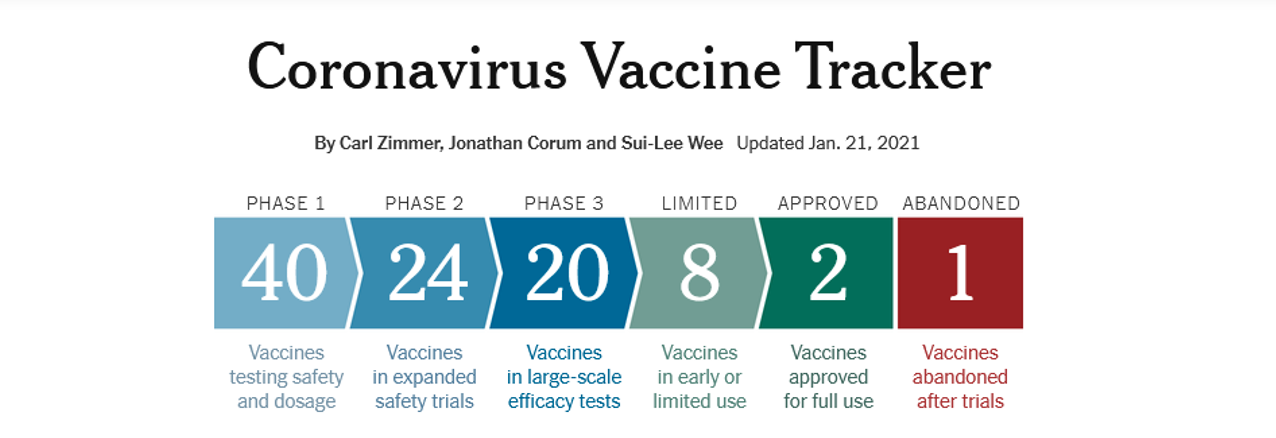
New York Times :: Coronavirus Vaccine Tracker

Milestones :: Perspectives :: Research


New York Times :: Coronavirus Vaccine Tracker
21 Jan 2021

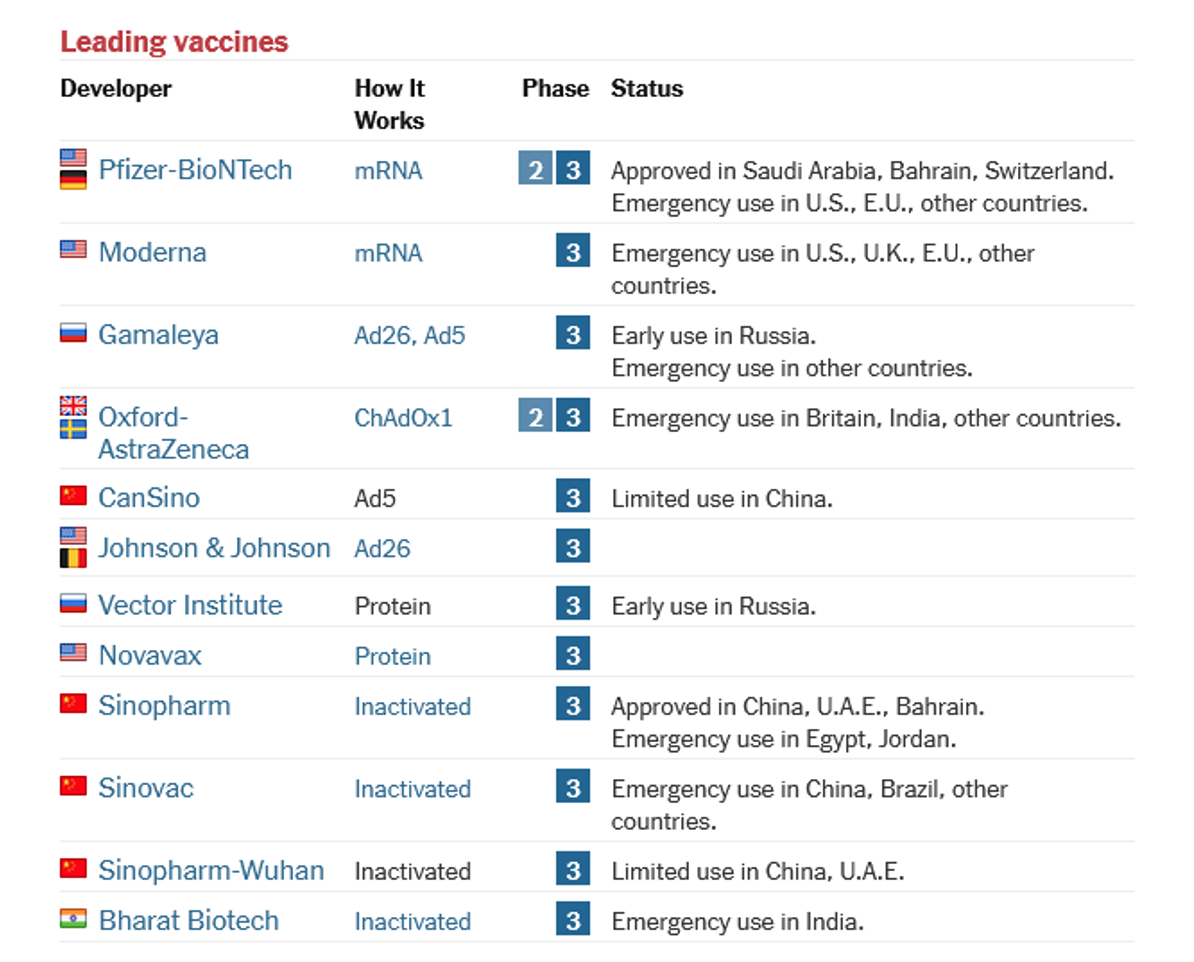
New additions and recent updates
Jan. 21
Gamaleya begins testing a single-dose version called “Sputnik Light.”
Jan. 21
Turkey’s Erciyes University moves to Phase 2.
Jan. 20
Korea’s Genexine moves to Phase 1/2.
Jan. 21
Gamaleya begins testing a single-dose version called “Sputnik Light.”

High-income countries are hedging their bets while low-income countries are left out

Milestones :: Perspectives :: Research


Duke Global Health Innovation Center
Launch and Scale Speedometer
January 19, 2021

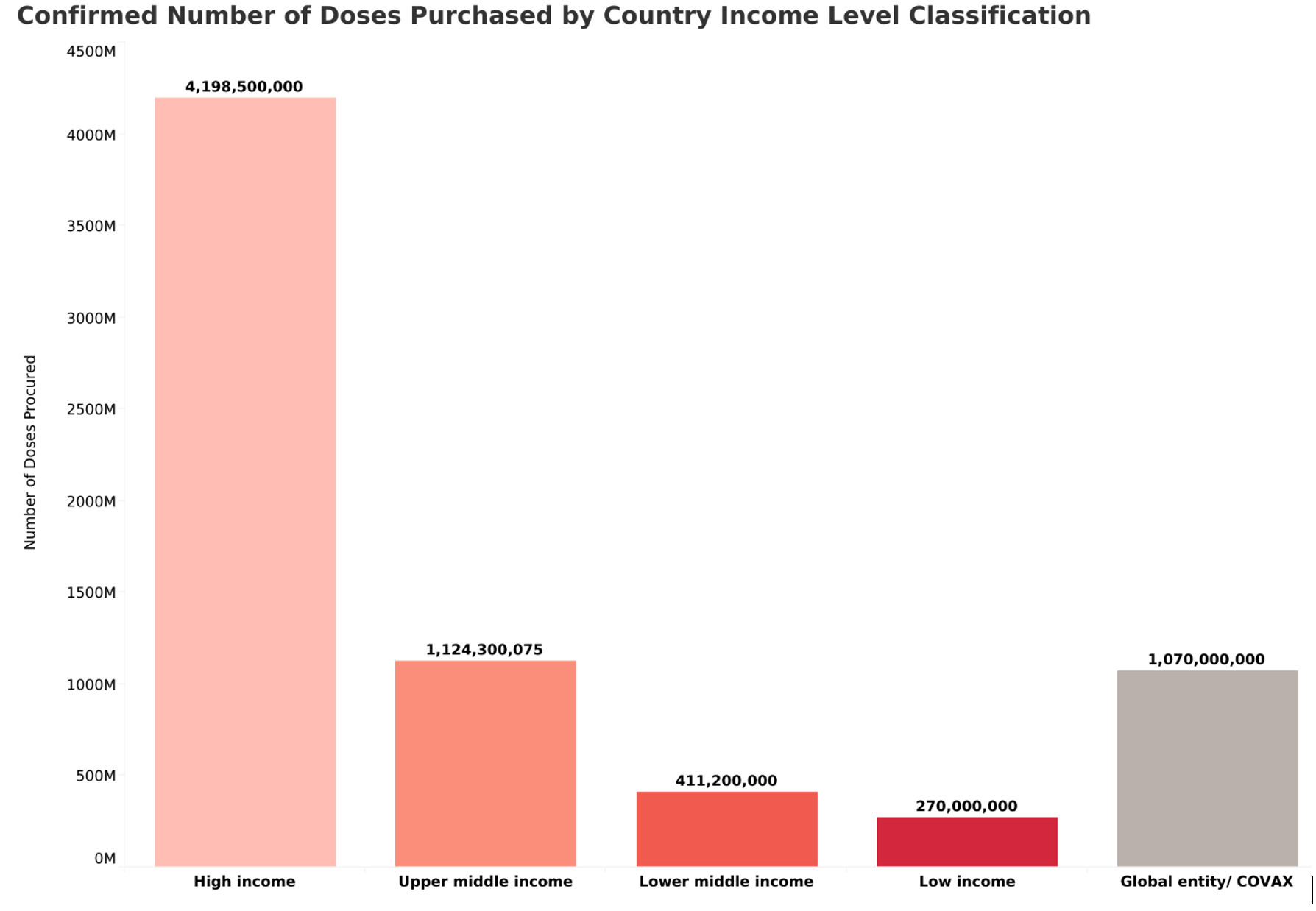
High-income countries are hedging their bets while low-income countries are left out
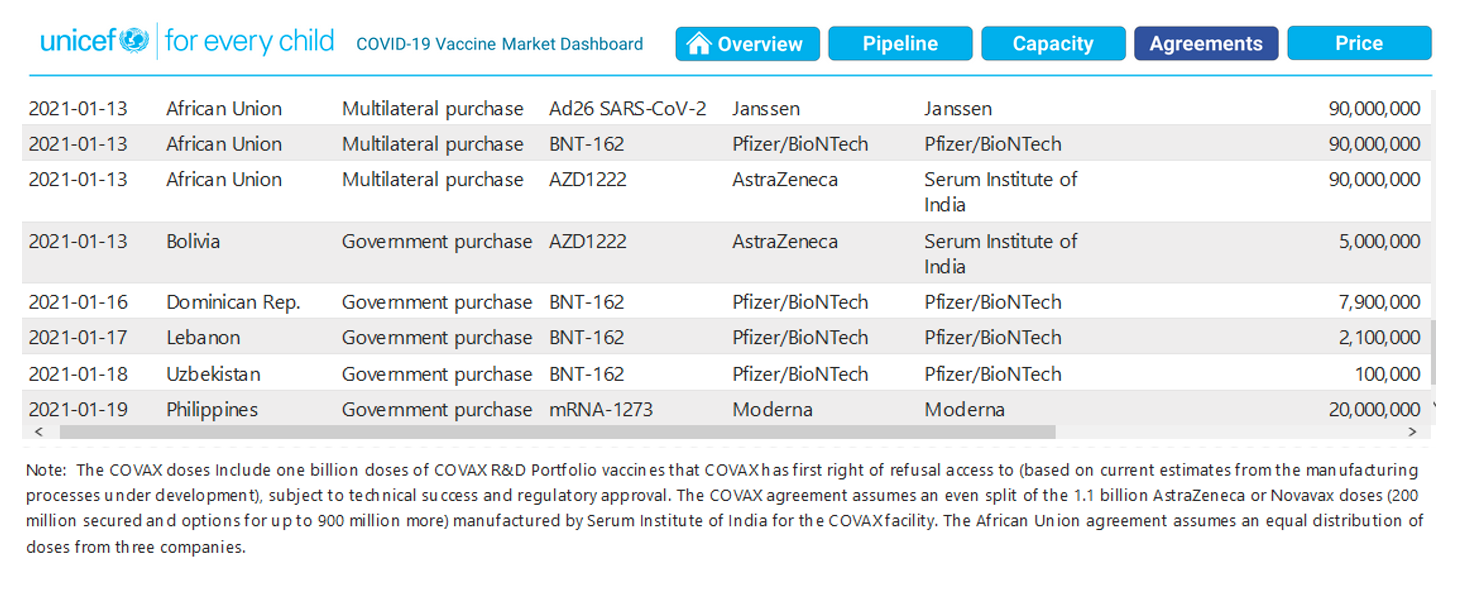
These direct deals made by high-income (and some middle-income) countries result in a smaller piece of the pie available for equitable global allocation. This pattern results in a majority of vaccines going to high-income countries and fewer doses available for low- and middle-income countries and for equity-focused partnerships like COVAX.


Updated: January 19, 2021


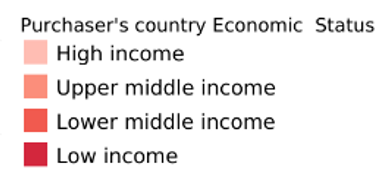
High-income countries currently hold a confirmed 4.2 billion doses, upper middle-income countries hold 1.1 billion doses, and lower middle-income countries hold 411 million doses, and low-middle income countries hold 270 million.
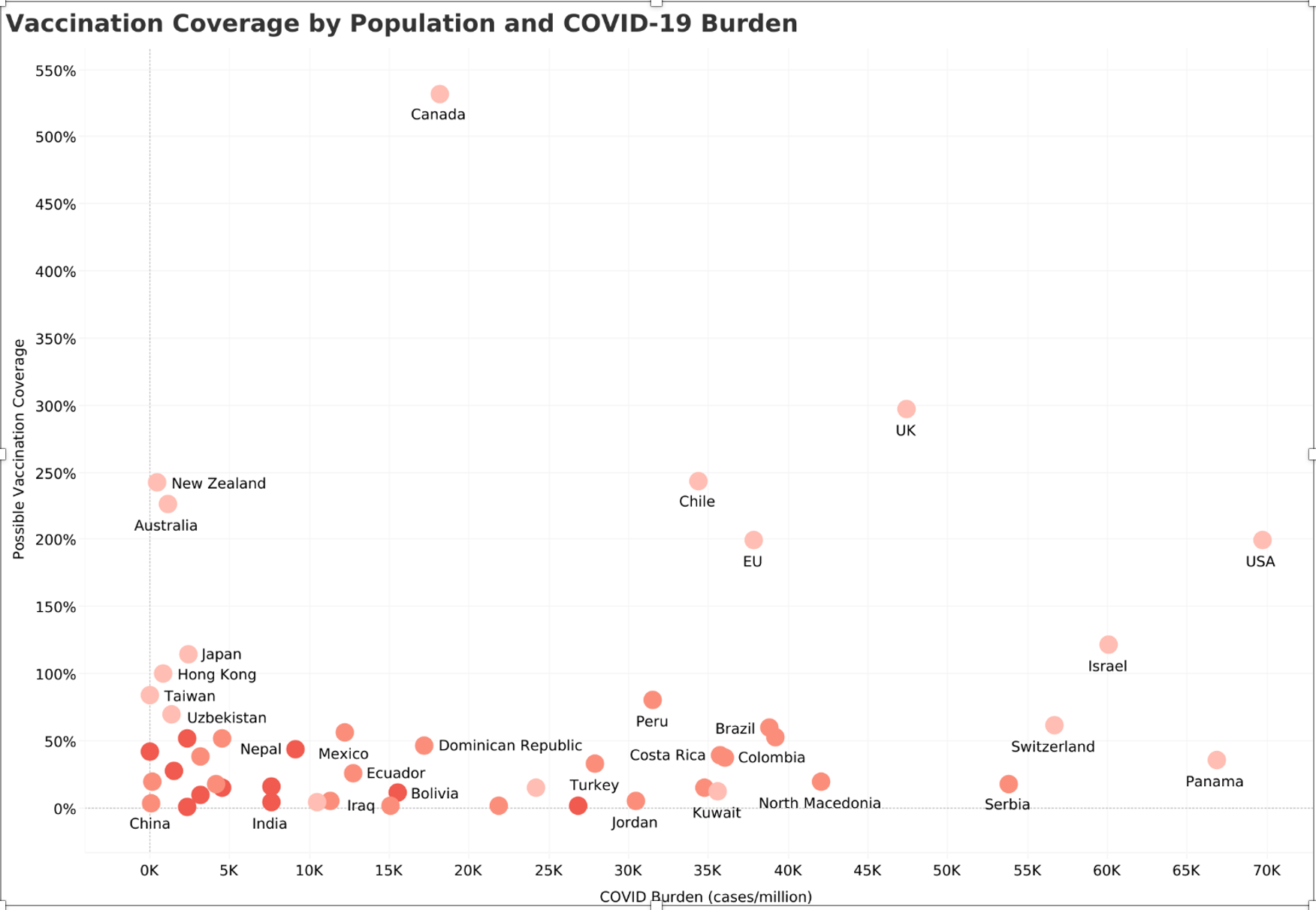
Many high-income countries have hedged their bets by advance purchasing enough doses to vaccinate their population several times over. Since none of these candidates are approved, some of the purchased vaccine candidates may prove to be unsuccessful.


Updated: January 19, 2021

While this makes sense from the perspective of an individual country, it leads to deep inequities in terms of global allocation. While some middle- and lower-middle income countries are represented here with direct deals, none of them have enough to vaccinate their entire populations. At the same time, Canada has purchased enough to vaccinate its population five times over. (Again, it is important to remember that not all of these vaccines will necessarily receive approval and move to market.)

CEPI, one of the COVAX founding partners, is negotiating with self-financing countries to ensure that, once a certain percentage of their population has been vaccinated, a percentage of the doses secured through bilateral deals would be shared through the COVAX Facility. These negotiations are ongoing; however, high-income countries have little incentive to share from their advance purchase stock.

COVID Vaccines Development/Procurement/Distribution/Policy – Russia, China

Milestones :: Perspectives :: Research


COVID Vaccines Development/Procurement/Distribution/Policy – Russia, China

Russia: Sputnik V – “the first registered COVID-19 vaccine” [to 23 Jan 2021]
https://sputnikvaccine.com/newsroom/pressreleases/
Press Releases
Hungary becomes the first country in EU to authorize the Sputnik V vaccine
Press release, 21.01.2021 12:20:00
…The vaccine was approved under the emergency use authorization procedure. The approval is based on the results of the clinical trials of Sputnik V in Russia and a comprehensive assessment of the vaccine by experts in Hungary…

Ministry of Health of the UAE has approved the use of Sputnik V vaccine
Press release, 21.01.2021
…The vaccine was registered under the emergency use authorization procedure based on the results of the Russian Phase III clinical trials which included over 33,000 subjects. Moreover, local Phase III clinical trials of Sputnik V in the UAE are ongoing under the supervision of the MOHAP and Department of Health (DOH) of Abu Dhabi with 1,000 volunteers already enrolled into the study. Medical protocols are handled by the public health provider, the Abu Dhabi Health Services Company, SEHA…

Turkmenistan has become the first country in Central Asia to register Sputnik V vaccine
Press release, 18.01.2021
…The vaccine was approved under the emergency use authorization procedure without additional clinical trials in Turkmenistan…

RDIF and the Gamaleya Center announce creation of International scientific advisory board on Sputnik V vaccine represented by leading scientists from 9 countries
Moscow, January 18, 2021 – The Russian Direct Investment Fund (RDIF, Russia’s sovereign wealth fund) and The National Research Center for Epidemiology and Microbiology named after N.F. Gamaleya (Gamaleya Center) announce the creation of an International Scientific Advisory Board on the Sputnik V vaccine – the world’s first registered vaccine against coronavirus.
Leading scientists in virology, microbiology, genetics and biotechnology from Argentina, Croatia, France, Germany, India, Russia, Sweden, UK and USA, representing top research and medical centers, have joined the Board.
The list of participants of the International scientific advisory board on Sputnik V vaccine:
1. Carlos Zala, Adjunct Professor, Department of Microbiology, University of Buenos Aires, School of Medicine, Argentina;
2. Omar Sued, President of the society of infectologists, Argentina;
3. Dragomira Majhen, Dr.Sc., Senior research associate, Scientist, Laboratory for Cell Biology and Signalling Division of Molecular Biology Ruđer Bošković Instiute, Croatia;
4. Cecil Czerkinsky, PhD, M.D., Research Director, Institute of Molecular and Cellular Pharmacology, France
5. Wibke Bayer, Privatdozentin, Principal Investigator on Vaccine Development, the Institute for Virology of the University Hospital in Essen, University Duisburg-Essen, Germany;
6. Vasanthapuram Ravi, MBBS, M.D. Microbiology, Dean, Basic Sciences, National Institute of Mental Health and Neurosciences (NIMHANS), India;
7. Niklas Arnberg, Professor of Virology, Umeå University, Sweden;
8. David Livermore, Professor of Medical Microbiology at the University of East Anglia, UK;
9. Len Seymour, Professor of Gene Therapies in the Department of Oncology at the University of Oxford, UK;
10. Hildegund C.J. Ertl, M.D., Professor, Vaccine & Immunotherapy Center, The Wistar Institute, USA;
11. Ronald Rodriguez, M.D., Ph.D., Professor of Urology, University of Texas Health Science Center at San Antonio, USA;
12. David A. Ornelles, Ph.D., Associate Professor of Microbiology & Immunology, Wake Forest School of Medicine Biotech Place, USA;
13. Alexander Gintsburg, RAS Academician, Professor, Director of the Gamaleya Center;
14. Denis Logunov, RAS Corresponding Member, Doctor of Biological Sciences, Deputy Director for Science of the Gamaleya Center;
15. Sergey Tsarenko, Professor, Faculty of Medicine, Lomonosov Moscow State University, Deputy Chief Physician for Anesthesiology and Reanimation at Hospital No. 52 in Moscow;
16. Alexander Rumyantsev, President of Dmitry Rogachev National Research Center, RAS Academician, M.D., Professor.


::::::

China: COVID-19 Vaccines – Announcement/Regulatory Actions/Deployment

National Health Commission of the People’s Republic of China [to 23 Jan 2021]
http://en.nhc.gov.cn/
China calls for international vaccine cooperation to defeat COVID-19 pandemic
2021-01-21
BEIJING — China calls on the international community to work together to contribute to the equitable distribution and use of COVID-19 vaccines around the world and help defeat the pandemic, a foreign ministry spokesperson said on Jan 20.

Spokesperson Hua Chunying made the remarks in response to a question about China’s expectations of promoting international cooperation on COVID-19 vaccines.

“We have always maintained that the virus knows no borders and humanity shares a common destiny. Solidarity and cooperation are the most powerful weapon to defeat the COVID-19 pandemic. It is also the common consensus of the international community,” Hua said at a press briefing.

China is at the forefront of vaccine research and development globally, with one vaccine for conditional marketing and several others being in clinical trials at different stages, Hua said, adding that this has provided significant support for China’s fight against the pandemic and its participation in international cooperation on vaccines.

Currently, China has started the vaccination of key groups, and the domestic demand for vaccines is huge, Hua said, adding that while meeting domestic demand, China has overcome difficulties and made every effort to carry out international cooperation on vaccines with other countries, especially developing countries, in different ways, and provided support and assistance within China’s capabilities according to their needs.

Chinese enterprises are conducting joint vaccine research and development with partners in more than 10 countries, including clinical trials and production. As part of the cooperation, Chinese enterprises have provided vaccines to partner countries, Hua said.

Chinese companies have started to export to countries that urgently need vaccines, have approved Chinese vaccines, and have authorized the emergency use of Chinese vaccines in their countries. “Most of them are developing countries,” she added.

China has joined the WHO-led COVAX initiative to support the G20 in promoting international cooperation on vaccines and multilateral cooperation to promote the equitable global distribution of vaccines, the spokesperson said…

POLIO – Public Health Emergency of International Concern (PHEIC); WHO/OCHA Emergencies

Emergencies

POLIO
Public Health Emergency of International Concern (PHEIC)

Polio this week as of 20 January 2021
:: The 148th session of the Executive Board (EB) is currently underway with Member States meeting virtually to discuss the most pressing global health issues including COVID-19 and Polio. The EB reports on both polio eradication and on polio transition planning/post-certification are available here under “148 Executive Board”. These reports will help inform the discussions on polio eradication by Member States.

Summary of new WPV and cVDPV viruses this week (AFP cases and ES positives):
:: Pakistan: 10 WPV1 and three cVDPV2 positive environmental samples
:: Afghanistan: 15 cVDPV2 cases and two cVDPV2 positive environmental samples
:: Burkina Faso: one cVDPV2 case
:: Chad: four CVDPV2 cases
:: Guinea: three cVDPV2 cases
:: Sudan: four cVDPV2 cases

::::::
::::::

Editor’s Note:
Continuing with this edition, we include information about the last apparent update evident on the WHO emergency country webpages, recognizing almost universal and significant interims between such updates regardless of the level of the emergency listed.

WHO Grade 3 Emergencies [to 23 Jan 2021]

Democratic Republic of the Congo – No new digest announcements [Last apparent update: 12 Jan 2021]
Mozambique floods – No new digest announcements identified [Last apparent update: 3 November 2020]
Nigeria – No new digest announcements identified [Last apparent update: 29 Jun 2020]
Somalia – No new digest announcements identified [Last apparent update: 17 July 2020]
South Sudan – No new digest announcements identified [Last apparent update: 4 February 2020]
Syrian Arab Republic – No new digest announcements identified [Last apparent update: 24 October 2020]
Yemen – No new digest announcements identified [Last apparent update: 30 June 2020]

::::::

WHO Grade 2 Emergencies [to 23 Jan 2021]
Afghanistan – No new digest announcements identified [Last apparent update: 5 July 2020]
Angola – No new digest announcements identified [Last apparent update: 03 December 2020]
Burkina Faso – No new digest announcements identified [Last apparent update: 17 décembre 2020]
Burundi – No new digest announcements identified [Last apparent update: 04 July 2019]
Cameroon – No new digest announcements identified [Last apparent update: 22 August 2019]
Central African Republic – No new digest announcements identified [Last apparent update: 12 June 2018]
Ethiopia – No new digest announcements identified [Last apparent update: 22 August 2019]
Iran floods 2019 – No new digest announcements identified [Last apparent update: 12 March 2020]
Iraq – No new digest announcements identified [Last apparent update: 16 December 2020]
Libya – No new digest announcements identified [Last apparent update: 7 October 2019]
Malawi Floods – No new digest announcements identified [Last apparent update: 09 October 2019]
Measles in Europe – No new digest announcements identified [Last apparent update: 16-12-2020]
MERS-CoV – No new digest announcements identified [Last apparent update: 8 July 2019]
Mozambique – No new digest announcements identified [Last apparent update: 03 November 2020]
Myanmar No new digest announcements identified [Last apparent update: :: 3 January 2021
Niger – No new digest announcements identified [Last apparent update: 29 December 2020]
occupied Palestinian territory – No new digest announcements identified [Last apparent update: 4 September 2019]
HIV in Pakistan – No new digest announcements identified [Last apparent update: 27 August 2019]
Sao Tome and Principe Necrotizing Cellulitis (2017) – No new digest announcements
Sudan – No new digest announcements identified [Last apparent update: 24 June 2020]
Ukraine – No new digest announcements identified [Last apparent update: 1 May 2019]
Zimbabwe – No new digest announcements identified [Last apparent update: 10 May 2019]

::::::

WHO Grade 1 Emergencies [to 23 Jan 2021]

Chad – No new digest announcements identified [Last apparent update: 30 June 2018]
Djibouti – No new digest announcements identified [Last apparent update: 25 novembre 2020]
Kenya – No new digest announcements identified [Last apparent update: 11 December 2020]
Mali – No new digest announcements identified [Last apparent update: 3 May 2017]
Namibia – viral hepatitis – No new digest announcements identified [Last apparent update: 20 July 2018]
Tanzania – No new digest announcements identified [Last apparent update: 21 October 2020]

::::::
::::::

UN OCHA – L3 Emergencies
The UN and its humanitarian partners are currently responding to three ‘L3’ emergencies. This is the global humanitarian system’s classification for the response to the most severe, large-scale humanitarian crises. 
Syrian Arab Republic – No new digest announcements identified
Yemen – No new digest announcements identified

::::::

UN OCHA – Corporate Emergencies
When the USG/ERC declares a Corporate Emergency Response, all OCHA offices, branches and sections provide their full support to response activities both at HQ and in the field.
COVID-19
:: Coronavirus Disease (COVID-19): Weekly Epidemiological Update (17 January 2021)

East Africa Locust Infestation
:: Desert Locust situation update – 22 January 2021

::::::
::::::

WHO & Regional Offices [to 23 Jan 2021]

WHO & Regional Offices [to 23 Jan 2021]

Weekly Epidemiological Record, Vol. 96, No. 03, pp. 13–20 22 January 2021
:: Report of the Meeting of the WHO Global Advisory Committee on Vaccine Safety (GACVS), 1–3 December 2020


::::::

WHO Regional Offices
Selected Press Releases, Announcements
WHO African Region AFRO
:: Seven things to know about COVID-19 variants in Africa 22 January 2021
New COVID-19 variants have emerged in Africa as the continent records a new peak in infections. While virus mutations are not unusual, those that are more infectious are worrisome. Professor Francisca Mutapi, Professor in Global Health Infection and Immunity, University of Edinburgh, explains the implications of SARS-CoV-2 variants and what African countries can do to respond.

WHO Region of the Americas PAHO
No new digest content identified

WHO South-East Asia Region SEARO
No new digest content identified

WHO European Region EURO
:: Scaling up telemedicine services in Romania post COVID-19 19-01-2021
:: New WHO report: population-based screening for cardiovascular disease risk factors does not reduce CVD mortality 19-01-2021
:: Reaching Turkey’s health policy goals could avert thousands of deaths says research from WHO/Europe 19-01-2021
:: Family physicians’ crucial role in mental health 18-01-2021
:: Universal health coverage high on the political agenda during the Regional Director’s visit to Georgia 18-01-2021

WHO Eastern Mediterranean Region EMRO
:: Afghanistan commences first polio vaccination campaign of 2021 18 January 2021
:: WHO and KSRelief continue fight against child malnutrition in Yemen 18 January 2021

WHO Western Pacific Region
:: 19 January 2021 | Feature story
WHO and DHL team up to get health-care equipment to the Pacific
Delivering supplies to Pacific islands during a global pandemic is no easy task. Reduced flight schedules and other logistical challenges mean that shipments of life-saving goods must be carefully coordinated to ensure that Pacific islanders receive vital health-care equipment.
:: 18 December 2020 | News release
WHO and EU join together to support COVID-19 response and systems strengthening in Asia
This week, the World Health Organization (WHO) and the European Union (EU) agreed to join forces to support eight South East Asian countries in their response to COVID-19 and to strengthen preparedness for future pandemics.
:: 17 December 2020 | News release
From containment to suppression: WHO and Lancet COVID-19 Commission highlight lessons from the Western Pacific Region
Professor Jeffrey D. Sachs, Dr Takeshi Kasai and expert panellists across Asia and the Pacific explored lessons from coronavirus disease 2019 (COVID-19) suppression at a forum jointly hosted today by the Lancet COVID-19 Commission and the World Health Organization (WHO).

CDC/ACIP [to 23 Jan 2021]

CDC/ACIP [to 23 Jan 2021]

http://www.cdc.gov/media/index.html

https://www.cdc.gov/vaccines/acip/index.html

Latest News Releases, Announcements

Media Statement from Rochelle P. Walensky, MD, MPH, CDC Director and ATSDR Administrator

Wednesday, January 20, 2021

   It is truly a privilege to join the world’s premier public health agency. For 75 years, CDC has carried out a mission to protect America’s safety, health, and security at home and abroad.

   I am proud to join this agency, and I recognize the seriousness of the moment. The toll that the COVID-19 pandemic has had on America is truly heartbreaking — for the loss of our loved ones and our beloved ways of life. At Massachusetts General Hospital, I saw firsthand the many difficulties this pandemic brings to our frontline workers and first responders, hospitals and public health systems, communities, and loved ones…

MMWR News Synopsis

Friday, January 22, 2021

:: Vaccination Coverage with Selected Vaccines and Exemption Rates Among Children in Kindergarten — United States, 2019–20 School Year

:: COVID-19 Case Investigation and Contact Tracing Efforts from Health Departments — United States, June 25–July 24, 2020

:: COVID-19 Trends Among Persons Aged 0–24 Years — United States, March 1–December 12, 2020 (Early Release January 13, 2021)

:: Emergence of SARS-CoV-2 B.1.1.7 Lineage — United States, December 29, 2020–January 12, 2021 (Early Release January 15, 2021)

Coronavirus Disease 2019 (COVID-19)– CDC

Selected Resources

:: Requirement for Proof of Negative COVID-19 Test or Recovery from COVID-19 for All Air Passengers Arriving in the United States Saturday, January 23, 2021

:: COVID-19 Vaccination Toolkits Friday, January 22, 2021

:: CDC Strategy for Global Response to COVID-19 (2020-2023)

Updated Wednesday, January 20, 2021

This strategy provides an overarching framework for the U.S. Centers for Disease Control and Prevention’s global response to the coronavirus (COVID-19) pandemic. The CDC strategy aligns with the U.S. Government (USG) strategy and the U.S. National Security Strategic goals to protect the American people and ensure the U.S. health security by mitigating the spread of infectious disease threats abroad.

The strategy defines CDC’s program priorities and guides development of criteria for monitoring and evaluating achievements and impact on health security at home and abroad. The strategy also addresses the urgent need to prioritize our global response work to reduce the global burden of COVID-19, while continuing to build global capacity to prevent, prepare for and control future pandemics. CDC’s response work supports countries and vulnerable populations, while providing global public health leadership in furthering the science and technical experience with COVID-19.

CDC will focus on mitigating the global impacts of COVID-19 and using CDC’s scientific and technical expertise to support our global health platform and program successes. In alignment with the USG strategy, CDC will implement activities using a phased approach to the pandemic that accounts for immediate and long-term public health needs, including anticipating and preparing for future global public health emergencies.

Goals

The goals of CDC’s strategy for global response to COVID-19 are to:

[1] Limit transmission of COVID-19;

[2] Minimize the impact of COVID-19 in vulnerable populations;

[3] Reduce specific health threats that pose current and future risk to the United States;

[4] Increase the scientific knowledge about SARS-CoV-2 (the virus responsible for COVID-19) and provide global public health leadership; and

[5] Support the development of long-term health security in low- and middle-income countries…

Africa CDC [to 23 Jan 2021]

Africa CDC [to 23 Jan 2021]
http://www.africacdc.org/
News
Press Releases
Kenya adopts Trusted Travel digital tool for COVID-19 test result verification
21 January 2021
On 9 January 2021, the Government of the Republic of Kenya announced the launch of its Trusted Travel platform, based on the Africa CDC Trusted Travel platform, becoming the first country to adopt the platform for managing travels during the COVID-19 pandemic.

“The ministry has collaborated with the African Union and Africa CDC, with technical support from PanaBIOS to implement an online system to authenticate and verify laboratory test certificates for travellers,” said Mr Mutahi Kagwe, Cabinet Secretary for the Ministry of Health.

In October 2020, the African Union officially launched the Trusted Travel platform as part of the overall Trusted Travel Initiative during a joint ministerial meeting of the ministers of health, transport, and information and communication of African Union Member States.

Developed by PanaBIOS Consortium and Econet Group as a public-private partnership with Africa CDC, Trusted Travel is a top-class digital solution to support Member States in verifying COVID-19 test certificates for travellers and to help harmonize entry and exit screening across the continent…

Press Releases
AMSP opens COVID-19 vaccines pre-orders for 55 African Union Member States
JOHANNESBURG, SOUTH AFRICA, 19 JANUARY 2021. Following the announcement by the African Union Chairperson, President Cyril Ramaphosa, on 14 January 2021 that the African Union has secured a provisional 270 million COVID-19 vaccine doses for Africa through its COVID-19 African Vaccine Acquisition Task Team (AVATT), the Africa Medical Supplies Platform (AMSP), on behalf of the Africa Centres for Disease Control and Prevention (Africa CDC), today commenced the COVID-19 vaccines pre-order programme for all African Union Member States. The African Export-Import Bank (Afreximbank) will facilitate payments by providing advance procurement commitment guarantees of up to US$2 billion to the manufacturers on behalf of the Member States.

While AVATT has secured a provisional 270 million COVID-19 vaccines doses from Pfizer, Johnson & Johnson and AstraZeneca, AMSP – the single-source platform enabling faster, more transparent and cost-effective access to COVID-19 supplies – has opened today pre-orders, offering an equitable access to COVID-19 vaccines doses for the 55 African Union Member States.

“These are historical times. For the first time in history, Africa has secured access to millions of vaccine doses in the middle of a pandemic as most of Western countries,” said African Union Special Envoy Strive Masiyiwa. “There is still a huge shortage of vaccine doses and that is why this continental collaboration has designed a fair allocation coupled with timely and equitable access of COVID-19 vaccines across the continent.”…

China CDC

China CDC
http://www.chinacdc.cn/en/
No new digest content identified.

National Health Commission of the People’s Republic of China [to 23 Jan 2021]
http://en.nhc.gov.cn/
News
Jan 23: Daily briefing on novel coronavirus cases in China
On Jan 22, 31 provincial-level regions and the Xinjiang Production and Construction Corps on the Chinese mainland reported 107 new cases of confirmed infections.

Shanghai completes vaccination of about 820,000 people
Updated: 2021-01-20 chinadaily.com.cn
Nearly 820,000 individuals working in epidemic prevention and control roles in Shanghai have received their COVID-19 vaccinations as of Monday, a senior health official in the municipality said on Jan 19.
Of these individuals, nearly 240,000 have received the required two shots.
No severe adverse reactions have been reported for individuals aged between 18 to 59, said Sun Xiaodong, deputy director of the Shanghai Municipal Center for Disease Control and Prevention.
Sun pointed out that every individual who faces a high risk of being exposed to the virus, such as workers dealing with imported cold-chain products at airports and customs, and those who work in international transportation, has already been vaccinated…

National Medical Products Administration [to 23 Jan 2021]
http://english.nmpa.gov.cn/news.html
News
Chinese mainland reports 94 new locally transmitted COVID-19 cases
2021-01-22
The Chinese mainland on Thursday reported 103 newly confirmed COVID-19 cases, including 94 locally transmitted and nine arriving from outside the mainland, the National Health Commission said on Jan 22.

China calls for international vaccine cooperation to defeat COVID-19 pandemic
2021-01-21
[See COVID – CHINA above for detail]

Over 15 mln doses of COVID-19 vaccine administered in China
2021-01-21
More than 15 million doses of COVID-19 vaccine have been administered in China since the country launched its vaccination program in December last year, China’s health authorities said on Jan 20.

Organization Announcements

Organization Announcements


Paul G. Allen Frontiers Group [to 23 Jan 2021]
https://alleninstitute.org/what-we-do/frontiers-group/news-press/
News
No new digest content identified.


BARDA – U.S. Department of HHS [to 23 Jan 2021]
https://www.phe.gov/about/barda/Pages/default.aspx
BARDA News
No new digest content identified.


BMGF – Gates Foundation [to 23 Jan 2021]
http://www.gatesfoundation.org/Media-Center/Press-Releases
Press Releases and Statements
No new digest content identified.


Bill & Melinda Gates Medical Research Institute [to 23 Jan 2021]
https://www.gatesmri.org/
The Bill & Melinda Gates Medical Research Institute is a non-profit biotech organization. Our mission is to develop products to fight malaria, tuberculosis, and diarrheal diseases—three major causes of mortality, poverty, and inequality in developing countries. The world has unprecedented scientific tools at its disposal; now is the time to use them to save the lives of the world’s poorest people
No new digest content identified.


CARB-X [to 23 Jan 2021]
https://carb-x.org/
News
No new digest content identified.


Center for Vaccine Ethics and Policy – GE2P2 Global Foundation [to 23 Jan 2021]
https://centerforvaccineethicsandpolicy.net/
News/Analysis/Statements
No new digest content identified.


CEPI – Coalition for Epidemic Preparedness Innovations [to 23 Jan 2021]
http://cepi.net/
Latest News
COVAX announces new agreement, plans for first deliveries
22 Jan 2021
[See Milestones above for detail]

Upcoming CEPI-CIHR grant funding opportunity for Canadian researchers
19 Jan 2021 By Jodie Rogers
CEPI and the Canadian Institutes of Health Research (CIHR) Institute of Infection and Immunity (III) will soon launch a new grant funding opportunity for researchers in Canada to pursue projects advancing CEPI’s work to expedite the development of vaccines against emerging infectious diseases, including COVID-19.


EDCTP [to 23 Jan 2021]
http://www.edctp.org/
The European & Developing Countries Clinical Trials Partnership (EDCTP) aims to accelerate the development of new or improved drugs, vaccines, microbicides and diagnostics against HIV/AIDS, tuberculosis and malaria as well as other poverty-related and neglected infectious diseases in sub-Saharan Africa, with a focus on phase II and III clinical trials
No new digest content identified.


Emory Vaccine Center [to 23 Jan 2021]
http://www.vaccines.emory.edu/
Vaccine Center News
No new digest content identified.


European Medicines Agency [to 23 Jan 2021]
http://www.ema.europa.eu/ema/
News & Press Releases
News: Extra dose from vials of Comirnaty COVID-19 vaccine (updated)
Last updated: 20/01/2021
EMA’s human medicines committee (CHMP) has recommended updating the product information for Comirnaty to clarify that each vial contains 6 doses of the vaccine…


News: Global regulators highlight key role of healthcare professionals in fostering confidence in COVID-19 vaccines
Last updated: 19/01/2021
EMA has endorsed a joint statement published today by the International Coalition of Medicines Regulatory Authorities (ICMRA) to inform and help healthcare professionals answer questions about the evaluation, approval and monitoring of safe, effective and high-quality COVID-19 vaccines…
[See COVID above for detail]


European Vaccine Initiative [to 23 Jan 2021]
http://www.euvaccine.eu/
Latest News
No new digest content identified.


FDA [to 23 Jan 2021]
https://www.fda.gov/NewsEvents/Newsroom/PressAnnouncements/default.htm
Press Announcements /Selected Details
January 22, 2021 – Coronavirus (COVID-19) Update: January 22, 2021
:: The FDA’s Office of Criminal Investigations recently investigated a case that has led to an arrest and the filing of a criminal complaint by the U.S. Department of Justice for introducing misbranded drugs into interstate commerce. The criminal investigation found that in a variety of online postings from as early as March 2020, the defendant, Johnny T. Stine, claimed to have a COVID-19 vaccine that he offered to inject in customers for $400-$1000 each. Stine’s company, North Coast Biologics, had previously received a warning letter from the agency for promoting an unapproved COVID-19 vaccine product.
“Unproven injectable vaccines purported to prevent or treat COVID-19, made from unknown substances under unknown conditions, present significant health risks in and of themselves. They also can lead consumers to make lifestyle choices that increase their actual risk of infection with COVID-19, or to delay or stop appropriate medical treatment,” said Special Agent in Charge Lisa L. Malinowski, FDA Office of Criminal Investigations Los Angeles Field Office. “The FDA will continue to investigate fraudulent COVID-19 treatments and bring to justice those who try to profit from the pandemic by offering unproven and illegally marketed coronavirus products.”

January 21, 2021 – FDA Approves First Extended-Release, Injectable Drug Regimen for Adults Living with HIV

January 19, 2021 – Coronavirus (COVID-19) Update: January 19, 2021
:: The FDA updated its “Investigational COVID-19 Convalescent Plasma” guidance and corresponding webpage. The revisions provide recommendations regarding when individuals who have received an investigational COVID-19 vaccine as a participant in a clinical trial, or received an authorized or licensed COVID-19 vaccine, qualify as convalescent plasma donors. In addition, the agency has extended the period of enforcement discretion described in the guidance.


FDA – COVID-19 Vaccines [to 23 Jan 2021]
www.fda.gov/covid19vaccines
News and Updates; Upcoming Events
No new digest content identified.


Fondation Merieux [to 23 Jan 2021]
http://www.fondation-merieux.org/
News, Events
No new digest content identified.


Gavi [to 23 Jan 2021]
https://www.gavi.org/
News releases
COVAX announces new agreement, plans for first deliveries
22 Jan 2021
[See Milestones above for detail]


GHIT Fund [to 23 Jan 2021]
https://www.ghitfund.org/newsroom/press
GHIT was set up in 212 with the aim of developing new tools to tackle infectious diseases that
Press Releases
No new digest content identified.


Global Fund [to 23 Jan 2021]
https://www.theglobalfund.org/en/news/
News
No new digest content identified.


Global Research Collaboration for Infectious Disease Preparedness [GloPID-R] [to 23 Jan 2021]
https://www.glopid-r.org/news/
News
No new digest content identified.


Hilleman Laboratories [to 23 Jan 2021]
http://www.hillemanlabs.org/
No new digest content identified.


Human Vaccines Project [to 23 Jan 2021]
http://www.humanvaccinesproject.org/media/press-releases/
Press Releases
HVP COVID Report
Issue 25: Can President Biden’s Team Speed Vaccine Delivery?
Jan 22, 2021
By Michael Osterholm, Ph.D.
Professor, University of Minnesota and Director of the Center for Infectious Disease Research and Policy


IAVI [to 23 Jan 2021]
https://www.iavi.org/newsroom
PRESS RELEASES/FEATURES
January 19, 2021
IAVI at HIVR4P Virtual 2021
IAVI to participate in major HIV prevention research conference beginning January 27

January 13, 2021
Researchers demonstrate protection offered by novel TB vaccine candidate in animal model
:: A study of MTBVAC efficacy in a macaque model of tuberculosis shows that the vaccine candidate protects against aerosol infection with Mycobacterium tuberculosis.
:: Researchers from Europe and the U.S. demonstrate that the MTBVAC vaccine protects better than the current BCG vaccine in a model of tuberculosis in macaques and compare the immunological patterns to those conferred by MTBVAC in clinical trials.


International Coalition of Medicines Regulatory Authorities [ICMRA]
http://www.icmra.info/drupal/en/news
Selected Statements, Press Releases, Research
No new digest content identified.


International Generic and Biosimilar Medicines Association [IGBA]
https://www.igbamedicines.org/
News
Press Releases/Announcements
No new digest content identified.


IFFIm
http://www.iffim.org/
Press Releases/Announcements
No new digest content identified.


IFRC [to 23 Jan 2021]
http://media.ifrc.org/ifrc/news/press-releases/
Selected Press Releases, Announcements
No new digest content identified.


Institut Pasteur [to 23 Jan 2021]
https://www.pasteur.fr/en/press-area
Press release 19.01.2021
COVID-19: a lentiviral vaccine candidate for intranasal administration provides sterilizing protection in animal models
Scientists from the Institut Pasteur-TheraVectys Joint Laboratory recently published in Cell Host & Microbe1 the results of tests, in two preclinical models, of a COVID-19 vaccine candidate using a lentiviral vector administered by nasal route. Their study demonstrates that the vaccine candidate induces antibody response with strong neutralizing activity against SARS-CoV-2, as well as substantial cell-mediated responses. Intranasal vaccination with this vector drastically reduces lung viral loads and prevents pathogenic pulmonary inflammation. This research proves the high vaccine efficacy and the fact that its intranasal administration attracts the effectors from the protective immune response into the upper respiratory tract through which the virus enters the body.


IRC International Rescue Committee [to 23 Jan 2021]
http://www.rescue.org/press-release-index
Media highlights [Selected]
Press Release
New IRC report: Nine ways Biden can help 235 million of world’s most vulnerable, restoring “soul of America,” and advancing US interests
January 21, 2021

Press Release
The IRC applauds the Biden Administration’s measures on Day One to restore US humanity and leadership; urges action on refugee resettlement
January 20, 2021


IVAC [to 23 Jan 2021]
https://www.jhsph.edu/research/centers-and-institutes/ivac/index.html
Updates; Events
No new digest content identified.


IVI [to 23 Jan 2021]
http://www.ivi.int/
Selected IVI News, Announcements, Events
No new digest content identified.


JEE Alliance [to 23 Jan 2021]
https://www.jeealliance.org/
Selected News and Events
No new digest content identified.


Johns Hopkins Center for Health Security [to 23 Jan 2021]
https://www.centerforhealthsecurity.org/news/center-news/
Center News
No new digest content identified.


MSF/Médecins Sans Frontières [to 23 Jan 2021]
http://www.msf.org/
Latest [Selected Announcements]
Rohingya refugee crisis
Relocations, reduced services leave Rohingya communities at breaking point in Bangladesh
Project Update 21 Jan 2021

Brazil
COVID-19 leaves Amazonas health system saturated, overloaded and struggling
Project Update 21 Jan 2021

South Sudan
Falling international funding exposes communities in Jonglei to a lack of healthcare
Project Update 19 Jan 2021

Yemen
Yemen: “These sanctions have to make clear that they do not apply to humanitarian aid”
Interview 18 Jan 2021


National Vaccine Program Office – U.S. HHS [to 23 Jan 2021]
https://www.hhs.gov/vaccines/about/index.html
Upcoming Meetings/Latest Updates
No new digest content identified.


NIH [to 23 Jan 2021]
http://www.nih.gov/news-events/news-releases
News Releases
Full-dose blood thinners decreased need for life support and improved outcome in hospitalized COVID-19 patients
January 22, 2021 — Full doses of blood thinners, in addition to being safe, were superior to the doses normally given to prevent blood clots in hospitalized patients.


PATH [to 23 Jan 2021]
https://www.path.org/media-center/
Press Release
No new digest content identified


Sabin Vaccine Institute [to 23 Jan 2021]
http://www.sabin.org/updates/pressreleases
Statements and Press Releases
No new digest content identified.


UNAIDS [to 23 Jan 2021]
http://www.unaids.org/en
Selected Press Releases/Reports/Statements
21 January 2021
Remembering Andrew Mosane, AIDS activist and progressive “radical”

20 January 2021
Challenge the stigma, pursue your right to health

19 January 2021
The road to PrEP in Guyana

19 January 2021
Modelling shows the value of favourable societal environments


UNHCR Office of the United Nations High Commissioner for Refugees [to 23 Jan 2021]
http://www.unhcr.org/en-us/media-centre.htmlS
Selected Announcements
No new digest content identified.


UNICEF [to 23 Jan 2021]
https://www.unicef.org/media/press-releases
Selected Press releases, Statements
Press release
01/22/2021
COVAX announces new agreement, plans for first deliveries
[See Milestones above for detail]

Statement
01/22/2021
Remarks by Henrietta Fore, UNICEF Executive Director, at press briefing on COVAX
As delivered
[See Milestones above for detail]

Press release
01/20/2021
UN agencies warn economic impact of COVID-19 and worsening inequalities will fuel malnutrition for billions in Asia and the Pacific — FAO-UNICEF-WFP-WHO
Child and maternal diets particularly vulnerable


Unitaid [to 23 Jan 2021]
https://unitaid.org/
Featured News
22 January 2021
Cost of rapid COVID-19 tests halved as global investment ensures availability of high volumes for low- and middle-income countries
:: Over 250 million antigen rapid tests (Ag RDTs) every year to be made available for low- and middle-income countries for a unit price of less than US$2.50, thanks to set of new agreements, the first of which with Premier Medical Corporation (PMC) of India who will provide up to 120 million tests
:: Agreements follow an open call for Expressions of Interest (EOI), launched last year by FIND and Unitaid on behalf of the Access to COVID-19 Tools (ACT) Accelerator, to drive equitable access to fit-for-purpose Ag RDTs for COVID-19
:: Further announcements focused on technology transfer and scale up of regional manufacturing capacity expected in the coming weeks


Vaccination Acceptance Research Network (VARN) [to 23 Jan 2021]
https://vaccineacceptance.org/news.html#header1-2r
Announcements
No new digest content identified.


Vaccine Confidence Project [to 23 Jan 2021]
http://www.vaccineconfidence.org/
News, Research and Reports
No new digest content identified.


Vaccine Education Center – Children’s Hospital of Philadelphia [to 23 Jan 2021]
http://www.chop.edu/centers-programs/vaccine-education-center
News
No new digest content identified.


Wellcome Trust [to 23 Jan 2021]
https://wellcome.ac.uk/news
News
Explainer | 22 January 2021
When will the world be vaccinated against Covid-19?
…Current estimates are that it will probably take well into 2023-24 for everyone who needs a vaccine to receive one(opens in a new tab)….

Explainer | 22 January 2021
Principles and guidelines for reporting on Covid-19 vaccines

Explainer | 22 January 2021
What are ‘adverse events’ and ’emergency use authorisation’ in relation to vaccination?

Explainer | 21 January 2021
How have Covid-19 vaccines been made quickly and safely?


The Wistar Institute [to 23 Jan 2021]
https://www.wistar.org/news/press-releases
Press Releases
Jan. 21, 2021
Wistar Scientists Make Pivotal Discovery on the Mechanism of Epstein-Barr Virus Latent Infection
A previously unknown enzymatic function of the EBNA1 viral protein might instruct new approaches for EBV-associated cancer.


WFPHA: World Federation of Public Health Associations [to 23 Jan 2021]
https://www.wfpha.org/
Latest News
WFPHA Welcomes the Entry into Force of the Treaty on the Prohibition of Nuclear Weapons
Jan 21, 2021 | News

WFPHA at EB148: Statement on Oral Health
Jan 20, 2021 | News

WFPHA at EB148: Statement on COVID-19 Response
Jan 19, 2021 | News
“…To protect people’s lives, an effective and safe COVID-19 immunization should be considered a global public good, and vaccines should be produced at larger volumes, distributed equitably between countries, and provided at no cost to the user. Furthermore, without an equitable distribution of COVID-19 vaccines between countries, the world economy will not recover, causing greater human suffering and premature mortality.
Unless governments and the pharmaceutical industry take urgent action to ensure that enough COVID-19 vaccine doses are produced, 92 low- and middle-income countries will be able to vaccinate against COVID-19 only one in five people in 2021. On the other hand, high-income countries, which account for just 14% of the world’s population, have already purchased 48% of the 8.6 billion doses of the most promising vaccines.
This can be achieved by waiving intellectual property rights to vaccines, tests, and treatments related to COVID-19, openly sharing the vaccines’ technology and intellectual property through the WHO, fully funding COVAX, stopping bilateral deals, and investing in WHO efforts and in the strengthening of national health systems…”


World Organisation for Animal Health (OIE) [to 23 Jan 2021]
https://www.oie.int/en/for-the-media/press-releases/2021/
Press Releases
Launch of the multi-year, multi-partner Global Burden of Animal Diseases programme
Animal health leaders and researchers from the Global Burden of Animal Diseases (GBADs) programme have secured US$7 million from the Bill & Melinda Gates Foundation and UK’s Foreign, Commonwealth and Development Office, to rollout a framework on measuring animal health burdens and their impacts on human lives and economies. The information provided by GBADs will guide public policy and private sector strategy, contributing to improve animal health and welfare more effectively. It will also be a basis for further academic research.
19 January 2021
[See Milestones above for detail]


::::::


ARM [Alliance for Regenerative Medicine] [to 23 Jan 2021]
Press Releases – Alliance for Regenerative Medicine (alliancerm.org)
Press Releases
No new digest content identified.


BIO [to 23 Jan 2021]
https://www.bio.org/press-releases
Press Releases
BIO Welcomes U.S. Involvement in COVAX, ACT Accelerator Programs
January 21, 2021
The Biden administration just announced its intent for the United States to join the COVAX vaccine facility, which aims to deliver COVID-19 vaccines to poor and under-developed countries… “As the organization representing U.S. biotechnology companies who are leading the world in the of development COVID vaccines and therapeutics, BIO welcomes Dr. Anthony Fauci’s statement today that the United States will be joining the global COVAX and ACT Accelerator programs, which are the chief international efforts charged with getting COVID treatments to patients around the world…:

Biotechnology’s Leading Trade Group Restructures for the Future
January 19, 2021
Washington, DC –  The Biotechnology Innovation Organization (BIO), which announced its transition to a new CEO in June to Dr. Michelle McMurry-Heath, is announcing a new leadership team and organizational structure that promises to provide long-term stability for the organization’s ambitious agenda. Some staff reductions were made to align the organization for the new strategic direction…

BIO Applauds Incoming Administration’s Decision Elevating Key White House Science Post to Cabinet-level Agency
January 16, 2021


DCVMN – Developing Country Vaccine Manufacturers Network [to 23 Jan 2021]
http://www.dcvmn.org/
News; Upcoming events
No new digest content identified.


ICBA – International Council of Biotechnology Associations [to 23 Jan 2021]
https://internationalbiotech.org/news/
News
No new digest content identified.


IFPMA [to 23 Jan 2021]
http://www.ifpma.org/resources/news-releases/
Selected Press Releases, Statements, Publications
Biopharmaceutical global body kicks off 2021 with new CEO leadership line up
21 January 2021
The biopharmaceutical global industry, represented by the International Federation of Pharmaceutical Manufacturers and Associations (IFPMA), is pleased to announce that Jean-Christophe Tellier, UCB Chief Executive Officer & Chairman of the Executive Committee has assumed the role of IFPMA President. Jean-Christophe Tellier succeeds David A. Ricks, Chairman and Chief Executive Officer, Eli Lilly and Company. Albert Bourla, Chairman and CEO of Pfizer, has been appointed IFPMA Vice President and will together with Isao Teshirogi, President and CEO of Shionogi, complement the IFPMA CEO leadership team. They will serve as the Chair and Vice Chairs of the IFPMA CEO Steering Committee…

IFPMA, GSCF, ICBA Joint Statement on the item 14.2 Strengthening preparedness for health emergencies: implementation
20 January 2021
“…The COVID-19 pandemic has highlighted the importance of timely pathogen sharing in the context of public health emergencies. The criticality of fast, timely and unrestricted access to pathogen information in allowing the development of medical countermeasures and understanding the genomic epidemiology of the virus has been recognised by both the Committee’s interim report, under paragraph 42, and the Director-General’s report on the ‘Public Health Implications of Implementation of the Nagoya Protocol’, under paragraph 3.
Though the preamble to the Nagoya Protocol recognises the IHR and “the importance of ensuring access to human pathogens for public health preparedness and response purposes”, currently, the global ability to share pathogen samples and their related data in a timely manner is being impacted due to the inefficient and bureaucratically burdensome bilateral system envisaged under the same Protocol, most notably for seasonal influenza viruses. Navigating a system in which each country has different access requirements that must be negotiated bilaterally is simply not feasible when dealing with the emergence of a novel pathogen.
In light of this, IFPMA fully supports the Committee’s approach of “conducting an article-by-article analysis” and “considering how the Regulations could facilitate the rapid sharing of scientific findings and samples within the global scientific community under Article 6.”

IFPMA Statement for EB148 agenda item 14.1 Covid-19 Response
19 January 2021
We share the deep sense of responsibility that together we have to end this pandemic and are proud to be a founding member of the ACT A. We are keenly aware that science and innovation are only part of the equation. As part of our responsibility towards society, we must also ensure equitable global access to safe, high quality, effective, and affordable COVID-19 vaccines and therapeutics. The biopharmaceutical industry has shown its openness to new approaches and numerous collaborations with all stakeholders to respond to the urgent needs of the pandemic. This, however, should not come at the cost of diluting quality and safety of vaccines and medicines, nor should it impact key incentives that foster innovation, namely intellectual property rights. The existing IP framework has enabled the pharmaceutical industry to respond swiftly to the global crisis and develop several new vaccines with remarkable speed, by engaging in new collaborations to leverage both new approaches and existing molecules. This scientific excellence would not have been possible without the important incentives such as those provided by IP rights. Indeed, our expertise and risk-taking ability has allowed us to roll out several new vaccines in less than a year…”


PhRMA [to 23 Jan 2021]
http://www.phrma.org/
Selected Press Releases, Statements
Research shows gene therapies can offer cost savings potential of up to $1.8M over five years for patients with certain blood diseases
January 15, 2021
A recent analysis by Health Advances looks at two particularly burdensome hematological (or blood) diseases — hemophilia A and beta thalassemia — and finds that potential gene therapies in the pipeline could reduce per patient costs by as much as 41% and 90%, respectively, over five years. Research-based knowledge gained in recent years about the genetic foundation for these diseases has facilitated the pursuit of several promising gene therapy approaches.
Blog Post
Journal Watch

Journal Watch
Vaccines and Global Health: The Week in Review continues its weekly scanning of key peer-reviewed journals to identify and cite articles, commentary and editorials, books reviews and other content supporting our focu-s on vaccine ethics and policy. Journal Watch is not intended to be exhaustive, but indicative of themes and issues the Center is actively tracking. We selectively provide full text of some editorial and comment articles that are specifically relevant to our work. Successful access to some of the links provided may require subscription or other access arrangement unique to the publisher.
If you would like to suggest other journal titles to include in this service, please contact David Curry at: david.r.curry@centerforvaccineethicsandpolicy.org

Convalescent Plasma for the Treatment of COVID-19: Perspectives of the National Institutes of Health COVID-19 Treatment Guidelines Panel

Annals of Internal Medicine
January 2021 Volume 174, Issue 1
http://annals.org/aim/issue

Special Articles
Convalescent Plasma for the Treatment of COVID-19: Perspectives of the National Institutes of Health COVID-19 Treatment Guidelines Panel
FREE
Alice K. Pau, PharmD, Judith Aberg, MD, Jason Baker, MD, MS, Pamela S. Belperio, PharmD, … et al.
Pages:93–95

Uganda’s increasing dependence on development partner’s support for immunization – a five year resource tracking study (2012 – 2016)

BMC Public Health
http://bmcpublichealth.biomedcentral.com/articles


Research
Uganda’s increasing dependence on development partner’s support for immunization – a five year resource tracking study (2012 – 2016)
In Uganda, there are persistent weaknesses in obtaining accurate, reliable and complete data on local and external investments in immunization to guide planning, financing, and resource mobilization. This study aimed to measure and describe the financial envelope for immunization from 2012 to 2016 and analyze expenditures at sub-national level.
Authors: Carol Kamya, Christabel Abewe, Peter Waiswa, Gilbert Asiimwe, Faith Namugaya, Charles Opio, Immaculate Ampeire, Stephen Lagony and Charlotte Muheki
Citation: BMC Public Health 2021 21:160
Content type: Research article
Published on: 19 January 2021

The Competing Demands of Patient Privacy and Clinical Research

Ethics & Human Research
Volume 43, Issue 1 January–February 2021
https://onlinelibrary.wiley.com/toc/25782363/current

The Competing Demands of Patient Privacy and Clinical Research
Connie M. Ulrich, Christine Grady, George Demiris, Therese S. Richmond


Pages: 25-31
First Published: 19 January 2021
ABSTRACT
Privacy and confidentiality of personal medical information are cornerstones of ethical clinical care and ethical research. But real‐world research has challenged traditional ways of thinking about privacy and confidentiality of information. In today’s world of “big data” and learning health care systems, researchers and others are combining multiple sources of information to address complex problems. We present a case study that highlights the ethical concerns that arise when a patient who is employed by an academic medical center learns through a research invitational letter that her private information was accessed at this center without her consent. We discuss the ethical challenges of balancing patient privacy with advancing clinical research and ask, what level of privacy and confidentiality can and should patients expect from their clinician providers, fellow research colleagues, and institutions?
Essay

Should the Regulation of Research Misconduct Be Integrated with the Ethics Framework Promulgated in The Belmont Report?

Ethics & Human Research
Volume 43, Issue 1 January–February 2021
https://onlinelibrary.wiley.com/toc/25782363/current

Should the Regulation of Research Misconduct Be Integrated with the Ethics Framework Promulgated in The Belmont Report?
Barbara K. Redman, Arthur L. Caplan


Pages: 37-41
First Published: 19 January 2021
ABSTRACT
The federal research misconduct regulations finalized in 2005 did not incorporate important principles regarding human subjects protections articulated in The Belmont Report, yet research misconduct can involve harms to research subjects and to subsequent patients whose treatments are based on false research findings. Consistency with the Belmont principles would require assuring regular monitoring to detect research misconduct, tracing effects of research misconduct on trial participants and informing them of these effects, and assuring timely correction of published reports of research findings if research misconduct related to the study was subsequently discovered. Research misconduct has historically been viewed as a matter for the scientific community to manage; it is actually a threat to the welfare of human subjects and ethically ought to be treated as such.

Lockdowns and low- and middle-income countries: building a feasible, effective, and ethical COVID-19 response strategy

Globalization and Health
http://www.globalizationandhealth.com/
[Accessed 23 Jan 2021]


Lockdowns and low- and middle-income countries: building a feasible, effective, and ethical COVID-19 response strategy
Lockdowns can be an effective pandemic response strategy that can buy much needed time to slow disease transmission and adequately scale up preventative, diagnostic, and treatment capacities. However, the broad restrictive measures typically associated with lockdowns, though effective, also comes at a cost – imposing significant social and economic burdens on individuals and societies, especially for those in low- and middle-income countries (LMICs)… In response to the urgent need for more policy development around the contextual challenges involved in employing such measures, we propose some strategies LMICs could adopt for safe and responsible lockdown entrance/exit or to avoid re-imposing coercive restrictive lockdown measures altogether.
Authors: Oghenowede Eyawo, A. M. Viens and Uchechukwu Chidiebere Ugoji
Content type: Commentary
20 January 2021

The state of health research governance in Africa: what do we know and how can we improve?

Health Research Policy and Systems
http://www.health-policy-systems.com/content
[Accessed 23 Jan 2021]


The state of health research governance in Africa: what do we know and how can we improve?
The developments in global health, digital technology, and persistent health systems challenges, coupled with global commitments like attainment of universal health coverage, have elevated the role of health r…
Authors: Juliet Nabyonga-Orem, James Avoka Asamani and Micheal Makanga
Citation: Health Research Policy and Systems 2021 19:11
Content type: Research
Published on: 22 January 2021

Prioritizing knowledge translation in low- and middle-income countries to support pandemic response and preparedness

Health Research Policy and Systems
http://www.health-policy-systems.com/content
[Accessed 23 Jan 2021]


Prioritizing knowledge translation in low- and middle-income countries to support pandemic response and preparedness
The COVID-19 pandemic has created urgent demand around the world for knowledge generation about a novel coronavirus, its transmission, and control, putting academic institutions at the frontline of politics. W…
Authors: Yodi Mahendradhata and Anna Kalbarczyk
Citation: Health Research Policy and Systems 2021 19:5
Content type: Commentary
Published on: 18 January 2021

Gene and Cell Therapy for Inherited and Acquired Immune Deficiency

Human Gene Therapy
Volume 32, Issue 1-2 / January 2021
https://www.liebertpub.com/toc/hum/32/1-2


Special Issue: Gene and Cell Therapy for Inherited and Acquired Immune Deficiency
Guest Editor: Adrian J. Thrasher, PhD
Guest Co-Editors: Uta Griesenbach, PhD , Andrew H. Baker, PhD , Hildegard Büning, PhD
Editorial
Gene and Cell Therapy for Inherited and Acquired Immune Deficiency
Hildegard Büning, Andrew H. Baker, Uta Griesenbach, Terence R. Flotte, and Adrian J. Thrasher
Pages:1–3
Published Online:18 January 2021

Bringing Gene Therapies for HIV Disease to Resource-Limited Parts of the World

Human Gene Therapy
Volume 32, Issue 1-2 / January 2021
https://www.liebertpub.com/toc/hum/32/1-2


Commentaries
Open Access
Bringing Gene Therapies for HIV Disease to Resource-Limited Parts of the World
Joseph M. McCune, Emily H. Turner, Adam Jiang, and Brian P. Doehle
Pages:21–30
Published Online:30 October 2020
Initiated by the Bill & Melinda Gates Foundation in 2019, the HIV Frontiers Program aims to move work on HIV cure toward interventions that will ultimately be available to all, most especially those in resource-limited parts of the world where the prevalence of disease is high (Fig. 1). It starts with the premise that the journey will be long (15–25 years) and that it will ultimately yield a “single-shot cure,” that is, a product that is delivered percutaneously (in vivo) in a single encounter, safely, and effectively modifying selected cells in the body so that viral replication and spread are suppressed and reinfection blocked.

Gene Editing for the Treatment of Primary Immunodeficiency Diseases

Human Gene Therapy
Volume 32, Issue 1-2 / January 2021
https://www.liebertpub.com/toc/hum/32/1-2


Reviews Open Access
Gene Editing for the Treatment of Primary Immunodeficiency Diseases
Rajeev Rai, Adrian J. Thrasher, and Alessia Cavazza
Pages:43–51
Published Online:16 October 2020
https://doi.org/10.1089/hum.2020.185
With conventional treatments for primary immunodeficiency diseases (PIDs), such as allogeneic stem cell transplantation or autologous gene therapy, still facing important challenges, the rapid development of genome editing technologies to more accurately …

HIV Gene Therapy: An Update

Human Gene Therapy
Volume 32, Issue 1-2 / January 2021
https://www.liebertpub.com/toc/hum/32/1-2


HIV Gene Therapy: An Update
Tatjana I. Cornu, Claudio Mussolino, Matthias C. Müller, Claudia Wehr, Winfried V. Kern, and Toni Cathomen
Pages:52–65
Published Online:21 December 2020
https://doi.org/10.1089/hum.2020.159
Progress in antiretroviral therapy has considerably reduced mortality and notably improved the quality of life of individuals infected with HIV since the pandemic began some 40 years ago. However, drug resistance, treatment-associated toxicity, adherence …

Disability inclusion in humanitarian action

Humanitarian Exchange Magazine
Number 78, October 2020
https://odihpn.org/magazine/inclusion-of-persons-with-disabilities-in-humanitarian-action-what-now/


Disability inclusion in humanitarian action
by HPN October 2020
The theme of this edition of Humanitarian Exchange, co-edited with Sherin Alsheikh Ahmed from Islamic Relief Worldwide, is disability inclusion in humanitarian action. Persons with disabilities are not only disproportionately impacted by conflicts, disasters and other emergencies, but also face barriers to accessing humanitarian assistance. At the same time, global commitments and standards and the IASC Guidelines on the inclusion of persons with disabilities in humanitarian action all emphasise how persons with disabilities are also active agents of change. Disability and age-focused organisations have led on testing and demonstrating how inclusion can be done better. Yet despite this progress, challenges to effective inclusion remain.

As Kirstin Lange notes in the lead article, chief among these challenges is humanitarian agencies’ lack of engagement with organisations of persons with disabilities. Simione Bula, Elizabeth Morgan and Teresa Thomson look at disability inclusion in humanitarian response in the Pacific, and Kathy Al Jubeh and Alradi Abdalla argue for a ‘participation revolution’, building on learning from the gender movement. Tchaurea Fleury and Sulayman AbdulMumuni Ujah outline how the Bridge Article 11 training initiative is encouraging constructive exchange between humanitarian and disability actors. The lack of good, disaggregated data is highlighted by Sarah Collinson; Frances Hill, Jim Cranshaw and Carys Hughes emphasise the need for training resources in local languages and accessible formats; and Sophie Van Eetvelt and colleagues report on a review of the evidence on inclusion of people with disabilities and older people.

Rebecca Molyneux and co-authors analyse the findings of a review of a DFID programme in north-east Nigeria, while Carolin Funke highlights the importance of strategic partnerships between disability-focused organisations, drawing on her research in Cox’s Bazar. Sherin Alsheikh Ahmed describes Islamic Relief Worldwide’s approach to mainstreaming protection and inclusion, while Pauline Thivillier and Valentina Shafina outline IRC’s Client Responsive Programming. The edition ends with reflections by Mirela Turcanu and Yves Ngunzi Kahashi on CAFOD’s SADI approach.

The Ethics of Continuing Placebo in SARS-CoV-2 Vaccine Trials

JAMA
January 19, 2021, Vol 325, No. 3, Pages 205-316
https://jamanetwork.com/journals/jama/currentissue


Viewpoint
The Ethics of Continuing Placebo in SARS-CoV-2 Vaccine Trials
Annette Rid, MD; Marc Lipsitch, DPhil; Franklin G. Miller, PhD
free access has active quiz has multimedia has audio
JAMA. 2021;325(3):219-220. doi:10.1001/jama.2020.25053
This Viewpoint proposes that prioritizing all placebo-group participants in coronavirus vaccine trials as vaccine first receivers could perpetuate health inequities and compromise the chance to learn from their participation, proposing instead to limit prioritization to placebo participants who would be prioritized for vaccination anyway under NASEM or ACIP frameworks.
Conversations with Dr Bauchner: Coronavirus Vaccine FDA Update
Conversations with Dr Bauchner: COVID-19 Vaccines and Herd Immunity

Evaluating SARS-CoV-2 Vaccines After Emergency Use Authorization or Licensing of Initial Candidate Vaccines

JAMA
January 19, 2021, Vol 325, No. 3, Pages 205-316
https://jamanetwork.com/journals/jama/currentissue


Evaluating SARS-CoV-2 Vaccines After Emergency Use Authorization or Licensing of Initial Candidate Vaccines
Steven Joffe, MD, MPH
free access has active quiz has multimedia has audio
JAMA. 2021;325(3):221-222. doi:10.1001/jama.2020.25127
This Viewpoint discusses the ethics of including a placebo arm in randomized trials of coronavirus vaccines once authorized vaccines have become widely available, and proposes use of adaptive platform trial designs as an optimal approach to nimbly and ethically compare future investigational COVID-19 vaccines with proven effective ones.

Public Health Messaging in an Era of Social Media

JAMA
January 19, 2021, Vol 325, No. 3, Pages 205-316
https://jamanetwork.com/journals/jama/currentissue


Public Health Messaging in an Era of Social Media
Raina M. Merchant, MD, MSHP; Eugenia C. South, MD, MSHP; Nicole Lurie, MD, MSPH
free access has active quiz has audio
JAMA. 2021;325(3):223-224. doi:10.1001/jama.2020.24514
This Viewpoint discusses the rapid spread of scientific misinformation on social media platforms throughout the COVID-19 pandemic and proposes strategies to counteract its adverse effects including surveillance of digital data and partnering with trusted messengers to engage the public and advance scientifically sound public health measures.

Health Care Is a Right, Not a Privilege – A New Series on US Health Care and Health Policy

JAMA
January 19, 2021, Vol 325, No. 3, Pages 205-316
https://jamanetwork.com/journals/jama/currentissue


Editorial
Health Policy
Health Care Is a Right, Not a Privilege – A New Series on US Health Care and Health Policy
Howard Bauchner, MD; Phil B. Fontanarosa, MD, MBA; Karen Joynt Maddox, MD, MPH
Two fundamental questions about health care in the US remain unanswered: is health care a right or a privilege and, relatedly, is the US committed to ensuring that every individual has access to some form of health insurance like in every other modern high-resource country.1,2 President Obama, despite the success of the Affordable Care Act (ACA) in increasing the number of individuals with health insurance in this country, seldom addressed this issue directly, even in a wide-ranging special communication in JAMA.3 President Trump has done little with respect to increasing the number of individuals with insurance; instead, his administration has challenged the legality of various aspects of the ACA in court, although overturning it would reduce health coverage significantly. However, there has been encouraging, if incomplete, movement at the state level. In total, 39 states have now expanded Medicaid under the auspices of the ACA, including a number of states, such as Oklahoma and Louisiana, with a historically conservative populace.

Point-of-care testing for sexually transmitted infections in low- and middle-income countries: a scoping review protocol

JBI Evidence Synthesis
January 2021 – Volume 19 – Issue 1
https://journals.lww.com/jbisrir/Pages/currenttoc.aspx


SYSTEMATIC REVIEW PROTOCOLS
Point-of-care testing for sexually transmitted infections in low- and middle-income countries: a scoping review protocol
Martin, Kevin; Roper, Tom; Vera, Jaime H.
JBI Evidence Synthesis. 19(1):155-162, January 2021.

Making the investment case for national regulatory authorities

Journal of Pharmaceutical Policy and Practice
https://joppp.biomedcentral.com/
[Accessed 23 Jan 2021]


Making the investment case for national regulatory authorities
Well-functioning national regulatory authorities (NRAs) ensure access to safe, effective, quality-assured, and affordable medical products. However, the benefits of their work are often unseen and difficult to…
Authors: Gloria Twesigye, Tamara Hafner and Javier Guzman
Citation: Journal of Pharmaceutical Policy and Practice 2021 14:16
Content type: Commentary
Published on: 21 January 2021

Drug supply situation in Rwanda during COVID-19: issues, efforts and challenges

Journal of Pharmaceutical Policy and Practice
https://joppp.biomedcentral.com/
[Accessed 23 Jan 2021]


Drug supply situation in Rwanda during COVID-19: issues, efforts and challenges
COVID-19 is a threat to health systems around the world and Rwanda is not an exception. The impact of the pandemic is far-reaching and access to health commodities is not spared. Proper drug supply is critical…
Authors: Theogene Uwizeyimana, Hashim Talib Hashim, Jean Damascene Kabakambira, Jean Claude Mujyarugamba, Jackson Dushime, Blaise Ntacyabukura, Remy Ndayizeye, Yusuff Adebayo Adebisi and Don Eliseo Lucero-Prisno III
Citation: Journal of Pharmaceutical Policy and Practice 2021 14:12
Content type: Commentary
Published on: 20 January 2021

COVID-19: the intersection of education and health

The Lancet
Jan 23, 2021 Volume 397 Number 10271 p253-346, e3-e5
https://www.thelancet.com/journals/lancet/issue/current


Editorial
COVID-19: the intersection of education and health
The Lancet
What lessons does the COVID-19 syndemic offer when considering the convergence between health and education? The International Day of Education, on Jan 24, provides an opportunity to reflect on the weaknesses of the education system before COVID-19, and on the impact of school closures and education disruptions on children and adolescents. Since March, 2020, more than 1·5 billion students worldwide—an unprecedented number—have been affected by school or university closures. The implications of these closures are enormous. In addition to the loss of learning, a lack of access to school means that many children lose protection from hazards such as domestic violence and child abuse, others lose access to the only nutritious meal of their day, and many will miss immunisations that are often given at school. Furthermore, school closures deprive children and adolescents of social and emotional experiences essential for their development and wellbeing.

Adolescents are particularly affected by both closures and by distance learning in higher education. In the short term, some students are leaving school to find work earlier than they might otherwise have; others might be experiencing mental health problems such as loneliness and anxiety. In the long term, there is a danger that hard-won progress in secondary school attendance in low-income and middle-income countries will be reversed. And it is not only schools that shape education. Cultural events, sport, and religion have been disrupted, in many countries for almost a year. Under lockdowns, children who have not yet reached school age have been forced to remain at home, and low levels of stimulation during a child’s early years are likely to have far-reaching consequences for their development. Health and education are bidirectionally linked: a good-quality education is an investment for health, and health is essential for effective learning. These disruptions to education, and the subsequent widening of inequalities in learning, will adversely affect the health of this generation and their children.

The disproportionate effect of school closures on girls and poorer students is especially concerning—millions of children are predicted to drop out of school (the humanitarian analysis organisation ACAPS says 24 million; Save the Children estimates 9·7 million). Many educational institutions have re-established their programmes online to mitigate short-term interruptions in learning. However, the effects of a digital divide and intangible losses of cognitive and social skills cannot be easily repaired. The economic crisis is pushing poor households into greater poverty, with families turning to early marriage as an alternative form of income. This predicament further perpetuates intergenerational poverty and inequality. Education is the only ladder out of poverty for many children and adolescents, and it is crucial to empower girls to economic independence and resist violation of their rights.

Education systems will be most beneficial when they provide more than a curriculum in science, maths, languages, and other academic subjects. Programmes that better support the cognitive and behavioural skills of children—self-reliance, decision making, anxiety management, communication, and assertiveness—will enable them to thrive. Traditional educational skills need to be expanded to encompass training in sexual and reproductive health and rights, child nutrition, and mental health.

This conceptual change in the value of education needs to start at the national level with revitalised education programmes. There is evidence that holistic approaches to education that value health and wellbeing can be effective. But their success is dependent on the political will to implement and support them. For example, the Health Promoting Schools approach developed by WHO values schools as social communities inclusive of students, teachers, and families; however, WHO reports that few countries have successfully implemented it at scale. This approach is aligned with the Sustainable Development Goals (SDGs) for health (SGD3) and quality education (SDG4), which explicitly acknowledge the linkage between health and education. Yet, the two sectors remain distant; arguments over whether to close schools to prevent infection can even imply that they are in opposition. This disconnect needs to be remedied. Closer cooperation would revitalise not only education, but also child and adolescent health.

Precise mapping reveals gaps in global measles vaccination coverage

Nature
Volume 589 Issue 7842, 21 January 2021
http://www.nature.com/nature/current_issue.html


News & Views | 16 December 2020
Precise mapping reveals gaps in global measles vaccination coverage
Precise maps of routine first-dose measles vaccinations show slowing progress around the world between 2010 and 2019, and large gaps in coverage in many places. Many countries are unlikely to achieve global 2020 coverage targets.
C. Edson Utazi & Andrew J. Tatem

Mapping routine measles vaccination in low- and middle-income countries

Nature
Volume 589 Issue 7842, 21 January 2021
http://www.nature.com/nature/current_issue.html


Article | 16 December 2020 | Open Access
Mapping routine measles vaccination in low- and middle-income countries
Alyssa N. Sbarra, Sam Rolfe[…] & Jonathan F. Mosser
Abstract
The safe, highly effective measles vaccine has been recommended globally since 1974, yet in 2017 there were more than 17 million cases of measles and 83,400 deaths in children under 5 years old, and more than 99% of both occurred in low- and middle-income countries (LMICs)1,2,3,4. Globally comparable, annual, local estimates of routine first-dose measles-containing vaccine (MCV1) coverage are critical for understanding geographically precise immunity patterns, progress towards the targets of the Global Vaccine Action Plan (GVAP), and high-risk areas amid disruptions to vaccination programmes caused by coronavirus disease 2019 (COVID-19)5,6,7,8. Here we generated annual estimates of routine childhood MCV1 coverage at 5 × 5-km2 pixel and second administrative levels from 2000 to 2019 in 101 LMICs, quantified geographical inequality and assessed vaccination status by geographical remoteness. After widespread MCV1 gains from 2000 to 2010, coverage regressed in more than half of the districts between 2010 and 2019, leaving many LMICs far from the GVAP goal of 80% coverage in all districts by 2019. MCV1 coverage was lower in rural than in urban locations, although a larger proportion of unvaccinated children overall lived in urban locations; strategies to provide essential vaccination services should address both geographical contexts. These results provide a tool for decision-makers to strengthen routine MCV1 immunization programmes and provide equitable disease protection for all children.

Measles epidemic in pediatric population in Greece during 2017–2018: Epidemiological, clinical characteristics and outcomes

PLoS One
http://www.plosone.org/
[Accessed 23 Jan 2021]


Measles epidemic in pediatric population in Greece during 2017–2018: Epidemiological, clinical characteristics and outcomes
Maria Gianniki, Tania Siahanidou, Evanthia Botsa, Athanasios Michos
Research Article | published 20 Jan 2021 PLOS ONE
https://doi.org/10.1371/journal.pone.0245512

Opinion: Standardizing gene product nomenclature—a call to action

PNAS – Proceedings of the National Academy of Sciences of the United States of America
January 19, 2021 118 (3)
https://www.pnas.org/content/118/2


Opinion
Opinion: Standardizing gene product nomenclature—a call to action
Kenji Fujiyoshi, Elspeth A. Bruford, Pawel Mroz, Cynthe L. Sims, Timothy J. O’Leary, Anthony W. I. Lo, Neng Chen, Nimesh R. Patel, Keyur Pravinchandra Patel, Barbara Seliger, Mingyang Song, Federico A. Monzon, Alexis B. Carter, Margaret L. Gulley, Susan M. Mockus, Thuy L. Phung, Harriet Feilotter, Heather E. Williams, and Shuji Ogino
PNAS January 19, 2021 118 (3) e2025207118; https://doi.org/10.1073/pnas.2025207118
The current lack of a standardized nomenclature system for gene products (e.g., proteins) has resulted in a haphazard counterproductive system of labeling. Different names are often used for the same gene product; the same name is sometimes used for unrelated gene products. Such ambiguity causes not only potential harm to patients, whose treatments increasingly rely on laboratory tests for multiple gene products, but also miscommunication and inefficiency, both of which hinder progress of broad scientific fields. To mitigate this confusion, we recommend standardizing human protein nomenclature through the use of a Human Genome Organisation (HUGO) Gene Nomenclature Committee (HGNC) gene symbol accompanied by its unique HGNC ID. We call for action across all biomedical communities and scientific and medical journals to standardize nomenclature of gene products using HGNC gene symbols to enhance accuracy in scientific and public communication.

Vaccinology in the post−COVID-19 era

PNAS – Proceedings of the National Academy of Sciences of the United States of America
January 19, 2021 118 (3)
https://www.pnas.org/content/118/2


Perspective Open Access
Vaccinology in the post−COVID-19 era
Rino Rappuoli, Ennio De Gregorio, Giuseppe Del Giudice, Sanjay Phogat, Simone Pecetta, Mariagrazia Pizza, and Emmanuel Hanon
PNAS January 19, 2021 118 (3) e2020368118; https://doi.org/10.1073/pnas.2020368118
Abstract
The COVID-19 pandemic is a shocking reminder of how our world would look in the absence of vaccination. Fortunately, new technologies, the pace of understanding new and existing pathogens, and the increased knowledge of the immune system allow us today to develop vaccines at an unprecedented speed. Some of the vaccine technologies that are fast-tracked by the urgency of COVID-19 may also be the answer for other health priorities, such as antimicrobial resistance, chronic infections, and cancer, that the post-COVID-19 world will urgently need to face. This perspective analyzes the way COVID-19 is transforming vaccinology and the opportunities for vaccines to have an increasingly important role in health and well-being.

The impact of the COVID-19 pandemic on maternal and perinatal health: a scoping review

Reproductive Health
http://www.reproductive-health-journal.com/content
[Accessed 23 Jan 2021]


The impact of the COVID-19 pandemic on maternal and perinatal health: a scoping review
The Covid-19 pandemic affects maternal health both directly and indirectly, and direct and indirect effects are intertwined. To provide a comprehensive overview on this broad topic in a rapid format behooving …
Authors: Bethany Kotlar, Emily Gerson, Sophia Petrillo, Ana Langer and Henning Tiemeier
Citation: Reproductive Health 2021 18:10
Content type: Review
Published on: 18 January 2021

Just societies: A new vision for health equity in the Americas after COVID-19

Revista Panamericana de Salud Pública/Pan American Journal of Public Health (RPSP/PAJPH)
https://www.paho.org/journal/en


22 Jan 2021
Just societies: A new vision for health equity in the Americas after COVID-19
Editorial | English |
[Extract]
The significant challenges to equity in health in the Region of the Americas, as detailed in the report of the Pan American Health Organization Independent Commission on Equity and Health Inequalities in the Americas (1), gave original impetus to this Special Issue on Equity in Health by the Pan American Journal of Public Health. The report, Just Societies: Health Equity and Dignified Lives, analyzed a vast body of evidence that indicated the overwhelming inequalities in the Region that relate to three factors: structural drivers, conditions of daily life, and governance for health equity (taking action).
Highlighting the continued realities of the interrelationship between social and health inequities in the Americas is by no means new (2). However, since early 2020 this interrelationship has been further exposed and exacerbated by the unprecedented COVID-19 pandemic, which is testing governments, communities, economies, and individuals in ways previously unimagined in their scope and intensity (3). The crisis is exposing underlying inequalities in health and the cost of inaction to address this long-standing social injustice, and the COVID-19 response is even reversing improvements in social and health indicators made in the last two decades (3, 4).[…]

Regulatory Harmonization and Streamlining of Clinical Trial Applications globally should lead to faster clinical development and earlier access to life-saving vaccines

Vaccine
Volume 39, Issue 5 Pages 777-864 (29 January 2021)
https://www.sciencedirect.com/journal/vaccine/vol/39/issue/5


Review article Open access
Regulatory Harmonization and Streamlining of Clinical Trial Applications globally should lead to faster clinical development and earlier access to life-saving vaccines
Lorenz Scheppler, Norbert De Clercq, Mic McGoldrick, Jacqueline Dias
Pages 790-796

Impacts of free vaccination policy and associated factors on influenza vaccination behavior of the elderly in China: A quasi-experimental study

Vaccine
Volume 39, Issue 5 Pages 777-864 (29 January 2021)
https://www.sciencedirect.com/journal/vaccine/vol/39/issue/5


Research article Open access
Impacts of free vaccination policy and associated factors on influenza vaccination behavior of the elderly in China: A quasi-experimental study
Xuewen Jiang, Xiaopeng Shang, Junfen Lin, Yanrong Zhao, … Yinwei Qiu
Pages 846-852

The Use of Nanobiotechnology in Immunology and Vaccination

Vaccines — Open Access Journal
http://www.mdpi.com/journal/vaccines
(Accessed 23 Jan 2021)


Open Access Communication
The Use of Nanobiotechnology in Immunology and Vaccination
by Reza Keikha, Karim Daliri and Ali Jebali
Vaccines 2021, 9(2), 74; https://doi.org/10.3390/vaccines9020074 – 21 Jan 2021
Abstract
Nanotechnology uses the unique properties of nanostructures with a size of 1 to 200 nanometers. Different nanoparticles have shown great promise for the production of new vaccines and drugs. Nanostructures can be used to deliver immunological compounds more effectively than microstructures to target […]